Alaska Native Government & Policy

Alaska Native leaders say tribal recognition is long overdue

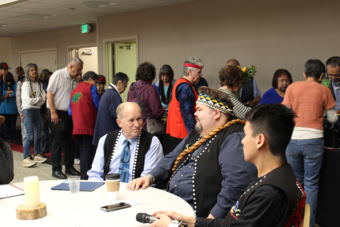
Gov. Bill Walker talks with Central Council President Richard Peterson at the Indigenous Peoples Day celebration Oct. 9, 2017, at Elizabeth Peratrovich Hall. (Photo by Adelyn Baxter/KTOO)
Former Gov. Bill Walker talks with Central Council President Richard Peterson at the Indigenous Peoples Day celebration Oct. 9, 2017, at Elizabeth Peratrovich Hall. (Adelyn Baxter/KTOO)

At this year’s Alaska Federation of Natives convention, sponsors of a ballot initiative took the opportunity to say their piece on why tribal recognition in the state is long overdue.

Multiple attempts to pass a bill through the Legislature have been unsuccessful. This year, a tribal recognition bill was passed in the House but never went to a vote in the Senate. 

Chalyee Éesh Richard Peterson is the president of the Central Council of the Tlingit and Haida Indian Tribes of Alaska. He’s also one of the initiative’s sponsors. 

“A bill that did come forward from Rep. Tiffany Zulkosky to recognize tribes couldn’t make it because they were unable to really just get their business done,” Peterson said. “We thought it was better to just, let’s put this in the hands of the people.”

The initiative wouldn’t give tribes any new powers because they are inherently sovereign. Instead, the initiative aims to have the state acknowledge that sovereignty. 

Co-sponsor La quen náay Liz Medicine Crow said the relationship between the state and tribes needs to be solidified into law — otherwise tribes are caught in the middle of the politics of the current administration.

“The state of Alaska has too often used our Native communities and our tribes as a political hot potato,” Medicine Crow said.

The state and Alaska Native tribes already work together in a government-to-government capacity with tribal compacts. 

The state has a compact in child welfare that allows tribes to take charge in providing their own child welfare services. And earlier during the AFN conference, Gov. Mike Dunleavey spoke about creating tribal compacts in education. 

“I was very excited to hear that Governor Dunleavy is supportive of a government-to-government relationship with tribes,” Medicine Crow said. “That’s what this ballot initiative concretes and puts into law, we need to have that in order so that it is not just formal, but it is forever.”

To make it on next year’s ballot, the initiative needs over 36,000 signatures within a year after being approved. Two months in, over a third of those signatures have already been gathered. 

Proposed Ambler project underscores promise and peril of the Alaska Native Claims Settlement Act

Martha Wood secures her boat on Thursday, July 22, 2021 in Ambler. Wood was fishing for sheefish when her line broke, and returned to shore to get a replacement. (Loren Holmes / ADN)

To Bryant Sun, a 17-year-old from the Iñupiat village of Shungnak, plans for a nearby open pit mine and 200-mile access road pose too much of a risk to his family’s traditions of subsistence hunting and fishing.

In this remote Northwest Alaska region, where the only way in and out is on a plane or boat, groceries can be impossibly expensive: $10 for a bottle of salad dressing or a box of cereal.

So Sun’s family, and many others, depend on seasonal harvests of moose, caribou, bears, berries and fish. They have two subsistence cabins — one upriver from town and one downriver.

“Traffic that’ll be going through there, with all that equipment and stuff — they’ll just scare everything off,” Sun said in an interview outside his Shungnak home in July. “That road would affect everything, I’d say.”

Sun’s village sits on the banks of the upper Kobuk River, a murky, fertile ribbon of water that connects Shungnak with two other predominantly Native villages, Ambler and Kobuk. Just north are the Brooks Range foothills, where a mining company, Ambler Metals, is drilling to test the viability of a potentially lucrative copper prospect.

From left, Bryant Sun, Mark Griest, Baron Jones, and Kaden Douglas hang out on July 23, 2021 in Shungnak. All four boys are rising seniors. Sun’s family, and many others, depend on seasonal harvests of moose, caribou, bears, berries and fish, and he is concerned about the proposed Ambler Access Road. “Traffic that’ll be going through there, with all that equipment and stuff, they’ll just scare everything off,” Sun said. “That road would affect everything, I’d say.” (Loren Holmes / ADN)

Fred Sun, Bryant’s father, works at Ambler Metals’ mining camp in the mountains.

A map showing thr route of 211 mile Ambler Road (Kevin Powell / ADN)

His passion for subsistence is equal to his son’s. But after years in the mining industry, Fred, 47, is comfortable with the idea of the project 25 miles from his home.

“When you’re Bryant’s age, you don’t really have bills to worry about. He’s never even bought a gun before, and he uses guns all the time. He doesn’t realize everything he uses to help fill our freezer costs money,” said Fred, who’s also the president of Shungnak’s tribal council. “We can’t live our subsistence lifestyle without having a job.”

The divide between father and son reflects a wider ambivalence about the mine and road projects that extends across the three Upper Kobuk River villages. It also reflects tensions embedded in the federal legislation that settled Indigenous Alaskans’ land claims: the Alaska Native Claims Settlement Act, which turns 50 this month.

The act aimed to clear the way for construction of the trans-Alaska pipeline by extinguishing Indigenous land claims, with a transfer of 44 million acres — about 10% of the state — to dozens of newly formed Native-owned corporations.

Fishing nets and a hide hang outside Miles Cleveland’s Ambler home in July. (Loren Holmes / ADN)

Congress’ vision behind the legislation was at least partially one of self-determination: Indigenous shareholders could, in theory, sustain their urban and rural lifestyles with profits from management and development of their corporate lands.

But the act was also meant to assimilate Native people into the capitalist system. And development and natural resource extraction can clash with subsistence traditions of hunting, fishing and gathering.

The projects near the Suns’ home embody the tensions between the region’s economy and subsistence culture, as Northwest Alaska’s regional, Native-owned corporation, NANA, is participating in the preliminary stages of the mine’s development. As part of a deal it struck with Ambler Metals, NANA’s shareholders are being hired to work on an exploratory drilling effort, and NANA land is being used as a staging area.

The Bornite camp, photographed on July 24, 2021. Copper was discovered in the area in 1947, and a 328m exploration mine shaft was drilled by Kennecott in the 1960s, which showed economically viable mineral potential. In 1965 another large deposit was discovered nearby at Arctic, increasing mining interest in the area. Bornite sits on NANA Regional Corporation land, while Arctic, around 15 miles northeast from Bornite, sits on state land. (Loren Holmes / ADN)

NANA executives say the drilling and exploration process they’re participating in will help them decide if the balance is right. And that process requires deliberation and continuing discussion with affected communities and shareholders, said Lance Miller, NANA’s vice president of natural resources.

“You still have to have something that makes sense economically. It has to make sense socially, environmentally — that triple bottom line,” he said.

The mine still faces a number of obstacles before it can be built, including securing substantial financial investment and major federal permits. Environment groups and tribes near the road’s route have also filed lawsuits challenging key Trump-era environmental approvals.

But for now, the project continues to move forward.

Geo techs Samantha Horner, left, and Braden Son catalog core samples from the Arctic deposit on July 24, 2021 inside the core shack at Bornite. Horner is from Kobuk and Son from Shungnak, the two closest communities to the mineral deposits. (Loren Holmes / ADN)

Living off the land

The Upper Kobuk, like many areas of rural Alaska, straddles the modern and traditional.

Residents have internet-equipped cellphones, order packages from Amazon and can reach Anchorage by plane in a matter of hours. But yearly rhythms still largely revolve around the subsistence calendar.

In the spring, there’s duck and beaver hunting, and sometimes bear. In the summer, people harvest sheefish from the river, set nets for chum salmon and gather blueberries, salmonberries and cranberries. Fall is hunting season for caribou and moose.

Frances Williams pulls a salmon from a subsistence setnet on the Kobuk River Thursday, July 22, 2021 near Ambler. (Loren Holmes / ADN)
From left, Jeremy Williams, Dwayne Johnson and Frances Williams float down the Kobuk River after checking a subsistence setnet. (Loren Holmes / ADN)

One state survey showed that in a single year, Ambler’s collective subsistence harvest added up to 600 pounds of food per resident, while Shungnak’s and Kobuk’s are both several hundred pounds.

Those resources are especially important given the high cost of groceries and the scarcity of high-paying jobs in the Upper Kobuk: In Ambler, for example, the median household income is $45,000, far below the statewide figure of $75,000.

“Food is so expensive up here. Gas is so expensive. Everything’s expensive,” said Miles Cleveland, 70, a borough assembly member from Ambler. “You need a job to go to the store.”

Clara Jones, 49, has three freezers at her home in Ambler, plus another in a tent outside, that preserve the harvests she shares with family members and friends — including many in other villages and even on the road system.

On a warm July day, she watched from the riverbank as her son motored out on the Kobuk to set a subsistence net for chum salmon; she’d already cut up and shipped 30 sheefish to relatives elsewhere.

“All the rich resources we have here, we can live off of,” Jones said. “That’s how we always were taught by our grandparents, and we continue to do it. And I’m hoping to pass it on to my children, my grandkids.”

Clara Jones shows one of her several freezers filled with subsistence foods on Thursday, July 22, 2021 in Ambler. Jones, 49, has three freezers, plus one in a tent outside her home, that preserve the harvests she shares with her family members, including many in other villages and even outside Anchorage. (Loren Holmes / ADN)

A history of prospecting

Prospectors first began searching for minerals in the Upper Kobuk around 1900. By the 1960s, a subsidiary of mining giant Kennecott Copper Co. was setting up summer camps for helicopter-assisted exploration.

One Shungnak elder, Neal Sheldon, said he used to walk several hours across the tundra into the mountains to work at the mining camp, known as Bornite. Fred Sun’s father worked with prospectors, too; he would leave Bornite late after his shift as a camp dishwasher, and drink tea that colleagues left warming over the coals of a fire they’d set at the halfway point on their walk back to their village.

Today, Ambler Metals, a joint venture between Vancouver and Australian mining firms, uses the Bornite camp as a base for its exploratory drilling sites perched on sheer cliffs deeper in the mountains.

A drilling rig platform sits near an active rig at the top of a ridge at the Arctic deposit on July 24, 2021, about 20 miles north of Kobuk. Arctic, discovered in 1965, is the most advanced exploration project in the Ambler Mining District, and has an estimated 39.5 million metric tons of mineral resources consisting primarily of copper, zinc, lead, gold and silver. (Loren Holmes / ADN)

If it’s built, the mine could employ hundreds of people and produce hundreds of millions of dollars in wages, and boosters say its minerals would aid the world’s transition away from fossil fuels. But it would place a major industrial operation in the Upper Kobuk watershed.

In spite of the risk the project poses, some residents already have a level of comfort with the mining industry because they’ve worked at the existing Red Dog project, 150 miles to the northwest.

That large mine sits on NANA-owned land and is operated by multinational Canadian company Teck; it opened three decades ago and employs hundreds of NANA shareholders, some whose yearly incomes reach $100,000 or more.

Red Dog has also made hundreds of millions of dollars in royalty and tax-like payments to NANA and the Northwest Arctic Borough, which describe the mine as a foundation of the region’s economy.

Before Red Dog was built, some residents were worried about its impacts on subsistence, and the mine has faced lawsuits and criticism from a neighboring village over its environmental record. But many local leaders and residents now hail it as a success story.

“They’ve been a good partner,” said Cleveland, the borough Assembly member. “They’ve done great things for a lot of us, as far as employment and people that work there.”

Red Dog’s supply of ore, though, is now running low, prompting tough questions about what will come next.

Miles Cleveland, Sr. sits in his home on Thursday, July 22, 2021 in Ambler. “They’ve been a good partner,” said Cleveland, 70, an elder and borough assembly member from Ambler, speaking about Red Dog, the large open-pit zinc mine which has been operating on NANA land for about 30 years. “They’ve done great things for a lot of us, as far as employment and people that work there.” (Loren Holmes / ADN)

The road

There are important differences, however, between Red Dog and the Upper Kobuk project.

The new mine would tap a deposit that is smaller and less lucrative than Red Dog. Its major deposit also does not sit on NANA land, though NANA’s deal with Ambler Metals allows the Native corporation to take a stake in the mine if it’s built.

Then, there’s the road.

Red Dog also ships out its minerals on a road built for that purpose. But its route connects the mine only to an isolated port on the Chukchi Sea coast, with no communities along the way.

The Ambler road would connect the Upper Kobuk to the rest of Alaska.

Starting from the Dalton Highway — the road from Fairbanks to the North Slope oil fields — it would end in the area of the mine, which lies near other mineral deposits that could also be developed.

The route is expected to connect to Kobuk, and potentially to Shungnak and Ambler as well.

And that makes residents nervous.

An access road runs between the community of Kobuk and the Bornite camp in the Ambler Mining District, on July 24, 2021. The area has been explored for its mineral potential since the 1950s, and contains a number of significant copper, zinc, lead, gold, silver and cobalt deposits. (Loren Holmes / ADN)

Upper Kobuk locals say the caribou they harvest already face pressure from sport hunters on fly-in trips. And many residents worry the road could bring in even more hunters from Fairbanks or Anchorage.

There’s also the potential for collisions with caribou or other impacts on wildlife from mineral-hauling trucks, which could make as many as 170 trips a day during peak production. And if the additional mineral prospects along the road’s route are built into mines, that could add to the pressure.

“I’m just worried about it messing up the migration route,” said Jones. “Everybody depends on their game.”

Alaska’s economic development agency, and others involved in the road’s planning, say the route will be open only to private use — not to hunters or for other recreational purposes.

Skeptics cite the case of the Dalton Highway, where the northern stretches were initially closed to the public before the state government opened them in the 1990s. Local and tribal interests sued to block the move, citing risks to subsistence harvests and public safety, but a 1994 Alaska Supreme Court decision allowed the opening to proceed.

The groups pushing the Ambler road say the circumstances are different. In its 1994 decision, the Supreme Court cited a federal right-of-way grant for a “public road,” while the Bureau of Land Management says the federal grant for the Ambler road would be specifically for “limited access” and not open to the public.

A mountain rises up from the Kogoluktuk River valley on July 24, 2021 near Kobuk. (Loren Holmes / ADN)

Road supporters also argue that NANA wants to keep the road closed to the public where it stretches across its lands, and NANA itself says it’s counting on an “ironclad assurance” that access remains “private and controlled.” Boosters also say federal permits can restrict use of the road and that mine operators would want to limit access to ensure the safety of their trucks.

Many locals are unconvinced those limitations can be enforced.

“They say the road is basically going to be for the mine itself. But you know how the United States works,” said Chuck Schaeffer, a NANA shareholder who works as a supervisor at the Bornite camp and still thinks the project’s benefits are worth the risks it poses. “Give it 10 or 20 years and everybody’s going to be using the roads. What does that mean? The rivers, the migration of the caribou herds — it’s going to affect everything.”

Assistant camp manager Chuck Schaeffer, left, helps George Smith prepare drilling pipe to be airlifted to a drill site on July 24, 2021 at the Bornite camp. (Loren Holmes / ADN)

The road project also faces some intense opposition in villages in the Koyukuk River valley. The route travels through that region, but residents are largely shareholders in Doyon instead of NANA.

Critics say Koyukuk River residents would take on all the risks from the road, without the benefits from NANA’s potential stake in the project.

Then, there’s a worst-case scenario of a spill or accident at the mine that could contaminate the Kobuk River.

“Every mine has a tailings — what happens if it fails?” asked Shungnak resident Anthony Norris, 31. “That’s a disaster.”

George Smith communicates by radio to helicopter pilot Andrew Chan as he lifts a load of drilling pipe on July 24, 2021 at the Bornite camp. (Loren Holmes / ADN)

A huge word

But in the Upper Kobuk, at least, some residents also say the mine and road projects could come with significant benefits.

One is the road’s potential to bring cheaper goods and access to a region that faces extremely high prices, like the $10 for a gallon of gasoline that Ambler residents were paying this summer.

Not everyone is convinced that the road would significantly reduce costs: The Upper Kobuk would still be a 450-mile drive from Fairbanks, and it’s not certain that all three villages would be able to connect to the route.

Carl Snyder fishes for sheefish with his son Carl Jr., 5, on July 25, 2021 in Kobuk. (Loren Holmes / ADN)

Carl Snyder fishes for sheefish with his son Carl Jr., 5, in Kobuk. (Loren Holmes / ADN)

But supporters envision a road link making life in the Upper Kobuk more sustainable. There’s also the potential for construction jobs and work at the mine, though projections say it would only operate for a dozen years.

Many Upper Kobuk residents already have summer work at the mining camp at Bornite, like Fred Sun.

Sun, in an interview, pointed out that more than half the members of Shungnak’s tribe live outside the village, and that many NANA shareholders live outside the region. The road and mining project could be a means to keep more of them in rural Alaska, he suggested.

“I have so many friends and relatives that live in Fairbanks and Anchorage who would rather live in Shungnak. But there are just no opportunities there — there’s no work, the cost of living is too high,” Sun said. “It kind of hurts a lot. If my kids decided to, I’d like them to have the opportunity to live at home, if they so choose.”

Children play in Kobuk on July 25, 2021. (Loren Holmes / ADN)

Ambler Metals’ final decision on whether to build the open pit mine is still likely three years away.

As the mine and road projects continue to move forward, Upper Kobuk residents on both sides of the issue, and those withholding judgment for now, say they will continue advocating for the best interests of their villages.

But in interviews, many said they don’t think their opinions will matter.

“Regardless of what we say and how we say it, that road is definitely going to be shovel-ready within three to five years. And there’s not a darn thing we can do about it,” said Conrad Douglas, 64, a city council member in Ambler.

An unfinished road leads from Shungnak northeast toward the community of Kobuk, the Dahl Creek airstrip, and the Ambler Mining District on July 23, 2021. Kobuk and the Dahl Creek airstrip are around eight miles from Shungnak. (Loren Holmes / ADN)

Ambler Metals President Ramzi Fawaz said the mine will not be built without “social acceptance” and “social license” — which, he said, his company has not yet obtained.

“I’m not there yet,” he said. “This is an ongoing thing, and it will continue to be ongoing. Nothing is taken for granted.”

Fawaz is originally from Lebanon. He has worked on resource development projects around the world and only recently moved to Alaska to oversee the mining project.

In an interview, at his company’s Anchorage headquarters at the base of a corporate office tower, he acknowledged that he can’t fully grasp the stakes for the villages nearby.

But, he added: “I have lived and done a lot of projects in similar environments, and what I’m hearing doesn’t surprise me.”

“It is genuine, it is important and it goes to the heart of how people live and what they want and what they desire and what they fear,” he said. “I’m going to do my utmost to understand and respect and do what I’m told, and what I’m being advised. And that’s all I can do.”

Ambler Metals employs some locals with long histories in the region, and who also say they appreciate the weight of the debate.

Schaeffer, the Bornite camp supervisor, believes the project offers worthy benefits. But he does not discount its risks.

Schaeffer supports “responsible development,” he said.

But, he added, the “responsible” in that phrase is a “real huge word.”

This story is part of a reporting collaboration between Alaska Public Media, Indian Country Today and the Anchorage Daily News on the 50th anniversary of the Alaska Native Claims Settlement Act. Funding for the ANCSA project was provided by the Alaska Center for Excellence in Journalism. 

Tlingit and Haida expands in the Aak’w Village District

The Andrew Hope Building, pictured here on Feb. 10, 2021, houses the headquarters of the Central Council of Tlingit and Haida Indian Tribes of Alaska.
The Andrew Hope Building, pictured here on Feb. 10, 2021, houses the headquarters of the Central Council of Tlingit and Haida Indian Tribes of Alaska. It’s named after an Alaska Native leader who was a charter member of the Alaska Native Brotherhood, a territorial and state legislator and Central Council president. (Photo by Jeremy Hsieh/KTOO)

The Central Council of the Tlingit and Haida Indian Tribes of Alaska is expanding in the Aak’w Village District in downtown Juneau.

The tribe bought two buildings, one at 400 Willoughby Ave. and the other at 410 Willoughby Ave. Both are near the tribe’s headquarters.

Tribe President Chalyee Éesh Richard Peterson said that the move is a return of land to Indigenous people. The tribe committed to developing a tribal campus when a resolution from the Juneau Tlingit and Haida Community Council was adopted at this year’s Tribal Assembly.

Peterson said these new buildings are a step in that direction.

“Many of our clients fall under different programs, not just one program. So they have to kind of traverse all across town just to get services,” Peterson said. “It’s not the most conducive thing. So for us, it really does make things better if we can build and expand in a campus setting.”

The tribe is outgrowing its current building too. It now employs over 400 people in Juneau and elsewhere.

A lot of employees are working from home right now, and Peterson wants to be able to bring employees back to the office. But to do that safely, everyone will need to have their own offices.

“We’re running out of space. And we really can’t, with this pandemic, we  really can’t double up and put like two people to an office anymore, right?” Peterson said.

There’s some work to do before that happens, like redesigning the buildings inside and out.

There are currently leased spaces in the two buildings. But as the leases expire, Peterson says the tribe will consider each one and decide if they want to keep the leases or move the tribe’s employees into those spaces.

Metlakatla takes fishing rights dispute to federal appeals court

""
The 32-foot gillnetter F/V Deja Vu sails on Aug. 3, 2020 near Metlakatla. (Courtesy of Johon Atkinson)

Alaska’s sole Native reservation has taken a fishing dispute with state authorities to a federal appeals court. Metlakatla Indian Community is asking the U.S. Circuit Court of Appeals for the 9th Circuit to rule that Metlakatla’s tribal members don’t need state permits to fish in their traditional waters.

Congress created the Annette Islands Reserve in the late 19th century as a self-sustaining home for the people of Metlakatla.

Now, the Metlakatla Indian Community tribal government argues the 1891 law also gives its modern-day members unfettered rights to commercially fish around Ketchikan and Prince of Wales Island.

Its tribal members are the only people authorized to fish within 3,000 feet of the reserve’s shores. But in other parts of the southern panhandle, the same rules apply to them as anyone else. And the tribe took the Dunleavy administration to court last year to force the issue.

But a federal judge dismissed Metlakatla’s case. That brings us to Monday’s oral arguments.

“The district court erred in three main ways that are interrelated,” said Metlakatla’s attorney, Julie Weis, addressing the 9th Circuit in California.

She said established precedent and longstanding principles of Indian law provide a legal basis for Metlakatla’s interpretation of the 1891 law creating the reserve: namely, that Metlakatla’s tribal members have a right to fish the southern panhandle.

The problem for Metlakatla’s case is that the 1891 law doesn’t explicitly mention fishing. The 101-word statute says only that the reservation was set aside “for the use of the Metlakahtla Indians.”

But Weis cited a 1996 9th Circuit opinion that found that when reservations are created by fiat — as opposed to by a negotiated treaty — important rights and privileges are often left out of the text.

“The court indicated that we should look at the circumstances of the reservation’s creation and the history of the people for whom the reservation was created,” Weis said.

And she said Metlakatla’s fishermen had long harvested in waters within a day’s travel from their home. She said that was proof enough that they did not believe they were bound by the reserve’s waters extending out 3,000-feet.

“The facts alleged in the community’s complaint and the inferences drawn therefrom demonstrated that an Indian in Southeast Alaska more than a century ago could not have conceived of an invisible line around the reserve beyond which it could not fish,” Weis said.

Weis argued that the U.S. Supreme Court had recognized the importance of fishing to Metlakatla’s citizens more than a century ago.

“The court stated, Congress must be held to have known that without the food yield of the sea, these Indians could not survive there being a little or no agricultural land on the islands, or for that matter, in all southeastern Alaska,” she said.

That 1918 Alaska Pacific Fisheries case upheld Metlakatla members’ exclusive right to fish in waters near Annette Island. But Weis said the tribe was not a party to the case back then, so they weren’t able to argue for the wider interpretation they’re seeking in 2021.

Weis asked the three-judge panel to reverse a lower court judge’s dismissal and instruct the District Court to define Metlakatla’s fishing rights off the reservation.

But the state’s attorney fired back that Metlakatla’s demands would give their tribal citizens an unfair advantage over other Alaskans. Alaska Assistant Attorney General Laura Wolff said Alaskans have to follow uniform fishing rules and regulations.

“They’re not asking just to share fishing,” she said. “They’re asking for a priority.”

She emphasized that the 1891 law doesn’t say anything about fishing, and the Congressional Record doesn’t indicate that was ever a consideration.

“And these facts don’t add up to the legal conclusion that the act created an off-reservation right when the act is completely silent,” she said.

Wolff argued that the state’s fishing permit system, which in most cases only allows a limited number of vessels to commercially fish in state waters, was the state’s primary method to prevent overfishing. Wolff argued that allowing otherwise would undermine that.

“Opening up the limited entry program would derail the conservation purposes,” she said.

Judge William Fletcher, part of the three-judge panel, seemed to question that last point.

“It may derail this particular program, but I don’t think it would disable the state from regulating for purposes of conservation,” the judge said.

He said prior cases had held that tribal fishing rights are subject to state regulations aimed at conserving fisheries. Metlakatla’s attorney agreed.

A ruling is expected next year.

Many see Red Dog as an ANCSA success story. What happens when the ore runs out?

1989 file photo of Red Dog Mine. (Bill Roth/ADN)

It can feel counterintuitive to see the massive Red Dog mine, dug into the mountains of Northwest Alaska, as an essential support to the region’s Indigenous tradition of living off the land.

The operation, run by multinational mining company Teck, is industrial: open pits, a huge mill and trucks hauling zinc and lead concentrates to the coast for shipping.

A map showing the location of the Red Dog Mine. (Kevin Powell/ADN)

But one crucial fact makes Red Dog very different from other large mines: It sits on land owned by NANA, the Native corporation for Northwest Alaska that itself is owned by some 15,000 Indigenous shareholders with roots in the region.

NANA took possession of the land that’s now the Red Dog mine after Congress approved the 1971 Alaska Native Claims Settlement Act, which transferred roughly 10% of the lands in the state to Indigenous-owned corporations.

In a landmark agreement with a Teck predecessor company in 1982, NANA agreed to let the firm access its lands. Teck, in return, shares profits from mineral sales along with jobs for Indigenous shareholders and NANA-owned companies, and NANA participates in the mine’s oversight.

Some residents have been skeptical all along, and the mine has not delivered on all of its promises. But decades later, NANA executives and many Northwest Alaska residents describe the Red Dog deal as the kind of success that their leaders originally envisioned.

The mine, they say, is a steady source of jobs and cash in a place where those things are otherwise hard to find.

But Red Dog also has a limited lifespan: Its operators say there could be just 10 years until the mine’s supply of ore runs out. And that fact is casting uncertainty across the state — over the economy in Northwest Alaska, the communities in the region near where NANA is eyeing a new mine, and the Native corporations statewide that depend on the Red Dog revenues that NANA is legally required to share with them.

Hundreds of NANA shareholders now work at the mine, earning yearly salaries that can reach $100,000 or more. The money, mine boosters say, is essential for sustaining life in the region’s remote villages, where residents can pay $10 a gallon for gas that fuels the snowmachines and boats they use for traditional harvests.

“Since we merged with a Western culture, everything needs cash,” said Tristen Pattee, a NANA shareholder who works at Red Dog. “It’s just required now.”

Kituq Williams skips his snowmachine on the Kobuk River on Thursday, July 22, 2021 in Ambler. In the distance is Jade Mountain, an important source of Jade, the Alaska state gem. (Loren Holmes/ADN)

Ambler

Pattee’s home village of Ambler, on the upper Kobuk River, has a poverty rate nearly triple the state average.

The nearest university is 300 miles away, reachable only by plane. Pattee dropped out of college after a semester.

At 36, his job at Red Dog has made him an economic anchor in the village of 300 people.

Pattee buys gas for family members to get out on the river to hunt and fish, or to pick up firewood. And he’s invested more than $100,000 in his own business, boating tourists to the Great Kobuk Sand Dunes or to see caribou swim across the Kobuk on their yearly migration.

Pattee started his career at Red Dog just out of high school in 2004, driving huge mining trucks. He now works rotations in the mine’s environmental department, with responsibilities that include air and water sampling.

Tristen Pattee, holding the fish, works at Red Dog and runs a tourism business in his home village of Ambler, taking tourists on the Kobuk River. His earnings from the mine have made him an economic anchor in his community. (Courtesy Tristan Pattee)

Outside the mine, Pattee said, he saw no clear job prospects in Ambler. The likely alternatives were going back to school or working with his father’s bar business in Anchorage.

“But there are a lot of people in the village that would have no opportunities like that,” Pattee said. “If this place didn’t exist, it would be very difficult.”

Stories like Pattee’s are scattered throughout the villages of Northwest Alaska. NANA’s agreement with Teck requires Red Dog to give a hiring preference to NANA shareholders, and 750 currently have jobs with the mine, including contractors.

Many shareholders work at the mine for a few years, acquiring skills they can use back home, then return to their village. Upriver from Ambler in the village of Shungnak, former Red Dog employee Fred Sun is now working at another mining prospect much closer to his hometown.

Sun, 47, is an avid subsistence hunter and fisherman. But he says those activities wouldn’t be possible without the cash he earns from the mining industry.

“Nobody has dog teams anymore, at least in our area. We need gas, we need ammunition, guns to hunt animals with,” he said. “They kind of mix together, you know? We can’t live our subsistence lifestyle without having a job.”

Lee Stalker, left, waves to a passing boat as Stalker and his son Herman Stalker prepare to subsistence set net fish for salmon on Wednesday, July 21, 2021 at South Tent City in Kotzebue. (Loren Holmes/ADN)

Mixed attitudes on Red Dog

Academic and economic studies have shown that Red Dog’s impacts on the Northwest Arctic are substantial, with one showing that the mine, in previous decades, provided more than 10% of jobs in most villages. NANA shareholders collectively earned nearly $50 million at the mine last year, according to Teck.

At the same time, those studies have shown some of Red Dog’s unfulfilled potential.

Many of the mine’s Indigenous workers actually reside outside the Northwest Arctic Borough: Only about 20% of Teck’s workforce lives in the region.

Turnover is high, with roughly 75% of Red Dog workers leaving within a decade —  though research shows that many workers who leave maintain higher incomes than the rest of the region’s population.

And while NANA and Teck’s predecessor originally set a goal for its workforce to be nearly 100% shareholders by 2001, it’s long been stuck at closer to 60%. The biggest obstacle is filling what Cole Schaeffer, the mine’s human resources superintendent, calls “technical and professional” jobs that require more training — and which some Alaska Natives may pass up at Red Dog if a similar position is available in an urban environment.

There are plenty of NANA shareholders, including some who have worked at Red Dog, who don’t see the mine as crucial. Some argue the shift work pulls them away from their families and makes it hard to plan their subsistence harvests. Others say there’s enough work in the region’s villages to pay their bills.

Conrad Douglas points to an erosion control project next to his house on Thursday, July 22, 2021 in Ambler. “Regardless of what we say and how we say it, that road is definitely going to be shovel-ready within three to five years. And there’s not a darn thing we can do about it,” he said. (Loren Holmes/ADN)

“The Upper Kobuk villages can survive on their own, without the help of the mines,” said Conrad Douglas, 64, an Ambler City Council member who’s worked at Red Dog and calls the mine a “scar on our property.”

Community leaders in Kivalina, the only village downstream from Red Dog, also say they’ve borne a disproportionate share of the mine’s impacts.

They’ve long maintained that Red Dog’s discharge has contaminated their water supply and subsistence resources, even though it’s closely regulated by the state government.

“We still don’t harvest our beluga the way we used to when we were growing up. The berry-picking sites are still places that we avoid,” said Millie Hawley, the administrator of Kivalina’s tribal government.

NANA shareholders in Kivalina receive annual dividend payments from the corporation. But Hawley said residents are dissatisfied that more of them aren’t hired to work at the mine, in spite of an extra hiring preference for shareholders from the village. And Kivalina still lacks piped water and sewer systems, even as Red Dog generates hundreds of millions of dollars in yearly profits and can produce 5% of the global zinc supply.

The Red Dog zinc and lead mine port operations are on the shore of the Chuckchi Sea South of Kivalina, AK in Northwest Alaska on Wednesday, August 6, 2014. The mine is a joint venture between Teck Alaska Incorporated and NANA Regional Corporation, the native corporation for Northwest Alaska. (Bob Hallinen/ADN)

“The state benefits. The borough benefits. The people in the NANA region, shareholders benefit,” Hawley said. “But Kivalina has taken the brunt of it all. Other people get paid in wages, and we get paid in negative impacts.”

NANA’s executives said they’ve tried to be good partners with Kivalina, and acknowledged that there’s room to improve their relationship with the village. The corporation convenes a subsistence committee that includes representatives from Kivalina, and earlier this year, the mine delayed the start of its shipping season in response to members’ concerns about effects on hunting of bearded seal and beluga whales.

NANA executives also said the dynamics are complicated by the fact that global warming and thawing sea ice are forcing Kivalina’s relocation.

“The potential challenges that Kivalina faces can be compounded by the idea that they’re in the watershed of a world-class mine — and yet they are a community that experiences some pretty intense poverty and challenges,” said Liz Qaulluq Cravalho, NANA’s vice president of lands. “And we have invested in ways to tackle some of those things.”

A Bering Air plane flies over Kivalina before landing on the runway in 2012. (Loren Holmes/ADN)

Red Dog’s wastewater discharge, meanwhile, must meet the standards of its Clean Water Act permit overseen by the Alaska Department of Environmental Conservation. Department officials said that while Red Dog has periodic permit violations like other large mines, its discharge is too diluted to be detectable at Kivalina’s water source, some 50 miles away.

“From a simple dilution standpoint, the water is as safe as if the mine didn’t exist,” Allan Nakanishi, a DEC engineer, said in an interview.

A settled debate

While differences of opinion about Red Dog persist, debate over the mine has been largely settled for the past three decades.

But the not-too-distant future could test residents’ ideas about getting by without it.

Teck says Red Dog has enough ore to keep operating until 2032, at which point it will have to shut down without additional supply.

There’s a major deposit 10 miles from Red Dog that could extend the mine’s life by decades, said Les Yesnik, Red Dog’s general manager.

But Teck’s understanding of the geology in that area is still uncertain. And Yesnik said the company is still working with neighboring villages to make sure they’re comfortable with the potential impacts from development — including a new road that would have to be built to the deposit.

It could take five years before it’s clear if the project is viable, Yesnik said.

Red Dog’s future is enormously consequential for the region. In addition to the royalty that Teck shares with NANA, it makes yearly payments in lieu of taxes that cover 80% to 90% of the Northwest Arctic Borough’s annual budget.

The mine’s importance also extends far beyond Northwest Alaska. That’s thanks to provisions in the 1971 Native claims settlement legislation that require Native corporations to share 70% of their natural resource revenues.

Satellite view of the Red Dog Mine, Aug. 12, 2021. (Planet Labs PBC)

That means that of NANA’s $175 million in proceeds from Red Dog in 2020, it redistributed $100 million, according to the corporation’s annual report. In some years, the mine has been responsible for more than half of all the resource revenue shared statewide between the regional corporations.

The regional corporations, in turn, share half of that redistributed revenue to the roughly 150 village corporations operating in their areas. And for many of those village corporations, the money can make up more than half of their annual revenues.

“It’s the difference between being unprofitable on a steady-state basis versus being able to maintain a certain degree of solvency — without having to consider really difficult decisions like selling your land,” said Nathan McCowan, who chairs a group that represents village corporations, the Alaska Native Village Corporation Association.

Red Dog’s eventual closure, McCowan said, could have major impacts on the operations of those village corporations. And many of them maintain essential services in rural communities hundreds of miles from Red Dog, like grocery stores or fuel distribution operations.

Both NANA and the Northwest Arctic Borough, meanwhile, are conscious of the need to diversify.

But for now, Red Dog remains a major economic engine for the region and for NANA shareholders. And the borough’s efforts to promote alternatives like tourism and green energy don’t appear likely to replace mining’s impact in the near future.

“Those will not carry a region,” said Lance Miller, NANA’s vice president of natural resources.

With a successor for the mining industry missing and Red Dog’s future uncertain, NANA is now eyeing a new copper prospect — one that’s just 20 miles upstream from Pattee’s village of Ambler.

George Smith signals to a helicopter to lift a load of drilling pipe on July 24, 2021 at the Bornite camp. (Loren Holmes / ADN)

That project presents a different set of considerations from Red Dog: It would come with a new, 200-mile road that could connect the remote Upper Kobuk River villages to the rest of Alaska. Residents and local leaders are split.

Supporters cite the potential for jobs and cheaper access to food and commodities to help sustain their communities. Opponents say the new road and mine threaten their subsistence harvests and way of life.

This story is part of a reporting collaboration between Alaska Public Media, Indian Country Today and the Anchorage Daily News on the 50th anniversary of the Alaska Native Claims Settlement Act. Funding for the ANCSA project was provided by the Alaska Center for Excellence in Journalism. Read more from the series.

Proposal would give 30 Alaska tribes the power to prosecute violence in villages

A woman's face on a television screen inside a Senate committee room
Michelle Demmert testified via video link in the U.S. Senate Indian Affairs Committee room. (Liz Ruskin/Alaska Public Media)

Alaska tribes could gain the power to prosecute domestic violence and sexual assault in Native villages as part of a pilot program under consideration in the U.S. Senate.

The program would have Alaska tribes fill some of the law enforcement gaps in remote communities where people don’t have ready access to a police force or state troopers.

Michelle Demmert, policy director of the Alaska Native Women’s Resource Center, told the Senate Indian Affairs Committee Wednesday in vivid terms what that lack of law enforcement looks like.

“In a homicide case, it took 11 hours for law enforcement to appear. The 13-year-old victim’s body laid outside, across the street from the family’s home,” Demmert testified. “Sometimes these crime scenes are like this for days on end. We have lost our loved ones and are powerless to do anything more than sit vigil, protecting a crime scene until law enforcement arrives.”

Demmert also told of a violence victim who was stuck in a village in the Interior for 17 days, needing medical care. Bad weather prevented troopers from coming to investigate.

“The circumstances described are repeated throughout remote Alaska,” she said. “They will continue until our local governments have the authority and resources they need to address public safety.”

Alaska often ranks as the nation’s most dangerous state for women, and Alaska Native women suffer crime rates much higher than the state average, Demmert told senators.

“Don’t tie our hands,” she said, pleading for Congress to give Alaska tribes law enforcement powers.

U.S. Sen. Lisa Murkowski authored the pilot program. It would give 30 Alaska tribes the kind of jurisdiction Lower 48 tribes have over domestic violence and related crimes. The tribes would be able to prosecute anyone — Native or not — who commits such crimes against a tribal member in their villages. The number of participating tribes could be expanded beyond 30.

No one at the hearing spoke against the idea.

Murkowski said she believes the U.S. attorney general will work with tribes to ensure tribal justice systems can protect a defendant’s rights. Murkowski acknowledged that the idea of tribes prosecuting violent crime makes some people uncomfortable. It’s especially controversial when the tribe prosecutes a non-member, as federal law allows to protect domestic violence victims who are tribal members.

“What more do we need to do?” Murkowski asked an advocate for tribal jurisdiction. “Because I’ve got some convincing (to do) with some colleagues who are not sure that this is going to be ‘too experimental,’ that this justice will be too experimental. My response right now is, in many cases, there is no justice. That is the experiment that is happening: no justice.”

She drafted the program to be included in a bill to renew the Violence Against Women Act. Alaska Congressman Don Young has supported a similar program for five Alaska tribes in a VAWA renewal bill that passed the House in March.

Site notifications
Update notification options
Subscribe to notifications