Alaska Native Government & Policy

A historic settlement turns 50, but questions linger over whether it was fair

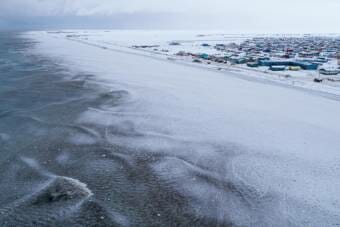
An aerial shot of Utqiagvik in the snow, taken from just off the coast
Waves churn newly-forming ice next to the shoreline in Utqiagvik on Nov. 1, 2021. (Loren Holmes/ADN)

The portfolio of Alaska’s largest corporation includes two oil refineries, a construction business and one of the North Slope’s few hotels.

At Arctic Slope Regional Corp.’s headquarters in Alaska’s northernmost community, Utqiaġvik, the richly decorated boardroom features a skin boat used for whaling that rests on the floor, encircled by the conference table.

Since its inception, ASRC has paid out more than $1 billion in dividends, with recent per-shareholder payments as high as $7,000 a year. Only people with Alaska Native heritage can own shares, with a few exceptions. And the shares cannot be sold, only issued directly by the corporation or passed from existing shareholders to their loved ones.

""
In Arctic Slope Regional Corporation chairman Crawford Patkotak’s office, whaling memorabilia sit alongside a bumper sticker for U.S. Congressman Don Young in a windowsill overlooking Utqiagvik on Nov. 2, 2021. (Loren Holmes/ADN)

This unique ownership structure was created by the U.S. Congress in a landmark land claims deal with Alaska Native leaders that turns 50 years old this month.

But while the deal helped create monetary wealth for ASRC’s 13,000 shareholders and those of dozens of other Alaska Native-owned corporations, it also came at a huge cost.

A map showing land ownership on Alaska's North SlopeFor all of ASRC’s assets, its shareholders still cannot claim title to their ancestral Iñupiat lands 25 miles from the corporation’s Utqiaġvik headquarters — or to any oil that might lie beneath them. That property now belongs to the U.S. government, which established the area as a naval oil reserve in the 1920s before later designating it the National Petroleum Reserve in Alaska.

To the east, Prudhoe Bay, one of North America’s largest oil fields, belongs to the state of Alaska, which receives royalty and tax revenue from the $35 million in crude piped off the North Slope every day. And nearly all of the Arctic National Wildlife Refuge is in federal hands, frustrating ASRC’s efforts to open it to oil development and provoking routine clashes over access and management with the Iñupiat residents of Kaktovik, the only village that lies within the refuge’s boundaries.

An aerial photo looking down along the Arctic Ocean coastline
The Arctic Ocean meets the shore just east of Nuvuk, the northernmost point in the USA, on Nov. 1, 2021. Nuvuk is 9 miles northeast of Utqiaġvik, Alaska. Archaeological evidence indicates that the site was occupied about 1,500 years before the arrival of the first Europeans. (Loren Holmes/ADN)

That tension between monetary wealth and lost land is at the heart of the Alaska Native Claims Settlement Act, which President Richard Nixon signed into law in December 1971.

The legislation was, in effect, an experiment by a mostly white Congress pulled between two conflicting approaches to Indigenous people: self-determination, and assimilation and termination — the concept of ending the government’s obligations to Natives.

By creating more than 200 Native-owned corporations like ASRC and seeding them with 44 million acres of land and $1 billion, the legislation was one of the most progressive land deals ever struck between the U.S. government and Indigenous people.

A black-and-white photo of a group of 14 men posing together inside a hotel
As a result of the passage of the Alaska Native Claims Settlement Act, monetary awards were made to Native regional corporations created by the Act on July 1, 1972 at the Anchorage Westward Hotel. Pictured L-R: Alaska Lt. Gov. Red Boucher, Mike Swetzof (Aleut League), Jack Wick (Koniag, Kodiak), Martin Olson (Bering Straits), George Miller (Cook Inlet Region), Joe Upicksoun (Arctic Slope), John Sackett (Doyon, Tanana Chiefs), Robert Marshall (Ahtna), Cecil Barnes (Chugach), Robert Newlin (NANA), Bob Willard (Sealaska), Morris Thompson (BIA area director), Sen. Ted Stevens and Don Wright (AFN president). (Dept. of Interior/Ted Stevens Foundation photo)

But by establishing for-profit corporations, Congress also pulled Alaska Natives into a Western, capitalist system and cut off access to lands that, for generations, sustained them through subsistence harvests of fish and game. The vast majority of Alaska lands — some 90% — were taken away from the state’s Native people.

“This capitalist system was imposed on us in a colonistic way: ‘Either you’re going to do it this way or you’re not going to do it at all. And you’re going to conform to this or you’re not going to do it at all,’” said Qaiyaan Harcharek, an avid subsistence harvester in Utqiaġvik. “It got us where we are today. But it’s a drop in the bucket for the Indigenous people of Alaska.”

The face of a man seen in the rear-view mirror of the car he's driving on snowy roads
Qaiyaan Harcharek gives a driving tour of Utqiagvik on Nov. 2, 2021. “ANCSA got us what we have today,” he said. “It’s a drop in the bucket.” (Loren Holmes/ADN)

Hindsight

Today, with 50 years of hindsight, discussions about the settlement with Alaska Natives inside and outside the corporate world provoke complicated emotions — a reflection of the legislation’s wide-ranging impacts on Native and non-Native people in Alaska.

The North Slope, with its rich oil and gas resources, is a useful test case to examine the legislation’s huge cultural and economic stakes.

Utqiaġvik, the 5,000-person North Slope hub town, is almost unrecognizable from what it was in the 1960s, when a previous generation of Iñupiaq leaders first organized to stake their claim to their ancestral lands.

Elders still remember emptying honey buckets full of sewage and melting ice on Coleman stoves to wash up each morning.

In the years following ANCSA’s passage, oil money began pouring into the community and its surrounding villages, allowing them to invest in infrastructure envied by other regions of rural Alaska.

Now, a 3-mile underground “utilidor” moves water, wastewater and utility lines around town, and gas fields not far away supply heating fuel to local homes.

Pineapples and mangoes on display in a grocery store produce section
Fresh pineapples are $13.49 each at the Stuaqpak grocery store on Oct. 31, 2021 in Utqiagvik. (Loren Holmes/ADN)

Grocery stores sell hot food and fresh fruit and vegetables. And students, who once flew hundreds of miles even to reach middle school, can now attend Barrow High School and take classes from a tribal college, Ilisagvik. Iñupiaq is now taught at school — a stark change from a few decades ago, when government-run schools punished North Slope residents for speaking it.

“I got my hands whipped,” said Harry Brower, 63, the borough mayor.

The region’s modernization grew out of ANCSA’s passage in 1971 and the establishment of the  North Slope Borough the following year. But the Iñupiat had to fight for both.

Statehood

The push toward a settlement lasted years, and it began as the state government started selecting pieces of its land entitlement granted by Congress under the 1958 Statehood Act. The state got to select 100 million acres, about one-fourth of the land in Alaska.

Some of the areas it chose caused conflicts with Native communities, whose members were encountering newly built cabins on their ancestral lands and greater competition from non-Native residents for fish and game.

Unlike in the Lower 48, Alaska tribes hadn’t been conquered in wars and they hadn’t signed treaties ceding their lands. So Alaska Native groups began filing land claims.

A man sitting in an office, gesturing with both hands as he speaks.
North Slope Borough mayor Harry Brower sits in his office on Nov. 3, 2021. Behind him is a painting of the first North Slope Borough mayor, Eben Hopson, Sr., as well as a walrus skull and Yankee whaling ships fashioned out of baleen. (Loren Holmes/ADN)

While the Native leaders largely enjoyed support from the state’s representatives in Congress during the land claims era, including Rep. Nick Begich and Sens. Ted Stevens and Mike Gravel, they also faced disinterest, opposition and blatant racism.

Oliver Leavitt, an ASRC board member and Iñupiaq elder who spent time working with Congress in the 1970s, described attitudes there in blunt terms: “To them, you were a f–king savage.”

“They just didn’t give a damn about you,” Leavitt, 78, said in an interview in ASRC’s Utqiaġvik offices. “They’d tell you to get the f–k out of their office.”

A man standing in front of a large wall map of the North Slope
Arctic Slope Regional Corporation board member Oliver Leavitt stands in front of a map of the North Slope in the ASRC board room on Nov. 2, 2021 in Utqiagvik. Leavitt spent time working on Native claims issues with Congress in the 1970s. (Loren Holmes/ADN)

Oil

An event on the North Slope dramatically changed those political dynamics: The 1968 discovery of the Prudhoe Bay oil field.

The field contained billions of barrels of oil. But the Native land claims stalled construction of the trans-Alaska pipeline, which got congressional leaders’ attention.

“People really could care less about the Alaska Natives,” Ron Birch, who worked as chief of staff to Stevens during the land claims era, said in a recent interview. “But senators and congressmen out of Texas and Oklahoma and Louisiana cared a lot about big oil.”

A black-and-white photo of three men studying a map
L-R, Oliver Leavitt and Mayor Jake Adams of Barrow visit Senator Ted Stevens in Washington D.C. on September 6, 1972, regarding ANCSA land selections for the Arctic Slope Region. (U.S. Senate/Ted Stevens Foundation photo)

Other dynamics converged to help overcome institutional opposition to the settlement.

One was a homegrown movement of Alaska Native leaders — activists and regional Native organizations from around the state who coalesced into the Alaska Federation of Natives.

The group, led by figures like Emil Notti, Don Wright, John Borbridge and Willie Hensley, included representatives from the North Slope to Western and Southeast Alaska. And it fought, said co-founder Hensley, with “two hands tied behind our back.”

At one point, AFN had $9 in the bank, and one man mortgaged his house to fund his participation in the movement, Hensley and other early AFN leaders recalled during October retrospectives hosted by the Alaska Historical Society. AFN ultimately secured loans from a tiny Alaska Native village that had made money from an oil and gas lease sale, and from a Washington tribal government.

“We didn’t have any lawyers, initially,” said Hensley, who wrote a key research paper on Natives’ legal standing for a 1966 university graduate course. “We didn’t have any money. We didn’t have any time.”

An audience, all standing, filling the floor of an arena
Alaska Federation of Natives delegates applaud during a presentation of the Shirley Demientieff award Thursday, Oct. 17, 2019 during the AFN convention at the Carlson Center in Fairbanks. (Loren Holmes/ADN)

Some in Alaska’s business and political establishments opposed transferring land to Native people, and AFN’s leaders said they faced death threats and hostile newspaper editorials. But Stevens, Gravel and Begich all helped push the legislation across the finish line in Washington, D.C.

Stevens, the Republican senator, was convinced that any Alaska lands that could be shifted out of federal ownership would end up benefiting the state, said Birch, his chief of staff at the time.

“Ted would explain tirelessly, ‘No, I’m taking the land away from the federal government and giving it to Alaskans,’” he said.

Gravel, Alaska’s other U.S. senator, was a Democrat who owed his election to the Alaska Native community, and he supported the legislation. Nixon’s White House and some of his top aides were also key allies and early supporters of a 40-million acre settlement, which gave political cover to Republican lawmakers who had previously opposed a deal with that much land.

“‘Tricky Dick,’ they called him. But as far as I’m concerned, he’s a hero,” Hensley said. “He’s the fellow who created self-determination.”

A natural gas stack with a flame at the top, with the sky in the background
Natural gas flares at a processing facility just outside Utqiagvik on Nov. 2, 2021. The gas heats homes and is burned to provide electricity for the community. (Loren Holmes/ADN)

Settlement

The drawn-out political process that led to the settlement tested the bonds between the Native groups that came together to form AFN, and they forced the North Slope’s leaders, along with others, to make concessions.

A particularly difficult set of questions arose around how to divide up the money and land that Congress would set aside on a statewide basis. In the end, the lands were split up based on the North Slope’s preferred formula, which tied each region’s share to the size of their original land claim.

But other parts of the settlement were divided on a per capita basis, which the thinly settled North Slope vehemently opposed, saying the method benefited more populous Alaska Native groups at their expense. Another provision opposed by the North Slope that was included in the legislation required corporations to share 70% of their resource revenue — including from oil.

A man gesturing while giving a speech
Arctic Slope Regional Corporation chairman Crawford Patkotak speaks in support of an amendment preserving access to natural resources during discussion of a resolution reinstating a climate action leadership task force and declaring a state of emergency on climate change, on Saturday, Oct. 19, 2019 during the Alaska Federation of Natives convention at the Carlson Center in Fairbanks. In December 2019, the ASRC board voted unanimously to leave AFN in order to focus on local concerns on the North Slope. (Loren Holmes/ADN)

North Slope leaders were some of the most strident in their arguments for the settlement, even withdrawing from AFN at one point, and their contemporaries said their positions helped move the negotiations’ center of gravity.

Among those early leaders was Charles “Etok” Edwardsen, who protested outside a 1969 Prudhoe Bay lease sale held by the state with signs that read: “2,000,000,000 Native land robbery” and “Eskimos own North Slope.”

Protestors handed out leaflets that said the lease sale was “perpetrating of economic genocide on a native minority,” and Edwardsen told reporters it represented “the rape of Alaska Natives.”

After the settlement’s passage through Congress, North Slope leaders wrote to Nixon asking him to veto the legislation. And when AFN convened to consider whether to recommend to Nixon that he sign the bill, the North Slope delegation voted no.

Its leader, Joe Upicksoun, delivered a scorching indictment in a speech.

“You can obviously see that I am hurt and frightened and perhaps bitter,” he said. “This hurt and fright and bitterness have been caused by the other Natives demanding more than their just share; by the state being dishonorable in grabbing whatever she could; by the Congress’ incompetence in not really understanding the problems and not trying to; by the oil companies stepping on us as if we were not people; by Western society moving in on us and brushing us aside.”

Hensley said other Native leaders felt similarly to Upicksoun, even as they voted to recommend that Nixon approve the settlement.

“You’d think there would have been celebration. But there wasn’t — we knew what we were giving up,” he said at the historical society’s recent retrospective. “The remarkable story is that people just didn’t sit back and cry about it all. They said, ‘What the heck, let’s get this thing together and let’s see what we can do with it.’”

A black-and-white photo of a man with a pipe, standing, speaking to three seated men in
L to R: Eben Hopson of Barrow and Flore Lekanof of the Pribilof Islands listen as attorney Lester Miller, representing the Aleut League, and Sen. Ted Stevens confer during an ANCSA hearing in the Committee on Interior and Insular Affairs in Washington, D.C. on August 7, 1969. (U.S. Senate / Ted Stevens Foundation photo)

No ‘trail of tears’

The ink on the settlement wasn’t even dry before the Iñupiat began work to improve on the deal Congress made with them.

Eight months before Nixon signed ANCSA, the region’s leaders had submitted their petition to form the North Slope Borough, which at 89,000 square miles is roughly the size of Minnesota. After voters in the region approved it, the new government entity began levying taxes on infrastructure built by oil companies.

The borough now raises $400 million a year in property taxes — levying more than $100 million on ConocoPhillips alone.

A man walking down a snow-covered street
A person walks down a street in the Browerville neighborhood of Utqiagvik on Nov. 1, 2021. (Loren Holmes/ADN)

The money is invested in water and sewer lines, communications infrastructure and schools. It also pays for police and fire departments, a wildlife department that does bowhead whale research, and a search and rescue department with four aircraft, including a massive Sikorsky helicopter.

Major oil companies sued to block the borough’s formation, but they were unsuccessful.

“There’s always, for the longest time, been those sentiments of the old guard: Don’t give any land to the borough. Don’t give any lands to the Natives. Fighting tooth and nail because oil is at stake up here,” said Gordon Brower, the borough’s current planning director.

A man sitting at his desk, gesturing as he speaks
Gordon Brower, director of the North Slope Borough Planning & Community Services Department, talks with a reporter in his office on Nov. 2, 2021 in Utqiagvik. (Loren Holmes/ADN)

ASRC, meanwhile, got to work creating an array of subsidiaries, including a construction company and fuel distribution and tourism businesses.

It also began signing leases with oil companies for the land ANCSA granted it — and for a tract inside the Arctic National Wildlife Refuge that it obtained through a federal land exchange orchestrated during the Reagan administration. So far, ASRC’s leasing revenue from that area, which doesn’t have to be shared with other Native corporations, is likely at least $50 million, according to public documents.

ASRC has now been listed as Alaska’s top revenue-generating business for the past 27 years. It says it has 13,500 employees across the country and ranks among the top regional corporations in its yearly cash dividends, though the impact of the COVID-19 pandemic did force reductions.

Original ASRC shareholders received $7,000 in 2018 and 2019, and the company employed some 500 shareholders during that time. At least one regional Native corporation has paid out less in dividends over its entire, five-decade existence than ASRC has paid in a single year.

North Slope leaders say they’re keenly aware of their relative fortune, particularly when they compare themselves to Native people outside Alaska.

“Ain’t no trail of tears in Alaska,” said Josiah Patkotak, who represents the North Slope in the state House. “We got the best deal that a Native people has got. Ever.”

Patkotak’s father, Crawford, is board chair and executive vice president of stakeholder engagement at ASRC, which paid him $2 million last year. In an interview at the corporation’s Utqiaġvik office, Crawford used a poker analogy to describe how the Inupiat have fared since the settlement: starting with two deuces — a very tough hand.

“Look at the challenges we had to face. Look at what mountains we had to climb. Look at the valleys we’ve had to endure. And we’re still here,” he said. “We ain’t going anywhere.”

""
The sun sets behind Utqiagvik on Nov. 1, 2021. (Loren Holmes/ADN)

This story is part of a reporting collaboration between Alaska Public Media, Indian Country Today and the Anchorage Daily News on the 50th anniversary of the Alaska Native Claims Settlement Act. Funding for the ANCSA project was provided by the Alaska Center for Excellence in Journalism. Read more from the ANCSA project.

Sitka Tribe’s shellfish lab honored for safeguarding traditional foods

A pair of purple-gloved hands using a small knife to push shellfish meat out of a while colander
Sitka Tribe of Alaska fisheries biologist Jen Hamblen empties blue mussel meat into a blender in 2016. (Emily Russell/KCAW)

For millennia, people in Southeast Alaska have relied on the sea for sustenance. But what happens when traditional foods could be deadly? That question was behind the founding of Sitka Tribe of Alaska’s Environmental Research Lab in 2016. The lab tests shellfish from 17 Southeast communities as well as tribes on Kodiak Island.

The state tests commercial shellfish for toxins. But Sitka Tribe Resource Protection Director Jeff Feldpausch says subsistence harvesters are left to fend for themselves.

“They don’t do any public testing or certifying any beaches in Alaska, like you see in Washington and other Lower 48 states,” he said.

Feldpausch says the state’s official message is simply not to eat the clams and mussels on the beach because of the risk of toxins.

“We just figured, you know, that’s not that’s not acceptable response,” Feldpausch said. “We started down this road with, I think, 15 other tribes in Southeast as far as looking at ways to address safe access to shellfish resources.”

Paralytic shellfish poisoning, or PSP, is caused by toxic algae blooms. Filter feeding shellfish like clams and mussels store the algae’s biotoxin in their tissues, which can prove fatal when ingested.

PSP has always existed in Southeast. Harvesters could once rely on ancestral knowledge alone to be safe, but climate change has made PSP more frequent and harder to predict without testing.

“You know, a lot of the old harvesters used to say you only harvests shellfish in a month with ‘r’ in it,  and we’re starting to find out that that’s not necessarily the case right now, ” Feldpausch said. “It’s just, with climate change, we’re seeing a higher frequency of PSP or biotoxin levels that can cause death.”

It was spring of 2016 when Sitka Tribe of Alaska took a risk and opened its research lab, the first of its kind in Southeast Alaska. In November, the lab was recognized by Harvard’s Honoring Nations program in the 2021 American Indian Governance awards. Out of the 70 different programs that applied, Sitka Tribe was one of the top six.

Feldpausch says that tribal sovereignty is at the heart of the lab’s mission.

“Unfortunately, statehood and the Alaska Native Claims Settlement Act separated tribes and tribal citizens from the land and the resources to where the point that tribes really don’t have much more input, or much more leverage on how those resources are managed than any other entity or individual within the state,” he says. “So basically, it’s given the tribes the ability to act to exert sovereignty over some of the resources.”

For those who use the lab’s services, it’s about more than just subsistence. Yakutat Tlingit Tribe’s environmental director Jennifer Hanlon says the initiative is part of a greater struggle for cultural preservation.

“This data — it’s really important to inform harvesters of the current levels, if there’s any concern related to when and where to harvest shellfish,” Hanlon said. “Because that is such an important subsistence food for us that nourishes our people and our communities, on so many levels. Not just nutritional, but also fostering that relationship to our ancestral lands and waters.”

Feldspauch says the tribe’s shellfish testing program is still expanding and now includes training for tribal citizens.

“We’re actually testing for two other biotoxins that are produced by harmful algal blooms. So we’re expanding our testing range,” he said. “We’re also testing subsistence resources for total mercury. And beyond that, we’ve, outside of the lab, we’ve actually grown to training tribal citizens or other tribes to do shellfish biomass surveys.”

Sitka Tribe offers free shellfish testing for Sitka residents and is continually monitoring Starrigavan Beach, with new data out every two weeks, year-round. For more information on the lab and their services, you can visit their website.

Dunleavy administration loses lawsuit over Kake subsistence hunt

Kake residents and Elders process moose meat to be distributed to the community
Kake residents and elders process moose meat to be distributed to the community (Courtesy of the Organized Village of Kake)

A federal judge has rejected the Dunleavy administration’s legal challenge to a special rural subsistence hunt that was authorized by federal authorities during the early months of the COVID-19 pandemic. The Southeast tribal government in Kake had organized the deer and moose harvest out of concerns about food security during the early months of the pandemic.

About a year and a half ago, fresh groceries in the community of Kake were in short supply. It was the early weeks of the COVID-19 pandemic, and meat, dairy and other perishables weren’t showing up on the barge as nationwide hoarding caused shortages of basics like toilet paper, flour and other staples.

And workers key to the nation’s food web were getting sick.

Our meat supply kind of got pretty low because of the virus hitting the meatpacking plants in the Lower 48,” Organized Village of Kake’s tribal president, Joel Jackson, told CoastAlaska.

The normal hunting season doesn’t begin till the fall, and it was too early for the salmon run in the Kupreanof Island community of a few hundred people.

But there are plenty of deer and moose in the dense forests, so Jackson went looking for permission to organize a community hunt — first to the state agency that oversees wildlife.

I went to the (Alaska Department of) Fish and Game, first of all, and they absolutely said, ‘No, that’s not going to happen,’” Jackson recalled.

Special 60-day hunt opened by federal agencies

In the end, the Federal Subsistence Board authorized a special hunt for the community of Kake in June. Two bull moose and five bucks were reportedly harvested, with the meat distributed to the community.

But then Republican Gov. Mike Dunleavy’s administration filed a lawsuit claiming there was no food security risk. It raised a number of procedural objections to allowing the special hunt.

There’s long been tension between state and federal authorities over subsistence rights. And the state’s position was that the special hunt was exclusionary and an example of federal overreach.

But federal Judge Sharon Gleason rejected the state’s request for a restraining order against the Federal Subsistence Board. She also rejected the state’s objections over the board’s excluding urban hunters harvesting moose in an area of the Interior, which the subsistence board had ruled was needed for public safety. That had been a second part to the state lawsuit.

In a 49-page order issued Dec. 3, she rejected all the state’s legal arguments.

Indigenous legal firm celebrates sovereignty win

The Native American Rights Fund, which offered legal aid to Kake’s tribe, welcomed the ruling.

“The Organized Village of Kake, like many Alaska Native communities, relies on subsistence hunting to ensure food security for its tribal citizens,” NARF staff attorney Matthew Newman wrote in a statement, saying the federal authorities did well to work with a Native community like Kake anxious about its food security.

“It was ridiculous of the state to suggest anything otherwise, and the court made the right decision when it held that the board acted within its authority,” the attorney’s statement added.

And Jackson, the tribe’s president, says it was a victory for tribal sovereignty in a crisis situation.

“I hate the word ‘subsistence’ because that’s Western world,” Jackson said. “But we practice our way of life here in the villages … If worse comes to worst, and somebody tries to limit us when we’re in dire need of something, I’m not going to sit back and wait for their decision — that’s not going to happen.”

Alaska Attorney General’s office considers appeal

A spokesman for the Department of Law released a short statement accusing the judge of ignoring the Alaska National Interest Lands Conservation Act — known as ANICLA — which proscribes subsistence rights on federal lands in Alaska.

“This ruling today is entirely contradictory to ANILCA, which was intended to protect the rights of all hunters on federal lands in Alaska and retain the state’s management authority with a subsistence preference only when necessary to restrict harvest,” wrote agency spokesperson Aaron Sadler.

“The state maintains the Federal Subsistence Board overstepped its authority — in part in illegal, secret meetings at that — including by restricting hunting in Units 13A and B and by authorizing an emergency hunt in Kake last year in spite of no food shortages,” the communications director added.

He said the state was considering an appeal.

‘River is getting close.’ Erosion is threatening Napakiak’s school

An aerial view of Napakiak and the eroding Kuskokwim shoreline on Sept. 22, 2021. (Gabby Hiestand Salgado/KYUK & Washington Post)

This story originally appeared in the Washington Post Magazine. It aimed to bring the issue of existential environmental threats, which Napakiak and many other communities in the Yukon-Kuskokwim Delta face, to a national audience.

On the first day of school in August, Principal Sally Benedict gathered her 22 high school students to explain why they had moved from their K-12 school into a detached portable unit next door. “Technically, you guys are called displaced children,” Benedict said. “We’re doing this because of the erosion.” The William Miller Memorial School in Napakiak, a Yup’ik village on a small island in Western Alaska, is tucked in a bend of the longest free-flowing river in the United States: the Kuskokwim. The river provides the lifeblood for Napakiak’s 370 residents, but now also threatens their existence.

How long would they be in the portable building? asked one student. Until a new school is built, Benedict replied.

During high tide, the river is only 64 feet from the high-schoolers’ original classroom and gets closer by the day. On windy days, waves crash against the shore where students used to play, battering it until the land relents and crumbles. Exposed roots of willow trees and broken slabs of mud hang off the riverbank, telltale signs of erosion. The school district plans to demolish the school, or at least part of it, during this academic year before the river swallows it up.

Some students aren’t waiting around to watch that happen. The day before school started, Madison Andrew, 14, embraced her mom ahead of an approximately 12-mile boat ride to Bethel, a hub city of about 6,300 people. Uncertain whether she would have a school to attend if she stayed, she had transferred schools, leaving behind her friends, her family, and her community. “She’s pretty much my right arm, my right leg, my left arm, my left leg,” said Andrew’s mother, Jackie Grey. “She does everything from helping in the house to being there for me. So it’s like a big piece of my heart is being ripped.”

High School student Madison Andrew stands between the Napakiak school and the eroding shoreline in Napakiak, Alaska on Aug. 10, 2021. Napakiak students are at risk of losing access to the school’s gymnasium due to the rapidly eroding shoreline and Madison has decided to go to school in Bethel so she is guaranteed the opportunity to play sports. (Katie Basile/for KYUK and the Washington Post)

Once the school is gone, the heart of the community will be missing too. As the village’s largest building, the school hosted everything from sled-dog-racing award ceremonies, to funerals, to basketball games. In the event of spring floods, when the frozen river would thaw faster than it could drain, residents would gather in the school’s gym.

The Kuskokwim River has been eating away at Napakiak for decades; the community is accustomed to moving homes back when the water gets too close. But the school is too big to move, and the river is approaching too fast, accelerated by climate change. In a region warming two to three times faster than the rest of the world, the village is losing ground three times faster than it was 10 years ago, according to studies of Napakiak’s erosion.

The village’s senior Elder, Annie Nelson, who is 90 years old and stands under 5 feet tall, remembers sitting in a circle as a little girl with her elders. They told her that Napakiak would suffer this fate. “When the people begin to change in attitude and love starts to get cold, they predicted the weather will begin to change and erosion will start happening and people will start moving,” she tells me in Yup’ik through an interpreter. Yup’ik, meaning “real person,” refers to both a group of Alaska Native people primarily residing in Western Alaska and their Indigenous language. Although most adult villagers speak Yup’ik and English, Annie is one of the few people left in the village who exclusively speaks her native tongue.

As we speak, Annie’s great-granddaughters clean wild berries and greens they had harvested to prepare a dessert called akutaq. The young girls are continuing their ancestral traditions on their ancestral lands, a lifestyle revolving around fishing, hunting, and gathering. “They have always been here. They belong to this land. This land is their food,” 81-year-old Jacob Black, the second-oldest of the village Elders, says of the community in Napakiak.

But their lifestyle has changed in some ways too. The Yup’ik people weren’t always as stationary as they are now. They moved with the seasons, from fish camps in early summer, to berry camps in late summer, to hunting camps in the fall. “Our Elders were living their ways of life, what they call nomads,” says Black. “They move from this place to this place, where everything was abundant. That cycle, I’ll never forget.”

Their nomadic way of life changed when the United States began to enforce the requirement that Yup’ik children attend school in Western Alaska, sometime after World War II. Along with churches, schools affixed families to a single location, transforming seasonal camps into permanent, year-round communities. Now, some of those villages face the threat of being wiped away by climate change, and residents say that the government, which helped anchor them there, is not doing enough to protect them.

While growing up in Napakiak, 61-year-old Walter Nelson heard the Elders’ climate change prophecies from his mother, Annie. Now, white-haired himself, he is the coordinator of the village’s 173-page Napakiak Managed Retreat Plan, a detailed 50-year plan to move the entire community to a safe and sustainable location. The retreat is estimated to cost more than $100 million, and the village has secured less than 10% of that amount.

Annie Nelson is the senior Elder in Napakiak and remembers when the Kuskokwim River shoreline was a mile from the village. Annie is pictured at home with her great-granddaughters, Natalia Ayagalria (left) and Charlene Ayagalria (right) on July 20, 2021. (Katie Basile/for KYUK and the Washington Post)

Nelson says that’s due to barriers that essentially exclude Alaska Native villages from funding sources. Some grants require fund-matching, and others call for the community to have its own heavy machinery. He says that Napakiak, where the median household income, according to the U.S. Census, is less than half the national average, simply doesn’t have the resources to manage those grant application requirements or the overhead they’d demand. To Nelson, the biggest challenge is cobbling together dozens of small grants, typically several hundred thousand dollars each. “You’re applying for this mini grant, instead of getting one big federal or state grant to take care of all your needs,” he explains.

The 2021 bipartisan infrastructure bill includes $216 million in federal funding to help tribes adapt to or relocate away from environmentally vulnerable areas. That figure pales in comparison to the $4.5 billion that the Alaska Federation of Natives estimates is needed to protect Alaska Native communities’ infrastructure over the next 50 years. And not only does the infrastructure bill’s funding for climate resilience efforts fall short in terms of dollars, says Max Neale, a senior program manager for the Alaska Native Tribal Health Consortium’s Center for Environmentally Threatened Communities, but these efforts also perpetuate programs that often ignore Alaska’s tribes. “The infrastructure bill largely provides funding to existing programs with inequitable regulatory barriers and program designs that disadvantage or exclude our communities,” Neale wrote in an email.

Napakiak is one of 73 remote Alaskan communities facing the highest level of threat due to erosion, flooding, and permafrost degradation, according to the 2019 Denali Commission Statewide Threat Assessment. Most are small Alaska Native villages. Newtok, a village in the same region that is also being displaced by a river, decided to move the entire community to another location 9 miles away. That process began decades ago and is only halfway done.

Napakiak’s water treatment plant and well, the village’s only source for clean drinking water, sits close to the river. July 23, 2021 in Napakiak. (Katie Basile/for KYUK and the Washington Post)

Nelson says the community’s biggest retreat priority right now is to make sure it still has a school. The existing one is owned by the Napakiak Corporation, the village’s business entity, and operated by the Lower Kuskokwim School District, but the state of Alaska is responsible for providing funding to build a new one. Despite the impending displacement, the state hasn’t granted the money. “The challenge for this project, and many projects, because we’ve got a long list of capital needs in the state, is resources,” says Tim Mearig, the facilities manager for the Alaska Department of Education and Early Development.

Walter Nelson, the coordinator of the village’s 173-page Napakiak Managed Retreat Plan, on Oct. 22, 2021 in Napakiak. (Katie Basile/for KYUK And The Washington Post)

With Alaska’s finances tied directly to fossil fuel production (oil revenue supplied more than two-thirds of the state’s budget in 2020), and oil production steadily declining for decades, the amount the state has spent on school construction and maintenance has dwindled in recent years. This year, Alaska’s budget for new school construction dropped to $0. Napakiak’s new school is estimated to cost more than $40 million. Even if funding were available, Napakiak is fourth on the state’s priority list. Mearig says the communities ahead of it have unsafe or crowded schools, while Napakiak has a disaster that he says hasn’t fully arrived yet.

“Why does something have to happen first in order to get some help?” asks Benedict, the school principal. Although the state has not yet funded a replacement school, it did award $3.1 million in this year’s budget to demolish the existing building to prevent it from falling into the river. The school district plans to take down half of the school this spring, hoping to preserve the gym for another year or two before the river inevitably reaches that too.

As their former classrooms turn to rubble, students will watch from portable classrooms nearby. In addition to the one they’re already using, more units will be shipped into the community; if there are obstacles in that process, the students will have to return to remote learning, Benedict says. This is a particularly painful option in Napakiak, where nobody has access to broadband Internet at home.

Napakiak School Principal Sally Benedict looks out at the encroaching Kuskokwim River from the school steps. Boxes of contaminated soil from the school’s former fuel tanks wait to be transported out by barge. (Katie Basile/for KYUK And The Washington Post)

Yet some students have chosen to go fully remote, like Annie Nelson’s 7-year-old great-granddaughter, Evelyn Nelson. For Evelyn’s family, the decision was partially because of the pandemic but also because of Evelyn’s inability to evacuate quickly if the river reached the school suddenly during a storm. She wears leg braces because of osteoporosis. “She wouldn’t have enough time to get out of the building,” says her mother, Amanda Black. “And I know she will be scared.”

Evelyn loves school and asks to go even on weekends. Math and science are her favorite subjects. Speaking on the first day of school, Evelyn says she understands her mother’s decision to keep her home, but that doesn’t make it any easier. “River is getting close. That means no more school,” says Evelyn. “I miss school. I’ll be sad all day. I’ll miss my teacher and my friends.”

Berries, wildlife and toxic land: The continuing push to clean up contamination in rural Alaska

Project Chariot. (Alaska Public Media)

When a string of Yup’ik elders from St. Lawrence Island, Alaska, all received the same cancer diagnoses, officials initially shrugged it off as a bizarre medical mystery. But not long after, a different village reported an increase in unusual cancer symptoms as well. Then another case struck. Hours away in Unalakleet, several locals were diagnosed with Parkinson’s, a rare disease for Alaska Native populations.

It was becoming clear that these grim trends weren’t a coincidence.

And upon further investigation, it turned out the residents in all three villages had unknowingly been consuming contaminated drinking water and food.

“Emotionally, it cuts you to the core,” said Delbert Rexford, Inupiaq, president and CEO of Ukpeaġvik Iñupiat Corporation, the village corporation for Utqiagvik, the nation’s northernmost community. “My cousins, my aunts and uncles have been a part of that.”

Rexford has been advocating for the cleanup of contaminated lands for the past few decades. It’s a challenge that many Alaska Native leaders are familiar with.

When the Alaska Native Claims Settlement passed into law in 1971, 44 million acres of Alaskan land were promised to Alaska Native regional and village corporations. As it turned out, a significant portion of these lands were contaminated prior to their conveyance — berries poisoned and harvests tainted by long forgotten war relics abandoned on the outskirts of Alaska Native villages.

“Let me be clear: under ANCSA, Alaska Native people gave up 88 percent of our traditional lands. In exchange, we received, in part, contaminated sites that we may be legally liable for,” Sarah Lukin, Alutiiq, said in a 2017 testimony on the issue.

Pollution and chemical runoffs aren’t exactly what most people would expect to find in Alaska’s wilderness, especially in the remote areas where affected villages are located. The explanation lies in an often overlooked chapter of the state’s past.

Alaska served as a critical military outpost from World War II through the Cold War. It was an ideal location for strategists — the region was close to Russia yet still U.S. territory, it had large stretches of wilderness perfect for training, and there was little regulatory oversight. Somewhere between a reliable homebase and a foothold abroad, Alaska drew the attention of the sharpest military minds of the day.

Simple combat drills soon turned more ambitious. In 1958, the U.S. government planned to explode an atomic bomb in the Arctic, just 26 miles away from the Inupiaq village Point Hope. The proposal, coined Project Chariot, was intended to create an instant harbor in the frozen coastal region.

The front page of the Tundra Times with the headline “Project Chariot Still On.” (Photo courtesy of Tundra Times)

Leaders across the state widely supported the initiative. Alaska had joined the union just one year earlier, and many residents hoped the nuclear blast would ignite a new era of economic opportunity.

The neighboring Inupiat village however, was not sold on the idea. To spread word of the upcoming detonations, local Inupiaq artist Howard Rock founded Tundra Times, the first Alaska Native newspaper. It would go on to become an organizing powerhouse, and later set the stage for ANCSA itself. Armed with support from the state’s other Indigenous cultures and joined by a handful of defecting U.S. Atomic Energy Commission scientists, the Point Hope community was able to successfully halt Project Chariot.

Tundra Times headlines about nuclear experiments. (Photo courtesy of the Tundra Times)

Unfortunately, remnants of these covert Cold War era missions remain. Still in the early days of statehood, there wasn’t extensive protocol for military withdraws. Chemicals, equipment, and weapons were simply left behind — sometimes with a sign that warned of their danger, but usually with no notice at all.

Today, chemicals such as arsenic, asbestos, lead, mercury, pesticides, and polychlorinated biphenyls are still found in rural Alaska. Many of these contaminants are linked to illnesses, such as cancer and Parkinson’s.

To make matters worse, multiple contaminated sites are found on traditional subsistence lands, locations that Alaska Natives have harvested for centuries. Part of the ecosystem for decades now, some of these toxins have seeped into the food chain. For example,  recent study discovered that marine life near affected areas contain significant amounts of PCBs.

It’s a particularly unjust situation. Families go to harvest in areas that are known for nourishment and generational gathering. Years later, they find out that these abundant lands had been endangering them all along.

“What’s happening on our traditional lands… it’s hard to fathom. We do continue to harvest, but are there contaminants out there that we don’t know about?” Rexford asked. “Only studies will show.”

In recent years, melting permafrost has unveiled new dangers. As temperatures rise and the geography shifts, more unidentified landfills, debris, and equipment are starting to appear.

The list of incidents keeps growing: sharp cables emerging from riverbanks, thousands of crushed barrels rising out of the tundra, a landfill discovered in a lagoon valued for beluga harvesting.

“We haven’t even come to scratch the surface of what is really there,” Rexford said.

‘There’s a lot of finger pointing’

According to a 1998 U.S. Department of the Interior report, at least 650 of these sites were known to be contaminated at the time of their conveyance. Around a third of the contaminated areas were Formerly Used Defense Sites, known as FUDS.

The U.S. Department of Defense is responsible for cleaning the Formerly Used Defense Sites, in accordance with the Comprehensive Environmental Response, Compensation and Liability Act. However, they are not responsible for cleanup of privately owned defense sites, which technically includes any land conveyed under ANCSA.

Abandoned army barracks in the Aleutian-Pribilof Islands. (Photo courtesy of Tundra Times)

As people grew sick, and more attention was brought to the contaminated sites, Alaska Native communities faced an additional problem: they were now responsible for cleaning up toxic land that they had not contaminated themselves, per the legal dynamics.

“It is damaged goods, effectively. And you are a small, small village, and you’re up against the federal government saying, ‘Hey, don’t you have a responsibility to clean this up before you give it to us?’ It is truly a situation that is daunting,” said Alaska Sen. Lisa Murkowski in a 2020 interview.

It’s not a minor cost. The Alaska Native Village Corporation Association estimates Alaska Native corporations would have to spend at least $6 billion to complete the cleanup of all of these locations.

“In return for the extinguishment of Aboriginal rights to these lands, the federal government gives us lands that are contaminated, then they make us clean it up? Everybody agrees, that’s going a little too far,” said Brennan Cain, Vice President and General Counsel Eyak Corporation, the village corporation for Cordova, a small southern Alaskan community near Prince William Sound.

All parties involved recognize that the situation is unfair. The challenge isn’t proving the need for a clean up — it’s determining who is responsible for it.

The Department of the Interior’s Bureau of Land Management is in charge of transferring ANCSA conveyances to ANCs. They aren’t in charge of cleaning the conveyances, but they also can’t transfer lands that are known to be contaminated. The Bureau says they were uninformed about any contaminated lands they had previously handed over. Meanwhile, the Alaska Department of Environmental Conservation and the Environmental Protection Agency oversee the physical clean up. However, they aren’t liable for the contamination, so they aren’t expected to cover the costs. Technically, the original entity that damaged the land is supposed to fund the cleanup. But this information isn’t always available, and around 100 sites don’t have their past owners identified.

“There’s a lot of finger pointing,” said Cain.

The debate is still occurring today.

In May 2021, Alaska Gov. Dunleavy sent a letter to President Biden, requesting that the federal government complete the required cleanup of hundreds of contaminated sites found on ANCSA lands.

“It has been 50 years since ANCSA became law, and the cleanup of contaminated lands has yet to be addressed,” said Kim Reitmeier, executive director of the Alaska Native Corporation Regional Association, in the governor’s press release.

Reitmeier’s statement summarizes the frustration many feel about this topic. The sites have been identified, the negative impacts have been witnessed, and everyone agrees it’s a problem. So what will it take to get rid of contaminated lands?

Next generation needs to ‘pick up the mantle’

It’s been decades since the government first acknowledged the poisoned lands, but Rexford doesn’t believe the surprises have ended.

His region has a reason to be wary.

In 1990, a series of government documents from the 60s became declassified. They revealed that radioactive soil had been buried underground near Point Hope after Project Chariot was shut down. By the time locals were informed of this, it was too late – the effects had taken root. Today, cancer is still the leading cause of death in the village.

Tundra Times article discussing the radiation discovery. The question posed in the headline — “When will the next shoe drop?” — still stands today. (Photo courtesy of Tundra Times)

The community fears more cases like this could occur if extensive clean up measures aren’t implemented in the near future.

There has been some progress over the past few years. In 2018, legislation was passed that amended CERCLA, to ensure that Alaska Native Corporations would not be held liable for the contaminated sites.

Other organizations have helped where they can as well, such as the Bureau of Land Management.

“The BLM working cooperatively with all stakeholders and using four databases from Alaska Department of Environmental Conservation developed a comprehensive Contaminated Lands Inventory to aid in cleanup prioritization. More than 6,000 sites were reviewed resulting in 94 sites identified with an additional 104 sites as possibly containing contaminated lands,” said Lesli Ellis-Wouters, communications director for the Alaska Bureau of Land Management.

A map of contaminated sites in Alaska. (Image courtesy of Bureau of Land Management)

It’s a strong step in the right direction, but Cain fears the momentum will fade.

“There’s been some progress, but we need to keep going. It’s such a huge issue,” said Cain. “And at this rate, it’s literally going to be 100 years before all these sites get cleaned up.”

Thirty years ago, it appeared the situation had been solved. A resolution was passed, with concrete steps to address contamination. But after the initial excitement around the announcement died down, people slowly forgot about the issue. In the end, only minor changes resulted from the well thought out plan.

Today, there are now additional obstacles to consider.

For one, this problem has been around for so long, that many of the go-to experts are starting to retire. Most of this task force has been somewhat volunteer based, working outside of the regular job description and hours, so there aren’t direct replacements for the roles. As the original advocates begin to leave the scene, new leaders will have to step in to take their place.

“The next generation of folks need to sort of pick up the mantle,” Cain said.

Cordova, Alaska. (Photo courtesy of David Little)

There is also the issue of coordination.

Future advocates might find success in establishing a lead department to oversee clean up. One option would be the Army Corp of Engineers, which is already in charge of removing the Formerly Used Defense Sites.

Cain also recommends increased logistical planning between regions. Sites could be ranked by order of importance based on subsistence use and village proximity. Regional leaders could then determine the most efficient route for the equipment to be transported.

Employment opportunities from the operation could go to local Alaska Native shareholders, suggests Rexford. The training they would receive from these roles could be applied to other cases as well.

“It’s our homeland. It’s under our feet. And we want a sense of ownership in cleaning it up,” he said.

Even with all logistics in place, one major challenge would still remain: there isn’t enough funding. With clean up costs in the billions and tight federal budgets, the government isn’t likely to foot the entire bill anytime soon.

However, outside funding initiatives could make a difference. Putting capital toward the cleanup effort is a direct way for nonprofits, such as environmental justice initiatives, to assist. Their impact would be visible, immediate, and in many cases, life saving.

As Rexford prepares to begin another year advocating for the ANCSA conveyances to be cleaned, he reflects on the circumstances. Despite their small population, his community has been able to raise awareness about an injustice that threatens thousands across Alaska.

But that’s part of the problem. Something tells Rexford that more populated areas of the United States wouldn’t have been left to face nuclear waste and cancer causing toxins alone for this long.

“What about a community of 800 that is exposed to some of these elements that are life threatening? Don’t they deserve equity? Don’t they deserve the same level of environmental justice that our brothers and sisters to the south receive?” he asked. “Or are they just termed as being expendable? As collateral damage?”

This story is part of a reporting collaboration between Alaska Public Media, Indian Country Today and the Anchorage Daily News on the 50th anniversary of the Alaska Native Claims Settlement Act. Funding for the ANCSA project was provided by the Alaska Center for Excellence in Journalism. Read more in the series on Indian Country Today’s website.

Petersburg’s tribal administrator takes job leading United Fishermen of Alaska

(Photo courtesy of Tracy Welch)

A statewide commercial fishing industry trade group has hired Petersburg Indian Association’s tribal administrator as its next executive director.

Tracy Welch, 34, is wrapping up work with Petersburg’s tribe this week and starts at United Fishermen of Alaska on Dec. 7. UFA advocates for the industry and represents commercial fishing groups from the Bering Sea to Seattle.

Welch said she was able to attend the Pacific Marine Expo in Seattle in November with UFA members.

“It was a good chance to meet some of the board of directors and some of the fishermen from around the state and on the west coast,” Welch said. “So definitely something a little bit out of my wheelhouse, but it’s going to be nice to go back to working for and with fishermen, too.”

Welch grew up in Petersburg and has a background in commercial fishing, gillnetting and long-lining with her father. She went to college at Notre Dame and law school at University of Oregon. Welch served on the tribal council of the Petersburg Indian Association starting in 2017 and became council president later that year before taking over as tribal administrator in 2019.

Welch said the tribal government has grown into a larger role over the past five years.

“The organization has really turned around and become a true partner in the community,” she said. “I think you can see that in the various services that we offer and partnership with the borough and partnership with Mountain View Food Service. You know, we do a lot of trail work, and we started a transit program that’s probably the high point of my time at PIA.”

That transit program offers free rides in the community to elders and people with disabilities. PIA also helps distribute low cost meals to seniors. The tribal government has added to its inventory of affordable housing this year and hopes to add more.

UFA executive committee president Matt Alward writes in an email that the board is excited to welcome Welch to the organization.

“She may be new to UFA, but is no stranger to commercial fisheries in Alaska,” Alward writes. “Her unique background, knowledge of the commercial fishing industry, and excellent interpersonal skills will be tremendous assets to our members.”

Welch replaces Frances Leach, who is leaving to start up a lobbying firm in Juneau. Several with ties to Petersburg have held the UFA job before, including Bobby Thorstenson and Julianne Curry.

Welch’s last day on the job at PIA is Friday, Dec. 3, but she plans to help with the transition for the new tribal administrator. The tribe is still advertising that job.

Site notifications
Update notification options
Subscribe to notifications