Alcohol & Substance Abuse

Corrections seeks alternatives to halfway houses

Corrections Commissioner Dean Williams
Corrections Commissioner Dean Williams speaks to reporters after Gov. Bill Walker announced his appointment in January 2016. Williams is seeking alternatives to traditional halfway houses. (Photo by Skip Gray/360 North)

Alaska’s Department of Corrections is starting to test alternatives to the halfway house system in an effort to reduce the number of offenders who commit new crimes after they’re released from prison.

Corrections Commissioner Dean Williams said it doesn’t make sense to keep doing things the same way, when the majority of prisoners cycle in and out of state custody. 

Williams said one of the most important things the Department of Corrections can do is help people leaving prison find a stable place to live.

“Without a place to stay, you’re desperate, and you’ll go wherever you can go,” he said. “That’s why our recidivism rate has been 60, 65 percent for the last 20 years.”

Halfway houses are the traditional approach for people making the transition out of prison. They are privately operated buildings that allow inmates to live beyond the prison walls. They serve inmates who have not completed their sentences, and who are expected to have challenges moving back into the community.

But Williams also wants to try different models.

One approach could be based on Haven House, which serves women in Juneau, and My House, which serves homeless teens in Wasilla.

“Most of the people in those homes are former heroin addicts, or former opioid addicts,” he said. “So they’re all kind of on a treatment plan. They all kind of hold each other accountable. What really happens in these peer-oriented places is that people start to get a connection with each other and they get invested in each other’s success.”

Haven House serves both women who are on parole and those who haven’t committed offenses.

Julee Douglas said it could also serve those who haven’t completed their sentences. She’s the house manager at Haven House. She said other parts of the state could learn from the experience of Haven House’s residents.

“We just take their hand and gently support them along the way,” Douglas said. “And we’ve had good success doing that.”

The department has also launched a pilot program with inmates at Wildwood Correctional Center in Kenai.

Thirteen of them are working this year at Pacific Star Seafoods’ cannery in Kenai. They live at a bunkhouse operated by the cannery. While prisoners have worked at Pac Star for several years, they used to go back to the prison at night. Now they’re staying in the community.

Nate Berga is Pac Star’s plant manager in Kenai. He said the pilot program has been going well since it started more than three months ago.

“To be honest with you, there’s no difference from those employees that are through the pilot program or employees that we’ve hired in any other part of the state or outside Alaska,” he said. 

Berga said some of the workers actually have more job skills than other cannery hires.

Williams is looking at another model to help residents from rural Alaska return to their communities, since there are no halfway houses in Alaska villages. The Department of Corrections is considering working with community leaders to find stable housing in their home communities.

Community members, landlords or family members would work with the state to supervise inmates who haven’t finished their sentences.

Williams said the state would pay a housing voucher to the people providing rental housing to the inmate.

“If I can support someone back in a local community and pay almost the daily rate I would pay for them to be in a halfway house, why wouldn’t I pay the same amount for them to live in Hoonah, for example, or another Southeast community, if I can find a place where they can be supported and be supervised?” Williams said. 

Williams said half of Alaska inmates who re-offend commit new offenses quickly — within six months, which makes the transition to stable housing important.

 “They’re failing early on,” Williams said. “And the reason why they fail early on is that they don’t have a place to live, they don’t have a job, and they don’t have a purpose. Without that, it doesn’t matter what we do behind the walls or any fancy treatment that we do. If you do not have a place to live, a job to have, a function, some support network, it’s all over.”

Williams said the voucher program will start small, with perhaps two to five residents. And it will only occur in communities that support it.  
Sitka Counseling fights opioid crisis with treatment, prevention

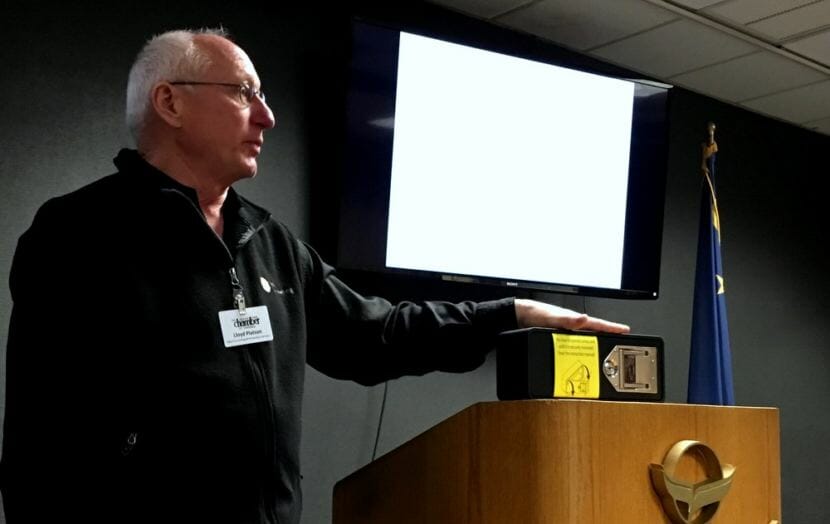
Sitka Counseling prevention director Loyd Platson displays a free lock box for homeowners concerned about seeing their prescription meds falling into the wrong hands. The lock boxes, along with free disposal bags, pharmacy drop boxes, and a special incinerator are all part of a program designed to “remove social access” to opioids and other dangerous drugs. (Photo by Robert Woolsey/KCAW)

Sitka Counseling is tucked away in the woods behind Sitka National Historical Park, but it is a very visible player in the mental health of the community

Top staff outlined the organization’s service plan for the Chamber of Commerce recently, and it extends far beyond substance abuse treatment and mental health counseling.

To illustrate the scope of Sitka Counseling’s services, clinical director Marita Bailey asked the chamber audience to consider a hypothetical question: How many would raise their hands if they had been affected by substance use or mental health problems, either personally or by a friend or family member?

She guessed about half might be willing to raise their hands. Then, Bailey reframed the question.

If I were to change that question to: How many of you have been affected by divorce or separation? Or your child is not responding to your parenting techniques. Or your child has ADHD and they’re struggling in school to really learn. Maybe you’re having problems with your partner, and you need someone to talk to about it. Or postpartum depression. Or anxiety. I would venture to say that if we changed the question, everyone in the room would raise their hand. Because at some point or another we all experience some challenges. So that idea of stigma is very real.

Sitka Counseling has an annual budget of $2.8 million, and a full-time staff of 37. Its funding is a mixture of grants and Medicaid. The organization serves 350 unique clients every year, anywhere between 40 and 60 of whom travel from out of town.

Prevention director, Loyd Platson told the chamber that he worked to build strategic partnerships within Sitka, to stem the opioid crisis. He showed the audience free lock-boxes they could install in their homes to keep prescription medications safe; he had small drug disposal bags that neutralized unused medications with activated charcoal; and he showed pictures of the drop boxes installed at Sitka’s pharmacies, where police could collect unused drugs and dispose of them in a new incinerator designed especially for this purpose.

Much of Platson’s program is funded by two major grants: A Drug-Free Communities grant ($125,000 a year for 10 years) and a Strategic Prevention grant ($150,000 a year for 4 years).
Although both grants will run dry in a few years, Platson says prevention will continue.

Part of the reason that we invest in the grant through things like this, the incinerator, or the drop boxes — those are things that will continue on afterwards. The Sitka Police Department has made a commitment that they will continue to collect medications, incinerate medications. We can do that without any extra funding. How do we think about sustaining the efforts that we have through funding? Maybe it’s through city support, or individual organizations. I know that I wouldn’t be here if Sitka Counseling hadn’t stuck its neck out a little bit and provided my salary for the three years now, before we even got the grant. So it’s organizations coming together, it’s individuals making a commitment to say “We want our community to be healthy and rather than just talking about it we’re willing to pull our pocketbook and support it anyway we can.” Sometimes that’s just with people, sometimes financially.

Platson told the chamber that all of these prevention products and services were free to the public, thanks to the grant funding. “The object,” he said, “is to remove social access to drugs.”

Alaska AG joins effort to stiffen penalties for drug companies

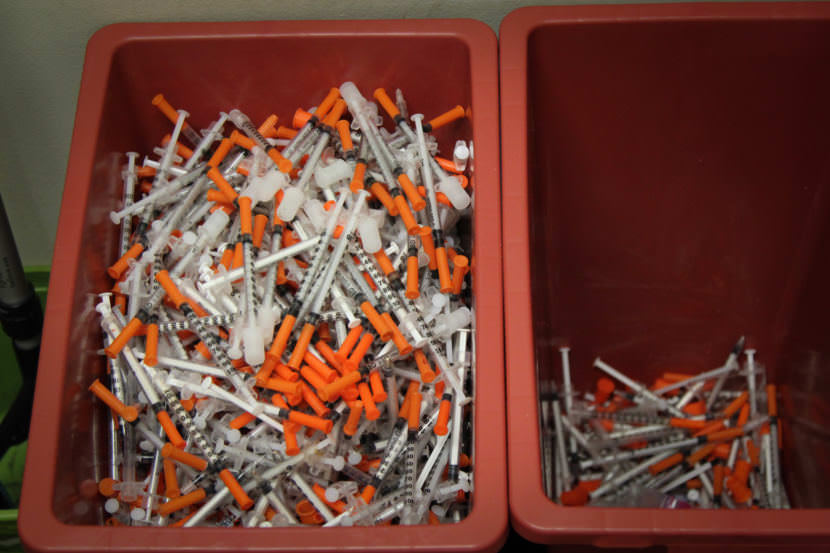
Discarded needles at the Four A’s syringe exchange in Anchorage. (Photo by Zachariah Hughes/Alaska Public Media)
Discarded needles at a syringe exchange in Anchorage in 2017 (Photo by Zachariah Hughes/Alaska Public Media)

The Walker administration wants stronger penalties for drug manufacturers that don’t do enough to curb opioid abuse.

Along with 37 other attorneys general, Alaska’s Jahna Lindemuth signed onto a letter sent to the top senators on the Judiciary Committee and Health, Education, Labor and Pensions Committee, urging them to expedite passage of the Comprehensive Addiction Recovery Act 2.0 sponsored by Ohio Republican Sen. Rob Portman. The bipartisan bill continues funding for “evidence-based prevention, treatment and recovery programs” connected to the national opioid crisis.

Within the legislation is a provision modeled on a separate bill, the Comprehensive Addiction Reform, Education and Safety Act of 2018 introduced by Democratic Sens. Maria Cantwell of Washington and Kamala Harris of California. It would increase financial penalties on companies that ignore or fail to report unusual prescription patterns that signal misuse, abuse and resale of painkillers.

The attorneys general letter faults companies that manufacture powerful opioids for past instances of not heeding concerns about over-prescribing, illegal sales and rampant abuse when they were raised. Under the proposed law, companies that don’t report suspicious sales activity would see the civil fine increase ten-fold to $100,000, and criminal violations for improperly reporting data double to $500,000.

Gov. Bill Walker sent along his own letter to senators urging them to pass both pieces of legislation.

Bethel council considers ending hard liquor sales, except by freight

Council member Leif Albertson, left, is sponsoring an ordinance that would end hard liquor sales in Bethel. (Photo by Christine Trudeau/KYUK)

Bethel City Council decided at its last meeting to move forward on an ordinance to end hard liquor sales in the city.

The ordinance would exclude liquor orders by freight.

Sponsor Leif Albertson told his fellow council members he was prompted to bring the ordinance up as a possible way for the city to proceed on alcohol related issues by what people in the community have said to him over the past couple of years.

“We have, I think, probably all of us gotten an earful about the alcohol situation in Bethel,” Albertson said. “There’s been some problems with that. We’re looking at a local option vote on the horizon, and I think this is an option that might be a compromise.”

Albertson said that the city’s problem is driven by cheap hard liquor.

While some council members agreed to have a discussion at the next meeting on implementation, they’re also eager for public feedback on the idea.

The opposing votes came from Mayor Richard Robb and council member Raymond “Thor” Williams.

Williams suggested that this move would just drive people back to bootlegging, both in Bethel and in the surrounding region.

“I’m not in support of this introduction because it says back to the community that the city of Bethel is for bootlegging again,” Williams said. “That’s all this is going to do because the majority of people that drink in our community drink hard alcohol. The reason that we went wet was to deal with bootlegging.”

As written, should the ordinance pass, vendors sending hard alcohol in by freight would be required to track those sales and make that data available to state and local authorities.

Discussion will continue with a public hearing May 22 at the next council meeting.

Federal designation puts Alaska in touch with millions to fight drug trafficking

Alaska Gov. Bill Walker, flanked by more than 30 law enforcement officials, holds a press conference on Friday, May 18, 2018, at the state crime lab in Anchorage.
Alaska Gov. Bill Walker, flanked by more than 30 law enforcement officials, holds a press conference on Friday at the state crime lab in Anchorage. (Photo by Casey Grove/Alaska Public Media)

The state of Alaska is set to receive millions of federal dollars to combat illegal drugs after a recent “high intensity drug trafficking area” designation.

Alaska is the last state to get the designation, which allows access to a total nationwide funding pool of $250 million. Public safety officials say the money will help facilitate collaboration between federal, state and local law enforcement.

It remains unclear how much funding Alaska will receive or when it will be available.

Gov. Bill Walker announced the designation and touted his administration’s public safety action plan during a press conference Friday at the state crime lab. Walker, who is running for re-election this year, was flanked by more than 30 officials from various law enforcement agencies.

Walker said the state is in a position where it needs to rely more on federal resources for drug enforcement programs.

“In the past, we haven’t, and we haven’t gone after some things that perhaps we should’ve gone after,” Walker said. “So it’s a matter, I think, of prioritizing. You know, applying for grants takes time, it’s a lot of work, and we’re applying for a lots of grants and lots of different funding from the federal government.”

Despite that increasing reliance, Walker said he appreciates the state Legislature’s recent action to fund certain requests under his public safety plan.

“Not just funding, but also specific positions, prosecutors,” Walker said. “And so I think they recognize the need, the urgency of it, so I think they did the right thing on that. We could always use more, we would always appreciate more, but we’ll celebrate what we have.”

The legislation includes money to hire five new state prosecutors and $12 million to fight drug abuse.

Recovery experts fear Alaska’s meth epidemic getting worse

James Savage at his Fiend2Clean office in Wasilla (Photo by Zachariah Hughes/Alaska Public Media)

Methamphetamine appears in Alaska at greater volumes than ever before.

Opioid crisis is making meth’s negative health impacts worse, allowing it to reach new users and being used in riskier ways.

People working at the ground level warn it’s getting worse.

James Savage works at Fiend2Clean, a recovery support nonprofit based in a one-story Main Street building in Wasilla.

The first time he used meth, the 30-year-old said sitting at his desk, was to get off painkillers.

“I was absolutely miserable in all facets of my life,” Savage said of his years abusing drugs.

Doctors first prescribed Savage pain medications when he was 19, he fell off a ladder and broke his foot.

The former wrestler grew up in Alaska.

Savage is big guy. Doctors gave him high doses of strong opioids early in his treatment.

He spiraled into addiction with years spent circulating through pain management clinics in Anchorage and the Valley.

A prescriber eventually flagged Savage for doctor shopping and his prescription was cut off.

Some people usually turn to heroin in similar circumstances. But Savage did not.

He hates needles. Savage was reticent to try replicating a high-potency pharmaceutical high with street heroin.

Instead, a drug buddy said he could detox by using methamphetamine.

“You have a lot of folks that are under the impression that their addiction is bad enough with heroin,” Savage said. “They decide go to methamphetamine to try and wean themselves off.”

Savage went into a days-long meth induced mania, followed by two or three days of coma-like sleep. He bypassed the debilitating pain and discomfort of opioid withdrawal.

Seven months of “white knuckle sobriety” followed he said and eventually, Savage relapsed.

Instead of returning to opioids he started using meth, “all day, every day.”

Savage entered a treatment program in 2015 and has been recovering for almost three years.

Now he works at Fiend2Clean.

While opioids are getting a lot of media and policy attention, meth never left Alaska after its last devastating iteration in the early 2000s.

One of the most public manifestations of the problem — meth labs — stopped appearing. The supply merely shifted without demand ever fully going away.

People increasingly are using meth alongside opioids to cope with the drowsy, narcotic effects that can go along with high doses of heroin and painkillers.

“Someone who typically passes out or falls asleep after injecting heroin will be able to stay awake,” Savage said. “They’ll feel the effects longer, without falling asleep or having an adverse reaction to the amount of heroin they’re using.”

The combination balances out the powerful drugs allowing the user to stay functional for those trying to hold down jobs or mask their addiction by not nodding off in public, according to Savage.

The combination also makes for an intense rush.

In the past, combining shots of heroin with cocaine or other amphetamines was called a speedball. Now, meth has eclipsed other uppers as the most common accelerant.

The health calamities associated with meth are rising in Alaska, in part because the drug itself is more potent all the way down to the street level and because of how it is being used in combination with other drugs.

The rate of meth-related overdoses increased by more than four times in less than a decade, going from 1.4 fatalities per 100,000 persons during 2008–2010 to 5.8 per 100,000 between 2014–2016, according to a 2017 report by the state’s Division of Public Health.

Of the 193 lethal overdoses caused by meth in that period, 54 percent also involved an opioid, such as heroin.

Those closest to the drug problem are alarmed.

Ron Greene is in charge of one of the state’s only methadone programs for treating opioid addiction. (Photo by Zachariah Hughes/Alaska Public Media)

Narcotic Drug Treatment Center clinical director Ron Greene has spent 30 years in the treatment field.

The downtown Anchorage facility is one of the state’s only methadone clinics.

“We see as much methamphetamine use here as we see opiate use in this clinic,” Greene said from behind his cluttered desk.

As early as 2003, Greene forecast the current heroin crisis when he saw the drug of choice among people seeking treatment shifted away from prescription pills to potent black tar heroin.

From his current vantage point, meth is “out of control.”

Based on drug test results among people entering treatment, he estimates 60 to 70 percent of the people seeking care for opioid addiction also have meth in their system.

Tje overlap is consistent with what similar methadone clinics are seeing outside of Alaska, too.

“We’re seeing the exact same thing: Intravenous drug use, heroin, methamphetamine,” Greene said. “We’re seeing the same thing as our counterparts down there in the Lower 48.”

Across the country, meth is the cheapest and more pure than it has ever been.

Over a decade ago, most meth in Alaska and across the Western states was manufactured in small domestic operations within houses, RVs and apartments.

But since federal legislation in 2006 limited access to many of the essential ingredients, production has moved abroad.

Nearly all the meth arriving in the U.S. is made in industrial labs by drug cartels in Mexico, according to the most recent threat assessment from the Department of Justice and Drug Enforcement Agency.

The international production model has pushed quality and consistency way up,  even as prices have gone down.

The U.S. market is awash in inexpensive, potent methamphetamine, according to the DEA.

Anchorage Police Department Lt. Jack Carson said it has been a long time since they’ve seen a “mom’n’pop” meth operation.

“We just don’t see that that often any more,” Carson said, explaining that buying the finished product from suppliers in Mexico or Lower 48 is significantly cheaper than trying to collect the necessary precursor ingredients in Alaska.

“What we are seeing is meth coming in bulk from the source states in Lower 48, coming into the mail system, then getting distributed down,” Carson said.

Alaska’s market is exceptionally lucrative for suppliers who can get drugs into the state.

Street prices in Anchorage remain several times higher than in Lower 48 cities, both for meth and heroin, though the potency of both has risen.

When drugs move out to smaller Bush communities or commercial fishing towns, the price goes up again.

The size of the shipments that Law enforcement agencies intercept has risen significantly the last few years, too.

Federal drug cases used to be built on 1-pound shipments they interdicted. Now 5-pound packages trafficked into Alaska isn’t uncommon.

Federal officials don’t anticipate the trend reversing any time soon.

Site notifications
Update notification options
Subscribe to notifications