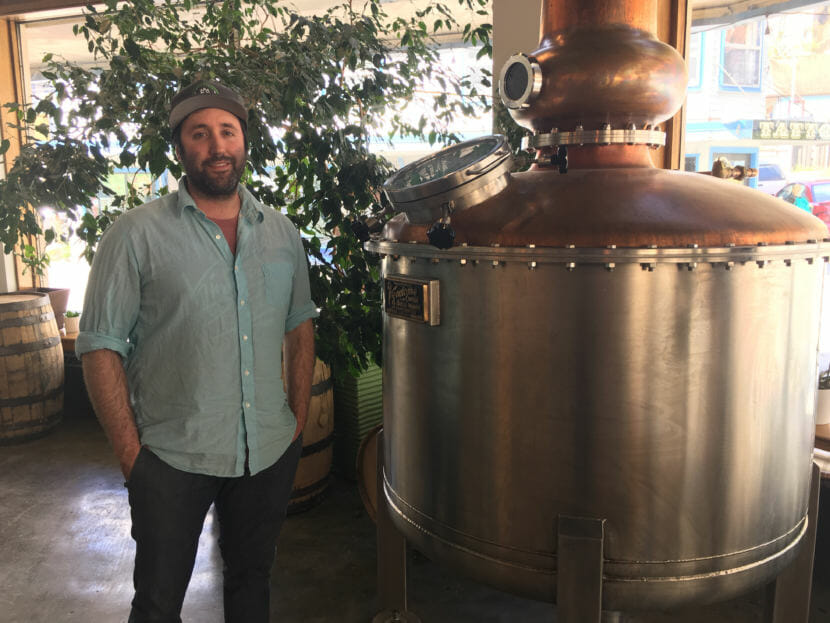
Amalga Distillery co-owner Brandon Howard opposes a proposal to reduce the amount breweries and distilleries can sell as samples. His Juneau business has benefited from the sales. (Photo by Andrew Kitchenman/KTOO)
It’s not clear whether the Alaska Legislature will completely revise state alcohol laws for the first time in 35 years. Some brewery and distillery owners want to head off a proposal limiting how much they can serve customers.
Getting alcohol producers, wholesalers and retailers to agree can be a challenge. The concerns of groups that want to prevent and treat alcohol abuse make it even more complicated. But until last week, these groups were in agreement over the need to make changes.
At a Senate Finance Committee meeting in April, Soldotna Republican Sen. Peter Micciche described what went into the legislation, Senate Bill 76, to change the state’s alcohol laws, known as Title IV.
“We brought together a group of folks that perhaps don’t always see eye to eye, and over an extensive series of meetings, brought it – the Title IV you see today – where they have agreed that this is the path forward for the industry,” Micciche said.
Among the many changes the bill would make, it would adjust license fees to cover a bigger share of state costs to regulate alcohol sales. It would simplify the licenses that alcohol sellers must have. And it would make the penalties more consistent for businesses whose workers sell alcohol to minors.
Until last week, it didn’t address the divisive issue of how much breweries and distilleries can sell directly to the public as samples. But on Friday, the House Labor and Commerce Committee amended the bill, dropping the amount of beer and liquor samples these businesses can sell by a third.
Brandon Howard is the co-owner and co-founder of Amalga Distillery in Juneau. His business’s tasting room has helped attract customers’ interest since it opened nearly a year ago.
“When they visit a brewery or a distillery, they expect to have an experience in a tasting room,” Howard said. “And it’s where we build our brand. It’s where we establish ourselves.”
Howard is concerned about the late change to the bill.
“To come in and potentially undermine this bill, that’s been worked on by a steering committee over the last six years at the end of session is irresponsible and selfish,” he said. “I mean, it’s unconscionable.”
But there are bar owners who support the change. They see the current laws that allow breweries and distillers to serve alcohol as disturbing what was once an even playing field, turning it into one that’s unfair. That’s because bar owners have to pay many thousands of dollars for their licenses.
Abby Williams, co-owner of Louie’s Douglas Inn in Douglas, said she expected competition with similar bars.
“What I didn’t expect going into business and into debt by purchasing a beverage dispensary license and doing an extensive remodel on a building, that I would soon be competing with the manufacturers: those that manufacture or distill a bottle of liquor for an amount substantially less than the price I’m required to pay to the distributors,” she said.
The bill still has a couple of steps where it could be changed or stalled. It goes to the House Finance Committee next. Then it would face a vote on the House floor. And if the House passes it, the Senate – which already passed it – will have to decide whether to agree to the House’s changes and send it to Gov. Bill Walker’s desk.
Bethel residents will be asked to vote again this October on whether to have legal sales of alcohol in town.
A petition submitted by Evon Waska Sr. has gathered enough signatures to put the local option issue back on the city’s October ballot.
Waska’s petition turned in 297 qualifying signatures, more than enough to meet the bar of 248 signatures needed to put the alcohol local option on the ballot. That represents 35 percent of last year’s election turnout of 710 voters.
Bethel City Council now is required to put the alcohol issue on the ballot come October under Alaska state law, according to City Clerk Lori Strickler.
Stickler anticipates the item will appear before the council at the May 22 meeting for introduction, with a public hearing to follow June 12.
If the local option proposition passes in October, Strickler said Bethel liquor stores would have 90 days to close after the council certifies the election.
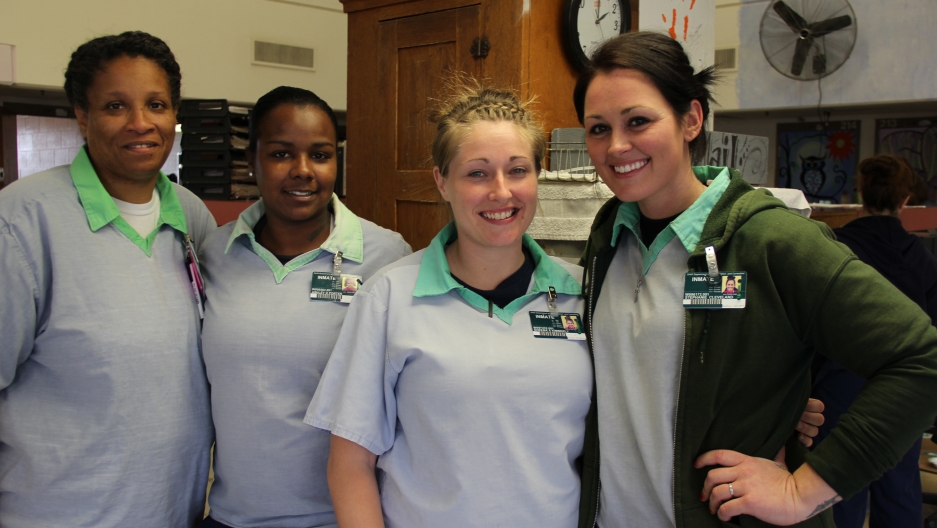
Women serving time at the Ohio Reformatory for Women are offered a comprehensive treatment program called Tapestry. It helps them stay clean and make an easier transition when they finish their sentence. Lisa Duncan, Ashley Porter, Sheena Kimberly and Stephanie Cleveland, all of whom are in the program, are pictured from left to right. (Photo by Allison Herrera/PRI)
It’s a chilly March afternoon in Marysville, Ohio, and I’m riding around on a golf cart with Clara Golding Kent, the public information officer for the Ohio Reformatory for Women.
It’s right after “count,” when officials make sure the women serving time at Ohio’s oldest prison are where they’re supposed to be.
Just now, the women here are heading to lunch, jobs and classes or socializing in the yard.
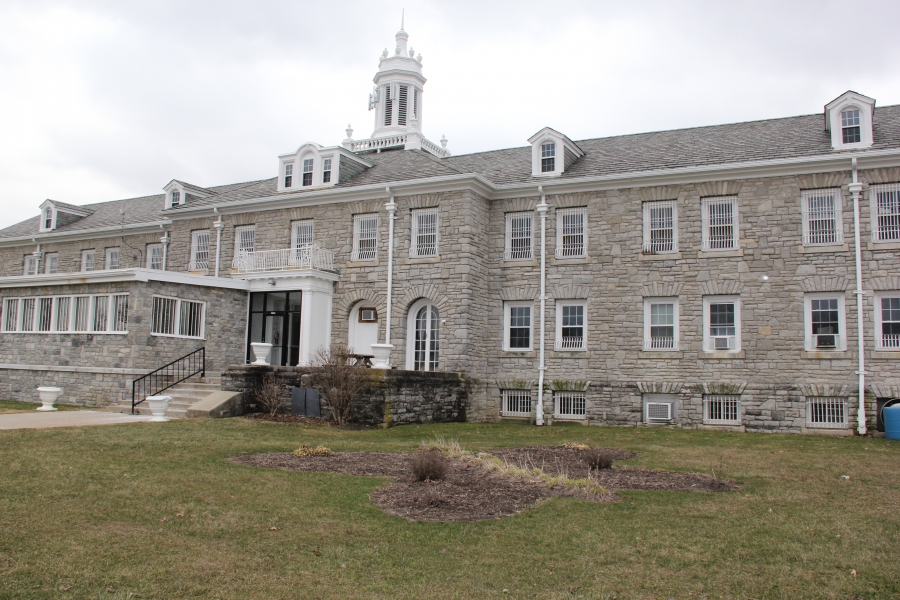
Ohio Reformatory for Women was built in 1916 but has expanded beyond the original stone structure.
Plus, nowadays, they’re doing more to enable women to succeed outside the prison and hopefully stay out.
Golding Kent acts as my tour guide.
“This used to be the old warden’s house,” she shouts over the hum of the golf cart, referring to a vacant lot we are passing by. It’s being redeveloped: “We’re making it into a new nursery.”
You read that right. Officials are building a nursery at a prison.
Pregnant women serving three years or less at the reformatory are allowed to keep their babies with them until their sentence is up.
The reformatory is one of only four prisons in the U.S. that allow children and infants to stay with their mothers while they’re incarcerated.
The number of women serving time in Ohio prisons is rising.
Nearly 3,000 women were imprisoned statewide in 2017, according to the Ohio Department of Rehabilitation and Corrections.
The figure has remained high over the last several years.
One of the main reasons: Crimes related to drug addiction are going up, and more women are getting swept up in it.
Some of those crimes are explicitly addiction-related, like drug trafficking. Others, like burglary, may have been committed in support of a drug habit.
Additionally, Ohio is at the epicenter of the national opioid abuse epidemic that’s ripped apart families and communities, caused a huge spike in addiction-related crimes and led to a record number of overdoses.
In response, health officials, community organizations and law enforcement agencies across the state are looking for effective ways to treat women struggling with opioid addiction. They want to keep them out of prison and away from the pressures that keep them reoffending.
It’s a big challenge but one program seems to be working, and it’s here at ORW.
The Ohio Reformatory for Women is located in Marysville, Ohio, and offers an inpatient treatment program called Tapestry. (Photo by Allison Herrera/PRI)
The golf cart crawls toward one of the low-slung, concrete buildings, and Golding Kent tells me about Tapestry, an inpatient treatment program for women here.
The women must be clean and sober to take part, and they can be at any stage in their sentence.
Unlike more typical inpatient programs that last 30 or 90 days, Tapestry is an 18-month commitment.
It focuses not only on keeping the women clean and sober but delving into the root causes of their addiction and, ultimately, changing their lives.
Annette Dominguez, who’s led the program for the last five years, said it’s about healing mind, body and spirit.
The program works on changing how women think about themselves and getting them to open up about some of the trauma that led them to use drugs in the first place.
“It’s not just about not using drugs anymore, but it’s about changing how you think. How you think about the world. How you think about your place in it. How you think about yourself,” she said, adding, “Most of the women come with serious self-esteem issues in addition to domestic violence, sexual abuse issues that they have. So, they come here with other women who have similar issues and (can) be part of the community, which in itself is an agent of change.”
Women learn how to relate to one another and to others beyond their immediate surroundings.
They chat via Skype once a week with a school for children with disabilities in South Africa, to learn empathy.
If someone about to be released is looking for a job, a Tapestry graduate on the outside can help them network. And the program’s graduates stay in touch through a Facebook group.
Lisa Duncan and Ashley Porter are both in the middle of their sentences at the reformatory.
Duncan has been here a few times. She’s a graduate of the Tapestry program but comes back to volunteer with women like Porter who are in thick of it. Duncan lives in the same house with the women.
They refer to themselves as “sisters.”
“We are here to basically guide them,” Duncan said of her role with the program. “I’m a repeat offender, and that’s why I think it’s very important for me to be here because the sisters will understand that if you don’t stay connected, then there is definitely another number (prison sentence) under your belt. If you don’t stay connected, you’re definitely not strong enough to stand on your own. It’s too hard. We need each other to survive.”
Porter said that Tapestry is different from other programs she’s done in the past.
“This is different than a 30-day program. I know that after I finish here, I’ll be able to survive with the help of my Tapestry sisters. And support my kids.”
Many of those same women will use drugs to deal with that trauma. They rely on a high to numb the pain.
Heather Ruble was suffering from addiction before she served four years at the Ohio Reformatory for Women. She’s a graduate of the Tapestry program, an inpatient treatment program that helps women not only stay clean and sober but change their thinking about themselves. (Photo by Allison Herrera/PRI)
That’s certainly what happened to Heather Ruble.
She graduated from Tapestry before she left ORW in 2015. She was charged with two felony counts of drug trafficking and served a mandatory four-year sentence.
Her daughter, Vanessa, was 4 and went to live with Ruble’s parents.
When I meet Ruble at her tidy, clapboard home in Lima, Ohio, she tells me how her drug abuse got out of control after her daughter was born.
She was raped twice. The first time, in 2008, she was helping an intoxicated friend get home.
There, a neighbor pulled her into an abandoned home and attacked her.
Ruble had been clean and sober for a few years but did cocaine after the attack.
She went to a nearby Walmart to wash up before heading home to her daughter. She never reported it.
The second time, a couple of years later, a former boyfriend broke into her house while she was gone. When she got back home, he brutally beat her and raped her.
This time, she reported it but she ended up with a pending domestic violence charge; he was let go.
She finally ended up telling her father what happened right before she went to prison.
“I was ashamed. I felt like it was my fault. It would never have happened if I were to just stay at home with my child. I turned that on myself and that was probably the day that changed me for a very long time.”
She started using again.
When Ruble went to the reformatory, she kept in contact with her daughter through letters and phone calls.
Her mother brought her daughter for visits, and they remained very close. Her daughter is now in middle school, and Ruble says they are closer than ever.
She said the Tapestry program made her take a look at herself — she realized she wasn’t a bad person. She had made some mistakes but wanted to change.
“I don’t have to like or love anyone that treats me as if I’m worth nothing. Or will never be anything. It’s just, and I don’t know, it was just the best thing that ever happened to me,” Ruble said of Tapestry.
Ruble now works for a community nonprofit on a rapid response team that intervenes when people overdose.
She gives people Narcan to prevent future overdoses and offers counseling.
She said before the rapid response team in Lima was set up, there would be as many as eight deaths a week. Ruble says that number has lowered a little, but not by much.
There have been more drug busts and more education but she still sees a lot of people who are using.
Montgomery County Jail, about an hour southwest of the reformatory, has a social worker on staff who helps find housing for those in need and can work with women who want to enter into a treatment program.
That’s a change from a few years ago — when the jail had no social worker and fewer programs.
Maj. Matt Haines has been with the Montgomery County Sheriff’s Office for 13 years and was on the police force before that and says he hasn’t seen anything like this recent spike in women in his jail.
He said they’ve had to reorganize the different “pods” or rooms where the women live because they’ve run out of beds.
One thing is clear with the women here: They didn’t wake up one day and decide to be addicted to drugs. It just spiraled.
A woman we’ll call Janet (we can’t use her real name because the jail did not give us permission) testifies to that: “I was taking pain medication for my foot and that’s where opiates escalated. And then they become too expensive on the streets. You start using heroin. It’s cheaper. It’s easier to get,” she said.
She is one of 174 women awaiting a court hearing in Montgomery County and seeing what treatment options will be offered to her before she gets released.
She said she’s “done” with using, like a lot of other women I meet here.
The problem is, many of the women will go back to the same neighborhoods where they were using and be around the same people they were using with.
The Montgomery County Sheriff’s Office and the drug court gives them treatment options, of which there are a few that treat just women.
Haines wants to find ways to keep people out of jail. That seems to be the opposite of President Donald Trump’s recent get-tough statements about drugs — he recognizes opioid addiction as a major epidemic but has called for harsher penalties for those dealing and trafficking, including capital punishment.
But Haines says, “We cannot arrest our way out of this problem. These women need help, and we are not equipped here at the Montgomery County jail to treat this disease. We keep seeing the same person and the behavior that causes the addiction is still there.”
“When you’re talking with a with a person that’s experiencing addiction, you see it’s not an ‘addict.’ And I really cannot stand that term because it takes the human being out of this whole disease and this illness. It’s the same thing as having a chronic health care illness,” said Emily Surico, who works at East End Community Services, an organization that’s been in the Twin Towers neighborhood of Dayton since 1998.
Twin Towers has been hit hard in the opioid epidemic.
Her organization works closely with the Dayton Police Department to offer treatment and support to women before and after they are incarcerated.
Surico said Dayton Police led the way in curbing overdose deaths.
In 2016, Montgomery County had more than 800 deaths due to overdoses. In 2017, it was just over 500. A small step, she said, but a good one.
It’s not the be-all and end-all. Surico and others in the community working to address these problems recognize that addiction isn’t something you can solve overnight. Another thing they agree on: You can’t just arrest your way out of this problem. For a lot of these women, they just need another chance.
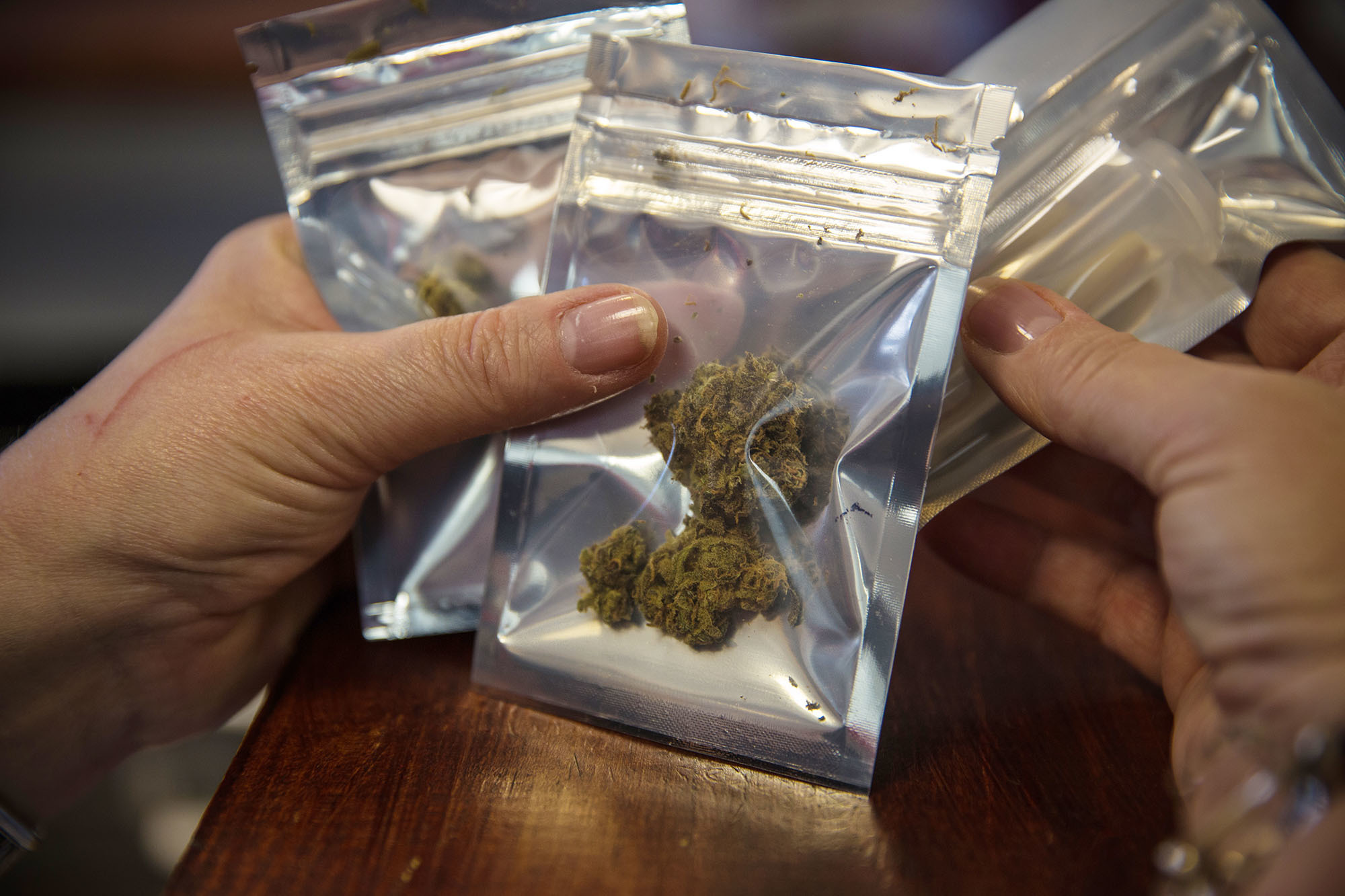
Medical marijuana is dispensed in Takoma Park, D.C. in 2014. (Photo by Evelyn Hockstein/The Washington Post/Getty Images)
Medical marijuana appears to have put a dent in the opioid abuse epidemic, according to two studies published Monday.
The research suggests that some people turn to marijuana as a way to treat their pain, and by so doing, avoid more dangerous addictive drugs. The findings are the latest to lend support to the idea that some people are willing to substitute marijuana for opioids and other prescription drugs.
Many people end up abusing opioid drugs such as oxycodone and heroin after starting off with a legitimate prescription for pain. The authors argue that people who avoid that first prescription are less likely to end up as part of the opioid epidemic.
“We do know that cannabis much less risky than opiates, as far as likelihood of dependency,” says W. David Bradford, a professor of public policy at the University of Georgia. “And certainly there’s no mortality risk” from the drug itself.
The National Academy of Sciences, Engineering and Medicine says there’s good evidence that cannabis is effective at treating pain for some conditions. So Bradford and three colleagues — including his scientist daughter — decided to see whether people who can get easy access to medical marijuana are less likely to get prescription opioids. The answer, they report inJAMA Internal Medicine, is yes.
“There are substantial reductions in opiate use” in states that have initiated dispensaries for medical marijuana, he says.
The researchers studied data from Medicare, which mostly covers people over the age of 65. (It was a convenient set of data and available to them at no cost). They found a 14 percent reduction in opioid prescriptions in states that allow easy access to medical marijuana.
They estimate that these dispensary programs reduced the number of opioid prescriptions by 3.7 million daily doses. States that allowed homegrown marijuana for medical use saw an estimated 1.8 million fewer pills dispensed per day. To put that in perspective, from 2010 to 2015 Medicare recipients received an average of 23 million daily doses of opioids, the researchers say.
Because opioid use nationwide was rising during the study period, their estimate of reduced uses reflects a slowing of the increase, rather than an actual decline in opioid use in these states, Bradford says.
The analysis found a correlation and can’t prove that marijuana use led to a reduction in the growth of opioid use. There might be other factors at work.
Even so, the findings suggests that expanding access to medical marijuana could help ease the opioid epidemic.
Hefei Wen at the University of Kentucky College of Public Health was lead author on another study in the same journal that reached similar conclusions. Wen, with Jason Hockenberry at Emory University, used Medicaid data. Medicaid is primarily a health insurance program for low-income people.
The authors write that laws that permit both medical marijuana and recreational marijuana for adults “have the potential to reduce opioid prescribing for Medicaid enrollees, a segment of population with disproportionately high risk for chronic pain, opioid use disorder and opioid overdose. Nevertheless, marijuana liberalization alone cannot solve the opioid epidemic.”
Bradford agrees that medical marijuana laws could have a role to play. “But it is not without risks,” he says. “Like any drug in our FDA-approved pharmacopeia, it can be misused. There’s no question about it. So I hope nobody reading our study will say ‘Oh, great, the answer to the opiate problem is just put cannabis in everybody’s medicine chest and we are good to go.’ We are certainly not saying that.”
One concern is marijuana use might encourage people to experiment with more dangerous drugs. Dr. Mark Olfson, a professor of psychiatry and epidemiology at Columbia University, authored a study that found marijuana users were six times more likely than nonusers to abuse opioids.
“A young person starting marijuana is maybe putting him — or herself at increased risk,” Olfson says. “On the other hand there may be a role — and there likely is a role — for medical marijuana in reducing the use of prescribed opioids for the management of pain.”
This is a question of balancing risks and benefits. And that’s difficult to do with the current studies based on broad populations — and in this case, populations that are not representative of the at-risk population as a whole.
Olfson says what they really need is studies that follow individuals, to see whether marijuana use really does supplant opioids. It’s hard to do study in this area because the federal government regards marijuana as a very dangerous drug and puts tight controls on research.
“That does make this a difficult area to study, and that’s unfortunate because we have a large problem with the opioid epidemic,” Olfson says “And at the same time, with an aging population, we have lots of people who have pain conditions and who will benefit from appropriate management.”
The hospital’s Rainforest Recovery Center currently offers two distinct services: a roving van that picks up inebriated people and takes them to a six-bed room where they can spend the night. It’s known as sleep-off. It also offers detox: rehab services for both in-patients and out-patients seeking treatment.
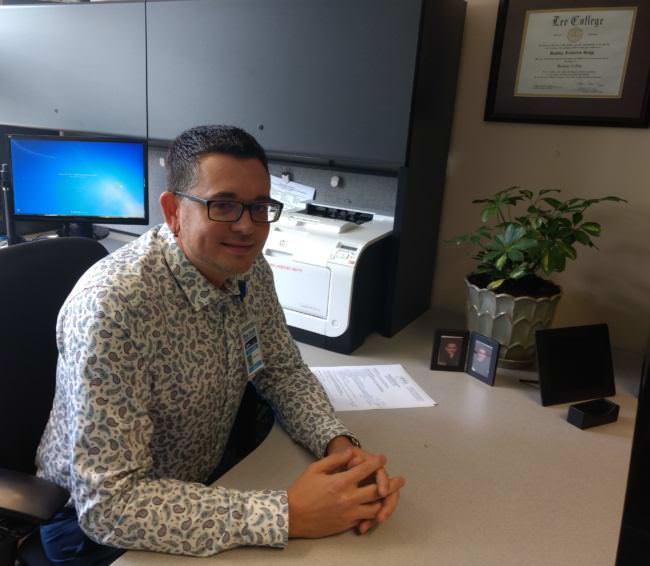
Bradley Grigg, seen here on July 24, 2017, is Bartlett Regional Hospital’s chief behavioral health officer. (Photo by Jacob Resneck/KTOO)
“Detox does provide that medical oversight with medication and supports to assist that individual through that phase whether it’s one day, three days, four days. Sleep-off is for an individual who is not currently in detox but is intoxicated and is accessing our sleep-off center, which is another portion of Rainforest, until their blood alcohol level reaches a point where they can voluntarily leave.”
Detox in-patients are currently treated inside the hospital. But Bartlett is working on a plan to build a separate 4,000-square-foot facility with four beds.
That would essentially separate its addiction treatment services from the rest of the hospital to take pressure away from the emergency room and the hospital’s nursing staff. A conceptual plan is expected next month with design beginning this summer. Bids for construction could go out as early as the end of November.
On a related note, hospital CEO Chuck Bill also told the Assembly that a long-term housing complex for those living on the street has reduced demand for emergency services.
“Before Housing First came online we were averaging about 75 percent occupancy in sleep-off. Since it’s been online we’re averaging around 25 percent, which is significant, obviously.”
Juneau’s Housing First opened its doors last year. It houses 32 people identified as vulnerable, many of whom deal with substance abuse.
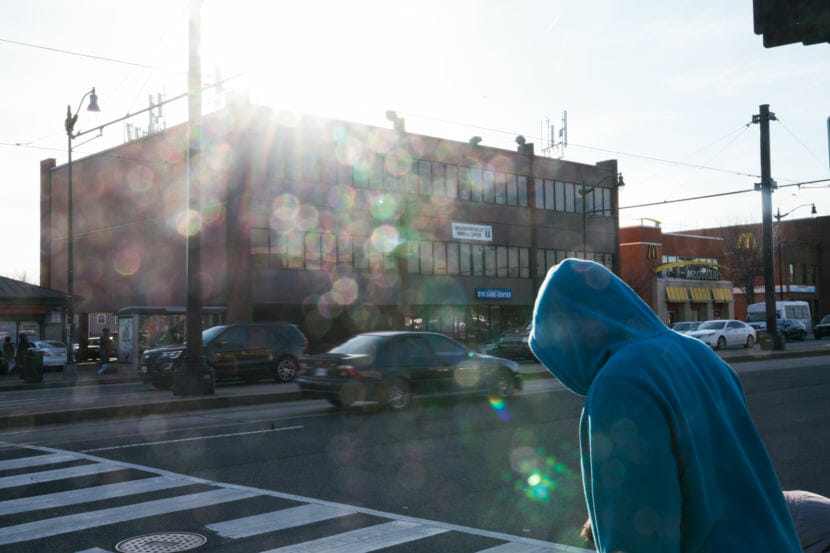
A man walks on Benning Road in Northeast Washington, D.C., in front of the Greater Northeast Medical Center, where Dr. Edwin Chapman works. (Photo by Claire Harbage/NPR)
The current drug addiction crisis began in rural America, but it’s quickly spreading to urban areas and into the African-American population in cities across the country.
“It’s a frightening time,” says Dr. Edwin Chapman, who specializes in drug addiction in Washington, D.C., “because the urban African-American community is dying now at a faster rate than the epidemic in the suburbs and rural areas.”
Chapman is on the front line of the opioid epidemic crippling his community in the Northeast section of Washington. He heads the Medical Home Development Group, a clinic specializing in addiction medicine.
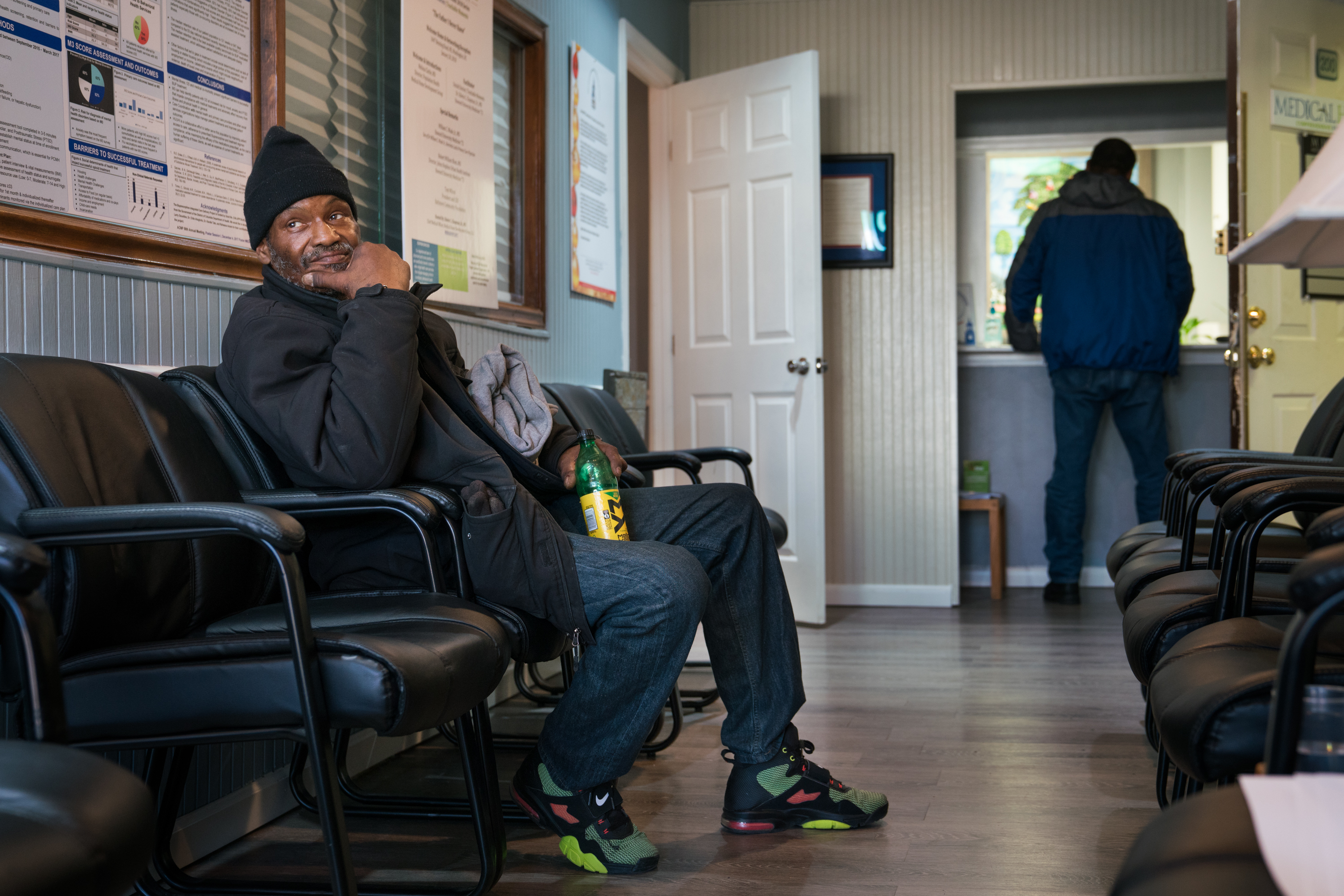
About a dozen patients sit in the lobby of his clinic on a recent Monday morning. The clinic is on a busy street, and even on the second floor you can hear blaring ambulances whiz by — Chapman says often they stop right outside his building.
“Sometimes we’ll have a cluster of folks outside selling drugs,” he says. “We’ve had overdoses right outside, right under the building, right next door to the building.”
According to the Office of the Medical Examiner in Washington, D.C., overall opioid overdose deaths among black men between the ages of 40 and 69 increased 245 percent from 2014 to 2017.
Nationally, the drug death rate is also rising most steeply among African-Americans. Among blacks in urban counties, deaths rose by 41 percent in 2016, according to the Centers for Disease Control and Prevention.
African-American communities are in the midst of a drug epidemic and the culprit is fentanyl, says Dr. Melissa Clarke, who works with Chapman at Medical Home.
“African-Americans are falling victim to fentanyl and carfentanyl because they are so much more potent than heroin,” she says. Fentanyl is a powerful synthetic opioid that is often laced in heroin and other street drugs, Clarke says.
“People who’ve even been lifelong heroin users are dying because they don’t understand how to titrate those doses,” she says. That’s a huge part of the challenge. It’s always been impossible for addicts to know the potency of street drugs, but with fentanyl in the mix, they’re even more dangerous now. “We feel like we have a fire underneath us — people are dying every day,” she says.
Gerald A. Goines Sr. sits in the waiting room of Dr. Chapman’s clinic in northeast Washington, D.C. (Photo by Claire Harbage/NPR)
This epidemic started in white suburban and rural areas where people are overdosing mostly with prescription medicine like Percocet and OxyContin. Chapman says that African-American patients have historically been less likely to be prescribed pain narcotics.
“The theory is that African-Americans tolerate pain better. That’s a myth,” Chapman says. But it probably saved blacks from falling victim to the initial opioid crisis, he says.
On a recent Saturday morning, a crowd of mostly health professionals and a handful of patients gather at Chapman’s clinic. He has organized an event to discuss this current drug crisis and to encourage people to come up with solutions to the epidemic. The doctor is warm and laughs easily, but he’s serious about tackling this epidemic head-on. His urgency comes from experience. Like many here, he’s a graduate of the historically black Howard University’s College of Medicine. He has been practicing medicine for close to 40 years, and for 12 years he ran the methadone clinic at the D.C. General Hospital.
“Those patients were very segregated from the community and only their substance abuse was treated,” he says. That experience taught him many lessons, including the need to address patients’ overall health, not just their addiction. He also learned about the effects of incarceration on drug addiction — many addicts cycle in and out of prison, he says. His patient population is largely made up of African-American, long-term heroin users — many with a history of poverty and mental health problems.
“I’m always asked, ‘Why do you treat these folks?’ ” he says. ” ‘Aren’t you afraid to have people like that come into your office?’ ”
He says he sees drug addiction like any other chronic disease and treats a full load of patients with Suboxone, a medication that keeps his patients’ relentless cravings in check. He’s certified by the Drug Enforcement Administration to prescribe the drug, but by law he can only treat up to 275 patients annually because of federal provider treatment caps.
His treatment model works, he says. His clinic has a 78 percent retention rate a year — that’s the percentage of patients who stay with him annually, keeping their drug addiction in check. Abstinence therapy has a 10 percent retention rate nationwide.
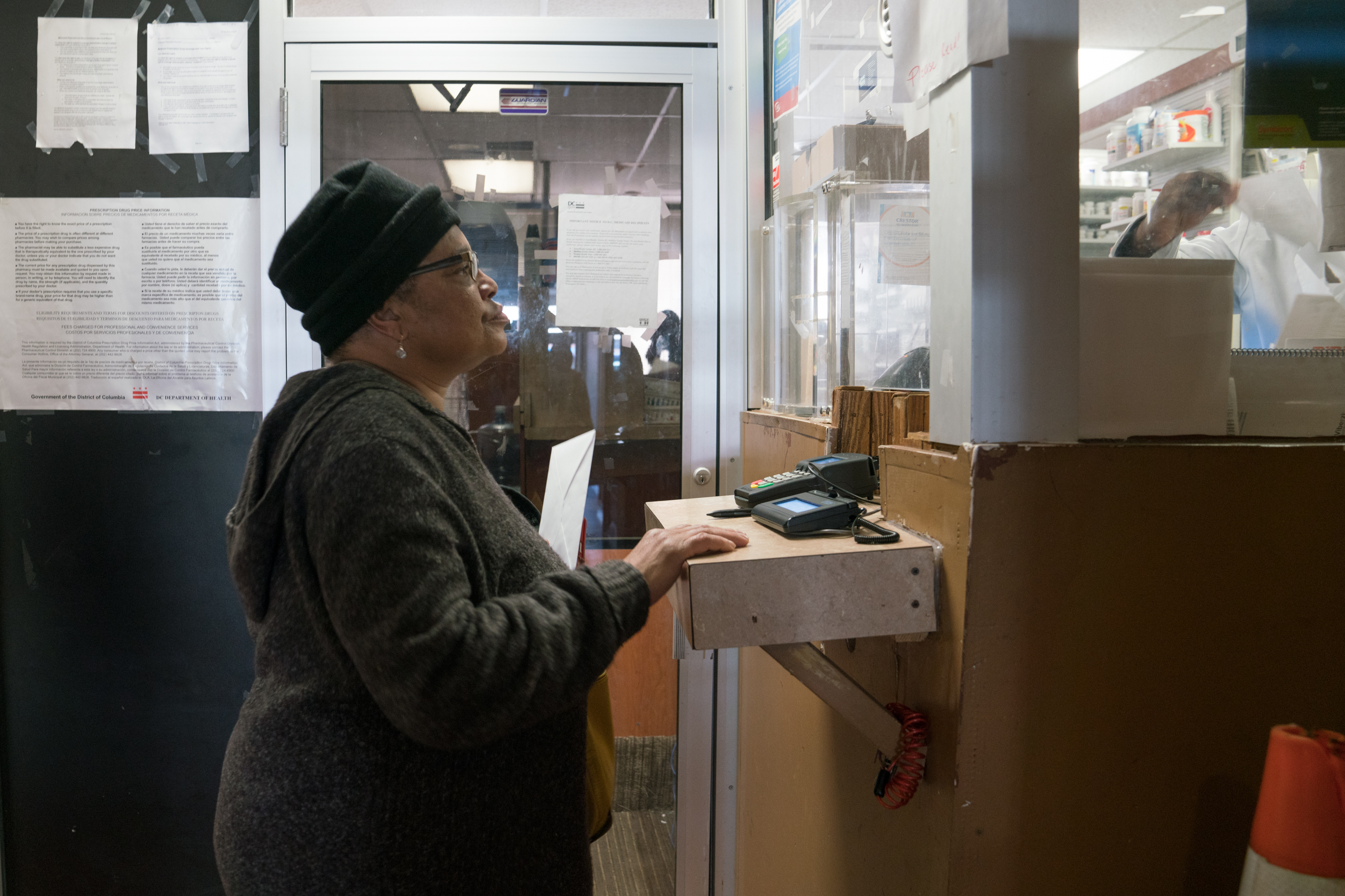
Pauletta Jackson drops off her prescription for Suboxone at the pharmacy just downstairs from Chapman’s clinic. (Photo by Claire Harbage/NPR)
One of the challenges is debunking myths — “this is a chronic disease and not a moral failing,” he says, noting that science shows drug addiction is a brain disorder and some are more predisposed to it than others.
Chapman is soft-spoken, but his determination to fight this current drug crisis in his community is unwavering. He has partnered with several groups, including Howard University and the Johns Hopkins Urban Health Institute, to share information and raise awareness. Fighting stigma is a big part of the battle against this epidemic, he says.
“Seventy-eight percent of the overdoses in the district are African-Americans,” says Chapman. “It’s just that the population has been totally ignored. They are invisible.”
He mentors young physicians to work with addicts. Doctors like Dr. Melissa Clarke, who is also certified to prescribe Suboxone. She says finding him wasn’t easy.
Not enough doctors
“Oh, like a needle in a haystack,” she says, “there are not a lot of practices out there that have fully embraced as much as Dr. Chapman has that medical home approach to care.”
She admires his dedication, saying, “He’s always had the vision, he’s always had the understanding of opioid addiction is a chronic disease.”
Chapman’s father worked with the Urban League in Gary, Ind., where he fought hard to get black physicians hospital privileges in the 1940s. Chapman credits his father for his career choice and work ethic. He says he’s on a mission to debunk drug-related myths and to fight stigma.
Larry Bing has been a patient of Chapman’s for two years now.
“I’m 64,” he says. “I’m an addict and spite of being on Suboxone and in therapy, every day ain’t a good day for me.”
Bing is tall, handsome and he has been to prison about seven times. He started using when he was 15. He has tried to get off drugs several times before with methadone, a more conventional treatment offered by the D.C. government, but he relapsed four times. “Had I known about the Suboxone before the methadone, I would have tried it first,” he says.
But it still isn’t easy. “When you talk about addiction it ain’t necessarily just the drug,” he says. “It’s that lifestyle, too, that you crave.”
Bing heard about Chapman on the streets from an addict friend who later died from an overdose. Bing’s treatment is covered by Medicaid and Medicare and he knows he’s lucky to have the support of his wife, Evelyn. The Bings have been married for 22 years.
Evelyn Bing a, 67-year-old native Washingtonian who is fond of stylish hats, says her husband was already struggling with addiction when they met in 1992. Evelyn didn’t know. When she found out, she chose to stick by him, but she doesn’t wish that experience on anybody. “It was a horrific experience sometimes, it wasn’t easy. It was hard, it was sad, it was ugly.”
Often he’d go get cigarettes, “and going to get cigarettes lasted for five days,” she says. “I was terrified that something really happened to him.”
Unable to sit at home and wait, she prowled dark streets looking for him, she says, and her biggest fear was that he’d end up back in prison or dead. Though she’s grateful her husband found Chapman, she knows many in her community aren’t as lucky. “I don’t think we as African-Americans are getting the best resources,” she says.
And as the opioid crisis spikes in D.C., she says many African-Americans are desperate for help. “I’d like to see more Dr. Chapmans, drugs off the street, crime stopped, more schools, more programs to educate on what using drugs do to people.”
Evelyn Bing says her husband’s life is improving, and for that, she credits Chapman. “He listens and cares for his patients’ overall health,” she says.
Dr. Edwin Chapman wants to galvanize his community to fight this drug epidemic. “It’s going to be what we do at the grass-roots level, on the ground, more so than what the federal government is doing,” he says. “This is very urgent.”
Chapman is unassuming, but forthright and passionate about his work. At 71, he says he can’t think about retirement — “not when my city is right in the middle of a raging epidemic.”
Copyright 2018 NPR. To see more, visit http://www.npr.org/.
Close
Update notification options
Subscribe to notifications
Subscribe
Get notifications about news related to the topics you care about. You can unsubscribe anytime.

9(MDEwMjQ0ODM1MDEzNDk4MTEzNjU3NTRhYg004))
9(MDEwMjQ0ODM1MDEzNDk4MTEzNjU3NTRhYg004))