A Juneau man in federal court pleaded guilty Friday to a single count of drug distribution.
Crystal meth. (Public domain photo by Psychonaught)
At the plea hearing, U.S. District Chief Judge Timothy Burgess asked the defendant Ricky Stapler Lisk about his education, work and health.
The judge then asked whether the 36-year-old Lisk had any questions about the agreement. Burgess cleared the courtroom for a few minutes, then proceeded with the hearing. Lisk pleaded guilty.
According to the plea agreement, Lisk admitted that heand Charles Cotten Jr. sold about 27 grams of methamphetamine in June to another person. That person was acting under the direction of law enforcement.
A Hoonah man faces criminal charges after police seized more than 9,000 synthetic opioid pills from packages that he was allegedly receiving and shipping across Alaska and the U.S.
Nickolas Paul Cakmis, 39, was charged Wednesday with one count of misconduct involving a controlled substance in the third degree.
The charge carries a maximum five-year prison sentence and a fine of up to $50,000.
Over the course of two months, investigators seized packages containing the synthetic opioid tramadol that Cakmis was allegedly sending and receiving at the Hoonah post office.
Tramadol is a synthetic opioid used for pain management.
Cakmis moved to Hoonah, a Southeast Alaska town of about 750 people, in October, charging documents say. Online public records show a Kotzebue post office box as Cakmis’ mailing address.
On Dec. 13, the U.S. postmaster inspector got word that Cakmis was “mailing a large number of pills in Priority Mail parcels,” charging documents say.
Eight packages containing about 2,500 tramadol pills were opened and seized.
Then, on Dec. 14, a package from India came in for Cakmis at the Hoonah post office. Another 2,000 tramadol pills were seized. A second international package addressed to Cakmis was seized on Dec. 20, with 2,000 pills.
Despite his incoming packages being seized, Cakmis continued to ship tramadol pills across the U.S., charging documents say.
On Jan. 28, the postal inspector spoke with the Hoonah postmaster.
The postmaster said “Cakmis has been coming into the Hoonah post office approximately every two weeks to mail multiple parcels using fictitious return addresses and never uses his name,” court documents say.
On Jan. 30, law enforcement intercepted seven packages that Cakmis shipped with fake return addresses in Juneau. Another 1,880 pills were seized.
On Feb. 13, officers spoke to Cakmis at his Hoonah job.
He admitted to getting overseas shipments of tramadol, which he would reship “throughout Alaska” and the U.S., according to charging documents.
His overseas source would text him or message him on the WhatsApp smartphone app and tell Cakmis where to ship the drug.
“He started to reship tramadol in early October 2017 when he moved to Hoonah,” the court documents say.
Tramadol is used for pain management in both humans and animals. Veterinarians prescribe the drug for dogs and cats. It’s described as a small, white, bitter-tasting pill.
The drug is a much weaker opioid than fentanyl, a powerful synthetic opioid responsible for at least 22 overdose deaths in the first five months of 2017, said Jay Butler, chief medical officer for the Alaska Department of Health and Social Services.
While tramadol does “have some abuse potential,” it is generally less addictive than drugs like oxycodone or morphine, Butler said.
But tramadol overdoses are “very challenging,” Butler said, due to some effects of the drug — like seizures and heart arrhythmia — not seen in other opioids.
“Patients who have a tramadol overdose are seriously ill and often take days of intensive medical support to be able to recover,” Butler said.
Butler said he has heard public testimony that tramadol is diverted and abused in rural areas of Alaska more often than urban parts of the state.
“I think it’s filling the market niche in areas where the price of heroin is very high,” Butler said.
Tramadol has been listed as a federal controlled substance since 2014.
In November, Alaska legislators passed a bill adding tramadol to the state’s controlled substance list, which gave law enforcement the ability to prosecute cases on the state level.
Cakmis and his attorney could not immediately be reached Thursday. His next hearing is scheduled for Feb. 24.
Tramadol has been in Alaska news this year after Iditarod officials said dogs on four-time Iditarod champion Dallas Seavey’s team tested positive for tramadol.
On Wednesday, Seavey’s attorney held a news conference during which he said that an investigation had proven that the musher did not drug his sled dogs during the 2017 race to Nome.
ANCHORAGE — Alaska authorities say the synthetic opioid fentanyl is an escalating problem in the remote state, and it’s leading to a significant increase in deaths.
Alaska State Trooper Capt. Michael Duxbury said at a news briefing Tuesday that the dangerous black market drug is “by far the biggest concern” in the opioid crisis.
Alaska chief medical officer Jay Butler says 2017 statistics have not been finalized, but there were at least two dozen fentanyl-related deaths, compared with five or six deaths the previous year.
Duxbury says Alaska is a destination state, with opioids like heroin and other illegal drugs manufactured elsewhere and brought to the state by gangs and Mexican drug cartels.
Duxbury says dealing with the state’s opioid crisis presents challenges amid state budget cuts and trooper staff shortages.
Drugmakers gave millions of dollars to pain-treatment advocacy groups over a five-year period beginning in 2012, in effect promoting opioids to individuals most vulnerable to addiction, according to a new report released Monday by a U.S. senator.
The 23-page report, put out by Missouri Democratic Sen. Claire McCaskill, sheds light on the pharmaceutical industry’s efforts to shape public opinion and to fuel demand for such lucrative and potentially addictive drugs as OxyContin, fentanyl and Vicodin. These drugs have played a key role in the addiction crisis that has swept the U.S. in recent years, claiming hundreds of thousands of lives.
Fueling an Epidemic: Exposing the Financial Ties Between Opioid Manufacturers and Third Party Advocacy Groups describes how the arrangement between pharmaceutical makers and advocacy groups “may have played a significant role in creating the necessary conditions for the U.S. opioid epidemic.”
“The pharmaceutical industry spent a generation downplaying the risks of opioid addiction and trying to expand their customer base for these incredibly dangerous medications, and this report makes clear they made investments in third-party organizations that could further those goals,” McCaskill said. “These financial relationships were insidious, lacked transparency and are one of many factors that have resulted in arguably the most deadly drug epidemic in American history.”
The report follows a similar investigation in 2012 carried out by Sen. Max Baucus, D-Mont., and Chuck Grassley, R-Iowa, that looked into financial ties between drugmakers and medical providers who helped establish guidelines for prescribing opioids. That investigation was ultimately shelved.
“It looks pretty damning when these groups were pushing the message about how wonderful opioids are and they were being heavily funded, in the millions of dollars, by the manufacturers of those drugs,” Lewis Nelson, a Rutgers University doctor and opioid expert says, according to the Center for Public Integrity.
But some of the groups and companies say they’ve changed their practices as the toll of opioid abuse has become clear.
Bob Twillman, the executive director of the Academy of Integrative Pain Management, says in an email to NPR that his organization in recent years has focused on improving access to methods other than opioids to control pain. Those include physical therapy, chiropractic, massage and acupuncture.
“Insurance coverage has been a big barrier to greater use of these, because patients often have to pay out of pocket,” he says. “That’s what we’ve emphasized — a position that, if anything, should DECREASE opioid prescribing.”
Still, he says, some people need opioids to control their chronic pain and the AIPM also tried to ensure they are able to get the medication they need.
Paul Gileno, the founder and president of the U.S. Pain Foundation, says the bulk of the money his organization received, $2.5 million, goes to a copay assistance program.
“The program is designed to ensure that people with cancer pain and breakthrough cancer pain have help paying the copays for prescribed analgesics,” he says by email.
The new report says that nearly all health advocacy groups accept funding from drug manufacturers, adding, “These financial relationships — and the lack of transparency surrounding them — have raised concerns regarding the information and initiatives patient advocacy organizations promote.”
The report cites the Journal of the American Medical Association as saying that 8 percent of such patient groups responding to one study “reported [that] pressure to conform their organizations’ positions to the interests of industry funders is of concern.”
A single company, Purdue Pharma, the maker of OxyContin, funneled $4.7 million to advocacy groups over the five-year period, according to the report.
Purdue Pharma says it has stopped marketing OxyContin to doctors altogether. The company will still sell the drug, but its representatives will no longer peddle it when visiting physicians. The company has come under fire in recent years for what some say were aggressive and misleading claims about whether its drug was as addictive as other opioids.
Also cited in the report are Depomed, which markets the narcotic Nucynta, the brand name of the opioid pain reliever tapentadol, and three makers of fentanyl, a powerful and potentially addictive pain reliever: Janssen Pharmaceuticals, Mylan and Insys Therapeutics, whose founder was charged in October for using bribes and kickbacks to promote unacceptable uses of the company’s flagship fentanyl spray, Subsys.
The companies gave more than $10 million between 2012 and 2017 to 14 advocacy groups and affiliated doctors, the report says.
In that period, Insys gave $2.5 million to the U.S. Pain Foundation for one of the group’s patient assistance programs, the report says.
The Associated Press writes: “The findings [in the report] could bolster hundreds of lawsuits that are aimed at holding opioid drugmakers responsible for helping fuel an epidemic blamed for the deaths of more than 340,000 Americans since 2000.”
Copyright 2018 NPR. To see more, visit http://www.npr.org/.
More than three months after President Donald Trump declared the nation’s opioid crisis a public health emergency, activists and health care providers say they’re still waiting for some other action.
The Trump administration quietly renewed the declaration recently. But it has given no signs it’s developing a comprehensive strategy to address an epidemic that claims more than 115 lives every day. The president now says that to combat opioids, he’s focused on enforcement, not treatment.
Trump spent just over a minute of his 80-minute State of the Union address talking about opioids. In a speech this week in Cincinnati, he had a few more comments. The opioid epidemic, he said, “has never been worse. People form blue ribbon committees. They do everything they can. And frankly, I have a different take on it. My take is you have to get really, really tough, really mean with the drug pushers and the drug dealers.”
The president’s mention of “blue ribbon committees” sounds like a slam on one he convened last year, chaired by former New Jersey Gov. Chris Christie — the President’s Commission on Combating Drug Addiction and the Opioid Crisis. The commission issued more than 50 recommendations. The administration has so far followed up on just a few of those recommendations.
Some officials and care providers who work on the frontlines of the opioid crisis, however, are scathing about what they see as a lack of action from the White House. Former Congressman Patrick Kennedy, who served on the White House opioid commission, says he’s “incredulous” that, after declaring a public health emergency in October, the president still hasn’t requested any money from Congress to combat the epidemic.
“I mean this is just a mental health crisis of the first order,” Kennedy says, “and this administration has done nothing.”
Here’s what the administration has done so far:
President Trump declared a public health emergency in October to deal with the opioid epidemic. The declaration brought no new money to fund the federal response.
In November, President Trump announced he’s donating his third-quarter salary — about $100,000 — to help the Department of Health and Human Services fight opioids.
The Centers for Medicare and Medicaid Services announced a policy change in November that allows states to apply for waivers allowing them to use Medicaid to pay for residential drug treatment at facilities that have more than 16 beds. Some states are already taking advantage of that policy change.
President Trump signed the Interdict Act in January giving federal agents additional tools for detecting fentanyl and other synthetic opioids at the border.
Also this month, Attorney General Jeff Sessions announced an operation using medical data to crack down on pharmacies and doctors that dispense suspicious amounts of opioids.
Here are things critics point out the administration hasn’t done:
There is still no head of the Office of National Drug Control Policy. In October, Trump’s nominee to the position, Rep. Tom Marino, R-Pa., withdrew his name after reports linked him with a bill that limited the DEA’s ability to investigate abuses by opioid manufacturers and distributors.
President Trump still hasn’t nominated anyone to head the Drug Enforcement Agency.
The administration hasn’t asked Congress for any new funding to address the opioid epidemic.
Roughly 64,000 people died from drug overdoses in 2016, and data from the CDC indicates deaths are rising. Kennedy says what’s needed is a coordinated federal response similar to the one in the mid-1990s — when the U.S. spent $24 billion a year to address the HIV/AIDS crisis.
“We’re talking about a major league crisis and they’re taking credit for little things, while the whole country is burning down,” Kennedy says.
Instead of a big boost in funding, the Trump administration is focused, in many cases, on cutting spending.
In the 2018 budget, the president recommended cutting the Office of National Drug Control Policy budget by 95 percent, and may do so again this year.
“It’s very hard to make sense of,” says Keith Humphreys, a professor of psychiatry at Stanford and former policy adviser to the drug czar’s office in the Obama administration. “I mean, it’s like closing a fire station in the middle of a wildfire.”
A law signed by President Barack Obama that designated a billion dollars to help states combat opioids runs out of money this year. Humphreys has seen no sign President Trump intends to ask Congress to renew that funding.
“The 2018 budget had a $400 million cut to the Substance Abuse and Mental Health Services Administration, which is the lead agency that funds treatment in the United States,” Humphreys says. “So, the administration’s impulse seems to be not to spend more — in fact to spend less.”
The White House is preparing to act on one of the recommendations of its opioid commission—that it launch a campaign to educate the public, especially young people, on the dangers of opioids. The campaign is being developed not by the Office of National Drug Control Policy, but by a team in the White House led by Kellyanne Conway.
Copyright 2018 NPR. To see more, visit http://www.npr.org/.
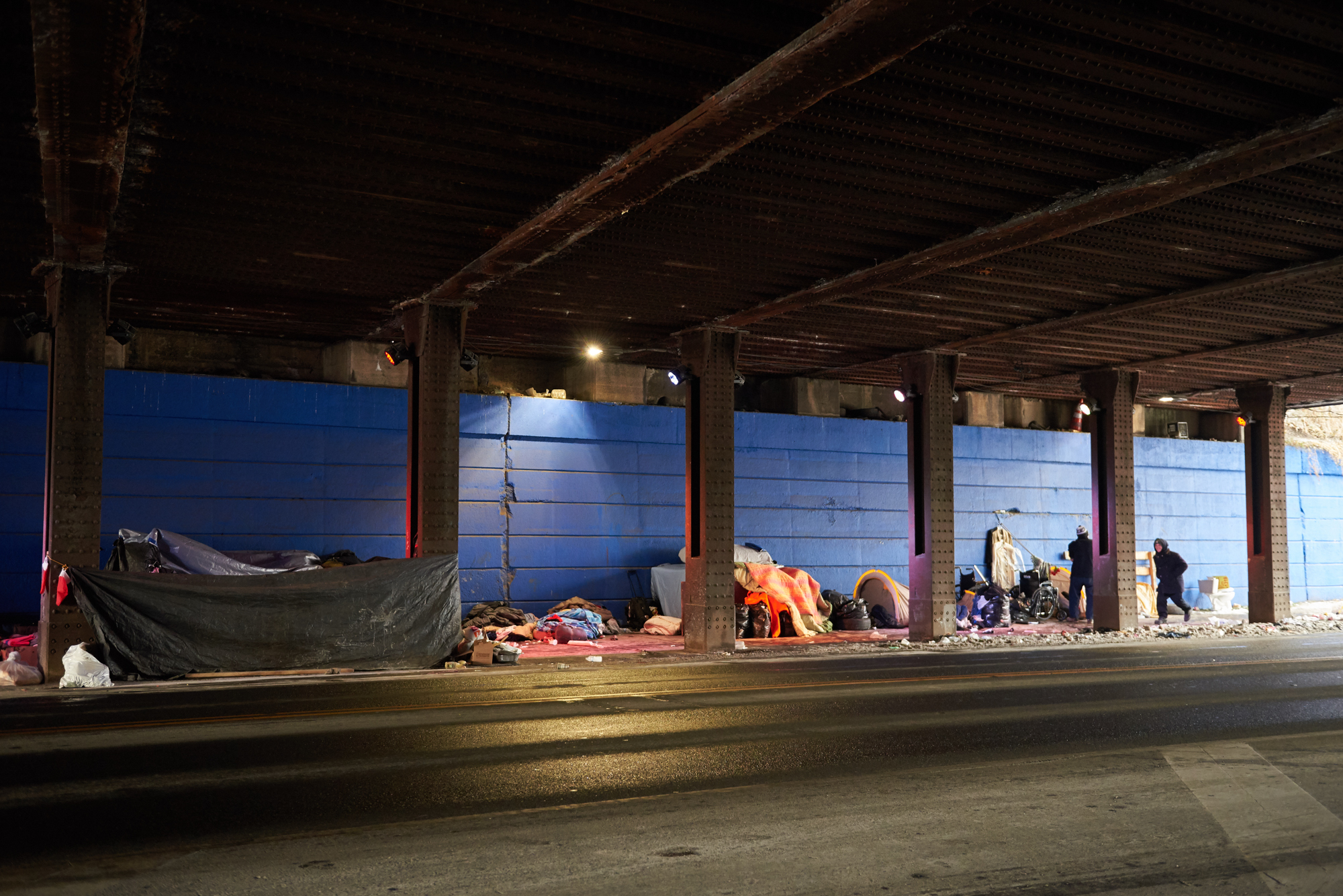
The mix of people in rows of tents under a bridge in Philadelphia’s Kensington neighborhood includes homeless adults and some visitors from the suburbs who come here to inject opioids in secret. (Photo by Natalie Piserchio/WHYY)
Top Philadelphia officials are advocating that the city become the first in the U.S. to open a supervised injection site, where people suffering from heroin or opioid addiction could use the drugs under medical supervision.
But the controversial proposal aimed at addressing the city’s deadly drug crisis must first overcome resistance from top city police officials, community residents and the federal government.
It’s a divisive idea: People bring their own drugs to shoot up under the watch of medical staff, in a facility that provides clean needles and other equipment. Advocates say the goal is to provide a bridge to treatment.
There are about 90 such official facilities around the world. Though some U.S. cities — including Seattle, San Francisco and Denver — are talking about establishing this sort of city-sponsored site, there are none in the United States, so far.
Philadelphia may be unusually well-positioned to be the first; its opioid crisis is mostly concentrated in one neighborhood, where some of the purest, cheapest and most deadly heroin in the nation can be purchased.
The city’s new district attorney, Larry Krasner, has promised he would not prosecute users at the safe-injection site.
“Supervised injection sites are a form of harm reduction,” says Krasner, who was sworn into office just last week.
The rise in opioid deaths in Philadelphia reflects a nationwide epidemic; the size and lethality of the problem, Krasner says, should be shifting the conversation away from the country’s long history of responding to drug users with criminal punishment.
“The only way to get people to turn their lives around,” he says, “is to keep them alive long enough so they can do that. And we’re going to do that.”
Philadelphia’s Mayor, Jim Kenney, says he soon will make a public announcement on the topic of establishing a supervised injection site — but, so far, he has not provided details.
Sources close to Kenney say he is still working to bring skeptical members of his administration and other opponents on board.
Kenney has been working on Philadelphia’s drug problem for months, first launching a task force to combat the opioid crisis, then creating a new position in city hall to coordinate so-called harm reduction initiatives.
Other plans underway include establishing rules for doctors to more safely prescribe opioids; public education campaigns aimed at combating the stigma around usage of the drugs; and ensuring that those whose overdose is reversed in an emergency room are put directly into treatment — what’s known as a “warm handoff.”
The idea of a safer place to use heroin appeals to people like Johnny, a 39-year-old electrician from Philadelphia’s suburbs. (Because he is using an illegal drug, NPR is using only his first name.)
“I would absolutely go there,” Johnny says, adding that he recently relapsed after being sober for seven years.
“Every shot — you never know what’s going to happen,” he says. “It can always be your last one.”
On his lunch breaks from work, Johnny says, he often travels to Philadelphia’s Kensington neighborhood — the epicenter of the city’s opioid crisis — to use drugs.
Recently, a sprawling open-air drug market and homeless encampment in Kensington along decommissioned train tracks was cleared out, prompting droves of opioid users to regroup in smaller pockets under bridges, in alleyways, on the streets and in abandoned buildings.
Proponents of medically supervised, indoor sites for opioid injection say such places would be much safer than tent encampments like this one — and could help people addicted to opioids transition into treatment and away from drug use. (Photo by Natalie Piserchio/WHYY)
Under one of those bridges recently, there was a row of tents. Many people live there, and some visitors, like Johnny, use the tents as a private place to do heroin.
He says he would rather inject his drugs in a medically supervised facility, and he thinks Philadelphia residents would prefer that, too.
“People are not going to be shooting up on your front stoop” he says, “or in your back yard, hiding. It will cut down on people dying in abandoned houses around here — or even here.” He motions to the tents. “They come down here and get high and die here under a bridge.”
But some law enforcement officers have a different view. Philadelphia’s police commissioner, Richard Ross, has been skeptical about designating a legal place for the use of an illegal narcotic.
And even if local police can be convinced, the proposal is likely to provoke a standoff with the federal government, which has promised to aggressively crack down on similar plans in Vermont.
Patrick Trainer, a special agent with the Drug Enforcement Administration’s Philadelphia field office, says he is no fan of the model.
“The concept, for us, with safe injection sites, is just not a concept we can get behind,” Trainer says.
Such a site could attract street drug dealers and increase their sales, Trainer worries. More than that, he says, the federal government is leery about looking the other way in the face of drug use, worried about where that first step might lead.
“Is it going to stop with a safe injection site?” he asks. “Are we going to do that and then, next year and the year following, are we then going to be talking about, OK, there are still overdose deaths, so maybe we need to look into government-supplied drugs?”
Jen Bowles, a researcher now at the University of California, San Diego, who has studied opioid use in Kensington, says research in other cities has shown that safe injection sites actually decrease fatal overdoses and do not cause a spike in crime.
“There’s a tremendous fear that says, ‘If we create a space in which drug users can more safely consume drugs, that may somehow be encouraging drug use,’ ” Bowles says. “But that conflicts with the science that finds that not to be true.”
Still, evidence-based studies don’t change all minds. No Kensington residents agreed to speak out publicly for this story, since the exact proposal is still being hashed out. Some, though, say the idea of a safe-injection site makes them uneasy. Winning the support of the community will likely be another battle.
Nonetheless, the statistics are creating new urgency.
Opioids were the main driver in what officials believe were 1,200 drug overdose deaths in Philadelphia last year.
That’s four times the city’s murder rate.
Standing along the row of tents, Johnny thinks he has a good counter-argument for those troubled by the notion that opioid injections by people like him can and should be made to be safer, and that the city should play a role in making that happen.
“Someday their children could be out here using,” he says. “Wouldn’t they want their children to be in a safe environment if they’re not able to beat the disease?”


9(MDEwMjQ0ODM1MDEzNDk4MTEzNjU3NTRhYg004))
9(MDEwMjQ0ODM1MDEzNDk4MTEzNjU3NTRhYg004))

9(MDEwMjQ0ODM1MDEzNDk4MTEzNjU3NTRhYg004))
