Alcohol & Substance Abuse

New pretrial system scales back cash bail, increases monitoring

District Court Judge Kirsten Swanson presides over her first case on Dec. 2, 2016.
District Court Judge Kirsten Swanson presides over her first case in December 2016. Swanson and other Alaska judges started using new pretrial risk scores this month. (Photo by Matt Miller/KTOO)

Alaska’s criminal justice system is scaling back the use of cash bail for many awaiting trials.

And the state has created an entirely new Pretrial Enforcement Division. Sixty officers are responsible for monitoring defendants’ compliance with their conditions of release.

Judge Kirsten Swanson presided over a routine hearing Tuesday in Juneau District Court. She said many of the same things she would say before Jan. 1.

But there was a moment that revealed a new wrinkle, when public defender Deborah Macaulay asked Swanson what Macaulay’s “score” was.

The score is supposed to indicate how likely Macaulay’s client is to face new criminal arrests if she’s released before her trial.

It’s a 10-point scale. Macaulay’s client had a score of 5, which means low risk.

Under the new system, most people with low scores will be released without needing to pay cash bail.

Whether a defendant stays in jail will depend less on how much money they have.

Macaulay asked for no cash bail for her client, but Swanson disagreed. She set bail at $1,000, all cash, because of the level of the charge.

Then Swanson told the defendant to stay out of trouble if she posted bail.

“You need to keep in contact with your attorney,” Swanson said. “Don’t violate any laws. And you need to keep in contact with the pretrial enforcement division officer.”

That officer is another new feature of the system that went into effect Jan. 1.

Before, defendants out on bail were monitored by third parties, like family members, which could be unfair to people with no one to turn to.

Now, pretrial officers check to see if defendants are complying with the conditions of their release.

State Pretrial Enforcement Division Director Jeri Fox described how that works on Talk of Alaska on Tuesday.

“We have officers going to homes, knocking on doors, and making sure that if someone, for example, has a no-alcohol condition, that they don’t come and answer the door with a beer in their hand,” she said. “And if they do, they’ll be going to jail.”

And they could help connect defendants with services like alcohol or drug treatment to reduce the risk of new offenses.

Susanne DiPietro worked with the Alaska Criminal Justice Commission, which recommended the new pretrial system.

“In the past there has not been a systematic way to monitor high-risk individuals, or higher-risk individuals, who may have been able to pay bail and be released before the disposition of their case,” she said. “This is expected to be a pretty important public safety benefit.”

The new system is expected to reduce the number of people in jail, although state officials don’t have an estimate.

Stanford University assistant professor Sharad Goel has studied similar pretrial systems in other states. He said the sets of rules – or algorithms – used to determine the risk scores have a strong track record.

“An algorithm is almost always going to beat the human at saying, ‘What is the likelihood that this person will show up at their trial date if released? What is the likelihood that this person will commit a violent crime if released?'” he said. “Then there are always the hard questions of, ‘Well, what do you do? What does it mean to be high risk? If someone has a 10 percent chance of not showing up at the trial, does that mean that they’re high risk? Does that mean that you detain them?’”

Alaska’s risk score for new criminal arrests is based on six pieces of information drawn from public records, including the total number of arrests in the past five years. Goel said it’s good that Alaska’s system is simple, but he said the system risks reinforcing racial bias.

“If you’re a minority and you engage in drug use, you’re more likely to be arrested than if you’re white,” he said.

State officials said they studied the effect of risk scores on different racial groups. They concluded it wouldn’t hurt minorities.

Fox also said it’s a tool that’s open to improvement.

“What we’ve got to do in the future is to re-validate that and to make sure that indeed we are not seeing disparities between race or gender in how the tool actually performs,” she said.

Officials emphasize that they’ll review the system in six months to make sure it’s working the way it’s supposed to.

KTOO’s Matt Miller contributed to this report. 
Petersburg police collect over 11,000 pills in less than a year

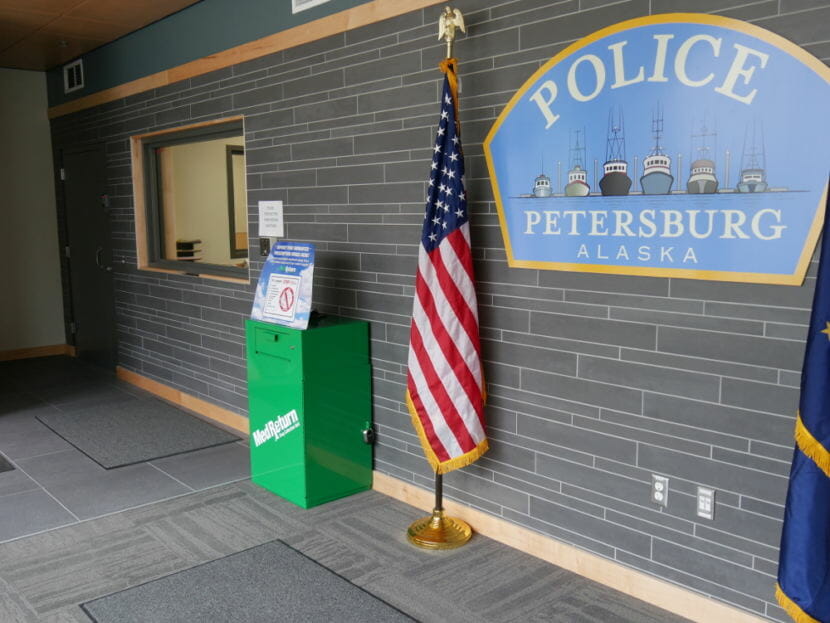
The drug take-back bin is in the lobby of the newly remodeled police station. (Photo by Joe Viechnicki/KFSK)

Petersburg Police Department has gathered over 11,000 unused prescription medication and other pills since it opened up a collection box in the new police station lobby in late February.

The department released the 2017 statistics this week.

The drug take back bin was opened Feb. 22 in the community of more 3,000 people. As of mid-December the pills collected was 11,550. Residents have also turned in 13 Epi Pens, 70 ounces of drug liquids, 26 grams of creams and 162 inhalant doses.

Police Chief Kelly Swihart was surprised by that level of use.

“Just an incredible amount of unused medications that were turned in and I really wanted to give a shout out to our evidence technician Barb Beasley and Becky Turland from (Petersburg) Mental Health who are collecting those stats and disposing of the unneeded medications for us,” Swihart said.

He noted some of the busier months for the collection box were later in 2017, so use by the public may be increasing.

As for other statistics, the department received a total of 3,833 calls last year, 497 of which were 911 calls.

Borough police keep track of calls with a software system from a Utah company called Spillman Technologies.

Swihart thinks crime statistics last year kept pace with those from prior years.

“This is the first full year that we’ve had Spillman as a record management system,” he said. “We implemented it back in mid-2016 so we’ve refined the way we collect statistics a little bit but I think we’re tracking pretty much with what we have done in the past.”

There were over 3,500 calls that were for the police, with 81 fire calls and 215 for emergency medical responders.

The police say more than 3,400 of the calls are closed cases. The department had 95 drug-related cases last year and had 75 jail bookings. Twenty-eight of the calls were determined to be unfounded. Borough police had 35 calls from outside of the old city limits.

Woman charged in rash of fentanyl overdoses at Eagle River prison

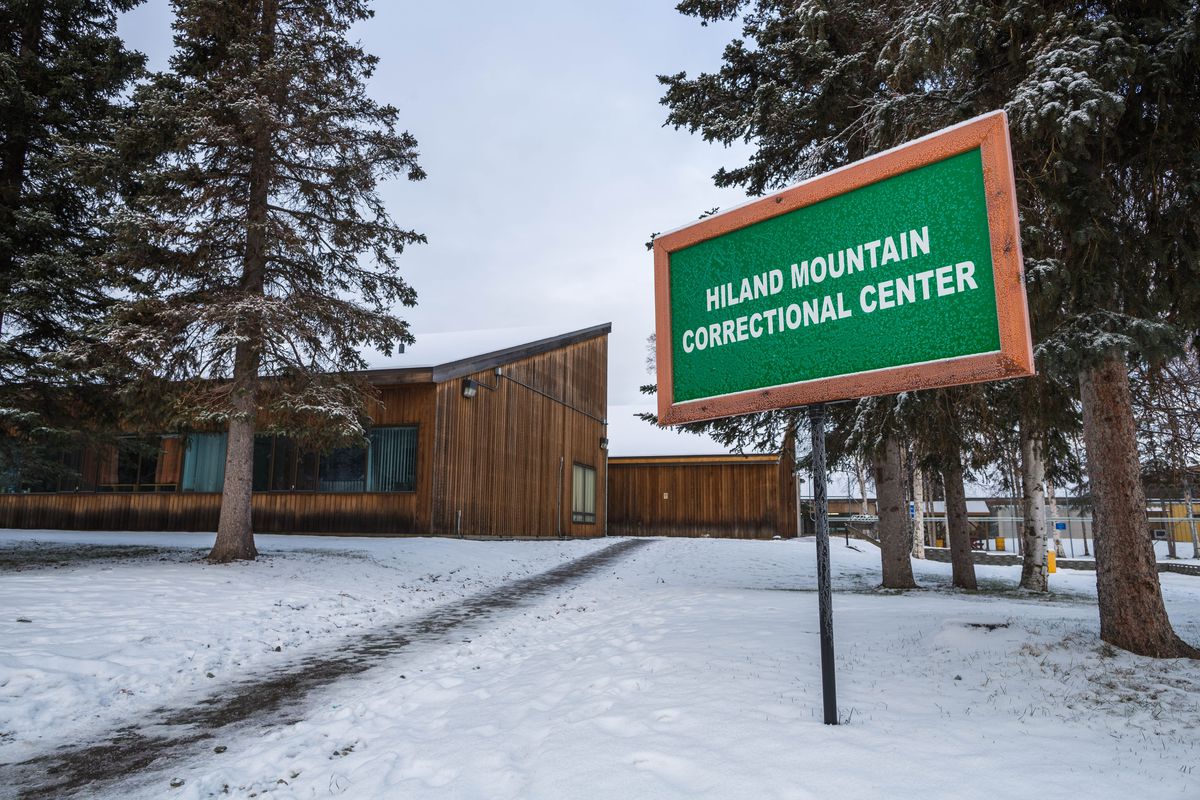
Hiland Mountain Correctional Center, photographed on Nov. 17, 2012. (Photo by Loren Holmes/ADN archive 2012)

A woman incarcerated at Hiland Mountain Correctional Center in Eagle River gave a powerful synthetic opioid to other inmates, causing four overdoses in late October, according to charges filed in federal court Tuesday.

Dorothy Elizabeth Lantz, 36, was charged with one count of distribution of a controlled substance for providing inmates with fentanyl at the women’s prison. Investigators allege she carried the drugs inside her body when being transferred on Oct. 30 from the Anchorage Correctional Complex to Hiland.

Four women collapsed from drug overdoses during the last two days of October, Christine Truong, special agent with the Drug Enforcement Administration, wrote in the criminal complaint filed in U.S. District Court.

One of those women overdosed twice in one day, Truong wrote.

All of the women were revived, and there were no fatalities.

The first inmate who overdosed admitted to taking fentanyl Oct. 30.

She told investigators that she had used drugs for 15 years, and that she took “a very small amount” of the drug, which was wrapped in plastic when she got it.

The second inmate identified in the complaint made a Nov. 4 call that was recorded. During the call, she said that she had taken the fentanyl in a powdered form.

The third inmate told investigators that she “was up and talking and then … was ‘out,’ ” the charges say.

Right before she blacked out, the second inmate had fallen down, and they were told to go into lockdown and return to their cells.

The third inmate told investigators that she was in the hospital for a few hours, then returned to the prison, where she overdosed a second time that same day.

A fourth inmate was found “in an unresponsive state with her hands clenched in front of her” on Oct. 31, the complaint says.

She was holding a condom that contained a white powder and eight white pills, later found to be fentanyl and methadone, respectively.

That same inmate told investigators that she took a tiny amount of the drug — about “1/20th of a Tic Tac,” she said — in powder form.

She had been abusing drugs for more than 15 years but had never overdosed, the inmate told investigators.

The fentanyl was “very, very potent,” she said, according to the charges.

Another inmate told investigators that she had also been given fentanyl, and that others had taken the drug but hadn’t overdosed.

Lantz admitted to giving fentanyl to four inmates — three who overdosed and one who did not. She said she carried it inside her body when being taken from the Anchorage Correctional Complex to Hiland. She said she didn’t know where it came from and only had it because she had “come across it,” the charges say.

Lantz was arrested on a parole violation Oct. 24, online records show, in a case where she pleaded guilty to driving under the influence. A warrant for her arrest had been issued nearly a year before she was taken into custody.

Lantz arrived at Hiland on Oct. 30, the same day the first overdose occurred, according to the Alaska Department of Corrections.

When Lantz was interviewed, she told investigators that the drugs were gone and that she had flushed what was left down the toilet. She said she traded drugs for items from the commissary.

“Lantz began to cry and she asked if she was going to ‘get into legal trouble,’ ” the charges say.

On Nov. 1, the Alaska Department of Corrections said that five women overdosed in the prison and had to be revived with Narcan, used to counteract the effect of opioid overdoses.

At the time, the agency said it didn’t know what drug had caused the overdoses.

“Drug overdoses aren’t unheard of in prisons, but to have 5 back-to-back, that is very uncommon,” agency spokeswoman Megan Edge said at the time.

Lantz remained incarcerated Tuesday at Hiland, online records show.

Fentanyl is a synthetic opioid that is used to treat severe pain, and is 50 to 100 times more powerful than morphine, according to the Centers for Disease Control and Prevention.

The drug played a role in 27 deaths in Alaska between 2014 and September 2016, according to the state health department.

Gov. Bill Walker declared Alaska’s opioid crisis a public health disaster in February.

Life expectancy drops again as opioid deaths surge in U.S.

Life expectancy in the U.S. fell for the second year in a row in 2016, nudged down again by a surge in fatal opioid overdoses, federal officials report Thursday.

“I’m not prone to dramatic statements,” says Robert Anderson, chief of the mortality statistics branch at the National Center for Health Statistics. “But I think we should be really alarmed. The drug overdose problem is a public health problem, and it needs to be addressed. We need to get a handle on it.”

The trend is especially concerning because life expectancy is considered an important indicator of the general well-being of a nation.

“It gives you sort of an overall sense of what’s going on,” Anderson says.

Life expectancy, which is the average time someone is expected to live, generally has been rising steadily for decades in the United States, with only occasional downward ticks.

The last time the U.S. life expectancy dropped was in 1993 because of the AIDS epidemic. Life expectancy hasn’t fallen two years in a row in the U.S. since the early 1960s.

“This is quite concerning,” Anderson says.

According to the latest analysis, U.S. life expectancy fell from 78.7 in 2015 to 78.6 in 2016. That follows a drop from 78.9 in 2014 that researchers hoped would be an aberration.

“For any individual, that’s not a whole lot. But when you’re talking about it in terms of a population, you’re talking about a significant number of potential lives that aren’t being lived,” Anderson says.

Many factors are probably playing a role, including an apparent plateau in the reduction of deaths from heart disease, Anderson says. But a significant factor is the upswing in deaths from opioid overdoses.

Tens of thousands of Americans have died from opioid overdoses in recent years. A report released Thursday found drug overdoses jumped significantly in 2016 to more than 63,600, and more than 42,200 of them were attributed to opioids. In 2015, more than 52,400 deaths were attributed to overdoses, and 33,000 of them involved opioids.

The rate of drug overdose deaths involving synthetic opioids also jumped significantly, from 3.1 per 100,000 in 2015 and 6.2 per 100,000 in 2016.

“It’s just really dramatically increased,” Anderson says, noting the latest increase is “far and above greater than any of the one-year increases that we’ve seen to this point.”

The upsurge suggests the epidemic “appears to be accelerating,” he says.

“I was pretty shocked to see that our life expectancy has declined for the second year in a row,” says Arun Hendi, a demographic and sociologist at the University of Southern California. “I think we should be very worried.”

Hendi says the nation “urgently” needs to cut off the supply of drugs flooding the market, “particularly heroin and fentanyl.” The U.S. also needs to increase the availability of treatment for addicted Americans and improve access to high-quality health care, he says.

Some researchers studying mortality trends say the opioid epidemic is just part of a larger problem.

“It’s also a crisis in which people are killing themselves in much larger numbers — whites especially,” says Anne Case, an economist at Princeton University who has been studying what she and her husband and fellow Princeton economist Angus Deaton call “Deaths of Despair.”

“Deaths from alcohol have been rising as well. So we think of it all being signs that something is really wrong and whatever it is that’s really wrong is happening nationwide,” Case says.

The decline of well-paying jobs with significant yearly salary increases, job security and good benefits may be fueling a sense of frustration and hopelessness, Case says. That may be one reason fewer people are getting married and more people are having children outside of marriages, Case says.

“They don’t have a good job. They don’t have a marriage that supports them. They may have children that they do or don’t see,” Case says. “They have a much more fragile existence than they would have had a generation ago.”

As a result, “it may be the deaths from drugs, from suicide, from alcohol are related to the fact that people don’t have the stability and a hope for the future that they might have had in the past,” Case says.

Other ethnic groups also appear to be suffering from the same issues, too, including African-Americans.

“Rates of mortality for Africans-Americans have risen after a fairly long period of decline, and that is concerning and disturbing and it may reflect a wider array of harms arising from drug issues,” says Jonathan Skinner, a professor of economics at Dartmouth College.

Copyright 2017 NPR. To see more, visit http://www.npr.org/.

Why prison drug treatment programs in Alaska ramped down at ‘exactly the wrong time’

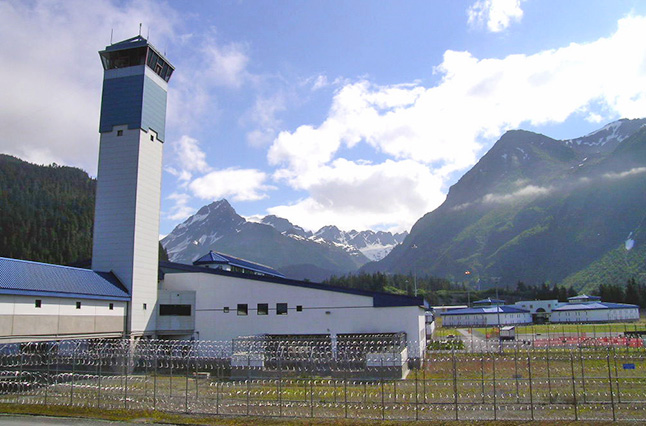
Spring Creek Correctional Center in Seward. (Photo courtesy Alaska Department of Corrections)
The state closed the residential drug treatment program at Spring Creek Correctional Center in Seward after a provider’s contract ended Dec. 31, 2016. (Photo courtesy Alaska Department of Corrections)

A state contract to provide drug and alcohol treatment to inmates ended at a bad time last year. It delayed services for some that could help prepare them to re-enter the community at the same time a controversial state law reduced criminal sentences.

Drug and alcohol treatment is expected to play an important part in supporting the changes being made to Alaska’s criminal justice system. They began after Gov. Bill Walker signed Senate Bill 91 in July of last year. The idea is that inmates are less likely to commit crimes in the future if their addictions are treated.

But a key state contract to provide treatment with the nonprofit organization Akeela ended on Dec. 31, 2016. The next day, the state increased the use of parole and community supervision outside of jail for offenders.

“It was terrible timing for this event to happen,” said Anchorage Democratic Rep. Ivy Spohnholz, the chairwoman of the House Health and Social Services Committee. “It was exactly the wrong time.”

She noted that roughly four out of five inmates have a substance use disorder.

Akeela provided treatment in prisons across the state. When the contract ended, state officials say they focused their efforts on 55 prisoners who were in the middle of treatment, using temporary employees to fill the gap. Others had to wait — the state is supposed to be able to treat 240 prisoners at a time with inpatient or intensive outpatient drug treatment.

While one new contract was in place on Jan. 1, two others didn’t start until Dec. 8. And other contractors are still looking for workers to operate the programs.

Christopher Constant directs grants and contracts for Akeela. He said Akeela decided to end the contract because the state didn’t build in any vacation or sick leave for its workers.

“We ended up literally underwriting the state’s treatment services more than half a million dollars in a year from our own revenues from other programs,” he said. “And so we were stealing from other programs to pay for the state’s treatment services.”

Constant said Akeela gave the state six months’ notice that it needed to build more time off for workers into the contract.

State officials have a different view of the contract negotiation.

Laura Brooks directs health and rehabilitation services for the Department of Corrections. She noted that Akeela had agreed to a similar contract that covered services last year.

Akeela gave a month’s notice that it wouldn’t renew its contract for 2017.

“I don’t think there would ever be a good time for us to lose a substance abuse contract,” Brooks said. “Eighty percent of our population have substance use issues. And so this is a critical need for our population. So, absolutely, any time that we are left either without services or face a reduction in services, it’s going to affect their transition back to the community.”

State officials said limited drug treatment providers limited where the state offers treatment.

With the loss of Akeela, the state closed the residential treatment program at Spring Creek Correctional Center in Seward.  Some of those inmates moved to a similar program at Wildwood Correctional Complex in Kenai.

The state replaced Akeela with three smaller contracts with the Salvation Army’s Clitheroe Center; Cook Inlet Council on Alcohol and Drug Abuse; and Norton Sound Behavioral Health.

“I’m confident that the contracts that we have now in place are going to be able to provide our offender population with the substance abuse programs and services that they need,” Brooks said.

SB 91 is providing an additional $1 million per year for substance abuse treatment. State officials are still determining how it will use that money to expand drug and alcohol treatment.

One step the state has taken in increasing the use of the medication Vivitrol to treat inmates addicted to opioids.

Christopher Constant with Akeela said the state isn’t doing enough to increase the individual and group counseling that are at the heart of drug treatment. He believes the state will have to increase this treatment if the sentencing changes are going to work.

“There wasn’t an incremental increase proposed anywhere, so it’s just, to me, it’s a failed promise,” he said. “And what the state really needs to do is fulfill the promise and that’s provide community based-support for all of these people they continue to push back out of the institutions that they’ve created.”

Constant is also a member of the Anchorage Assembly.

Rep. Spohnholz said that other lawmakers focused too much on the cost savings from SB 91. She said that perhaps the state should have added more substance abuse treatment before implementing the law.

“Perhaps those pieces were done out of order, that really we should have sunk a few million dollars on the front end into addiction treatment,” she said. “And then rolled out the sentencing reforms. And instead, we did it the opposite way and are experiencing some backlash as a result.”

The state is keeping a close eye on the effectiveness of the expanded use of Vivitrol in treatment. The University of Alaska Anchorage is conducting a study of the medication in corrections.

Editor’s note: This story has been updated to note that Christopher Constant is a member of the Anchorage Assembly.

Russia banned from 2018 Olympics; Alaska skiers speak out against doping

Russian athletes Alexander Legkov and Maxim Vylegzhanin, who won gold and silver, respectively, in the men’s 50 km mass start during the 2014 Winter Olympics in Sochi were both found guilty of doping and stripped of their medals. (Photo courtesy the Office of the Russian President.)

Russia has been banned from the upcoming winter Olympics in South Korea. The International Olympic Committee made the announcement Dec. 5 at a news conference.

“The Russian Olympic Committee is suspended with immediate effect,” International Olympic Committee president Thomas Bach said.

The ban is based on a report that shows long-term manipulation of anti-doping efforts in Russia, including during the 2014 winter Olympics in Sochi.

“The report clearly lays out an unprecedented attack on the integrity of Olympic games and sports,” Bach said.

World Anti-Doping Agency is leading the effort against that attack. Earlier this year the agency and the International Olympic Committee laid out the evidence of widespread doping in Russia — evidence that Rosie Brennan has spoken out against.

Brennan skis professionally for Alaska Pacific University in Anchorage and is the U.S. Ski and Snowboard’s athlete representative for WADA. Brennan says she’s happy the International Olympic Committee came to this decision – that the committee supports clean and healthy athletes.

Six Russian cross-country skiers were found guilty of doping during the 2014 Olympics in Sochi, two of whom have been stripped of their medals.

Brennan said there’s no tolerance for doping on the American team.

“We are held to a pretty high moral standard and our coaches have been pretty supportive against doping,” Brennan said. “I just think we have the kind of culture that frowns upon doping and looks at it as a pretty negative aspect of sport in general.”

So far, Sadie Bjornsen is the only Alaskan qualified for the upcoming Olympics.

In a written statement, Bjornsen said it’s her dream to win an Olympic medal and she’s worked hard to do that in a clean and healthy way.

She’s thankful the IOC has the same expectations for the athletes she’ll be competing against at the upcoming winter Olympics.

Site notifications
Update notification options
Subscribe to notifications