Alcohol & Substance Abuse

Corrections investigating overdoses at Alaska women’s prison

Updated | 10:31 a.m. Nov. 2

Five inmates overdosed at Hiland Mountain Correctional Center in Eagle River over a 24-hour period, from Monday night to Tuesday night, according to the Alaska Department of Corrections.

All five women are expected to survive. Officials credit a rapid response administering the overdose-reversing drug Narcan. DOC said responding paramedics used Narcan to revive the first woman who overdosed, and DOC staff administered the drug to reverse the four subsequent overdoses.

DOC spokesperson Megan Edge said corrections staff have been getting more training and Narcan kits to deal with overdoses after Gov. Bill Walker declared a state opioid disaster in February.

Edge said while drug overdoses occur from time to time in state correctional facilities, a cluster of five in a single day is uncommon.

“The reality is, we are in the middle of an opioid epidemic, and prisons aren’t immune to that,” Edge said.

DOC’s Professional Conduct Unit is investigating questions like how the drugs got into a state-run correctional facility, Edge said. The department is still looking into what type of opioid the inmates had used, she said, and the department not saying yet what they suspect.

Despite efforts to stop drugs getting into prisons and jails, they make it in, so Edge said correctional officers and nurses at the facilities are trained on what to do to save prisoners from an overdose.

“And so they’re constantly looking for more tools and resources that they can use in those situations, I mean, DOC is the largest substance abuse treatment provider in the state, and so that means we need the tools and resources to do it,” Edge said.

That includes distributing emergency kits that have doses of Narcan at correctional centers and probation offices around the state. Edge says the kits were installed as a result of policy measures that kicked in after Walker’s formal disaster declaration.

— Casey Grove, Alaska Public Media

Original story | 2:43 p.m.

JUNEAU — The Alaska Department of Corrections is investigating after five women overdosed at a prison near Anchorage.

The non-fatal incidents, which involved inmates at the Hiland Mountain Correctional Center in Eagle River, occurred Monday and Tuesday.

Corrections spokeswoman Megan Edge said it remains unclear how the women obtained the drugs or what drug or drugs they took.

Four of the women were taken to a local hospital for treatment. Edge says toxicology tests were taken. The other woman was stabilized and stayed at the prison.

The department says prison nurses and correction officers responded quickly.

Edge said while overdoses occur in prisons, having five occur so close together is very unusual. She says the department is taking the matter seriously.

The Associated Press

Alaska sues OxyContin maker, alleging deception

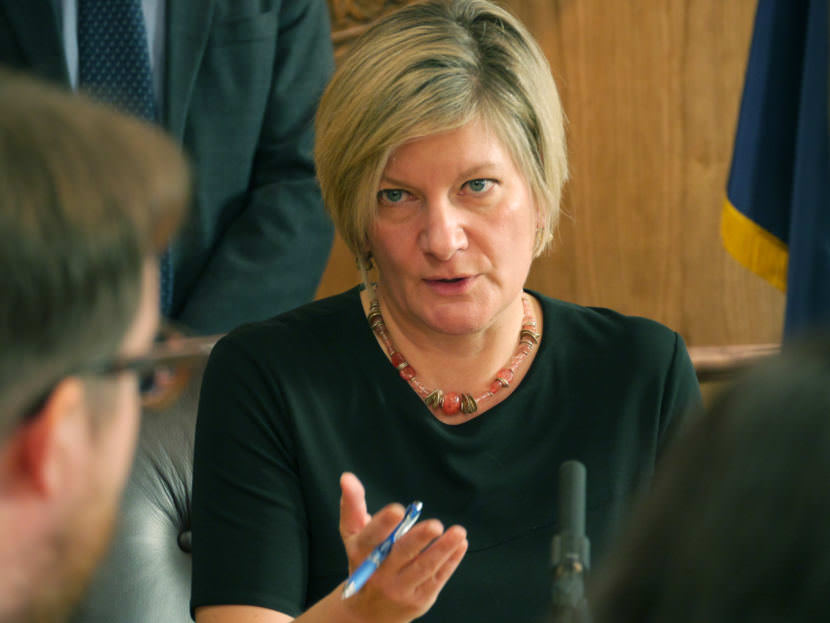
Alaska Attorney General Jahna Lindemuth discusses a lawsuit the state is filing against Purdue Pharma in the state Capitol on Oct. 31, 2017. Purdue makes the prescription pain pill OxyContin. (Photo by SKip Gray/360 North)
Alaska Attorney General Jahna Lindemuth discusses Tuesday a lawsuit the state is filing against Purdue Pharma in the state Capitol. Purdue makes the prescription pain pill OxyContin. (Photo by Skip Gray/360 North)

The state of Alaska has sued Purdue Pharma.

Attorney General Jahna Lindemuth alleged the company engaged in deceptive practices in the sale of the opioid drug OxyContin.

Purdue misled Alaska doctors about OxyContin, she said.

“We believe, based on our investigation, that Purdue overstated the benefits of their drug and understated its risks in violation of Alaska’s Unfair Trade Practices (Act) and Consumer Protection Act, to the detriment of the people of Alaska,” she said Tuesday during a press availability in the Capitol.

The state filed the 85-page lawsuit in Anchorage Superior Court on Monday.

Lindemuth said the state decided to pursue its own lawsuit, rather than join other states in a federal lawsuit, because it wanted to enforce Alaska’s strong state consumer protection laws.

“Where it’s something that’s so impacting Alaska in such a great manner and where it’s such an important issue for Alaska, we think that we need to be out front and pursuing those claims ourselves and having a direct role in how those claims are investigated here in Alaska and how those claims are pursued going forward,” she said.

Lindemuth said Purdue used medical professionals who worked to appear neutral in promoting the drug to Alaska prescribers.

“These deceptive tactics and false statements have contributed to Alaska’s opioid epidemic and worsened the crisis,” she said.

Ninety-five people in Alaska died last year from overdoses that included opioids.

Alaska’s drug overdose death rate of 11 per 100,000 people is above the national average.

Alaska hired South Carolina-based law firm Motley Rice to both investigate the issue and represent the state in the law suit.

The company will only be paid 20 percent of the result if the state wins.

Purdue Pharma’s headquarters are in Connecticut.

Lindemuth said Alaska also could sue other drug makers and distributors.

“We want to put manufacturers and distributors on notice that we’re paying attention, and that we are going to pursue claims when they step over the line and market using false and misleading practices,” she said.

For its part, Purdue responded in an email saying: “We vigorously deny these allegations and look forward to the opportunity to present our defense.”

Purdue points out that the Food and Drug Administration approved its medicine, but the company wishes to work collaboratively to solve the opioid crisis.

The company also said OxyContin accounts for 2 percent of total opioid prescriptions.

In Alaska, OxyContin accounted for 90 percent of the state’s Medicaid spending on brand-name opioids.

Alaska Chief Medical Officer Dr. Jay Butler said the lawsuit is part of the state’s effort to reduce both the supply and demand for opioids, particularly to treat chronic pain.

Doctors and other prescribers have driven much of the demand, Butler said.

“They thought they were doing the right thing, and some of what their practices have been based on is information that was provided to them, which really was misrepresenting what was in the science,” he said.

For example, the lawsuit alleged Purdue made statements about using a 12-hour dose of OxyContin to treat chronic pain that were contrary to the company’s own knowledge and studies, as well as to general scientific evidence.

Gov. Bill Walker said the lawsuit follows up on his declaration of an opioid addiction epidemic.

“As I’ve said many times, there’s no one single thing you can do that’s suddenly going to turn things around,” Walker said. “There’s a number of levers to move, and this is one of them.”

The lawsuit doesn’t say exactly how much money the state is seeking from Purdue.

But the state does say the state is seeking $25,000 for each violation of the state Unfair Trade Practices Act.

One state attorney says there could be thousands of violations, the total would be more than $50 million.

State of Alaska sues OxyContin maker

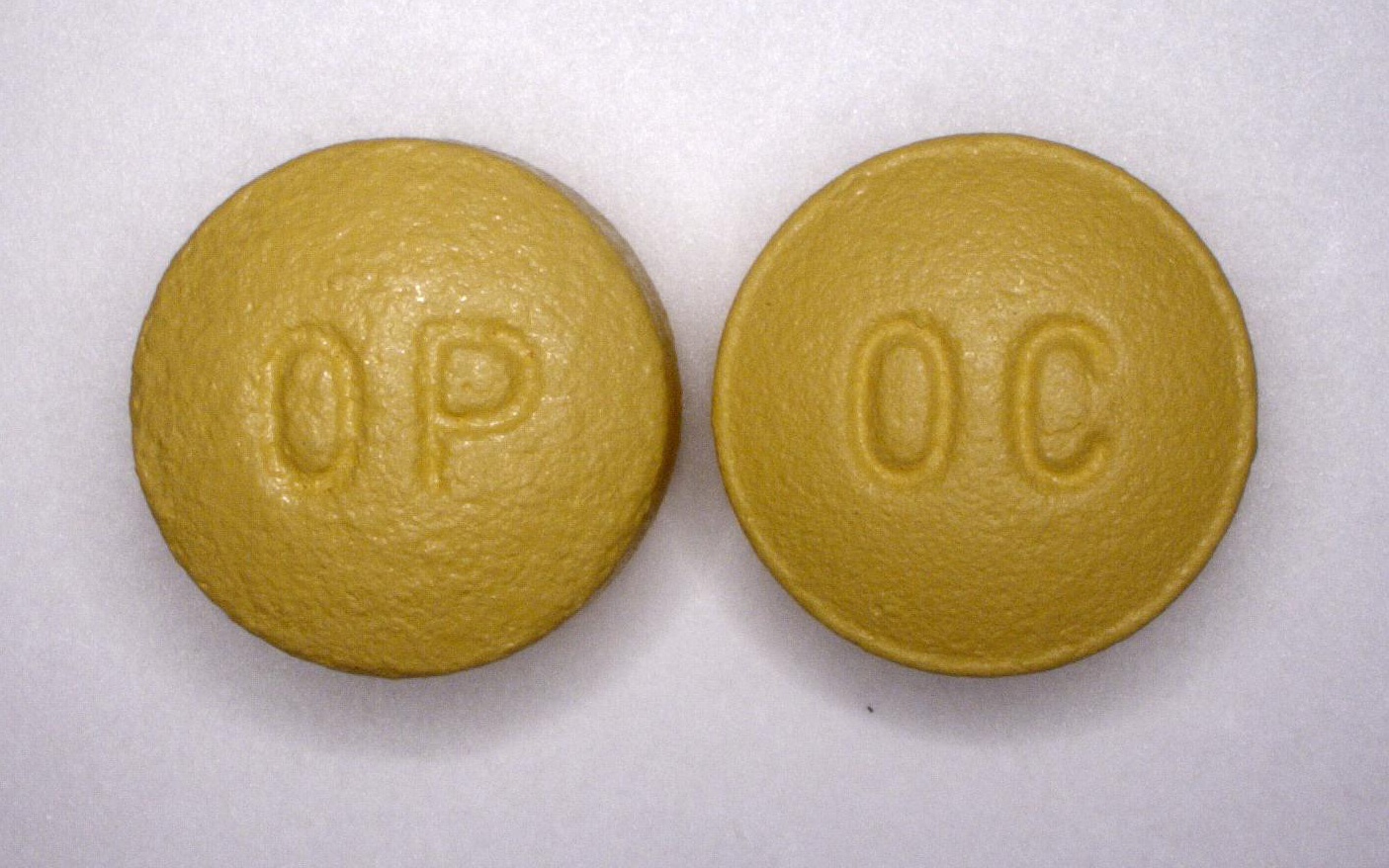
40 milligram OxyContin pills. (Photo courtesy U.S. Drug Enforcement Agency)
Forty-milligram OxyContin pills. (Photo courtesy U.S. Drug Enforcement Agency)

The state of Alaska is suing Purdue Pharma, the maker of prescription pain pill OxyContin.

Attorney General Jahna Lindemuth outlined the state claims at a news conference in the Capitol today:

“We believe based on our investigation that Purdue overstated the benefits of their drug and understated its risks in violation of Alaska’s Unfair Trade Practices and Consumer Protection Act to the detriment of the people of Alaska. Additionally, we believe that Purdue exhibited a pattern of deceptive marketing practices to convince practitioners to prescribe their drug, including the use of seemingly neutral medical professionals and organizations who promoted the drug to their colleagues without disclosing their relationship to Purdue (Pharma).”

Lindemuth said 80 percent of those addicted to heroin started with prescription opioids. She said about 95 percent of Medicaid money spent on opioids in Alaska is for OxyContin.

Purdue Pharma has denied similar claims. The Associated Press reports more than two dozen states, cities and counties have sued the Purdue Pharma and its related companies.

Gov. Walker announces public safety plan

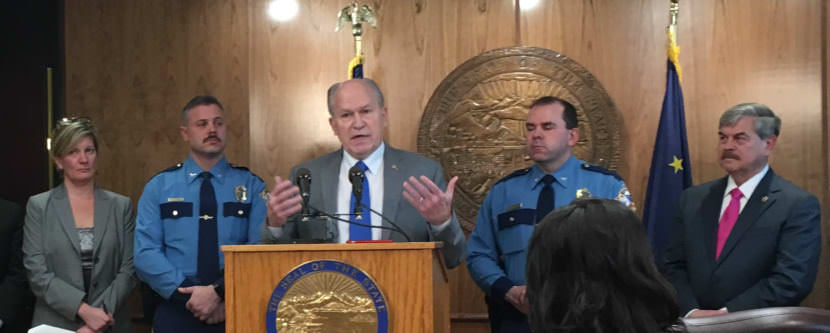
Gov. Bill Walker speaks about his public safety plan. Listening to him are: Alaska Attorney General Jahna Lindemuth, Alaska State Troopers Director Col. Hans Brinke, Alaska Wildlife Troopers Director Col. Steve Hall, and Public Safety Commissioner Walt Monegan, on Oct. 30, 2017. (Photo by Andrew Kitchenman/KTOO)
Gov. Bill Walker speaks about his public safety plan in the Capitol on Monday. Listening to him are: Alaska Attorney General Jahna Lindemuth, Alaska State Troopers Director Col. Hans Brinke, Alaska Wildlife Troopers Director Col. Steve Hall, and Public Safety Commissioner Walt Monegan. (Photo by Andrew Kitchenman/KTOO)

Gov. Bill Walker and four of his cabinet members announced a series of steps today to reduce crime. They include more spending on public safety and improved access to mental health and substance abuse treatment.

Walker said reducing crime will require more state government spending in some areas.

“Rather than focusing on fixing the blame, we need to be focused on fixing the problem,” Walker said. “One thing we have found out over the past several years: We cannot cut our way into a safer Alaska.”

Walker put Attorney General Jahna Lindemuth in charge of developing a plan to reduce crime. She said it will take enhanced collaboration across different departments, along with closer work with tribal and municipal law enforcement.

“We can each be doing our own thing, but what this is all about is working together better, in doing more with what we have,” Lindemuth said.

Lindemuth also said she will seek state funding for five more prosecutors, including one focused specifically on drugs statewide.

Public Safety Commissioner Walt Monegan said the department is working to improve recruitment to fill 43 open state trooper positions and 34 vacant village public safety officer jobs.

Monegan said one barrier to attracting applicants is the annual cycle of layoff notices sent to public workers during disagreements among lawmakers over the state budget.

“We don’t want to have any pink slips. And the state right now doesn’t attract a lot of good people as it should,” Monegan said. “But we are working on a huge plan.”

The administration also is hoping to fund more treatment of opioid addiction as a way of reducing thefts caused by drug use.

The Department of Health and Social Services is aiming to add space at drug treatment facilities and to increase treatment using medication.

Health Commissioner Valerie Davidson said the state’s Medicaid expansion is central to the treatment efforts. She said the largely federally funded expansion is helping people who are addicted to drugs when they leave jail.

“When someone is leaving a correctional facility, if they have the opportunity to be able to go into treatment or better after-care, to be able to support the services that they received in a correctional facility, we know we’re going to have better outcomes as a state,” she said.

Senate President Pete Kelly said he expects the Senate to support efforts to improve public safety, but was skeptical of the governor’s proposal to introduce a payroll tax.

“Addressing public safety is obviously very important and he’s going to find a lot of support from the Senate to do that,” Kelly said. “Some of the proposals he’ll make I’m sure we’ll jump on because they’re good ideas. I don’t like the idea of politicizing public safety for what appears in my book to be a philosophical desire by the administration and others to impose a tax on Alaskans.”

Walker administration officials have said a payroll tax would help bring the state budget into balance.

Quyana Cab Company pleads not guilty to bootlegging charges

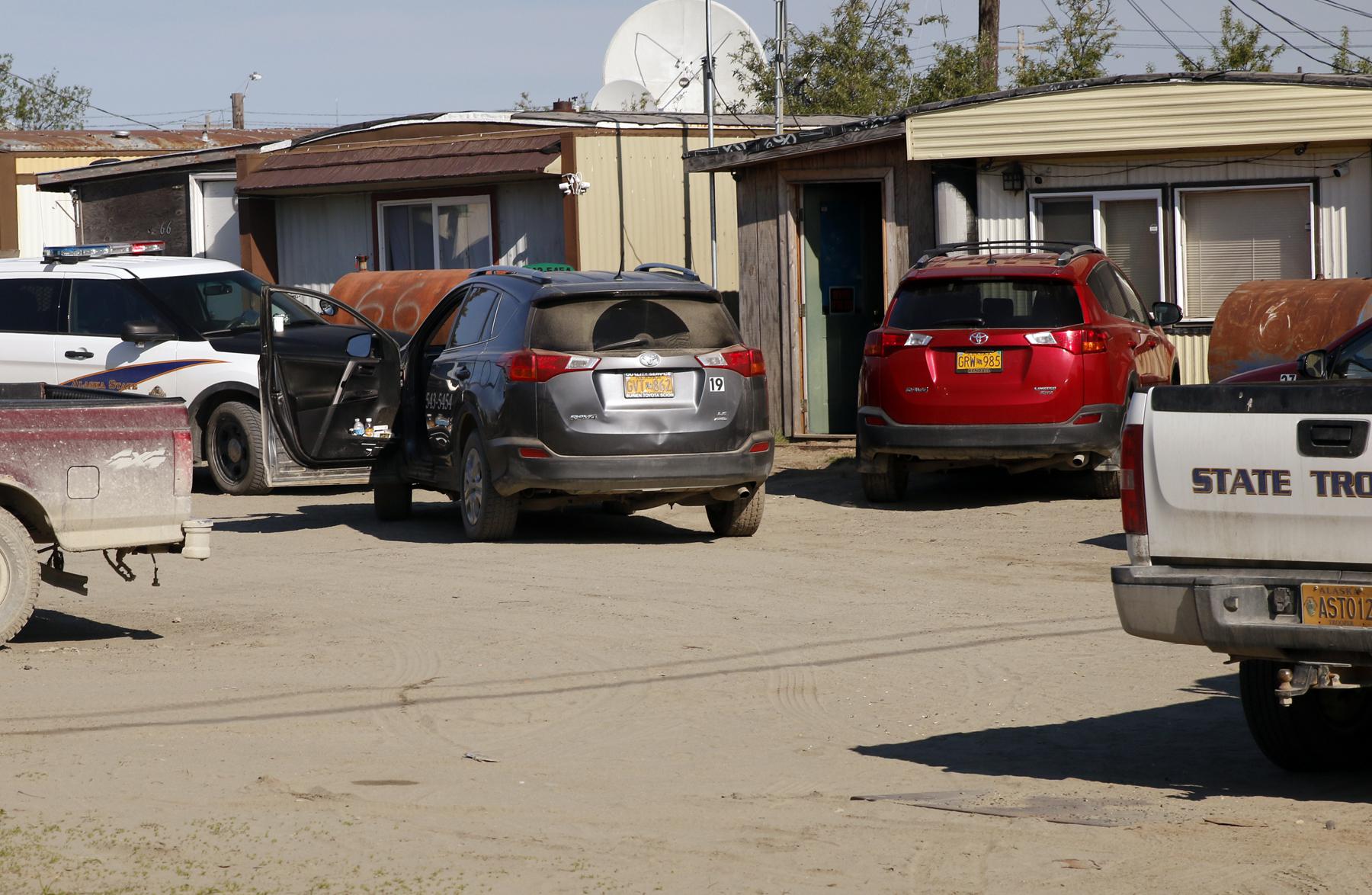
Alaska Troopers search homes and cabs in Bethel's Trailer Court, on June 7, 2016, looking for evidence of illegal alcohol sales. (Photo by KYUK)
Alaska Troopers search homes and cabs in Bethel’s Trailer Court, on June 7, 2016, looking for evidence of illegal alcohol sales. (Photo by KYUK)

The Quyana Cab Company pleaded not guilty Wednesday to all 18 counts of bootlegging charges against it.

Quyana is one of several Bethel taxi companies that were investigated by the Alaska State Troopers in a massive, two-year sting.

While plenty of individual cab drivers were accused of bootlegging, Quyana is the only company that was charged with a crime.

Its owners were not in court for Wednesday’s arraignment and Heather Sia, a defense attorney with the Valcarce Law Office, entered a not guilty plea on the company’s behalf.

The cab company was one of five defendants arraigned Wednesday on bootlegging charges. Sia also entered a not guilty plea on the behalf of Quyana cab driver James Dong Kim.

The three other defendants do not appear to be affiliated with Quyana Cab, although two of them are cab drivers. They also didn’t show up at the hearing and were not represented by attorneys, so the court issued warrants for their arrests.

Sang Ho Kim, Christina Engebreth and Ajeti Sejdula are all charged with selling alcohol without a license.

Officers have repeatedly tried to deliver court summons to Engebreth and Sejdula, but can’t seem to find them. Sedjula’s former employer, Kusko Cab, said that he moved back to Europe almost two years ago and did not leave a forwarding address.

While officers have successfully summoned Sang Ho Kim to court, he has repeatedly asked to delay his trial. The court has denied this request.

In all, 23 Bethel residents were charged with selling alcohol without a license last September following the troopers’ investigation.

The maximum sentence they face is one year in jail and a $25,000 fine. Because it is charged as a company, the maximum sentence for Quyana Cab would be a $500,000 fine. Quyana Cab’s trial is tentatively scheduled for Dec. 11.

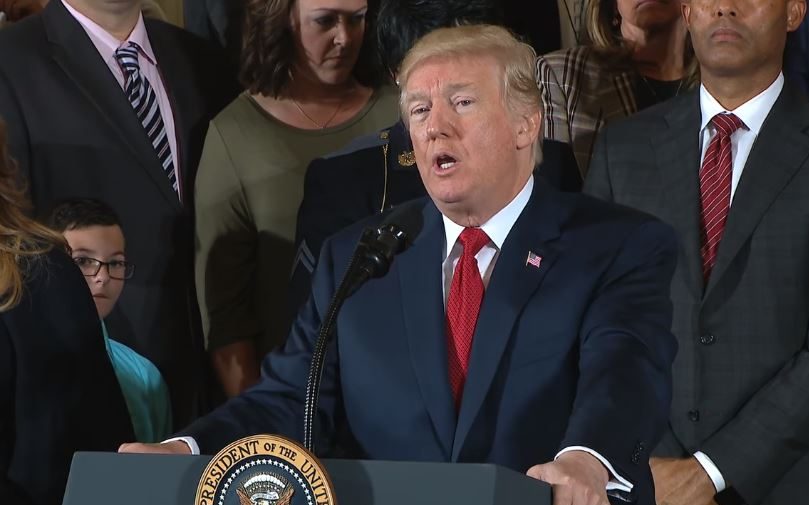
Trump’s opioid disaster declaration could expand help to suffering Alaskans

President Donald Trump delivering remarks after formally declaring the opioid crisis a national health emergency. (Screenshot of Whitehouse.gov video)

President Donald Trump took a major step in dealing with the opioid epidemic killing tens of thousands of Americans a year.

“I am directing all executive agencies to use every appropriate emergency authority to fight the opioid crisis,” the president proclaimed Thursday.

The White House speech laid out an ambitious vision of stamping out opioid addiction within a generation while treating those currently suffering.

Trump mentioned his own brother’s struggle with alcoholism, and being moved by infants born at a hospital in West Virginia dependent on opioids. But the speech offered few concrete policy proposals to aid public health officials, families and first-responders across the country.

Alaska’s Bill Walker was among six governors who were at the White House for the president’s signing ceremony.

“It had a very familiar feel to it, when on Feb. 14 when I issued a declaration of disaster,” Walker said. “I think it’s a positive thing that we’re all… we’re all on the field now.”

Walker was the second governor in the country to declare a state-level disaster related to opioids.

Supporters of the move say it helped save lives by putting thousands of units of the overdose-reversing drug Nalaxone into the hands of Alaskans and marshaled state resources to better confront addiction while curbing access to prescription pain pills.

Walker said the federal declaration could unlock more funds for Alaska or provide greater flexibility in federal rules.

“Much of what he has proposed is much of what we’re doing in Alaska already but to do it on a national basis, I think has greater significance,” Walker said.

One of Alaska’s authorities on the opioid crisis is Dr. Jay Butler, the state’s chief medical officer, who was also in Washington for the day’s events.

“What we heard today was a very high-level overview, which I think was very positive,” Butler said. “But there’s two questions. What are some of the specifics this will mean? And are there resources that’ll support some of the visionary ideals that we heard today?”

Butler hopes the declaration will prompt a supplemental appropriation from Congress to bring more money into states for treatment and prevention efforts.

One remark the president made that stood out to Butler was a reference to ending a rule known as the IMD exclusion, which bans Medicaid payments to treatment facilities that have more than 16 beds.

In Alaska, that’s been a major barrier.

Anchorage Assembly member Christopher Constant, who has worked for the Akeela Recovery center, said if it weren’t for the IMD rule they’d be able to double the number of beds at the facility.

State officials have already asked for an exemption from the policy. After Trump’s declaration today, people working up-close on substance abuse and recovery are optimistic.

Karl Soderstrom is one of the founders of Fiend 2 Clean, a program in Wasilla that helps connect people with treatment and recovery.

He described the declaration as a “really, really big deal.”

Soderstorm constantly works with people who are trying to get clean, but don’t have the money for private treatment options, and can’t get a spot in facilities that accept Medicaid.

“The majority of Alaskans that are indigent, that are homeless, that are IV-drug users, a lot of these folks meet the criteria for a residential-treatment stay, but don’t have access to one,” Soderstorm said.

Soderstrom said the president’s move opens the door for expanded treatment, and he hopes programs like his will see a trickle-down in funds if federal dollars follow.

He thinks it’s unfortunate the disaster declaration has taken so long, and pointed out that since the president first announced his intention of designating a federal emergency in August, thousands of Americans have died from opioid overdoses.

Still, for Soderstrom, this drives the issue to the front of public consciousness.

“I think it’s great news,” Soderstrom said. “I think that President Trump was really smart to put the Commission on Substance Abuse together, and I think this is just the tip of the iceberg. This disaster declaration pushes the opioid epidemic up as a priority. So now we have to do something about it.”

Both of Alaska’s senators applauded today’s move and say they’ll push for additional resources.

Site notifications
Update notification options
Subscribe to notifications