Alcohol & Substance Abuse

Teen Xanax abuse is surging

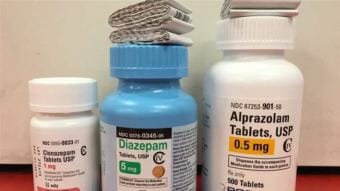
Clonazepam (traded as Klonopin), diazepam (Valium) and alprazolam (Xanax) are among the class of widely prescribed anti-anxiety medications known as benzodiazepines. Addiction treatment experts say teens are abusing the drugs and mixing them with opioids and alcohol. (Photo by Pew Charitable Trusts)

BALTIMORE — Teen drug use during the summer often goes unnoticed. It’s when school starts and students nod off in class, exchange pills in the hallways and fail tests that the truth becomes apparent.

This school year, addiction specialists say they’re expecting an onslaught of teens addicted to Xanax and other sedatives in a class of anti-anxiety drugs known as benzodiazepines, or “benzos.” Many teens view Xanax as a safer and more plentiful alternative to prescription opioids and heroin — with similar euphoric effects.

But addiction experts warn that the pills kids are taking, often found in their parents’ or grandparents’ medicine cabinets, can be just as deadly as opioids, especially when taken in combination with other drugs or alcohol. And it’s much harder to kick the habit.

Like any addictive substance, Xanax when used early increases the risk of addiction later in life. According to the U.S. Surgeon General’s 2016 report on drugs and alcohol, nearly 70 percent of adolescents who try an illicit drug before age 13 will develop an addiction within seven years, compared with 27 percent for those who first try an illicit drug after age 17.

Nationwide, prescription drug abuse among adolescents has dropped dramatically in the last 15 years, according to survey results published in December by the National Institute on Drug Abuse. Last year’s results indicate that about 4 percent of high school seniors misused prescription painkillers, a sharp decline from 2004, when nearly 1 in 10 teens misused opioids.

In fact, an increasing percentage of high school kids — at least 26 percent of seniors in 2014, up from 5 percent in 1976 — are abstaining from all substances, including alcohol, marijuana and tobacco, according to an historical analysis of the survey data published in July.

Even so, addiction practitioners say they’re seeing a surge in the number of young patients who are hooked on Xanax. Many take high daily doses of the drug, sometimes in deadly combination with opioids and alcohol.

Addiction treatment centers are “the tip of the spear,” said Sharon Levy, director of adolescent addiction treatment at Boston Children’s Hospital and lead author of the adolescent drug use study. “We see things first. So, I’m not surprised that the spike in Xanax use isn’t reflected in national data yet.”

“Adolescent benzo use has skyrocketed,” Levy said, “and more kids are being admitted to hospitals for benzo withdrawal because the seizures are so dangerous.” At the same time, she said, far fewer kids are seeking treatment for prescription opioid addiction.

“When I ask them if they’re using opioids, they say, ‘No. I wouldn’t touch the stuff.’”

High doses

Marc Fishman, an addiction psychiatrist and professor at Johns Hopkins University School of Medicine, said benzos are quickly overtaking opioids as the primary prescription drug of abuse among the adolescent patients he sees at Mountain Manor Treatment Centers in Baltimore and other Maryland locations. And many of them are extreme, high-dose users, he said.

Like opioids prescribed for pain, benzodiazepines prescribed for anxiety eventually stop working, forcing users to take higher and higher doses to get the same effect. Kids who can’t get the pills at home buy them on the dark web or concoct designer versions of benzos in their bathtubs, he said.

People with mental illness are at much higher risk for developing an addiction to opioids, and Fishman said the connection between mental illness and benzos is even stronger.

Three FDA-approved medicines are available to treat the symptoms of opioid addiction: buprenorphine (most often sold as Suboxone), methadone and Vivitrol, a long-acting injectable medicine that blocks the euphoric effects of opioids and alcohol.

But no medicines exist to blunt the withdrawal symptoms and cravings associated with benzodiazepine addiction. Instead, patients typically enter residential treatment where a specialist gradually tapers them off the medication. If stopped too quickly, benzodiazepine withdrawal can result in seizures and even death.

For people who overdose on opioids, Narcan is widely available and can easily be administered by first responders, friends and family members to block the deadly respiratory depression of opioids. A similar drug, flumazenil, can block the respiratory depression of benzodiazepines, but it is rarely available outside of hospitals.

Plentiful supply

The burgeoning abuse of Xanax and other benzodiazepines among high school kids and young adults over the last several years primarily stems from the fact that there are more of the pills out there, Levy argued.

As more adults are prescribed Xanax, Valium, Ativan and other benzodiazepines to calm their nerves and promote sleep, “we’re creating these vast reservoirs for kids to find,” she said.

The other problem, she said, is that adolescents think the benzos are safe because their parents use them. Many kids say they don’t take the pills to get high; they take them to feel normal, Levy said. “Some patients even ask me to just prescribe Xanax for them so they don’t have to buy it illegally. They think it’s good for them.”

“That one idea — that something is safe or beneficial or medical — has launched many an epidemic in the past,” Levy said. “So, my colleagues and I are watching this with trepidation.”

Melissa Ellis, now 24, started using Xanax when she was in high school. Nationwide, treatment experts say they’re seeing a surge in Xanax use disorders among adolescents and young adults. (Photo by Pew Charitable Trusts)

Easy to love

Melissa Ellis, who grew up in Baltimore in what she described as an addiction-prone family, loved Xanax from the first time she tried it. “I noticed this new guy I was dating kept nodding off so I asked him what he was taking. He told me it was Xanax and gave me a handful of bars [the pill form with the highest dose]. I’d never heard of it before. But as soon as I tried it, I knew it was for me.

“It takes away everything you have in your mind that’s bothering you and everything you feel that hurts, and before you know it, those feelings are just gone.”

Melissa was 15 then and just entering high school. Now she’s 24 and struggling to take care of her 3-year-old son. She says she’s determined to beat her addiction to Xanax and be free of all drugs except the depression medicine she’s been taking for more than a decade. Otherwise, she said she could lose her son.

The first time Melissa tried to stop taking Xanax, she was four months pregnant. She managed to get through her pregnancy without relapsing. “But the day after my son was born, I told my friend in the hospital to bring me some. And I started all over again.”

Melissa also started injecting heroin then. “The two drugs are made for each other,” she said. “What one doesn’t have, the other one does. With the dope [heroin], the high doesn’t last as long as Xanax. So, I was more into the Xanax.”

But after she started combining the two, she overdosed, and her mom found her passed out on the floor one day. That’s when she first checked into Mountain Manor.

Melissa detoxed from both drugs, spent two weeks in residential treatment and started taking Suboxone to relieve her opioid cravings. She also attended outpatient classes and stayed sober for a year.

“I got so much closer to my son back then,” she said wistfully. “Everything was better. I was doing so good. But I started hanging out with old friends and I relapsed on Xanax.”

Now, she’s back at Mountain Manor, trying again. She hopes to leave treatment by the end of the week and move into a mother-and-child sober living facility nearby. For now, her mother is taking care of her son.

“It’s really hard,” Melissa says. Withdrawal from Xanax can cause irritability, insomnia, anxiety, panic attacks, tremors, nausea and other flu-like symptoms. And unlike opioid withdrawal, which usually lasts for about a week, it can last for months.

“Treatment is scary all around. It’s fine when you’re here. You can’t go down the street and meet your dealer. The scariest part is when you go back out there.”

New report shows fatal opioid overdoses still on rise in Alaska

A new Division of Public Health report offers a bleak outlook of Alaska’s continued struggle with opioid addiction.

The number of fatal overdoses increased for the fifth year in a row.
According to preliminary data, 107 Alaskans died from opioid overdoses last year.

Though the state overall is below the national average for fatal overdoses, the rates vary by region, with the highest concentration in Anchorage — at 20.4 per 100,000 people in 2017.

One bright spot in the findings is that the rate of opioids dispensed to Medicaid patients has decreased, which the report’s authors suggest could indicate “more judicious” prescribing practices among healthcare providers.

Many people’s first exposure to powerful narcotics is through legally prescribed painkillers that have a high risk of causing dependence.

There’s also evidence that more of the overdose-reducing medication naloxone is reaching drug-users, curbing the number of fatal overdoses.

Surgeon General says preventing addiction requires looking at larger community problems

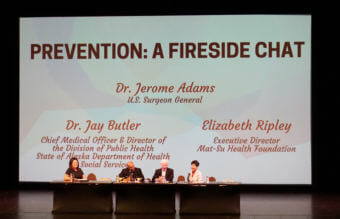
Stephanie Allen, left, Surgeon General Jerome Adams, Jay Butler and Elizabeth Ripley are part of a panel discussion at the Prevention Summit in Palmer. (Photo by Anne Hillman)
United Way of Mat-Su executive director Stephanie Allen, left, Surgeon General Jerome Adams, Chief Medical Officer Jay Butler and Mat-Su Health Foundation CEO Elizabeth Ripley are part of a panel discussion at the Prevention Summit in Palmer. (Photo by Anne Hillman/Alaska Public Media)

Surgeon General Jerome Adams spoke at the Alaska Prevention Summit panel in Palmer, as part of a larger Alaska tour talking about solutions to the opioid epidemic.

Adams told Glenn Massay Theater crowd Tuesday that he sees some progress in combating the epidemic.

Doctors are prescribing opioids less frequently, but the drugs are still available.

“The first drug dealer for the majority of folks isn’t some bad guy out on the street,” Adams said. “It’s grandma, it’s aunt, it’s uncle. It’s the next-door neighbor. It’s you all. It’s us, who have left medications in our cabinets.”

Alaska Department of Health and Social Services distributes drug disposal bags that make opioids unusable to hopefully solve that issue.

Medications can also be taken back to pharmacies and police departments.

Mat-Su Health Foundation partners with other groups to address childhood trauma in trying to prevent opioid addictions, CEO Elizabeth Ripley said, which means getting at the root of some community problems, such as racism and the unequal representation of people of color in the foster care and criminal justice systems.

“A crucial part of what we have to do is go upstream and say ‘We’re causing stress for certain segments of our community in disproportionate ways, and we have to break down those barriers,’” Ripley said.

Mat-Su region organizations host Undoing Racism workshops and conversations around race to begin that process.

During an interview after the panel conversation, Adams said addressing the opioid crisis has opened the door for larger conversations.

“When you look at untreated mental health issues, when you look at un-wellness in our communities, all those lead to substance use disorder,” Adams said. “If we use this tragedy as an opportunity to address those upstream causes then we’ll solve not only the opioid epidemic but so many other health woes that are affecting our country.”

Helping people understand that health affects all aspects of our society, including the economy, is part of the strategy.

“Investing in health is also investing in jobs,” Adams said. “It’s also investing in safety and security. It’s investing in the things that they care about and they vote on. And if we don’t invest in those things it’s going to continue to be a drag on our economy, on our safety, and our ability to devote resources to the things that we care about.”

To accomplish these larger goals, Adams said communities need to focus on developing new partnerships with businesses, the faith community, and treatment providers that the use limited funding more efficiently and effectively.

Whittier police arrest two men with 33-pound bag of meth

Methamphetamine
Methamphetamine. (Photo courtesy DEA)

Two men who allegedly had 33 pounds of methamphetamine in a backpack after leaving a ferry in Whittier made their initial court appearances Monday in Anchorage.

Whittier Police arrested Eric James Hansen and Marshal Parke on Thursday. Federal authorities say Hansen brought the meth – worth about $225,000 in wholesale quantities – from Bellingham, Washington, to Whittier on the state ferry Kennicott.

The ferry made stops in Southeast Alaska on its way to Whittier, the closest state ferry terminal to Anchorage, about 60 miles away.

According to the charges, Alaska Marine Highway employees notified Whittier police about a “suspicious passenger.” That passenger later turned out to be Hansen, the charges say. The charging document does not say what made Hansen seem suspicious but notes he had been seen with the backpack in the Whittier ferry terminal.

The charges say Parke was driving a GMC Yukon with Alaska license plates when police stopped the SUV, and Hansen was in the passenger seat. An unnamed woman rode in back. The charging document says police brought in a drug-sniffing dog that indicated the odor of narcotics coming from the vehicle.

The charges say that after getting a search warrant, police found the backpack filled with meth, as well as $8,000 cash in a briefcase, a scale with drug residue on it, a glass pipe with burnt edges and a small baggie with white powder.

D.C. has had more than 300 synthetic marijuana overdoses in 2 weeks

A scene of H Street NE in Washington, D.C. on Wednesday, July 25, 2018.
A scene of H Street NE in Washington, D.C. on Wednesday, July 25, 2018. (Photo by Eslah Attar/NPR)

More than 300 people have overdosed in Washington, D.C. just in the last two weeks after consuming what is suspected to be synthetic marijuana, known as K2.

The crisis is offering a glimpse into a wrenching national problem — the Centers for Disease Control and Prevention is tracking multiple outbreaks across the country associated with synthetic cannabinoids use and The Food and Drug Administration recently warned of “severe illnesses and deaths” that have resulted from the use of contaminated synthetic marijuana products in recent months in several states.

Synthetics are a collection of man-made psychoactive chemicals that are sprayed on plant material. They are sold under several catchy brand names such as K2, Spice, AK-47, Mr. Happy, Scooby Snax, Kush and Kronic, according to the CDC.

They come in shiny packages with bright logos – they could easily be mistaken for party favors. They are often made from a combination of legal components — but those combinations are proving deadly and are creating big challenges for the first responders, health workers and law enforcement.

The CDC received its first reports of sales of synthetic marijuana in 2004, and the department says use of the products has increased over the past several years in spite of increased legislation.

As a food delivery driver who zig-zags through Washington, D.C., David Barnett, 32, says he has seen that “overdoses are happening everywhere,” — even in some of the more prosperous neighborhoods in the city.

“I’ve seen people overdosing in Adams Morgan, Columbia Heights, the H Street corridor,” he says, “and a couple of days ago I saw paramedics helping a woman outside of Union Station.”

“It’s not just near homeless shelters,” echoes Douglas Buchanan, spokesperson for the D.C. Fire and EMS Department.

Barnett says K2 has become popular because it’s cheap and inconspicuous. K2 is now ubiquitous in the city, he says. “It’s sold at gas stations, corner stores and tobacco shops” on the internet and on the streets, says Barnett. “I see the empty wrappers everywhere” he says.

“I’ve seen people overdosing in Adams Morgan, Columbia Heights, the H Street corridor,” said David Barnett, a fast food delivery driver. (Photo by Eslah Attar/NPR)

“If you’re on probation and your urine is tested, K2 doesn’t show up in the test,” that’s why people are using it more, Barnett says.

That’s not necessarily true according to the Department of Forensic Sciences in D.C., but it’s a popular belief out in the streets of the nation’s Capital (more on this later.)

On a recent muggy summer day in Washington, D.C., Barnett wore a white sleeveless tank-top on his lunch break at a burger joint in the Northeast section of the city. This week the manager at that restaurant called paramedics after a customer started vomiting and passed out, typical signs of an overdose of K2.

When D.C. Fire and EMS responders get a phone call for help, Buchanan says, they often see multiple patients at each location.

“They are lethargic, vomiting, often unconscious and just out of it,” he says.

Since July 14 this year his department has received 463 calls for suspected K2 overdoses. In that 12-day span, 340 patients were transported to area hospitals with symptoms of K2 ingestion, according to Buchanan.

Some people have also died over that time period in Washington, D.C. — while their specific causes of death have not been confirmed, the Office of the Chief Medical Examiner “heavily suspects” they are related to K2 overdose. OCME’s spokesperson says “there are deaths that are being investigated to determine if they are linked to the recent spike in K2 usage.” Because toxicology takes some time, the official results are pending.

An ambulance at the scene of an overdose in the NoMA neighborhood of Washington, D.C. on Wednesday, July 25, 2018. (Photo by Eslah Attar/NPR)

Overdose and death from K2 isn’t new in Washington, D.C., although officials say this current outbreak seems more deadly.

D.C. Fire and EMS says it transported 105 patients with suspected K2 overdoses to area hospitals in all of July last year and 597 patients in July 2016.

According to the CDC, synthetic cannabinoids are not the same as natural marijuana. But, the agents “are designed to stimulate the receptors in the brain that are also targeted by marijuana,” says Tegan Boehmer, a senior research scientist at CDC’s National Center for Environmental Health in Atlanta.

In this photo illustration, packets of K2 or “spice”, a synthetic marijuana drug, are seen in East Harlem on August 5, 2015 in New York City. (Photo by Spencer Platt/Getty Images)

Boehmer says that since July 13, 2018, state health departments across the country have reported 255 cases, including eight deaths associated with synthetic cannabinoids that contain brodifacoum, an ingredient used in rat poison.

“The contents of synthetic cannabinoid products can be unpredictable” says Boehmer. “The concentration of the active ingredient(s) can vary significantly between batches or even within the same batch,” making the drugs very dangerous.

Since March, Illinois, Wisconsin and Maryland have reported the most cases. The CDC data don’t include recent cases in Washington, D.C.

Cat-and-mouse

Often chemicals involved in a particular batch of synthetic cannabinoids are not banned, says Dr. Jenifer Smith. She’s the director of the Department of Forensic Sciences in Washington, D.C. Even though the components are legal, she says, synthetic cannabinoids are dangerous, she says, “not just because of the chemicals [individually], but because of the mixture of chemicals.”

Dr. Jenifer Smith, director of the Department of Forensic Sciences in Washington, D.C. Her department has a new lab where testing of controlled substances is done. (Photo by Eslah Attar/NPR)

That’s one of the reasons that synthetic cannabinoids pose a cat-and-mouse scenario for law enforcement. Once a substance becomes illegal, the producers of synthetic cannabinoids switch the banned substance to a legal chemical.

Dr. Smith has been at the helm of the Department of Forensic Sciences since July 2015. For 23 years she was a special agent at the Federal Bureau of Investigations (FBI) – she has an easygoing manner, but is determined to drill down the message to her city that synthetic cannabinoids are dangerous.

“When you go to a pharmacy you’re buying a measured drug, it’s regulated,” she says. But with synthetic marijuana, “you have no idea what you’re buying and it’s not in any way controlled when it’s made. It’s very, very dangerous.”

Dr. Smith’s department in D.C. has a new lab, The Public Health Laboratory Division, where testing of controlled substances is done.

“It makes a big difference” in collecting data and helping battle drugs in the city, she says, “we now have our own internal capabilities so we can do all these great testing methods.”

She says that “in the past any controlled substance collected in the District was tested by the DEA and only if the sample was going to be presented in court as evidence.” So there would be delays or substances wouldn’t be tested at all, “now we are able to test immediately and get results,” getting answers to complex questions is very satisfying says Dr. Smith.

The Public Health Laboratory Division, where testing of controlled substances is done. (Photo by Eslah Attar/NPR)

The Public Health Lab’s data is also shared with local labs in order to inform the toxicologists who are testing urine samples as a condition of parole. Sometimes there is a newer form of drug in a batch and it may not be “seen” or detected even though the urine tests are now designed to cover a broad range of “metabolites” of these drugs, according Dr. Smith.

For instance, in this recent uptick of overdoses in the district, Dr. Smith says two types of synthetic cannabinoids have been identified by her staff consistently, “one of them we had seen before, but we did find a new one that we believe is new to the District” though it’s been known by DEA since at least 2014. Both chemicals are controlled substances, says Dr. Smith.

Toxicologists at the Public Health Lab are able to identify and decipher what the original compound make up is, says Dr. Smith. But the challenge is if the compound is new, “how can you say that it is illegal even though it fits in this class of chemicals that are not healthy for somebody to take?” That’s what law enforcement is up against, says Dr. Smith.

Different people, varying effects

For the last three years, the month of July has consistently seen the highest overdose spike in D.C. and Dr. Smith has a theory.

“It may be somewhat related to the heat” she says that lack of hydration may increase the impact of the chemicals on the body, “people can exhibit different symptoms depending upon their predispositions to particular ailments” as well as “genetic susceptibilities that you may have if you’re exposed to a chemical.”

“Another challenge with synthetic cannabinoids is that the effect is broader both because of individual pre-dispositions and the mix of chemicals in a particular batch — which can potentially change from batch to batch,” said Smith. “The effect [that K2] has on me may actually be different from the effect it has on you.”

She says that for some, K2 may cause them to pass out and for other people the synthetic marijuana may just put them in an excited state.

An ambulance responding to a call on Florida Avenue NW in Washington, D.C. (Photo by Eslah Attar/NPR)

The Drug Enforcement Administration says that large amounts of precursor raw material come from China, Mexico and India. But substances used to make synthetic cannabinoids are also procured here in the U.S. with some of the largest production clandestine labs based in Dallas, Miami and New York.

David Barnett, the food distribution driver and native Washingtonian, smiles easily, but his facial muscles tense suddenly when talking about this recent outbreak. “It’s sad” to see what’s happening in D.C. right now, he says. And though illegal drugs — from marijuana to heroin to crack — have been part of city life, he says of K2: “This one is crazy.”

Copyright 2018 NPR. To see more, visit http://www.npr.org/.

State government receives grant for opioid-related job training

Heidi Drygas, Commissioner, Alaska Department of Labor and Workforce Development presents a budget. overview to the Alaska House Finance Committee, Jan. 29, 2016. (Photo by Skip Gray/360 North)
Heidi Drygas, commissioner of the Alaska Department of Labor and Workforce Development, presents on the budget in January 2016. On Thursday, she spoke about a federal grant the state received. (Photo by Skip Gray/360 North)

Some Alaskans with opioid addictions who are leaving prisons or juvenile justice facilities will receive federally funded job training.

A grant also will pay to increase the number of people trained to provide opioid treatment.

State Labor and Workforce Development Commissioner Heidi Drygas said the opioid crisis is affecting Alaskans from all backgrounds.

“It’s affecting those who are impacted by addiction, whether they are themselves addicted and trying to come off opioids, or whether they have family members that are addicted,” she said. “Those individuals need assistance — first of all, getting clean and getting sober – but also they need help seeking employment.”

Drygas said family members of those with addictions could also receive job training.

She said her department applied for the grant as soon as officials became aware of it. It received $1.26 million of $21 million the U.S. Department of Labor is awarding to all states.

“That small grant of $1.2 million is huge to our department and our state,” she said. “We can have a really great impact with that amount of money.”

The grant also will pay to inform at-risk youths about the dangers of addiction. It will train teachers in addiction and how to help students having crises. And it will pay for medical devices that are designed to help people who are withdrawing from opioid use.

The grant starts this month and lasts two years. The state is working to launch the programs.

Site notifications
Update notification options
Subscribe to notifications