Alcohol & Substance Abuse

In Kotzebue, revenue doubts loom as alcohol returns to the ballot

On October 4th, Kotzebue will decide whether or not they want alcohol sold in the city.(Photo by Tyler Stup/KNOM)
On Oct. 4, Kotzebue will decide whether or not they want alcohol sold in the city.(Photo by Tyler Stup/KNOM)

Since October 2011, the city-owned Kotzebue Package Store has been selling alcohol.

Come October 4th, local voters will decide the fate of the store, when they’re asked if the city should ban alcohol sales all over again.

Hans Nelson, resident of Kotzebue since 2009, says he led the alcohol ban solo from initial petition through signature collection and onto the ballot.

“I was a lone soldier on the venture,” Nelson said. “There were folks that wanted to volunteer and participate, but it was an opportunity for me to not only hear those who were concerned, but also be able to tell the story.”

Hans started the petition in July and by mid-August had secured the 193 voter signatures needed to put the issue on the ballot. He says it’s a moral issue: “that alcohol in itself has affected many of our homes, in particular to our elders, and it also has affected many of our youth.”

He says the petition appeals to business arguments as well; citing concerning language on the 2015 audit of the Package Store’s revenue. Hans specifically quotes one passage in particular:

“We were unable to perform audit procedures over the package store inventory, and we issue a disclaimer of opinion on the package store major fund. There are no formal procedures for performing a physical inventory count, and no policies and procedures for reconciling a general ledger to the year and inventory listing. Formal policies appear to be in place, but those policies were not followed at year end.”

Kotzebue City Attorney Joe Evans says that the language surrounding the audit isn’t a sign of business mismanagement at all. He adds that is what audits are for in the first place — namely, to identify better business practices — and that this year’s audit has eliminated last year’s problems.

The Package Store was in the black by October 2011. Those profits have bought loaders, a snow blower, a garbage truck, and police vehicles amongst other community improvements and loan payments. Setting its sights toward larger goals, the city borrowed $3.5 million from Wells Fargo Bank and used $2.2 million of that to construct a youth center and approximately $1.3 million to finish the Swan Lake small boat harbor.

As of now, one million of that $3.5 million dollars has been paid off. Current Package Store profits go exclusively towards repaying that debt, in addition to expanding the parks department and providing recreational opportunities for children and elders.

If the city loses alcohol sales, then they will lose an important portion of enterprise revenue.

Without alcohol profits, Evans doesn’t know where the city will make up the lost funds.

He is quick to point out that “municipal government does not operate at a profit, so Public Works, Police, Fire, Parks and Rec, none of them generate revenue.”

“The only enterprise activity the city operates that generates net revenue is the Package Store,” he added.

Without booze revenue, there is no source of money readily available as a substitute. Kotzebue would have to pull funds from sources like taxes or fees. If the city is unable to make the payments, then they will default on the loan.

Petitioner Hans Nelson thinks the city would be fine rearranging funds from other places to pay off any loan debt but adds that “(Kotzebue) should never bank on alcohol and the sale of it.”

This vote could be the second time that Kotzebue votes to ban alcohol.

Before 2011, Kotzebue had been a dry community for 20 years.

Advocacy group says beer is “100% better” than heroin

Crowd at the 5th Annual Capital Brewfest Saturday.
The crowd at the 5th Annual Capital Brewfest on Saturday. (Photo by Quinton Chandler/KTOO)

The party was on at the Juneau Rotary’s Capital Brewfest.

There was a stage, live music and a large room packed with people drinking from short glasses of beer. The organization Juneau – Stop Heroin, Start Talking passed out koozies that said “BEER AND BACON ARE 100% BETTER FOR YOU THAN HEROIN.”

Beer and Bacon 100% Better than Heroin koozie
Koozies distributed at the Capital Brewfest on Saturday read “BEER AND BACON ARE 100% BETTER FOR YOU THAN HEROIN.” Some of the proceeds from the fifth annual Capital Brewfest went to Juneau – Stop Heroin, Start Talking. (Photo by Jeremy Hsieh/KTOO)

The group fights against heroin abuse and will take a quarter of the money raised from the brew fest.

Its participation raised the question: Is it appropriate for an anti-heroin group to take donations from a beer festival – especially considering Alaska’s high rates of alcoholism?

Adam Buechler wasn’t too concerned.

Keg at the Capital Brewfest Saturday.
Keg at the Capital Brewfest Saturday. (Photo by Quinton Chandler/KTOO)

“It’s weird, but a lot of programs will substitute one addiction with another and I think the majority of people will agree that beer is a better addiction than heroin,” Buechler said.

Hailey Ward was on vacation from her job at a homeless shelter in Calgary, Canada. She’s a nurse and said addictions are her specialty. The koozies caught her off guard.

Heroin is not something I joke about,” Ward said. “It’s something I see as a very serious thing in my work environment, so mixing my vacation life, going to a beer festival and seeing them almost joking about heroin, yeah, it caught me for a moment for sure.”

Still, she said it’s a beer festival and she wasn’t offended.

“I’m also here so I can’t be like, ‘Oh I’m very offended about this,’” Ward said.

Outside the Capital Brewfest Saturday.
Outside the Capital Brewfest on Saturday. (Photo by Quinton Chandler/KTOO)

Izzie Felstead thought the koozies had a good message.

“I thought it was really cool because I don’t use koozies very much but if I’m going to have a koozie at least it says something better than like, ‘drink beer,’” Felstead said.

She also liked the rubber wristbands making the rounds.

“I have a wristband that says ‘Stop Heroin, Start Talking,’” Felstead said. “I think that’s a better message because kids will wear them rather than having something they have to put on a beer.”

Each year the Juneau Rotary partners with another organization to help throw the brew fest. The partner gets 25 percent of the money the festival raises. Rotary officials said historically, the event has raised about $25,000.

But should Michele Morgan’s organization, Juneau – Stop Heroin, Start Talking, take that money?

The CDC has reported Alaska has one the highest rates of binge drinking in the country. The state reported in 2010 Alaska had the highest rate of fetal alcohol syndrome.

Morgan agreed that alcohol can be dangerous, but said the brew fest is a legal event and it gives her a chance to spread her message.

“I did the bacon fest and we did the same thing, ‘Bacon is 100 percent better for you than heroin.’ Anything is better for you than heroin. I mean, it can kill you with one mistake,” Morgan said.

She said she will go to any event to spread awareness and try to save the next generation from the dangers of heroin.

“I don’t eat bacon. I don’t eat farmed meats, but I did bacon stickers for the bacon fest. I did the beer ones for the beer fest. I don’t drink beer,” Morgan said.

Michele Morgan founder of Juneau - Stop Heroin, Start Talking.
Michele Morgan founded Juneau – Stop Heroin, Start Talking. (Photo by Quinton Chandler/KTOO)

Morgan got one complaint about the brew fest. She said a woman whose son is an addict emailed her and said she was upset by the organization taking part.

“We talked and I explained to her, ‘These are decisions. Not everyone is an alcoholic,’” Morgan said. “‘These people here, alcohol is legal in the United States. I’m not the one who makes it legal.’”

She told her, the opportunity to bring awareness to a new group of people and get some much-needed money for their cause was huge. And she’s thankful for it.

“We talked and emailed and she actually understood and apologized, and said ‘I understand. This event is happening. If this is an adult event and these people are maintaining and doing well, why do we have to take that away from shining a light on how horrible heroin is?’” Morgan said.

Morgan said the money she gets from the Rotary will help fund her awareness campaign. It will also help in a new venture. She and a woman whose son died from heroin abuse are planning to take the message into Juneau’s schools.

She wants to talk about the state’s report that Southeast Alaska saw a near 500 percent increase in Hepatitis C cases in five years. The report links the increase to injection drug use.

Editor’s note: KTOO is a sponsor of Capital Brewfest. 

A Stark Choice For Filipino Drug Addicts: Surrender Or Risk Being Killed

Lilibeth Diego, 53
Lilibeth Diego, 53, a laundry woman who is married with three children, started using methamphetamine, or shabu, when she was 17. She recently turned herself in to authorities because she feared she could be killed under President Rodrigo Duterte’s war on drugs. She says she has been clean for the past several weeks. (Photo by Alecs Ongcal for NPR)

Lilibeth Diego lives in Malate, in one of Manila’s seemingly endless slums. People are packed so tightly here, they often wash and bathe outside. Diego is 53 and has been a meth fiend, she says, since high school.

“Every day since 1981,” she says. And she’s got the emaciated-looking face and lack of teeth to prove it. She swears she never dealt drugs. A few weeks ago, though, after recently elected President Rodrigo Duterte launched his war on drugs, she surrendered, along with her husband.

She says it was an easy choice.

“I’m scared to die,” she says.

She’s so scared to die that she went to her precinct, signed some papers, got a briefing and was sent home. She says she’s been clean ever since.

In the Philippines, the official death toll in President Rodrigo Duterte’s war on drugs has topped 3,000 since he took office in late June. At least half were killed in encounters with police, according to the country’s police chief. The government says more than 700,000 people, like Diego, have surrendered. They’re fearful of what the president’s war on drugs might bring for them.

That number has overwhelmed the government, which has neither the budget nor the infrastructure to help so many addicts. There are fewer than 50 government-accredited treatment and rehab centers in the entire country. Diego, like many of those who surrender, is required only to attend Zumba classes every other week.

“Now that we’ve surrendered, we’re being closely monitored,” Diego says. “If we start using again, the cops will know. And they’ll come after us.”

At the precinct station, the commander, Chief Inspector Paulito Sabulao, says those who surrender and stay clean are safe.

“But I warn them,” he says, “if they continue using — or dealing — they’ll be killed.”

For all his tough talk, though, Sabulao’s cops haven’t killed anyone since the war on drugs began 3 1/2 months ago. And that has gotten him in trouble with his bosses.

“My colonel was under pressure from his bosses,” he says, “and asked me why we haven’t killed anybody. And he told me to start killing people who were known drug personalities. But I told him I didn’t want to make any mistakes. I need to make sure that these people are really criminals.”

Sabulao says he favors a more community-based approach, reaching out to those in his precinct for help and guidance in identifying and eradicating the threat. More than 400 people have surrendered in his precinct, he says, since the war on drugs began. He’s using them to learn more about the dealers who remain.

It’s a relationship based on trust, he says. And it seems to be working. In his precinct, petty crime has fallen to near-record lows, he says, since the war on drugs started. And there have been no drug-related murders, either.

“If police start killing people, some drug suspects get paranoid they’ll be next,” he explains. “So they start eliminating people they believe might inform on them to save themselves. If we don’t kill anybody, they don’t kill anybody.”

Other commanders appear less cautious — and more eager to follow orders.

Three-hundred yards down the street and down another alley, a few dozen mourners gather in front of a coffin. Aristotle Garcia, 47, was killed in an encounter with police two nights ago. The cops say he was dealing. His sister, Karen Rana, disagrees.

The wake for Aristotle Garcia, a suspected drug dealer shot by the police during an operation. Garcia's relatives believe he was not a dealer, but a drug user who was set up. (Photo by Alecs Ongcal for NPR)
The wake for Aristotle Garcia, a suspected drug dealer shot by the police during an operation. Garcia’s relatives believe he was not a dealer, but a drug user who was set up. (Photo by Alecs Ongcal for NPR)

“No,” she says. “He was a user.” She says he didn’t even deal a little on the side to support his own habit. “Nowadays, with this kind of situation that is happening everywhere, especially here in Manila, he will not do that. Because he’s already afraid of being caught and killed.”

She pulls out her phone and displays the police photo of her brother’s body. He’s got a .38-caliber revolver in his left hand, and some banknotes lie next to his right hand. The police report says Garcia was trying to sell drugs to an undercover cop, but got spooked and pulled a gun. The cop, the report says, fired on Garcia in self-defense — six shots to the chest.

Rana says her brother was right-handed, so the gun in his left hand makes no sense. She believes her brother was executed by police. Her surviving brother, Aaron Garcia, thinks he knows why.

“He has information. He knows all the persons here. All the users here. All the pushers here,” he says.

He’s convinced one of them set his brother up. But the cops are sticking to their story. There will be no investigation.

The family is resigned to it. But even in their grief, they say they are not against Duterte’s war on drugs. They only wish police would be more careful.

Chief Inspector Sabulao, just up the block, shows me a list with 18 photos and names. These are alleged dealers, he says, from the community — identified by the community — and he’s ready to move on them.

“I only need them to resist,” he says, grinning broadly. “I encourage them to resist.” Because then, he says, “They’ll be killed.”

Copyright 2016 NPR. To see more, visit http://www.npr.org/.

Insurance data shows a surge in spending on opioid treatment and testing

Drug users in recovery listen to a counselor at a treatment center in Westborough, Mass., in March. (Photo by John Moore/Getty Images)

The nation’s opioid problem comes with staggering physical and emotional costs to patients and families. But the financial burden on the health system has been harder to peg.

A report set to be released Tuesday shows a more than thirteenfold increase in spending by health insurers in a four-year period on patients with a diagnosis of opioid dependence or abuse.

From 2011 to 2015, insurers’ payments to hospitals, laboratories, treatment centers and other medical providers for these patients grew from $32 million to $446 million.

While the latest figure represents a small portion of the overall spending on medical care in the United States, the rapid rise is cause for concern, says Robin Gelburd, president of Fair Health, a nonprofit databank that provides cost information to the health industry and consumers.

“That really shows the stress on the health system and the impact on the individuals,” said Gelburd.

The Fair Health study found a sharp difference in how much insurers spend on individual patients with such a diagnosis.

On average, insurers spend $3,435 a year on an individual patient, but for those with an opioid dependence or abuse diagnosis, that amount jumps to $19,333. Those numbers reflect what insurers actually paid. The report also includes data on what providers charged, amounts that are lowered by their contracts with insurers.

The study, out Monday, builds on one Fair Health released in early August that found a thirtyfold increase in the volume of insurance claims related to opioid dependence diagnoses between 2007 and 2014.

The latest study by Fair Health — part of a series — looked at amounts associated with claims billed by providers and paid by insurers for the types of medical services used.

Both studies use de-identified claims data from insurers representing more than 150 million insured Americans who either have insurance through work or buy coverage on their own.

There have been other efforts by several researchers to quantify the cost of the opioid problem on the overall economy, estimated in the tens of billions of dollars.

The new report adds to the available data “that it’s not just the human cost associated with the opioid crisis that is enormous, but also that the economic costs are staggering,” said Dr. Andrew Kolodny, senior scientist at Brandeis University. He didn’t work on the study.

The surge in spending on patients with opioid diagnoses is likely a combination of factors, the report notes. As media attention focuses on drug dependency, more people may be seeking treatment. At the same time, prescription and illegal use of narcotics may also be increasing.

The study found that emergency room visits and laboratory tests accounted for much of the spending.

Based on claims volume, the fastest-growing set of services in terms of utilization were for alcohol or drug therapy. Lab tests, including checks for barbiturate or opioid use, weren’t far behind.

Researchers didn’t use 2015 data for lab test costs, noting that a change in billing codes was made that increased the number of categories — and, in some cases, appear to generate higher charges by insurers. It is too early to estimate the long-term effects of the change, Gelburd said.

The report gives some examples of the changes, however. For example, one billing code for a test on opiate use commonly brought in a $31 payment from insurers prior to the change. The two billing codes that replaced it now are commonly paid at $78 and $156.

The new billing codes may reflect new technology in testing, said Gelburd. She said some observers speculate that the rapid increase in lab spending might reflect that, with more patients in therapy, the tests are being used to ensure they are taking their proper medications and not abusing narcotics.

But the spending might also reflect a growing use of very expensive urine and blood tests when less expensive ones would be sufficient, said Kolodny.

“I worry about profiteering,” said Kolodny. “We do need tests, but not the expensive ones. A lot of clinics are making extra money off these lab tests.”

The overall increase in spending across all types of medical services “is a societal issue,” said Gelburd, who says policymakers need to ensure that changes are made to address the problem.

“Are medical school curricula adjusting to recognize the growing need for these services? Are insurers increasing the number of providers in their networks to ensure sufficient access? Are consumers being educated? It’s an issue that has to be dealt with in all quadrants.”

Kaiser Health News is an editorially independent news service that is part of the nonpartisan Henry J. Kaiser Family Foundation. Julie Appleby is on Twitter: @Julie_appleby.

Copyright 2016 Kaiser Health News. To see more, visit Kaiser Health News.

Ketamine has split personality: risky club drug, effective anesthetic

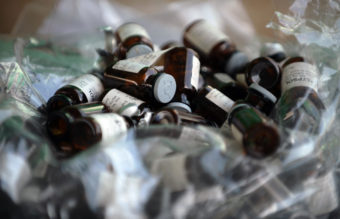
These glass capsules contain the drug ketamine. (Photo by Nicolas Asfouri/AFP/Getty Images)

Special K. K-land. Or even “baby food,” because “users sink into a blissful, infantile inertia,” the Drug Enforcement Agency says — ketamine is best known as an club drug here in the U.S.

Most recently, ketamine played an integral role in HBO’s summer murder mystery “The Night Of” — Andrea and Naz took some and hooked up. He blacked out and awoke to find her stabbed to death in her bed. And he doesn’t remember if he did it.

But in many countries around the world, the hallucinogen has another purpose: It’s the only drug available to sedate people during surgeries or to help with pain after operations.

“Ketamine is a safe, simple and cheap anesthetic,” says Dr. Jannicke Mellin-Olsen, an anesthesiologist at Baerum Hospital in Oslo, Norway. “It is vital to global health.”

And she is trying to keep it that way.

Mellin-Olsen was just elected as one of two presidents of the World Federation of Societies of Anesthesiologists. At the group’s annual meeting in Hong Kong last week, she called on the U.N. to keep ketamine free of global trade restrictions and not to treat the drug as a controlled narcotic, like heroin and cocaine.

“The experience with restricting other medicines, like morphine, is that governments put so strict procedures for acquiring it, that it in effect, it becomes unavailable,” Mellin-Olsen says.

“That would be catastrophic for millions of people,” says Miguel Trelles, an anesthesia adviser for Doctors Without Borders, who coordinates their surgery and emergency medicine unit. “I’m not saying ketamine is a panacea,” he says, “but it saves lives.”

When you have surgery in the U.S., doctors give you a cocktail of drugs to knock you unconscious. Some of these drugs lower your blood pressure and suppress your cough reflex — which keeps you from choking on your own vomit. So doctors put a tube in your throat to make sure your airway is always open. They also have to monitor your blood pressure and breathing throughout the operation.

But with ketamine, these fancy monitoring machines and procedures aren’t necessary, Trelles says. Health workers don’t need electricity, an IV or much training to use it. And ketamine doesn’t interfere with your cough reflex, he says. So doctors don’t have to put a tube in a patient’s throat.

All these properties mean that hospitals in poor countries can still use ketamine for sedation and pain relief, even if they don’t have trained anesthesiologists on staff. At Doctors Without Borders clinics around the world, doctors and nurses use ketamine in about 90 percent of C-sections and 95 percent of trauma surgeries in war zones, after earthquakes and in ERs.

But ketamine can have some serious side effects, such as flashbacks, amnesia, impaired motor function, loss of touch with reality and panic attacks.

When people take ketamine recreationally, they can build up a tolerance. Some people end up taking large quantities. Over time, the drug can permanently damage the kidneys and bladder, causing severe cramps, bloody urine and painful urination.

But chronic use of ketamine was never what its creator had in mine.

Back in the 1960s, Calvin Stevens was a chemist at Parke-Davis pharmaceutical company. He was trying to create for an anesthetic to replace PCP, which had some bad side effects.

Eventually, Stevens synthesized ketamine. And he struck gold.

The drug could sedate someone in minutes and wore off after only an hour or so. By 1970, the Food and Drug Administration approved the drug as a fast-acting, short-lasting anesthetic. A few years later, military doctors and nurses were using it on soldiers in the Vietnam War.

But over time, better anesthetics and analgesics slowly replaced ketamine in Western operating rooms, except for pediatric and veterinary surgeries. Recreational drug users discovered the drug’s trance-like properties. Eventually the abuse of ketamine started to overshadow its medicinal use.

The biggest problems with ketamine abuse have arisen in southern Asia, especially China.

“Ketamine is the most popular of all recreational drugs taken in South China, which is arguably the epicenter of global ketamine consumption and production,” Vice’s Motherboard wrote a few years ago in a feature about the drug. “Here, in the heart of China’s longtime manufacturing base, the drug is snorted and swallowed on a level unheard of in the West.”

One study found the number of ketamine abusers more than tripled in Hong Kong from about 1,600 people in 2000 to more than 5,000 in 2009.

And the ketamine problem has continued to spread throughout East Asia and Australia, according to the U.N. Office of Drugs and Crime. “But because ketamine is a legal substance — and therefore not controlled — the true extent of its use is unclear and probably underestimated.”

Right now, the U.N. recommends no restrictions on the trade and distribution of ketamine. It’s up to individual countries to regulate it.

But China wants that to change. The country has petitioned to the U.N., four times since 2006, to designate ketamine as a controlled narcotic. The U.N. rejected its latest petition this past May, after the World Health Organization recommended against regulating the drug.

“The medical benefits of ketamine far outweigh potential harm from recreational use,” Marie-Paule Kieny of WHO said in December. “Controlling ketamine internationally could limit access to essential and emergency surgery, which would constitute a public health crisis in countries where no affordable alternatives exist.”

Copyright 2016 NPR. To see more, visit http://www.npr.org/.

Federal grants awarded to combat opioid use in Alaska

Prescribing of oxycodone and other opioid pain pills rose sharply after 2000. John Moore/Getty Images
Prescribing of oxycodone and other opioid pain pills rose sharply after 2000.
(Photo by John Moore/Getty Images)

Three multi-year federal grants focused on combating opioid use have been awarded to the Alaska Department of Health and Social Services.

The grants will amount to an estimated $3 million annually. One three-year grant from the Center for Disease Control totals $750,000, and will focus on data collection, analysis, policy review and public education on opioid overdoses.

The other two grants come from the Substance Abuse and Mental Health Services Administration. The first will fund $1 million annually for up to three years to expand medication-assisted treatment in the state. The second will provide another $1 million annually for five years to purchase and distribute naloxone, as well as train first responders on its use.

Gov.  Bill Walker stated in a press release his appreciation for this federal funding to help save lives and support Alaskan families and communities hurting from opioid addictions.

The grant period began on Sept. 1.

Site notifications
Update notification options
Subscribe to notifications