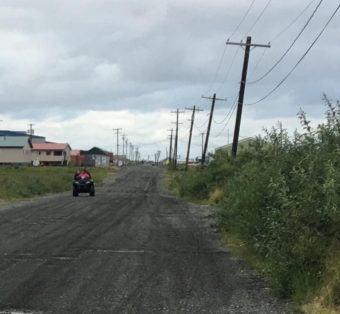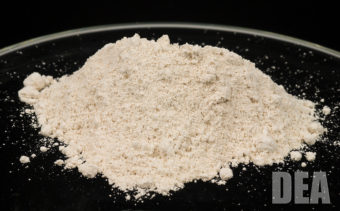
Four people have suffered apparent heroin overdoses earlier this week in Quinhagak, a village of about 700 people in the Bethel Census Area in southwestern Alaska. One person, who has been identified as Jamie Roberts, 19, died in an apparent heroin overdose. (Photo by Adrian Wagner/KYUK-Bethel)
Update 11:14 a.m. Friday, Aug. 19, 2016: Authorities have released the name of the teenager who died of an apparent heroin overdose in Quinhagak this week and say they are still investigating.
Jamie Roberts, 19, was pronounced dead Monday evening after more than two hours of resuscitation efforts.
Robert’s body has been sent to the State Medical Examiner for autopsy.
Western Alaska Alcohol and Narcotics Team, or WAANT, is in charge of the investigation.
Two men also overdosed that night and were medevaced to Bethel for treatment. Both have been discharged.
A fourth overdose was treated on site.
Quinhagak responds to a series of apparent heroin overdoses
The other man has not yet returned. The third person, a woman, is dead. The fourth person was treated on site.

Earlier reports stated three overdoses, but as of Wednesday afternoon, Trooper spokesman Tim DeSpain said four overdoses happened within the same timeframe.
Quinhagak tribal administrator Patrick Cleveland said one right after the other, three people apparently overdosed on heroin Monday evening.
“The first person that was found was unresponsive,” Cleveland said. “Not breathing, lips had turned blue and had to be revived with CPR.”
A medevac picked up the man, and before the aircraft could land in Bethel, another overdose was called in. When the medevac brought the second man to Bethel, word of the third overdose reached them, but that person was already dead.
“The young lady that passed, I think she was just out of high school, and the two men are late 20s, early 30s,” said Cleveland.
The deceased was 19 years old, DeSpain said. Her body has been taken to Anchorage for autopsy.
The fourth person, DeSpain said was treated in the village and not flown out. When the fourth overdose occurred hasn’t been released.
Cleveland said that in the 700-person village, no one is unaffected by the tragedy.
“I mean it pretty much shocked the whole community,” Cleveland said.
The overdoses have ignited anger at the drug dealers and a drive for change.
Michelle Matthew with the City of Quinhagak is organizing a community meeting for 5 p.m. today at the school gym to discuss the issue of drugs in the community and what people can do about it. Her expectations for the gathering run high.
“I hope people get a sense of hope and fearlessness, because that’s what’s driving these drugs to run amok in our villages,” she said. “Because people are afraid to speak up, and now we are.”
Matthew said the tribe is discussing placing extra security measures at its tribally-owned airport, something that she said has been brought up in the past.
The WAANT Trooper division — the Western Alaska Alcohol and Narcotics Team — is in town investigating the overdoses, and a team from Yukon Kuskokwim Health Corporation is expected to arrive today to debrief first responders and families.
Anchorage Police Chief Chris Tolley addresses reporters during a brief press conference in July of 2016. (Photo by Zachariah Hughes/Alaska Public Media)
The year 2016 has been the fourth deadliest year in two decades, according to data provided by the Anchorage Police Department.
Twenty-four people have been killed so far in the municipality this year.
In July alone there were nine homicides within the city. The figures come on the heels of 2015, which saw the highest number of murders since 1995.
The persistent news of violent incidents has many residents asking whether something has changed and made the city more dangerous.
“There’s no doubt about it,” Anchorage Police Chief Chris Tolley said during a recent interview. “Right now we’re having a lot of crimes. And I’m concerned, and I know the community is concerned.”
The police department tracks a lot of data related to crime and is seeing a 15 percent increase in calls for service, according to Tolley. That uptick in the overall volume includes everything from assaults to property theft to reports of suspicious activity.
But what has most people’s attention is what seems like a lot more violent crime –shootings, stabbings, and a rash of murders, 12 of them clustered around just six weeks this summer between June 27 and August 5.
Two of the deaths this year were officer-involved, including one in July, which some feel should not be counted alongside other homicide or non-negligent manslaughter cases.
Tolley is most concerned about the how persistently it’s young people being killed in incidents this year.
“We’re seeing a trend here where half the victims are under the age of 21,” he said.
There is no one cause that explains all of this year’s homicides, Tolley is quick to point out.
Investigators have found no compelling evidence the murders are linked to gang activity.
Mental health problems have played a prominent role in some of the events, but the most consistent factor is the presence of drugs and alcohol.
“Most of these incidents are things that went too far,” Tolley said. “Disputes over different things, over drugs or things like that.”
Thirty percent of the cases are connected to domestic violence, which is up from an average closer to 20 percent, Tolley said.
Across the municipality, neighborhood crime watch groups post information to Facebook pages, much of it unconfirmed, according to APD spokesperson Jennifer Castro. A growing number citizens are signed up to get crime alerts sent straight to their phones. It can be easy to feel like chaos is descending, simply because a torrent of ominous information is constantly pouring in. Tolley and other city officials are urging a bit more hesitation and consideration, based on the actual number.
The homicide rate in Anchorage has fluctuated between 3.7 and 7.7 deaths per 100,000 residents during the last decade. If 2016 ends with no more murders — which would be unlikely — it would equate to a rate of close to eight.
By contrast, the murder rate in St. Louis last year was 59.
Tolley called a violent year like this in Anchorage a “fluke,” but does not consider it either unprecedented or an anomaly.
“Over eight and 10 year trends you do see spikes like this,” he said. “Is this one of those spikes? Probably.”
The year is far from over, he adds.
In response to violence, particularly among young people, the department plans on relying more heavily on School Resource Officers — the police who are permanently stationed within schools — once classes resume. As staffing levels within APD rise, the department is re-evaluating its policies and procedures to find updates and efficiency. They’re also trying to develop better lines of communication with communities.
Tolley cautions that police are only one part of a comprehensive solution, and one that’s often called upon only in the aftermath of violence.
“This isn’t about the police department solely. It’s about our community,” Tolley said. “I can’t fix this by myself, the administration can’t fix it by itself — it takes the community to take ownership over this. Police are not a substitution for health services. Police are not a solution for school teachers.”
It’s a view shared by Mayor Ethan Berkowitz’s administration, which is committed to restoring police staffing levels that saw a dramatic reduction under the previous administration.
“The police force has grown substantially over the last year. We’re almost at 400 officers now, which was the goal,” Berkowitz said.
More police officers is the starting point for improved public safety, in Berkowitz’s view, because the extra capacity means officers can be more proactive, instead of constantly responding to incidents once they’ve already occurred.
Like Tolley, the mayor sees the recent violence as beyond any single, easy explanation. However, he believes problems are being exacerbated by shrinking state support in areas that overlap with violent crime, like reduced drug and alcohol treatment options, and the release of prisoners from correctional facilities.
Berkowitz is adamant that even amid recent upticks, Anchorage is still a relatively safe city.
“The idea that you can have a totally safe community is something we aspire to, but it’s not gonna happen,” he said of the notion that crime could be fully eradicated.
Berkowitz and Tolley also share the view that the recent violence is overwhelmingly connected to the drug trade and what the mayor calls “bad lifestyle choices.”
The other substantial piece in the administration’s approach to community policing has been trying to foster and rebuild community partnerships.
“The community also has a responsibility to help the police do their job,” Berkowitz said.
Some see the administration’s manner so far as more dictatorial than an equal partnership.
“If our community is not involved in providing the solutions, then we’re already missing the peace,” said Mao Tosi, a community advocate who’s been deeply involved with the city’s anti-gang efforts and supporting at-risk youth.
His diagnosis traces the escalation in violent crime to cuts in social services and opportunities for low income communities started in 2009 under the administration of Mayor Dan Sullivan. Those reductions to services and staff haven’t yet been recouped, according to Tosi.
“So we have less police officers,” he said, counting off lessened support in the last few years. “In our school district they’re cutting funds in our education, so we have less teachers, less programming.”
“All these things are almost the perfect storm of issues coming together,” Tosi added.
He supports the administration’s efforts to pursue a better community policing model, but thinks that after several years of worsening relations between APD and communities experiencing the heaviest toll from violent crime the gap is dauntingly wide. Efforts at improved communication are great, but he says that so far policy has come from the top floor of city hall, without enough input from those closest to what’s happening on the street.
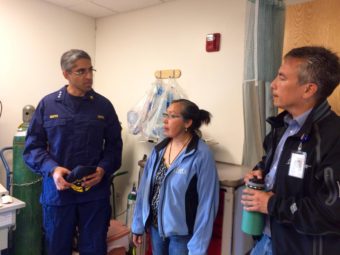
U.S. Surgeon General Dr. Vivek Murthy in the Napaskiak clinic with Community Health Practitioner Augusta Williams and YKHC CEO Dan Winkelman. (Anna Rose MacArthur, KYUK)
The national opioid epidemic gives no exception to rural Alaska.
The U.S. Surgeon General will release a report on substance abuse addiction and health later this year.
To prepare, the nation’s top medical officer is meeting with health care providers around the country on ways to prevent or treat opioid addiction.
U.S. Surgeon General Vivek Murthy traveled last week to Napaskiak, a town of 500, located 7 miles down the Kuskokwim river from Bethel, to learn how the opioid epidemic is affecting the small Alaska village, but Larson has other issues on his mind.
“We have a water and sewer haul system, and like 40 percent of the home system is not working,” he said. “And we’re having problems with sanitation.”
Larson’s list continues.
Alcohol-related problems like public drunkenness and domestic violence have increased since Bethel opened a liquor store, he said.
“Another issue that we’re facing today is suicide,” he said. “We have like 500 people, and we lose one person every year.”
He attributes the deaths to not enough jobs, cultural ties between elders and young people unraveling, and drugs.
“But it’s been around for a long time, the alcohol and drug abuse,” he said. “I think there’s more of it today.”
Opioids can often lead to heroin once the opioid prescription runs out or gets too expensive.
On the clinical side, the health corporation offers offering Narcan, a drug that blocks the effects of opioids and can reverse an overdose. It is also closely monitoring how many opioids it’s prescribing and for how long. On the behavioral health side, the health corporation heavily relies on tele-medicine. That’s when a patient talks to a counselor through a TV screen.
Murthy sees this technology, combined with drugs like Narcan, holding the greatest hope for rural communities such Napakiak for accessing substance treatment.
The U.S. Surgeon General’s office will release a report later this year on treating substance abuse addiction.
Surgeon General reports— such as the 1964 report on tobacco— have a history of changing government policy and health care.
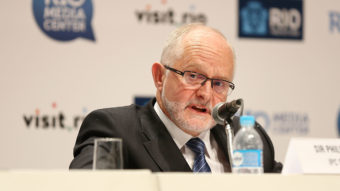
Sir Philip Craven, president of the International Paralympic Committee, announces Sunday that the entire Russian Paralympic team will be barred from next month’s games in Rio de Janeiro. “The anti-doping system in Russia is broken,” he said. Joe Scarnici/Getty Images
Russia’s entire Paralympic team is banned from next month’s Paralympics in Rio de Janeiro as part of the same doping scandal that also cost Russia a large part of its Olympic team.
“The anti-doping system in Russia is broken, corrupted and entirely compromised,” Sir Philip Craven, president of the International Paralympic Committee, told a news conference in Rio on Sunday.
In scathing language, Craven went on to say:
“I believe the Russian government has catastrophically failed its para athletes. Their medals over morals mentality disgusts me. The complete corruption of the anti-doping system is contrary to the rules and strikes at the very heart of the spirit of Paralympic sport. It shows a blatant disregard for the health and well-being of athletes and, quite simply, has no place in Paralympic sport. Their thirst for glory at all costs has severely damaged the integrity and image of all sport.”
“As a result, the Russian Paralympic Committee is suspended with immediate effect,” he added. The committee said its decision was unanimous.
Russia’s Sports Minister Vitaly Mutko said his country would appeal the ban, Reuters reported.
The Olympic Games, which opened Friday, run through Aug. 21 in Rio, while the Paralympics will be held in the city from Sept. 7 through 18.
The Paralympic Committee said Russia had received 267 slots for its para-athletes in 18 sports and it was now trying to determine what to do with those positions, which could go to other countries.
Many of Russia’s Olympic and Paralympic athletes were tested at the same Moscow lab that’s been implicated in the doping scandal.
Yet the International Olympic Committee decided not to ban the entire Russian Olympic team despite a detailed report last month by The World Anti-Doping Agency that found evidence of systematic, state-sponsored doping in Russia dating back to 2010. About 120 Russian Olympic athletes have been barred and around 270 have been cleared to compete.
The report last month found there were recurring cases of “disappearing positive samples” at the Moscow lab where athletes and para-athletes were tested. That investigation produced 35 names of Russian para-athletes who had disappearing samples, the IPC said.
The Russians have one of the world’s top Paralympic teams. They won 102 medals at the 2012 Summer Paralympics in London, coming in third, behind China and Great Britain and just ahead of the United States.
Copyright 2016 NPR. To see more, visit http://www.npr.org/.
Cook Inlet Tribal Council runs one of only two detox centers in the state of Alaska.
At the Alaska Wellness Summit in Palmer Thursday, CITC CEO Gloria O’Neil announced that the Ernie Turner Center in Anchorage will be sold to Southcentral Foundation.
O’Neil said the move is part of a plan to expand CITC’s addiction treatment services to the Matanuska-Susitna area.
“And SEF will take up providing detox, being a medical provider, and CITC will focus on expanding treatment beds to the community,” O’Neil said. “And we’re able to respond to the complex needs and the changing needs in the community.”
The Ernie Turner Center is the only detox facility in Anchorage and maintains the only drug addiction beds available to Muni and Mat-Su patients.
O’Neill said that CITC will partner with the Knik and Chickaloon tribes on Mat Su drug and alcohol treatment services.
Close
Update notification options
Subscribe to notifications
Subscribe
Get notifications about news related to the topics you care about. You can unsubscribe anytime.