Alcohol & Substance Abuse

Organ Donations Spike In The Wake Of The Opioid Epidemic

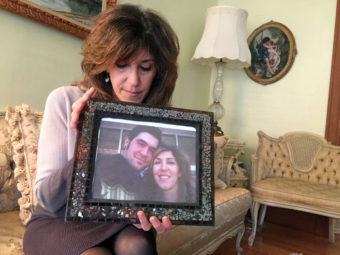
Debbie Deagle holds a photo of her son Stephen and herself. (Photo by Martha Bebinger/WBUR)

On the final day of June 2015, Colin LePage rode waves of hope and despair. It started when LePage found his 30-year-old son, Chris, at home after an apparent overdose. Paramedics rushed Chris by helicopter to one of Boston’s flagship medical centers.

Doctors revived Chris’ heart, but struggled to stabilize his temperature and blood pressure. At some point, a doctor or nurse mentioned to LePage that his son had agreed to be an organ donor.

“There was no urgency or, ‘Hey, you need to do this.’ I could see genuine concern and sadness.” LePage says, his voice quavering.

The next morning, after another round of tests showed no signs of brain activity, LePage said goodbye to the son who’d been revived but wasn’t fully alive.

“I sat in a chair with him and held his hand,” LePage says. “It wasn’t clinical. It didn’t feel like someone’s gaining something here. I knew that someone was, and that’s comforting that someone else has been able to have a little piece of my son and some of their pain is not what it used to be.”

Chris’ liver is now working in the body of a 62-year-old pastor. His case is one among the nearly 900 percent increase so far in donations across New England since 2010. So far this year, more than 1 in 4, or 27 percent, of donations in New England are from people who died after a drug overdose. Nationally, that rate dips to 12 percent for the same time period.

“It’s remarkable and it’s also tragic,” says Alexandra Glazier, president and CEO of the New England Organ Bank. “We see this tragedy of the opioid epidemic as having an unexpected life-saving legacy.”

That legacy is much more dramatic in New England than across the U.S. as a whole, where organ donations from drug users are up from 341 in 2010 to 790 through Aug. 31 of this year.

Percentage of organs donated by overdose donors
Source: The New England Organ Bank

It’s not clear why. Overdose death rates are high in New England, but not the highest in the country. Glazier says the 12 transplant centers in that region may be more aggressive about finding a match for patients with failing hearts, livers or kidneys. And she says New Englanders tend to be pragmatic about end-of-life decisions.

Some hospitals in Massachusetts report that they are performing a record number of transplants. At Lahey Hospital and Medical Center in Burlington, the number of patients receiving a liver transplant has roughly doubled in the past three to four years.

Hospitals are required to test organs and warn patients if there is a risk of contracting HIV or hepatitis B or C, which are more common in IV drug users. That risk may be less troubling for patients these days because there are drugs to treat these viruses if patients become infected.

Some patients in need of organs still hesitate at the idea of accepting a liver or kidney donated by a drug user. But not at Lahey, where Dr. Mohamed Akoad chairs the department of transplantation.

“Most of these patients trust the fact that these donors are tested and they understand that their chance of dying while waiting for an organ is high,” he says.

Akoad says Lahey has not had any cases of HIV or hepatitis B or C transmission in recent years.

That’s the case at Mass General in Boston as well. Dr. Jay Fishman, associate director of the hospital’s transplant center, says an organ from someone who used drugs is not necessarily risky and may even be healthier than other options.

“You have to remember that as awful as this outbreak is, these are younger people who are dying, often with needles in their arms, and many of them were first-time drug users,” Fishman says. “They weren’t all addicts.”

Despite the increase in available organs, there’s no sign that the supply is keeping up with the demand from aging Americans and those with chronic diseases.

“The number of people on the waiting list is increasing faster than the number of donors, even with the increases related to overdoses,” says Dr. David Klassen, chief medical officer at the United Network for Organ Sharing, which tracks and manages organ donations in the U.S.

There are likely many more organs available from the victims of drug overdoses than those collected. Some patients addicted to heroin or other opioids don’t carry a driver’s license, haven’t spoken to a family member about their end-of-life wishes, or aren’t in touch with family members who could give consent to donate an organ.

“I’ve never heard anyone talk about organ donation as a possibility. I’m not sure it’s on their radar screen,” says Dr. Jessie Gaeta, chief medical officer at the Boston Health Care for the Homeless Program.

Gaeta says she isn’t sure how she would suggest organ donation, even to her high-risk patients.

“It’s really nihilistic to say that to someone in their early 20s,” Gaeta says. “I have so much hope for my patients, yet if someone does die and there’s a chance for their organs to be helpful, that’s one good thing to come of a death like that.”

For many mothers and fathers, sisters and brothers who’ve lost someone to an overdose, organ donation is a nearly taboo topic. It can trigger feelings of guilt, anger and despair, even among people who participate.

Debbie Deagle sat next to her son Stephen’s unresponsive body for six days before agreeing to turn off his respirator.

“Before they took him,” Deagle says, weeping, “I had my head on his heart, just so I could hear that beat, and they had to peel me off.”

More than a year later, Deagle is still haunted by questions: Should she have asked for another opinion about the scans of Stephen’s brain?

“Never in a million years do you ever visualize kissing your child whose heart’s beating and having to watch them wheel that stretcher away and know they’re going to cut him open and take out a beating heart,” Deagle says.

The transplant patient who received Stephen’s heart did not make it, leaving Deagle with the feeling her son had died again. She has written to the patients who received Stephen’s liver and kidneys, but has not heard back.

This story is part of NPR’s reporting partnership with WBUR and Kaiser Health News.

Copyright 2016 WBUR. To see more, visit WBUR.

Man charged with DUI after hitting Ketchikan welcome arch

A 24-year-old Ketchikan man was charged with drunken driving after allegedly driving into the Welcome Arch on Mission Street downtown late Wednesday.

Officers received a report about midnight of a vehicle hitting the Ketchikan Welcome Arch, according to the Ketchikan Police Department.

Police contacted the driver, who appeared intoxicated but refused to submit to field sobriety tests and refused to provide a breath sample.

The man was charged with driving under the influence and refusal to submit to a chemical test.

He was taken to the jail where he was processed and then released on his own recognizance.

Marijuana fees could fund Sitka student travel

marijuana in hand
Marijuana. (Creative Commons photo by Katheirne Hitt)

During their regular meeting Tuesday night, the Sitka Assembly approved – on first reading – a dedicated fund for student activity travel using marijuana fees.  See ordinance here: Ord 2016-39

The ordinance, co-sponsored by Assemblyman Steven Eisenbeisz and Deputy Mayor Matthew Hunter, proposes depositing all money generated from marijuana licensing fees into a specific fund for student travel. Depending on how Sitka’s marijuana industry evolves, Eisenbeisz believes this could generate $8000 to $10,000 a year for activity travel sponsored by the Sitka School District.

This year, Sitka High School received roughly $132,000 for student activities from the city. The local contribution has been fairly stable, but with more teams and clubs flying to meets, the need is greater.

Superintendent Mary Wegner appreciates the Assembly’s work.

“Activities and athletics are a great antidote to smoking marijuana. When you’re involved with activities, you don’t want to. So it is a very interesting and novel approach, but I appreciate the [Assembly’s] creativity in keeping the students first and foremost in their minds and in their actions,” Wegner said.

The Assembly also decided – on first reading – to move $250,000 from the general fund into a committed fund balance for landslide mitigation. This includes legal, geotechnical, and other costs anticipated by the city.

Specifically, the city wants to proceed with geotechnical mapping around Keet Goshi Heen Elementary School, which has been identified as a moderate risk area. City Administrator Mark Gorman said some of the money could also be used for legal fees related to the Kramer Avenue landslide.

“We have two suits that have been filed against the city, related to the landslide. These came in about six weeks ago. We are working with council – David Bruce, who you met with several times – and he’s given us his best case scenario as to what the expenses are going to be this year. And it includes geotechnical work,” Gorman said.

Bruce, an attorney based in Seattle, has been working with the city since November. Gorman also hopes the city’s insurance will kick in to help with legal fees.

In other business, Sitka Community Hospital took a major step toward paying down its line of credit, which the Assembly increased two years ago to resolve the hospital’s cash crisis. The hospital is in a much better financial position now, with 81 days of cash on hand. And Tuesday night (09-27-16), they presented the Assembly with a check for $463,000 towards that line of credit.

“That will bring us down where we’ll owe slightly less than $1 million dollars,” said hospital CEO Rob Allen. We’re also set up so that from this month forward, we’ll be making monthly payments on the line of credit.

ECG Consulting is currently looking at ways for Sitka Community Hospital and SEARHC to integrate operations. Allen says the hospitals will hold a work session with the Assembly in November to discuss the findings.

During his report, City Administrator Mark said that construction on Jeff Davis Street may take longer than anticipated due to issues with the old sewer main.

The Assembly’s next meeting will take place on October 11th in their new chambers at Harrigan Centennial Hall. During that meeting, the current Assembly will resolve old business and then change hands, welcoming a mayor and either one or two new Assembly members.


Advocates frustrated with pace for rules to dispense overdose antidote

Nalaxone Narcan
(Creative Commons photo by Punching Judy)

Advocates of a bill that would allow pharmacists to dispense an opioid-effects blocking drug with restrictions are frustrated that regulatory barriers the law was supposed to knock down are still up.

Gov. Bill Walker signed the  law six months ago to ease access to the life-saving drug, but new rules are more than a month away.

Scores of people have died in Alaska from heroin and other opioid overdose deaths this year, according to some estimates.
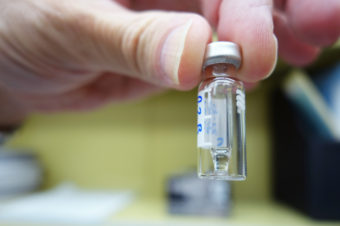
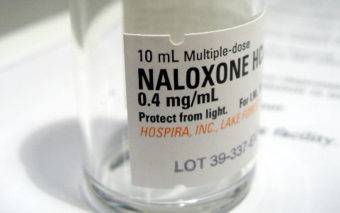
The drug naloxone, also known by the brand name Narcan, can block the effects of opioids and has been known to reduce the rates of opioid-related overdose deaths.

Senate Bill 23 sponsor Sen. Johnny Ellis, an Anchorage Democrat, said he’s frustrated with the time it’s taking to write the rules.

“The board of pharmacy in my opinion has been very bureaucratic in dragging their feet when lives are at stake,” Ellis said.

Ellis wrote in a letter to Walker dated Sept. 2 that the Alaska Board of Pharmacy should move faster.

The law gives pharmacists the ability to independently dispense naloxone if they complete a training program. The rules that are being written would implement these parts of the law.

Department of Commerce, Community and Economic Development officials working with the board of pharmacy said the board is following the law.

They laid out a timeline that could lead to the final rules in November.

Department Division Operations Manager Sara Chambers said the board is gathering public comment on the rules.

“This isn’t a rubber stamp process that the law requires the board to follow,” Chambers said. “It requires them to give thoughtful consideration to both the dispensation standards and the training program standards.”

Michele Morgan of the Juneau-based organization Stop Heroin, Start Talking said she’d like to see the board of pharmacy adopt emergency regulations, which would allow the board to issue rules before the public process is over, and to later make changes based on public comments.

“It’s important for people who not only are using drugs like heroin off the street but even people who are using prescription opiates to have that (naloxone) and to empower that family or the mother or the friend to be able to save that person’s life,” she said.

Nalaxone reverses the effects of opioid overdoses.

But Chambers said the idea of emergency regulations wasn’t raised until rule-writing was well underway.

She said the Department of Law advised against it.

The board did issue guidance to pharmacies that said they could comply with Senate Bill 23 and dispense naloxone before the rules are finalized.

But Ketchikan pharmacist Barry Christensen said pharmacies aren’t likely to dispense naloxone without a prescription from a doctor or other prescriber until the rules are done and the training is available.

“The number of pharmacies that are going to have that available, I think are going to be very limited until everything gets completed,” on the regulations, Christensen said.

A separate track for advancing the use of naloxone is moving forward much faster.

The Department of Health and Social Services was awarded a five-year, $4.5 million federal grant to buy and distribute — and train people to use — naloxone.

Andy Jones oversees the naloxone program for the department. He’s chief of rural and community health systems.

The program would allow drug users and their family members, as well as law enforcement, healthcare providers, and others in contact with drug users to have access to naloxone with training.

Jones said the state received the grant two and half weeks ago, has already ordered its first batch of naloxone doses, and wants to have the drugs available by mid-November.

“You know, we have an aggressive schedule,” Jones said. “The reason we have an aggressive schedule is because once naloxone is in our hands, it doesn’t do us any good at the state to be holding onto it and waiting and waiting to build a program. It’s intended to go to the local jurisdictions, so that they can hand it and they can provide it, actually, to the general public.”

The state had 83 prescription opioid overdose deaths and 36 heroin overdose deaths last year. Jones says overdose deaths are likely higher this year, although an official count isn’t available.

Deadly Opioid Overwhelms First Responders And Crime Labs in Ohio

Bob Topmiller, chief of toxicology at the Hamilton County Coroner's Office, holds a small vial containing carfentanil extracted from a sample of blood. Jake Harper/Side Effects Public Media
Bob Topmiller, chief of toxicology at the Hamilton County Coroner’s Office, holds a small vial containing carfentanil extracted from a sample of blood.
Jake Harper/Side Effects Public Media

Jamie Landrum has been a police officer for two years in District 3 on the west side of the Cincinnati. In late August, the city was hit by 174 overdoses in six days. Landrum says officers were scarce.

“We were literally going from one heroin overdose, and then being on that one, and hearing someone come over [the radio] and say, ‘I have no more officers left,’ ” Landrum says. Three more people overdosed soon after that.

Heroin isn’t new in Cincinnati, but the recent surge in overdoses is being blamed on an even more potent drug called carfentanil. It’s 100 times stronger than fentanyl, a more common synthetic opioid that is itself much stronger than heroin. Carfentanil is used to sedate elephants. It can be dangerous to even touch it without gloves.

City and county agencies in the Cincinnati area — from law enforcement to the county coroner — are straining to respond to the carfentanil wave.

Carfentanil is part of a shift to synthetic opioids in Cincinnati and around the country. Last year in Hamilton County, Ohio, there were more deaths attributed to fentanyl than to heroin.

Suspected carfentanil cases were first reported in the U.S. in July in Ohio. The rate of overdoses has dropped since that shocking 174 in six days, but not by much. There are currently 20 to 25 overdoses a day, on average, reports Hamilton County’s heroin task force. Police are calling it the new normal.

About an hour into a recent shift, Officer Landrum gets a call. A man has overdosed at an apartment building on the outskirts of town. His girlfriend found him and called 911.

By the time we get there, there’s a crowd outside. The man is unconscious in the back of the ambulance, and EMTs have given him three doses of Narcan, an antidote for opioid overdose. For a heroin overdose, one round of Narcan is usually enough.

EMTs clap and shout his name, trying to wake him up, but something’s wrong. They turn off the music blaring in the ambulance and continue working. After a few minutes, Officer Landrum gives me an update.

“This is the most I’ve ever seen,” she says. “He’s gotten four Narcans so far, and he’s still not awake.”

The EMTs decide to take him to the hospital. We follow, not knowing if the man will make it. “Whatever he got ahold of, it’s really bad,” Landrum says.

For first responders, the arrival of carfentanil can be summed up with one word: More. More overdoses, more Narcan, more time spent on each call.

And when the efforts to save someone’s life fail, more work gets passed on to the Hamilton County Coroner’s Office.

“The caseload keeps getting larger and larger,” says Bob Topmiller, who heads the toxicology section at the coroner’s office, where they test blood and urine. “We may have had a 100- or 150-case backlog a year ago, and it’s almost doubled.” The time it takes to process a sample has also doubled, from one month to two.

Evidence of the deluge is all over the lab: Equipment spills into the hallways, envelopes cover the intake desk, and everyone seems to be busy.

And it’s more than the number of cases causing the flurry of activity. It’s the fact that the drug was never meant for people.

“It’s what we don’t know about this drug that scares us,” says Dr. Lakshmi Sammarco, the coroner for Hamilton County. “We don’t have any human testing data. We don’t know what the lethal level really is. There is no therapeutic level — it’s not meant for human use.”

Dr. Lakshmi Sammarco, the coroner for Hamilton County, Ohio, worries about the paucity of information about how carfentanil, an animal drug, affects humans. Jake Harper/Side Effects Public Media
Dr. Lakshmi Sammarco, the coroner for Hamilton County, Ohio, worries about the paucity of information about how carfentanil, an animal drug, affects humans.
Jake Harper/Side Effects Public Media

That means Sammarco’s team is using the samples coming in to try to extrapolate some important information, like the lethal dose per kilogram of body weight, or how long carfentanil stays in someone’s system — things that could help the people treating the overdoses.

Sammarco says this process is part of a pattern they’ve dealt with before, playing catch up with the suppliers as new drugs appear.

“However, in the spectrum of opiates, this is about max,” she says. “Out of all of them, carfentanil really is the most potent.”

For now, Sammarco can only say that there have been eight deaths in which carfentanil might be the cause. Her office is working to test samples dating back to July, when the drug first showed up in Ohio.

At the hospital, Landrum follows the overdose victim into the emergency room. After about half an hour, doctors and nurses stabilize him.

We leave after that. The man didn’t have any drugs on him, so he wasn’t charged with any crime. His girlfriend wouldn’t say where the drugs came from, though she did mention that the two of them had overdosed the week before.

“Believe it or not, we’ll probably be responding out for her here shortly,” says Landrum. Even after close calls, people keep using. Addiction is too strong.

What’s worse, the danger of carfentanil seems to act as an advertisement: People seem to equate near death with a really good high, and the problems in Cincinnati are attracting customers. Landrum says recently she met a couple from Indianapolis in town to buy drugs. Another officer talked to people from central Kentucky.

So far, the DEA says carfentanil has only been confirmed in Ohio and Kentucky. Other states are starting to test for it, bracing for its arrival.

This story is part of a reporting partnership with NPR, Side Effects Public Media and Kaiser Health News.

Copyright 2016 Side Effects Public Media. To see more, visit Side Effects Public Media.

Parole violation sends ‘the banished man’ back to jail

Derek Adams - The banished man
Derek Adams teleconferences into his arraignment at the Bethel courthouse on Friday. (Photo by Adrian Wagner/KYUK)

Derek Adams, “The Banished Man” as some have begun to call him, was arrested Wednesday for violating his parole.  Law enforcement officials found that he was carrying hundreds of dollars in cash and a large amount of what appears to be heroin.

According to his report, Bethel Police Sgt. Jeff Lee stopped Derek Adams early Wednesday morning during a routine traffic stop. Adams gave Lee a false name during the stop, but Lee recognized Adams and smelled alcohol on his breath. Lee arrested Adams for violating his parole, which forbade the consumption of alcohol. It was later determined that Adams also tested positive for THC and opiates.

After Adams was taken to the Yukon Kuskokwim Correctional Center, he attempted to dispose of a package filled with a suspicious substance while using the bathroom. In an affidavit, officials said that they found the package hidden behind the toilet. They then strip searched Adams and found another package. Samples from both tested positive for heroin. The report described differences in the appearance of the two packages. The first bundle contained a white and brown powder, while the second held a black tar-like substance.

The report goes on to say that the suspected heroin was split into smaller tinfoil-wrapped portions and that some had been numbered, indicating that Adams was probably selling the drugs or delivering them. Police said a gram of heroin sells for $500 to $800 in Bethel but did not specify how much heroin was found on Adams. The document also states that drug dealers often do not deliver drugs themselves because of the risk of getting caught. Officials also found several hundred dollars on Adams.

Authorities are charging Adams with two drug related felonies and one drug related misdemeanor.

This arrest comes just a week after Adams was sentenced to time served, and what amounted to 10 years of probation for criminally negligent homicide connected to a 2013 fire that killed three people in the village of Nunam Iqua. Adams was jailed for three and a half years following the fire, released for good behavior, and then banished by Nunam Iqua and two nearby villages. At last week’s sentencing, Judge Charles Ray said that he hoped the 22-year-old would take this opportunity to turn his life around.

Adams was arraigned Friday at the Bethel courthouse. His bail was set for $50,000. His next court date was set for Oct. 3.

Adams was prosecuted by District Attorney Michael Gray, who set up a plea deal for Adams in the case involving the Nunam Iqua fire. Many community and village members believed that the prosecution was soft on Adams during last week’s sentencing. Gray said Thursday that the state did not have enough evidence to prosecute Adams for the crimes they believed he might have committed.

“I suppose I’m not surprised to see him back; I’m surprised to see him back this soon. And the cases are really different cases. You don’t prosecute someone because you think they are a bad actor, you prosecute someone because they committed specific crimes. In the Nunam Iqua homicide case we got what we could, there was just no better outcome in the deck of cards that was left for the state,” Gray said.

Gray echoed the words of Judge Charles Ray, saying that Adams had definitely had a difficult life which may have set him up for failure. Adams’ father was an alcoholic who abused Adams.

“I’m sorry that maybe he didn’t have the time to kind of turn things around, or he didn’t have the structure. It’s just unfortunate. You hate to see any young person screw their life up as badly as he seems to be screwing his up right now,” Gray said.

Prior to his sentencing, Adams had been living on the streets in Bethel. His attorney said during the proceedings that she did not expect him to pay for her services because he had no way of doing so.

Site notifications
Update notification options
Subscribe to notifications