Alcohol & Substance Abuse

Instead of handcuffs, Juneau police bring services to Bergmann Hotel

Brianna McCourt works the front desk at the Bergmann Hotel. Friday, Nov. 4. (Photo by Quinton Chandler/KTOO)
Brianna McCourt works the front desk at the Bergmann Hotel on Friday, Nov. 4. (Photo by Quinton Chandler/KTOO)

Brianna McCourt had a bad feeling when she walked outside the Bergmann Hotel and saw state troopers and police with their mobile command center at her doorstep.

“The mobile command center showed up and we’re like, ‘What’s really going on here,’” said McCourt, who works security at the Bergmann for a company called CPR Services that recently took over building management.

McCourt said when she got word the police were heading to the building, she thought the worst.

“It’s the Bergmann. I mean it’s been known for its riffraff and its drugs,” McCourt said.

Juneau police descended on the downtown housing development last Friday, but they didn’t come to make arrests. They wanted to help.

It’s not unusual for the police to be called to the hotel, but this time was different.

McCourt said the police weren’t alone.

“They came with the Department of Health and Social Services,” she said. “I believe that they had Front Street Clinic, and drug and alcohol treatment (officials to) speak with the residents that lived here.”

Residents got information on programs that could help them find work and opportunities to get counseling for substance abuse and mental health.

Service providers passed out sharps containers for safe disposal of used needles, and they gave her McCourts of Narcan – a medication that reverses the effects of an opioid overdose.

“Having sharp boxes in the bathroom and knowing that we have stuff to help people if we do run into an overdose is very helpful,” she said.

Boxes of Narcan given to employees of the Bergmann Hotel during a Juneau Police Department outreach effort.
Boxes of Narcan given to employees of the Bergmann Hotel during a Juneau Police Department outreach effort on Friday, Nov. 4. (Photo by Quinton Chandler/KTOO)

Lt. Kris Sell with Juneau Police Department said their outreach to the hotel was part of a strategy to, once a month, give special attention to issues they’re especially worried about in Juneau.

“Part of the chief’s instruction for me is once a month he wants to know, ‘OK, what can we go do that’s a focused approach to some area or some problem?’” Sell explained.

The department has gotten a lot of complaints from people in the Bergmann’s neighborhood, Sell said.

“People that lived up there and people that worked up there were unhappy with noise and finding needles in the area,” Sell said.

She said not all of these problems were tied directly to the hotel, but it was the place people most often associated their complaints with.
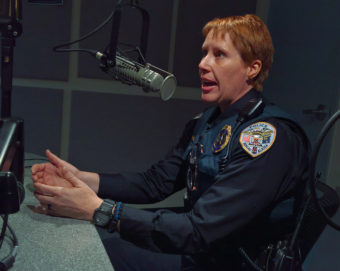
Lt. Kris Sell, Juneau Police Department
Lt. Kris Sell of the Juneau Police Department speaks on A Juneau Afternoon, April 1, 2016. (Photo by Jeremy Hsieh/KTOO)

So Sell said JPD had a choice. They could have focused on one option: finding lawbreakers and arresting them, but they didn’t want to.

“Really, modern policing is also about, ‘How do you apply positive pressure so that you can work with the people that are having challenges and get them on a more law-abiding path so they can get along with their neighbors?’” Sell explained.

She said most of the residents were suspicious at first.

When they offered one guy help, he hesitated but eventually said he wanted a job.

“He probably asked two or three times before we introduced him with the gentleman from the job service if we were tricking him or if this was some sort of trap,” Sell said.

Some people turned them down flat, but most were receptive after they got over their surprise.

Brianna McCourt said it goes a long way when people from the community show up and say, “We want to help you.”

“I do sympathize with what the police and the community did today, with the outreach program,” she said. “It kind of shows people that there is help out there if you ask for it. A lot of problems a lot of times with being a recovering addict is you’re afraid to ask for that help.”

McCourt knows what she’s talking about.

She is in recovery right now for the second time.

She was sober for eight years before she relapsed. She said her drug of choice was methamphetamine.

She didn’t decide to get clean until she had a near fatal car accident this summer.

“I didn’t want to ask for help. I didn’t want to admit that it was indeed a problem,” McCourt said.

She admitted that it can be hard to help other people, especially addicts because they need to want to help themselves first.

But she said people shouldn’t turn anyone away if they do make the decision to help themselves.

Quinhagak man faces charge of conspiracy misconduct in connection to Bethel raid

A Quinhagak man was arraigned on charges Thursday in connection to a raid on a Bethel home, where law enforcement seized large amounts of heroin and cocaine.

Albert R. Cleveland was arrested up for violating his parole during the raid in October.

Cleveland was on parole for third-degree assault and has, what Jared Karr of the District Attorney’s office called, “an extensive criminal history” that includes 10 previous convictions.

Cleveland now faces a charge of second-degree conspiracy misconduct, which carries a maximum 10-year sentence and a $100,000 fine, in addition to any sentence he may get for the parole violation.

At the arraignment, Cleveland told the judge that he didn’t know the others arrested in the house during the raid.

Six other people were arrested during the raid and were arraigned earlier this week.

Cleveland maintained at the proceeding that he was at the wrong place at the wrong time, but Judge Bruce Ward called him an “extreme danger to the community” and set bail at $150,000.

Cleveland was involved in a series of overdoses on August 15 in Quinhagak that left a 19-year-old dead. Cleveland also overdosed and was medevaced to YKHC in Bethel where his life was saved.

It is not clear if Cleveland provided the heroin, which was laced with another more powerful drug called fentanyl, to the others involved in the incident.

In May, police raided his home after receiving a tip that he was dealing in the village.

Cleveland has a preliminary court date set for Nov. 14 at the Bethel Courthouse.

Aleknagic man pleads guilty to reduced charge in stabbing death of his wife

An Aleknagik man will serve three years of jail time after pleading guilty in the death of his wife, who was stabbed multiple times in February.

Robin Chythlook, 52, was sentenced to 10 years of jail time with seven years suspended, meaning he will serve three years.

Chythlook had originally been charged with attempted first-degree murder, but instead pleaded guilty Thursday to a reduced charge of first-degree assault with a deadly weapon.

Chythlook allegedly stabbed his wife more than two dozen times at their home, then threatened law enforcement when they responded to the scene.

Assistant district attorney Pamela Dale agreed to settle with a guilty plea to the reduced charge, saying proving attempted murder would have been difficult to do.

“I would’ve had to prove that he intended to kill her,” Dale said after the hearing. “He did stab her a great number of times, he stabbed her 28 times. What was unusual is that it wasn’t the sort of stabbing through the body that I would’ve been able to argue to the jury was a substantial step towards trying to kill her.”

Dale described the wounds as closer to a half-inch-deep punctures.

Investigating state troopers found Chythlook had used two knives in the brutal, unprovoked attack.

Chythlook’s sentence fits the guidelines adopted under the state’s recent criminal justice reform, known as Senate Bill 91, Dale said.

“When this case came in before SB 91 he would’ve been presumptive seven to 11 years. After the change in SB 91 he was presumptive five to nine years. And so the 10 with the seven (suspended) is within the sentencing range,” Dale said.

Chytlook will be on probation for three years after his release, and will be required to attend counseling for alcoholism and domestic violence.

He has been in custody since his February arrest.

More children are being poisoned by prescription opioids

Young children and teenagers are increasingly likely to be poisoned by opioid painkillers that are often prescribed for other family members, a study finds.

The number of children hospitalized for opioid poisoning almost doubled from 1997 to 2012, from about 1.40 per 100,000 kids to 3.71 per 100,000.

“Opioids are ubiquitous now,” says Julie Gaither, a postdoctoral fellow at Yale School of Public Health and the study’s lead author. “Enough opioids are prescribed every year to put a bottle of painkillers in every household. They’re everywhere, and kids are getting into them.”

The study, which was published Monday in JAMA Pediatrics, examined more than 13,000 hospital-discharge records from 1997 to 2012 for opioid poisonings and used census data to extrapolate rates. The discharge data was collected by the Agency for Healthcare Research and Quality.

The data stops in 2012, so it may not reflect more recent trends in opioid prescribing and public awareness. But the findings track with adult rates of abuse and addiction, which have dropped since 2012 but remain troublingly high, experts say.

The rate of toddlers hospitalized more than doubled, going from 0.86 per 100,000 to 2.62 per 100,000. It’s likely that these very young patients take the drugs because they think they are candy or a treat. Opioids can be dispensed as pills, patches, or a flavored lollipop.

Teens are also at risk of overdosing on their parents’ meds. Of all children, this age group is most likely to be hospitalized for opioid poisoning, and are more likely to do be poisoned deliberately — likely, the researchers wrote, because teenagers are at a particularly high risk of depression and suicide. In 2012, 10.17 per 100,000 teenagers were hospitalized for opioid poisoning.

The findings, Gaither and her co-authors say, indicate a need for public health approaches that not only address overprescribing, but also try to raise awareness about the need for safe storage of these painkillers.

Doctors need to to talk to patients about ways to store drugs safely, especially if children are in the household, Gaither says.

That’s a good idea in theory, says Jonathan Chen, a physician at Stanford Medicine who has researched how guidelines for prescribing opioids affect primary care. But doctors already face a lengthy list of sensitive subjects they should discuss with patients. And they aren’t always conditioned to consider how a patient’s medications could affect other family members.

“Conceptually, yes, of course that should be part of the conversation,” Chen says. But he notes that doctors have a long list of things to discuss with patients, and But there’s a lot of things we should discuss.” Chen was not involved with the study.

Pediatricians could also play a role by asking parents at well-child and well-baby visits about whether there’s a risk of children being exposed to opioids. But that sort of screening hasn’t traditionally been drilled into doctors the same way as discussing other risks, such as safe storage of cleaning supplies, whether the family has a swimming pool and whether there are guns in the home.

Doctors also may not be conditioned to considering toddlers as particularly at risk of opioid poisoning.

“This is largely seen as an adolescent problem or an adult problem,” says Sharon Levy, who directs the adolescent substance abuse program at Boston Children’s Hospital and is an associate professor of pediatrics at Harvard Medical School. “But this paper really highlights that this really knows no age boundaries.” Levy was also not involved with the study.

It’s also unclear, Levy says, what the long-term health effects are for children who ingest opioids they weren’t prescribed, including addiction.

And there are serious short-term risks, including death. “Opioids cause respiratory suppression,” she said. “If you are a 30-pound person and getting into the medication that was supposed to be for a 150-pound person, it’s going to be a whopping dose for you.”

The findings also suggest doctors should also be more thoughtful in prescribing to children, especially teenagers. About 1 in 10 high school students reports having taken opioids for a nonmedical reason, and close to 40 percent of them say they got those drugs through their own prior prescriptions.

The American Academy of Pediatrics notes that the rate of young patients being prescribed opioids almost doubled between the 1990s and 2000s.

The Centers for Disease Control and Prevention has been pushing doctors to prescribe opioids more safely by prescribing for just a few days. That could help reduce the number of leftover pills. Large prescriptions — coupled with the fact that many people don’t know how to dispose of drugs when they no longer need them — can make it easier for children and teens to get ahold of them, Gaither says.

That’s an important factor to consider, Chen says. “Leftover pills aren’t used, but do they get returned to the pharmacy, or thrown in the trash? Nope. They’re stored in the medicine cabinet.”

Smaller prescriptions will likely help, but they won’t solve everything, Chen notes. After all, there are situations where a larger opioid dosage makes sense. For instance, someone suffering long-term cancer probably needs a larger amount of heavy duty painkillers, even if he or she has children in the house.

But the risk to children must be a part of the conversation, Gaither says. “We’ve got to pay attention to children and the toll the opioid crisis is taking on them,” she says. “Kids make up about a fourth of the U.S. population, and they’re suffering from this crisis, too.”

Copyright 2016 NPR. To see more, visit http://www.npr.org/.

Consumers’ mental health nonprofit begins membership drive in Juneau

Wade Rathke 20161011
Wade Rathke poses for a photo outside KTOO on Oct. 11, 2016. Rathke is an activist who founded ACORN and is president of the board of the Juneau-based Mental Health Consumer Action Network. (Photo by Jeremy Hsieh/KTOO)

A fledgling Juneau nonprofit formed to advocate for mental health consumers began a membership drive and door-knocking campaign this weekend.

Mental Health Consumer Action Network founder Greg Fitch said this follows the organization’s first official board meeting earlier this month, and getting MCAN’s charitable tax status and other organizational business in order.

MCAN’s new board president Wade Rathke has decades of experience with the once-infamous organization ACORN International, which he founded in 1970. The progressive group has had its scandals, some real, some bogus, but that’s old news now. Rathke still works with many nonprofits and lives in New Orleans — he’d worked with Fitch at ACORN there in the ‘90s — but was recently in Juneau for the first board meeting and discussed his role and aspirations for the new organization.

Rathke said he hasn’t had mental health issues himself, but, “I think it’s important that people build an organization to give them voice and to allow them to empower themselves around their own grievances and issues to be able (to) act. Mental health consumers over the last, you know, 50 years … are people who’ve been marginalized without a voice in many cases.”

He said organizing the marginalized is exactly what he’s spent his life doing.

“Part of what’s so true about mental health issues, people see it as personal, their own private concern,” he said. “And don’t realize there are other people who are struggling in some cases with the same thing who they could unite with and not only find support but collective cause.”

For a long time, he said society has treated people with mental health issues like a “crazy aunt in the closet.”

“And that’s not appropriate,” he said. “And to have people increasingly willing to talk about issues they’ve faced, how they’ve met those challenges, and how they could have met those challenges in a better way both for themselves and our whole society is a radical new thing, and that’s why I think it’s so exciting to see what MCAN is going to be.”

Rathke said he expects challenges recruiting potential members, who may perceive risk in outing themselves as mental health consumers. But, he’s optimistic.

In a year’s time, Rathke said he’d like to see MCAN with a stable membership in Juneau and possibly start expanding to Fairbanks and Anchorage.

After Mental Health Trust CEO quits abruptly, some board members allege open meeting violations

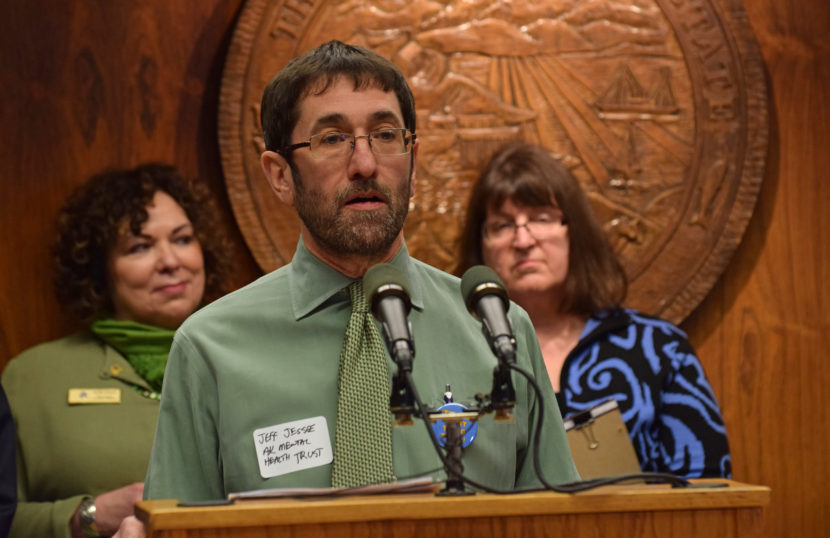
Jeff Jessee addresses reporters at a press conference in the Capitol, March 17, 2015. He was the CEO of the Alaska Mental Health Trust authority at the time, but resigned Wednesday.
Jeff Jessee addresses reporters at a press conference in the Capitol, March 17, 2015. He was the CEO of the Alaska Mental Health Trust authority at the time, but resigned Wednesday. (Photo by Skip Gray/360 North)

Some trustees of the Alaska Mental Health Trust Authority are alleging that their CEO’s resignation indicates violations of the Alaska Open Meetings Act.

Jeff Jessee submitted his resignation letter during a special meeting of the board of trustees on Wednesday afternoon.

Trust board chair Russ Webb said Wednesday that the transition was under discussion for several years, though an unofficial transcript of the meeting shows that several board members were surprised by the decision.

When asked why he was changing roles, Jessee, who was accompanied by the trust’s chief communications officer, began reading from his resignation letter.

“It is clear that a majority of the board of trustees believes that significant changes in the trust’s organization and efforts must be made to meet these challenges,” he read. “And they believe ‘these changes will require new perspectives and ideas to ensure that the trust can meet the needs of the beneficiaries well into the future.’”

When asked if he agreed with this position he responded, “Well, I believe it’s in the best interest of the beneficiaries, the trust and myself that I take a position within the trust where I can continue to serve the beneficiaries, which is why I got into this field in the first place.”

When asked if he felt the best position he could be in would not be as the CEO, he paused for several seconds and declined to comment.

Jessee will transition to a new role focused on programming, ahead of his planned retirement in three years.

The Mental Health Trust was created to fund comprehensive care for people with mental health illnesses and other disabilities. It is a state-owned corporation with cash and land assets that are managed by different state agencies.

If the governor’s office approves, Greg Jones, who formerly served as the executive director of the Trust Land Office, will serve as the interim CEO. The board of trustees voted 4-3 for the switch in roles.

During the meeting, Mental Health Trustee Laraine Derr alleged that other trustees were holding secret meetings about the future structure of the trust.

“You’re trying to move Jeff out of his job, and you don’t know where you’re going,” Derr is quoted as saying in the transcript. “I mean, I assume you probably do, because you guys have had enough meetings, secret meetings that we don’t know what’s going on. … Until yesterday, I didn’t know what you guys were doing. We have not been included. You’re trying to remove the CEO. … There are three of us sitting here that don’t know — that have never been involved in a meeting.”

Fellow trustee Jerome Selby agreed. Speaking by phone, he said he did not receive any information about the resignation before the meeting. There was not a board packet either.

“The motion that was read that accepted Jeff’s resignation appointed this person I’ve never heard of as the interim CEO, and then gave instruction to that new interim CEO to put Jeff in this new position — had never been discussed at any meeting that I’m aware of. Official meeting,” he said. “So how did it get to the meeting yesterday, all written out? There must have been a fair amount of discussion going on among those four people which violated the Open Meetings Act of the State of Alaska.”

The board has been openly discussing hiring someone to look at the organizational structure of the trust.

Selby said it’s a bad time to lose someone like Jessee in the CEO position, especially because of his experience advocating on behalf of trust beneficiaries in the legislature.

“I think it’s the worst possible time for him to resign, personally. We’re facing what’s probably going to be one of the hardest legislative sessions budget-wise in the state of Alaska.”

The trust was also recently criticized in a letter written by former Attorney General Bruce Botelho and former Commissioner of Natural Resources Harry Noah, both of whom were involved in establishing the trust in 1994.

In the letter, Botelho and Noah ask Rep. Mike Hawker and the Legislative Budget and Audit Committee to request a special audit because they believe the corporation is not following the statutory requirements for how its assets are managed.

They allege the board is taking money from the principal of the trust and using it to buy real estate instead of contracting with the Alaska Permanent Fund Corporation to manage the assets as is required by statute.

During the meeting, board chair Webb directed the board to discuss the letter at a later date, after they had fully read and understood it.

Jessee did not have any comments on the letter and said it was not part of the decision for him to shift roles.

On Wednesday, Webb called it a “separate and irrelevant issue” and said the allegations that others are managing the fund are “manifestly untrue.”

Selby, who was appointed to the board in February, said the concerns about the trust’s fiscal management need to be taken seriously and investigated.

“All of my red flags are waving at the moment,” Selby said.

Webb could not be reached for further comment. Jessee said he is not usually involved in revenue generation for the trust.

The exact details of Jessee’s new role and salary are yet to be determined. In 2015, he received more than $215,000 in compensation. He served in the position for 21 years.

Editor’s note: KTOO’s building sits on land leased from the Alaska Mental Health Trust Authority. KTOO has also applied for and received occasional grants for special reporting projects from the authority.

Site notifications
Update notification options
Subscribe to notifications