
KENAI — The operators of a residential drug treatment facility at a Soldotna hospital are seeking funds from the state to become central Kenai Peninsula’s first medical detox center.

If the state grant gets approved, then Serenity House intake coordinator Shari Conner said the new detox center would be located near the hospital’s campus in downtown Soldotna.
She said part of the grant would fund education and access to other services for people struggling with addiction.
More Alaskans killed themselves in 2015 than in any previous year since at least 1978. Two hundred people died by suicide in the state, 28 more than the previous record set in 2013.
Need help?
Alaskans can get support at carelinealaska.com or by calling 1-877-266-4357.
Experts said it’s difficult to determine the causes for the high number of suicides.
Kate Burkhart, the executive director of the Statewide Suicide Prevention Council, said inconsistent access to behavioral health care contributes to the state’s high suicide level.
“We have very high incidences of adverse childhood experiences, interpersonal violence and domestic violence, substance abuse, and depression and other mental-health disorders,” she said. “And so we have that constellation of risk factors present pretty much throughout the state. Access to health care though, is not consistent throughout the state.”
“Suicides that receive a great deal of coverage in the media, for someone who’s already at risk, it can increase that risk,” she said.
The suicide prevention council worked with AFN on prevention programs at this year’s convention.
The suicide total includes 67 deaths of Alaska Natives. Among Alaska Native men, the age-adjusted rate was 80 suicides per 100,000, more than six times the rate for all American adults.
Barbara Franks is a board member of the Statewide Suicide Prevention Council. Her son Ron died by suicide in 1997 when he was 23. Franks, who is Tlingit, said focusing on ethnicity can detract from understanding the individual causes of suicide.
“I stopped the categorizing when they say a young male from Alaska,” she said. “You get to find that people will become more sensitive of how they’re categorized than to (finding) out why or what happened.”
Franks said the downturn in the state’s economy likely contributed to the high number of suicides last year. It’s too early to say whether the number has dropped this year, since 2016 statistics aren’t compiled until next year.
The Statewide Suicide Prevention Council, schools and other suicide prevention programs receive $1.6 million annually.
Burkhart said it’s difficult to compare the 2015 suicide total to past data. That’s because the stigma surrounding suicide discourages reporting, and that stigma has changed over time.
“As we get better and better at tracking the data, and as people are less reluctant to say, ‘Yes, my loved one died by suicide,’ we are going to see an increase in the numbers,” Burkhart said. “It happens with other things like domestic violence and other issues where stigma has prevented a good picture being painted.”
Public health experts say that if people notice warning signs of suicidal behavior, such as talking about it or ways to do it, they should seek advice on treatment. The volume of calls to the state’s suicide prevention careline have increased more than 60 percent in the last two years.
Gov. Bill Walker’s new budget proposal increases funding for a programs that include suicide prevention.
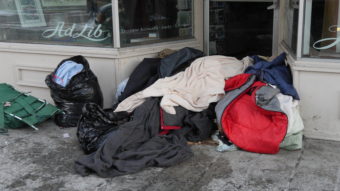
A pile of blankets in the doorway of a business on Franklin Street in downtown Juneau. (Photo by Quinton Chandler/KTOO)
Three people walk into the Glory Hole on Monday. (Photo by Quinton Chandler/KTOO)
Meal preparation at the Glory Hole. (Photo by Quinton Chandler/KTOO)
Patrons at the Glory Hole on Sunday. (Photo by Quinton Chandler/KTOO)
Glory Hole visitors eating breakfast on Monday. (Photo by Quinton Chandler/KTOO)
It’s cold in Juneau. Earlier this month, the city saw one its heaviest snowfalls in at least a couple of years and, according to the National Weather Service, temperatures ranged between the teens and the mid-20s.
Karli Phillips was sleeping outside.
“Oh my gosh, so that storm, we were actually sleeping way under a dock and it just got drenched,” Phillips said. “This is like 3, 4 o’clock in the morning. We’re soaking wet, shivering and everything (was) just gushing water.”
Phillips is homeless and she regularly comes to the Glory Hole, one of Juneau’s few homeless shelters, for food and to get warm. She said that night she didn’t even go to sleep.
“So, I ended up just shivering in a doorway under some sheets I found,” she said. “I feel bad because I think I took them from somebody but, I didn’t sleep that night because I was afraid I would die.”
Winter months are an especially dangerous time for Juneau’s homeless population.
Rose Lawhorne said if you’re sleeping outside on a night like Phillips just described, dying isn’t far-fetched.
“Weather and temperatures down around zero or in the teens like we’ve had them, or with lots of snow, or wind … even damp clothes really contributes to life-threatening hypothermia,” Lawhorne explained.
She is a nurse and supervisor in the Emergency Department at Bartlett Regional Hospital.
She said during winter, homeless people can get hit hard.
“More affected, colder, more illness during the winter months,” Lawhorne said. “We’ll start seeing them multiple times in a day, hungry and cold just looking for a way to get out – out of the elements.”
Rose Lawhorne is an registered nurse and supervisor in the Bartlett Regional Hospital Emergency Department. (Photo by Quinton Chandler/KTOO)
Lawhorne doesn’t know how many people come into the ER for exposure because those cases aren’t always captured in the hospital’s records.
“But what I can tell you is we get many patients every day who are brought to us by either Rainforest Recovery,” she said. “They walk in themselves, they’re brought by friends or family who are concerned, or JPD brings them to us and that is multiple times per day,”
Lawhorne said the range in conditions is huge. Some people are just cold and hungry and some are literally freezing to death.
At the Glory Hole, Executive Director Mariya Lovishchuk said the shelter has 40 beds for overnighters and during the winter they’re usually over capacity.
“We don’t turn anybody away for the lack of beds,” she said. “So last night we had 46 people sleeping here, so if we don’t have beds we put people on the floor.”
Glory Hole Executive Director Mariya Lovishchuk in November 2013. (Photo by Lisa Phu/KTOO)
Lovishchuk said they give breathalyzer tests every night so people who have a blood alcohol level over 0.1 aren’t allowed in that night. People can also be suspended for longer periods.
“When people commit violent offenses or exhibit behavior that is really frightening toward other patrons or staff, they do get suspended from here,” Lovishchuk said. “I think we have two or three people who cannot get any services here.”
She said the Glory Hole is the only short-term shelter that takes men, women and children in Juneau, so unless suspended people and people who choose not to sleep in the dorms have somewhere else to go, they’ll end up outside. Phillips chooses not to sleep in the shelter.
“I actually haven’t gotten sick from sleeping outside. I’ve gotten sick from sleeping in here,” Phillips said.
She claimed the dorms’ air quality is poor and they get overcrowded.
“People don’t regularly bathe or wash themselves,” she said.
Another person said they didn’t sleep in the shelter because they kept getting into fights and being outside was easier even though it’s clearly dangerous. Phillips and others said when they’re outside, they have to wear a lot of layers and sleep under multiple blankets, sleeping bags and comforters – anything to stay warm.
Recently there was a rumor that a homeless man died sleeping on the street. An officer in the Juneau Police Department has said it’s just a rumor. Lovishchuk said she spent three hours trying to confirm it and now also thinks it’s just a rumor, but she said it definitely could happen.
Yaghanen Youth Program Coordinator Michael Bernard teaches campers how to set a small mammal snare during one of the camp's educational sessions in October 2016. (Photo by Scott Moon/Kenaitze Indian Tribe)
Yaghanen Youth Program Coordinator Michael Bernard at one of the camp's educational sessions in October 2016. (Photo by Scott Moon/Kenaitze Indian Tribe)
Josh Grosvold and Wally James laugh after their attempt to call moose in October 2016. (Photo by Scott Moon/Kenaitze Indian Tribe)
Kaleb Franke, at right, talks about how to build an emergency shelter, like one he constructed at left, as campers listen in a wooded area near Spirit Lake in Kenai, in October 2016. (Photo by Scott Moon/Kenaitze Indian Tribe)
Safety and Security Officer Kaleb Franke takes aim on a moose that came to campers. Campers were taught respect for animals, as well as firearm safety from Franke and other adults during the camp, in October 2016. (Photo by Scott Moon/Kenaitze Indian Tribe)
Kenaitze Indian Tribe Safety and Security Officer Kaleb Franke, right, gives thanks to a moose that came to him during the Kenaitze Indian Tribe's Dnigi Camp in October 2016. Campers Andrew Wilson, Gideon Collover, and Youth Advocate Yuzhun Evanoff watch. (Photo by Scott Moon/Kenaitze Indian Tribe)
David Knight, Braden Lemm and Jonny Wilson use snow-covered taiga to clean the moose's hide before packing it out in October 2016. Nearly every part of the moose that came to campers will be put to use. (Photo by Scott Moon/Kenaitze Indian Tribe)
Campers Gideon Collover, Braden Lemm and Youth Advocate Jonny Wilson load a moose leg into a game bag after processing the moose in the field in October 2016. (Photo by Scott Moon/Kenaitze Indian Tribe)
Campers and staff hang moose quarters to dry following the hunt in October 2016. (Photo by Scott Moon/Kenaitze Indian Tribe)
Andrew Wilson, his brother Jonny, and Gideon Collover, right, get direction from Yaghanen Youth Program Coordinator Michael Bernard as they process the moose that came to campers in October 2016. (Photo by Scott Moon/Kenaitze Indian Tribe)
Youth from the camp delivered organs from the moose to Elders at Tyotkas Elder Center in October 2016. (Photo by Scott Moon/Kenaitze Indian Tribe)
Elder Ernie Jordan, in white, receives moose meat from youth from Yaghanen during lunch in October 2016. From left are Gideon Collover, Andrew Wilson, Doug Gates, Michael Bernard, Wally James and Corvus Leavitt. (Photo by Scott Moon/Kenaitze Indian Tribe)
Youth Advocate Yuzhun Evanoff looks at a preserved moose skull while learning about moose with campers around a campfire at their Spirit Lake Camp in October 2016. (Photo by Scott Moon/Kenaitze Indian Tribe)
With a flashlight and a little smoke from a campfire, Youth Advocate Doug Gates creates a Star Wars light saber for Josh Grosvold and other campers in October 2016. (Photo by Scott Moon/Kenaitze Indian Tribe)
First light rises above Spirit Lake during the Dnigi Camp in October 2016. Campers were treated to a clear sky and cold air during the weekend gathering. (Photo by Scott Moon/Kenaitze Indian Tribe)
Kenaitze Indian Tribe in Kenai is taking an innovative approach to drug, alcohol and tobacco prevention. In addition to more overt prevention efforts, like signs and education, the tribe offers culturally-relevant healthy activities through their Yaghanen Youth Center, located in Soldotna, including a moose camp in the fall for young men.
Yuzhun Evanoff carefully strips the outside layer off a large, burgundy leg of moose.
“This meat was hung — it develops a crust on it. So right now we are stripping it off so we can butcher this meat and give it to our elders,” said Evanoff.
Evanaff is Dena’ina from Nondalton near Lake Clark. He grew up in Soldotna and now works as a youth advocate for the Kenaitze Indian Tribe’s Yaghanen Youth Center in Soldotna.
A few weekends ago, the group of young men had a successful hunt on the Kenai through the center.
Evanoff shows 15-year-old Wally James how to peel a piece of white tendon off the meat.
James is a freshman at Kenai Central High School. Yup’ik and originally from Russian Mission, he moved to Kenai last year. He has been moose hunting before.
“It reminds me of when I go hunting and fishing in my hometown with my sister and family,” said James.
Standing in the large warehouse-like building surrounded by seven young men butchering meat at four tables, Yaghanen Youth Center administrator Michael Bernard said it’s not just about putting food in the freezer.
“The concept is that we are providing a safe, positive atmosphere where young people can come and learn that it is OK to be substance free,” said Bernard.
Yaghanen is a prevention and early intervention organization that provides a safe environment for youth.
The harvest and processing of the moose, Leonard said, is also a way to convey critical, traditional values to young men.
“The activities that we do have a cultural relevance to them. We are touching on several if not many of the cultural values, the hard work, sharing, teamwork and providing for our elders,” said Leonard.
Moose is a traditional food for Kenaitze Indians. The camp is free and open to all young men in the community — Native and non-Native alike.
The young men receive training on gun safety, knife-handling, butchering and food handling. They also learned about moose natural history and how to build survival shelters.
Bernard said they try to schedule the camps during school vacations and are working with the Kenai Peninsula Borough School District to allow students to earn elective credit for attending the camps.
Gideon Collver is a junior at Soldotna High School. The 16-year-old is not Alaska Native and said he had never gone moose hunting before. He said the best part was being in the woods and learning about respect for the animal.
“Kind of an inward respect. Treating it with respect. We were all fairly silent when we got it. Seeing that it had given its life so that we could have food. It gave me more respect for the Dena’ina and how their survival depended on something else’s death,” said Collver.
Kenaitze tribal member Sandy Wilson is a Youth Advocate at the Yaghanen Youth Center. She said the camp is also about building pride and confidence.
“Teaching our culture makes them proud of who they are and teaches them where they come from and so when we teach our culture it gives them a sense of pride,” said Wilson.
Wilson is also the mother of several children involved in programs at the youth center.
Her oldest son, 23-year-old Jonathan Wilson, started attending activities at the youth center when he was in sixth grade. Now he’s a mentor in the program.
“I’m the oldest of eight and all of them are coming up through this program, so it is kind of something for me to watch them grow,” said Wilson.
In Kenai at the tribe’s senior center, the young men deliver the meat to elders.
Kathleen Zaukar, originally from Sleetmute, has lived Kenai for several years. She said she does not have any moose meat in the freezer this year and she is happy to have some freshly delivered from the young men.
“I got me a kidney,” said Zaukar.
A delicacy that Zaukar said she will eat fried.
“And it’s great that they teach them how to do that. Because that’s our culture, and if we don’t have our culture anymore then we don’t got nothing,” said Zaukar.
Next time, Zaukar said she’s putting in a request for moose ribs. Her favorite.
In addition to the moose camp, Yaghanen Youth Center hosts a fish camp, an archeology camp, a science camp and a construction camp. They also have after school programs that prepare students for Native Youth Olympics and that teach archery, Native dance, and drumming. All the camps and programs are open to Native and non-Native students alike.
The Ketchikan City Council agreed unanimously Monday to support Akeela-Gateway’s application for a state grant to develop a sobering center at Ketchikan’s former state-run juvenile detention center.
The state recently shut the center down in response to budget cuts, and the facility reverted to the City of Ketchikan.
The city asked for proposals from community groups interested in using the building, and Akeela was the only one that submitted.
Akeela’s Joel Jackson said the community very much needs a place where people under the influence of alcohol or drugs can safely sleep it off, and then be steered toward treatment, which Akeela offers in a separate facility.
The grant and the building are two opportunities that aligned at just the right time, he said.
“So, we have a facility that’s zoned correctly that’s available, and we had a grant proposal that came out the second of November, allowing us to ask for money to provide a service that fits into our continuum of care,” he said.
The state grant would provide $1 million a year for three years.
The state will announce the award in early January, Jackson said, and the recipient would have until July to start providing services. There are some minor revisions that would be needed at the facility, he said.
Part of the motion that the Council approved states that the building would be provided to Akeela at no cost for the three-year grant period. Some Council members wanted to make sure the city wouldn’t be on the hook for major maintenance costs during that time, as long as the building is in good condition at the start of the three-year lease.
City Manager Karl Amylon said if Akeela is successful in obtaining the grant, then a detailed lease agreement will come back to the council for review and approval.
Also Monday, the Council approved a motion to authorize the city’s Museum Department to move forward with development of a permanent exhibit, which will go in the Centennial Building. Another motion authorizing up to $70,000 to clean, treat and repair the Chief Johnson totem pole also was approved.
Monday’s Council meeting was rescheduled from its regular Thursday meeting day.
The next City Council meeting is a special budget meeting, set for 7 p.m. Nov. 28.
Is marijuana a gateway drug to smoking cigarettes? PhotoAlto/Katarina Sundelin/Getty Images
California’s decision to legalize marijuana was touted as a victory for those who had argued that the state needed a system to decriminalize, regulate and tax it.
But the new law, approved by voters on Nov. 8, also could be a boon to the tobacco industry at a time when cigarette smoking is down and cigarette companies are looking for ways to expand their market, according to researchers in Los Angeles County and around the state.
They warn that unless the state proceeds carefully, the legalization of marijuana for recreational use could roll back some of the gains California has made in reducing the use of tobacco.
“There is a concern that there could be a potential renormalization of smoking,” says Michael Ong, an associate professor at UCLA’s David Geffen School of Medicine.
Ong says it will depend on how the initiative is implemented, whether officials follow through on the regulation, and how involved public health officials are with it. “It will be important to make sure that we don’t have a setback in terms of what we have done for clean air in California … and what we have done to reduce tobacco’s harms,” he says.
Ethan Nadelmann, executive director of the Drug Policy Alliance, which supports marijuana legalization, defended the measure, saying there is no evidence that legalization leads to increased cannabis consumption — or tobacco smoking.
California’s adult smoking rate is the second-lowest in the country, at 11.6 percent, according to the California Department of Public Health. The smoking rate dropped by more than 50 percent between 1988 and 2014, cutting health care costs and reducing tobacco-related diseases, according to the department.
The headway against smoking over the past few decades is due to a combination of factors, including tobacco taxes, laws restricting where people can smoke, and broad-based media campaigns and programs to help people quit. Despite the decline in smoking, the use of e-cigarettes has increased dramatically over the past few years, with nearly 10 percent of adults ages 18 through 24 now using them, according to the department.
Another ballot initiative passed by voters last week could push the smoking rate even lower. Prop. 56 will add $2 per pack to the tax on cigarettes and increases taxes on electronic cigarettes that contain nicotine and other tobacco products. The money will help pay for health care and increase funding for tobacco control and prevention.
The marijuana initiative, Prop. 64, allows adults ages 21 and over to grow, buy and possess small amounts of marijuana for personal use. It also regulates recreational marijuana businesses and imposes taxes that will help pay for drug education and prevention programs.
Bonnie Halpern-Felsher, a pediatrics professor at the Stanford University School of Medicine, says she is concerned that there may not be enough education and prevention written into the proposition, especially targeted at youth.
Marijuana is already the most widely used illegal drug among adolescents. Many young people consider marijuana and blunts, which are marijuana rolled with a tobacco leaf wrapper, to be more socially acceptable and less risky than cigarettes, according to a recent study co-authored by Halpern-Felsher. The study also found that youths who saw messages about the benefits of marijuana were more likely to use it.
Blunts are particularly worrisome because they contain nicotine as well as marijuana, Halpern-Felsher says. Many young people may not understand the risk of blunts or marijuana, she notes, and once they start thinking that smoking one product is acceptable, they may believe it’s OK to smoke other things as well. “That’s my concern,” she says. “I do think people are going to generalize.”
From the tobacco industry’s point of view, marijuana could serve as a “smoke inhalation trainer,” and thus become a gateway to tobacco use, says Robert K. Jackler, a professor at the Stanford School of Medicine who researches tobacco advertising. He says tobacco and marijuana are marketed in similar ways — as products to help people relax and ease their stress. “There is tremendous overlap potential,” he says.
Tobacco companies could easily try to exploit that similarity to enter the marijuana market, Jackler says. They already have enormous influence on state laws and regulations, and could try to set up small dispensaries and make marijuana another one of their products.
“The tobacco industry is always looking for replacement products because, at least in America, smoking is down,” he says. “This will give them a new entry into the market. They are best equipped to exploit this market opportunity.”
In fact, the tobacco industry considered getting into the marijuana market in the 1960s and 70s and could easily do so, says Stanton Glantz, a professor at University of California, San Francisco School of Medicine. Glantz believes that even as the newly approved tobacco tax reduces California’s smoking rate further, legalized marijuana will help sustain the tobacco market. He says he expected to see mass marketing and branding of marijuana over time.
Along with some therapeutic benefits of marijuana, there are also health risks, Glantz says. “The likely costs that are going to be incurred by all the marijuana-induced diseases don’t come close to being covered by the taxes that are written into Prop. 64,” he warns.
The initiative should have included higher taxes, graphic warning labels, provisions to keep demand low and a broad-based education campaign like there is on tobacco, Glantz argues. “The ideal situation is where it’s legal so nobody is thrown in jail, but nobody wants to buy it.”
Legalization supporters said they don’t believe the tobacco industry will get involved in the marijuana market until and unless federal prohibition ends. Marijuana is still illegal under federal law.
Nadelmann, of the pro-marijuana Drug Policy Alliance, says it is misguided to conflate the two products. Young people can distinguish between the effects of cigarettes and marijuana, he says.
“Teenagers are actually smarter than most of the adult propaganda,” Nadelmann says. “They know smoking cigarettes is really stupid and that smoking marijuana is not such a major issue.”