Alcohol & Substance Abuse

Funding for opioid overdose kits offers ‘hope’ for Alaska’s drug epidemic

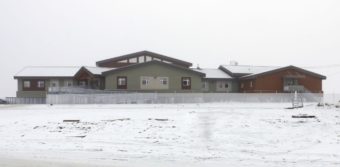
The Yukon Kuskokwim Ayagnirvik Healing Center in Bethel offers alcohol and opioid addiction treatment. (Photo by Dean Swope/KYUK)

The state government is gearing up for a major battle against the opioid epidemic sweeping through Alaska.

Andy Jones, the section chief for the state Department of Health and Social Services, is heading up a new statewide program to get the drug Naloxone, also known by its commercial name Narcan, into the hands of heroin users, no matter where they live, be it the cities or the Bush.

Alaska recently received a $4.2 million grant for a five-year “Project Hope” program from the federal government’s Department of Health and Human Services.

“What that equates to is about 5,000 of these lifesaving kits every year,” Jones said.

Jones said it was a fight just getting the funds, because the opioid epidemic is not only here, but also in the Lower 48, where the number of deaths far exceeds those dying from heroin overdoses in Alaska.

“If you look at one or two or three deaths, people in the Lower 48 look at that as that’s not significant, but that’s not true,” Jones said. “That’s really significant to that community because they have a smaller population and they know each other. Those are their loved ones. And so we won that battle, which is exciting.”

Since getting the money two and a half months ago, Jones’s team has developed kits with education and training materials and a simple drug delivery system to keep people alive when they are overdosing.

“You know if you ever have an allergy and you squirt up some sort of anti-allergy up your nose, we’re all familiar with that, right? It’s very easy, the same concept,” Jones said. “I actually taught my 3-year-old daughter how to use it. And when I did that, it was like…’This is it.’”

This system, provided free through Project Hope, is not cheap.

Buying it at a pharmacy costs $150 per dose. The same drug delivered through a needle costs a lot less: $20 to $30 per dose.

“It’s horrible, outrageous. Unfortunately it’s the pharmaceutical community,” Jones said.

The overdose death in Quinhagak might have been avoided if Project Hope had been operating last summer.

Jones wants to work with health organizations, community groups, tribes, or anyone willing to help get the medicine to heroin drug users when they need it.

Keeping users alive is only the first step toward getting them into a recovery program.

Here, Alaska has a long way to go.

There are nowhere near enough detox programs. The waiting list for those that exist is long.

Most would have to leave the state for that service, and that’s only the beginning.

Because once off the drug, users need counseling and community support to help keep them on the road to recovery.

That is a much larger community challenge that has just begun in Alaska and has not reached the Bush yet in any significant way.

Public health nurses meeting in Anchorage this week were looking at community programs in Juneau and the Matanuska Susitna Borough, along with a web-based support system called “Rockstar” out of Ohio, where former heroin users help others get clean and stay clean.

Egegik man sentenced in Southeast meth case

A man from Egegik was sentenced to 20 months in jail after he pleaded guilty to possession with intent to distribute more than 3 pounds of methamphetamine.

Jason Corey Vincent Alto, 21, was caught May 30 last year while he was traveling on the ferry vessel MV Kennicott from Washington State toward Whittier.

The U.S. Coast Guard and state trooper drug enforcement cooperated on the bust, which happened in Ketchikan.

Jack Schmidt, assistant U.S. attorney in the Juneau office, prosecuted the case in federal court.

“Mr. Alto had been carrying in excess of 3 pounds of methamphetamine on the Alaska state ferry,” Schmidt said. “Just happenstance that when he disembarked in Ketchikan, he exhibited signs that he was potentially a drug trafficker. He was contacted, and they got a warrant, and a dog hit on his luggage which contained the 3 pounds of methamphetamine.”

Depending on how it was cut, that could have been more than 5,000 doses, and the street value depended on what part of the state it was bound for, which Schmidt said was determined in the investigation.

It was the largest meth bust ever in Southeast Alaska, Schmidt said.

“Typically we have people dealing in ounces, maybe in the half-pound range. It’s highly unusual to see anything above a kilo, which is about 2.2 pounds, and here it was nearly 3 pounds,” he said.

Alto, then a 20-year-old with substance abuse problems, was classified as a drug mule, responsible for trafficking the narcotics, but likely not for dealing them.

Schmidt had asked for nearly three times the jail sentence that U.S. District Court Judge Timothy Burgess handed down.

“I thought that sending a message was an important aspect of the case, given the quantity of the amount of drugs,” Schmidt said. “But the defendant had a fairly minimal criminal history, and he was young, and I think those were the things the judge had taken into consideration in fashioning the sentence the way he did.”

According to reporting in the Juneau Empire, Alto told the judge he plans to return to Egegik and study to become a commercial pilot.

He is in custody and will serve the remainder of his 20 months in jail before beginning five years of supervised release.

Vote postponed over Juneau’s controversial ‘camping ordinance’

Juneau homeless resident Everett Johnson, far left, testifies about sleeping on the streets before the Juneau Assembly on Monday. (Photo by Jacob Resneck/KTOO)

Juneau’s controversial anti-camping ordinance that would empower police officers to crack down on homeless people sleeping downtown has been postponed until next month.

That’s following more than 90 minutes of testimony from dozens of residents including merchants, social workers and homeless people.

They all agreed on one thing: Juneau has a serious homeless problem.

But speakers had radically different viewpoints.
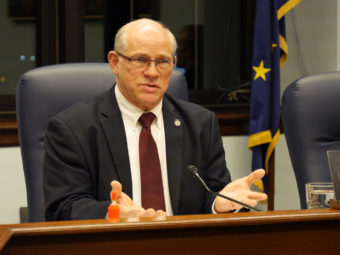
Douglas resident Greg Capito told the Juneau Assembly on Monday night that tensions are rising between increasingly desperate people sheltering downtown, and that employees and patrons are increasingly afraid.

“In the last three years, downtown Juneau has changed and, ladies and gentlemen, not for the better,” Capito said. “There’s fear in the eyes of everybody. When you look in somebody’s eyes and see fear you never forget it.”

Other speakers also testified that they were feeling increasingly unsafe downtown, especially after dark.

But 27-year-old homeless Juneau resident Lisa Williams said that if the proposed ordinance is passed, she doesn’t know what she’d do.

“We have nowhere to go. And we’re already homeless,” she said. “If we had money to pay for something we would pay for it. You guys are trying to give us tickets or whatever — but if we’re homeless how are we going to pay for it? We don’t have anything, we don’t have a home. We’re staying in cubbyholes and everyone is saying they’re scared but — we’re harmless.”

Daryl Miller, owner of a downtown commercial printing business, said he likes the idea of more shelter capacity and an emergency warming station. But he’s reached the breaking point with people sleeping downtown.

“I’m tired of babysitting and cleaning up on a daily basis,” Miller testified. “So much so that I will be moving my business in the next three months from its current location, and one of the main reasons is because of the daily cleanup.”

Another longtime homeless resident, Everett Johnson, said elected officials don’t know what it’s like to be destitute and challenged them to put themselves in his place.

For people like him it’s a matter of daily survival, he said.

“You want to get us off downtown? OK — build us another shelter. Don’t make it difficult. We’re already having a hard time,” Johnson said, his voice trembling with emotion. “As I look at every one of you you guys got a bed, a warm place. Not me, not me. As a matter of fact, I brought my bed with me and that’s my sleeping bag.”

The Juneau Assembly concluded the ordinance’s public hearing and is scheduled to revisit the issue at its Feb. 13 meeting.

Could ticketing the homeless help downtown Juneau?

Two people and a dog curl up near a boiler room on Shattuck Way on Jan. 20, 2017, in downtown Juneau, Alaska. (Photo by Rashah McChesney/Alaska's Energy Desk)
Two people and a dog curl up near a boiler room on Shattuck Way on Friday morning, Jan. 20, 2017, in downtown Juneau, Alaska. (Photo by Rashah McChesney/Alaska’s Energy Desk)

Local policymakers are considering giving police the power to ticket homeless people that sleep outside in downtown Juneau.  A statewide count conducted a year ago found 50 people living without shelter in the community, and another 160 in shelters and transitional housing.

I rode along with a Juneau police officer recently to see how the police deal with the community’s most visible residents right now.

It’s an hour before dawn and Juneau Police Officer Alexander Smith is making his usual rounds. In front of the downtown cruise ship terminals, a man is tucked deep into a sleeping bag against a building to keep out of the rain. It’s a similar scene on South Franklin Street. A couple is covered in blankets in front of a shuttered storefront. Officer Smith knows most of these people’s names. And they know his. He radios in to check for arrest warrants. But first, he confiscates an open can of malt liquor, pours it out and moves on.

Homelessness in downtown Juneau has became an increasingly visible issue. Merchants have complained to the police department, but downtown beat officers like Smith say their hands are tied.

“Doorways like these easements here are private property. So it’s the responsibility of the business owner to contact us if there’s trespassing issues, vandalism and that kind of thing,” Smith said. “So if we see someone sleeping in the doorway we can contact them and make sure they’re alive and breathing, but we don’t have any legal authority to remove somebody from the doorway simply for them standing there.”

But a proposed anti-camping ordinance sets out to change that. If adopted, the ordinance would let officers ticket people camping on private property within the downtown core.

Juneau’s police chief has come out in support of the initiative, though Officer Smith admits enforcement with tickets could be challenging.

“It kind of goes along with the open container tickets and that kind of thing, where a lot times the people who have been here long enough they don’t care,” Smith said. “They’ll take 20 tickets and be like, ‘Whatever.’ Now whether or not a new citation will actually change your behavior is debatable. But it’s one of those things that hopefully will be an incentive.”

The Juneau Police Department later clarified that under the ordinance anyone caught camping downtown who refuses to move could be arrested for disorderly conduct – a jailable offense.

Joshua Donald Smith (no relation) found himself sleeping outdoors. The 45-year-old says he’s dealing with substance abuse issues, and that he’s aware why some downtown merchants are upset.

“I understand the businesses. A lot of the homeless people kind of wreck it for other folks by defecating on the street, throwing their trash everywhere, just basic disrespect for the community,” he said. “But there’s some of them on the other side that go sweep up — voluntarily.”

Juneau has homeless shelters including the 40-bed Glory Hole downtown. But the shelter won’t take drunk people — for understandable reasons. And that, Joshua Smith says, doesn’t work for some people struggling with addiction and in crisis.

“This guy lost his mother the other day,” he recalled. “He had a bad night and he was drinking and wasn’t dealing with his emotions and he got kicked out for six months the next day. The guy lost his mom and now he’s in the rain. It’s a sad situation. I don’t want to say let’s make it easy for these people get drunk and wasted all the time, but there’s got to be a happy medium where they can have a roof.”

In the summer the city-run Thane campground provides low-cost camping that acts as transitional housing. But it’s in an avalanche zone and unsafe in the winter. That leaves homeless people without a legal place to camp on public or private property.

At the Glory Hole, Juneau’s 40-bed downtown shelter, it’s just after sun up and about two dozen people are drinking hot coffee and tea. Some spent the night here others have just come in from the cold. Steven Lythgoe, 43, says he’s been homeless on and off for about seven years. He says he’s working to his driving license reinstated and getting back to work but he’s running up against the shelter’s 90-day limit and isn’t where he’ll go.

“There are some services and they take quite a while to actually get done. There is quite an extensive waiting list, you’ll be waiting up to six months in some cases and you can’t stay here for that long,” Lythgoe said. “And that’s what it makes it really hard. And so you’re having to try and find somewhere to go. And they do, I think, they need to make a place where people can put tents and be safe in their tent.”

downtown Juneau
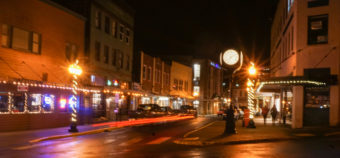
A car and pedestrians make their way past Front Street storefronts in downtown Juneau on Thursday, Jan. 19, 2017. Moving objects appear blurred because of an extended exposure. (Photo by Jeremy Hsieh/KTOO)

Juneau’s proposed ordinance isn’t without controversy. In a letter Thursday, four Juneau-based Alaska Native institutions urged the Assembly to abandon the proposal. The city attorney’s office has cautioned that federal courts have struck down city laws that effectively criminalize homelessness. That’s why the ordinance targets illegal camping rather than just sleeping or vaguely defined loitering or vagrancy.

Officer Smith says that the anti-camping ordinance would allow him to focus on the type of sleepers who are attracting the most complaints but not everyone sleeping downtown.

“It probably won’t have too much of an actual impact on people who are just kinda slumped over in the doors,” the officer said. “Because, you know, if they don’t have any money or any means to provide for themselves, giving them a ticket or kicking them to the next doorway is not going to change a whole lot. But for people that are building legitimate tents and camps it might create an incentive for them not to do that.”

That may or may not satisfy downtown merchants but it will allow police to take a more aggressive approach in dealing with some of Juneau’s most vulnerable residents.

The public hearing — and a possible vote — will be held Jan. 23 in the Juneau Assembly’s chambers.

Clarification: This story has been updated to reflect that under the proposed ordinance, failure to comply with a police order to move on could also lead to a criminal charge.

Officials catch heroin in both Anchorage and Nome

Heroin has been at the center of two anti-drug enforcement efforts in different Alaska towns.

Alaska State Troopers seized heroin and meth in Anchorage that troopers say was intended to be sent to Nome.

Troopers seized 8 ounces of heroin and 1 ounce of crystal methamphetamine last week.

In Nome, Alaska State Troopers’ Western Alcohol and Narcotics Team troopers and the Nome Police Department teamed up to conduct search warrants at several locations in Nome thought to be a part of heroin distribution throughout the city.

WAANT ended two separate investigations resulting in the arrest of Benjamin Milton, 34, and Rayne Aukongak, 30, according to troopers.

Milton and Aukongak were both arrested on separate counts of distribution and possession of heroin.

After the arrest, the two men were remanded to Anvil Mountain Correctional Center for misconduct involving a controlled substance.

Aukongak had a bail hearing earlier Wednesday afternoon. Since being remanded, Milton has had no further hearings as of yet.

Gov. Walker hits on same budget themes with new Legislature

Gov. Bill Walker delivers his State of the State address to the Alaska Legislature, January 18, 2017. Behind him, left to right, are Senate President Pete Kelly (R-Fairbanks) and Bryce Edgmon (D-Dillingham), Speaker of the House.
Gov. Bill Walker delivers his State of the State Address to the Alaska Legislature on Wednesday. Behind him, left to right, are Senate President Pete Kelly, R-Fairbanks,  and House Speaker Bryce Edgmon, D-Dillingham. (Photo by Skip Gray/360 North)

Same concepts, new Legislature.

In his annual State of the State Address on Wednesday, Gov. Bill Walker pushed a lot of the same ideas and proposals for solving the state’s budget crisis as last year.

Walker said the state government risks spending all of its savings if it denies there’s a problem and hopes for oil prices to rise.

“Here’s the hard truth: Denial doesn’t make the problem go away. Hope doesn’t pay the bills,” Walker said. “We need to pass a plan to stabilize our fiscal future and we need to do it now.”

The gap between state spending and the money it brings in from oil, as well as other taxes and fees, is roughly $3 billion.

Walker renewed his call for a series of measures he proposed last year. They include drawing money for the budget from Permanent Fund earnings. Walker also wants to introduce an income tax. Walker said relying heavily on spending cuts would hurt the state’s economy.

“Whatever your plan may be, put it out there,” Walker said. “And let’s get to work to find a solution. But if your plan does not close the fiscal gap, be sure to also identify the amount from our dwindling savings it’ll take each year to cover the gap under your plan.”

Walker said the state Board of Education is taking a series of steps to improve schools.

And he called for more efforts to reduce deaths from heroin and prescription opioids, by limiting the number of opioids in prescriptions, and strengthening a database used to track opioids.

Walker said the state government will seek to involve every sector of the state to address climate change.

“It is one of the greatest challenges of our era,” Walker said. “We look forward to working with you to create a legacy of timely response.”

Walker’s speech touched on other topics. He called for oil drilling in the part of the Arctic National Wildlife Refuge. And he said he’ll continue efforts to build a natural gas pipeline.

Lawmakers from both houses say they’ll offer more details on their budget plans in the coming weeks.

Site notifications
Update notification options
Subscribe to notifications