Alcohol & Substance Abuse

Dentists work to ease patients’ pain with fewer opioids

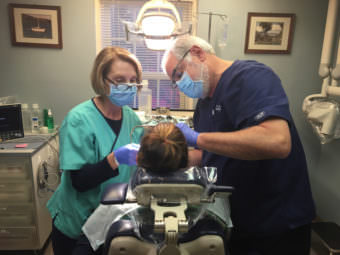
Dr. Joel Funari performs some 300 tooth extractions annually at his private practice in Devon, Pa.. He's part of a group of dentists reassessing opioid prescribing guidelines in the state.
Dr. Joel Funari performs some 300 tooth extractions annually at his private practice in Devon, Pa.. He’s part of a group of dentists reassessing opioid prescribing guidelines in the state.
Elana Gordon / WHYY

Firsts can be life changing — think about your first kiss, your first time behind the wheel of a car. But what about the first time you got a prescription for a narcotic?

James Hatzell, from Collingswood, NJ, is now a technology officer for a college addiction treatment program. He didn’t realize it at the time, but that spring day of his junior year of high school — seven years ago — was a pivotal moment in his life.

“We’re in our 2001 Honda Odyssey minivan, driving to the dentist,” Hatzell recalls. “And we get there, and I’m just pumped. I was very excited to get my wisdom teeth out.”

The prospect of pain didn’t thrill the teen, but he’d heard from friends that when the dentist took out his teeth, he’d get his very own bottle of pain pills.

Those pain pills, Hatzell now says, eventually derailed his life.

Dentists have long been frequent prescribers of immediate-release opioids like Vicodin and Percocet for the pain from tooth extractions. That’s a lot of pills and teeth; annually more than 3.5 million people, mainly young adults, have their wisdom teeth removed.

For many patients, these drugs never pose a problem. But deaths of some 165,000 people in the U.S. in the last 15 years involved an overdose of heroin or opioids, and many other people are struggling with addiction. Health officials say the nation’s major epidemic of drug use has been fueled by the misuse of prescription painkillers.

So dentistry is at a crossroads. Many in the field are now reassessing their prescribing habits, with state dental boards and associations issuing new guidelines for patients and practitioners. As of this year, Pennsylvania requires new dentists and those renewing their clinical license to get training in the best practices of opioid prescribing.

Hatzell says he was always a little afraid of narcotics in high school, until that day he had dental surgery. He’d tried Vicodin recreationally before that, he says, but with caution. Friends would find an extra pill in a medicine cabinet at home; they’d crush it, mix it with pot, and share it.

But getting his own prescription from a health professional felt different, Hatzell recalls. It seemed legitimate — like maybe it wasn’t as dangerous as he’d feared.

On the way home from the dentist’s office that day, Hatzell was still high from the drugs he was given during the procedure and could not wait to pop his first pill.

His mom noticed.

At 17, James Hatzell received his first prescription of opioids after undergoing surgery to have his wisdom teeth removed. He soon started abusing the drugs, and became addicted, he says. Now 23, he's been in recovery for three years.
At 17, James Hatzell received his first prescription of opioids after undergoing surgery to have his wisdom teeth removed. He soon started abusing the drugs, and became addicted, he says. Now 23, he’s been in recovery for three years.
Elana Gordon / WHYY

“We got home, and my mom took the pills and was like, ‘You can’t have these,’ ” he says.

But he knew where she’d hid the bottle. When she wasn’t watching, he sneaked into her room, emptied out the pills, and replaced them with Advil.

“I definitely was every parent’s worst nightmare,” Hatzell now says, and laughs.

He can joke about that day now, he says, but what opioids did to him and his family wasn’t funny. A few years later he was arrested for dealing drugs in college.

A 2011 study in the Journal of the American Dental Association estimates that dentists are responsible for 12 percent of prescriptions for fast-acting opioid pain relievers — just below general practitioners and internal medicine doctors as top prescribers of common opioids. Roughly 23 percent of opioids in the U.S. are used non-medically, according to the study.

Dr. Joel Funari, a dentist who specializes in oral and maxillofacial surgery in Devon, Penn., says that when he started out as a dentist more than three decades ago it was common to prescribe a bottle of 30 or more narcotic pills after procedures such as a wisdom tooth extraction. He now calls that excessive prescribing.

“Dentists don’t like to see patients in pain,” Funari explains. “We tend to be compassionate people and I think we were falling into a trap we were creating ourselves.”

In 2014, Funari joined a group tasked by the Pennsylvania department of health to develop prescribing guidelines for dentists. In reviewing the science, he and his colleagues realized there’s a better way to address standard dental pain.

“Non-steroidal anti-inflammatory drugs — the Motrins, the Advils, the Aleves — when used in a certain way, are very effective,” Funari says. “More effective than the narcotics.”

NSAIDs reduce inflammation, which is a main source of the pain, he says. And because wisdom tooth removal is so common, it has actually been an ideal procedure to study the benefits from this alternative in treating pain.

The 2014 guidelines that Funari and his colleagues came up with are the state’s first to tackle how to best use a combination of opioids and other drugs to manage pain in dental patients. National discussions have been expanding, too.

Dr. Paul Moore, a dentist and pharmacologist at the University of Pittsburgh’s School of Dental Medicine, studies the relative usefulness of ibuprofen and other NSAIDs in acute pain management, and worked on a recent update of the American Dental Association’s prescribing guidelines for opioids. It was the national group’s first update on the topic in a decade, Moore says.

The effort to get dentists and dental students to be wiser prescribers recently became personal for Moore. Among the more than 3,000 overdose deaths in Pennsylvania last year, one young man was Moore’s nephew. The growing abuse of opioids by adolescents particularly concerns him.

“I’m very sensitive to the issue,” he says.

Prescribing more pills than are needed to mitigate pain, Moore says, leaves extra pills or an unused prescription that can be sold or abused.

Dr. Elliot Hersh, a professor of pharmacology and oral surgery at the University of Pennsylvania School of Dental Medicine and a research collaborator of Moore’s, says he regularly brings in a retired narcotics officer to address his class of dental students.

“I’ve been teaching my students that you have to be really, really careful with these drugs,” he says. “That if you write too many of these prescriptions, for either good or bad intentions, either the state dental board and/or the DEA [Drug Enforcement Agency] is going to come down on you.”

Hersh says one of the biggest hurdles in improving prescribing habits is countering — among his students, practicing dentists and patients — long-held misunderstandings about the pain-relieving power of less addictive drugs.

NSAIDs work at least as well as opioids, he says; they just haven’t received as much hype, because they’re available over the counter.

“A lot of the lay public believes if they’re available over the counter, they’re weak and they don’t work,” Hersh says.

Hatzell is 23 and has been in recovery for his opioid addiction for three years now. He says one of the most terrifying thoughts he faces as he navigates his recovery is that he might need surgery one day, and again need pain medication.

These days, whenever he goes to a dentist or doctor, he makes it a point to say right up front that he cannot take opioids.

This story is part of NPR’s reporting partnership with WHYY’s The Pulse and Kaiser Health News.

Copyright 2017 WHYY, Inc.. To see more, visit WHYY, Inc..

Health officials distribute new technology for Alaska’s war on opioids

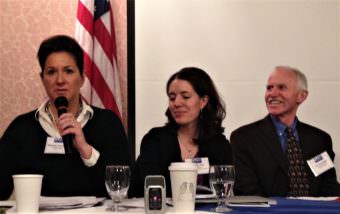
Homeless youth advocate Michelle Overstreet, left, talks about drug abuse during an Alaska Municipal League forum Feb. 22, 2017, in Juneau. Dr. Anne Zink, center, and Dr. Jay Butler, right, were also on the panel. (Photo by Ed Schoenfeld/CoastAlaska News)
Homeless youth advocate Michelle Overstreet, left, talks about drug abuse during an Alaska Municipal League forum Feb. 22, 2017, in Juneau. Dr. Anne Zink and Dr. Jay Butler also were on the panel. (Photo by Ed Schoenfeld/CoastAlaska News)

Alaska has another tool in the fight against opioids.

Public health officials are distributing thousands of disposal bags that chemically react to and leave no trace of the drugs.

The bags are sealable pouches containing active carbon. You add drugs and water, seal and shake it, and wait for 30 seconds. The carbon neutralizes the drugs, so they have no effect. The biodegradable bags can be thrown out with the trash.

Michelle Overstreet is executive director of My House, a Wasilla-based organization that helps homeless teenagers. She told those at an Alaska Municipal League meeting in Juneau that it’s important to dispose of drugs safely at any time, not just official drop-off days.

“We’ve had parents coming in to get those, we’ve had grandparents coming in to get those,” she said. “People are excited about having a way to get rid of those that isn’t throwing them in the garbage or down their septic system, which then can leach into their well.”

A drug-disposal pouch from a painkiller company that's providing 25,000 such bags to Alaska. (Photo courtesy Mallinckrodt Pharmaceuticals)
A drug-disposal pouch from a painkiller company that’s providing 25,000 such bags to Alaska. (Photo courtesy Mallinckrodt Pharmaceuticals)

Mallinckrodt Pharmaceuticals, which makes opioid pain-killers, is contributing 25,000 disposal bags to the state.

Alaska Chief Medical Officer Dr. Jay Butler said his agency is sending 1,000 bags to its clinics.

“I recognize that some of our public health centers don’t have full-time staffing anymore. But that is one of the ways we want to get these into the communities. Or if we can provide some directly to you, we’d be happy to do that also,” he told municipal leaders at the forum.

Public health official Andy Jones said distribution began a few weeks ago.

They’re going to hospitals, recovery centers, homeless shelters, tribal governments and others who can get them to all parts of Alaska.

“There’s a lot of communities that don’t have public health centers,” Jones said. “So we’ll also be looking at the clinics and community health aides.”

“We do have a lot of itinerant nurses within public health nursing that travel go out to the communities quite often,” he said. “So they’re going to be equipped with these pouches and they can hand these out as they travel across the state.”

Jones said the bags are an easy way to dispose of unused prescription painkillers, which are frequently stolen or sold to addicts.

“The targeted audience may not be the individual who’s using, especially,” he said. “More or less, (it’s) the individual who’s coming into recovery.

“When you go into those recovery centers or those homes, they can’t be carrying pills or prescriptions,” Jones said. “These bags give them that way to dispose of those medications in the right manner.”

Gov. Bill Walker recently declared the opioid epidemic a state emergency. Other efforts include distributing 5,000 naloxone kits, which can stop opioid overdoses.

Study shows rise in some prenatal exposure to opiates

A new study from a Alaskan epidemiologist looks at infants who were exposed to opiates before birth.

Unlike previous studies, it goes beyond the sharp rise in cases for a portion of the population to explore what happens next.

The rate of neonatal abstinence syndrome for Medicaid-eligible births increased nearly seven-fold from 2004 to 2015.

Neonatal abstinence syndrome is when babies are in withdrawal from drugs after being born.

In 2004, 2.7 out of every 1,000 live births in this group had the syndrome, and in 2015, it was 18.4.

However, state maternal and child health epidemiologist and study author Abigail Newby-Kew said these numbers do not reflect the entire state.

The study only looks at Medicaid-eligible births because that’s the most complete, long-term data set available, she said during a phone interview. It cannot be used to draw conclusions about rates for the entire population.

The study has other limitations, too, because the syndrome isn’t always diagnosed the same way in each hospital.

“Symptoms vary greatly based on just the type of drug the mother was using, the amount of the drug the mother was using,” Newby-Kew said. “It’s very possible that an infant might not display symptoms until they are already outside the hospital. In that case the hospital could miss it entirely.”

The study does mirror national trends.

The number of kids born with opioids in their systems is on the rise.

This study then goes a step further, to see what happens to the babies once they leave the hospital.

“It’s not a problem that ends once a kid makes it out of the hospital,” Newby-Kew said. “Both the child and the mother are going to need additional support down the line.”

That could include substance abuse treatment for the parents or developmental learning assistance for the child.

Newby-Kew said the long-term impacts of prenatal exposure to opioids is still unknown and needs more research.

At the moment, there aren’t many ways to find out what happens to these families, Newby-Kew said, but one available data set is from the Office of Children’s Services.

Federal and state laws require medical providers to report children who are prenatally exposed to substances to child protection services, though not all do.

There were 541 cases diagnosed during the 12-year-long study period.

It’s unknown whether the mothers were using the drugs legally or not.

Nearly two-thirds of the cases were reported to child services, and about 140 children were temporarily or permanently taken from their homes.

The agency does not automatically remove a child from a home where people are using substances, Child Services operations manager Travis Erickson said during a phone interview.

“When there are substances involved, we assess the impact of those substances on the parents’ ability to care give for the children,” Erickson said. “We’re really looking beyond ‘are there substances being used’ to things like ‘how does that change the parents’ behavior.’”

The assessments include talking to medical providers and law enforcement agencies, and seeing what sort of safety nets the family has in place.

Erickson said that although there is a well-known rise in opioid use statewide, for child services “alcohol is still by far and away the most common underlying substance that causes child abuse and neglect.”

Fansler lays out position on taxes, opioid disaster, subsidies

District 38 state Rep. Zach Fansler laid out his position on proposed taxes, the governor’s opioid disaster declaration, changes to oil and gas subsidies, and more Friday during a live KYUK call-in show with constituents.
State Rep. Zach Fansler meets February 11, 2017, with District 38 constituents at an open house meeting at the Kuskokwim University Campus. (Photo by Katie Basile/KYUK)
State Rep. Zach Fansler meets Feb. 11, 2017, with District 38 constituents at an open house meeting at the Kuskokwim University Campus. (Photo by
Katie Basile/KYUK)

Fansler said he supports House Bill 115, the proposed fiscal solution for the state from the House Finance Committee.

The bill combines earnings from the Permanent Fund with an income tax to generate state revenue, while using a formula to maintain a Permanent Fund Dividend.

“This is something that I’m very supportive of,” Fansler said, referring to the state income tax, “and something that I’ve heard from folks over and over in the region about. That this is really the fair way to make sure all Alaskans are giving with equity.”

Fansler expects to see those revenues flowing back to help the region.

“We have water and sewer issues,” he said. “We have a lot of issues with erosion. We’re on the forefront of climate change, and the only way to get these services is to raise more money.”

A proposed tax the representative has not made up his mind about is House Bill 60 and Senate Bill 25, a bill to triple the state’s motor fuel tax over the next two years from a national low of 8 cents per gallon to 24 cents per gallon by July 2018.

The tax has not been raised in almost 50 years.

“It’s probably something that does need to happen,” Fansler said. “But I think that we need to make sure we are raising it in a way that doesn’t price people out of living here on the YK Delta.”

The tax would go into a designated fund to repair state roads, airports and ferries. Fansler said he will need to hear from constituents to make his decision on the proposed increase.

Gov. Bill Walker’s disaster declaration for the state’s opioid epidemic earned applause from Fansler. The governor said his orders will require legislation to address the epidemic on all fronts, and Fansler had some ideas.

“We need to make sure we’re fully funding these programs that are in place already,” Fansler said. “We need to make sure we’re passing legislation that is intelligent and that is going to get critical services such as rehab programs, such as return to work programs, things like that, that are going to help people kick the habit and move on with their lives, and stay away from it in the long term.”

Fansler said he met with the governor last week to discuss ways to cut off the supply of illegal opioids and heroin to bush communities.

Reforming the way the state taxes the oil and gas industry is an issue Fansler campaigned on, and he says he doesn’t think House Bill 111 on that issue goes far enough.

“I think it’s a good first step,” he said. “It’s important to note that it doesn’t immediately make a large scale difference.”

Fansler said it’s too early for him to take a position on Sen. Lyman Hoffman’s proposed Senate Bill 18, a bill to create a new kind of borough that would have taxing power to build energy infrastructure.

“To lower energy costs, I applaud that,” Fansler said. “We’ll see as this bill goes on if this is a vehicle to do that.”

Hoffman says the bill will likely see substantial changes made in committee.

Senate Bill 91, which passed last year, overhauled the criminal justice system and, according to some critics, has made consequences too light for serious offenses.

There are no specific changes to the bill that Fansler said he supported at this time, but he’s open to suggestions from constituents.

Fansler said that he supports tribes developing their tribal courts, and he wants his office to act as a clearing house on that issue.

Bethel city manager plans crack down on city truck drivers

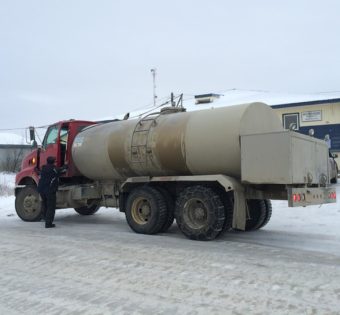
Bethel water truck.
Bethel water truck. (Photo by Anna Rose McArthur/KYUK)

Bethel city water trucks get more than their fair share of abuse, but after an incident that left a brand new water truck tipped on its side, the Bethel City Manager decided to change the accident policy to give city truck drivers who are found to be negligent tickets and drug tests.

It’s pretty common to hear about water and sewer trucks crashing into things in Bethel. They’re huge vehicles driving on tiny, often slick roads.

But Bethel City Manager Pete Williams said at Tuesday’s City Council meeting that it is more than city roads that are the problem in these accidents. He should know; Williams was a truck driver.

“I drove truck for 20 years, and I would never have been a truck driver if I went through all the accidents I see out there,” Williams said.

He says the high number of accidents in Bethel has to change, and he has a plan on how to make that happen.

“We’re gonna kinda take a different approach to how to deal with these when they happen. We’re gonna sit the driver down, take a drug test,” Williams said.

Federal law requires drug tests after major accidents, but the ones the City Manager is focusing on are minor ones that are not covered under federal law. What Williams wants to do is reduce the kind of bumping and scraping that has become common in the Bethel fleet.

Earlier this year, the city received new water trucks costing $250,000 each after the previous City Manager secured funding for them. Williams says that the latest accident was unacceptable.

“Running into houses, these aren’t incidences, these accidents, and you should get a ticket. We might lose some drivers, but we just can’t continue the way we’ve been going on this,” Williams said.

Losing drivers could mean a slowdown in water and sewer service until new drivers are found. Drivers are drug tested before they are allowed to drive for the city, but until now, they haven’t usually retested for drug use unless they are in a major accident.

Walker orders state agencies to pursue grants to fight opioid epidemic

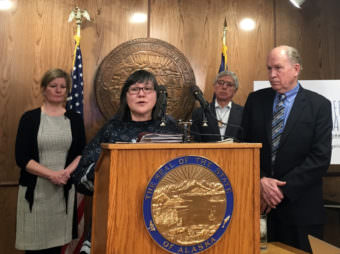
Gov. Bill Walker, state Emergency Programs Section Chief Andy Jones, Kara Nelson and state Chief Medical Officer Dr. Jay Butler during the Feb. 16 announcement of Walker's order on opioid addiction. (Photo by Andrew Kitchenman/Alaska Public Media/KTOO)
Gov. Bill Walker, state Emergency Programs Section Chief Andy Jones, Kara Nelson and state Chief Medical Officer Dr. Jay Butler during the Feb. 16 announcement of Walker’s order on opioid addiction. (Photo by Andrew Kitchenman/Alaska Public Media/KTOO)

Gov. Bill Walker took action this week to try to stem the epidemic of overdose deaths from heroin and other opioid drugs.

Walker signed a disaster declaration that’s intended to make it easier to give overdose victims the life-saving overdose antidote naloxone.

More than 120 Alaskans have died from opioid overdoses over the past three years. Walker said declaring a disaster will enable a coordinated statewide response.

“I mean, it’s not one particular region, one particular income strata,” Walker said. “It is widespread, and it’s just, the stories were just horrific from across the state.”

Walker ordered state agencies Thursday to apply for grants to prevent and treat addiction. They’ll also work to eliminate illegally imported drugs and help monitor controlled drugs. And they’ll aim to add funding for treatment using methadone and other medications.

State Chief Medical Officer Dr. Jay Butler is leading a weekly Instate Command System of senior state officials to respond to the epidemic, similar to the response to oil spills and other disasters.

“The challenge of the opioid epidemic is that it’s more than just a criminal justice issue, but it’s also a health issue,” Butler said. “We need to address it very broadly in terms of being a health issue, a public safety issue, an education issue, a medical practice issue. We need to have a multi-pronged approach.”

Butler said making naloxone more widely available is an important first step. But he said it’s important to transition those recovering from overdoses into withdrawal and addiction treatment.

“It’s not a cure-all,” Butler said. “It’s like a tourniquet in a severe trauma case. It saves a life, but it does not cure addiction. That’s why a much broader-based approach is needed.”

The state will spend more than $4 million on the effort. All of the funding comes from four federal grants.

Butler said more doctors should receive training to provide patients with methadone and other drugs that help treat addiction, including Vivitrol and buprenorphine.

“Many of my colleagues I will hear say, ‘Well, I didn’t really go into medicine to treat addiction,’ but I think we all went into medicine to make people well,” Butler said.

A key part of the opioid response is the people in recovery who work as peer counselors, connecting those who are using heroin and other drugs with the treatment they need.

Juneau resident Kara Nelson is a certified recovery and re-entry coach. She directs Haven House Juneau, a peer-led, faith-based transitional home for women leaving prison. She praised Walker’s approach.

“I think it’s just going to give us more ammo when we’re trying to fight to bring different supports, and say we need more treatment, we need more detox, we need to treat this as a public-health issue,” Nelson said. “What that means is long-term recovery supports, which we are lacking so much here in the state.”

Walker said he will work with the Legislature for changes to state law to aid the effort.

Site notifications
Update notification options
Subscribe to notifications