Alcohol & Substance Abuse

Fentanyl and other addictive opioids stolen from Haines clinic

Highly-addictive opioids including fentanyl, morphine and oxycodone were stolen from the Haines SEARHC Clinic during a break-in late last week.

The Haines Police Department has warned first responders about the increased potential for drug-related emergencies because of the incident.
The break-in happened late Thursday night or early Friday morning last week.

On Tuesday, the police department released a list of substances that were taken. They include narcotics and benzodiazepines.

The police news release said the majority of the drugs are pills, but several were in an injectable form. The department declined to say what quantities of each drug were taken.

Narcotics, which include opioids, are psychoactive compounds prescribed for pain relief. The narcotics stolen include fentanyl, morphine, codeine, hydrocodone and oxycodone.

Fentanyl is a synthetic opioid that can be more than 100 times more potent that morphine. It has caused hundreds
of overdose deaths in the United States and Canada in recent years.

Benzodiazepines also are known as tranquilizers or sedatives. Several types, including lorazepam, diazepam and clonazepam, were stolen from the clinic. Some of the well-known brand names for those substances are Ativan, Valium and Klonopin.

The police are asking the community to speak with family and friends about the dangers of using controlled substances that are not prescribed to them.

What does recidivism mean anyway?

Ideally, when someone gets out of prison, they don’t go back.

In reality, nearly two out of every three offenders in Alaska go back inside within three years.

Some call this the revolving door. The technical term is recidivism.

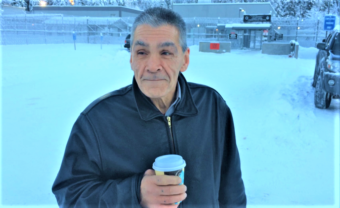
Elasonga Milligrock and Dani Cashen visit outside KTOO. Cashen says felons can be stigmatized by the community. (Photo by Scott Burton/KTOO)

I’ve been through Alaska’s revolving door myself, and hope to bridge the gap between convicts, ex-cons and the communities they’re trying to re-enter.

The Alaska Judicial Council defines a case of recidivism as when an offender is re-arrested, has a new court case filed or is remanded to custody for new charges or for probation/parole violations.

Listen to the story here:

For 25 years, I found just about all of the ways in and out of prison — more times than I care to count. Ironically, I’d never heard the word recidivism. I found I was not alone, so I hit the streets and asked about it.

After asking three random people, not one knew what the word recidivism meant.

At a Juneau Reentry Coalition gathering, it was better understood.

The coalition is a group of people and organizations dedicated to reducing recidivism, among other justice reforms.

I met Logan Henkins, a carpenter and ex-convict, who got it.

Logan Henkins and his girlfriend, LauraLee Peters. (Photo by Elasonga Milligrock/KTOO)

“Recidivism to me is the percentage of people that go into prison and continue to go back after they’re released because of not changing,” Henkins said.

The part about not changing was right on the money for me.

Eventually, I decided to change my ways, got treatment for my alcohol and drug abuse, and now I am staying out of jail.

But, that personal change, was only part of the equation.

When a person gets out of jail, the process is called re-entry — they’re re-entering society.

And I’ll tell you what, it isn’t easy.

It can be like starting a life in a foreign land where the people don’t want you there.

“I am a felon, yes, and I am a recovering addict after five years,” said Dani Cashen, who’s starting a house cleaning business. “I’m still a felon and it still tracks me and haunts me and follows me wherever I go.”

That stigma is something all felons and ex-convicts experience.

Unlike me, with my tattoos, you might not know Cashen had been to prison – unless you’re an employer.

By law, she has to check the felon box on things like job applications.

And then there’s the rest of life’s challenges, like getting housing and keeping up with the conditions of your release.

I’ve been on parole for three years. I check in with my parole officer downtown once a month, can’t leave town unless approved, can’t go into bars, and, I take random drug tests at my PO meetings. I have to obey all state and federal laws.

If I miss or fail any stipulations, it’s back to prison.

If that isn’t hard enough, imagine adding on mental health issues, which might go undiagnosed and untreated in prison.

Bruce Van Dusen is the executive director at Polaris House, an organization dedicated to supporting people with mental illness. (Photo by Elasonga Milligrock/KTOO)

“In general, the story is around the whole country is that the prisons have become the mental health providers,” said Bruce Van Dusen, who is an ex-convict and executive director of Polaris House, an organization dedicated to supporting people with mental illness.

It’s also part of the re-entry coalition trying to stop the revolving door.

“Because they have so many people who are incarcerated who have schizophrenia, or depression, or bipolar,” Van Dusen said.

Thankfully, people like Van Dusen are helping.

And then there’s Ramona Wigg who is a volunteer advocate for people going through reentry. Despite the many challenges, Wigg says she has seen attitudes around reentry shift for the better.

Despite the many challenges, Wigg said she has seen attitudes around re-entry shift for the better.

“It’s just now coming out in the public, so now it’s popular I guess. But it’s important and it should have been popular years ago,” Wigg said. “Think of all the lives we could have saved.”

Confronting and sharing these experiences, including my own, are just a few steps toward understanding and reducing recidivism as a community.

In my next story, I’ll profile a few people staying out of trouble and try to identify why.

This story is part of an ongoing project on re-entry and recidivism. 360 North is also producing a television documentary on the topic slated for June.

KTOO’s project focusing on recidivism is funded, in part, by a grant from the Alaska Mental Health Trust Authority.

Correction: In a previous version of this story Ramona Wigg was misidentified as a mother of a person going through the revolving door. She is a volunteer advocate for people going through reentry. 

Juneau residents arrested in Ketchikan hotel room for heroin, meth

Two Juneau residents are facing drug charges after police served a search warrant Wednesday at their Ketchikan hotel room and allegedly found heroin and methamphetamine.

Ashley L. Bethel, 28, and Gregory O Brown Jr., 33, made their first court appearance Wednesday afternoon.

They each were charged with second- and third-degree misconduct involving a controlled substance.

Bethel and Brown had about 20 grams of heroin and about 12 grams of meth, according to the complaint filed in court by the Ketchikan Police Department.

Police say they also found syringes, “tooters” or cylindrical devices to consume drugs, foil packaging and about $200 cash.

Police say the woman told them she had consumed meth within the past two days.

According to court records, District Court Judge Kevin Miller appointed the Public Defender’s office to represent them, and set bail at $12,500 for the man and $11,000 for the woman.

The next scheduled court hearing for each is 3 p.m. March 23.

Tenants displaced after Juneau’s historic Bergmann Hotel condemned by city

Juneau police and community members look on as residents of the Bergmann Hotel hurriedly packed their belongings and left their rooms on Friday March 10, 2017 in Juneau, Alaska. The building has been condemned and residents were given 24-hours to leave. (Photo by Rashah McChesney/Alaska's Energy Desk)
Juneau police and community members look on as residents of the Bergmann Hotel hurriedly packed their belongings and left their rooms Friday in Juneau. The building has been condemned and residents were given 24-hours to leave. (Photo by Rashah McChesney/Alaska’s Energy Desk)

The historic Bergmann Hotel used as a tenement has been condemned by the City and Borough of Juneau over health and safety hazards.

Tenants were coming to terms Friday with the city’s condemnation order.

Code violations have been ongoing for years, but few tenants realized this was really the end.

I read that sign and walked right past it just like most every other tenants did, probably most of them didn’t even read it — a few of them can’t,” said Dave Lane, a carpenter who works as a handyman in exchange for lodging.

The Bergmann Hotel was built in 1913. It’s been listed on the National Register of Historic Places since 1977.

The city says the owners had been on notice since October.

There’s significant health and safety issues at the Bergmann including an inoperable sprinkler system for fire, inconsistent heating, no hot water, sewage issues and improper roofing,” Deputy City Manager Mila Cosgrove said, “All of those issues pose significant risks to the people who are tenants there.”

About 50 people live in the building. Most pay about $600 a month. Tenants do much of the repair and upkeep themselves to keep the heat on and water flowing.

James Cole, 49, said he was caught off guard as he worked to clear out the basement.

“The whole point of it is I just gave them $600 yesterday for rent and the guy — he wouldn’t give me my money back,” Cole said. “I told him, ‘Dude. I just gave you $600 just yesterday.’ Now if I don’t get my $600 back — I’m going to take him to court. I want my money back if I can’t stay here.”

The city said it’s working with social service agencies to help displaced tenants with nowhere to go. As many as 30 spaces have been available at its downtown church.

“We’ll be open every night for them until Tuesday from 7 p.m. to 7 a.m. so they can sleep,” said Lt. Dana Walters of the Salvation Army. “We have cots, we have blankets. People are allowed to bring like one bag with them but then they have to take it. We unfortunately don’t have room for people to store things.”

The hotel property is controlled by Camilla Barrett who owns it through a limited liability corporation.

Juneau police officers confer as they take Chuck Cotten, property manager at the Bergmann Hotel, into custody. Cotten was responsible for removing residents from their rooms before Friday in Juneau. The building has been condemned. (Photo by Rashah McChesney/Alaska’s Energy Desk)

Barrett also is a defendant named in a lawsuit brought by the city in its attempt to recover the cost of demolishing the Gastineau Apartments, a fire-ravaged downtown property owned by a limited liability corporation controlled by the Barrett family.

Dave Lane said he’s worked for about three years to try to keep the building habitable.

But there’s been little investment from the Barretts, he said.

“Right now they don’t get a lot out of it so they don’t want to put a lot into it,” Lane said. “They’re not looking into the fact that, ‘Okay — if we put some money into this’ Because I mean, look at this place … it wouldn’t really take that much to put this into — have it a really nice building.”

Efforts to reach Camilla Barrett – whose legal name is listed as Kathleen Barrett — and her attorney that represented her in the city’s lawsuit over the Gastineau Apartments were unsuccessful.

Many of the residents suffer from mental illness and substance abuse.

“We do support safety and things like that. We don’t want to see our mental health consumers housed in a dilapidated situation,”said Gregory Fitch, executive director of the Mental Health Consumer Action Network in Juneau. “But considering the cold — I think we could’ve waited a week.”

The National Weather Service forecasts temperatures to dip into the 20s over the weekend.

Juneau struggles with homelessness and a lack of affordable housing. It remains unclear what options many of these tenants will have after the city boards up the Third Street property.


YK tribes look for solutions to impacts of alcohol on villages

Tribal members from more than a dozen YK Delta tribes met March 8, 2017, in Bethel to discuss how their villages have been affected since alcohol sales began in Bethel last spring and what tribes can do about it. (Photo by Gale Ekamrak/KYUK)

Representatives from more than a dozen tribes across the Yukon-Kuskokwim Delta came together to share how their communities have been affected since Bethel started selling alcohol last spring.

Bethel’s alcohol stores are affecting the entire region, and it’s up to the tribes to do something about it. That’s the message from a tribal gathering held Wednesday in Bethel.

But before the meeting began, a tragedy underlining its purpose struck.

A woman was thrown from a snowmachine Wednesday morning and died. Alaska State Troopers responded to the crash west of Akiachak on the Gweek River trail.

The driver was intoxicated, and at about the time he was being charged with a DUI and criminally negligent homicide, the meeting in Bethel was beginning.

Tribal members — one after another — stood up and shared their stories about how their villages have been affected since Bethel started selling alcohol.

“The bootlegging issue has increased,” said Nick Duney, Tribal Council president of Marshall, a dry village.

“Kids are depressed, walking around like they have no hope. Gunshots heard outside of my house multiple times. Neighbors that are always drinking,” said Kimberly Smith, substance abuse prevention coordinator in Akiak, another dry village.

“Since I started in December,” said Steven Andrew, an Atmautluak tribal police officer, “I’ve already got one locker filled with empty bottles of booze. I can’t even count how many bottles I’ve taken away so far.”

At one point, Andrew apologized for pausing during his speech, saying he’d only gotten three hours of sleep the night before after responding to a call involving alcohol.

The testimony continued. People shared stories of domestic violence increasing, of people drinking and dying from exposure, of children being taken from their parents, and of suicide. The problems, they said, have gone up since Bethel opened its alcohol stores.

Harold Napoleon, of the Native Village of Paimute, summed up the meeting by saying that, “You cannot have a liquor store in Bethel and have it not affect every single village in the region. The result is always people dying, being beat up, abused, neglected, or dead.”

There were solutions offered, but nothing voted on.

Solutions included hiring more law enforcement officers, collecting data on rising social ills, and even suing the City of Bethel.

Robert Henderson with the Alaska Attorney General’s office also offered a way to help through empowering tribal courts.

He explained how tribes can form an agreement with the state, like Anvik did in January, to send low-level criminal cases to tribal court instead of state court. Those cases often involve alcohol.

The group also heard an update on the Emmonak Women’s Shelter from Lenora Hootch. The community voted to legalize alcohol in October, and Hootch says that issues similar to what the villages around Bethel are seeing are also appearing in Emmonak and its surrounding villages.

“We’re seeing the rates of domestic violence have risen,” she told the room. “We’ve had more suicides. The vandalism has risen.”

Gov. Bill Walker’s rural affairs adviser Gerad Godfrey attended the meeting and said he could bring the consensus of what the group decides to the governor’s ears.

The meeting will reconvene Thursday at the Bethel Cultural Center to vote on how to address the villages’ alcohol issues.

The group will also discuss state Sen. Lyman Hoffman’s proposal to create a new kind of energy borough in the region under Senate Bill 18.

Walker bill aims to curb opioid epidemic

State officials discuss legislation aimed at curbing opioid abuse with reporters in the state Capitol on March 6, 2017.
State officials discuss legislation aimed at curbing opioid abuse with reporters in the state Capitol on Monday. From left to right: Alaska Attorney General Jahna Lindemuth, Health Commissioner Valeria “Nurr’araaluk” Davidson, Lt. Gov. Byron Mallott, and Gov. Bill Walker. (Photo by Andrew Kitchenman/KTOO and Alaska Public Media)

A new bill is aimed at curbing opioid addiction and overdose deaths. The bill lets patients tell health care providers and hospitals to not give them opioids. It also requires health care providers receive training in opioid addiction.

Gov. Bill Walker introduced the bill.

“It’s not the be-all-and-end-all,” Walker said. “There’s many paths to recovery. There’s many other things that we are working on. But this is one we believe is quite significant.”

The bill also limits initial opioid prescriptions to a seven-day supply. The measure requires pharmacists and veterinarians to register their prescriptions in a database. Doctors and nurses who prescribe opioids would check the database.

The database would be updated daily instead of once a week if the bill is enacted. And prescribers would get a report card from the state Board of Pharmacy indicating how frequently they prescribe opioids compared with similar providers.

Health and Social Services Commissioner Valerie “Nurr’araaluk” Davidson said another important piece of treating addiction is the state’s Medicaid expansion. It’s added health coverage for 30,000 Alaskans.

“Every one of us in this room knows somebody – we’re related to somebody, we have somebody – who is struggling with opioid addiction,” Davidson said. “And I would encourage you, that if you think that’s not true, I would encourage you to look a little bit harder.”

Walker introduced the bill at press conference Monday in which he announced other opioid-related measures. The state will begin giving prison inmates who enter with addictions the medication Vivitrol. It helps them overcome addiction by blocking the effects of opioid drugs.

Two versions of the bill — House Bill 159 and Senate Bill 79 — were referred to the Health and Social Services and Finance committees in each body.

Site notifications
Update notification options
Subscribe to notifications