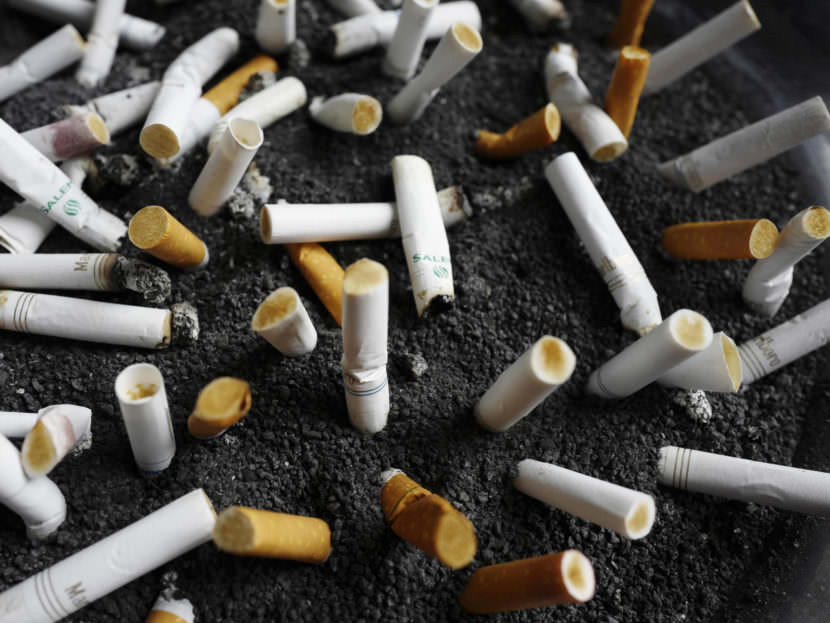
But this weekend, new regulations on the tobacco industry came into force in the United Kingdom, and they go even further than what an EU directive required.
The Tobacco Products Directive was revised by the EU a year ago to impose new restrictions on tobacco products in hopes of deterring smoking, especially among young people. The restrictions include the banning of flavored cigarettes that mask the smell and taste of tobacco, and the addition of larger warnings and graphic photos of some of the health risks. The EU cites evidence that pictorial warnings have been shown to contribute to the reduction of smoking rates in Canada and Brazil.
There are also new rules regulating the amount of nicotine that e-cigarettes may contain, something the directive says was previously unregulated. There will also be new packaging and labeling rules for e-cigarettes.
All of the regulations were set to go into effect Saturday, one year after they passed, to give businesses time to clear out old stock.
The U.K. has decided to go even further than the EU in regulating tobacco products with a rule that standardizes cigarette packaging. All cigarettes in the U.K. must now be sold in green packaging with graphic warning labels, with the brand name printed in a standard typeface. The BBC reports that some have called the new standardized cartons “the ugliest color in the world.”
The rules will also ban the selling of “half packs” of 10 cigarettes, setting the minimum at 20.
Charities devoted to fighting cancer and other diseases linked to smoking applauded the new rules. The British Lung Foundation tweeted, “Every person discouraged from smoking could be a life saved. Standardized packaging is a positive step. Now we need a tobacco control plan.” Cancer Research UK says it is currently investing in studies to “evaluate the impact” of the standardized packaging.
Some critics of the new restrictions say they are “infantilizing.” Simon Clark, director of the smoker’s rights group Forest, released a statement this week, saying that the rules are counter-productive. “The idea that people smoke because of the packaging is absurd. There’s no evidence that plain packaging has any impact on youth smoking rates,” Clark says.
Others fear that the new restrictions on e-cigarettes will encourage people to go back to regular cigarettes, or will buy products on the black market.
Copyright 2017 NPR. To see more, visit http://www.npr.org/.
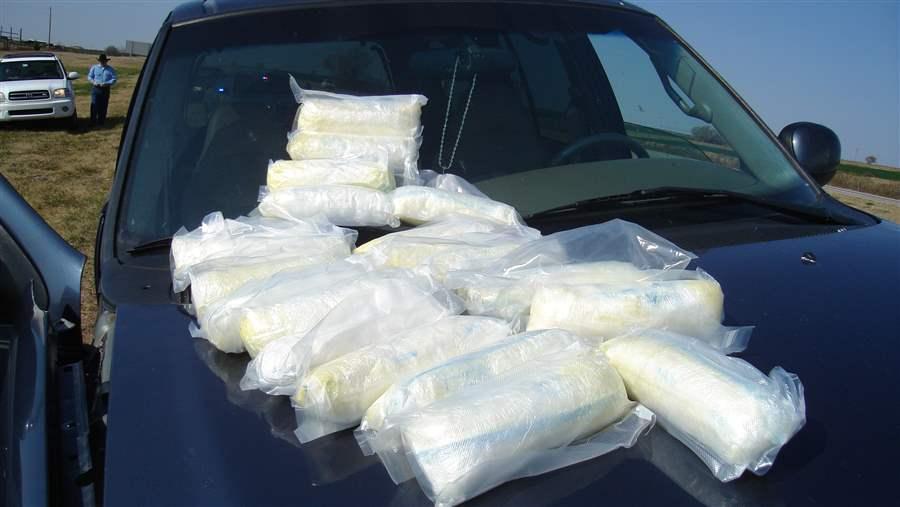
An Oklahoma narcotics agent displays 20 pounds of Mexican crystal meth seized from a drug dealer. As federal, state and local health officials focus on the opioid epidemic, the supply and use of methamphetamine is surging in Oklahoma and other Western, Midwestern and Southern states. (Photo courtesy Oklahoma Bureau of Narcotics)
The opioid epidemic has killed tens of thousands over the past two years and driven major reforms in state and local law enforcement and public health policies for people with addiction.
But another deadly but popular drug, methamphetamine, also has been surging in many parts of the country. And federal officials say that, based on what they learned as opioids swept the U.S., methamphetamine is likely to spread even further.
“The beginning of the opioid epidemic was 2000 and we thought it was just localized,” said Kimberly Johnson, director of the Center for Substance Abuse Treatment at the Substance Abuse and Mental Health Services Administration, or SAMHSA. “Now we know that drug outbreaks aren’t likely to stay localized so we can start addressing them sooner and letting other states know of the potential for it spreading.”
From Arizona, New Mexico and Oklahoma to Montana, Wisconsin and Minnesota and all across the South, inexpensive methamphetamine is flowing in from Mexico, fueling what police and epidemiologists say is an alarming increase in the number of people using the drug, and dying from it.
Nationwide, regular use of the inexpensive and widely available illicit stimulant increased from 3 percent to 4 percent of the population between 2010 and 2015, according to SAMHSA. At the same time, heroin use shot from 1 percent to 2 percent of the population.
The number of people using methamphetamine, also known as meth, crystal meth, crystal, crank, ice and speed, has been among the highest of any illicit substance for decades. But despite the stimulant’s harmful long-term effects on the body — including rotting teeth, heart and kidney failure, and skin lesions — its overdose potential is much lower than prescription painkillers and other opioids.
Still, overdose deaths from methamphetamine have spiked recently.
In 2014, roughly 3,700 Americans died from drug overdoses involving methamphetamine, more than double the 2010 number, according to the Centers for Disease Control and Prevention. In 2015, the most recent year for which federal data are available, nearly 4,900 meth users died of an overdose, a 30 percent jump in one year.
Early warnings
In Oklahoma, methamphetamine was involved in 328 overdose deaths last year, a sharp climb from 271 in 2015, and more than the combined deaths from prescription painkillers hydrocodone and oxycodone, according to Mark Woodward, a spokesman for the Oklahoma Narcotics Bureau.
In contrast to the last epidemic, which began in the 1990s, rural meth labs are now a rarity and the fires and explosions that captured headlines back then are practically nonexistent today, Woodward said. “A lot of people thought if meth labs are down, meth use is down.”
“But so much is coming in from Mexico, and it’s just as good as the domestic cooked product,” he said. “Why risk leaving a paper trail at a pharmacy when you have a buddy coming up from El Paso tonight with a cheap supply?”
The majority of methamphetamine now is smuggled across the Southwest border, according to the Drug Enforcement Administration’s 2016 National Drug Threat Assessment Summary.
Its purity is high and its street price is relatively low, much cheaper than heroin.
“While the current opioid crisis has deservedly garnered significant attention, the methamphetamine threat has remained prevalent,” the report warns.
Minnesota, a hot spot during the last methamphetamine epidemic, is experiencing a surge in admissions for treatment of methamphetamine addiction, according to the state Human Services Department.
In the upper Midwest and much of the rest of the country, 2005 was the peak year for methamphetamine use. After that, federal and state laws restricting the sale of an essential ingredient in methamphetamine, the over-the-counter cold medicine pseudoephedrine, led to a sharp decrease in U.S. meth labs.
As more meth started coming in from Mexico, the number of people seeking treatment began creeping up again and began to surge in many places in 2015. Last year, nearly 11,600 meth users were admitted for treatment in Minnesota, according to state data — a significant increase over the 6,700 who sought treatment for methamphetamine addiction in 2005.
Methamphetamine also is showing up in places that never experienced an earlier epidemic.
“What we’re seeing is that the use of methamphetamines has recently moved out of trailer parks and rural areas and into inner cities,” said Ken Roy, medical director of a major treatment facility, Addiction Recovery Resources, in New Orleans. “We’re seeing a lot of heroin addicts that also use methamphetamines. It used to be the only way we got meth patients was when they came to the hospital from rural areas.”
Different drugs
Opioid users experience a dreamlike state and typically nod off. But methamphetamine produces an entirely different high. Users experience a sense of elation and hypervigilance, and often become paranoid and aggressive.
“They may binge on meth for days without eating or sleeping, and they often start seeing things that aren’t there,” said Carol Falkowski, an addiction expert in Minnesota.
Death from a methamphetamine overdose also is very different from an opioid death. With opioids, which affect the part of the brain that controls breathing, high enough doses can shut down respiratory functions, quickly causing death.
With methamphetamine, death is typically caused by a stroke or heart attack, and is characterized by extreme sweating as the body overheats prior to death. Because methamphetamine represents a lower risk of overdose, many use it for decades, which often results in gradual organ failure and death. Those deaths are typically not counted in the overdose statistics.
Likewise, treatment for addiction to methamphetamine is different than for opioids. No FDA-approved medications exist to stop the cravings for methamphetamine, whereas three effective drugs are available to help people recover from opioid addiction.
As a result, methamphetamine treatment primarily consists of outpatient therapy, often after a brief stay in a residential facility.
People who stop using methamphetamine do not suffer the severe withdrawal symptoms such as the vomiting, muscle pain and other flu-like symptoms suffered by opioid users. But they do tend to become immobilized, sleeping a lot and binge eating, as well as suffering from severe depression, anxiety and drug cravings.
Falkowski said that during the last methamphetamine epidemic, there was more emphasis on the way people behaved when using meth for long periods of time, and the threat they posed to public safety.
Health officials in places like Minnesota and Oklahoma say the health care providers who helped legions of people overcome methamphetamine addiction during the last epidemic are prepared for a new onslaught. But Johnson, the SAMHSA director, cautioned that the addiction treatment workforce has not grown in proportion to the growth in overall drug use since then.
Tackling a new meth addiction wave on top of an opioid epidemic could strain the nation’s health care system, she said. “I don’t think what we’ve done to scale up access to treatme nt for opioid disorders is going to be that helpful for methamphetamines.”
Tom Price speaks at the 2010 Conservative Political Action Conference. He was a Georgia Congressman at the time and is now secretary of health and human services in the Trump administration. (Creative Commons photo by Gage Skidmore)
Addiction experts are up in arms following remarks from Health and Human Services Secretary Tom Price, in which he referred to medication-assisted treatment for addiction as “substituting one opioid for another.”
Nearly 700 researchers and practitioners sent a letter Monday communicating their criticisms to Price and urging him to “set the record straight.”
The medicines Price referred to are methadone and buprenorphine, both of which are opioids. The letter notes that there is a “substantial body of research” showing the drugs’ effectiveness and they have been the standard of care for addiction treatment for years. The drugs tamp down cravings and prevent withdrawals, helping people suffering from addiction to stop misusing prescription or illicit opioids and get back to living productive lives. Experts say Price’s remarks, made last week to theCharleston Gazette-Mail, ignore the primary benefits of such medications and go against scientific evidence.
“I was just totally gobsmacked,” says Brendan Saloner, an addiction researcher and assistant professor at the Johns Hopkins Bloomberg School of Public Health.
Saloner says that Price’s own Department of Health and Human Services (HHS) displays information online that contradicts his comments.
“I couldn’t believe we were having to reopen this conversation. It totally flies in the face of all the evidence,” he says. “These drugs are highly effective in restoring a sense of normalcy in people’s lives.”
Price instead touted treatment with a third addiction medicine, Vivitrol, a brand name formulation of naltrexone, which is an opioid blocker. All three drugs — methadone, buprenorphine and naltrexone — have been shown to help reduce relapse and keep people in treatment.
“Instead of talking about getting the right medication to the right patient at the right time, [Price] actually maligned the use of buprenorphine and methadone,” says Dr. Corey Waller, an addiction psychiatrist who heads legislative advocacy at the American Society of Addiction Medicine.
Addiction experts say that Price’s remarks are consistent with widespread, but inaccurate, views on the use of buprenorphine and methadone, also known as opioid maintenance therapy. They worry that the secretary’s comments perpetuate those views. “It’s not replacing one drug for another because we define addiction based on behavior, not on the absence or presence of a drug,” says Waller.
An HHS spokesperson, Alleigh Marre, wrote in an email that Price’s remarks did not signal a shift in the department’s policies regarding the drugs. “One of the five pillars of the secretary’s strategy to combat the opioid epidemic is expanding access to treatment and recovery services, including medication-assisted treatment,” she wrote.
Then-senator Jeff Sessions at a Trump campaign event last year. (Photo by Gage Skidmore/Flickr/Creative Commons)
Updated at 12:10 p.m. ET
In a memo to staff, Attorney General Jeff Sessions ordered federal prosecutors to “charge and pursue the most serious, readily provable offense” — a move that marks a significant reversal of Obama-era policies on low-level drug crimes.
The two-page memo, which was publicly released Friday, lays out a policy of strict enforcement that rolls back the comparatively lenient stance established by Eric Holder, one of Sessions’ predecessors under President Barack Obama.
“This policy affirms our responsibility to enforce the law, is moral and just, and produces consistency. This policy fully utilizes the tools Congress has given us,” Sessions told thousands of assistant U.S. attorneys in the memo. “By definition, the most serious offenses are those that carry the most substantial guidelines sentence, including mandatory minimum sentences.”
He elaborated on the memo in a brief speech to the Sergeants Benevolent Association of New York City, which honored him with an award Friday in Washington, D.C.
“Charging and sentencing recommendations are bedrock responsibilities of any prosecutor. And I trust our prosecutors in the field to make good judgments,” Sessions said. “They deserve to be unhandcuffed and not micromanaged from Washington.”
Holder had asked prosecutors to avoid slapping nonviolent drug offenders with crimes that carried mandatory minimum sentences, practices that, as NPR’s Tamara Keith explains, “give judges and prosecutors little discretion over the length of a prison term if a suspect is convicted.” Holder’s recommendation had been aimed partly at helping reduce burgeoning prison populations in the U.S.
Now, if prosecutors wish to pursue lesser charges for these low-level crimes, they will need to obtain approval for the exception from a U.S. attorney, assistant attorney general or another supervisor.
But in his speech Friday, Sessions asserted that the policy change is aimed not at low-level drug users, but rather drug dealers and traffickers.
“If you are a drug trafficker,” he said, “we will not look the other way. We will not be willfully blind to your misconduct.”
Keith notes this marks a return to the “tough-on-crime philosophy” of the 1980s and ’90s — a return that advocacy groups have feared for some time.
“This is a disastrous move that will increase the prison population, exacerbate racial disparities in the criminal justice system, and do nothing to reduce drug use or increase public safety,” Michael Collins, deputy director at the Drug Policy Alliance, said in a statement emailed to NPR. “Sessions is taking the country back to the 1980s by escalating the failed policies of the drug war.”
The memo also drew a long, scathing rebuke from Holder himself.
“The policy announced today is not tough on crime. It is dumb on crime,” he said in a statement. “It is an ideologically motivated, cookie-cutter approach that has only been proven to generate unfairly long sentences that are often applied indiscriminately and do little to achieve long-term public safety.”
DOJ has taken an unwise step backward to discredited criminal justice policies. The need for reform still exists. pic.twitter.com/Q0GT99qYBz
But Sessions argues the shift in policy is a means of fulfilling the Justice Department’s “role in a way that accords with the law, advances public safety and promotes respect for our legal system. It is of the utmost importance to enforce the law fairly and consistently.”
And Sessions made it clear that he wants this shift in policy to be immediate.
“Any inconsistent previous policy of the Department of Justice relating to these matters is rescinded, effective today,” he wrote.
You can read the full text of Sessions’ memo to prosecutors at this link or by scrolling below.
Copyright 2017 NPR. To see more, visit http://www.npr.org/.
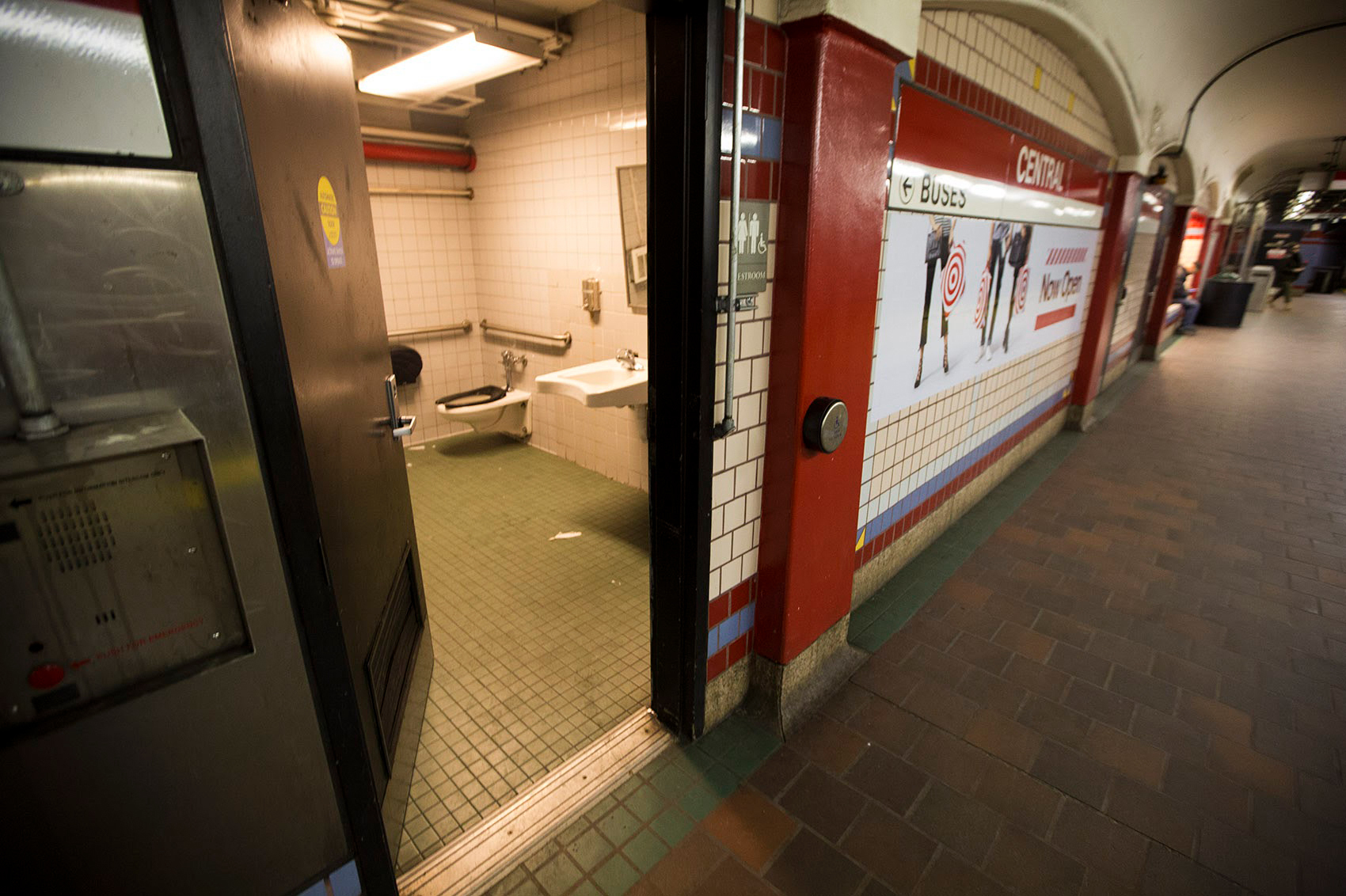
A public restroom on the platform of the Central Square MBTA station in Cambridge, Massachusetts, which people have used as a place for getting high. (Photo by Jesse Costa/WBUR)
A man named Eddie threads through the mid-afternoon crowd in Cambridge, Massachusetts. He’s headed for a sandwich shop, the first stop on a tour of public bathrooms.
“I know all the bathrooms that I can and can’t get high in,” says Eddie, 39, pausing in front of the shop’s plate glass windows, through which we can see a bathroom door.
Eddie, whose last name we’re not including because he uses illegal drugs, knows which restrooms along busy Massachusetts Avenue he can enter, at what hours and for how long. Several restaurants, offices and a social service agency in this neighborhood have closed their restrooms in recent months, but not this sandwich shop.
“With these bathrooms here, you don’t need a key. If it’s vacant you go in. And then the staff just leaves you alone,” Eddie says. “I know so many people who get high here.”
At the fast food place right across the street, it’s much harder to get in and out.
“You don’t need a key, but they have a security guard that sits at the little table by the door, directly in front of the bathroom,” Eddie says. Some guards require a receipt for admission to the bathroom, he says, but you can always grab one from the trash.
A chain restaurant a few stores down has installed bathroom door locks opened by a code that you get at the counter. But Eddie and his friends just wait by the door until a customer enters the restroom, then grab the door and enter as the customer leaves.
“For every 10 steps they use to safeguard against us doing something, we’re going to find 15 more to get over on their 10. That’s just how it is. I’m not saying that’s right, that’s just how it is,” Eddie says.
Eddie is homeless and works at a restaurant. Public bathrooms are one of the few places where he can find privacy to inject heroin. He says he doesn’t use the drug often these days. Eddie is on methadone, which curbs his craving for heroin, so he only uses the drug occasionally to be social with friends.
He understands why restaurant owners are unnerved.
“These businesses, primarily, are like family businesses; middle class people coming in to grab a burger or a cup of coffee. They don’t expect to find somebody dead,” Eddie says. “I get it.”
Managing public bathrooms is “a tricky thing”
Many businesses don’t know what to do. Some have installed low lighting — blue light, in particular — to make it difficult for people who use injected drugs to find a vein.
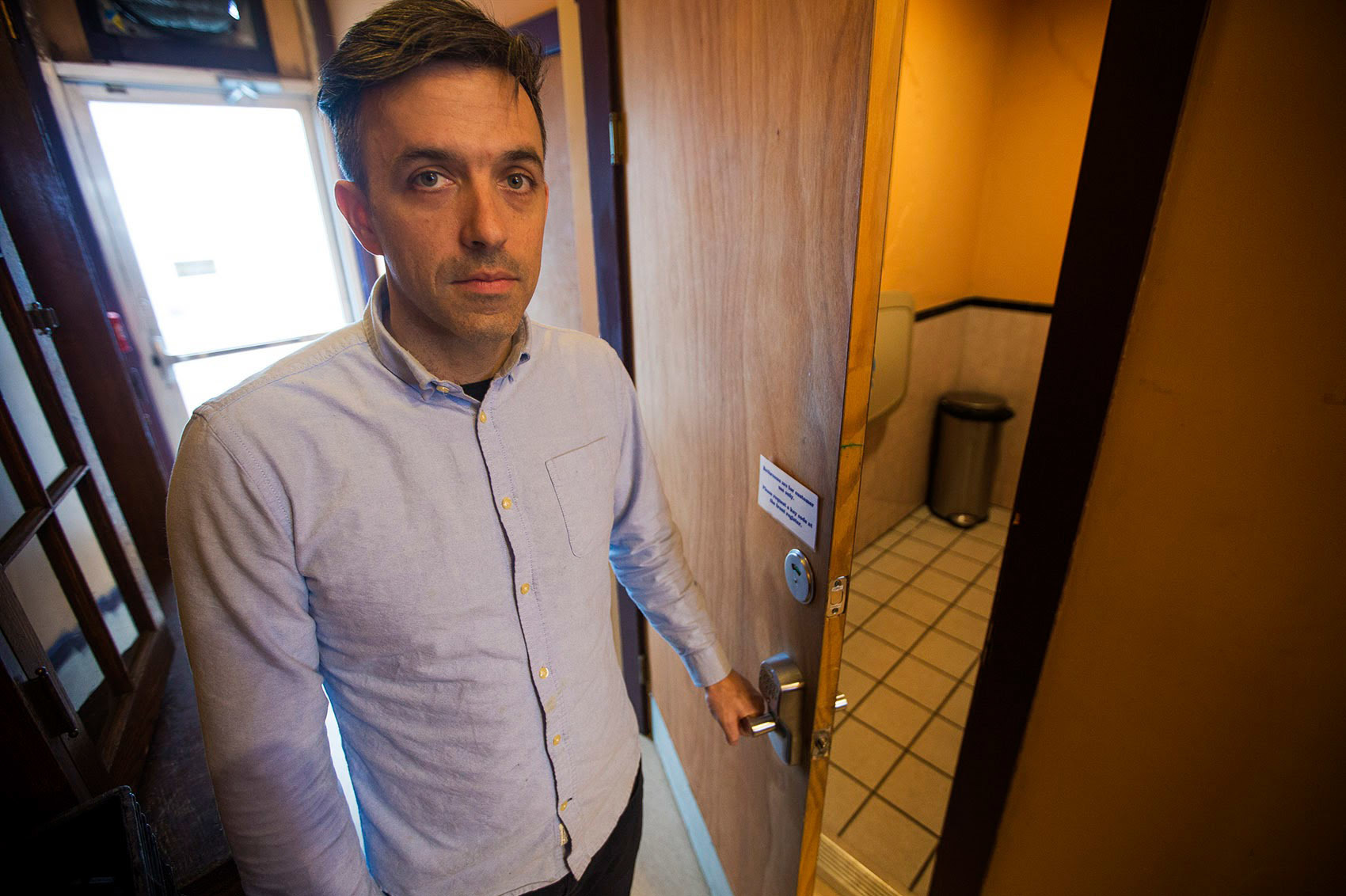
The bathrooms at 1369 Coffee House in the Central Square neighborhood of Cambridge, Mass., are open for customers who request the key code from staff at the counter. The owner, Joshua Gerber, has done some remodeling to make the bathrooms safer. There’s a metal box in the wall next to his toilet for needles and other things that clog pipes. And Gerber removed the dropped ceilings in his bathrooms after noticing things tucked above the tiles.
1369 Coffee House owner Josh Gerber opens the bathroom door, which has a combination lock given to patrons at the front counter. (Photo by Jesse Costa/WBUR)
“We’d find needles or people’s drugs,” Gerber says. “It’s a tricky thing, managing a public restroom in a big, busy square like Central Square where there’s a lot of drug use.”
Gerber and his staff have found several people on the bathroom floor in recent years, not breathing.
“It’s very scary,” Gerber says. His eyes drop briefly. “In an ideal world, users would have safe places to go [where] it didn’t become the job of a business to manage that and to look after them and make sure that they were OK.”
There are such public safe-use places in Canada and some European countries, but not in the U.S., at least not yet. So Gerber is taking the unusual step of training his baristas to use naloxone, the drug that reverses most opioid overdoses. He sent a training invitation email to all employees last week. Within 10 minutes he had about 25 replies.
“Mostly capital ‘Yes’ exclamation point, exclamation point, ‘I’ll be there for sure!’ ‘Count me in!’ ” Gerber recalls with a grin. “You know, [they were] just thrilled to figure out how they might be able to save a life.”
Safe spaces and hospital bathrooms
Last fall, a woman overdosed in a bathroom in the main lobby of Massachusetts General Hospital in Boston. Luckily, naloxone has become standard equipment for security guards at many hospitals in the Boston area, including that one.
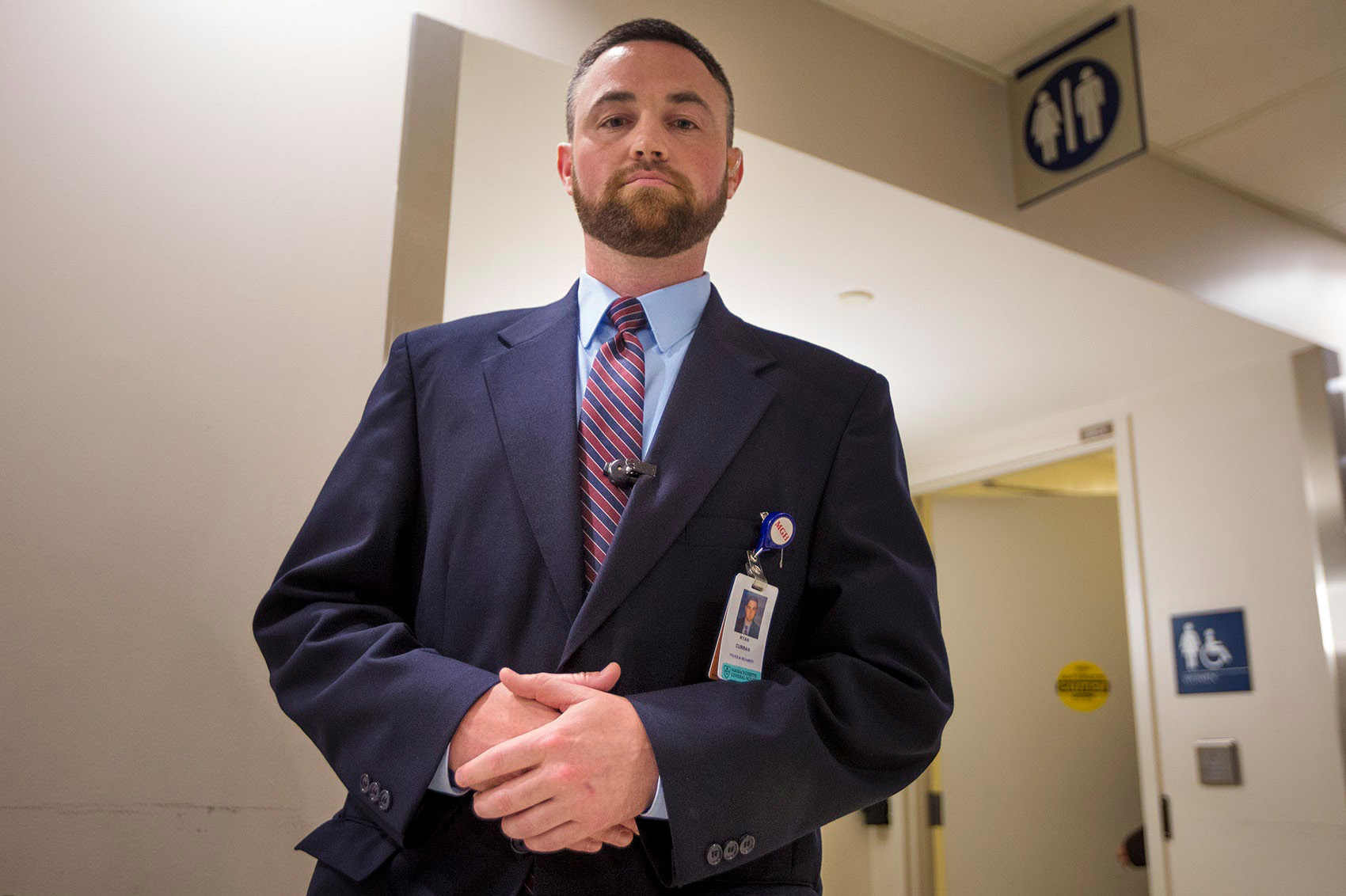
“I carry it on me every day, it’s right here in a little pouch,” says Ryan Curran, a police and security operations manager at Massachusetts General Hospital, pulling a small black bag out of his suit jacket pocket.
The woman who overdosed survived, as have seven or eight people who overdosed in the bathrooms since Curran’s team started carrying naloxone in the last 12 to 18 months.
“It’s definitely relieving when you see someone breathing again when two, three minutes beforehand they looked lifeless,” Curran says. “A couple of pumps of the nasal spray and they’re doing better. It’s pretty incredible.”
Massachusetts General Hospital began training security guards after emergency room physician Dr. Ali Raja realized that the hospital’s bathrooms had become a safe haven for some of his overdose patients.
“There’s an understanding that if you overdose in and around a hospital that you’re much more likely to be able to be treated,” Raja says, “and so we’re finding patients in our restrooms, we’re finding patients in our lobbies who are shooting up or taking their prescription pain medications.”
Many businesses, including hospitals and clinics, don’t want to talk about overdoses within their buildings. Curran wants to be sure the hospital’s message about drug use is clear.
“We don’t want to promote, obviously, people coming here and using it, but if it’s going to happen, then we’d like to be prepared to help them and save them and get them to the (Emergency Department) as fast as possible,” Curran says.
Ryan Curran, the day shift operations manager of police and security at Massachusetts General Hospital, stands in front of the bathrooms in the main lobby. (Photo by Jesse Costa/WBUR)
Speed is critical, especially now, when heroin is routinely mixed with fentanyl. Some clinics and restaurants check on bathroom users by having staff knock on the door after 10 or 15 minutes, but fentanyl can deprive the brain of oxygen and cause death within that window. One clinic has installed an intercom and requires people to respond. Another has designed a reverse motion detector that sets off an alarm if there’s no movement in the bathroom.
Limited public discussion
There’s very little discussion of the problem in public, says Dr. Alex Walley, director of the Addiction Medicine Fellowship Program at Boston Medical Center.
“It’s against federal and state law to provide a space where people can use (illegal drugs) knowingly, so that is a big deterrent from people talking about this problem,” he says.
Without some guidance, more libraries, town halls and businesses are closing their bathrooms to the public. That means more drug use, injuries and discarded needles in parks and on city streets.
In the area around Boston Medical Center, wholesalers, gas station owners and industrial facilities are looking into renting portable bathrooms.
“They’re very concerned for their businesses,” says Sue Sullivan, director of the Newmarket Business Association, which represents 235 companies and 28,000 employees in Boston. “But they don’t want to just move the problem. They want to solve the problem.”
Walley and other physicians who work with addiction patients say there are lots of ways to make bathrooms safer for the public and for drug users. A model restroom would be clean and well-lit with stainless steel surfaces, and few cracks and crevices for hiding drug paraphernalia. It would have a biohazard box for needles and bloodied swabs. It would be stocked with naloxone and perhaps sterile water. The door would open out so that a collapsed body would not block entry. It would be easy to unlock from the outside. And it would be monitored, preferably by a nurse or EMT.
There are very few bathrooms that fit this model in the U.S.
Some doctors, nurses and public health workers who help addiction patients argue any solution to the opioid crisis will need to include safe injection sites, where drug users can get high with medical supervision.
“There are limits to better bathroom management,” says Daniel Raymond, deputy director for policy and planning at the New York-based Harm ReductionCoalition. If communities like Boston start to reach a breaking point with bathrooms, “having dedicated facilities like safer drug consumption spaces is the best bet for a long-term structural solution that I think a lot of business owners could buy into.”
Maybe. No business groups in Massachusetts have come out in support of such spaces yet.
This story is part of a reporting partnership with NPR, WBUR and Kaiser HealthNews.
A draft document from the White House budget office, obtained by NPR, proposes nearly zeroing out funding for the Office of National Drug Control Policy, despite Trump campaign promises to tackle the opioid epidemic. Office of National Drug Control Policy
Updated at 8:15 p.m. ET
In an all-staff email to employees in the Office of National Drug Control Policy, acting Director Richard Baum shared some news he described as “very discouraging for our Nation’s effort to address drug abuse.” A draft document from the White House budget office, obtained by NPR, proposes nearly zeroing out funding for the ONDCP and fully eliminating several programs involved in fighting the opioid crisis. Leaked documents indicate about a 94 percent overall cut.
“These drastic proposed cuts are frankly heartbreaking,” wrote Baum, whose position is also referred to as “drug czar.” His email explained that the document was “pre-decisional” and could change. He asked that the information not be shared outside of the agency. But it quickly leaked out, causing alarm in the tightknit addiction help community and among lawmakers.
“We have a heroin and prescription drug crisis in this country, and we should be supporting efforts to reverse this tide, not proposing drastic cuts to those who serve on the front lines of this epidemic,” Sen. Rob Portman, R-Ohio, said in a statement.
The leaked document is what’s known in budget lingo as a “passback,” the proposal from the Office of Management and Budget for what should be included in the president’s budget. Agencies can appeal, and Baum wrote in his email that he and others have been trying.
“I want you to know that senior ONDCP staff have engaged, and continue to engage, with senior leadership in the White House Office of American Innovation and in OMB to address our agency’s budget concerns,” Baum wrote in the email to staffers. “These conversations are ongoing. We hope to turn this around.”
The document calls for reducing funding for ONDCP from $388 million in 2017 to $24 million in 2018, eliminating the High Intensity Drug Trafficking Areas grant program and the Drug-Free Communities Support Program. These are popular programs in states hit hard by the opioid crisis. The budget states these cuts would “reflect a smaller, more streamlined organization that can more effectively address drug control issues.”
Asked about the proposed cuts in Friday’s White House press briefing, Deputy Press Secretary Sarah Huckabee Sanders said, “When it comes to the opioid epidemic, I think the president’s been extremely clear this is a top priority for him. I certainly wouldn’t get ahead of conversations about the budget. We haven’t had a final document, and I think it would be ridiculous to comment on a draft version of something at this point.”
A White House spokesman wouldn’t say when a final budget document would be released.
A budget outline released earlier this year made no mention of ONDCP, but it called for a $500 million increase in spending on opioid treatment and recovery. The government funding bill signed by Trump on Friday also included a boost in funds to deal with the crisis.
The head of the Addiction Policy Forum said the administration “has taken several positive steps to support recovery and treatment efforts,” but that the cuts “would undermine the good already accomplished.”
“I would urge the Administration to reconsider these cuts, and continue to build a comprehensive plan to help Americans suffering with substance use disorders and their families,” the statement from President and CEO Jessica Nickel added.
President Trump made combating the epidemic of opioid-related overdose deaths a central theme of his campaign, delivering a speech in mid-October 2016 outlining a detailed policy prescription.
But since Trump took office, advocates and lawmakers have expressed concern over a lack of action. In March, Trump signed an executive order creating the President’s Commission on Combating Drug Addiction and the Opioid Crisis. The order directed the commission to present a report within 90 days. However, the president has not yet appointed anyone to serve on the commission (though New Jersey Gov. Chris Christie, who is supposed to chair it, has been holding meetings).
A White House spokesman, whom NPR has been asking about the commission, has responded for weeks with the same reply: “We don’t have any announcements at this time on that.”
Baum is the second acting drug czar in the Trump administration. Trump has yet to name his choice for director. For comparison, President Barack Obama’s first drug czar was confirmed by the Senate on May 7, 2009.
The ONDCP website, which was packed with information and resources during the Obama administration, was replaced when Trump took office with a message that says, “Check back soon for more information.” It hasn’t been updated since.
Copyright 2017 NPR. To see more, visit http://www.npr.org/.
Close
Update notification options
Subscribe to notifications
Subscribe
Get notifications about news related to the topics you care about. You can unsubscribe anytime.

9(MDEwMjQ0ODM1MDEzNDk4MTEzNjU3NTRhYg004))
9(MDEwMjQ0ODM1MDEzNDk4MTEzNjU3NTRhYg004))
9(MDEwMjQ0ODM1MDEzNDk4MTEzNjU3NTRhYg004))
9(MDEwMjQ0ODM1MDEzNDk4MTEzNjU3NTRhYg004))
9(MDEwMjQ0ODM1MDEzNDk4MTEzNjU3NTRhYg004))