The supermarket chain Safeway Inc. has agreed to pay $3 million in a settlement that involves missing pain medication from a pharmacy in Wasilla.
A settlement agreement signed Tuesday between Safeway and the Department of Justice said the Wasilla Carrs pharmacy was investigated by the Drug Enforcement Administration for failing to follow DEA protocols on reporting controlled substances like opioids when they go missing.
“We received a loss notification from Safeway in Wasilla regarding over 12,000 tablets of hydrocodone,” Seattle-based DEA agent Jodie Underwood said. “Our investigators reviewed the situation, it was determined they had not reported it in a timely manner.”
According to the settlement, the pills went missing in 2013 and were not reported to the DEA until 2014. The protocol is to report such a loss within one business day.
According to a statement from the DEA, the pills were stolen by employees.
The settlement documents say Safeway encouraged unlawful practices by directing pharmacists to report missing drugs only internally. It’s a practice the settlement describes in cases investigated at five different pharmacies, including the one in Wasilla.
“When there’s untimely reporting of a significant loss, it can thwart our investigative efforts. You know, we are in the middle of an opioid crisis,” Underwood said. “It is critical that all involved in the supply and distribution chain do their part.”
To settle the broader case, Safeway will have to pay the $3 million directly to the U.S. Attorney’s Office for the Western District of Washington within 20 days.
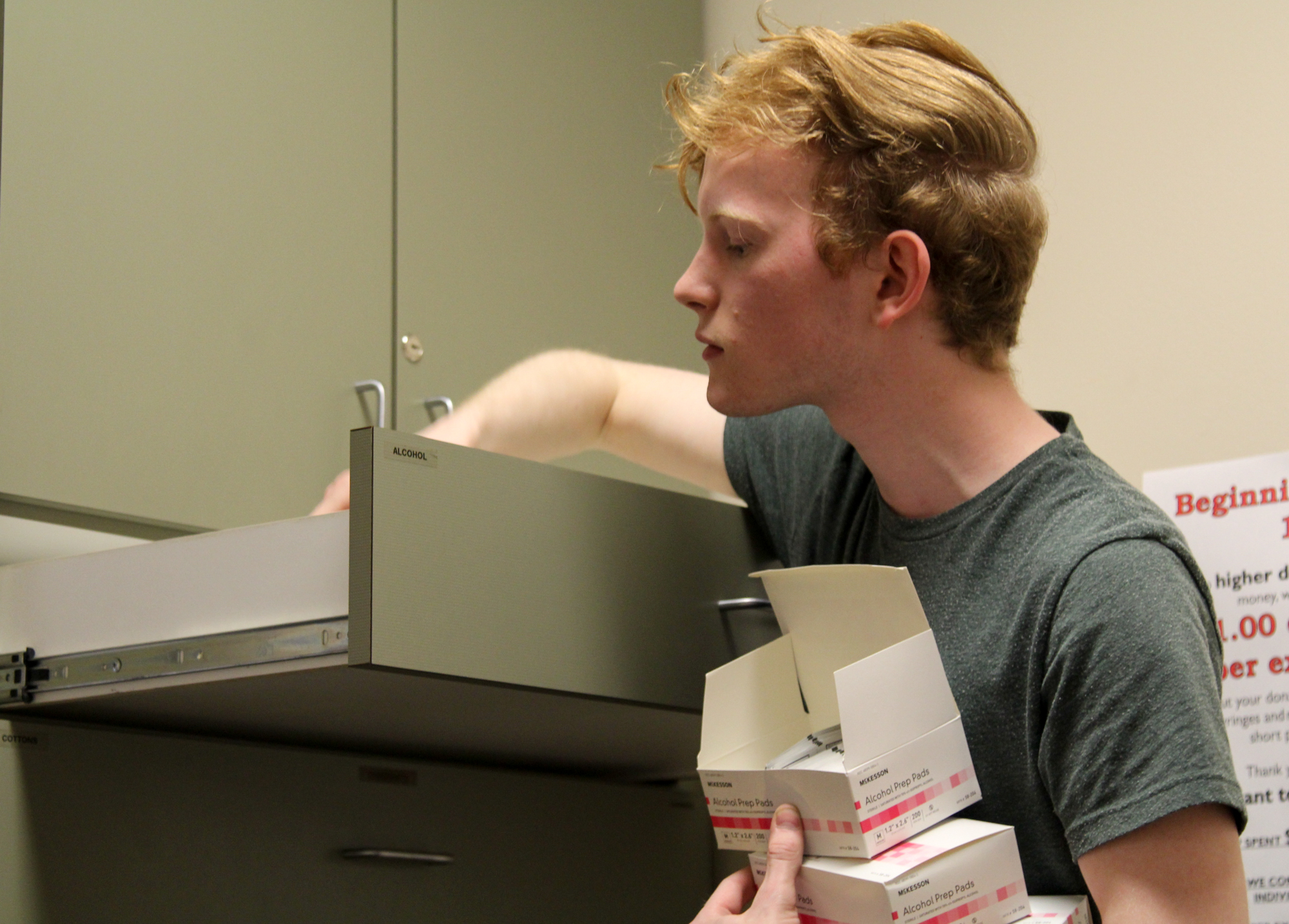
Volunteer Zane Davis restocks alcohol swabs and other supplies at the Alaska AIDS Assistance Association’s Anchorage office. (Photo by Zachariah Hughes/Alaska Public Media)
There is an abundance of jaw-dropping numbers when it comes to opioids in Alaska. Seventy-four percent of the state’s drug overdose deaths last year are attributed to prescription painkillers or heroin. Blood-born viruses like hepatitis C are exploding, and so are healthcare costs. One calculation estimated that to treat all the Alaskans who contracted hep C from injecting drugs in 2015 would cost $90 million.
Here’s another figure: the number of syringes exchanged at one Anchorage non-profit doubled in just two years.
In 2016, the program gave out slightly less than a half-million clean needles. And disposed of even more.
This year they’re on track to outpace that.
The program is a way of reducing health risks and long-term medical costs, but it isn’t without controversy.
Syringe exchange
On a recent Friday afternoon inside the Spenard office of the Alaska Aids Assistance Association, or the 4A’s, a 40-year-old man emptied a plastic vodka bottle stuffed with 31 needles. He was using scissors to cut open the bottle neck as a volunteer ran through a few standard questions.
“Gender?” The volunteer asked. “I’m male,” he answered, not looking up. “What’s your ethnicity?” “I’m white.” “Are you getting these for others?” “Yeah,” the man answered. “Two or three.”
“Great!” the volunteer replied before dropping a few packs of needles into a brown paper bag.
Alaska Aids Assistance Association runs the largest syringe exchange in the state.
Basic demographic is collected every time someone comes in to trade used syringes for new ones.
If a person’s new, or has no syringes to exchange, they get a “starter pack” of five, and however many cotton balls, alcohol swabs, tourniquets and small metal cookers they need.
It’s all anonymous — no one has to give his or her name. The exchange will only give out 50 needles to a person per day, a limit they had to impose to keep up with demand.
Friday afternoons are generally the busiest time for the exchange, according to Zane Davis, who volunteers for the shift every week.
“People are prepping for the weekend,” Davis said. “There are a lot of people who just wait until Friday and then they use over the weekend, so they’ve really got to come in and stock up.”
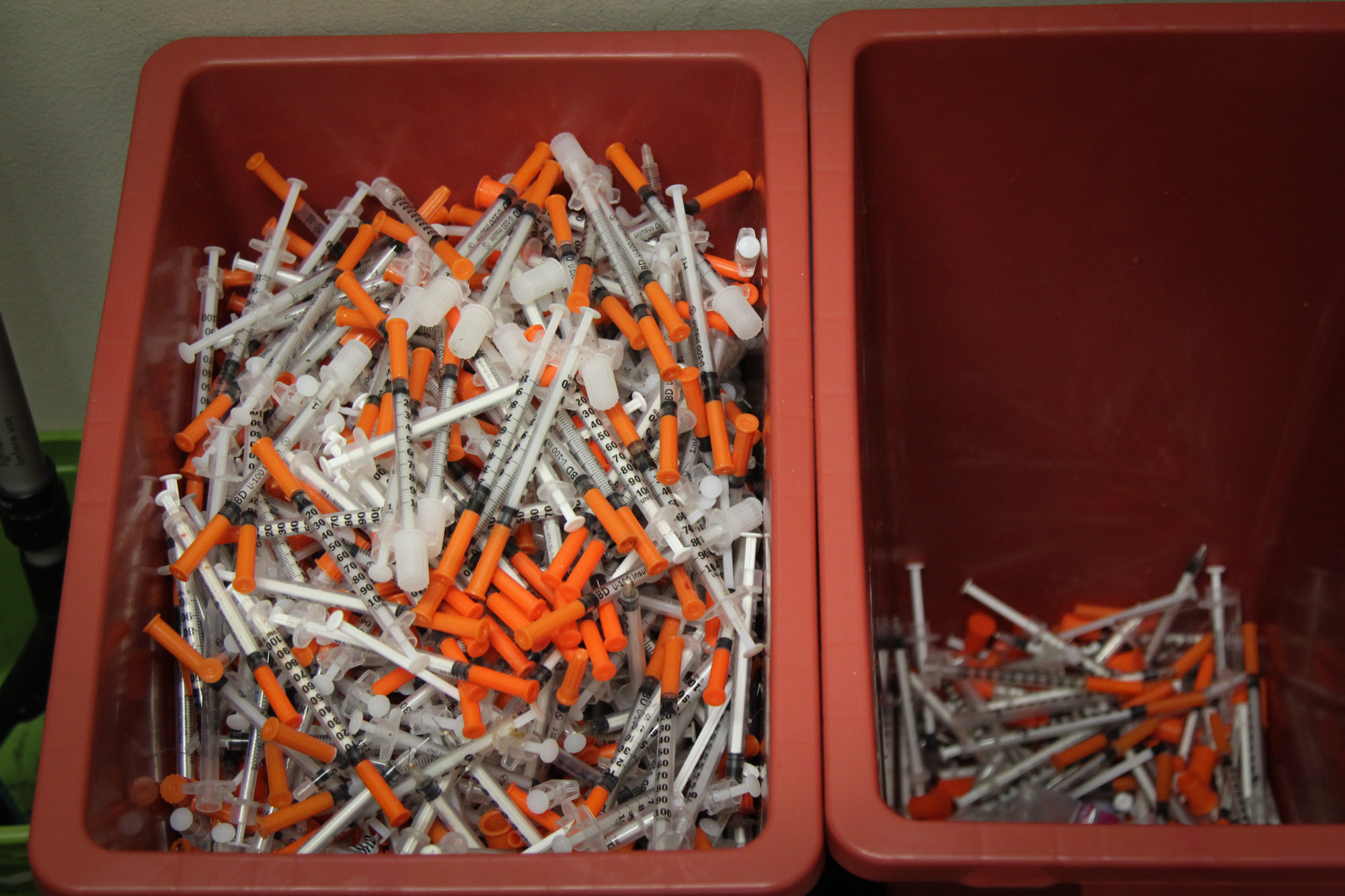
Discarded needles at the Four A’s syringe exchange in Anchorage. (Photo by Zachariah Hughes/Alaska Public Media)
Data collection
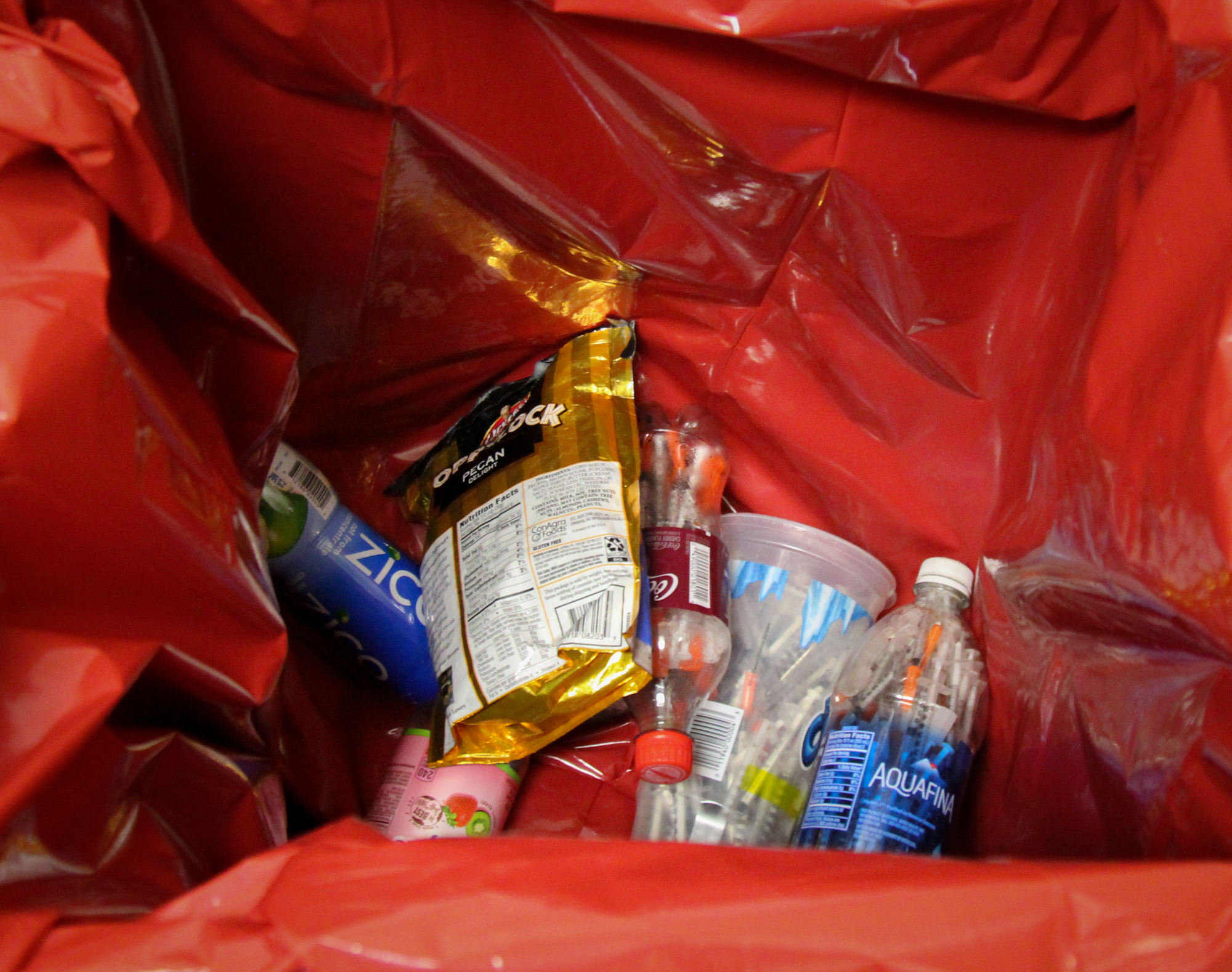
Within just a few hours, dozens of people come through. Two red trash cans gradually fill with orange-capped plastic needles. A cardboard box in the corner takes on a Big Gulp, Gatorade and soda bottles packed with syringes. The plastic containers are puncture proof, so its a safe way to carry needles and not get stuck.
Since 4A’s collects data at each exchange, they have a lot of information about who’s using the program. Last year, they gave out 479,177 syringes. They almost surpassed that figure 10 months into this fiscal year.
They see a stable base of about 2,200 users, but every month around 70-90 new people come in for the first time.
Most are picking up syringes for themselves. But plenty are getting them for others: Friends, partners, siblings.
One such person is a young man from north Anchorage who just wants to use his first name, John. He was picking up supplies for his brother, whom he’s trying to help.
“I’m keeping him at my place to clean him out, wean him down,” John said during a brief interview in a side office. He couldn’t stay long: his grandmother was waiting in the car outside, and it was a hot afternoon.
John knows the exchange well because he came here during his own addiction.
His path to heroin started like a lot of people’s across the country: first with painkillers that a doctor legally prescribed him for a back injury.
“Made me go down the rabbit hole,” John said. When his prescription ran out he unexpectedly went through withdrawal symptoms. “Started out with pills, and it went to heroin — smoking heroin. Then it went to shooting heroin.”
John sold everything he owned and bankrupted his business. His marriage of 12 years collapsed, and he lost his four daughters.
It took isolating himself in a cabin for over a month to get off heroin. He hasn’t used in eight months.
John is like a lot of the people who come to the exchange. The vast majority, 75 percent, are 20-40 years old. He’s white and male, which respectively account for 62 and 57 percent respectively of the 17,614 exchanges that happened last year.
(Another 24 percent of exchanges are with people who identify as Alaska Native, which is disproportionately high relative to the state population.)
Used syringes stored in puncture proof plastic drink containers disposed of at Alaska AIDS Assistance Association’s syringe exchange location in Anchorage (Photo by Zachariah Hughes/Alaska Public Media)
Reducing harm
Near closing time at 5 p.m., more people started showing up.
Eventually the woman at the front desk started inputting people’s data into her own computer and sending them to the exchange room with a hand-written Post-it note telling Davis which supplies give them.
Some people were anxious and rushed. Most were exceptionally polite. Many had on work clothes: stained jeans, mud-caked Xtratufs. They were coming from or going to their jobs: a painter, a heavy equipment operator, a bartender.
One woman in her 50s dumped 120 needles into a bin, explaining she collects and gives out syringes to to keep acquaintances from re-using the same ones.
“If they have to re-use them, tell them to put it in bleach for 10 minutes,” Davis said in a concerned tone.
“I know a lot of people who get infections from re-using,” the woman told him. “That’s why I try to say, ‘Hey! Here!’ and pass them out.”
Programs like this are criticized for enabling drug use.
Advocates say people are already addicted by the time they start showing up at needle exchanges, and the goal is to reduce further harm they could do to themselves or others in the course of injecting drugs.
The tip of a needle drastically dulls after each use, which can damage veins and makes infections more likely — infections which can spread if syringes are shared.
Public health officials also point out these programs are shown to funnel a portion of drug users toward health care and treatment they wouldn’t otherwise encounter.
A pre-med student at the University of Alaska Anchorage, Davis volunteers here in part because he believes it’s an effective way to limit the spread of disease as people cope with addiction.
“I think providing them with clean, safe supplies for free is the best way to prevent them from hurting themselves and the community more than they already are,” Davis said.
Davis is not alone on this point.
Alaska’s own Opioid Policy Task Force recommended expanded funding for for more syringe exchanges, particularly in rural areas.
(Another suggestion was supplying more Nalaxone, the overdose-reversing drug used by individuals and first-responders that is slowing the pace of opioid-related deaths, which 4A’s will give out to people if they go through a 10-minute training)
Few real options
Matt Allen, who coordinates HIV prevention at 4A’s, said the exchange guides many high-risk drug users toward the HIV and hepatitis C testing the non-profit runs on site, just a few feet from where the clean needles are kept.
Last year, 4A’s did 737 tests (however, only a portion of the HIV screenings were of IV-drug users).
“We get positives all the time,” Allen said.
Allen’s surprised by how un-surprised many people are upon receiving a diagnosis.
“They have an inkling that they’re positive,” Allen said. “Not just by showing symptoms, but because of their behaviors of sharing syringes.”
According to Allen, every day they get people who come into the exchange and want help.
“They’ll bring it up,” Allen said. Usually it’s through comments or asides: “‘I’m ready to get off of this,’ or ‘I don’t even want to be here.’ And that really starts the conversation.”
It’s frustrating, because there are few real options.
Often the most they can do is give the person a list of phone numbers for treatment facilities and tell them to call every day until a bed opens up.
Even still, the exchange is a cost-effective measure when it comes to preventing more expensive intervention down the line.
Exploring the costs
The price for curing a virus like hep C with medications is between $85,000 and $94,500. That covers almost a full year of running this syringe exchange.
About half the program’s budget is paying for all the needles to be carted away and incinerated. Just $43,643 was spent on the actual syringes last year.
Money is one of the key reasons syringe exchanges are challenging to run.
It can be a difficult endeavor to fund raise for, and the federal government has been strict about not allowing money to be spent on syringes.
Although recently, some of the purchasing prohibitions on other supplies have relaxed as public officials struggle to cope with the nation-wide opioid epidemic.
Part of the budget for supplies in Anchorage comes directly from people who use the exchange.
Since last March, 4A’s has asked people to give a dollar each time they come in. Not everyone has, but it’s not a requirement.
Plenty of people put handfuls of coins and crumpled bills in a red metal box on the wall.
Seeing the other side
Alaska Aids Assistance Association runs another exchange program in Juneau, and there are two more smaller exchanges in Homer and Fairbanks.
The Anchorage location ends up serving folks from around the state: people from 82 communities in Alaska were given needles last year.
Most people who come in are from Anchorage and the Valley, but villages, hubs, and towns across the Alaska are represented.
In most small communities there’s nowhere to buy syringes.
“It just makes you wonder if they’re just re-using and re-using those same syringes and sharing them,” Allen said.
Davis has an interesting perspective on this.
He grew up in the Matanuska-Susitna Valley, which has seen some of the worst consequences of the state’s opioid crisis.
“I had acquaintances in high school who ended up overdosing,” Davis said. “The Valley is pretty small, so you know pretty much everyone you went to school with, and there were one or two people who died.”
At the time, Davis said people were aware of what was happening but didn’t discuss it.
Davis also is in the unique position of seeing the other side of injection drug use.
His part-time job is in a hospital emergency room, and that’s where he encounters some of the same faces from the exchange.
“It’s not easy to see someone in the ER who’s overdosing who you see really regularly at the exchange and have maybe developed some rapport with them,” Davis said.
When it happens he tries to compartmentalize and focus on whatever task is at hand.
“Usually I end up seeing the patient in the syringe exchange about a week later.”
Discarded needles at the Four A’s syringe exchange in Anchorage. (Photo by Zachariah Hughes, Alaska Public Media)
Like much of the country, Alaska is seeing a surge in opioid and heroin addiction.
State officials are scrambling to deal with an expanding list of the consequences.
One side effect is a massive increase in diseases connected to injecting drugs, particularly hepatitis C, raising concerns about a potential tidal wave of health care costs facing Alaska.
Jay Butler has a framed picture of a Yup’ik mask made by artist Drew Michel on the wall of his midtown Anchorage office. It’s colored in hot, garish shades of paint representing a face in pain from hepatitis C.
“That’s certainly how I interpret it,” Butler said.
The piece is fitting, given that Butler is the chief medical officer for the state health department, and has been loosing sleep over hep C.
“We talk mostly about opioid overdose deaths, but there’s a lot more that happens related to opioid use than just deaths,” Butler said.
Like hep C infections, which can slowly destroy the liver. As more people inject prescription painkillers and heroin, there is a parallel rise happening in blood-born diseases.
Especially among young people.
“The most concerning trend that we see is an increasing number of diagnoses age 18 to 29,” Butler said.
That’s new. Hep C used to hit baby boomers the hardest. The virus wasn’t discovered until 1991, and by then millions had been exposed to it through blood transfusions, tattoo needles and syringes. Rates fell throughout the 1990s and bottomed out in the 2000s. But since then, the number of cases is increasing.
Reported infections among 18- to 29-year-olds doubled in Alaska during a five-year period from 2011 to 2015, according to the Division of Public Health.
While chronic hep C is not necessarily a death sentence, it creates a slew of long-term problems.
“About one in five people will develop more progressive liver damage with fibrosis,” Butler said, referring to scarring of the liver.
It can also cause cirrhosis to the point where the scarring diminishes liver function. Aside from discomfort, this “slow burn inflammation” can exacerbate other conditions, and in up to 5 percent of people lead to the kind of full liver failure that requires an organ transplant.
Until recently, the treatment available for the hepatitis C virus was ineffective and fairly toxic. But in 2013 the FDA approved a new class of direct-acting antiviral drugs, which can clear the body of hep C 90 percent of the time. It is effectively a new cure to a dangerous and widespread chronic condition.
But here is the catch: these medications are extremely expensive.
“The price is the downside and why I usually don’t say it’s a ‘miracle drug,’” Butler said. “Because miracles don’t come with a price, they’re gifts.”
A course of treatment for Viekira Pak or Harvoni, two common medications, can cost$85,000 to $94,500.
When these drugs first hit the market, Butler did a back-of-the-envelope calculation of what it would cost to treat the roughly 3.5 million Americans estimated to be infected with hep C.
“I was coming up with more than 10 percent of all the medical care in the country,” he said.
In other words, not financially feasible.
It’s especially troubling for a state like Alaska.
In rural areas people tend not to have regular access to clean syringes, which drives up the likelihood of re-use or needle sharing, increasing the risk of infections.
While hep C medications are expensive on the front end, they’re cheaper in the long-term than treating people’s liver damage or paying for transplants.
But that’s putting real stress on a prime source of care: Medicaid.
“We’ve seen definitely an increase in the number of individuals who access these medications,” said Erin Narus, the lead pharmacist for the state’s Medicaid program.
As patients and doctors have grown more familiar with the new anti-viral meds, they’re being prescribed with greater frequency.
In 2015, Alaska’s Medicaid program spent $5.9 million on hep C treatments, according to Narus.
The next year, that more than doubled to $13.6 million. And that money only bought treatment for about 150 people.
Nationwide, Medicaid spent about $2.2 billion on just one hep C medicine, Harvoni made by Gilead Sciences. That was more than any other single medication.
The second most purchased medicine that year was a brand of insulin that cost Medicaid $1.4 billion.
“It appears as if that outpaced the other drugs in that year,” Narus said of Harvoni.
Medicaid is just one of the insurers paying for these medications.
Numbers from private providers, Veterans Affairs and the Indian Health Service are not as public.
A report by the McDowell Group calculated that treating just the 1,009 people in Alaska estimated to have been infected with hep C from injecting drugs in 2015 would cost $90 million.
Even that model probably underestimates that full number of new cases.
The areas seeing the steepest growth rates in hep C infections are Southwest, Northern and Southeast Alaska; rural communities where health care, access to clean needles and testing are spread the most thin.
Among young people in Southeast, the rate of diagnosis went up 490 percent during five years.
Most of the officials interviewed during reporting said that when it comes to hepatitis C in Alaska, the reality is likely worse than what the data show.
Which is especially bad, because right now the state has no money.
“This is not a time when it is likely that we’ll be able to increase the amount of money being allocated to addiction treatment,” said Rep. Ivy Spohnholz, D-Anchorage, who chairs the House’s Health and Social Services Committee.
Without more funding for rehab programs or social services, legislators have been focusing on prevention efforts like those in House Bill 159, which limits access to pain pills and boosts reporting protocols to prescription drug data-base.
Gov. Bill Walker also accepted expanded Medicaid under the Affordable Care Act, and lawmakers are now hoping to tweak how the state delivers behavioral healthcare through the program.
The Alaska recently requested a 1115 waiver, according to Spohnholz, which could give the state more discretion from federal guidelines when it comes establishing what treatments Medicaid will pay for.
“We need to make sure that (a) person gets addiction treatment, therapy and that they’re getting their basic healthcare needs met,” Spohnholz said. “We need a lot more flexibility to be creative with that. The 1115 waivers could allow us to do that.”
The U.S. Senate is revising the Republican Affordable Care Act repeal, which could undermine Alaska’s approach to mitigating the worst effects of opioid abuse.
Provisions in the first draft of the bill could end the requirement that private health insurance cover mental health benefits, leaving people without access to addiction treatment.
More dramatically, it would make deep cuts to federal Medicaid spending compared with what’s in the ACA, and replace the open-ended system of reimbursements with a capped budget.
Alaska and other states would be forced to make more difficult choices about whether they can afford expensive treatments for growing problems like hepatitis C.
The Food and Drug Administration requested Thursday that the drugmaker Endo Pharmaceuticals stop selling Opana ER — its extended-release version of Opana.
The FDA says the move marks the first time the agency has taken steps to remove an opioid from the market because of “public health consequences of abuse.”
An increasing number of people, the FDA says, are abusing the powerful prescription pills by crushing, dissolving and injecting them. The sharing of needles by these drug users has fueled an outbreak of associated infectious diseases — HIV, hepatitis C and another serious blood disorder.
“We are facing an opioid epidemic — a public health crisis, and we must take all necessary steps to reduce the scope of opioid misuse and abuse,” says Dr. Scott Gottlieb, the FDA’s commissioner, in announcing the move.
“We will continue to take regulatory steps when we see situations where an opioid product’s risks outweigh its benefits, not only for its intended patient population but also in regard to its potential for misuse and abuse,” Gottlieb says.
In a written statement, Endo says the company is “reviewing the request and is evaluating the full range of potential options as we determine the appropriate path forward.” The company defended its drug, a version of the medicine oxymorphone hydrochloride, citing the opioid’s effectiveness in alleviating pain and Endo’s efforts to prevent abuse.
“As a pharmaceutical company with a demonstrated commitment to the improvement of pain management, Endo feels a strong sense of responsibility to improve the care of pain for patients, while at the same time taking comprehensive steps to minimize the potential misuse of its products,” according to the firm’s statement.
The FDA says if the company fails to voluntarily withdraw the drug the agency will force Opana ER’s removal from pharmacy shelves by revoking its market approval.
“In the interim, the FDA is making health care professionals and others aware of the particularly serious risks associated with the abuse of this product,” the FDA says.
Opana ER was approved by the FDA for pain management in 2006 as an extended-release opioid. Each pill is designed by the manufacturer to be swallowed and to slowly release the medicine into the bloodstream over a number of hours. But if crushed and snorted or injected, the opioid can deliver a potent high in a single wallop.
As public health authorities and the FDA became increasingly concerned about the nation’s epidemic of opioid abuse and overdoses, the company reformulated the drug in 2012, by adding a coating that was intended to make it harder to snort or inject the medicine.
But that strategy appears to have backfired, according to the FDA’s review of postmarketing data. Injections of the drug by people with an addiction disorder have continued to trigger outbreaks of HIV, which causes the acquired immune deficiency disorder (AIDS), and hepatitis C, potentially fatal liver infection, as well some cases of the serious blood disorder known as thrombotic microangiopathy.
“When we determined that the product had dangerous unintended consequences, we made a decision to request its withdrawal from the market,” says Dr. Janet Woodcock, director of the FDA’s Center for Drug Evaluation and Research. “This action will protect the public from further potential for misuse and abuse of this product.”
An FDA advisory committee voted in March that Opana ER’s benefits no longer outweighed its risks.
Copyright 2017 NPR. To see more, visit http://www.npr.org/.
A former inmate leaves Lemon Creek Correctional Center. (Video still courtesy 360 North)
What does re-entry mean? It refers to how someone who is incarcerated re-enters a community.
When a person gets out of prison, re-entering a community can be intimidating, difficult and scary. Statistically, one out of three will return to jail within three years. Creating a plan before leaving prison and following through with it can be a deciding factor for staying out.
Addiction, prison, and re-entry are all trials I’ve faced, as have these three people who agreed to share their stories.
Before getting out, inmates start planning for their release. It might include step-by-step programs, some required and some optional, intended to help to be successful in a community.
Ex-felon Edward Hanson said he’s been in once, and thinks he knows what’s kept him out.
Edward Hanson is an ex-felon who works at Fred Meyer in Juneau. May 29, 2017. (Photo by Elasonga Milligrock/KTOO)
“What really helped me, I don’t think I would’ve stayed out of jail if I wouldn’t have had a good support system from my folks, job-wise,” Hanson said. “Some people don’t have that and that’s, you know, I really believe it’s important to have that support system. Some people don’t have that.”
He said he had a clean record and was put into minimal custody.
“My dad had a business, so I went right to work soon as I was able to work. And I worked there the whole time I was at the halfway house.”
But what if you don’t have that personal support?
Meet Shaun Stewart. He’s in his early 40s, and had been in and out of prison since he was 13 years old.
Shaun Stewart poses with his son at his home in Juneau on May 29, 2017. (Photo by Elasonga Milligrock/KTOO))
“My family had cut me off, they had had enough. That was the big eye opener for me. I never felt so alone in my life. … 13 years over the last 20, I was alone for the first time. I didn’t want to be alone anymore,” Stewart said. “So I made some decisions to take some steps to make things better.”
He decided to make a change from within the corrections system, opting into a six-month therapeutic treatment program. There’s regimented chores, counseling, group therapy, and intense, positive verbal confrontations from other inmates who have been in the program longer.
Stewart said it was grueling.
“Finishing the program, (I) had an opportunity to go to the halfway house. Show up at the halfway house, again there was more treatment involved, there was after care, there was cognitive thinking class, one-on-ones. It was beneficial, I wouldn’t be where I am today without those classes — six years and a month of sobriety.”
Dani Cashen was in and out of jail for addiction, petty theft, and probation violations. About 6 months into a long sentence that began in 2010, she said she woke up.
Dani Cashen and her granddaughter pose for a photo outside Cashen’s home in Juneau on Sunday, May 28. (Photo by Elasonga Milligrock/KTOO)
“I’ve gotta be done, I’ve got to change my life,” she recalls thinking. “Getting up there in age. Enough is enough. I have a beautiful husband, a beautiful family, a beautiful home that I almost lost over this last charge. I got a big sentence and I knew that it was just time to be done.”
Cashen also opted into the corrections system’s residential treatment program.
“And that was when my real plan – I had to make a plan of action, what I was gonna do when I was gonna walk out those doors.”
Without a plan, she said it would have been easy to fall back into bad habits. Instead, she got into transitional housing, had an ankle monitor, and got a job.
“For the first time in my life, I knew where I wanted to go, and what I wanted to do,” she said.
These three former inmates all had different experiences, but all have similar takeaways for others re-entering society.
“You want to be done. No one can make you be done. You have to be done,” Cashen said.
“Anything you can use as a tool that helps you, that keeps you on the right track,” Hanson said. “Don’t be afraid to ask for help because there’s a lot of people out there that want to help you.
“I’ve built a life. I’m happy with a life that keeps me from wanting to go to my old life,” said Stewart. “Idle hands are the devil’s playground. If I can keep working, and I feel like I keep making steps in the right direction … change is possible.”
So re-entering back into a community from incarceration for these felons is an everyday work in progress. Edward Hanson works at Fred Meyer and takes care of his 70-year-young mom. Dani Cashen is still on parole and is starting her own cleaning business. And Shaun Stewart is also on parole, currently working at a local construction company. He recently received 70 percent custody of his 8-year-old son.
They’re doing well and living life on life’s terms, like normal people.
This story is part of an ongoing project on re-entry and recidivism. 360 North is also producing a television documentary on the topic slated to debut June 23.
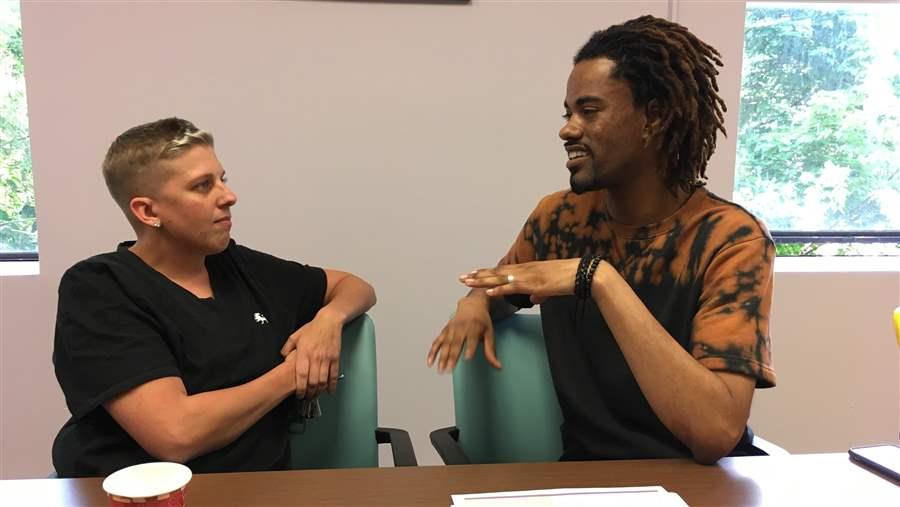
Community Health Action of Staten Island recovery coaches Jamie Longo, left, and Tarik Arafat discuss care for people recovering from drug addiction and alcoholism in New York. In recovery themselves, they are among the growing number of trained addiction professionals on the front lines of the opioid epidemic. (Photo courtesy The Pew Charitable Trusts)
NEW YORK — Five months into his job at a 24-hour walk-in behavioral health center here on Staten Island, Tarik Arafat has a new assignment. In three weeks, he’ll be on call for a nearby hospital to counsel people who have just been revived from an opioid overdose.
In recovery from drug addiction himself, Arafat, 25, said he understands why someone in a brightly lit emergency room who uses drugs would be more comfortable talking to him than to a medical professional. “My job is to open myself up and be like a toolbox for them,” he said.
Arafat’s mission, and that of other so-called recovery coaches, is not to convince overdose survivors to get into treatment, but to offer them advice on how to get started once they’ve decided they’re ready to quit. If they’re not interested in that moment, he’ll follow up with phone calls to see how they’re doing after they leave the hospital. He’ll also advise them on how to use drugs more safely, if that’s what they choose to do.
Nationwide, tens of thousands of opioid overdose victims have been saved over the last two decades by first responders, friends, family and bystanders who administered naloxone, an opioid overdose antidote.
But the majority of those who are rescued from near death go back to using drugs as soon as they leave the hospital, pushed by the brutal withdrawal symptoms that accompany an opioid overdose reversal.
In fact, the likelihood of a second overdose among those who survive their first is substantially higher, said Dr. Hillary Kunins, assistant commissioner for New York City’s alcohol and drug abuse agency.
To reduce those odds, New York City, Connecticut and Massachusetts are replicating a Rhode Island program that sends recovery coaches like Arafat to hospital emergency departments to meet overdose survivors and offer them support, whether it’s on the day of their ER visit or weeks or months later.
Officials in at least seven other states — California, Maine, North Carolina, Ohio, Oklahoma, Texas and Vermont — have been talking to the program’s founders over the last year about starting similar programs in their states. And New Hampshire and New Jersey have created similar programs.
Called AnchorED, the Rhode Island program dispatches recovery coaches to the bedside of overdose survivors in every hospital in the state. The coaches let the survivors know what resources are available to help them quit, or how they can reduce their chances of a fatal overdose, if they choose to keep using.
In the three years since it started, AnchorED’s recovery coaches have counseled more than 2,000 overdose survivors, with 87 percent of them opting to engage in some type of recovery service after being discharged from the ER, according to Michelle Harter, director of the state-funded program.
Not all of those who engage in recovery services — such as detox, spiritual guidance, medication-assisted treatment, peer counseling, job training and nutrition programs — end up quitting drugs, Harter said. “But we help them get started on a recovery pathway of their choice.”
New York City’s recovery coach program, called Relay, is slated to begin this month. It will start by employing 18 recovery coaches to be on call at hospitals in three of the city’s hardest hit communities: Richmond University Medical Center on Staten Island, Montefiore Medical Center in the Bronx, and New York-Presbyterian/Columbia University Medical Center in Washington Heights.
The plan is to set up similar programs in seven more hospitals by 2019, at an annual cost of $4.3 million. While the hope is that more people will get into treatment, the city’s primary goal is to reduce overdose deaths, Kunins said.
In addition to offering overall support, recovery coaches in New York’s program will talk to survivors about where to find drug treatment and mental health services and how to pay for them, as well as how to reduce their risk of a fatal overdose.
They’ll distribute naloxone kits, train survivors and their friends and family on how to use them, and tell them where they can get clean syringes and needles to avoid contracting HIV/AIDS and hepatitis C.
Once patients leave the hospital, the recovery coaches will follow up with daily or weekly phone calls for 90 days, or longer. But recovery coaches will hand off the work of providing services to a team of addiction specialists, health care providers and case managers.
Here on Staten Island, Arafat will rely on his colleagues at Community Health Action of Staten Island, located in a freshly painted new headquarters on Bay Street, to provide counseling and support services and to make referrals to local mental health and addiction treatment providers. He’ll take calls about overdose patients from nearby Richmond University Medical Center during his regular shift, 4 p.m. to midnight. Two other recovery coaches will cover the rest of the day. They expect to receive roughly one call a day because the hospital is taking in on average 30 overdose survivors a month.
In general, the job of a recovery coach is to help overdose survivors stay alive and as healthy as possible and, when they’re ready, work on their own personal goals for recovery. “I know that no one could talk me into getting treatment until I was ready,” he said. “I feel like this is what I was meant to do.”
Recovery coaches — sometimes called peers, peer professionals, outreach workers or people with lived experience — are not new. They’ve been working with people with mental illness and drug addiction for decades and they have proven highly effective at gaining patients’ trust and engaging them in programs designed to improve their health and long-term survival. As the opioid epidemic spreads, their numbers are increasing.
More than 33,000 people died of an opioid overdose in 2015, and with the advent of fentanyl and other powerful synthetic opioids in the illicit drug supply, the number of deaths is increasing dramatically, according to the Centers for Disease Control and Prevention.
Lived experience
New York’s Kunins says the city’s experience with the HIV/AIDS epidemic in the 1980s will be helpful as it dispatches peer recovery coaches to hospitals to try to reduce overdose deaths. Back then, the city was among the first to enlist peer professionals to meet injection drug users at needle exchanges and warn them about the dangers of the deadly disease and offer them help, she said.
“What set us up to do this work is the availability of these recovery organizations throughout the city and our historical knowledge that it’s important to tell people about them,” she said.
In Rhode Island, George O’Toole was the first recovery coach dispatched to an emergency room when the program started, in July 2014. He was on call from 8 p.m. on Fridays to 8 a.m. on Mondays. But demand was so high hospitals started calling him throughout the week, too.
By 2015, AnchorED was sending recovery coaches to 10 hospitals around the clock, seven days a week. Today, O’Toole manages a staff of 20 coaches who assist not only opioid overdose survivors but people who come into emergency rooms for drug- or alcohol-related problems.
Anchor Recovery Community Centers, the umbrella organization that runs the Providence-based program, also offers a mobile outreach service. Recovery coaches meet people in homeless shelters, tent cities and soup kitchens in and around Providence to tell them about recovery services they can access. “Most of the people they talk to have no idea these services are available,” O’Toole said.
There are no hard numbers, but O’Toole guesses that only about one in five people who land in Rhode Island emergency rooms after an overdose consents to seeing a recovery coach. An emergency room nurse or doctor asks them if they would like to talk to someone about recovery and harm reduction services and most refuse, he said.
“I get that. They just overdosed. You ruined their high. They’re embarrassed, ashamed, and don’t want to hear about it,” he said. “The ones who agree may already be motivated. They realize they just died and got brought back to life, and they need a plan for how that isn’t going to happen again. That’s why we’re here.”
Close
Update notification options
Subscribe to notifications
Subscribe
Get notifications about news related to the topics you care about. You can unsubscribe anytime.

9(MDEwMjQ0ODM1MDEzNDk4MTEzNjU3NTRhYg004))