Alcohol & Substance Abuse

Intent on reversing its opioid epidemic, a state limits prescriptions

A year ago, Maine was one of the first states to set limits on opioid prescriptions. The goal in capping the dose of prescription painkillers a patient could get was to stem the flow of opioids that are fueling a nationwide epidemic of abuse.

Maine’s law, considered the toughest in the U.S., is largely viewed as a success. But it has also been controversial — particularly among chronic pain patients who are reluctant to lose the medicine they say helps them function.

Ed Hodgdon, who is retired and lives in southern Maine, was just that sort of patient — at least initially.

Name a surgery, and there’s a decent chance Hodgdon has had it.

“Knee replacement. Hip replacement. Elbows. I’ve got screws in my feet,” he says.

Hodgdon has rheumatoid arthritis. And along with each surgery came an opioid prescription for pain. At first he got some relief from the drugs, but it didn’t last.

“It just numbed it for a while,” he says, “and then I needed more.”

Though Hogdon kept increasing the dose, the pain never went away.

“And then I found Dr. Medd. That’s my angel right there,” Hodgdon says, nodding toward Dr. Donald Medd, a general internist in Westbrook.

Medd had already started to taper high doses among patients like Hodgdon before Maine put a cap on new prescriptions for opioids last July. The new limit allows a maximum of 100 morphine milligram equivalents (the standard used to measure potency for all prescription opioids) for most patients per day — with certain exemptions for some cancer patients, those in hospice care, and some others. Patients with existing prescriptions were, by and large, given a year to meet the new restriction.

Medd was ahead of the game because he’d noticed that many of his patients on high doses of opioids grew increasingly angry about their pain as time wore on, and tended to demand ever more medication. At the same time, they were struggling to function in daily life because of the drugs’ side effects.

“You know, at some point the medications get in the way of some sort of recovery,” Medd says.

Opioids were affecting Hodgdon’s mood and his memory. Medd worked with him to cut the dose he was taking every day by two-thirds and helped him get in touch with a psychologist for further help. Though Hodgdon still lives with some pain, he says his life is infinitely better.

“I can remember things,” he says. “I get along better with people.”

Despite success stories like Hodgdon’s, Medd says he initially opposed Maine’s law. He didn’t want the legislature to interfere with medicine.

But now he thinks the law gave a necessary nudge to many doctors. Compared to a few years ago, Medd says, he and colleagues in his medical practice have cut the number of their chronic pain patients who are on opioids by almost half — from about 1,500 to 800.

In nearly all counties in the state, the number of prescriptions for painkillers is dropping. It’s a trend that Gordon Smith, executive vice president of the Maine Medical Association, says was underway even before the law took effect.

“We had the fourth largest drop in the country,” he says, citing a 21.5 percent reduction in opioid prescriptions from 2013 through 2016.

The data only include the first few months after Maine’s prescribing cap went into effect, Smith says; he expects the law will accelerate further reductions.

“Now having said that, it’s not been easy,” he says. “It’s been particularly difficult for patients,” he says — specifically for the 16,000 patients on high-dose opioids who were expected to taper to the 100 morphine milligram limit by July of this year.

“I was about four times above that,” says Brian Rockett. He operates a wholesale business buying lobsters on the Maine coast. Rockett started taking opioids years ago to ease the pain of injuries from racing motorcycles and boats. When he tried to taper the dose, he says, he had unbearable pain. So, he filed a notice of intent to sue the state over its restrictions on how much he could be prescribed.

“I just knew that I was facing possibly losing my business,” he says.

Rockett wasn’t alone in his inability to taper his use of the drug, and Maine lawmakers — like Dr. Geoffrey Gratwick, a state senator who is also a rheumatologist — took notice.

“A certain group of people simply cannot come off [opioids],” Gratwick says.

He recently pushed through a change to Maine’s law that allows broader exemptions, so that people with incurable, chronic conditions can continue to take high doses.

It put the decision about that back in the hands of the doctor and patient, Gratwick says, “where it should be.”

Under the revised law, Rockett was able to increase his dose, and dropped his lawsuit.

Even though more patients could, potentially, seek exemptions, Maine’s law is seen by its advocates as an important step. Recent data from the federal Centers for Disease Control suggest that nationwide, despite an overall decrease in recent years, the number of opioids prescribed still triple what it was in 1999.

Copyright 2017 Maine Public. To see more, visit Maine Public.

Federal officials tag drug package, make arrests at Fourth Street house

A white house with the number 427. A blue SUV sits in front of it.
This house is the address the Juneau Empire reported police searched Wednesday after drugs were delivered in a sting operation. (Photo by Quinton Chandler/KTOO)

JUNEAU, Alaska (AP) — Two people in Juneau who handled a drug package after it was spotted in the mailing process and then tagged by federal officials have been arrested.

The Juneau Empire reports 44-year-old Christian John Peters and 34-year-old Tiffany Jo Spaulding were arraigned on Thursday in U.S. District Court after a multi-agency warrant search of their house.

U.S. Postal Service Inspector Aaron Behnen says he came across a suspicious package from California on Aug. 6. He says it was sent to “Rosetta Stone” at the suspects’ address. It contained a large canister of coffee filled with 50 pills identified as oxycodone and 221 grams of suspected methamphetamine.

Federal officials placed an electronic alerting and tracking device inside the package and acted when it indicated that the package was opened.

Mandated reporting of prescribed controlled substances begins in Alaska

Medical professionals prescribing controlled substances in Alaska are now required to provide hard numbers. (Photo by Aaron Bolton/KBBI)

The state has been collecting data on prescription opioids and controlled substances since 2012, but until last month, prescribers and pharmacies have been volunteering that data.

As part of an ongoing legislative effort, medical professionals prescribing controlled substances are now required to provide hard numbers.

The effort will help the state grasp the size of the opioid crisis and doctors’ prescribing habits.

Alaska’s Prescription Drug Monitoring Program, or PDMP, is getting a facelift because of two pieces of legislation, Senate Bill 74, passed last year, and House Bill 159, which Gov. Bill Walker signed in late July.

On July 17, SB 74 began requiring any licensed prescriber of opioids and other controlled substances to report the number of prescriptions they’re writing.

Pharmacists also are mandated to report the number of those prescriptions going out the door weekly.

The program is ran by the state Division of Corporations, Business and Professional Licensing.

Director Sara Chambers said the data will help providers understand their prescribing habits.

“There is a new report through HB 159 that authorizes our agency and the Board of Pharmacy, which is within our agency, to create what are called prescriber report cards,” Chambers said.

These reports will let providers know just how many prescriptions they are writing and how that compares to their peers. Chambers explains the PDMP will serve as an educational tool for prescribers and pharmacists, and adds that it’s not a punitive measure.

However, governing boards, such as the Board of Pharmacy, will be able to access the data, and it can make decisions based on the information.

Prescribers also are required to access the PDMP database before prescribing controlled substances.

The database allows them to see the last time a patient was prescribed a controlled substance such as an opioid, how many pills they received and the frequency of those prescriptions.

A provider also will be able to see where the prescriptions are coming from.

“It can really help reduce doctor shopping. If there are people who don’t necessarily have a medical need for these substances, and if they’re going from doctor to doctor, pharmacy to pharmacy, this is a huge tool in deterring that type of activity,” Chambers said.

The division hopes to have every licensed prescriber in the state on board and reporting by the fall.

HB 159 will also require providers to shift from weekly reporting to providing daily reports next summer.

PDMP estimated numbers already are aggregated into annual reports for Alaska’s Legislature, but Chambers notes the division will be looking to spread the hard numbers far and wide.

“To help inform communities, to help inform age populations,” Chambers said, explaining who will benefit from the data. “Really spread the educational opportunities around to those who may be vulnerable and at risk and to those prescribing without realizing the impact that they’re having.”

The division will continue to examine trends and monitor their relation to medical professionals’ prescribing habits.

So far this year, the division estimates about 282,000 opioid prescriptions have been dispensed statewide.

On the Kenai Peninsula, there have been enough opioids prescribed to supply 54 out of every 100 people with a prescription.

Only the Prince of Wales-Hyder census area in Southeast Alaska has a higher per capita rate, and the Ketchikan Gateway Borough is a close third.

Correction: A previous version of this story reported that House Bill 74 required providers and pharmacists to report the number of prescriptions they’re writing and dispensing. The correct bill is Senate Bill 74. 

Bartlett hires former Juneau nonprofit director

(Photo by Heather Bryant/KTOO)
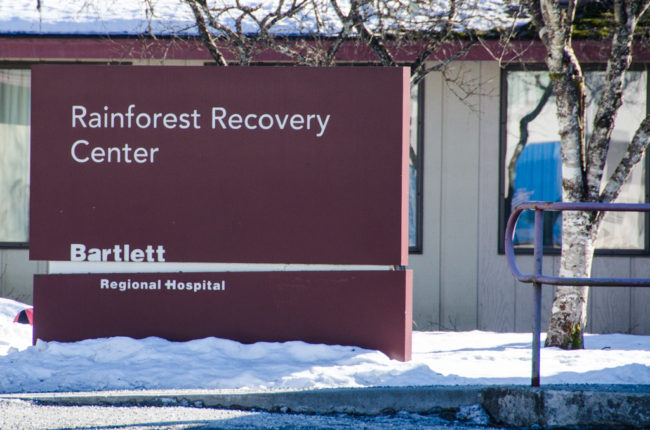
Rainforest Recovery Center is one of the services overseen by Bartlett Regional Hospital’s chief behavioral health officer. (Photo by Heather Bryant/KTOO)

The executive director of Juneau Youth Services abruptly left the nonprofit this summer under unclear circumstances. Now, he’s a top administrator at Juneau’s hospital.

Bartlett Regional Hospital’s chief behavioral health officer left last month to take a job in Pittsburgh. Hospital CEO Chuck Bill said there were three local candidates to fill the position. One of them was Bradley Grigg, who until very recently had been the executive director of Juneau Youth Services.

“Bradley was our number one choice and accepted the position,” Bill said Thursday. “He’ll be the administrator responsible for all of our behavioral and mental health services.”

Grigg was offered the job on July 18 – seven days after he’d left Juneau Youth Services after little more than a year.

He said he’s excited about his new position.

“It’s an honor to be a part of what Bartlett is doing in the community to meet the needs, especially in my field of behavioral health,” Grigg said.

The circumstances of Griggs’s departure from Juneau Youth Services isn’t clear.

Bradley Grigg’s first day at Bartlett Regional Hospital as chief behavioral health officer was July 24. (Photo by Jacob Resneck/KTOO)

Juneau Youth Services Board President Kathi Collum wouldn’t comment except to confirm his annual salary was $130,000 when he left July 11.

Grigg wouldn’t comment either.

“The circumstances, basically – I really don’t have a comment to that, at this point,” he said Thursday. “Both the board and myself made the decision. So, I left JYS, I think it was on July 9 or July 10; so that’s my only comment on that. I was the ED up until to that date.”

The nonprofit Juneau Youth Services has run programs for at-risk youth for more than 50 years. It has more than 110 employees in the community.

Chuck Bill said the hiring committee checked that Grigg’s resume was accurate but didn’t dig deeper.

“As in most references what they did is verify his dates of employment and that’s all we got,” Bill said. “But he’s well-known in the community and well-known to us.”

Bartlett’s chief behavioral health officer supervises about 70 employees and is responsible for the 12-bed mental health unit, psychiatric outpatient services and Rainforest Recovery Center.

His salary is $161,138.

Dillingham police arrest man allegedly dealing heroin from boat

Police allege heroin was being trafficked from the Andy O, a Bristol Bay drifter tied up in the Dillingham Harbor. The vessel is pictured here Monday, after police boarded and arrested operator Andrew Olsen. (Photo by Avery Lill/KDLG)
Police allege heroin was being trafficked from the Andy O, a Bristol Bay drifter tied up in the Dillingham Harbor. The vessel is pictured here Monday, after police boarded and arrested operator Andrew Olsen.
(Photo by Avery Lill/KDLG)

Dillingham police arrested a man Saturday night who was allegedly dealing heroin from a boat in the harbor.

Andrew “Weebee” Olsen, 29, was charged with one count of felony drug possession and one count of felony drug trafficking.

Police say they received a tip last week that there was a suspicious number of people coming and going from the fishing vessel Andy O.

Officers monitored the activity before they were granted a search warrant.

Five officers boarded and found numerous people onboard.

During a search they turned up 6 grams of heroin, more than 100 new syringes, a digital scale, burnt foil and other paraphernalia consistent with using and dealing heroin.

Police say the 6 grams of heroin would have provided an estimated 60 doses. Olsen had $275 cash on his person.

Olsen was listed as the operator of the boat and was arrested. He was ordered held on $10,000 bail at arraignment on the two charges.

Mary Tilden, 39, of Dillingham, also was onboard the Andy O, and had one dose of heroin on her person at the time of the search, according to police.

Tilden is on probation following a series of drug-related burglary and theft charges she pleaded to last fall.

Napaskiak home the scene Of Sunday Morning Violent Death

Alcohol is believed to be a factor in the shooting death of an off-duty village police officer in Southwest Alaska.

Adam Williams faces charges of first-degree murder in the shooting death of Nunapitchuk VPO Kyle Wassillie, 26, in Napaskiak.

Village public safety officer Greg Larson was called to a scene of a shooting Sunday morning.

When he arrived, a 9-year-old boy came out and told Larson that his older brother had shot a man. Larson went in side and found Wassillie lying in the entryway with a bullet through his chest and stomach area. His breathing was shallow.

The young boy’s brother, Adam Williams, 19, was found “passed out drunk.” Larson handcuffed Williams and Corey Nicholai, 18, who also was found intoxicated in a back room. Neither woke up.

Court documents indicate that the rifle suspected of firing the bullets was found in the kitchen. An empty cartridge was found by the body, and some large empty bottles of vodka also were found in the house.

Wassillie died later that morning.

Nicholai and Williams woke up and admitted they had been drinking earlier, but said that they had no memory of the shooting.

Court documents indicate that a witness confirms the young boy’s account about his brother. Adrian Andrew is a neighbor and called 911 after witnessing the shooting through a window.

Napaskiak is about 5-and-a-half miles south of Bethel in Southwest Alaska.

Adam Williams does not have a prior record.

Site notifications
Update notification options
Subscribe to notifications