
Alcohol & Substance Abuse

After Egan Drive wreck, police arrest intoxicated driver

A drink and car keys
(Creative Commons photo by James Palinsad)

A car driven by a 26-year-old woman, who police say was intoxicated at more than twice the legal limit to drive, crashed early Saturday morning.

Police identified the woman as Fuapauna Sua of Juneau and the car as a white 2014 Ford Fusion. According to a Juneau Police Department news release,  the driver was outbound when the vehicle went off the roadway near 1201 Egan Drive. The car hit a light pole and speed limit sign, the release said.

Sua was arrested for operating a motor vehicle while intoxicated, a class A misdemeanor.  Juneau police Sgt. Chris Gifford said that a preliminary police report did not indicate whether alcohol or some other substance was involved.

Gifford said tire marks were reported visible for about 500 feet. He said road conditions appeared dry, based off of pictures taken at the scene. The report did not indicate how fast the vehicle was traveling.

Police and Capitol City Fire/Rescue responded to the crash. Police said Sua was the only person in the vehicle.

Sua did not appear injured at the scene, according to police, but was transported to Bartlett Regional Medical Center for further evaluation.

“The first priority is the person’s well being. We want to make sure that they’re healthy and that any medical injuries or anything sustained as a result of that are seen to first,” Gifford said. “Second after that, then we address the issue of DWI. It’s standard. It’s a good decision to take someone to the hospital first before processing them.”

The vehicle sustained an estimated $10,000 in damages, according to the news release. The hood, bumper and grill were damaged in the incident. Gifford said the “passenger side was pretty damaged.” The vehicle was impounded.

Sua later provided a breath sample. Her breath-alcohol concentration was 0.163 percent, according to the release. The legal limit in Alaska is 0.08 percent.

Correction: A previous version of this story reported that the crash occured near Twin Lakes. The crash happened near 1201 Egan Drive. The story has been corrected to reflect the change.
Alaska Senate passes opioid addiction prevention bill by wide margin

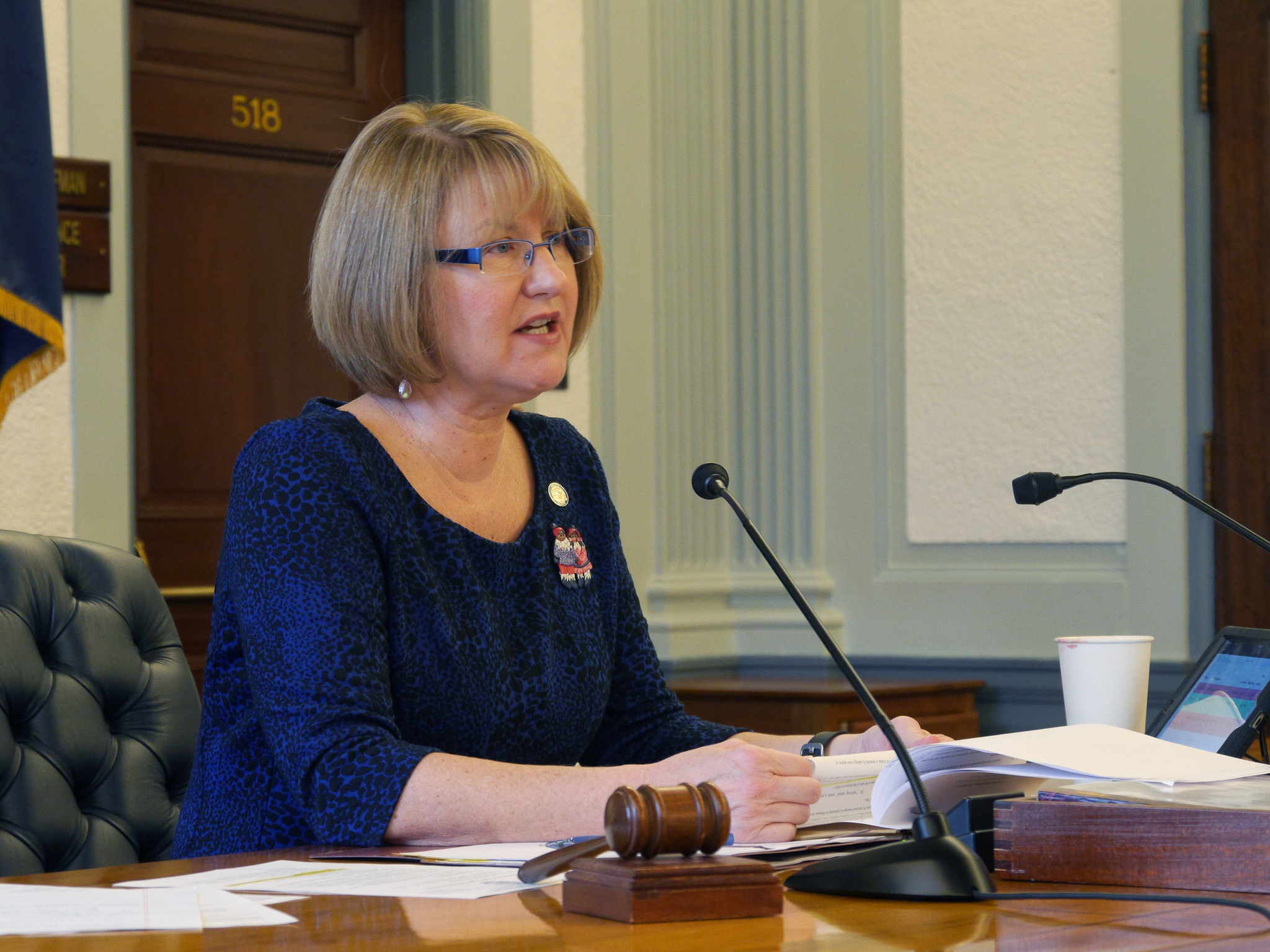
Sen. Anna MacKinnon, Co-Chair of the Senate Finance Committee, April 5, 2017. (Photo by Skip Gray/360 North)
Alaska state Sen. Anna MacKinnon, co-chair of the Senate Finance Committee, seen here in April, voted for HB 159, a bill that would limit opioid prescriptions from health providers in the state. (Photo by Skip Gray/360 North)

The state Senate overwhelmingly voted Thursday to pass a bill which would limit opioid prescriptions from health providers in the state as well as require training on opioid abuse for medical practitioners.

House Bill 159 passed with 17-1 vote.

Eagle River Republican Anna MacKinnon brought up in testimony an example of what she called one of several instances of over-prescription from Alaska doctors.

“We heard a story that was heart wrenching of a family that their loved one, their child, had been taken to the dentist and the dentist prescribed 30 days of oxycontin,” MacKinnon said. “Mr. President, that is not a standard dosage for someone to receive.”

The only vote against the bill was from Palmer Republican Shelley Hughes — a self-admitted protest vote.

Hughes thinks the bill has positive qualities, but it doesn’t address the root of the opioid problem, which she described as “pill mill practitioners and doc-shopper consumers.”

“It will require some excellent practitioners around the state to be better educated about the subject,” Hughes said. “But, they — I don’t believe for the most part — are not the problem. There may be a sliver of practitioners who don’t realize they’re over-prescribing, and this may change their behavior and that is my hope, but I don’t really think the bill gets to the root of the problem Mr. President.”

Senate Majority Leader Peter Micciche, a Republican, said despite the bill being introduced during a session focused on budgetary issues, the opioid crisis extends beyond public health.

“Some people want to know why we’re dealing with opioid abuse now with this budget crisis that we’re having,” Micciche said. “The reality of it is our approach is multifaceted. It’s an Alaskan issue for a lot of reasons, and part of it is costs.”

Micciche said teachers often cope with students of families affected by opioid addiction. He also claimed opioid addictions are the single biggest driver of crime statewide.

Following the vote on HB 159, Senate President Pete Kelly also appointed Sens. Cathy Giessel, Bert Stedman and Donny Olson to a conference committee about the House’s oil and gas tax credit bill.

Alaska Public Media’s Wesley Early contributed to this story.

Correction: In a previous story discussing a bill designed to limit opioid abuse, we stated that Senate president Pete Kelly had appointed three senators to a conference committee on a House income tax bill. The committee is actually on an oil and gas tax credit bill. This story has fixed the error.

Ohio sues 5 major drug companies for ‘fueling opioid epidemic’

The state of Ohio has sued five major drug manufacturers for its role in the opioid epidemic.

In the lawsuit filed Wednesday, state Attorney General Mike DeWine alleges these five companies “unleash a health care crisis that has had far-reaching financial, social, and deadly consequences in the State of Ohio.”

Named in the suit are:

  • Purdue Pharma
  • Endo Health Solutions
  • Teva Pharmaceutical Industries and subsidiary Cephalon
  • Johnson & Johnson and its subsidiary Janssen Pharmaceuticals
  • Allergan

The lawsuit — only the second such suit filed by a state, after Mississippi earlier this year — accuses the companies of engaging in a sustained marketing campaign to downplay the addiction risks of the prescription opioid drugs they sell, and to exaggerate the benefits of their use for health problems such as chronic pain.

“We believe that the evidence will show that these pharmaceutical companies purposely misled doctors about the dangers connected with pain meds that they produced, and that they did so for the purpose of increasing sales,” DeWine tells NPR’s All Things Considered. “And boy, did they increase sales.”

By the late 1990s, DeWine’s suit says, each of the five companies had embarked on a persuasion scheme targeting doctors, whom the state positions as victims of systematic misinformation:

“Defendants persuaded doctors and patients that what they had long known — that opioids are addictive drugs, unsafe in most circumstances for long-term use — was untrue, and quite the opposite, that the compassionate treatment of pain required opioids.”

Asked by NPR’s Robert Siegel whether doctors had a role of their own in overprescribing potentially dangerous medication, DeWine says more fault rests with a culture created by these companies.

“This was not something that the pharmaceutical companies just woke up some day and just started to do a little bit of it,” he says.

“I mean, there was a concerted effort for an extended number of years to really pound this into the heads of doctors. And when you’re told something time and time and time again and there’s a lot of advertising that is being spent, yeah, it takes a while to turn that around.”

In a statement provided to the Cleveland Plain Dealer, a spokeswoman for Jansen, one of the defendants, called the lawsuit “legally and factually unfounded”:

“Janssen has acted appropriately, responsibly and in the best interests of patients regarding our opioid pain medications, which are FDA-approved and carry FDA-mandated warnings about the known risks of the medications on every product label.”

Purdue Pharma, another defendant, told the Plain Dealer it has been involved in seeking to combat widespread opioid addiction:

“OxyContin accounts for less than 2 percent of the opioid analgesic prescription market nationally, but we are an industry leader in the development of abuse-deterrent technology, advocating for the use of prescription drug monitoring programs and supporting access to Naloxone — all important components for combating the opioid crisis.”

And that crisis shows few signs of ebbing soon.

As All Things Considered notes, the state of Ohio estimates some 200,000 people within its borders are addicted to opioids — a number roughly the same as Akron’s entire population. And Ohio Public Radio’s Jo Ingles reports for our Newscast unit that Ohio led the nation in opioid overdose deaths in 2014 and 2015.

In his release Wednesday, DeWine says he filed the suit in Ross County for a reason: “Southern Ohio was likely the hardest hit area in the nation by the opioid epidemic.”

Copyright 2017 NPR. To see more, visit http://www.npr.org/.

State grant to help Ketchikan agencies reduce recidivism

Hayward is begin kept at the Ketchikan Correctional Center. (Photo courtesy Alaska Department of Corrections)
Ketchikan Correctional Center. (Photo courtesy Alaska Department of Corrections)

A coalition of Ketchikan agencies is gathering to explore how to help people getting out of jail stay out of jail with the help of a state grant.

Akeela Gateway and Ketchikan Indian Community were awarded the grant through the Alaska Department of Health and Human Services Division of Behavioral Health.

The organizations plan to pull together representatives from state and local law enforcement, and social services groups to address that question.

Janalee Gage, who works with the substance abuse program at Akeela Gateway, said the state jail system is overcrowded.

Many of the people in jail are repeat offenders, which indicates that incarceration alone is not working.

“The idea is that instead of throwing people back in jail, we need to find a way to have them come back into society and invested in the communities they’re from or live in, and develop a productive lifestyle so they can actually be productive in their life versus in and out of the rotating door of the jail system,” she said.

Gage added that keeping people in jail costs a lot of money, and it’s more cost effective to help people stay out.

The effort is in the early stages now.

The first task is to identify what’s needed.

“We’re going to look at everything we have, what we do well, what are our strengths, what are the areas where we’re weakest in,” Gage said.

She said the goal is to provide people getting out of jail with some basic tools to help them stay on a law-abiding path, which includes signing them up for Medicaid so they can get substance abuse treatment, or helping them find safe, affordable housing.

But it’s still up to the individual to use those tools, she said.

Gage said after the group identifies what’s needed in the community, it will work on getting the community at large to help plan ways to implement any needed improvements.

A big role the community can play is a willingness to hire non-violent offenders who have recently gotten out of jail, or to not fire an employee who has made a mistake.

“We all make mistakes. We all screw up,” Gage said. “Some of us do it on a large scale. (But) we’re going to take the time to give you that chance.”

That can include requiring substance abuse treatment for an employee.

Gage said even if this effort helps only 30 percent of offenders stay out of jail in the future, that would be a huge improvement.

She said the initial planning and brainstorming effort will take place by the end of June. Community outreach will be scheduled later.

No legislative action on special session’s seventh day

There was no legislative action on the seventh day of the special session, May 24, 2017. (Photo by Andrew Kitchenman/KTOO and Alaska Public Media)
There was no legislative action on the seventh day of the special session. (Photo by Andrew Kitchenman/KTOO and Alaska Public Media)

There were no committee meetings and only technical floor sessions in the Capitol on Wednesday, the seventh day of the Alaska Legislature’s 30-day special session.

There has been no sign of progress in resolving the state’s budget crisis. House Speaker Bryce Edgmon put out a statement Tuesday saying that House members could go home for the Memorial Day holiday. He called on the Senate to act on a new revenue measure to use as a basis for negotiations. He also said he wants the Senate to appoint members to a committee to work out differences between the two chambers over changes to oil and gas taxes and tax credits.

Leaders of the two chambers are seeking to set the terms of the negotiations. Edgmon wants revenue measures to be a part of a compromise, while Senate President Pete Kelly has said his caucus doesn’t want a broad-based tax. It’s not clear at this point what will cause either side to budge.

There has been some progress on the only bill in the special session that’s not related to the budget. The Senate Finance Committee met Tuesday to hear testimony on Senate Bill 79, which is  intended to reduce overdose deaths from prescription opioids. Most professional groups appear to support the bill, but some doctors and pharmacists would like to see the Senate make changes to the bill. The House passed its version, House Bill 159, on Monday. The State Medical Board said one of the bill’s main provisions – which limits most opioid prescriptions to a seven-day supply – is too vague.

Special sessions typically cost $20,000 to $30,000 each day, according to the Legislative Affairs Agency. Much of that is to cover the living expenses for lawmakers and housing costs for them and their staffs who have to stay in Juneau.

Edgmon said House members won’t collect per diems while they’re home, which would lower the cost if they follow through on that.

But Alaskans who’d like to see the Legislature fix the state’s budget problem are unlikely to see much action until at least next week.

House passes bill intended to curb opioid overdose deaths

Rep. Ivy Spohnholz, D-Anchorage, speaks in support of House Bill 159, which is intended to reduce opioid overdose deaths. (Photo by Andrew Kitchenman/KTOO and Alaska Public Media)

The House passed a bill Monday intended to reduce the number of deaths from overdoses of prescription opioids.

House Bill 159 would cut the number of days’ supply of opioid pills in a single prescription. The vote in favor was 25-8.

Anchorage Democratic Rep. Ivy Spohnholz said the bill builds on recommendations from medical experts.

“This bill is allowing us to introduce accountability for the role that prescription opioids have had in our explosive opioid epidemic,” she said. “Addressing the opioid epidemic in the state of Alaska is going to take all of us.”

The bill also would require prescribers to receive continuing education in pain management and opioid misuse.

It would allow patients to have advance directives to stop providers from prescribing opioids when the patients are unconscious. And it would require veterinarians who write prescriptions to register with a statewide opioid database.

Anchorage Republican Rep. Lance Pruitt said the medical industry and the boards that license providers had a chance to curb unnecessary use of opioids.

“We allowed them that opportunity to make those decisions, and we haven’t seen action take place in the speed that we would like it to,” he said. “So here we are saying, it’s time for us to address it.”

Opioid prescriptions are generally limited to 30 days. The bill would reduce that to seven days. Doctors and other providers could still provide more for specific reasons, such as for patients who can’t afford to travel to refill their prescriptions.

Every Democrat and independent member voted in favor of the bill, while Republicans were split.

North Pole Republican Tammie Wilson said lawmakers are in a poor position to dictate to doctors how to do their jobs.

“I’m not a doctor,” she said. “I’m not convinced that seven days is the magic number that’s going to make everything better than what it is.”

The bill is the only legislation that’s not related to the state budget that’s included in the special session that began on May 18.

The Senate Finance Committee is scheduled to discuss the Senate version of the bill, Senate Bill 79, on Tuesday.

Site notifications
Update notification options
Subscribe to notifications