Gov. Bill Walker declared on Wednesday Alaska’s opioid epidemic a state disaster and ordered state and federal money for overdose medication.
In the declaration, Walker said the opioid epidemic goes “beyond the timely and effective response and recovery capability of local resources.”
The declaration will cost $4,058,316 from regular appropriations for the Department of Health and Social Services and from federal grants to fund naloxone distribution statewide. Naloxone is a drug that can reverse opioid overdoses.
In a letter to the state’s legislative leaders, Walker said the declaration will not draw funds from the Disaster Relief Fund or from additional state general funds.
The declaration authorizes the commissioner and the State Medical Officer of the Department of Health and Social Services to coordinate a response to the crisis.
According to the declaration, that response could include creating a statewide overdose response program and allowing anyone in Alaska to dispense and administer naloxone.
Walker plans to announce more information on his plan today.
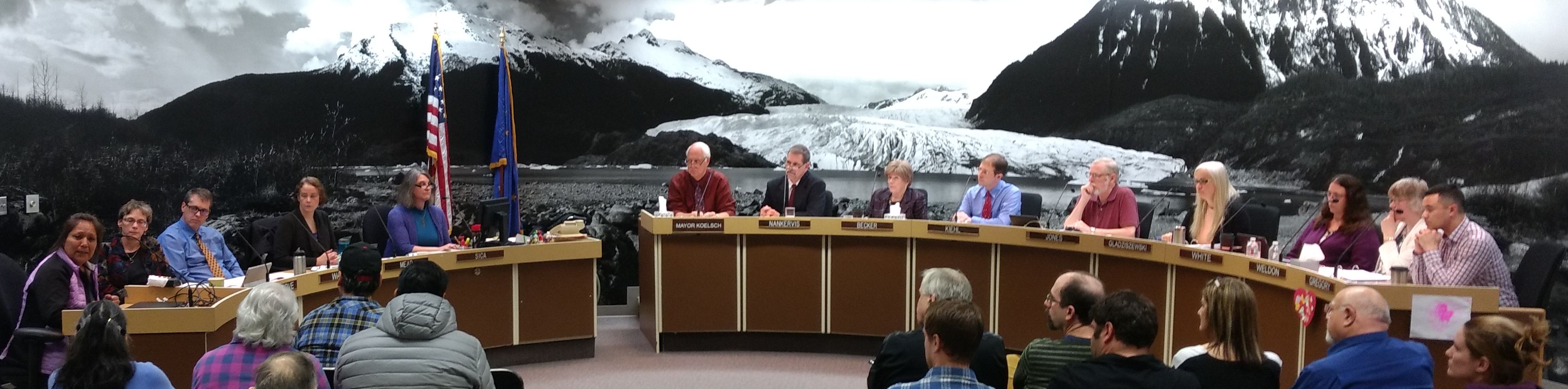
Homeless resident Catherine Duncan, far left, appeals to the Juneau Assembly not to pass a camping ordinance that would ban homeless from sleeping downtown on Feb. 13, 2017. (Photo by Jacob Resneck/KTOO)
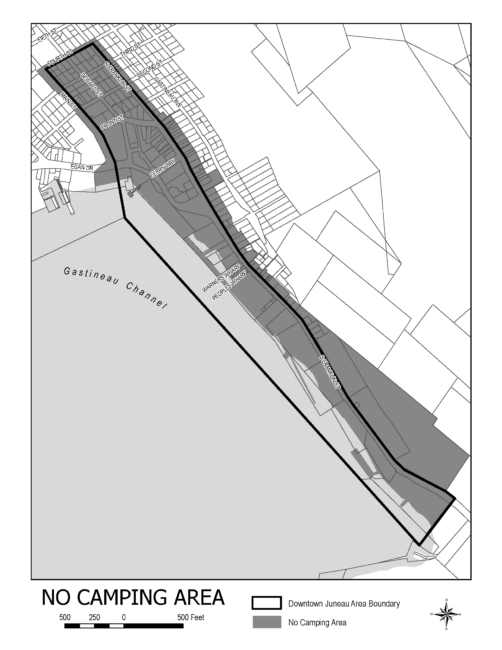
A divided Juneau Assembly passed a controversial anti-camping ordinance Monday to ban homeless people from sleeping near downtown businesses.
In the end, the controversial ordinance passed by a single vote. It will allow police to cite anyone caught sleeping on private property in the downtown core between midnight and 7 a.m.
The ordinance passed in a 5-4 vote. Supporters were: Mayor Ken Koelsch, Jerry Nankervis, Debbie White, Mary Becker and Beth Weldon. Opposed were: Norton Gregory, Jesse Kiehl, Loren Jones and Maria Gladziszewski.
Many downtown merchants have complained of people using shuttered storefronts to shelter from the cold. Those concerns were heard by a majority of the Assembly.
“This isn’t about the people who sleep on the sidewalk. This isn’t about people in Marine Park,” Assembly member Debbie White said. “This is about people who have invested in our downtown community, who employ our neighbors.”
Assembly member Jerry Nankervis echoed that it was a matter of rights of business owners.
“We are trying to reinforce — at least in my mind — that I believe people have private property rights,” he said, “and just because you’re homeless doesn’t supersede somebody else’s private property rights.”
Juneau Police Chief Bryce Johnson said the ordinance would be a tool “which would give us the option of either writing a ticket or taking someone to jail for disorderly conduct.”
It takes effect in mid-April when the city-run Thane Campground reopens.
Opposition came from four Assembly members including Norton Gregory, who noted that many homeless people suffer from substance abuse and mental illness.
“Those are the discussions that I wish we were having tonight and we were talking about rather than passing an ordinance about pushing these people out of the downtown area,” Gregory said.
Assemblyman Jesse Kiehl disputed the police chief’s argument it would improve overall public safety.
“Are people better off now in doorways? You bet they are,” he said. “Because those abandoned mine buildings above Gastineau Avenue are scary places and there are no lights and (the Juneau Police Department) doesn’t drive by and check.”
Merchants who had complained that homeless people had harassed and intimidated their customers and employees were pleased with the vote.
“I personally think this will help and I hope it’s the beginning of a longer process to address all the issues of the homeless in downtown Juneau,” said Eric Forst, owner of the downtown Red Dog Saloon.
Homeless residents reacted with dismay.
“I’m scared of what’s going to happen,” Lisa Williams, 27, said after the vote. “I don’t know where I’m going to go and I’m afraid to go up to the woods. I have no idea what it’s going to mean for me.”
The ordinance began as an initiative by Juneau Mayor Ken Koelsch, who proposed it after fielding complaints from merchants in December.
“I asked for the no camping ordinance to be drafted and introduced for action,” he said in prepared remarks. “I accept full responsibility. It speaks to a core value of mine regarding respect of property of others.”
The ACLU of Alaska has cautioned the city that a blanket ban on homeless people downtown would be unconstitutional.
Courts have ruled homelessness can’t be criminalized when the homeless population exceeds shelter space available.
For that reason City Attorney Amy Mead said this ordinance was drafted narrowly to only apply to private property.
So what if the homeless campers move to a public place like Juneau’s Marine Park?
“My advice to (the Juneau Police Department) is that it would be potentially unconstitutional to enforce the camping ordinance against those people at that time,” the city attorney said in a brief interview.
The argument over this ordinance may be over.
But both sides here agree that the quandary over Juneau’s homeless problem continues.
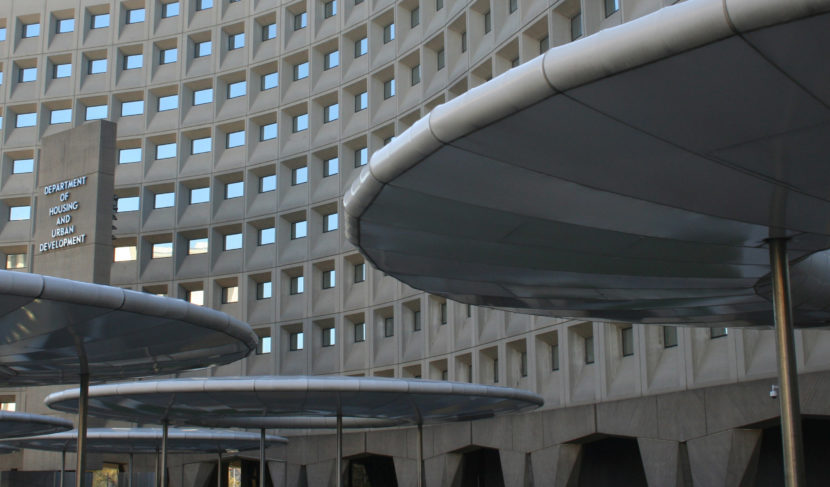
The headquarters of the U.S. Department of Housing and Urban Development in Washington in December 2006.(Creative Commons photo by David)
An ordinance to ban the homeless from camping in the downtown core continues to generate controversy. Now there’s questions over whether a ban could affect the community’s access to federal housing dollars.
There’s been a lot of outcry over a proposed ordinance that would ban homeless people from camping in Juneau’s downtown core. Proponents say it’s a public safety issue. Opponents say a camping ban would just move the problem around.
“The board made the decision that we were in support of the ordinance and I personally feel that was the right decision, not everybody on the DBA feels that way,” said Eric Forst, owner and manager of the Red Dog Saloon who penned the DBA’s letter of support for the ordinance.
He said it’s a complex problem and one that needs a lot of work.
“On either side of the issue we all feel that this not the silver bullet,” Forst said. “This is a step — there’s a lot more that needs to be done.”
He’s operated downtown businesses for about 20 years. There have always been homeless people around but that in the last 18 months or so it’s changed.
“(There’s) a younger, meaner more aggressive element that does not want to be helped — and that’s what this is targeted at,” he said.
In recent weeks a number of social care organization have testified that a camping ban wouldn’t solve anything and would waste police resources.
Homeless residents have also weighed in. Mary Bailey, 46, has recently been staying at the Glory Hole downtown shelter though she said she’s had to sleep by downtown storefronts.
“I mean, that’s the only thing that can protect us from the weather so I mean what’s going to happen?” Bailey said. “I mean, we need something what about a tent city? And if that law goes through, why don’t they put a tent city first?”
The city is working behind the scenes to identify a year-round campground. But that takes time. Rezoning would be at least several months away. City staff has proposed delaying any camping ban until mid-April when the city-run Thane campground reopens. It’s in an avalanche zone, so it closes down for the fall and winter.
Juneau Mayor Ken Koelsch, ordinance’s main proponent, said pushing the effective date to April 15 as a compromise. He’d like it to take effect earlier.
“We need to deal with our homeless problem,” Koelsch said. “We need to deal with our safety problem and we need to deal with both of them right now. And that’s the perspective I’m taking on it.”
“In Juneau we have two programs that are operated by St. Vincent de Paul to a total of $130,000 that has over 30 permanent supportive housing units in place,” said coalition Executive Director Brian Wilson.
Those funds come from the federal department of Housing and Urban Development, or HUD. In addition to these two resources, the new 32-bed Housing First shelter slated to open in May will likely be applying for federal funds to further expand. These federal dollars will likely be crucial, Wilson said, and when it comes to HUD reviewing grant applications in Washington. It’s a numbers game.
“The higher your score the more funding that you receive. The lower your score, you’re at jeopardy of losing funds,” Wilson said.
But could a camping ban really imperil federal funding? HUD, as a rule, doesn’t get involved in policy debates. But HUD officials would talk freely about what approaches to tackling homelessness they encourage — and discourage.
“Most of the evidence shows and most experts would agree that homelessness is not a crime, homelessness is a condition,” said HUD spokesman Lee Jones in Seattle. Congress has appropriated $1.9 billion nationwide for grants to communities dealing with homelessness. Typically 300 to 400 communities — both public agencies and private nonprofits — vie for a slice of the funds each year.
“It’s extremely competitive. $1.9 billion sounds like a lot of money, (but) we do have a fairly considerable homeless problem across the United States, in virtually every community large, small and in between,” Jones said.
How these communities — in HUD jargon they’re called Continuum of Care Programs — decide to deal with homelessness is definitely a factor, Jones said, when ranking funding requests.
“If the continuum has made efforts to essentially address homelessness as a condition rather than a crime they can score two extra points out of the 200 ideally they would need for a perfect application score,” he said.
Juneau Mayor Ken Koelsch
This is an issue some Assembly members want answered before the ordinance goes to a vote next week and city staff are working on trying to get answers.
“I think in order to make that policy decision the Assembly needs to understand that impact,” City Manager Rorie Watt said.
As for Mayor Ken Koelsch, he’s said he’s talked to the city’s DC lobbyist and congressional staffers for clarification but hopes to get the ordinance passed regardless.
“That would disturb me greatly to find out that a city that tries to help its citizens deal with trespassers on private property would suddenly not be received in the same light and that we would definitely follow up on,” the mayor said.
The Juneau Assembly likely won’t take further oral testimony, but with a vote scheduled for Monday, a crowded house is expected.
Petersburg police seized $8,000 worth of methamphetamine and a large amount of illegal marijuana at a trailer home in town Feb. 3.
Police initially were responding to a report from parents of high school students concerned that their kids were using and buying drugs.
Police investigated and eventually got a search warrant for the No. 12 trailer in Town Trailer Park located off Haugen Drive. Inside the home they found more than an ounce of meth, six quart-sized mason jars of marijuana, two handguns and cash.
One of the guns had been reported stolen in Petersburg last year.
Several people were in the residence at the time and all were identified, according to a news release from the police.
Police are working with the state prosecutor’s office and anticipate felony criminal charges to be filed.
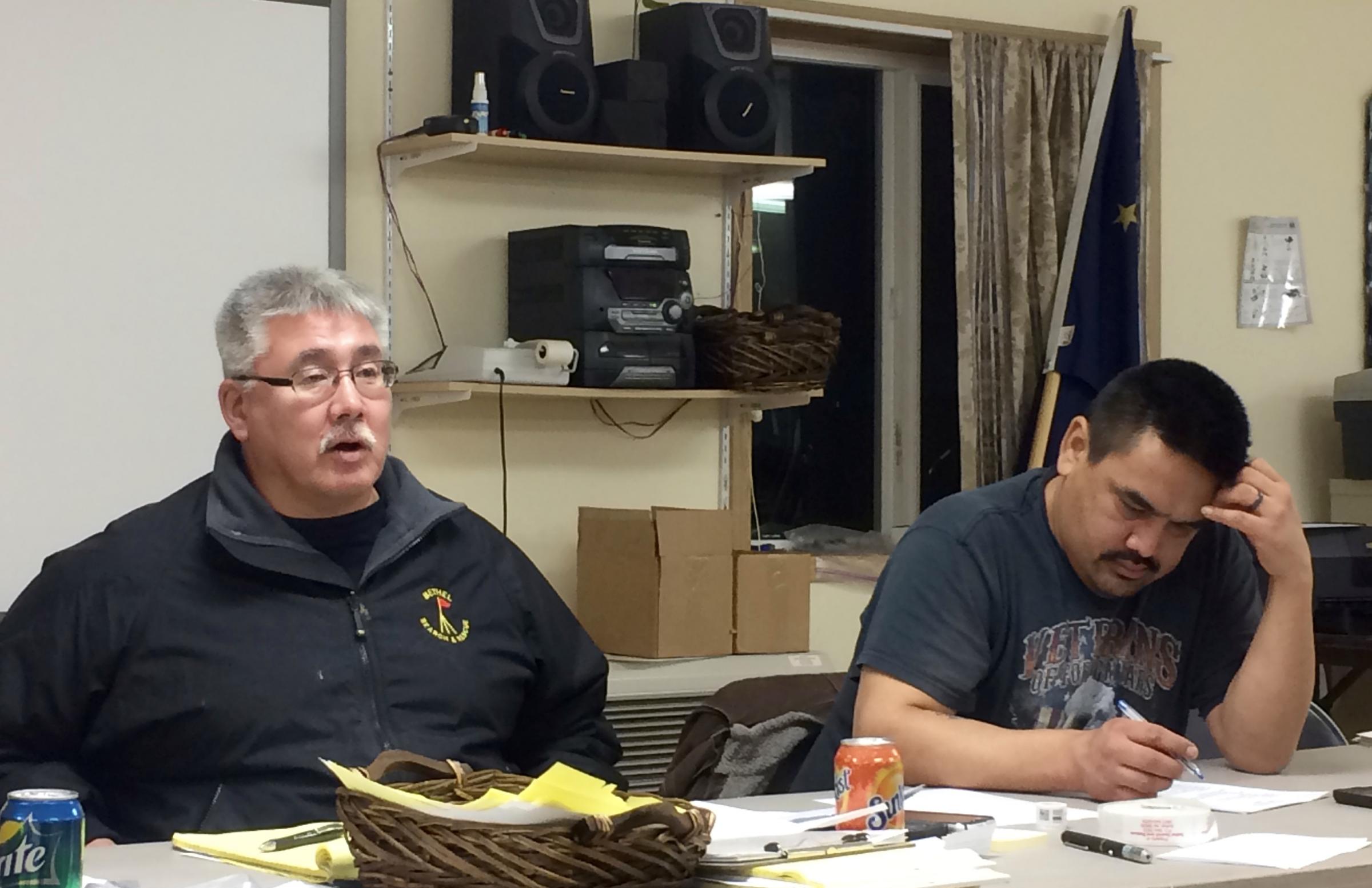
Bethel Search and Rescue President Mike Riley and Vice President Fritz Charles address BSAR members at a regular meeting on Feb. 2, 2017. (Photo by Anna Rose MacArthur/KYUK)
It’s the first winter in Bethel since a liquor store opened after almost 40 years of illegal sales. Alcohol is easier than ever to get, and Bethel Search and Rescue says the number of calls they receive, almost all alcohol-related, has spiked.
Volunteers are getting worn out, resources are depleting and the organization is asking the community for help.
Two weeks ago, Bethel Search and Rescue got a call.
A man had left Bethel sometime after midnight, heading to Akiak on a four-wheeler.
He had been drinking, hadn’t arrived in the village that morning, and the caller was worried.
Search and Rescue went looking and found the man, Charles Williams Jr., 29, dead on Steamboat Slough. He had apparently frozen to death.
It was Search and Rescue’s first body recovery of the winter, but the all-volunteer group doesn’t know if it will be the last.
“We ask if you come to Bethel to buy booze, bring it home first, and then start consuming it there for your own safety and the safety of others,” said Mike Riley, Bethel Search and Rescue president.
Since November when the river and overland trails froze, opening the paths to Bethel from the surrounding villages, the organization has seen a spike in calls. Most involve alcohol.
Historically, about 95 percent of the calls Bethel Search and Rescue receives involve alcohol. That percentage is still basically true, but instead of getting a few calls a month during the winter, like past years, Search and Rescue is getting about two calls a week.
Usually the calls come between midnight and 6 a.m., and responding to such a call can be tough.
John Wassilie has volunteered for Bethel Search and Rescue for more than 30 years.
When a call comes late in the night, he’s usually the first to grab his gear and go, jumping on his snowmachine to head out in the dark and the cold to look for someone.
All he knows is that the person was heading in a general direction and maybe the color of the person’s vehicle or coat, but finding them is just half the work.
“They don’t want to listen to you,” Wassilie said. “They don’t want to reason with you, and they want to try to get home.”
when people have been drinking, they’re not thinking clearly, he said. They’re verbally aggressive, and they’ll often use whatever they have on them as a weapon: broken sticks, bottles, “even their groceries when they’re drunk, because they don’t know what they’re doing,” Wassilie said.
Half the time, Wassilie hog-ties the person he’s found just to contain them, so he can get them out of the cold and somewhere safe.
The late nights, the physical danger, the emotional abuse, it all adds up.
Bethel Search and Rescue has 100 members, but only about 10 regularly respond to calls. At least one has talked about quitting and others are taking indefinite breaks.
Riley said that the group is funded through donations, and that the current call rate is unsustainable for their budget.
“It’s OK for now,” Riley said, “but if we keep this up, and we keep going out, and we’re out of our own pocket, we’ll be hurting for funding.”
The group is all volunteers, and most have jobs, families and other commitments.
Dozens will come out for big searches, the kind the group was created for, when people get trapped in unforeseen circumstances like a blizzard descending on a snowmachine or a storm stranding a boat.
Now, members say it’s become a drunk patrol, and a lot of people aren’t willing to head out looking for another intoxicated person at 3 in the morning.
But when the group was formed, it made a commitment, a commitment to help anyone who needed them, a commitment it’s kept, and one that Riley said it will continue.
“We’re going to keep on going for the people’s sake out there, for their families’ sake,” he said. “The biggest part of it is keeping everyone safe and bringing them home.”
Anyone can become a member of Bethel Search and Rescue.
The next meeting is the group’s annual assembly at 7 p.m. Feb. 15 at the Bethel Search and Rescue building.
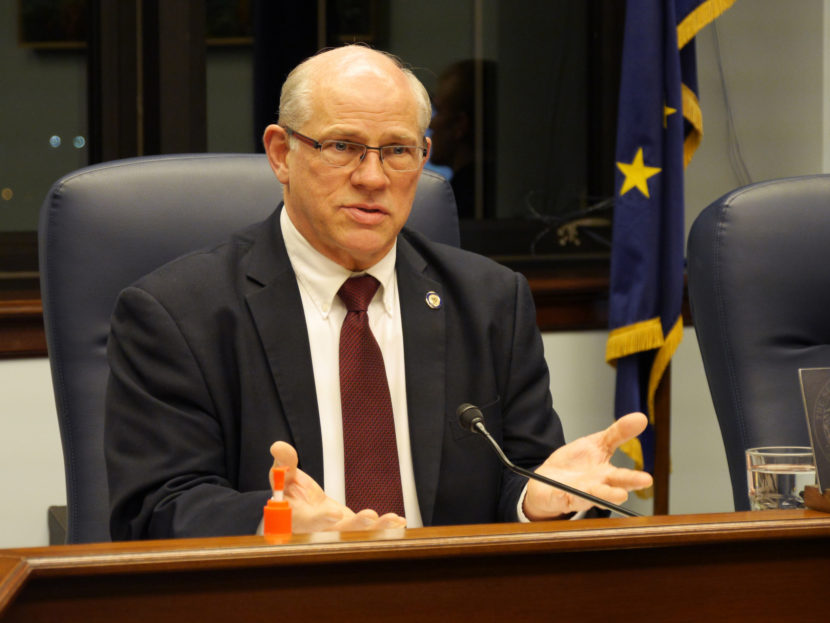
Sen. John Coghill, R-North Pole, is working on revisions to the criminal justice overhaul he helped write. This photo is from January 2016. (Photo by Skip Gray/360 North)
Legislators are considering changes to a seven-month-old law that overhauled the criminal justice system. The commission that helped shape the law has recommended 14 changes to it.
The law allowed some low-risk offenders to avoid jail time. And it made other changes in sentencing, bail and probation that are aimed at reducing the number of repeat offenders.
Critics say the law is allowing some people charged with serious crimes to be released the same day they’re arrested.
The Alaska Criminal Justice Commission recommended a series of changes Monday. It suggested that some felony convictions currently receiving suspended sentences should instead lead to up to 90 days in jail.
Sen. John Coghill helped write the law. The North Pole Republican said the Senate Judiciary Committee is trying to strike a balance in revising the law.
“I think we’re going to drill down pretty well in our committee, find what is the real public safety problem,” Coghill said. “Can we give the police tools, can we give the law tools to actually hold people accountable — so that when, whatever society dishes up, we can hold people accountable?”
Other recommendations in the report include correcting what the commission called an “apparent oversight” that eliminated a legal provision requiring sex offenders to serve probation. The commission recommended requiring mandatory probation for sex offenders.
The commission reached a consensus on the recommendations that became the basis for the law last year. But that consensus has been tough to find this year, with some commission members calling for restoring tougher penalties than most commission members recommend. The only time they reached a consensus this year was a recommendation to make technical changes to the law.
Anchorage Sen. Kevin Meyer, a Republican, said the recommendation on giving 90 days to Class C felons appears to be too soft.
“I think we have to keep in mind the victim,” Meyer said. “I know if someone was threatening me with a gun, I wouldn’t want just a slap on the wrist.”
Critics of the law have linked it to a rise in some crimes in parts of the state.
But Coghill said the sweeping nature of the law has focused public attention on it.
“So it’s not surprising that people would blame that when there was a failure in public safety or our ability to hold people accountable,” Coghill said. “But it just simply isn’t true that it’s the cause of all failures in our system.”
Anchorage Sen. Bill Wielechowski, a Democrat, said he doesn’t want to amend the law based on what he says may be “knee-jerk” reactions. He said any changes should be based on evidence from Alaska and other states.
“If just the penalties we have in the bill work and people are getting rehabilitated, then that’s certainly something I’d want to know,” Wielechowski said. “And by the same token, if it’s not working, if people are getting off and committing other crimes, then I certainly want to know that as well.
Coghill said some of the pushback to law was political, while other concerns were due to unrelated factors that predated the law, such as the ongoing opioid addiction epidemic. He said tight budgets in the Department of Law and local police departments also have caused problems, as has a separate change in bail schedules made by the court system.
“Yes, there’s been pushback,” Coghill said. “So what we tried to do is we tried to figure out what pushback is political, what is misinformation, what is a timeline problem, and what is a real public safety problem.”
Coghill is a nonvoting member of the commission. He plans to use the commission’s recommendations to draft potential changes to the law, which the Senate Judiciary Committee will discuss in the coming weeks.
Close
Update notification options
Subscribe to notifications
Subscribe
Get notifications about news related to the topics you care about. You can unsubscribe anytime.

 The
The