Alcohol & Substance Abuse

New alcohol healing center opens in Bethel, renewing hope for recovery

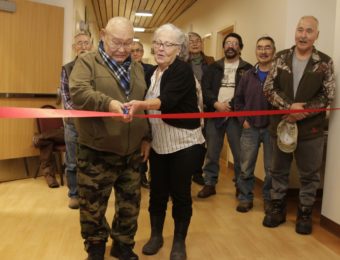
James Charlie Sr., YKHC Honorary Board Member, and Gloria Simeon, YKHC Board Vice Chair, perform the ribbon cutting ceremony at the opening of the Yukon Kuskokwim Ayagnirvik Healing Center on January 11, 2017, surrounded by YKHC board members.
James Charlie Sr., YKHC Honorary Board Member, and Gloria Simeon, YKHC Board Vice Chair, perform the ribbon cutting ceremony at the opening of the Yukon Kuskokwim Ayagnirvik Healing Center on January 11, 2017, surrounded by YKHC board members. (Photo by Dean Swope/KYUK)

Between the two open blades of a pair of scissors stretches a thick red ribbon across the hallway of the new Yukon-Kuskokwim Ayagnirvik Healing Center. Holding the scissors are Gloria Simeon, YKHC Board vice chair, and James Charlie Sr., honorary board member.

The ribbon falls in half with one cut, and the two ends flutter to the new wooden floor of the approximately $12.8 million facility as the crowd applauds and cheers. At one end of the hallway are 16 beds for inpatient alcohol treatment as well as an exercise room, craft rooms, and a kitchen. Down the other end are rooms for outpatient counseling for both alcohol and opioid addiction.

People in the Yukon-Kuskokwim Delta seeking treatment for alcohol addiction now have a newer, more spacious facility to help them. And with the new building, there is renewed hope for treating a disease that has long affected many lives in the region. The Yukon-Kuskokwim Health Corporation celebrated the opening of the Yukon-Kuskokwim Ayagnirvik Healing Center on Wednesday.

The Yukon Kuskokwim Ayagnirvik Healing Center celebrated its opening on January 11, 2017.
The Yukon-Kuskokwim Ayagnirvik Healing Center celebrated its opening on January 11, 2017.
(Photo by Dean Swope/KYUK)

In the middle sits a small gym with a single basketball hoop. Here, dozens of community members and YKHC board members and employees are gathering to commemorate the building’s opening.

Honorary Board Member James Charlie Sr. begins the ceremony with a prayer of thanksgiving.

“Quyana for this opportunity to get together to open this building,” he prayed, “which will help our people who need help in getting rid of alcoholism or other drugs.”

Gratitude and hope for a better future echoes throughout the morning’s speeches. Board members thank those who first began offering alcohol treatment in Bethel in the 1970s. Administrators thank the funders and construction workers who made the building possible. Ray Watson, Director of the Healing Center, thanks the employees filling the room, who every day guide patients toward recovery.

Ray Watson, Director of the Yukon Kuskokwim Ayagnirvik Healing Center, thanks all the employees who help guide patients toward recovery.
Ray Watson, Director of the Yukon Kuskokwim Ayagnirvik Healing Center, thanks all the employees who help guide patients toward recovery. (Photo by Dean Swope/KYUK)

“I always say,” Watson told the crowd, “I have a deep respect for those kind of people who choose this kind of work because it takes a lot of humility and love towards their fellow human beings to help them heal.”

Watson knows this work well: first as a patient in the 1980s, then as a counselor, and now as the center’s director.

“I always say the people who enter into counseling are the lucky ones because there are so many out there who don’t have that, or at this point in time, they’re not there yet,” Watson said.

Many speakers noted that everyone in the Delta knows someone in the region who struggles with alcohol or drugs. They might even one day seek treatment themselves.

The facility actually opened six weeks ago. Watson said the patients were sent on an ‘outing’ for the ribbon cutting to protect their confidentiality. But after the ribbon is thrown away, the cake eaten, and the balloons taken out, those patients will return. They may have to come back repeatedly if they relapse.

This new center, located behind the Bethel post office, was set to open a couple years ago. But in October of 2014, the partially constructed building caught fire and burned to the ground. Construction began again.

Diane Kaplan is the President and CEO of the Rasmuson Foundation, one of the building’s funders. She said that the fire and rebuilding can be seen as a metaphor for recovery.

Diane Kaplan, President and CEO of the Rasmuson Foundation, addresses the crowd at the ribbon cutting ceremony at the Yukon Kuskokwim Ayagnirvik Healing Center on January 11, 2017.
(Photo by Dean Swope/KYUK)

“People who don’t understand a lot about this disease will say, ‘Well how many people went into this facility and got sober?’ Well very often it doesn’t happen the first time,” Kaplan said. “So I think we can look at what happened to this building as there was a great effort to build it, and then something happened, and it fell down, and now it’s been picked up again. And that really is the message for people who struggle with alcohol.”

But as Director Watson said and can attest, recovery, like the new building, is possible.

Troopers thwart attempted alcohol importation to Elim

Alaska State Troopers thwarted two attempts to import alcohol to the community of Elim over the weekend.

Troopers seized an estimated total of 10 liters of alcohol in Nome Sunday, Jan. 8, in two separate incidents: one, an estimated 7 liters, the other about 3 liters.
Airline passengers believed to be involved in the alcohol smuggling attempts were traveling from Nome to Elim, a local option community where alcohol sales and importation are banned.

Suspects have been identified.

The total number and names of those suspects have yet to be released, as troopers continue their investigation.

Counterfeit prescription drug found in Alaska contained fentanyl

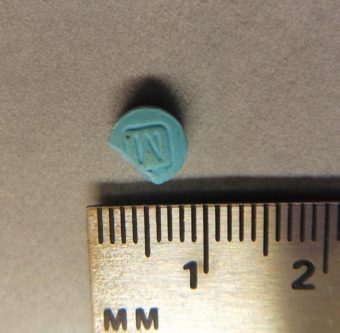
The counterfeit oxycodone tablet actually contained fentanyl. (Photo courtesy of Alaska Department of Health and Social Services.)

Late last month the state’s crime lab confirmed that a counterfeit prescription opioid tablet was found in Alaska.

The small blue pill looked like a generic oxycodone tablet but was actually made of the much stronger drug fentanyl.

This is the first such pill found in the state, but they’ve been circulating in the Lower 48 for more than a year.
People who buy drugs illegally may not be aware they are getting such a powerful opioid and could more easily overdose when using it, said Jay Butler, chief medical officer and director of Alaska Division of Public Health.

“In general use of illicitly obtained drugs is always going to be a game of Russian roulette,” Butler said.

People should seek treatment for their addictions, Butler advised, but if treatment isn’t available they should exercise caution with illegal drugs.

“Never use any kind of opioid medication alone,” Butler said. “Always have someone around who can help you if you overdose. Have Naloxone available. That’s the drug that can reverse the respiratory depression from opioid overdose. And avoid mixing drugs.”

“Many people who die of an overdose have multiple drugs and alcohol on board at the time of death,” he said.

The state plans to start distributing Naloxone to law enforcement agencies and health workers next week, Butler said.

The medication can be injected or administered through a nasal spray.

Study finds disturbing trend in mortality rate in Kusilvak Census Area

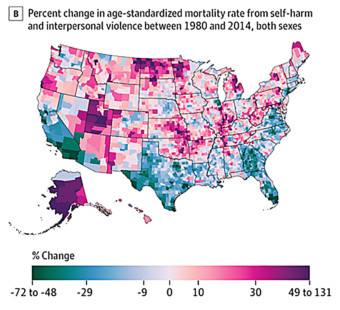
A graph showing the age standardized mortality rate from self-harm and interpersonal violence for both sexes in 2014 from a University of Washington study. The study showed the rate of suicide and homicide in Alaska's Kusilvak Census Area more than doubled between 1980 and 2014; a 130 percent increase and the highest rate in the nation. (Graphic by Institute for Health Metrics and Evaluation at the University of Washington)
A graph showing the age standardized mortality rate from self-harm and interpersonal violence for both sexes in 2014 from a University of Washington study. The study showed the rate of suicide and homicide in Alaska’s Kusilvak Census Area more than doubled between 1980 and 2014; a 130 percent increase and the highest rate in the nation. (Graphic by Institute for Health Metrics and Evaluation at the University of Washington)

The rate of suicide and homicide in the Kusilvak Census Area, located along the lower Yukon River, more than doubled since 1980, a rate increase higher than anywhere else in the nation.
A study from the University of Washington mapped how people in the U.S. died during those years. Its finding for the area is disturbing.

It’s a sobering increase from 51 deaths per 100,000 people in 1980 to 181 per 100,000 by 2014.

The area’s small population numbers were adjusted to be able to compare rates with larger population areas.While the finding from the University of Washington does come with some caveats, Abraham Flaxman, an assistant professor at the University of Washington’s Global Health Department, says it raises a red flag.

“Let me start by saying that 130 percent increase is huge,” he said. “And anytime we see an increase like that, and it’s an increase in something bad, we want to know about that.”

The data came from death certificates from across the nation, and using this source brings a potential defect to the study.

Flaxman said that even though death certification has been improving since the 1980s, quality varies and coroners in many areas would often list an alternate cause of death to avoid the stigma of suicide.

Another limitation of the study is that it doesn’t show how much of that 130 percent increase is from suicide and how much is from homicide.

But according to the State of Alaska’s death statistics, since 1999, which is about halfway through the study’s timeframe, suicides in the Kusilvak area have far exceeded homicides.

For example, there were 13 suicides and four homicides between 1999 and 2001. Between 2011 and 2013, there were 24 suicides and six homicides.

Presumably suicides account for most of the 130 percent increase, and Flaxman hopes that the numbers help local officials take action.

“So now it is out there, and what happens from there, I really hope this is something people find helpful and can use to improve population health,” Flaxman said.

Suicides in Alaska Natives is no secret.

In this same Census Area in 2015, four people killed themselves in Hooper Bay in a period of weeks.

While the continued high rate of suicides in Natives communities took center stage at the Alaska Federation of Natives Meeting that year, one Native man underscored the issue by flinging himself off the balcony and dying in front of the delegates.

One of the people trying to plug the flow of Alaska Native despair is Ray Daw, head of Behavioral Health at the Yukon Kuskokwim Health Corporation.

“Our prevention department, which is about four years old, has done a lot of work at understanding the impact of boarding schools, the impact of the epidemics that occurred two generations ago upon families in the region,” Daw said.

Colonization disrupted the local culture by killing whole families and communities with epidemics and then taking children away from the survivors to educate them in white-run schools. This led to family dysfunction and substance abuse, conditions ripe for suicide because youth lose the capacity to see a viable future.

The YKHC suicide prevention department works to reverse these forces by strengthening the Yupik culture.

It bases its treatment on ways Yupik people lived healthy lives less than a century ago, before there were such high suicide rates.

The department is fully staffed by local Alaskan Natives who all speak Yupik, Daw said.

“Research says that if you’re going to have effective work in behavioral health, you have to have people who are closer to the culture in terms of how they think, feel and behave, and understand the dynamics of problems and solutions a lot more effectively than someone who isn’t,” Daw said.

To get more Alaska Natives providing behavioral health care to Alaska Natives, the department partners with Dr. Diane McEachern at University of Alaska Fairbanks Kuskokwim Campus.

McEachern teaches the rural human services certificate program, and the human services associate degree program. Both are paths to a degree in social work.

Two Yupik elders are always in the classroom with McEachern.

The classes work on how to counsel people and how to heal communities.

McEachern is convinced that these classes can make a real difference.

“So we’re looking at what does it mean for a whole community to experience more health and well-being? And if that happens, what are all the ways to help that happen? And then, what outcomes can we imagine from that in terms of the rates of all these issues? Well, they would plummet,” McEachern said.

Professionals are putting their hope in historical healing and resiliency, strengths the elders in the classroom embody; strengths that the students work to build in their communities; and strengths that, when they were present, the young did not to take their own lives, but instead grew up and became elders and leaders in their own right.

The classes are rooted in the understanding that the rates of suicide, domestic violence and substance abuse are ways that the fallout from colonization manifest when one culture violates another.

From there, the students can move beyond the past to create a viable future.

“It’s is a social condition that happened to the Yupik people,” McEachern said. “And that’s a powerful insight for people to have, because now they can sit back and go, ‘Oh, it really wasn’t us. So what is us that kept us safe before? And let’s embrace that.’”

But will that be enough to curb a trend that has built and increased over more than 30 years?

No one knows the answer to that question.

There have been efforts to bring highly visible discussion of the issue, such as the Pulitzer Prize-winning series “A People in Peril: A Generation of Despair” published in 1988 by the Anchorage Daily News.

There has also been controversy and discussion, both public and private, along with community and private healing sessions. But despite all of this, there is still no sign of a reversal in the trend of increasing suicides in Alaska Native youth.

Johanna Eurich and Steve Heimel contributed reporting to this story.

A Peer Recovery Coach Walks The Front Lines Of America’s Opioid Epidemic

Seth Herald for NPR
Seth Herald for NPR

Charlie Oen’s battle with addiction started when he was 16 and his family moved to Lima, Ohio. It was the last stop in a string of moves his military family made — from Panama to North Carolina, Kentucky, Texas and Germany.

“I went toward a bad group because those were the people that accepted me,” he says. Drugs became a substitute for real friendships.

He started drinking, popping pills, cooking meth and shooting heroin. He was homeless for a while when his parents kicked him out of the house. “I would just be wandering the streets of Lima at all hours of the night until I found somewhere, chilled, sat down, fell asleep in an alley,” he says.

Seth Herald for NPR
Seth Herald for NPR

By age 19, Charlie was serving a three-year sentence in prison on a burglary charge. That’s where he stopped using drugs. He spent the last five months of his sentence in a community-based correctional facility where he took classes and completed group work to learn about addiction. The lessons stuck.

“I started telling people, ‘I want to be a probation officer,’ and everybody knocked it,” he says. “They were like, ‘You can’t do that, you’re a felon.’ I said, ‘Check it out, I’m going to do something.’ ”

One year later, he started working as a peer recovery coach, using his own experiences to help other people stay in recovery.

Charlie is one of five peer recovery coaches at Coleman Professional Services in Lima, and at age 25, he is by far the youngest. Each coach works with about 20 clients to help remove some of the impediments, big and small, to living a drug-free life. Some clients may need help learning to socialize without drugs or getting a ride to their recovery meetings. Others, like 52-year-old Anna Hershey, need more constant support.

“I texted you last night. I know it was late but I needed someone to talk to right away,” she tells Charlie when they meet in Coleman’s parking lot the week before Thanksgiving. She’d argued with her boyfriend the night before, and anger is usually a trigger for her drug use. Charlie is her first recovery coach in over 30 years of addiction.

“I’m proud of myself because I didn’t leave the house and go do the drugs, and that’s what I usually do when I get frustrated,” she tells him.

Seth Herald for NPR
Seth Herald for NPR

Over the course of their 90-minute appointment, Charlie takes Anna to two food banks to pick up donated groceries, and then to check on her application to ring a bell for the Salvation Army this winter. It’s been approved, and despite the previous night’s quarrel, she’s excited to share that news with her boyfriend when Charlie drops her off at home.

Some days Charlie meets with as many as five clients. Today it’s just two: Anna and Shelly Cavinder.

“It’s not been a great day,” Shelly tells Charlie as she gets in his car. She was written up twice in the morning at the women’s shelter where she’s living, which puts her on thin ice for the final two weeks of her stay. She’s moving into a new apartment and bought furniture in anticipation — but the unit where she’s storing the furniture got infested with cockroaches, and today, Charlie is helping her throw it all away.

Seth Herald for NPR
Seth Herald for NPR

Shelly is 50. She’s been using drugs since before Charlie was born. Still, she calls him her lifesaver. “If I didn’t have Charlie, I would probably be back on drugs and dead,” she says. “He even talks to me on his days off, you know, after hours when I have an issue.”

“I appreciate that Shelly,” Charlie says. She smiles and pats his leg.

“You’re welcome,” she replies.

The little pick-me-ups and attagirls Charlie gives Shelly every day go a long way to keeping her from becoming a statistic. There were 52,000 drug overdose deaths in the United States in 2015, 18 of them in this small Ohio county alone. Addiction is a tough disease to beat and relapse rates are high.

It can be easy to forget sometimes that Charlie has his own history with addiction, one he still deals with to this day. His first job out of prison was making salads at the Texas Roadhouse. He left the job when he was hired as a peer recovery coach two years ago.

Seth Herald for NPR
Seth Herald for NPR

He wants to continue working in the recovery field and plans on going to school to get a social work degree. But last year he started working three nights a week again at the Texas Roadhouse to help pay off his court fees, something he has to do before he can start taking classes. He’s got $2,900 to go, down from $10,000. “This is what I do to get the judicial system off my back,” he says.

After everything is paid off, he says he’ll keep working two jobs for a while, “to build the bank back up a little.”

Every day he makes a point to do something for himself — he’s in recovery, too, so focusing on self-care can be just as important as caring for his clients. Lately he’s been playing soccer at a park near his house, sometimes with friends, other times alone. “Early in the morning there’ll be no cars driving,” he says. “All you hear is your feet and the grass and the ball flying through the sky. It feels good.”

Seth Herald for NPR
Seth Herald for NPR

Charlie is five years clean, three years out of prison and has spent more than two years as a peer recovery coach. He has a lot of life to live. But, he says, “When people ask, ‘Where do you see yourself in five years?’ I’ve never had an answer. Because three years ago I didn’t think I’d be having this interview today.”

“So just as long as I continuously do what I’ve got to do and stay positive, stay out of the way and continue to want to strive, something will come my way. The doors will open.”

Seth Herald for NPR
Seth Herald for NPR

Meredith Rizzo, Carmel Wroth, Nancy Shute, Gisele Grayson and Diane Webber edited this story, which is part of a reporting partnership with NPR, Side Effects Public Media and Kaiser Health News.

Copyright 2016 NPR. To see more, visit http://www.npr.org/.

ABC Board will decide the owner of Bethel’s final liquor license

Reno Moore pulling stock on opening day of the AC Quickstop liquor store in May 2016.
(Photo by Geraldine Brink/KYUK)

Three businesses are vying for Bethel’s final liquor store license.

One business has already submitted its application, and the other two are in the three-week public notice period required before applying.

If the other two get their applications in on time, it’ll be up to the Alaska Alcoholic Beverage Control Board to decide which of the three businesses holds the final license.

But how will they choose?

The Players: The three competitors are Kusko Liquor, which would replace Cezary’s Auto Body and Paint; the main Alaska Commercial Company store; and Bethel Liquor Store LLC, which would replace Fili’s Pizza restaurant.

The Limit: Bethel is limited to just three liquor store licenses because of its population size. State law sets a limit of one license per 3,000 people or a portion of that, so Bethel gets three.

The Deadline: The two businesses in the public notice phase have to submit their applications by the second weekend of January in order to compete with the already submitted application. That’s because only applications submitted within the same 30 days are considered competing. The clock started ticking on December 16 when Kusko Liquor submitted its application first.

If all the applications are received before the second weekend of January, the board will decide on one applicant at its next meeting using some of the following criteria:

If an application doesn’t meet all state and local requirements, then it’s out.

If an application is protested by its local government and the board approves the protest, then it’s out.

If the board determines any application isn’t in the public’s interest, then that one’s out. The factors for considering public interest are safety, suitability, size of the premises, proximity to other licensed premises, and community amenities associated with the premises like entertainment, dining, and tourism. The local governing body can also add its preferences and priorities to this list.

If there are still competing applications after these factors have been considered, the board will resort to a drawing, essentially pulling a name out of a hat and declaring it the winner. Any loser has a right to appeal.

The board next meets in February 2017.

Site notifications
Update notification options
Subscribe to notifications