
Family

Americans say pass the turkey, not the politics, at Thanksgiving this year

(Creative Commons photo by Ruocaled)

Most Americans don’t want their family members to pass along their political opinions while passing the turkey and dressing this Thanksgiving.

According to a new NPR/PBS NewsHour/Marist poll, 58 percent of people celebrating the holiday are dreading having to talk politics around the dinner table. Just 31 percent said they were eager to discuss the latest news with their family and friends, while 11 percent are unsure.

That’s a slight uptick from a year ago, when a CNN poll found that 53 percent said they were dreading having to carry on such a conversation, with 43 percent saying they looked forward to such a dialogue.

“There’s a sense of dread. It suggests some indigestion may be part of Thanksgiving dinner if politics come up,” said Lee Miringoff, director of the Marist Institute for Public Opinion. “People you work with and go out with socially tend to share political views, but when you get to family, if politics is in the recipe, it may not taste very well.”

That trepidation about broaching politics isn’t coming from just one political party, but almost two-thirds of Democrats said they are, while only about half of Republicans were. (Fifty-six percent of independents also said so.)

President Trump is, unsurprisingly, a polarizing topic of potential dinner conversation. Forty-seven percent of people in the poll said they find it “stressful and frustrating” when talking with people who have a different opinion about the president than they do. (A Pew Research Center poll from June found 59 percent saying the same thing.)

In the Marist survey this month, 43 percent of people said they find it “interesting and informative” to engage with people who have different views of Trump. Not surprisingly, it’s Democrats who are less likely to want to engage with people who have different views of the president.

About two-thirds of Democrats said it’s stressful and frustrating to do so, while a majority of Republicans said it was “interesting and informative.”

A slight plurality — 47 percent — of independents also thought engaging with differing viewpoints was positive, while 44 percent found it to be a negative thing.

Political civility drops nationally, but not as much locally

The lack of civility that many anticipate will put a damper on their holiday season is emblematic of the broader political discourse across the country. Sixty-seven percent of adults said the tone and level of civility in Washington have gotten worse since Trump was elected a year ago. (Just 23 percent said it has stayed the same, with only 6 percent saying it has improved.)

Democrats, again, think the tone in D.C. has gotten worse by a higher margin — 79 percent think so with just 13 percent saying it has stayed the same and 5 percent saying it has improved.

Sixty percent of Republicans agree the level of civility has dropped, while 31 percent said it has stayed the same, and 7 percent say it has gotten better. Just over two-thirds of independents said it has gotten worse, about a quarter said it has stayed the same and 7 percent said it has gotten worse.

Americans are more optimistic about the level of discourse in their communities, however. Just over half of those surveyed said the tone and civility had stayed the same locally since Trump was elected, while 32 percent said it had gotten worse. Only 12 percent said it had gotten better.

And once again, it is Democrats taking the most dour view — 47 percent said things have stayed the same; 46 percent said they think it has gotten worse; and only 4 percent said the tone of discourse in their own communities has gotten better.

Compare that with 58 percent of Republicans and 47 percent of independents, who thought things locally have gotten better. Twenty-seven percent of GOP voters said the discourse in their community has improved, while just 9 percent of independents thought so.

Meanwhile, 30 percent of independents said things have gotten worse locally, and only 12 percent of Republicans thought so.

Overall, half of Americans still said they think the political discourse in the country is negative, while 36 percent classified it as angry. Only 11 percent said they think the current national conversation is positive.

Republicans are the most upbeat — 21 percent said they think the discourse is positive, but just over half still think it is negative, and about a quarter say it is angry.

Democrats were almost evenly split between thinking it is negative (45 percent) and angry (44 percent) with only 9 percent saying it is positive.

Americans across the board said they think both parties have crossed a line in attacking the other side — two-thirds thought Democrats had done so. Just 29 percent thought the party had stayed within acceptable bounds.

The numbers are almost identical for the GOP — with 67 percent saying Republicans crossed a line in attacking Democrats, and just 27 percent said it has been within acceptable boundaries.

Trump underwater as public disapproves of how Republicans handle health care, tax overhaul

Trump’s approval rating remains stagnant and steady at 39 percent. A majority (55 percent) continue to disapprove of the job the president is doing.

In Marist’s past 11 surveys testing the president’s approval, he hasn’t risen above 39 percent, where it has been five times, and hasn’t dipped below 35 percent.

“There’s not the typical pattern of a honeymoon,” Miringoff said. “This is just steady. It’s his base that approves, and that’s it.”

Those numbers could bode well for Democratic hopes in the 2018 midterms, but this poll also shows their advantage on who Americans would rather control Congress narrowing to just 3 points, 43 percent to 40 percent.

That’s a 12-point shift from just a week earlier, when Marist showed Democrats with a 15-point advantage. It is also a deviation from other recent polls that have given Democrats the wider gap they have needed historically to take back control of the House of Representatives.

Miringoff explained that the shift isn’t due to Republicans picking up voters, but to independents going from Democrats to undecided — for now.

That 15-point edge also came following the big Democratic gains in Virginia, New Jersey and elsewhere, which might have colored respondents’ preferences. (It also, however, coincided with the president’s trip to Asia, where he was uncharacteristically quiet on Twitter.)

On the issues, though, almost three-quarters of Americans said they disapprove of how Republicans have handled health care legislation. Some 60 percent want the Affordable Care Act changed to do more (41 percent) or want to let it stand (19 percent), while just 35 percent want it repealed completely (28 percent) or to do less (7 percent).

How Republicans are performing on the tax overhaul isn’t much better in the public’s eyes, either. Fifty-seven percent said they don’t like how the GOP has handled the possible overhaul, with only 31 percent approving. Additionally, one of Republicans’ most-used arguments isn’t resonating widely either — when asked if they’d be in favor of receiving a tax cut if it meant increasing the national deficit, two-thirds of Americans said no.

About 1 in 3 women says she has been subject to office sexual harassment

The poll also found that just over one-third of women said they have been sexually harassed in their workplace. Overall, 1 in 5 Americans, including men, says he or she has experienced sexual harassment.

Older women are more likely to say they have experienced sexual harassment — 32 percent above the age of 45 said they have been victimized during their careers, compared with 18 percent under 45.

The numbers come as many high-profile men, from Hollywood moguls like Harvey Weinstein to politicians like Sen. Al Franken, D-Minn., and Alabama GOP Senate nominee Roy Moore, have been accused of sexual misconduct or worse.

NPR’s former top news executive Michael Oreskes was forced to resign after multiple sexual harassment allegations were leveled against him. NPR CEO Jarl Mohn has taken a medical leave amid the fallout from Oreskes’ departure. NPR has also placed David Sweeney, who was recently promoted to the position of chief news editor, on paid administrative leave while reviewing allegations about his conduct as well.

More allegations surfaced on Monday, against New York Times reporter Glenn Thrush and Charlie Rose, who appears on CBS, PBS and Bloomberg.

Even as the list of the accused grows almost daily, a strong majority of Americans (88 percent) said they do believe their workplace takes reports of sexual harassment and abuse seriously, including 69 percent who said they are taken “very seriously.” Only 9 percent said they believe such allegations aren’t taken very seriously, and 4 percent said they aren’t taken seriously at all.

Almost two-thirds (64 percent) of employees also said they think the accuser is more likely to be believed by their place of business than the accused in such situations. Just 18 percent said the accused is more likely to be believed.

Copyright 2017 NPR. To see more, visit http://www.npr.org/.

Dog owners have lower risk of cardiovascular disease, Swedish data suggest

Daniel Carson carries his dog Cody across Sandy Beach on a sunny Sunday, March 1, 2015. Cody's paws are sensitive, Carson explained, and he has problems with the beach sand.
Daniel Carson carries his dog Cody across Sandy Beach on a sunny Sunday, March 1, 2015. Cody’s paws are sensitive, Carson explained, and he has problems with the beach sand. (Creative Commons photo by James Brooks)

Dogs shower their owners with affection and demand walks on a regular basis. And according to medical researchers, a corresponding link between dog ownership and heart health — previously called “probable” by experts — is supported by Swedish data.

An examination of Sweden’s national records — spanning more than 3.4 million people and 12 years — found that registered dog owners had a lower rate of cardiovascular disease and a lower risk of death.

The research was published in Nature’s Scientific Reports on Friday.

Several years ago, the American Heart Association concluded that pet ownership, “particularly dog ownership,” is “probably” associated with a reduced risk of cardiovascular disease. But they noted the “scant data” on pet ownership and human heart health in large general populations.

The researchers in Sweden set out to “clarify the association” between dog ownership and heart health. Unlike previous researchers, they had access to hospital visit data for millions of Swedish citizens, thanks to the public health care system — plus two large databases of dog owners, because dog registration is mandatory in Sweden.

Comparing the records, they found a reduced risk of heart attack, death from cardiovascular disease, and death from any cause among registered dog owners. The trend remained even when controlled for age, sex, education and socioeconomic status, among other factors.

The researchers note that previous research in Norway and the U.S., working with much smaller pools of data, didn’t find a connection between dog ownership and heart health. They suggest that the smaller sample sizes explain the lack of results.

They also acknowledge it’s possible that there are other explanations for the link, like some unknown factor that affects both the choice to own a dog and other lifestyle decisions. And the data are not perfect — while dog registration is mandatory, for instance, not all dog owners comply.

But overall, the researchers say the large Swedish data set provides “the most robust evidence so far of a link between dog ownership and health outcomes.”
“Dog ownership was especially prominent as a protective factor in persons living alone,” lead author Mwenya Mubanga said in a statement released by Uppsala University. “The results showed that single dog owners had a 33 percent reduction in risk of death and 11 percent reduction in risk of myocardial infarction (heart attack) during follow-up compared to single non-owners.”

Hunting breeds, like terriers and retrievers, had a particularly strong association with a lower risk of cardiovascular disease.

As NPR’s Allison Aubrey has reported, a study earlier this year found that dog owners get more exercise than non-dog owners — 22 more minutes of moderate-pace walking a day, on average:

“The study found that the dog owners walked briskly and got their heart rates up. At times, their pace was about 3 miles per hour, which the Centers for Disease Control and Prevention considers moderate intensity.

“Prior studies have shown that moderate-intensity walking is just as effective as running in lowering the risk of high blood pressure, high cholesterol, Type 2 diabetes and other conditions. And the more people walk, the more the health benefits increase, according to the American Heart Association. …

“As dog owners know, when your hound leaps up onto your bed in the morning, you have little choice but to get up and go.”

The companionship provided by a dog could also have positive effects on health, Allison reported.

Reaching out to youth where they are

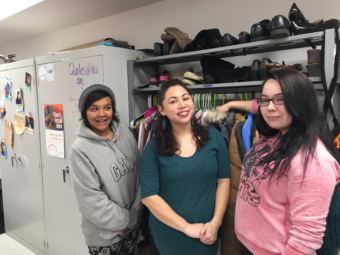
Nichelle, left, Serena and Ivory are staff with the Alaska Youth Advocates POWER Teen Center. (Photo by Anne Hillman/Alaska Public Media)

Sometimes when young people are in rough situations, they don’t want to ask for help. Especially not from adults.

That’s where peer outreach workers step in.

Alaska Youth Advocates have been connecting with youth on the streets of Anchorage and helping them find resources for 25 years.

Nichelle, 20, used to hang out at the Alaska Youth Advocates drop-in center over a year ago. But she says she was different then — she had been using heroin and other opioids for years.

“When I was using, it was like, I wasn’t thinking about how I was treating other people,” she said. “I wasn’t taking them into consideration.”

Since then she’s sobered up a couple times and moved around a bit. Over the summer, she was homeless and camping in the woods.

One day, two peer outreach workers saw her hanging out in a park and let her know she was still welcome at the  drop-in center, whenever she was ready.

Nichelle said at first she was too embarrassed to go back  because the people at the center had seen her at her worst.

“It was a nerve-wracking experience at first,” she said. “But then when I came in here I saw that they were here to support me and not judge me.”

That’s one of the key ideas behind the center – accepting the young people as they are.

It’s part of a strategy used around the world, called Positive Youth Development, that focuses on leveraging young people’s strengths as a way to help them learn how to be healthy adults. In order for it to work, youth have to feel safe, supported, and accepted.

Program coordinator Serena Nesteby said sometimes it’s easier for that to happen when young people are leading the effort.

“It’s easier for youth to talk to other youth,” she said. “It’s easier for them to connect to someone who is their same age who maybe went through same or similar experiences as them to reduce barriers and to build stronger relationships.”

And it’s not as if the workers are sent out unprepared – they each have to go through three months of intensive training on everything from addiction to housing to balancing school and work.

They bring up those skills in casual conversations and when teaching formal presentations.

Peer outreach worker Ivory, Eighteen-year-old , even demonstrates her favorite coping skill on a regular basis in the drop-in center kitchen – baking.

“Yeah, it just gives me something to do,” she said as she finished beating a bowl of lemon cake batter to share with whoever drops by. “I don’t know. It’s good for me.”

She said it helps her deal with stress.

Ivory is balancing motherhood with work and will soon start college, too.

When she dropped out of high school because of bullying and got pregnant at 15, she didn’t have a support network.

“My family wasn’t supportive of me,” she said. Her friends dropped her, too. “They actually told me I wasn’t going to succeed. That I was going to sit at home and not do anything with my life.”

She didn’t know about Alaska Youth Advocates or other resources, but now, as an outreach worker, she can fill the knowledge gap for other young parents.

She lets them know that, “they are not the only people out there. Like they’re important, too, and they can still finish high school, they can still have a job. They can still do what everyone else does when they are older, with children.”

But here’s the catch – Ivory said having a person like that in her life when she was pregnant or having a safe place to go, like the drop-in center, wouldn’t have helped her. She needed to struggle to prove to herself and her family that she could do it, she said.

Alaska Youth Advocates would not have been a good solution for her, but she said she sees how it helps others, like Nichelle.

After Nichelle finally came back to the youth center, she eventually developed enough courage to apply for a job to be a peer outreach worker.

Now she’s in training – and said learning everything in the packed three-inch binder is hard.

She laughed nervously, glancing at her work.

“There’s a lot of information you have to remember.”

Nichelle said working at the youth center forces her to be more outgoing and to face some of her past experiences. More than once she’s come into work and burst into tears. She used to apologize for her weaknesses, but not anymore.

“You know how I see it, at the end of the day is, youth here they see that I can be vulnerable and it’s ok for me to cry, like, then it can send a message to them that it’s okay for them to cry in here, and it makes it more of a safe space,” she said.

The peer outreach workers interacted with 300 different young people last year. More than half were homeless.

Some just received hygiene products, snacks, and information.

Others came to the center to cook a pot of spaghetti or get help finding housing.

The outreach workers met them where they were at. Literally.

Want to hear more Solutions Desk stories? Subscribe to the podcast on iTunesStitcherGoogle Play, or NPR.

For foster youth, sometimes the solution is saving each other

Natilia Edwards, left, and Anna Redmon gather for breakfast. (Photo by Anne Hillman/Alaska Public Media)

Anna Redmon, 22,  and Natilia Edwards, 19, spend a lot of time bantering — or is it bickering? Sometimes it’s hard to tell.

“The irritation in my voice irritates her,” Anna says over breakfast at a local coffee shop.

“She just has so much attitude,” Natilia retorts. “I’m like, ‘Can you rein it in, maybe like smile while you talk or something?’”

The pair say their breakfast chatter is pretty tame.

At home, they yell at each other at the top of their lungs across their small apartment but are dying laughing within minutes. They say they can be calm together, too, even sweet.

“It’s like the weird little things,” Anna says. “Like she’ll sit on the bathroom floor while I take a shower.”

“And we’ll just talk,” Natilia interjects.

“Yeah, we’ll just sit there and talk,” Anna agrees. “It’s just like those little things people don’t normally do.”

Just like a 22-year-old doesn’t normally become a foster parent to teens, who can stay in foster care until they are 21. But sometimes that’s the best solution.

Natilia and Anna almost didn’t meet.

Natilia was 13 when she entered foster care and she kept getting invites to gatherings from a group called Facing Foster Care in Alaska. It’s an organization run by and for current and former foster youth. Natilia says she did not want to go.

“It’s like a weird conference for all these foster kids,” she explains. She didn’t think she could possibly go. “Because I was like, being in foster care, it’s a bad thing. You have a lot of guilt as a foster youth because you think that maybe if you did something different, maybe something could have changed.”

She didn’t want to be around other foster kids.

Eventually, when Natilia was 16, she went to an FFCA weekend retreat and was surprised to see other kids she knew.

She also met Anna, a former foster youth and group leader, who was trying in vain to calm down a room full of young adults.

“We were all trying to getting everybody to be quiet and she would not stop,” Anna recalls, glaring jokingly at Natilia. “And I looked over and was like ‘Shut up!’ And she was like ‘I don’t know who you think you are!’ And it just downhill spiraled the whole retreat.”

But through FFCA, they kept running into each other and talking. At one point they united in a friendly rivalry against other youth, and it led to a solid friendship.

Like many friendships, they fell in and out of touch.

They hadn’t spoken much in months when Natilia texted Anna at the end of the summer, asking to hang out.

Anna arrived that evening.

Natalia says, “When I walked up to the car, immediately I set foot in the car, and I just completely started crying.”

Natilia says she was suicidal that day, had written her suicide note, and reached out to her older friend as her last resort.

After finishing her first year of college, she had been homeless all summer. Then she was kicked out of the most recent place she was staying.

When she reached out to some of her former foster parents, they didn’t offer much support.

Anna immediately offered space in the apartment she shares with her mother and her two-year-old daughter.

“I didn’t have an option if I was moving in or not,” Natilia says.

“There was no option, actually,” Anna agrees, speaking over her. “It was, ‘We’re gonna get your stuff and you’re moving in.’”

Natilia was uncertain at first but within an hour they were picking up Natilia’s things and moving her into the living room.

The pair spoke with the Office of Children’s Services and found out that because Anna is over 21, she can legally be Natilia’s foster parent.

Though some foster youth chose to age out of the system at 18, Natilia chose to stay until she’s 21, so she needs to live at an official placement.

The arrangement gives them access to extra resources, too.

Anna is the only one in the household currently working.

Natilia is focusing on getting healthy again and watching Anna’s toddler.

Though the two are close, it still took Natilia a while to be comfortable enough to ask for basic things.

“I think she just finally started asking last week or two weeks ago for the things that she needs,” like mouthwash and soap Anna says.

Sometimes they interact like friends. Sometimes like mother-daughter.

Anna reflects back on the day Natilia moved in.

She had just broken up with her boyfriend.

She was supporting her family.

Things were hard.

“I think we both saved each other there,” Anna says.

Natilia looks at Anna for a long moment then says softly, she didn’t know that. They’re quiet for a few seconds— then they jump back into the banter.

Want to hear more Solutions Desk stories? Subscribe to the podcast on iTunesStitcherGoogle Play, or NPR.

Want to join the conversation? This month we’re talking about young people. In December, we’re focusing on elders. Tell us what it’s like to age in Alaska by calling 907-885-6055 and leaving a voicemail. You can also text “aging” to the same number.

Naknek family has fostered over two dozen children

Nola Angasan posed with her adopted grandson, 4-year-old Fischer Angasan. (Photo by Avery Lill/KDLG)

The Angasan yard is packed with kids, some they have adopted, some they are fostering and some their biological grandchildren.

Inside Nola Angasan braids her granddaughter’s wet hair.

A group of the kids at the house just got back from the borough pool.

Nola’s husband, Steve Angasan, is at the beach with several more kids. They are setting a net for smelt.

The Angasan family has opened its doors to children who needed a place to stay for decades.

Steve Angasan grew up in South Naknek, flying across the Naknek River every day to go to go to school. When he and Nola married and settled in Naknek in the 1970s, they opened their house as a bad weather and sports home.

If students from South Naknek could not get back home after school because of weather or sports schedules, they could stay with the Steve and Nola.

In the early years, they often hosted six or seven kids for a night, and occasionally they hosted as many as 18.

Over the years, the population of South Naknek has dwindled to 71 people, and the Angasans found themselves hosting fewer students.

“When all those kids grew up and were gone, and I think there’s now only one more relative in South Naknek going to school, we decided to do foster care,” Nola Angasan said.

They got involved with foster care eight years ago when a local Office of Children’s Services worker came to the family with a request.

“She said ‘Nola, you always have kids wherever you go. There’s always a whole trail of kids behind you when you got to the school or to the pool. I need someone for this little boy, do you think you could be a foster parent?’’ Angasan said. “I said, ‘Well, if you need a place for the boy, I’ll surely take him.’”

Since then, as the number of foster families in the Bristol Bay Borough fluctuates, the Angasans have been a constant.

At times they have been the only foster care family in the borough.

“If I don’t, who’s going to do it, and where are they going to go? Our Native children need to be here with Native homes,” Nola Angasan said. “They have culture, and they have subsistence foods. They need to be safe. They need to be loved. They need to grow up knowing that someone cared for them.”

The Angasan yard is full of bikes and toys to keep kids active and entertained. (Photo by Avery Lill/KDLG)

School administration see the positive impact of the Angasan’s stable home.

“Nola and Steve Angasan are some of the most amazing individuals in our community,” said Bill Hill, superintendent of the Bristol Bay Borough School District. “They are taking in foster children from up and down the (Alaska) Peninsula and making a huge difference in their lives. The kids come to school, and they are happy. The kids have structure in their lives. Nola and Steve make sure that they are well fed and cared for in both the physical and the mental sense.”

Right now, Nola and Steve are fostering six children and have adopted two.

They have fostered more than 28 children altogether, some for only a few days, some for many months.

Additionally, they assist their daughter, Dorena Angasan, who is fostering seven children and has adopted one.

Nola can tell a plethora of stories of difficult situations she has dealt with as a foster parent.

Children that come into their home often carry with them emotional, behavioral and even physical challenges.

In each situation, however, she emphasized that the relationships built with children have more than made up for taxing circumstances.

She recalled with a chuckle that when she and Steve married more than 40 years ago, she told him she wanted to open an orphanage.

Several months ago, he stood in their living room full of kids and asked, “Are you happy that you got your way?”

“What did I get my way with?” Nola asked. He

reminded her she wanted an orphanage. “I guess this is the closest I’m going to get, so yes I am happy,” she said, still laughing.

Southeast Alaska Native literacy program expands

Tlingit & Haida Head Start teacher Kayla Tripp and her class look through six new Baby Raven Reads books Oct. 20, 2017, after they were delivered by Sealaska Heritage Institute staff. (Photo by Nobu Koch/courtesy Sealaska Heritage)
Tlingit and Haida Head Start teacher Kayla Tripp and her class look through six new Baby Raven Reads books Oct. 20, 2017, after they were delivered by Sealaska Heritage Institute staff. (Photo by Nobu Koch/courtesy Sealaska Heritage)

A Southeast Alaska Native cultural organization is expanding a children’s literacy program into nine other communities in the region.

The Sealaska Heritage Institute announced this week it will be partnering with the Central Council of Tlingit and Haida Tribes of Alaska’s Head Start to offer the Baby Raven Reads program in communities around Southeast.

Baby Raven Reads promotes literacy, language skills and school readiness for Alaska Native preschool-aged children.

A pilot program in operated in Juneau for three years but ended this year.

The organization’s education program manager Katrina Hotch said it initially was aiming to reach 50 families in Juneau, but ended up serving 190 families.

The program uses nearly 20 books published by Sealaska Heritage, featuring Native authors and artists.

But Hotch said training has been an important piece.

“The books were a part of the program but there were monthly family literacy nights and different trainings that happened throughout the year so helping parents to learn literacy exercises to do at home and training for early educators and different family members, I think that was a really impactful piece of it,” Hotch said.

The institute plans to offer family literacy events along with training sessions in Angoon, Craig, Hoonah, Klawock, Petersburg, Saxman, Sitka, Wrangell and Yakutat.

Some of the first events could be as soon as this January.

Hotch calls it an exciting development.

“I know we got a lot of responses you know and events would go up on Facebook and people would say when is this going to happen in my village and now we’re going to get to bring it to the outlying communities,” Hotch said. “So that is pretty exciting.”

As part of the expansion, Sealaska Heritage plans to publish another nine children’s books over the next three years. Those are given out free to Native families in the program.

Two of the most recent book offerings feature illustrations by Haida artist Janine Gibbons of Petersburg.

They’re also available to purchase on the institute’s website. Sealaska Heritage also is looking for other authors and illustrators for future publications.

The effort is funded with a grant from the U.S. Department of Education. It was among 15 programs in the country honored this year by the Library of Congress for implementing best practices for literacy promotion.

Sealaska Heritage is a private non-profit formed by Sealaska, the regional Native corporation. It aims to perpetuate and enhance Tlingit, Haida and Tsimshian cultures.

Site notifications
Update notification options
Subscribe to notifications