Family

New study suggests dental therapists improving oral health in YK Delta

Rural health aides have a long, successful history of improving access to health care in Alaska.

Now, dental a program based on that model is improving oral care in the Yukon-Kuskokwim Delta.

The Dental Health Aide Therapist program was controversial when it started a decade ago, but a new study suggests that smiles have gotten healthier, cleaner, and toothier in villages where it’s appeared.

Phylicia Wilde grew up in Mountain Village on the Yukon River.

When she was 12, she got a toothache. It started small, but soon she couldn’t sleep.

With the pain, she began missing school. Then, a dentist arrived for the village’s yearly dental visit.

“I was entered into that list to get seen, but the list was so long. It was four or five pages of patients,” Wilde said.

Wilde didn’t make the cut and had to fly to Bethel for treatment. By then, the tooth had abscessed, or become infected.

“It was on a permanent tooth that had a huge cavity, and I needed a root canal.”

If Wilde had had a dental provider in her village, she said that the problem may never have occurred.

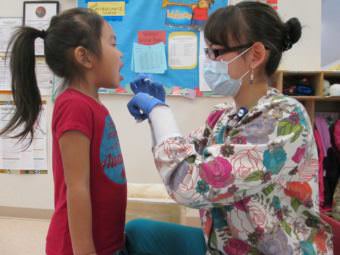
Now, Wilde herself is a provider, certified as a dental health aide therapist for the Yukon-Kuskokwim Health Corporation.

After training for two years, she offers many of the same services that dentists do such as X-rays, fillings and extractions.

This program was started by the state’s tribal health organizations because nothing else was working.

Dentists were willing to travel to rural areas and donate services, but it was never enough.

National dental groups sued to stop the program, saying that it wouldn’t be safe.

They lost, and the program began turning out trained health aides capable of doing dental therapy.

“Dental therapists seem to be making a difference in terms of providing the type of care that you and I would want for ourselves and maybe family members,” said Donald Chi, an associate professor of Dentistry at University of Washington and a pediatric dentist who’s practiced in the YK Delta.

Recently, he published a study evaluating the impact of dental therapists on Delta communities. The findings are significant.

The study is the first long-term review of health impacts by dental therapists, and Chi says that the results could change the way dental care is provided in rural areas across the U.S.

“The more number of dental therapist treatment days communities got, the more preventive care people got, and fewer people were getting extractions,” Chi said.

Dentist Judith Burks, who coordinates YKHC’s 10 dental therapists, has seen the transformation.

“I go out to villages and instead of the main focus being on emergencies, we get to focus on things like prevention and higher level care for the patients,” Burks said.

In other words, dental therapists can now educate communities on how to live healthier lifestyles for a healthier mouth, like not using tobacco and avoiding sugar.

Wilde knows her efforts mean that villagers are having fewer of the painful, sleepless nights and missed school days like she experienced growing up.

“It’s been awesome, just seeing the patients and their gratitude,” Wilde said. “That feeling is just amazing.”

YKHC hopes to nearly double the number of dental therapists serving the region over the next two years.

They’re offering full scholarships, and applications will be available on the YKHC website in February.

Toksook Bay fire destroyes family’s belongings, kills 5-year-old

A child is dead and a family’s belongings destroyed Saturday after a house fire in Toksook Bay.

Six people lived in the home. All but one, Kendrick Julius, 5, were able to make it out of the building after the fire started sometime before midnight.

City Administrator Paul Chimiugak provided the child’s identity; Kendrick was his nephew.

The cause of the fire is still undetermined.

Chimiugak said that there was a rush to respond to the blaze, with people stretching hoses to get water to it.

The flames were doused before any other structures were affected, but the house and everything inside were lost.

The community is collecting clothing for the family and asking people to ship donations. Grant Aviation, Ryan Air, and Ravn Alaska are all shipping the donations to Toksook Bay for free.

This is the village’s second house fire this month. No one was injured in the earlier blaze.

Donations can be shipped to:

Bob Julius and Family, Toksook Bay, Alaska 99637

  • Bob Julius: Pants size 30/30 or men’s size small sweatpants, shirt medium, coat medium, shoe size 8.5.
  • Cecelia Julius: Sweat pants preferred size medium, shirt large or extra large, coat large, shoe size 7.
  • Jennianne Theresa Julius: Pants size 3 or 4, shirt size medium, coat size medium, shoe size 7.5.
  • Natasha and Kayden: Clothing for 2-year-olds.

Community centers in Dillingham provide places of welcome for the old and young

Paul “Elvis” Chythlook dons a pair of gold chrome shades at the piano bench. He plays for the community in the Dillingham Senior Center regularly, gospel and traditional tunes he knows by heart. (Photo by Zoey Laird/KDLG)

In downtown Dillingham, both the senior center and the Christian youth center are places to find food and fellowship with others.

Paul Chythlook plays gospel piano at the Dillingham Senior Center, and afterwards I feel like I’ve been to church.

People call Chythlook “Elvis” for his baritone impersonation of the King.

Blind in one eye and arthritic, the 71-years-old plays by ear from a mental catalog of classics, barreling from Presley’s “Don’t Leave Me Now” to the hymn “Crying in the Chapel.” I request to hear the latter again.

Chythlook’s audience leans in, listening to the lyrics, all about coming together in fellowship.

“Elvis” rocks a pair of gold chrome shades and pounds out songs he’s played all his life. Across the keyboard, I make eye contact with a man I don’t know. We can’t help but smile.

Mischaell Romo, 4, lives in the same building as the Dillingham Christian Youth Center. She’s familiar with many of the youth who spend time there, and she’s always looking for someone to draw, paint, or color with. (Photo by Zoey Laird/KDLG)

High school night at the Dillingham Christian Youth Center looks like a roomful of siblings relaxing at home.

“We’re closer to being a family at the youth center than my own family is sometimes,” Noah Theurer, 17, said. The Theurers moved to Dillingham this summer, and Noah’s a regular at the youth center now. “We all pray together, we eat together, laugh together, you know it’s the whole nine yards of being a family.”

Jasmine and Tyler Romo run the non-profit organization and raise their kids in the same building.

Tonight, they work in the kitchen, while a game of foosball, music and young voices fill the center.

Their children, Mischaell, 4, and Giuseppe, 1, are doted on like everyone’s little brother and sister.

“My brothers and sisters, I haven’t seen them in a couple years,” Frank Nicholson said, shuffling cards and waiting for the lunch bell.

He visits with folks at the senior center more than some members of his family.

Philip Andrew joins us at the card table. “Old timer,” Nicholson said, “tell your life story.” Andrew guffaws, clearly used to the teasing, and takes a seat.

The two men are neighbors and good friends. I comment on a hole in Andrew’s shirt that’s comically positioned right over his belly button. He pats his stomach and grins.

“Every time I go over to his house he’s feeding his face,” Nicholson jabs. “Take a steam, feeding his face again.” Nicholson and I burst into laughter. “Typical day around here,” he says.

An elder told Ida Noonkesser “that if you treat people the way you want to be treated … you’ll have a bigger family.”

She didn’t understand at first, but now she’s the director of the Dillingham Senior Center, and has “a big whole family” aside from her biological one.

Noonkesser’s worked here for 17 years and she says, “It gives me joy to come to work Monday through Friday, because I get to spend time with the elders.”

She takes comfort in their friendship when she doesn’t see her parents or her 97-year-old grandmother as frequently.

“I can always feel the love from them,” Noonkesser said.

Many of the elders speak Yup’ik, Noonkesser’s first language, and “they have wisdom and give out advice.”

She likes to imagine they are all her adopted grandparents, and enjoys feeding them every day.

In the morning she cooks a meal with her staff, and when the lunch bell sounds at noon, she communes with her makeshift family of elders in the cafeteria.

Dillingham Senior Center director Ida Noonkesser stands before a board of memories. Photos of community elders are displayed from years past. Noonkesser was recently recognized for 17 years of service at the center. (Photo by Zoey Laird/KDLG)

Similarly, at the Dillingham Christian Youth Center, the “ideal result of coming together is sharing joy,” Jasmine Romo said.

Kids ages 10 to 18 are hosted on a foundation of faith, of “God’s love” and “bearing each other’s burdens.”

Young people like Sara Fuller, 17, assist the Romos at the center’s coffee corner, which serves beverages to the wider community for donations.

Behind the customer counter, Fuller refers to her cross necklace, saying she believes in “good lattes and God.” More seriously, she says “this youth center has changed lives.”

I ask her how, and she tells me about friends, who instead of sitting around at home, are finally eager to be somewhere after school.

“They’re getting out there and getting to know new people and having fun,” Fuller says, and I suspect she’ll be spending lots of time here in the coming school year.

Anastasia Heyano is in Fuller’s graduating class at the Dillingham High School, and she’s usually the youngest in the senior center at any given time.

She corrects me when I ask her what she likes about working with old people. “Elders,” she says, “have stories to tell and they’re really smart. Some of them have been everywhere.”

Heyano didn’t plan to work at the senior center this summer, but now she says, “I like it a lot … they’re funny, they’re chill, I mean, there’s no drama around them or anything.”

Her uncle “John John” Heyano is a regular, and he fist bumps her on his way to the cafeteria.

After lunch, I catch him chatting at the card table. When I ask him what he thinks of the senior center, he reminiscences about a time when more people got together to “just enjoy each other,”  like the elders do here.

John John is right. Simple, present minded togetherness like this doesn’t exist in most places and for most people. Maybe that’s why it feels so rare and wonderful.

Little Mischaell Romo hands me a brush and invites me to paint.

The youth center is quiet before the usual rush of kids at 3 p.m.

I sit alongside Mischaell and we paint a princess who wears shorts, a T-shirt and a crown. When she’s finished, I suggest that our princess needs a mantra.

Mischaell asks me what a mantra is, and I explain it’s something you say over and over because you believe it.

She decides I should choose one. I pull a lyric from “You Gotta Be” by Des’ree.

The song came into my mind all week, walking between the two centers and meeting kind Dillingham people, old and young. I paint the words and speak them as they appear on the page.

“Love will save the day,” I say. Mischaell follows the line of my brush with her eyes and repeats our mantra aloud. “Love will save the day.”

CDC: Half of all female homicide victims are killed by intimate partners

A lone bouquet of flowers stands in front of a home in Phoenix in 2013, after police said a man killed his wife, daughter and brother-in-law before killing himself. A new CDC report sheds light on patterns in homicides of women.
A lone bouquet of flowers stands in front of a home in Phoenix in 2013 after police said a man killed his wife, daughter and brother-in-law before killing himself. A new CDC report sheds light on patterns in homicides of women. Ross D. Franklin/AP

More than half of female homicide victims were killed in connection to intimate partner violence — and in 10 percent of those cases, violence shortly before the killing might have provided an opportunity for intervention.

That is according to a new report from the Centers for Disease Control and Prevention, published Thursday, that takes a close look at the homicides of women.

More than 55 percent of the deaths were related to partner violence, and the vast majority of those were carried out by a male partner.

“What’s notable is that this is across all racial ethnic groups,” says Emiko Petrosky, a science officer at the CDC and an author of the report. “Intimate partner violence can affect anyone … it really just shows that [this] is a public health problem.

Horizontal bar graph of the homicide rate for black and indigenous women compared to women from other ethnic groups.
(Courtesy Centers for Disease Control and Prevention and Katie Park/NPR)

The report also found that black and indigenous women are slain, in general, at significantly higher rates than women of other races. Black women are killed at a rate of 4.4 per 100,000 people, and indigenous women at a rate of 4.3 per 100,000; every other race has a homicide rate of between 1 and 2 per 100,000.

Hispanic women who were killed, meanwhile, were the most likely to be killed in connection to partner violence (61 percent of all homicides of Hispanic women).

It’s a well-established fact that a large percentage of female homicide victims are killed by intimate partners. Worldwide, the World Health Organization says a partner or spouse is the killer in 38 percent of women’s homicides. Previous research in the U.S. suggested that intimate partners carried out more than 40 percent of homicides of women and about 7 percent of homicides of men.

But the new report drew on coroner’s reports and death certificates, as well as crime data. It gives an even higher percentage — and provides a much more granular look at women’s deaths.

The CDC examined more than 10,000 homicides between 2003 and 2014. In female homicides in which the circumstances are known, the killer was a current or former intimate partner about half of the time, the report found. The number of killings related to partner violence rose to 55 percent if you include other kinds of victims.

This can include family members who may have tried to step in to prevent an intimate partner violence incident that was happening,” Petrosky says. “This could include bystanders, even, that just were at the wrong place at the wrong time.”

More than 98 percent of those homicidal partners were men. (In general, men are more likely to be involved in a homicide than women. Seventy-seven percent of homicide victims are men, according to the FBI, while more than 90 percent of known offenders are male.)

Of slain women of reproductive age, about 15 percent were pregnant or had recently given birth; the CDC suggests more research to determine whether that is higher than the general population.

The report was meant to find information that could help prevent such homicides — for example, by focusing programs on women who are at the highest risk of being killed.

For example, the researchers note that patterns of non-lethal domestic violence — referred to as IPV, or intimate partner violence — could be used to prevent homicides.

First responders could assess risk factors for violence to “facilitate immediate safety planning and to connect women with other services, such as crisis intervention and counseling, housing, medical and legal advocacy,” the report says.

“We found that approximately one in 10 victims of intimate-partner-violence-related homicide experienced some form of violence in the preceding month,” Petrosky says. “And when we look at it for the non-intimate-partner-violence-related homicides, that was less than 2 percent. So this indicates that there could have been potentially an opportunity for intervention for those women.”

The report also analyzed the method of homicide — more than half involved firearms and 20 percent involved some sort of blade.

Statutes limiting firearm access for people who are under domestic violence restraining orders can also help reduce the risk of homicide, the report suggests.

Copyright 2017 NPR. To see more, visit http://www.npr.org/.

Juneau Assembly considers sales tax revenue for child care

Colleen Brody, assistant director of Gold Creek Child Development Center in Juneau, said July 5 that their child care center has 60 spaces and about 130 children on its waiting list. (Photo by Jacob Resneck/KTOO)

Child care remains out of reach for many Juneau parents who can’t find a place or just can’t afford it.

Juneau has about 2,400 children under 6 and just 560 child care slots.

Now, a volunteer group is appealing to the Juneau Assembly to channel millions in sales tax revenue to address the problem.

Meghan Stangeland had her first child last year – a boy. Within two months, the 25-year-old mother had to be back at her job as a purchasing agent at a fish processing plant.

Her son came to work with her too.

“It was intense,” she said. “I mean, I was definitely grateful that my employer allowed me to. However, you are not quite as productive with a three-month-old strapped to your chest.”

It’s not like she didn’t try to find child care. She was willing to shell out the going rate of about $700 to $1,000 a month.

“Either they weren’t taking children that young, they never returned my phone call and I couldn’t contact anybody at the day care provider,” Stangeland said, “or the most frustrating situation was one day care provider who said they’d have one space available as of August, but she already had 40 applicants on file for that one position.”

She’s since found a temporary arrangement – for the summer.

“My fiancé’s sister watches my son full-time, but I’m not sure how sustainable that’s going to be as we enter the fall season as she has two children of her own and works with the school district,” she said.

Child care professionals say this isn’t at all uncommon.

“We call a lot of people who have family members that they’ve flown out to watch their children, people who haven’t been able to find care who decide to stay home,” said Colleen Brody, assistant director of Gold Creek Child Development Center that’s on the ground flood of the federal building in downtown Juneau.

State Department of Labor data reports there are about 2,400 children 6 and younger in Juneau, yet there are just 560 spaces at licensed child care centers, according to the Association for the Education of Young Children.

It’s gotten so bad, Brody said, that she gets calls from parents offered jobs in Juneau who then change their mind about relocating when they take a look at child care options.

“Multiple families that we’ve called that that’s an issue,” Brody said. “By the time we’ve offered them a spot, they’ve already left.”

A group of child care advocates recently approached the Juneau Assembly to allocate sales tax revenue to help.

The Assembly will likely ask voters in October to extend a 1 percent sales tax for another five years that would create a pool of about $47 million available for projects in the community.

The working group is calling it Best Starts and is asking the city to earmark $14 million over five years to subsidize child care and pre-school programs.

“Right now, our infrastructure for our kids is broken,” said former Juneau City Manager Kevin Ritchie, who recently made a pitch to the Assembly to fund the Best Starts initiative. “Economically, we can’t say we have a great economic development effort unless we have affordable and available child care.”

The proposal would expand pre-school programs and subsidies for low-income families. It would also boost wages for child care providers who have trouble keeping staff.

All this would build on programs already in place but thinly stretched.

“What we’re talking about doing is simply allowing child care centers that develop either from the private sector or the nonprofit sector to be successful financially,” Ritchie said. “The problem is now economically is there’s a huge pent-up demand for good quality child care but the people who demand it and want it can’t afford to pay for it, even fairly high-income families.”

The subsidy would be structured as $3.3 million annually.

It’s competing with a wish list totaling $125 million that includes renovating the downtown swimming pool, a new performance arts center and improved harbor facilities – to name a just few projects under consideration.

The Assembly will finalize what proposals would qualify for funding at its July 12 meeting next week.

“There’s been a lot of interest, we’re getting a lot of email about it,” Finance Committee Chairman Jesse Kiehl said. “We’re going to see where the group comes out here in our mid-July finance meeting.”

In the meantime, Meghan Stangeland and other working parents say they’re caught in a conundrum.

“It’s one thing if you can find a day care that will take your child, it’s another if you can afford to keep them in that day care,” Stangeland said. “And then you have the question of whether does it make more sense for one parent to stay home, because if their entire income is going towards day care, that doesn’t really pan out in the end.”

An online petition urging the Juneau Assembly to support Best Starts already has  gathered more than 600 signatures.

Ombudsman reports show failures by children’s services

State seal podium 2016 06 19
The seal of the state of Alaska in the governor’s temporary offices in Juneau, June 19, 2016. (Photo by Jeremy Hsieh/KTOO)

The state’s Ombudsman’s Office has released reports for two investigations into the Office of Children’s Services – both involving the same caseworker.

In the first investigation, a father who lived out of state was trying to gain custody of his daughter. According to the Ombudsman, the father called the caseworker more than 130 times to try to start a complicated interstate placement agreement. During that time, the 8-year-old girl was sexually abused by her foster father. The caseworker was alerted to the possible abuse by multiple people, including the girl’s teacher and her counselor, but it was several months before she investigated and removed the child from the home. The foster father is currently awaiting trial for nine counts of sexual abuse of a minor.

In the second case, a baby was taken from her mother at birth about three years ago. The mother told the caseworker to contact the child’s great-grandfather in Arizona so he could take custody of the girl. OCS is legally required to try to place foster children with relatives first. Instead, the girl was placed with a non-relative foster family in Alaska. The caseworker was asked 27 times to contact the great-grandfather but didn’t for more than two years. She told the court twice that she had started the out-of-state placement process even though she hadn’t.

Out-going state Ombudsman Linda Lord-Jenkins said the cases show that in the foster care system, failing to complete administrative tasks can have long-term impacts.

“In both of these cases relatives were very interested and took very proactive steps to try to get OCS to initiate the studies that could lead to the children being placed with them,” Lord-Jenkins said during a phone interview. “And the caseworker didn’t initiate them and didn’t initiate them for long periods of time despite the obligations and reminders to do so. And that’s very distressing.”

Since 2015, there have been eight complaints against this worker. Lord-Jenkins recommended that OCS review all of her cases to see if there are other problems. But OCS Director Christy Lawton said that wouldn’t necessarily help because many of these problems stem from excessively high caseloads.

“Which isn’t to say it’s okay for there to be delays or untimely communications,” Lord-Jenkins said. “But that is the reality when caseworkers are carrying twice or three times the recommended average, which has been the case, particularly in our Mat-Su office for the past year.”

Additionally, Lawton said the worker is now being overseen by a different supervisor.

Lawton said with the high caseloads — more than 3,000 kids are currently in foster care — these types of problems are not unique to this caseworker. She said her employees are doing the best they can.

“I think if we reviewed any number of cases, we would find similar problems where everything wasn’t done to the ‘T’ that it should in terms of every single policy, every single phone call returned, every single thing happening timely,” Lawton said. “It’s simply impossible to do that virtually for every single caseworker we have, who has more than the recommended national average of cases. It’s an impossible job.”

OCS recently underwent a federal review and the agency will be implementing their recommendations over the next few years to try to improve, said Lawton. Additionally, legislation that would increase the number of caseworkers and decrease their case load, House Bill 151, is working its way through the state legislature.

Ombudsman Lord-Jenkins said she hopes OCS will start examining how they handle different administrative processes to potentially prevent these problems in the future.

“I would like the public not to lambaste these folks who are doing the best they can with what they’ve got,” Lord-Jenkins said. “But to also recognize that these things should not happen.”

The state’s Ombudsman’s office can only make recommendations. It cannot force any agency to do anything.

Site notifications
Update notification options
Subscribe to notifications