Family

‘It’s really sad’: Juneau kids sorry to see playground burn

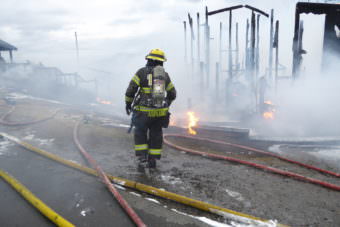
Foam clung to the charred remains of castle steeples and playhouses while firefighters swept the Twin Lakes playground with high-pressure hoses.

(Read more: Two teenagers charged in fire at Twin Lakes playground)

The smoke was thick but through the gaps, it didn’t look like much was left of the popular playground located in a park north of downtown Juneau.
The playground caught fire Monday evening. Bystanders watching from the sidelines said it was a huge loss.

Kala and Kaleb Burras with their parents Latroy, left, and Donny, right. Photo by Quinton Chandler/KTOO
Kala and Kaleb Burras with their parents Latroy, left, and Donny, right. (Photo by Quinton Chandler/KTOO)

Eleven-year-old Kala Burras was watching the fire crews with her parents and brother. She said she feels a strong connection to this park.

“It was really important because I liked to play on it everyday and it was just really fun to play on it and now that it’s gone, it’s really sad,” Burras said.

Kala said she especially used the park in the summer months, something she was looking forward to doing this year.

“I’m probably just going to go see if there’s any other thing I can do, like play at another park, but it’s probably not going to be as good as this one,” she said

Kala’s 10-year-old brother, Kaleb said he loves the park, too, and he and his friends usually play here during the summer.

“I’m probably going to stay home and play video games now,” he said.

But, he said video games won’t make up for it completely.

Nerio Bernaldo said that his kids hadn’t even seen the fire damage in person yet. He showed them a picture on Facebook before coming out to the scene.

“When I got wind of it, I told them about it and immediately they started crying, so I could see the effect that it had on them and that was just by word of mouth,” Bernaldo said. “So, I think by a lot of kids actually seeing it would cause a lot of emotional trauma and they’d be upset about what’s going on.”

Nerio Bernaldo on Monday.
Nerio Bernaldo on Monday. (Photo by Quinton Chandler/KTOO)

Bernaldo was sad and angry. He wants to know how the fire started. He said this playground was a go-to destination for a lot of families, including his. He said it was like a safe haven for his kids in a community where he is increasingly worried about his kids having a safe place to go.

A Facebook group called Rebuild Castle Park popped up Monday and within three hours of the fire, there were nearly 1,800 members.

Capital City Fire/Rescue is looking for information about the fire from the public. Contact the Juneau Police Department at 586-0600 with information. 

Senate passes survivors’ benefits bill, allowing municipalities to opt out

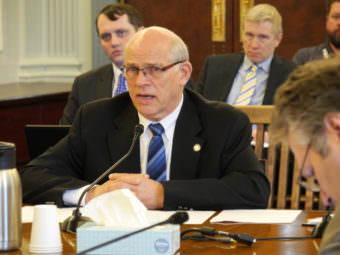
Sen. John Coghill, R- North Pole, testifies before the Senate Finance Committee in favor of SB 48, a bill he sponsored that would give medical insurance premiums for surviving dependents of certain peace officers or firefighters who die in the line of duty, April 5, 2017. (Photo by Skip Gray/360 North)
Sen. John Coghill, R- North Pole, testifies April 5 before the Senate Finance Committee in favor of Senate Bill 48, a bill he sponsored that would give medical insurance premiums for surviving dependents of certain peace officers or firefighters who die in the line of duty. The Senate passed House Bill 23, after amending it to include elements of the Senate bill. (Photo by Skip Gray/360 North)

The survivors of state employed police and firefighters who die in the line of duty would receive health insurance under a bill the Senate passed Wednesday.

The Senate amended House Bill 23 so that it no longer requires municipalities to cover their workers’s survivors. Instead, municipalities will be able to opt in if they choose.
North Pole Republican Sen. John Coghill said the bill combined different ideas after more than two years of debate.

“It would be so wrong for us to fail those communities and family members because we can’t agree on a couple of issues,” Coghill said. “This is the best we can do, given the timeframe we have and all the conditions we have to work with.”

Both former Gov. Sean Parnell and Gov. Bill Walker have provided benefits to survivors of state troopers who’ve died in the line of duty. But these survivors have lobbied over the last two sessions for a law to make the benefits permanent.

The bill would cover surviving spouses for 10 years, most dependent children until age 26, and dependents with permanent disabilities for life.

Anchorage Democratic Sen.Bill Wielechowski proposed an amendment that would have required municipalities to participate. The state would cover half the costs of municipalities with fewer than 10,000 residents. Larger boroughs and cities would have been required to pay the full cost.

Wielechowski said no one should be left out of the system.

“If you were to ask the people of Alaska should be something that is required, I think it would overwhelmingly be yes,” he said.

Wielechowski’s proposal was defeated by a 13-6 vote, with Wasilla Republican Mike Dunleavy joining the five minority-caucus Democrats in voting for the amendment.

Coghill said it may be appropriate to require municipalities in the future, once there’s a system in place. He noted the bill would allow both private donors and the state to provide money to lower the cost for municipalities that choose to opt in.

“Maybe there should be a requirement put on it. I don’t disagree entirely,” Coghill said. “I just don’t know that when you first formulate it, and you put it out like a suit of clothes and you must fit it, if it’s going to work for every community. So I think there has to be time for that.”

All 19 senators present voted for the bill. It goes back to the House, which must decide whether to agree to the Senate’s changes.

Immigration enforcement changes hit home in Alaska

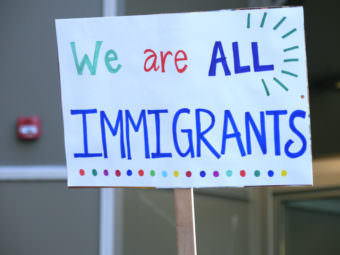
A sign held by Juneau resident Karri Willoughby at a rally at the Alaska state Capitol on Jan. 30, 2017. Protesters rallied against President Donald Trump’s executive order denying immigrants from seven Muslim countries the right of entry into the United States. (Photo by Skip Gray/360 North)

The Trump administration released new instructions late last month on how Homeland Security is supposed to implement immigration policies.

Under the Obama administration, immigration officers focused on deporting people who committed serious crimes.

Now, everyone who has violated immigration laws could be arrested, detained, and deported. These changes put some Alaskans in limbo.

Matteo and Valentine sat in their immaculate living room. The furniture, the art, and the wall color are all perfectly coordinated, like in a magazine.

A teacup-sized puppy in a pink sweater bounces around their feet and climbs up on the interpreter’s lap.

“They’ve just bought a house a few months ago, thinking they have a life in the United States,” the interpreter explained after Matteo spoke in Spanish. “But now, even being here, they don’t feel like the house really belongs to them.”

The couple arrived with two of their children in 2005 from Latin America.

We’re not using their real names or their country of origin. They have immigration documents, but they aren’t permanent residents. One of their children is undocumented. Matteo said they could be considered criminals just for having a child who is undocumented living in their house.

“They want to think sometimes it’s a nightmare because you can wake up from a nightmare but right now, it’s just simply terrifying,” the interpreter said.

Matteo used to work as a police officer fighting drug cartels in Latin America.

He was used to receiving death threats, but he says 10 years ago, they threatened to kill his oldest son.

He realized the danger was real and imminent, so they fled to the United States.

Valentine had to leave her oldest daughter behind with her parents. She hasn’t seen her in a decade.

Their immigration lawyer, Lea McDermid, said the family, like many others, is in limbo. Speaking during a phone interview, she said up until the new orders were issued, if a person filed paperwork to try to stay in the country legally they would be somewhat protected from being deported by the Department of Homeland Security.

“In other words, DHS knows you are here but because you are in the process of applying for a benefit you are considered extremely low priority for removal,” she said. “Well now, all the priorities are out the window. I mean Trump has announced that basically everyone is a priority for removal.”

“We should expect to see more people deported who are married to American citizens and don’t have criminal records,” said immigration attorney Margaret Stock during a phone interview. “That’s what I’m seeing.”

Stock said it’s not like people want to be out of compliance with immigration laws, it’s just really complicated.

“If you want to get your paperwork here in America processed you have to have money and time. You have to have all your documents in order and it’s not easy for people to do.”

For Matteo and Valentine, it was hard to live without documents their first few years in the country.

Matteo felt like one of the criminals he used to pursue as a law enforcement officer. As soon as they had documents and Social Security numbers, the couple established their own businesses and started building their lives here, in safety.

Matteo said he’s worried about how immigration laws are being enforced and what that means for his family.

He’s also concerned about how attitudes toward immigrants are changing.

“They’re not worried about the wall Trump wants to build at the border,” the interpreter said. “They’re worried about the wall that’s being built through hate and rejection of immigrants in the hearts and minds of people. Because that’s a wall that you can’t see.”

For now, Matteo and his family are just living their lives as normally as possible.

They are saving the money they planned to use to expand their house and setting it aside, just in case. But they can’t go back to Latin America because it’s too dangerous.

They want to stay here, in their home.

A judge orders one Syrian family’s asylum request be processed

A federal judge temporarily blocked enforcement of President Trump’s revised travel ban on Friday, but only as it applies to a family of Syrian asylum seekers.

The ruling, issued by U.S. District Court Judge William M. Conley, said the wife and 3-year-old daughter of a Syrian Muslim man living in Wisconsin faced the possibility of “suffering irreparable harm” if the executive order forced them to remain in Aleppo. It marks the first legal setback for Trump’s revised order on immigration, though its impact is limited to just the man and his family.

The plaintiff is listed as John Doe in court filings for the safety of his family. He says he fled Aleppo after being imprisoned and tortured separately by forces aligned with President Bashar Assad and anti-government rebels. The plaintiff was granted asylum in the United States in May 2016.

In July 2016, he applied for asylum on behalf of his wife and daughter. He first filed suit against Trump in February after the president’s Jan. 27 executive order on immigration halted the processing of the family’s visas. The Syrian man withdrew his suit after a Washington state court blocked enforcement of the travel ban nationwide, and processing of asylum applications resumed.

The man refiled on Friday, citing concerns that the new executive order, signed this week, will again prevent his family from entering the country when it takes effect on March 16.

The plaintiff argues that the executive order targets Muslims unfairly and implements a Trump campaign promise of a “total and complete shutdown of Muslims entering the United States.” The Syrian man also maintains that “the Executive Order exceeds the scope of the President’s authority and is unconstitutional.”

Department of Justice attorneys for Trump objected to the man’s request for a temporary restraining order and argued that the new executive order may not even apply to him.

“The court appreciates that there may be important differences between the original executive order, and the revised executive order issued on March 6, 2017,” Conley wrote in his ruling. “As the order applies to the plaintiff here, however, the court finds his claims have at least some chance of prevailing for the reasons articulated by other courts.”

In a follow-up hearing scheduled for March 21, Conley will consider extending his order that visas for the man’s family be processed.

Several other legal challenges to the new executive order will be heard in courts across the country next week.

Copyright 2017 NPR. To see more, visit http://www.npr.org/.

Lawsuit: Should foster kids know when the state uses their benefits?

Benjamin Dahl-Rouzan shares his story of living in foster care before the House's Health and Social Services Committee on Tuesday. Dahl-Rouzan is a member of the Alaska Youth Policy Summit, which is a group that advocate changes to the state's social services. (Photo by Kevin Reagan/ KTOO)
Benjamin Dahl-Rouzan shares his story of living in foster care before the House’s Health and Social Services Committee in 2015. A lawsuit is asking whether the state needs to notify families and guardians before it starts using Social Security benefits to pay for foster care services. (Photo by Kevin Reagan/ KTOO)

Some foster children are eligible to receive Social Security benefits, but the kids and their families don’t always know the money is available.

Instead, the state applies for the benefits and puts the funds toward paying for foster care services. Now a lawsuit is asking if the state needs to notify families and guardians before it starts taking the money.

About 160 foster kids in Alaska are entitled to Social Security benefits because they have a disability or one of their parents have died. But most of the time, the money doesn’t go to the individual child, it goes straight to the state.

“What smells bad about this is the state seems to be trying to gain federal money that it isn’t necessarily entitled to,” Superior Court Judge William Morse said while listening to oral arguments in the case late February.

“It seems like you are trying to take money from a child,” Morse told the attorney for the state.

The U.S. Supreme Court ruled that it is legal for state agencies to receive federal benefits on behalf of foster children and use the money to pay for the kids’ care while they are in custody. The question is: Can they legally do it in Alaska without providing any notice?

If a child’s guardian ad litem or attorney knew the child could get between $700 and $2,000 per month in federal benefits, they could try to find a relative or another person to be a private payee. Then, the money wouldn’t go toward the care the child is already entitled to from the state.

“You could be use these Social Security monies for tutoring, for therapy,” Attorney Jim Davis argued before the judge. “To do the things in life that your kids probably do and my kids probably do — go to the state fair, go to Alyeska, have an iPhone.”

Davis is representing foster children who are eligible for benefits.

In some cases, the money could be set aside in a trust to be used for education or medical needs when the child ages out of foster care.

Assistant attorney general Leah Farzin argued the state is not required to notify anyone about the potential benefits and providing notice would be a burden.

“We’re opposed because there’s no obligation to do so,” Farzin told the judge. “The state is not doing anything wrong. Therefore, the state being ordered to do something to correct a problem that doesn’t exist is unfair.”

“To who?” Morse asked.

“To the state,” Farzin replied.

“It’s unfair to you to have to add a paragraph to the GAL (guardian ad litem) appointment order?”

Morse said notifying people would not be a burden on the state, and could speed up the application process for the benefits by reducing the amount of research the Social Security Administration needs to do before designating a payee. That would get money to the kids faster.

The state contracts with a private company for about $10,000 per year to apply for benefits on behalf of the children.

Farzin also argued that using a child’s federal benefits to pay for their time in foster care frees up more state resources for all of the children who are in custody.

“When the state is the payee, all foster children get more resources,” Farzin said.

But Morse questioned if this is fair to the child who is entitled to the money.

“The child loses money if the state is the payee when there could have been a private payee,” Morse said.

According to the Office of Children’s Services, if the state spends less on a child’s monthly care than it receives in benefits, it returns the extra money to the Social Security Administration. The SSA holds the money until a new payee is assigned to the child.

The judge has up to six months to issue a ruling.

Study shows rise in some prenatal exposure to opiates

A new study from a Alaskan epidemiologist looks at infants who were exposed to opiates before birth.

Unlike previous studies, it goes beyond the sharp rise in cases for a portion of the population to explore what happens next.

The rate of neonatal abstinence syndrome for Medicaid-eligible births increased nearly seven-fold from 2004 to 2015.

Neonatal abstinence syndrome is when babies are in withdrawal from drugs after being born.

In 2004, 2.7 out of every 1,000 live births in this group had the syndrome, and in 2015, it was 18.4.

However, state maternal and child health epidemiologist and study author Abigail Newby-Kew said these numbers do not reflect the entire state.

The study only looks at Medicaid-eligible births because that’s the most complete, long-term data set available, she said during a phone interview. It cannot be used to draw conclusions about rates for the entire population.

The study has other limitations, too, because the syndrome isn’t always diagnosed the same way in each hospital.

“Symptoms vary greatly based on just the type of drug the mother was using, the amount of the drug the mother was using,” Newby-Kew said. “It’s very possible that an infant might not display symptoms until they are already outside the hospital. In that case the hospital could miss it entirely.”

The study does mirror national trends.

The number of kids born with opioids in their systems is on the rise.

This study then goes a step further, to see what happens to the babies once they leave the hospital.

“It’s not a problem that ends once a kid makes it out of the hospital,” Newby-Kew said. “Both the child and the mother are going to need additional support down the line.”

That could include substance abuse treatment for the parents or developmental learning assistance for the child.

Newby-Kew said the long-term impacts of prenatal exposure to opioids is still unknown and needs more research.

At the moment, there aren’t many ways to find out what happens to these families, Newby-Kew said, but one available data set is from the Office of Children’s Services.

Federal and state laws require medical providers to report children who are prenatally exposed to substances to child protection services, though not all do.

There were 541 cases diagnosed during the 12-year-long study period.

It’s unknown whether the mothers were using the drugs legally or not.

Nearly two-thirds of the cases were reported to child services, and about 140 children were temporarily or permanently taken from their homes.

The agency does not automatically remove a child from a home where people are using substances, Child Services operations manager Travis Erickson said during a phone interview.

“When there are substances involved, we assess the impact of those substances on the parents’ ability to care give for the children,” Erickson said. “We’re really looking beyond ‘are there substances being used’ to things like ‘how does that change the parents’ behavior.’”

The assessments include talking to medical providers and law enforcement agencies, and seeing what sort of safety nets the family has in place.

Erickson said that although there is a well-known rise in opioid use statewide, for child services “alcohol is still by far and away the most common underlying substance that causes child abuse and neglect.”

Site notifications
Update notification options
Subscribe to notifications