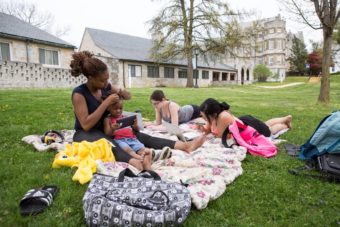
Yakobi Nash and his mother Iris at the Tenakee Springs Independent Learning Center. (Photo by Quinton Chandler/KTOO)
Megan Bush leads kids to the playground for their afternoon recess at the Tenakee Springs Independent Learning Center. Bush is the's center’s facilitator. (Photo by Quinton Chandler/KTOO)
Camille Chase swings on the Tenakee Springs playground in November 2016. (Photo by Quinton Chandler/KTOO)
Ila Mannino climbs playground equipment at the Tenakee Springs Independent Learning Center. (Photo by Quinton Chandler/KTOO)
The commons in the Tenakee Springs School building. (Photo by Quinton Chandler/KTOO)
Chris Mannino has a 6-year-old named Ila who she home-schools and takes to the independent learning center in Tenakee Springs all three days it’s open.
She said she only started thinking about home school after the town’s school closed back in 2013.
“Prior to that time, no absolutely not, home schooling was barely a word I knew. It was nothing that we were pursuing or interested in,” Mannino said.
The school reopened, but ever since, Mannino has been doing research to help figure out how she would home-school her daughter. She said that’s why this year when the school shut down, she was ready.
“So, I wish our school was open,” Mannino said. “I wish we had enough students to have a regular school. That would be my first choice. But since we don’t, I feel like I’ve had time to prepare to do this.”
The entrance to the Tenakee Springs School building. (Photo by Quinton Chandler/KTOO)
The Tenakee Springs School closed this summer after its enrollment fell to single digits. But then, the school building reopened as an independent learning center that gives home-schooled kids a place to socialize and take part in group activities.
Mannino enjoys being so close to her daughter but said sometimes it’s kind of tough.
“Home-schooling a 6-year-old, there is no break,” she said.
Tenakee Springs is a small Southeast Alaska town on Chichagof Island about 46 miles southwest of Juneau. In 2015, the state reported it had about 140 residents. It also has a small student body that fluctuates from year to year. Frances Ziel said some families were already choosing to home-school before the closure. After the school shut down, she said the district wanted to support them.
Ziel is a regional school board member for the Chatham School District who also lives in Tenakee Springs. She said last school year, enrollment dropped from 11 to five students when one family moved away. State education funding drops sharply when enrollment falls below 10.
“What we decided to do was turn the brick-and-mortar building into an independent learning center,” Ziel said.
Frances Ziel, right, during an advisory school board meeting. (Photo by Quinton Chandler/KTOO)
The learning center gives the community a chance to use at least some of the school’s resources.
She guessed there are about 12 school-aged kids in town and seven of them enrolled in distance education through the Chatham School District. The district is working with an accredited distance learning school that sends parents materials to help them home-school. What parents can’t provide at home, their children look for at the learning center.
“All children that are enrolled in Chatham School District can come here three days a week,” Ziel said. “They have two tutors here that are available if they are so needed or wanted by the students or parents.”
Kids are also given access to the school’s library, gym and classrooms; and they can come to special events like an upcoming talk on octopuses.
Mannino said she would get a lot more downtime during the day if her daughter were going to traditional school. Without the learning center, she’d almost get none.
“And that’s one thing that’s been really nice about the independent learning center. Ila can work with Megan and another couple of younger children for an hour or two, three days a week,” Mannino said.
Megan Bush is the independent learning center facilitator. (Photo by Quinton Chandler/KTOO)
Megan Bush is the independent learning center’s facilitator.
“Pretty much anything and everything that the ILC needs, that’s me,” she said.
One of her duties is to supervise a 4-year-old, and two 6-year-olds including Ila, Chris Mannino’s daughter, during the afternoon.
“So I consider my job to be providing opportunities that they’re not getting in their home school education. A big part of that is, especially for the younger ones, is social time,” Bush said.
The learning center is open three days a week from 9 a.m. to 1 p.m. and it serves kids of all ages. Bush said the building could easily accommodate 20 to 25 kids if the town had that many. Instead, she usually sees less than 10.
“From 9 to 11, I’m tutoring the middle and high school students,” Bush said. “I have one middle schooler and four high schoolers that come up here regularly and two more that come up here more occasionally.”
Chris Mannino isn’t sure what her family would’ve done if they had to home-school without the learning center. She said moving would’ve been one option on the table.
Community members gather for the Transgender Day of Remembrance on Nov. 20, 2016. (Photo by Anne Hillman/Alaska Public Media)
Standing in a wide circle around the edges of the sanctuary at St. Mary’s Episcopal Church on Sunday afternoon, more than 80 community members held candles and read the names of some of the transgender individuals from around the world who were killed this past year.
International Transgender Day of Remembrance honors those who lost their lives because of transphobia. The Trans Murder Monitoring project reports that at least 295 transgender and gender-diverse people were killed in the last 12 months worldwide, however that number is “just the tip of the iceberg.” According to the organization, which tracks the data, the number is far from complete because it only includes cases where the victims are identified as trans in the reports of their deaths. The organization says most countries don’t track murders of transpeople, and in some places trans-identities are not openly acknowledged.
The walls of the sanctuary at the Anchorage event were covered with 295 brightly colored paper stars. Christina Eubanks-Ohana came up with the idea of covering the walls with stars and purposefully chose bright colors to honor how families will remember those who were lost.
They were “lost in such a tragic way,” she said, “and yet they will always be to (the families) those toddlers and those rambunctious children. I really liked that this was a vibrant way of remembering them.”
Event organizer Jessica Greene said the Day of Remembrance is about more than just acknowledging the victims. It’s also a call to action for the wider community to recognize and support trans people.
“It’s about using that privilege — whether it’s white privilege, male privilege, cisgender privilege — it’s using that privilege that we just get because we’re some way to really advocate for those who don’t get that privilege,” she said.
Antonette Harper, who spoke during the ceremony, said the best way to fight violence against the transgender community is to increase awareness because violence stems from fear of the unknown. “So for the rest of the transworld, my suggestion is don’t start hiding now, and silence is no longer golden.”
She said people need to know one basic thing: “That we are human. We are not some alien beings, you know, that are out to molest and abduct your children or steal your husbands. No, we are human beings,” she stated. “We live just like everyone else. We have jobs. We pay taxes. We vote.”
You can find out more about being transgender here.
A judge on the High Court in London granted a dying British teenager’s request to be cryogenically frozen. The ruling was last month, but media coverage was restricted while the girl was still alive. Tim Ireland/AP
A 14-year-old girl in the U.K. who was dying of cancer won the right to be cryogenically frozen, in a case that’s being described as remarkable — and potentially the first of its kind.
The girl wanted to have her body preserved in the hopes that scientists someday would be able to bring her back to life and cure her illness. Her wishes were initially supported by her mother but not her father, which led the girl to seek a judge’s intervention to ensure that her mother would decide what would happen to her body.
The judge granted her request — and her father changed his mind and agreed to support his daughter’s last wish.
The girl, who is not being named to protect her privacy, has since died. The Associated Press reports that the court ruling came in October, but media coverage was restricted while the girl was still alive.
“During the last months of her life, the teenager, who had a rare form of cancer, used the internet to investigate cryonics. Known only as JS, she sent a letter to the court: ‘I have been asked to explain why I want this unusual thing done. I’m only 14 years old and I don’t want to die, but I know I am going to. I think being cryo‐preserved gives me a chance to be cured and woken up, even in hundreds of years’ time.
” ‘I don’t want to be buried underground. I want to live and live longer and I think that in the future they might find a cure for my cancer and wake me up. I want to have this chance. This is my wish.’
“The girl’s parents are divorced. She had lived with her mother for most of her life and had had no face-to-face contact with her father since 2008. She resisted his attempts to get back in touch when he learnt of her illness in 2015.”
The AP notes that cryogenic technology “has not yet been proven to be effective.” As Marcelo Gleiser wrote for NPR last year, the technical challenges of preserving and reconstructing a human brain, for instance, are “horribly daunting” — and it’s not at all clear whether it’s even possible. People who choose to preserve themselves cryogenically argue that future science may be leaps and bounds ahead of what’s currently understood to be feasible.
The girl’s mother supported her interest in cryogenics and agreed to her desire to have her body preserved. But her father was opposed, as the BBC reports:
“He said: ‘Even if the treatment is successful and she is brought back to life in let’s say 200 years, she may not find any relative and she might not remember things and she may be left in a desperate situation given that she is only 14 years old and will be in the United States of America.’
“Although he then changed his mind, saying he respected his daughter’s decision, he subsequently wanted to see his daughter’s body after her death — something to which she would not agree.”
The girl was too young to make a legally binding will, so she asked the court to intervene to guarantee that her mother would be solely responsible for determining how her remains would be handled.
The judge visited the teenager in the hospital and said he was impressed by the “valiant way” she faced her death, and that he had no doubt she had the mental capacity to file a lawsuit, according to the AP. He called the case unprecedented.
The girl died with the knowledge that she would be frozen, and her body has been sent to the United States for long-term cryogenic storage at a cost of $46,000, the AP reports.
The BBC notes there were some concerns among hospital staff about the way her body had been prepared for cryogenic freezing, and the judge in the case suggested there might be a need to regulate cryogenic freezing in the future to prevent problems in carrying out wishes such as these.
Copyright 2016 NPR. To see more, visit http://www.npr.org/.
Student Cierra Valentine (left) studies with friends and her son Jeremiah on the lawn at Wilson College in Chambersburg, Pa. Ryan Smith/Courtesy of Wilson College
The young women in this story have labels. Three labels: Single, mother, college student. They’re raising a child and getting an education — three of the 2.6 million unmarried parents attending U.S. colleges and universities.
Getting a degree is hard enough for anyone, but these students face extra challenges. And when it comes to helping out with their needs, Wilson College in Chambersburg, Pa., is considered one of the best in the country.
It’s a liberal arts school with 1,100 students. There’s a large farm, an equestrian program, and 15 students in the Single Parent Scholars program. This year all are moms, though men are welcome too.
They live in apartments that once were dorm rooms. And they are easy to notice on campus.
“We have children running around the dining hall while everyone else is trying to eat,” says Heather Schuler. She’s 25, a sophomore psychology major and the mother of a 2-year-old son.
Michele Rogers (left) and Heather Schuler are students — and single moms — at Wilson College in Chambersburg, Pa. Noah Adams/NPR
Schuler is sitting outside the dining hall with her friend Michelle Rogers, who has a 4-year-old daughter. Rogers, 27, a senior environmental studies major, says being a parent and a student requires some adjustments.
“I still sometimes have my mommy voice on,” she says. “I don’t even swear anymore. I’ll say like, ‘Sugar honey ice tea!’ or, like, ‘Shut the front door!’ ”
Heather Schuler laughs. She does it too. “I almost confronted someone at Target the other day for swearing, and my kid wasn’t even with me!”
Schuler grew up right here in Chambersburg. Michele Rogers is from Massachusetts. She’d been searching for a program to help single parents when she discovered Wilson.
“I Googled, ‘schools for single parents,’ mostly single moms. And I found maybe like five or ten.”
A lot of colleges and universities are taking interest in serving these students.
Eastern Kentucky University is building a $10 million apartment complex for single moms, and dads.
At Wilson College, says Rogers, having a dorm building all to themselves is wonderful.
“It’s a cool community where you’re not you’re not always on top of each other and always around each other,” she says. “You can always go in your room and the kids get to play together, which is awesome.”
The Single Parent Scholars program began 20 years ago as a wishful notion in the mind of Gwendolyn Jensen, who was Wilson College’s then-president.
She was looking out a window in her office one day, admiring a limestone dormitory building that had been shut down due to low enrollment. And she thought, Why not fill that up with moms and kids?
There, she talked with Sylvia Fields, who now is the executive director. Fields thought it was a great idea: “Don’t tell me any more,” she said. “How much do you need?”
“I was really afraid when we started the program,” recalls Jensen, who’s now retired and lives in Cambridge, Mass. “We had this idea and all of a sudden we had $400,000.”
Jensen spent much of that money rebuilding. The empty dorm would now have two-room apartments. Private bathrooms. Kitchens to share on each floor.
The Wilson student mothers live right in the center of campus, with classes just minutes away and the dining room close by.
Katie Kough is in charge of the single scholar program. On a tour, she shows off one of the laundry rooms, with coinless machines, and a poster with the guidelines.
“My favorite line from the laundry guidelines,” she says, “Is, ‘No pet debris or horse blankets allowed in our machines.’ ” (Remember, the college has an equestrian program.)
The bottom floor of the dorm has been given over to child care, with lots of windows and a playground outside.
Brinita Ricks, a graduate of the single-parents program, and her son, Troy, 10. Noah Adams/NPR
Students in the program pay the full tuition, room and board. Of course many apply for and receive loans and scholarships.
But the big thing for these single parents — and it’s a huge one, adds Katie Kough — is child care.
“The child care costs are nothing,” she says. Child care in the morning and throughout the day. Evening hours, too.
On a recent fall weekend, there was a 20th reunion for students who’ve gone through the program.
Katie Kough introduces me to Brinita Ricks – Katie calls her “an alumni superstar.”
Ricks started the program in 2008 and graduated four years later. Now she lives in Washington, D.C., where she’s a computer scientist with the U.S. Census Bureau.
She’s brought her 10-year-old son back with her to campus.
“We just took him on a tour down at the daycare,” she says. “And he remembered. He started in the baby class and moved on up to the big kids class.”
Katie Kough, once Ricks’ advisor, is now a friend.
“There are some women who have graduated from this program that probably no one ever thought that they would be a college student,” she says. “A college graduate student, or a professional, and they did it. ”
Kough says that in her eight years running this program, 38 students have made it through with a degree.
I tell these women when they start it’s going to be difficult, she says. “That the Devil’s gonna tap their shoulders three times a day and tell them to go home.”
She adds: “It wasn’t always pretty, and it wasn’t always easy. But some of these women are the strongest, strongest women that I know.”
Copyright 2016 NPR. To see more, visit http://www.npr.org/.
More grandparents are facing the challenge of raising their grandchildren because their own kids are addicted to opioids or have died from an overdose. (Creative Commons photo by Province of British Columbia)
The number of grandparents who are raising their grandchildren is going up and increasingly it’s because their own kids are addicted to heroin or prescription drugs, or have died from an overdose. For some, it’s a challenge with little help available.
In 2005, 2.5 million children were living with grandparents who were responsible for their care. By 2015, that number had risen to 2.9 million.
Child welfare officials say drug addiction, especially to opioids, is behind much of the rise in the number of grandparents raising their grandchildren, just as it was during the crack cocaine epidemic of the 1980s and ’90s. An estimated 2.4 million people were addicted to opioids at last count.
Caseworkers in many states say a growing number of children are neglected or abandoned by parents who are addicted. That has forced them to take emergency steps to handle a growing crisis in foster care — and often to turn first to grandparents for help.
“Obviously, the numbers have grown because of the current national opioid epidemic,” said Maria Moissades, who heads Massachusetts’ Office of the Child Advocate. “You’ve got grandparents who thought they were going to spend their retirement fishing and traveling. Now they’re raising [as many as] five grandkids.”
Federal law requires that states consider placing children with relatives in order to receive foster care and adoption assistance. And grandmothers and grandfathers often are the first — and best — choice when state and local caseworkers have to take a child out of a home and find someone else to take custody, said Angela Sausser, executive director of the Public Children Services Association of Ohio, a coalition of public child safety agencies in the state.
“When we are seeking caregivers for a child, you want to see who that child has relationships with,” Sausser said. “You’re removing them from their [nuclear] family. To minimize the trauma and help them feel some normalcy, you obviously want to seek out whoever is closest to that child.”
In some instances, caseworkers say, grandparents are also struggling with addictions.
In Ohio, for instance, the opioid epidemic has grown so large that caseworkers sometimes have a hard time finding any relatives who can step up, said Kim Wilhelm, protective services administrator for Licking County (Ohio) Department of Job and Family Services.
For every child in foster care who has been placed with a relative, another 20 children are being raised by relatives outside the system, said Jaia Lent, deputy executive director of Generations United, a Washington, D.C.-based family research and advocacy group.
Many grandparents face a host of emotional and financial challenges in their renewed parenting role. And there are often few state or local resources to draw on for help.
Twenty-one percent of grandparents caring for grandchildren live below the poverty line, according to Generations United. About 39 percent are over 60 and 26 percent have a disability. And because many are not licensed in the system, they are not eligible for the same services and financial support as licensed foster parents.
“Can’t y’all make it easier for grandparents? That’s my request,” said Dot Thibodeaux, president and founder of the grassroots support group Grandparents Raising Grandchildren Information Center of Louisiana.
“Most of us are on Social Security,” she said. “When the family grows, the Social Security does not. You have to make do with whatever you were getting, and that’s kind of hard.”
State help
A handful of states are trying to help. In Louisiana, state lawmakers in June voted to establish a grandparents’ council in the governor’s office to study remedies for those tasked with raising grandchildren.
In New Mexico, lawmakers voted in February to set up a task force to study the issue and recommend concrete policy changes that could help grandparents, from legal and financial help to food and housing assistance.
A bill lingering in the Massachusetts Legislature would provide grandparents caring for their grandchildren with property tax relief. And Georgia lawmakers considered bills that would make it easier for grandparents to take grandchildren in their custody to the doctor or to enroll them in school, but failed to pass them.
The growing trend and the problems it can cause are being noticed by Congress too. In May, U.S. Rep. Danny Davis, D-Ill., introduced a bill that would, among other things, make it easier for grandparents caring for children to receive Temporary Assistance for Needy Families. It’s lingering in committee.
In September, U.S. Senate inaction effectively killed a bill that would have provided federal funding for substance abuse programs for families with children at imminent risk of entering foster care. The bill also would have allowed states to waive foster care licensing standards for grandparents and other relatives.
Barriers to help
Grandparents — especially those who don’t become licensed foster parents or legal guardians of their grandchildren — face a host of emotional and legal challenges in getting help.
Many of them often don’t want to apply for legal custody because that would mean taking their own children to court. Or if they apply for welfare, the state could try to make their own children, who may already be struggling with addiction, pay child support.
Licensed foster parents have access to services and can get financial assistance with everything from medical care to a clothing allowance. But to qualify, grandparents would have to go through a lengthy process and meet certain requirements.
To be a licensed foster parent, for instance, states have specific requirements about square footage and bedrooms for each child. This makes sense if a child is being placed with a stranger, but creates barriers for grandparents who may need to accommodate multiple grandchildren in their homes, Lent said.
Although Louisiana offers financial subsidies to help grandparents with the costs of raising children, few apply because they are unaware of the help. Others don’t qualify because they make too much money — even if they earn very little, Thibodeaux said.
“You almost have to be on the streets,” said Thibodeaux, who serves on the governor’s grandparents’ council.
Some child welfare advocates say that what’s needed is more help for “kinship care” — relatives taking in and raising the children who’ve been neglected.
“Everyone agrees that kinship care is the right thing, but there’s no money to pay for it,” said Moissades, the Massachusetts child advocacy official.
But there could be a payoff if some help was provided grandparents who aren’t part of the foster care system. According to analysis of foster care payments by Generations United, grandparents and other relatives raising children save taxpayers $4 billion each year by keeping the children out of the foster care system.
A multigenerational problem?
Back in the 2000s, some states passed legislation establishing “kinship navigator” programs that serve as one-stop shops linking grandparents and other relatives with services such as counseling, housing assistance and short-term financial help.
With these programs, other grandparents raising children often served as the “navigators” to advise on how to get help with everything from legal advice to parenting skills.
But in some states, budget crunches have made funding for some of these programs unstable, Lent said. In 2008, Congress passed the Fostering Connections to Success and Increasing Adoptions Act, which included competitive grants for kinship navigator programs. Some states used the money to create new programs, but not all are available statewide. Some states, including Florida and Ohio, have federally funded navigator programs that cover part of the state.
Today Connecticut, Delaware, New Jersey, New York and Washington state still have statewide, state-funded programs.
Child welfare workers say that more federal funding is needed if every state is to have a navigator program and offer services statewide.
Isabel Barreiro, of the Children’s Home Society of New Jersey, which is contracted by the state to serve as a kinship navigator in Central New Jersey, said she’s often limited in how much she can do to help her clients.
For example, she said, many of her clients live in public housing. Sometimes multiple grandchildren can be dumped on a grandparent’s doorstep, which forces her to try to find a bigger place to live. Barreiro said she doesn’t have the ability to make a bigger apartment magically appear.
State child welfare agencies have some power to intervene with housing, she said.
“Child protection services needs to do a better job of really stabilizing these families,” Barreio said. “Don’t place a child with a 60-year-old grandmother who’s in Section 8 housing, and not help her.”
Diane Buck at her home in Juneau. (Photo by Elizabeth Jenkins/Alaska’s Energy Desk)
It could be harder for thousands of Alaskans to stay warm this winter. That’s because a state heating assistance program — created when oil prices were up — has gone away. In the past, the program offered relief for families and individuals who earned too much to qualify for federal heating assistance. Now, some of those households are starting to feel the effects.
There’s a white, rectangular box on Diane Buck’s wall that’s giving her a lot of anxiety. It controls the heat in her the three-bedroom home that she shares with her boyfriend, his daughter and his daughter’s three children.
Right now, the thermostat’s circular knob is turned to about 60 degrees.
“I call it the safe zone. The safe money zone. To get the house at least 69, 70, it will go up to here. The money zone is what I call it,” Buck said.
And she says that’s where her family would feel the most comfortable, temperature-wise, at 69 or 70 degrees. But as Buck suggests, turning the thermostat up to the “money zone” has consequences.
Even coming over here to look at it, she says, fills her with a sense of dread.
“It scares me. I really don’t like messing with it. That’s how afraid I am right now,” Buck said. “Because if it gets any higher than $600 a month, I’m screwed. I’m going to get a disconnect notice because I can’t pay it.”
She says last winter it wasn’t uncommon for her electric bill to climb to $600 a month — her entire disability check. And her boyfriend’s income mostly covers the rent. A relative was helping out with some of the expenses last year, but he moved out.
So, for the first time, Buck says her family needed the extra help. And she hoped they could rely on a state heating assistance program to stay warm. They were counting on it.
“I called them and they said, ‘No, we have a new application because of the budget cuts.’ And that’s when I’m thinking no we’re still qualified because who in their right mind is going to do a drastic cut when there’s family in need?” she said.
The Alaska Heating Assistance Program was created in 2008 when oil prices were high and the cost of heating fuel was, too. The application process was the same as its federal cousin, the Low Income Home Energy Heating Assistance Program.
But the state version served people above the federal income threshold. In other words, it helped families like Buck’s who were on the bubble.
“I printed out the application. I had it all filled out,” Buck said.
Fred Byrd is receiving less heating assistance this year. (Photo by Elizabeth Jenkins/Alaska’s Energy Desk)
When the price of North Slope crude was soaring, those funds even carried over into the federal program. There was more heating assistance, overall. But the state program didn’t make it through cuts to this year’s budget.
“I could probably heat this house with two candles if I had to,” said Fred Byrd.
He was also on the Alaska Heating Assistance Program. He’s a former state worker on social security disability. And he still qualifies for some federal heating assistance. But he says it’s about $500 dollars less than what he received before.
He thinks he’ll be able to make it through the winter. In his words, his financial situation isn’t in “dire straits.” He understands why the program was cut, but he wishes he would have known before this November.
“It’s a delicate subject. You get your hopes up. I might get subsidized for this and that will help,” Byrd said. “And then they turn around and slap you in the face. ‘Oh, no. I’m going to give you nothing.'”
The state sent out a letter this summer warning past recipients about the cuts.
And besides the declining oil revenue, the state says another reason it’s doing away with the program is there just wasn’t enough need. But Diane Buck doesn’t agree. She says her family could have really used the help.
“It’s sad. We actually have to wrap up in blankets. What can I do?” she said tearing up. “I can’t even provide enough electricity because if I did, it would be over $600.”
For now, Buck says it’s about keeping the thermostat out of the “money zone.”
Close
Update notification options
Subscribe to notifications
Subscribe
Get notifications about news related to the topics you care about. You can unsubscribe anytime.