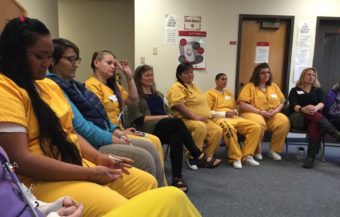
Women at Hiland Mountain Correctional Center listen to the songs they wrote together for their children. (Photo by Anne Hillman/Alaska Public Media)
A mother singing lullabies to a young child is an image that resonates with most people, but for some incarcerated women, even a simple song to lull her little one to sleep can prove problematic.
The Lullaby Project helps mothers who are in prison connect with their children.
Professional musicians work with inmates at the Hiland Mountain Correctional Center in Eagle River to write songs for the inmate’s children, which the musicians then record them onto a CD.
When the program began about two months ago, Shawn Muese, an inmate at Hiland, sat down with musician Hilary Morgan.
Muese carried a booklet she had filled with details about her seven kids and a letter addressed to them. She was ready to write them a lullaby – or so she thought.
“She actually came and had already written something,” Morgan said. “And she said, ‘This is the song.’ And I knew that this wasn’t the song, because it didn’t have her heart in it.”
Morgan said she tried to tease more out of Muese as they sat together, looking at photos of Muese’s kids and thought about the words they wanted to use.
Muese was impressed by Morgan’s ability to connect to her feelings.
“It was crazy because she could tell things I didn’t like just by my facial expressions, ‘Oh you didn’t like it. Okay, next.’”
During the five-hour-long session, they wrote about the first moments Muese spent with her children and how sorry she was to be away from them.
The goal of the Lullaby Project is to help mothers who are struggling to connect with their children and was developed by the Carnegie Foundation about 8 years ago.
Musicians have worked with teen mothers and women in homeless shelters and prisons.
This is the first time it’s been done in Alaska.
The project has three short phases – writing the songs, recording in a professional studio, then coming together to share them.
While writing, Morgan and Muese were having trouble thinking of the music behind the words, so Morgan asked Muese to sing the lullabies of her childhood.
“So she sings me this song and it’s in Samoan, and I’m like that doesn’t help. So I said, ‘That’s great. Did they sing any other songs?’ And she sings another song in Samoan, and a light bulb went on. I said, ‘Do your kids speak Samoan at home?’ She said, ‘Yeah, they do.’ ‘Do you want to write this in Samoan? And she said, ‘Can we do that?’”
After their writing session, Morgan joined with a local Samoan choir to record the piece.
When Muese sat with the other project participants to listen to the song for the first time, she erupted in sobs.
After the song ended, she tossed her arms around Morgan.
“You sound so awesome,” she said, while choking on tears. “They would never think you’re white!”
Muese knows the song won’t make up for the past, but she hopes it helps rebuild her relationship with her kids.
“What I’m hoping to get out of this is restoration, and I want to be able to see my kids,” Muese said. “It’s going on three years I haven’t seen my kids.”
She said the song and the words in Samoan also give her pride in her culture.
“The language is so beautiful. And just one line? It has a lot of meaning and that’s why I love my culture,” Muese said. “I love my language. You can just say one word in my language and it means a lot of things. I came in here all sad, but when I heard that, it’s like angels from heaven.”
She translated the words in the chorus as “angels from above, precious to my heart.”
“And that’s what I believe in. My kids are angels from above. God gave me my kids as precious angels,” she said, pausing. “I know I’m gonna get my angels back, I just gotta do me right now.”
All of the lullabies will be performed by the musicians and some of the inmates during a public concert at Hiland Mountain on Sept. 24 and will be available on a CD.
The funds go straight back into the project through the nonprofit Keys To Life so another group of women can also write their children a lullaby.
The Petersburg Children’s Center started up the new school year September 1 with expanded space and room for more kids.
The pre-school and daycare is filled with the sound of singing and activities again, thanks to donated money, labor and materials from individuals, organizations and businesses in town.
Center director Brandi Heppe said it was iffy whether they’d be able to open the new classrooms for kids by that date.
“It was a crunch to get our license by September 1st but we got all the paperwork in like we were supposed to and everything and we got the word that Friday before September 1st that we were able to open,” Heppe said.
Work started on the expansion in December and it’s been completed by volunteers and donations.
Two local residents especially have spent long hours volunteering their time.
“Yeah Bob Lynn and Jim Schwartz have been the spear headers of the entire building part of it,” Heppe said. “But we’ve had a lot of the community has donated money and a lot of other businesses have helped give us cost cuts for materials or services and then a lot of volunteers of programs, we’ve had Rocky’s Marine and the Coast Guard come in and a couple other groups show up and help.”
The budget for the added space is estimated at somewhere about $130,000.
The center has received cash donations for some of that, along with donated labor, equipment and building materials.
The expansion allows the center to grow from 42 to 65 kids and cut into the long wait list.
There are still parents waiting to get their children enrolled, Heppe said.
“After we added kids we still have a wait list because we’re still looking for more people to come work so we can add more kids to the classrooms.”
During the work day the center serves children age six weeks old to pre-kindergarten and also runs an after school program for kids kindergarten through sixth grade called Eagle’s Nest.
The daycare and preschool celebrated its 40th year in 2015.
Heppe said there’s still more work to do later this year.
“Well we’re waiting for cubbies to get in cause you know shipping to Alaska takes a while,” she said. “We just got our changing table in, we got our tables and chairs in. This fall Jim and Bob are going to come back and they’re going to redo the kitchen and the kids bathroom and a few more things around here so we still have a few more things to do.”
Kids had fun with the builders around last year and got used to seeing Schwartz and Lynn working on the expansion, she said.
The center will show off the expanded space in an open house sometime later this year.
“We wanna be able to open it up so people who used to work here or people who had their kids here be able to come see it,” Heppe said. “But we wanna be able to make sure we have all of our furniture and our classrooms completely put together cause we’re still working on getting the classrooms finished.”
The children’s center is done expanding the existing building but could one day build a new structure for the Eagle’s Next program on the lot next door.
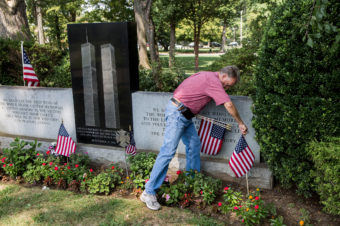
Russell Mercer replaces old U.S. flags with new ones at the Flushing World Trade Center Memorial at Flushing Cemetery in New York City. His stepson, Scott Kopytko, was killed on Sept. 11. Alex Welsh for NPR
Before Scott Kopytko joined the New York City Fire Department, he worked as a commodities broker in the South Tower at the World Trade Center. On Sept. 11, he rushed up the stairs of his old office building, trying to save lives with his fellow firefighters before the towers fell.
Scott Kopytko’s parents regularly visit a stone memorial at Mount St. Mary’s Cemetery in Flushing, Queens. Alex Welsh for NPR
“He went to work, and he never came back,” says his stepfather, Russell Mercer.
Almost every morning, Mercer and Kopytko’s mother take turns visiting the cemetery across from their son’s old high school in the Queens borough of New York City. Under a young oak tree next to fading tombstones, they water pink flowers behind a small, square stone engraved for Kopytko.
“It’s a place where we can go, me and my family, to talk to Scott. But there’s nothing there,” Mercer says. “We need some kind of DNA, some human remains, where you can go to and say, ‘This is where Scott is.’ ”
Fifteen years after the attacks, families of 40 percent of the World Trade Center victims have not received any remains of their loved ones.
Russell Mercer donates old U.S. flags from Sept. 11 memorials to a post of Veterans of Foreign Wars. He is still waiting to recover remains of his stepson, who was one of the New York City firefighters killed at the World Trade Center. Alex Welsh for NPR
Death certificates have been issued for these 1,113 victims. That number does include some of the immigrants who were in the U.S. illegally and working in the twin towers during the attacks. An estimated 60 immigrants, mainly from Mexico and Central America, are still missing, according to Joel Magallán, executive director of Asociación Tepeyac de New York, which coordinated support for victims’ families.
‘You Feel That It’s Not Real’
Many families are still waiting for the New York City Office of Chief Medical Examiner to identify remains collected after the attacks. They’re mostly bone fragments, some small enough to fit inside a test tube.
Sally Regenhard (left) holds a photo of her son, Christian, during a commemoration ceremony for Sept. 11 victims in New York City in 2008. Julie Jacobson/AP
“You feel that it’s not real. Your mind can’t accept the fact that this person died because there’s no evidence of it,” says Sally Regenhard, whose son, Christian, was a firefighter who died at the twin towers.
She remembers how search and rescue efforts eventually shifted toward a recovery mission for body parts at ground zero and the Fresh Kills Landfill on Staten Island, N.Y., where debris collected from the World Trade Center was sifted and stored.
“It was like, you know, being in the rain, in the misty rain, and then slowly, slowly as time went by, you realize it was less and less likely your loved one would be identified,” says Regenhard, who keeps a statue of St. Anthony, the patron saint of lost things, by the front door of her home.
‘As Long As It Takes’
Many of the remains were degraded by jet fuel from the hijacked planes and other chemicals released from the collapsed buildings.
“There was heat from the fires, water being poured upon them, rain, wind — the worst conditions that you can imagine for the preservation of DNA,” explains New York City’s Chief Medical Examiner Barbara Sampson.
But the medical examiner’s office was determined.
“We made a commitment to the families to do whatever it takes for as long as it takes,” she says.
That’s involved pushing DNA technology to its limits, with 10 scientists still dedicated to testing and re-testing the remains to find matches to DNA samples from the victims or their relatives.
(Left) A sister of FDNY Battalion Chief Orio Palmer, who was killed on Sept. 11, keeps drawings of Palmer along with family photos in her basement. (Right) Retired FDNY Lt. Jim McCaffrey holds a portrait of Palmer, his late brother-in-law. Hansi Lo Wang/NPR
Family members learn about new identification through phone calls from the medical examiner’s office. In recent years though, most notifications are to relatives who have already received partial remains. In August, 12 remains were matched with previously-identified victims.
“It’s not like we’re sitting by the phone anymore like we were years ago,” says Jim McCaffrey, a retired New York City fire lieutenant who is still waiting for the remains of his brother-in-law, FDNY Battalion Chief Orio Palmer.
Palmer’s family have buried a vial of blood he donated before Sept. 11, but McCaffrey says there is still a “strange, empty void” to not have remains.
“Every now and then, you’ll hear about some family getting a call. Hopefully that will happen for everyone,” he says.
‘Never … Put To Rest’
The last new identification was announced in 2015. But progress on other remains may be held back for years or more because current technology cannot make reliable matches with tiny DNA fragments.
Michael Burke keeps in his wallet a photo of his brother, FDNY Captain William Burke Jr., who was one of the first responders killed at the World Trade Center. Hansi Lo Wang/NPR
“The event itself can never really be put to rest because there will always be remains that can’t be identified,” says Jay Aronson, author of Who Owns The Dead?: The Science and Politics of Death at Ground Zero. “There’s almost this sort of a very American belief that technology will eventually solve all of our problems.”
Aronson says this raises complicated questions like, where should the unidentified remains be stored?
They’re currently sealed in plastic bags inside a repository next to the National September 11 Memorial & Museum, seven stories below ground — a location some families have been protesting against.
‘You Have To Have It’
There’s also the question of how long to wait for remains to be identified.
Michael Burke says he’s made peace with the possibility of never recovering any remains of his older brother, FDNY Capt. William Burke Jr., who stayed in the stairwell of the North Tower to help office workers trapped inside.
“You don’t believe that he just vanished, that he’s just pulverized into dust,” Burke says. “You believe in what he did that day. You believe that the soul of man is immortal and imperishable.”
Scott Kopytko’s parents plant flags and flowers at the Firefighter Scott M. Kopytko Triangle in Flushing, Queens. Alex Welsh for NPR
Families of other victims like Kopytko are holding onto hope.
“You have to have it. Once you give up, it’s all over,” says Mercer, who turned 69 in August.
If he can’t attend a funeral for his stepson’s remains in his lifetime, then he hopes his daughter or his 2-year-old granddaughter will get the chance.
“Somebody,” he says, “will get something.”
Copyright 2016 NPR. To see more, visit http://www.npr.org/.
Jacqueline de Chollet of Switzerland, now 78, helped found the Veerni Institute, which gives child brides and other girls in northern India a chance to continue their education. Yana Paskova for NPR
It all began with a shawl.
The year was 1993. Jacqueline de Chollet, a Swiss woman then in her 50s, was on vacation in India when she stopped at a dusty village and saw a woman in a house weaving a shawl.
“She had three or four children including a baby she was nursing in her arms,” de Chollet recalls. “And she looked way older than her age.”
Hoping to provide a little help, de Chollet offered to buy the shawl. “And as soon as I gave her the money a man walked in and took the money away from her.”
De Chollet was outraged. “I felt, this woman — nobody cares about her. She’s off the map. She has no rights.”
And in an odd way, de Chollet also identified with the woman. Odd, because, de Chollet had led a privileged existence as the daughter of a Swiss baron. Still, she says, growing up in the 1950s, she felt her own path in life had also been tightly circumscribed.
“My generation of girls did not go to university in Switzerland. We were sent to secretarial school and then expected to get married.”
Three students from the Veerni Institute are dressed up for a dance performance in honor of their teachers. Nearly half of the girls at the Institute were married as children. Poulomi Basu for NPR
Which is precisely what de Chollet had done. After a one-year stint as a secretary in New York, she married a British businessman at age 22 and moved to London to set up house.
“I had three children and lived in a very male-oriented society where women really were not included in the conversation,” she says.
Her early attempts to break free of those constraints were telling. She joined the board of a housing charity in London. At meetings, she says, “one member in particular would often remark that, ‘some of us here have no understanding of financial matters,’ looking straight at me as the only woman on the board. I used to leave in tears some times.”
Eventually, de Chollet had managed to come into her own, becoming the chair of that same charity board and getting involved with women’s rights groups.
Still, standing in the woman’s house in India that day in 1993, she was suddenly struck by the thought that, “there were people talking everywhere at conferences about women’s rights, but who, actually, was going to do anything for that particular woman — and the many women like her?”
Then she thought, “I am.”
In the more than 20 years since, de Chollet, who is now 78, would go on to found a project that has saved almost 200 north Indian village girls from a life of servitude. And she did do so by teaming up with the unlikeliest of partners — a then-18-year-old Indian guy with a knack for computers and no particular plans to tackle the child marriage issue.
Mahendra Sharma is the director of the Veerni Institute in the city of Johdpur, India. His involvement stems from the days when he was still in high school and Jacqueline de Chollet hired him to help set up the nonprofit’s computers. Poulomi Basu for NPR
The organization they’ve created is called the Veerni Institute. The nonprofit operates a boarding hostel for 75 girls in the city of Jodhpur and pays for them to attend a private middle and high school a short walk away. Its annual budget of just over $150,000 is raised from family foundations and individuals in Switzerland, the United Kingdom and the U.S.
Talk to the girls there and you quickly get a sense of the Veerni Institute’s impact. Child marriage has been illegal for decades in India. That’s why we can’t disclose any of the girl’s names. But on one of my trips, a bubbly, 16-year-old tells me, people in her village simply ignore the law.
“Our parents just hold the weddings in secret,” she says. “At night — very rushed.” She was married at age 9.
A bunch of other girls nod. They were all married around that age too. A shy girl in a pink T-shirt says she didn’t even understand what was happening at the time. Later, when she realized she’d been married, she says, “I was so sad, because I had really wanted to study.”
And if you’re a child bride, by the time you hit puberty, you’re sent to live with your husband to basically become a servant to your in-laws.
Yet here all these girls are, sitting in their dorm room at the Veerni Institute, talking excitedly about their dream jobs. “I want to be a teacher,” says the shy girl. “I think explaining things to students and seeing their progress would be so satisfying.”
Jacqueline de Chollet at the Veerni Institute. She travels to India six weeks of the year to spend time with the students. Courtesy of Jacqueline de Chollet
“I want to be a police officer,” says the outgoing one. “They can stand up for themselves and say whatever they want.”
And it’s all possible because the staff of the Veerni Institute have convinced the girls’ parents to agree to a deal: In exchange for the free lodging and tuition Veerni provides, the parents sign a pledge promising to hold off sending the girls to their husbands until they’ve at least finished high school.
It seems like an obvious solution. But the road to get there was anything but simple.
De Chollet began by trying to help women in remote villages get basic health care services including family planning. She and her third husband pitched in about $300,000 of their own funds to pay for a team of medical workers.
There were hiccups from the start. To conform with Indian laws about charitable donations by foreigners, de Chollet had to work through an Indian nonprofit to procure supplies. In the eyes of these Indian colleagues she was a British aristocrat — her second marriage had been to the Viscount of Weir, which had made her the Viscountess of Weir. And when she arrived in Jodhpur for the health team’s inaugural trip, she was horrified to find that the medical team’s van bore a huge sign reading “Viscountess of Weir project.” Not only was she no longer the Viscountess — she’d divorced that husband a few years earlier — but more important she says, laughing, “it sent totally the wrong message! It sounded like something out of the British Raj.”
But the effort had already been widely promoted as “the Lady Weir project.” Can’t you find a name that’s at least similar, her Indian colleagues asked. A friend in Delhi suggested a solution: “Veer” means hero in Hindi; “ni” means woman. How about Veerni? “So it’s the hero-woman!” de Chollet exulted. By 1994 the name was made official.
Jacqueline de Chollet in her apartment in New York. She felt it was crucial to find a strong partner in India. “You cannot run a project from abroad,” she says. Yana Paskova for NPR
Despite some early difficulties — including an incident when village men who were opposed to the medical team’s promotion of birth control chased them out and threw stones at the van — de Chollet persevered. It helped that she expanded the services to include health care that even the men would appreciate — glaucoma operations for elders in the villages, for instance, and basic check-ups for children. In each village she hired a man and a woman to work as the group’s contact, providing a source of income. Soon the villages began to warm up to the Veerni Project — so much so that by the early 2000s de Chollet felt it was time to broaden her ambitions into girls’ education.
“Education is the only thing you can do that will change society,” she says. “Everything else is just a band-aid.”
The problem: Village schools in India only go to fifth grade. There are plenty of schools in the city — even relatively low-cost public ones. But parents don’t have a lot of money to spend on lodging. They might raise it for a son but almost certainly not for a daughter.
At first de Chollet tried paying for a tutor to visit the villages for a few hours each week. But the girls’ exam results were abysmal. By 2004 de Chollet had reached two conclusions: She was going to have get the girls into a proper school in the closest city, Jodhpur. And she was going to need a really great local partner.
After all, running a boarding hostel for girls was a full-time enterprise. And though de Chollet was spending as much as six weeks of the year in India, she was based in London.
“You cannot run a project from abroad,” she says. “We needed to create a local leadership that could take the project to where it needed to go.”
As it happened, she’d had her eye on a promising candidate: a young man named Mahendra Sharma. They’d met a few years earlier when he was just a high school student. He was the nephew of Veerni’s accountant in Jodhpur — a city kid who was good with computers and looking for part-time work because his father had recently died and his mother needed support. De Chollet hired him to come in a few hours a week and help set up her charity’s email.
Sharma’s first impression of the Veerni project? “They did not know anything about the internet,” he says, smiling a little.
Mahendra Sharma watches a performance by students at the Veerni Institute. He says that many of them now get higher marks than he did when he was in high school. “It gives me a complex sometimes,” he says laughing. Poulomi Basu for NPR
De Chollet’s first impression of Sharma?
“Well, he was a very shy young man — quite self-effacing.”
De Chollet was working with a more experienced man to recruit girls for the new boarding hostel, but he quit. That guy told Sharma that fathers in the villages were openly opposed to the idea. His meetings with them had gotten tense.
“He said to me, the villagers are too aggressive,” Sharma recalls. “They have become crazy and it’s a very bad idea to bring girls [to the hostel].”
Sharma, by this point a college student, was interested in taking on the challenge. He figured the charity had built up so much good will in the villages by now. If he could just sit with these fathers and talk it through. So night after night he did, fielding questions like: Why don’t you take our boys to be educated. Why are you taking the girls?
“They would say, “What’s the point? [The girls] are not going to remain with us. They’ll go to their in-laws and if they’re over-educated then it will be very difficult for us to get a groom for them.”
Well, Sharma would answer, with an education, a girl can get a job and bring money into the in-laws house. In-laws would want that.
By the end of that first recruiting effort in 2005, the fathers of 39 girls had come around. It was short of the goal. De Chollet had raised enough money to support 60 girls, thanks to years of work with an early partner from Switzerland named Ann Vincent.
Still says Sharma, under the circumstances, “39 felt like a very good number!”
As a college student, Mahendra Sharma took on the challenge of convincing fathers to send their daughters to the Veerni Institute. He now serves as its director. Poulomi Basu for NPR
And he decided the Veerni Institute was his calling. No one was more surprised than Sharma. His family had raised him to believe that as a member of the Brahmin caste it was his duty to choose of life of service. But he’d always figured he’d become a doctor.
Now he concluded that he could make a much bigger impact by dedicating himself to the Veerni Institute: “I hadn’t seen anyone who was doing this kind of work.”
He switched his plan of studies. Today, at 30 and officially the director of the Veerni Institute, Sharma has master’s degrees in social science and social work and is working on a Ph.D in rural development studies.
That education has been helpful. But, he says, the biggest learning curve was cultural. Many of the villagers served by Veerni belong to India’s historically marginalized castes. And they were sometimes wary of Sharma, expecting that as Brahmin he would likely treat them with contempt.
So he learned to make an extra effort to make clear he understands he’s no better than them — never wearing sunglasses so he can look everyone in the eye, accepting any drinks offered “even if I don’t want water at that particular time” to avoid creating the impression that he considers the villagers “untouchable.”
The legacy of India’s former caste system created other, more worrisome predicaments for Veerni. The institute was also working with plenty of low-income villagers who belong to the region’s historically dominant caste — the Rajputs. Early on, when Rajput fathers found out their daughters would share quarters with “lower” caste girls, many of them threatened to pull their daughters out.
Go ahead, said Sharma. More than 10 fathers made good on the threat.
But over the years the academic achievements of girls at Veerni have changed the villagers’ views.
The Veerni Institute now makes it possible for 75 girls to continue their education. But the group has to turn away nearly 300 applicants each year for lack of funding. Poulomi Basu for NPR
Sharma had felt that even if the girls did not perform well on exams, Veerni would do a service by housing them for a few years. In their own homes they were treated so poorly — given less food then their brothers, made to do the heaviest chores, like carrying heavy buckets of water from the well.
“Just having their separate bed, milk in the morning, fruit in the afternoon, would be so entirely different for them,” he says.
But this past year, Sharma was thrilled when for the first time, every single girl in the program passed her final exam, including newcomers who had arrived well below grade-level. Forty of the girls got marks higher than what Sharma himself had managed in high school.
“It gives me a complex sometimes,” he says laughing.
Today parents of all castes beg to send their girls here. Veerni has enough funding for 75 girls and has to turn away nearly 300 a year.
Those cases haunt Sharma. “It’s so difficult saying no to a girl,” he says. “It’s a kind of heartbreak for us.”
And he feels saddest about those who are already married. As with so much else the nonprofit has done, Veerni’s focus on child brides developed organically. Sharma wasn’t trying to recruit child brides per se — just the girls who seemed most in need of help. Invariably, he’d find these were the girls who had already been married off.
As Veerni became popular, Sharma felt emboldened to propose the pledge that parents must now sign, committing to keeping their daughters in school until graduation — even if they’re married.
And last year a group of fathers stunned Jacqueline de Chollet at a meeting when they asked her, how about helping us put our girls through college?
“I was just … I was just speechless,” de Chollet says. “I thought it was so fantastic.”
Now, she says, the nonprofit’s biggest headache is the best kind of problem: How to meet the demand they’ve created. “This should be scaled up. It’s a model that can be replicated. We should have Veerni II, and Veerni III.”
Most gratifying she says, are the reports from the mothers of the girls. When their daughters come home on break they want to be treated the same as their brothers — insisting on getting just as much food, for example. When de Chollet compares their lives to the life of that woman with the shawl all those years ago, she’s overcome with admiration.
Many of the students at the Veerni Institute now aspire to college and careers. They speak confidently of becoming teachers and police officers. Poulomi Basu for NPR
“I’m so proud of them,” she says. “No way are they going to have their money taken away from them. No way. No way!”
Copyright 2016 NPR. To see more, visit http://www.npr.org/.
Since marijuana doesn’t benefit mother or baby it should be avoided, researchers say. But there is stronger evidence for the harms of alcohol and tobacco. (Photo by Roy Morsch/Getty Images)
Between 2 percent and 5 percent of women say they use marijuana while pregnant, according to the American College of Obstetrics and Gynecology. And while harm to the fetus is certainly plausible since the drug crosses the placenta, the evidence has been spotty. Now a review and analysis of 31 previously published studies has found no independent connection between a mother’s pot use and adverse birth events. But the doctors say that doesn’t mean it’s OK to partake.
Based on unadjusted data, the review found a link between marijuana use and both low birth weight and preterm delivery. But when the researchers adjusted the data to account for confounding factors including tobacco — which is often used alongside marijuana — there was no association, says Shayna Conner, an assistant professor in the division of maternal fetal medicine and ultrasound at Washington University in St. Louis School of Medicine and an author of the study.
In other words, from the available evidence it seems that the risk surrounding birth is from tobacco use and other factors, not from the marijuana itself.
Conner emphasizes that message is still clear: Don’t use pot when you’re pregnant. “Any foreign substance that doesn’t directly benefit maternal or fetal health should be avoided,” she says. But the analysis suggests that public health dollars budgeted for preventing bad birth outcomes should be spent to discourage the things with more evidence of harm, such as tobacco or alcohol, she says.
There are still plenty of reasons for women to be cautious about marijuana use. For one, the body of evidence on this topic is inconsistent. Different studies looked at different neonatal outcomes. And most of the studies relied at least in part on women to report their marijuana use. “That may mean that patients who do smoke but don’t tell their provider may be misclassified,” says Conner.
Moreover, this review, which was published Thursday in Obstetrics & Gynecology, focused only on adverse neonatal outcomes such as low birth weight, preterm delivery and stillbirth. It didn’t cover the long-term risk of neurodevelopmental problems such as cognitive difficulties or ADHD. A separate review of evidence published in December found that while the studies in humans on that topic are flawed, “there is a concerning pattern of altered neurodevelopment with early, heavy maternal use of marijuana.”
“Any time there’s a substance that we’re not sure of the effects on the fetus or the mother during pregnancy, unless we know of a strong benefit to using the substance we’d advise not to use it,” says Torri Metz, an assistant professor of maternal-fetal medicine at the University of Colorado Denver, and an author of that December paper. It also found no solid evidence for the benefits of medical marijuana in pregnancy to prevent nausea. She and her co-author called for high-quality prospective studies to better understand the impact of marijuana use on pregnancy and breastfeeding.
And how should women who are trying to conceive or who aren’t using birth control think about pot? The Centers for Disease Control and Prevention got a lot of flak earlier this year for recommending that women in those circumstances abstain from drinking alcohol altogether.
Very few studies have looked at the time of marijuana exposure and connected that to outcomes. But Conner said many of the studies covered by the new review included women in the earliest part of their pregnancies, which might give some reassurance to women who are worried about pot use before they discovered they were pregnant.
In Colorado, where both medical and recreational use of marijuana are legal, the Department of Public Health & Environment advises women not to use the drug during pregnancy. In fact, if the baby is tested at birth and is positive for THC, the law requires child protective services be notified.
A number of Juneau parents are worried about the price of EpiPens, according to Auke Bay and Glacier Valley Elementary School Nurse Luann Powers.
Most allergic reactions can be treated with Benadryl, but if there’s a life-threatening reaction, known as anaphylaxis, it usually sets in within two hours, she said.
“It can start with simple hives and then there can be problems with your respiration because it can cause swelling inside of the breathing tubes,” Powers said. “It can cause vomiting — severe vomiting because the gut is responding.”
That’s why it’s important for adults in charge of an allergic child to know how to recognize and respond to shock, she said.
“As soon as you give an EpiPen, you need to call 911 or have somebody calling 911 when the occurrence is happening,” Powers said. “That child will need to be seen at the emergency room following an EpiPen.”
Mylan, the pharmaceutical company that makes the EpiPen, said in a news release last week that it plans to offer a more affordable a generic version of EpiPens.
Mylan said the generic’s list price would be about $300. That’s less than half the EpiPen’s current list price, the release said.
The company expected to launch the generic in several weeks.
“I think it’s great if we can have generics. I think that will reduce the cost,” Powers said. “Although, I did query over at Costco this weekend to see what the difference in cost was and it’s not really that much.”
Juneau’s Costco pharmacy said before insurance, its current EpiPen alternative costs customers about $512. The price for a two pack of name brand EpiPens is about $680.
Those prices change drastically between pharmacies.
Juneau Drug Company only carries an EpiPen alternative for about $497.
At Ron’s Apothecary Shoppe, an alternative sells for $538 and the brand name costs $695.
Powers said the medicine generally expires after one year, so parents have to keep buying more.
She said she has 12 students with allergies who have EpiPens at Auke Bay Elementary. There are a few more who don’t have EpiPens but still have allergies.
“That number for me has gone up tremendously,” Powers said. “I’ve been a school nurse for 13 years and when I first started I only had a few kids, just at this school.”
She said the number of kids with allergies is going up around the district.
She said each school does keep a stock of EpiPens, provided for free by Mylan; but only a nurse, a health assistant or a teacher trained to give the injection can use them.
Close
Update notification options
Subscribe to notifications
Subscribe
Get notifications about news related to the topics you care about. You can unsubscribe anytime.