Family

Licensed child care availability up 21% in Juneau

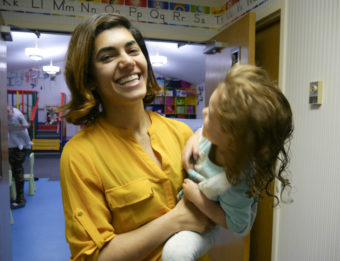
Issy Kako-Gehring holds her two-year-old daughter x. Issy runs the Gehring Nursery School in Juneau. (Photo by Lakeidra Chavis/ KTOO)
Issy Kako-Gehring holds her two-year-old daughter, Ally. Kako-Gehring runs the Gehring Nursery School in Juneau. (Photo by Lakeidra Chavis/ KTOO)

Licensed child care availability is up 21 percent in Juneau compared with last year, according to a local organization.

Child care providers and its supporters say that’s good news for a market that historically has struggled to meet demand.

Joy Lyon is the executive director the Association for the Education of Young Children, a Juneau-based organization that researches and provides services for child care in Southeast Alaska.

“We’re really excited that now we 21 percent more child care spaces than we did last year, at this time, so there’s an increase of 80-some spaces that is  the result of three different initiatives.”

One of the big initiatives relaxed city zoning rules that apply to child care centers, which the Juneau Assembly passed late last year.

One change let at-home child and day care providers have up to 12 children, instead of eight, without needing a permit from the city.

“The zoning laws have led to four new group homes, so they’re able to provide support for more children,” Lyon said. “That’s the model we hope to encourage for the other 30 family child care providers, and then two new centers have started since last year, which has led to the increase. One of the centers would not have been able to start without that change to the zoning laws.”

That center is the Gehring Nursey School.

Gehring Nursery School worker Allison Cadiente-Laiti-Blattner reads to a group of children. (Photo by Lakeidra Chavis/ KTOO)

On a recent morning there, about a dozen babies and children are running around, eating snacks and preparing to paint. Some are crowding in a circle to listen for an impromptu story time.

The five women that work at the day care also have their own children here. One teacher says watching her children grow up while working is a bonus.

Amy Myers is an administrator at the daycare. After getting pregnant two years, she says one of her first thoughts was: What about child care?

“I heard that there were waitlists for pretty much every day care,” she said, “and then not only were there waitlists for child care, there were no infant spots.”

She says if you’re lucky, the search starts early.

“So really it’s that moment you find out you’re pregnant, you have to get on a waitlist for somewhere,” Myers said.

Myers decided to be a stay-at-home mom, and eventually started working at the day care center.

Issy Kako-Gehring runs the center and says just two years ago, it couldn’t have existed under the city’s zoning rules for child care providers.

In 2014, she says she began meeting with Juneau Republican Rep. Cathy Muñoz and Juneau Assembly member Jesse Kiehl to address the issue. Those meetings eventually led to the zoning changes.

Two other initiatives have also contributed to additional childcare availability, Lyon said.

The first is the Hiring, Educating and Retaining Teaching Staff, or HEARTS initiative, which the city sponsors. The program’s goal is to the provide educational resources and help retain child care teachers.

The second initiative is a $1,000 grant that Lyon’s organization offers to new child care startups.

Kako-Gehring said families turning over is another factor.

“Part of that reason, I think, is that a lot of families are moving,” she said. “We’ve had at least 10 families in the last year, to move out of state, young families.”

Juneau has an aging community and the cost of child care here forces families to make important decisions, she said.

For mothers, she said, do you work and pay a thousand dollars a month for your child to be in day care, or do you stay home and watch them grow up?

“There’s a lot that’s involved in this 21 percent and it has to be looked at from every angle,” she said. “The 21 percent increase could also mean that less women are in the workforce.”

Kako-Gehring said her day care isn’t at capacity. That’s a good thing, she said; her workers aren’t overwhelmed. But when they do open a spot — it’s filled almost immediately.

A few other child care centers I called in Juneau had long waiting lists, too, especially for infants. But for the first time in five years, child care capacity in Juneau is rising.

How Domestic Violence In One Home Affects Every Child In A Class

Bear vs. Girl
(Illustration by LA Johnson/NPR)

Part of an NPR Ed series on mental health in schools.

Every Monday morning at Harvie Elementary School, in Henrico County, Va., Brett Welch stands outside her office door as kids file in.

“The first thing I’m looking for are the faces,” says Welch, a school counselor. She’s searching for hints of fear, pain or anger.

“Maybe there was a domestic incident at the house that weekend,” says Welch. “That’s reality for a lot of our kids.”

And a reality for a lot of kids in the U.S. While it’s difficult to get an exact number, researchers estimate that between 10 and 20 percent of children are exposed to domestic violence each year.

New data quantifies what many teachers and school counselors already know: While such violence often takes place outside of school, its repercussions resonate in the classroom.

It hurts not only the kids who witness the violence, but also their classmates. The harm is evident in lower test scores as well as lower rates of college attendance and completion. And the impact extends past graduation — it can be seen in lower earnings later in life.

“It’s a sad story,” says Scott Carrell, economist at the University of California, Davis, who has studied this for over a decade.

But, he says, there’s one thing he and his colleagues – economists Mark Hoekstra and Elira Kuka – found that can improve the situation “not only for that family but for all the child’s classmates.” What was it? Reporting domestic violence when it happens.

Violence At Home. Disruption At School.

Brett Welch says she’s noticed that kids who act out at school often come from tough home situations.

“Instead of asking for help, they’ll start being disruptive,” Welch explains.

“They’ll ask to go to the bathroom for the 15th time. And when they can’t, they’ll raise their voices. It can get to the level of throwing a chair – but that’s very rare.”

Kids who witness domestic violence are more likely to get in trouble at school and have behavioral problems, including being aggressive and bullying their classmates.

Welch says she understands why: School is “where they can feel powerful because they are completely powerless at home.”

She often works with those kids one-on-one or in small groups. She wants them to have at least one relationship where “they feel listened to and they feel respected and they know someone cares. That can change everything for them.”

Around the country there aren’t enough counselors like Welch to go around. Not all states require elementary schools to have counselors. And even where they are required, there can be large caseloads. Sometimes one counselor covers multiple schools and oversees more than 1,000 students.

Welch is stretched so thin she’s only at Harvie Elementary two days a week. But a kid may need Welch’s support at any time — and mornings in particular are key.

The first 10 minutes after a student arrives at school in the morning is a critical window, Welch says. If she’s able to catch them and make them feel heard, “it can completely change their day” — and it can change their classmates’ days, too.

Influence On Classmates

If one kid is having a hard day, Brett Welch says, it influences the rest of the children in the classroom.

“It takes the teacher’s attention, it interrupts learning and it interrupts the flow of the day.” She says she can see the impact on classmates’ academic work.

Scott Carrell’s data confirms what Welch has observed.

He links lots of academic metrics – like test scores, discipline infractions and college graduation rates — with court records on whether a parent has filed a restraining order.

Now, domestic violence and restraining orders happen in all the schools Carrell examined. But they were 10 times more likely to happen in the school serving the poorest population compared with the school serving the wealthiest population. So to make sure he wasn’t just seeing the effect of poverty, Carrell came up with a clever solution.

He looked at siblings – who come from the same family and go to the same school – but one sibling has a classmate who’s struggling with domestic violence and the other sibling doesn’t.

Examining lots of sibling pairs and crunching almost two decades worth of data, Carrell found that your classmates – and whether or not they come from a home with domestic violence – influence how well you do in school and beyond.

Measuring harm in dollar figures, Carrell looked at wages when the students grew up. He found that: “exposure to an additional disruptive peer throughout elementary school leads to a 3 to 4 percent reduction in earnings at age 24 to 28.”

Carrell says that number adds up quickly — because, in a class of 25 kids, that’s a 3 or 4 percent drop in wages for each person. Plus, if your classroom has multiple children from troubled homes, the tests scores get lower and lower and the wages drop gets bigger and bigger with each additional disruptive child.

Carrell argues this has implications for how to make schools and classrooms fair. He says, ideally, we would avoid concentrating disruptive kids in the same classroom or the same school.

And Carrell says his biggest takeaway is that “society has a vested interest in helping those families that are struggling with domestic violence. The more we can help other households, the better off our children will be.”

What can be done to improve things?

Carrell and his colleagues found one thing that, they say, really helps: parents reporting the domestic violence.

After reporting it, “things get better.”

Carrell says there are three things that might account for this: First, the violence in the homes may have stopped. Second, another adult has decided to make some positive changes in the child’s life. Third, people like Brett Welch get involved.

Reporting domestic violence forces the school to pay attention, and often that means the school counselors get involved.

Welch talks to students about finding safe places in their homes. She works on anger management. She helps kids improve their emotional vocabulary.

Vickie Fahed, a kindergarten teacher at Harvie Elementary, says she can see Welch’s impact on a child. When Fahed has angry or disruptive children, she sends them down the hallway to see Welch.

“The child comes back so relaxed and so at peace,” Fahed says.

When that child is at ease, the whole class can focus. And that translates into higher test scores and better graduation rates for the child and their classmates.

All this is great — at least on Mondays and Thursdays, when Welch is here.

“You can tell when she’s not here in this building,” says Fayed. “It’s a big difference. We’re like: ‘Okay, she’s not here today? Okay, wait till tomorrow.’ ”

On the days Brett Welch is in the building, she stands by the door as students leave.

“You tell them that you love them because you do,” Welch says. “And because maybe that’s what they need to be able to get through whatever they need to get through at home.”

And, both Brett Welch and Scott Carrell say, if the child’s home life gets better, things will get better at school — for that child, and for their classmates.

Copyright 2016 NPR. To see more, visit http://www.npr.org/.

Tlingit & Haida: Tribal youth court could launch in a few weeks

About 30 tribal officials and community members recently discussed ways to get a new youth court up and running in Juneau. It’s an opt-in program for youth tribal members in Southeast Alaska that’s an alternative to the regular justice system.

SueAnn Lindoff is in charge of the new program of the Central Council of Tlingit and Haida Indian Tribes of Alaska. She hopes they’ll be able to start taking youth through the program in a few weeks,  a student or two at a time.

“I don’t want five students because I’m a strong believer in quality versus quantity,” Lindoff said.

The framework for the program has a strong emphasis on tribal mentorship and tradition. During the meeting, people suggested youth could work with elders to learn about traditional values and stories.

“We don’t want to reinvent the wheel; we don’t want our personal identity to be first with this program,” she said. “What we want to do is we want to put a spoke in the existing wheel already — if it means make it bigger, make it stronger.”

The youth wellness court program has had hiccups; a coordinator left earlier this spring and planning large meetings has been difficult. This meeting was in a conference room on the top floor of the Andrew Hope Building.

Lindoff said it’s been a huge learning experience for her. She compared it to learning to drive a stick shift.

“If you don’t know how to drive, and you’re used to driving an automatic, well you jerk and jerk and stall,” she said.

But eventually, she said, you learn. The group, which had just met for the first time all summer, created a four-person task force to tackle major aspects of the program and to determine what troubled or disadvantaged youth might be missing. Another meeting is planned late September.

The U.S. Department of Justice awarded the Central Council a $550,000 grant last year to create the youth recidivism program for three years.

Louisiana Takes Stock Of The Damage After Devastating Flooding

Daniel Stover, 17, moves a boat of personal belongings from a friend's flooded home in Sorrento, La., on Saturday. Max Becherer/AP
Daniel Stover, 17, moves a boat of personal belongings from a friend’s flooded home in Sorrento, La., on Saturday.
Max Becherer/AP

Louisiana is entering recovery mode after devastating flooding killed 13 people and damaged at least 60,000 homes across 20 parishes.

But as Louisana Gov. John Bel Edwards told CNN, that process is “going to take many months.” He added that even though this flooding was “unprecedented and historic,” many are “just now realizing how significant it was.”

The Red Cross said the Louisiana flooding “is likely the worst natural disaster in the United States since 2012’s Superstorm Sandy,” and response efforts are “expected to cost at least $30 million.”

Edwards emphasizes that the state “really needs help.” Here’s more:

“Typically by this point in a storm, I think Red Cross would be receiving a lot more donations, I think there would be more volunteers signing up. Although we have some of that in place now, it would be very helpful if people would donate to the Red Cross, to the Baton Rouge Area Foundation, and also to come volunteer to help people get back in their homes as quickly as possible.”

Standing water closes roads in Sorrento, La., on Saturday. Max Becherer/AP
Standing water closes roads in Sorrento, La., on Saturday.
Max Becherer/AP

The governor’s office said “102,000 have registered for federal help,” as the Associated Press reports. FEMA spokesman Rafael Lemaitre said “more than 25,000 have filed flood claims.”

State officials estimate that 60,000 homes were damaged. But a report from the Baton Rouge Area Chamber, a local economic development group, put the number at 110,000. From member station WWNO, reporter Ryan Kailath explained the discrepancy to our Newscast unit:

“The higher local estimate is actually the total number of homes in the floodplain area, whether or not they’re damaged. The much smaller number that officials keep repeating is the number of homes that have been reported damaged.

“Because payouts can be tied to damages, each side has an interest in setting the number. After Hurricane Katrina, the numbers were still being debated long after the storm, with state estimates much higher than federal ones.”

Raven Harelson, 59, (left) carries a drawer to the trash heap in front the home of Sheila Siener, 58, as friends and family help to clean out the flood damaged home in St. Amant, La., on Saturday. Max Becherer/AP
Raven Harelson, 59, (left) carries a drawer to the trash heap in front the home of Sheila Siener, 58, as friends and family help to clean out the flood damaged home in St. Amant, La., on Saturday.
Max Becherer/AP

Regardless of the number of structures, The Advocate said residents are beginning to dig out their waterlogged homes, creating “massive debris piles” on the streets of Baton Rouge.

“Clothing and children’s toys, along with water-soaked carpeting and sofas and damaged refrigerators and stoves and the bric-a-brac of daily life were stacked outside houses” in the Baton Rouge area, as the newspaper reported.

Mike Johnson told The Advocate that his family home was flooded and “just about everything” was lost. “The hardest part of it is a lifetime of accumulation gone in a couple of hours,” he said. “Now it’s back to the drawing board.”

As Kailath reported on Weekend Edition Sunday, tens of thousands of South Louisiana residents were taken by surprise at the rising floodwaters, despite warnings.

He said “family after family” told him the same tale: “They heard the warnings, and thought — it won’t happen to me.”

That may be because many of areas hit are inland, and not ones that typically experience flooding. “People have a hard time grasping things they haven’t experienced,” Marshall Shepherd, the former president of the American Meteorological Society, told Kailath.

According to Shepherd, “people around the world are going to see more and more weather for which they have no reference point.”

Meanwhile, multiple counties in south and central Texas are threatened with flash flooding, with reports of water rescues.

Copyright 2016 NPR. To see more, visit http://www.npr.org/.

Millennials are more likely to live with mom and dad in some states

Young adults, often unable to find good jobs, even with a college education, are increasingly staying with their parents. (Photo by Associated Press)

By now, Karen Wilk thought she would have sold her five-bedroom house in Colts Neck, New Jersey, and downsized to a smaller home. But she has had to put those plans on hold because her 23-year-old daughter, who is finishing her college degree while working part-time, still lives with her. Wilk’s 27-year-old son moved out two years ago.

“I don’t want to chase my kids out, but I expected them to be more independent by now,” Wilk, 54, said. “I don’t see my kids affording our neighborhood for a long time.”

Almost a third of young adults — 18 to 34 — lived with a parent in 2014, making it the most common living arrangement for that age group for the first time in modern history, according to a study published earlier this year by the Pew Research Center. (The Pew Charitable Trusts funds both the Pew Research Center and Stateline.)

Multiple reasons are behind the trend, lingering effects of the Great Recession, high housing costs and student debt among them. Whatever the causes, millennials in some states are living with their parents in far greater numbers than in others.

In New Jersey, a whopping 43.9 percent of young people are living with at least one parent, according to a Stateline analysis of 2014 census data from IPUMS at the University of Minnesota. Connecticut (38.8 percent) was second and New York (37.4 percent) was third, followed by Florida (37.2 percent) and California (36.7 percent).

States with the fewest young people living with a parent were North Dakota (15.6 percent), Wyoming (18.7 percent), South Dakota (19.7 percent) and Nebraska and Iowa (both 20.7 percent).

Expensive Housing

In New York City and surrounding states, scarce and expensive rental housing is a major factor pushing young adults to return home, said Dowell Myers, a professor of urban planning and demography at the University of Southern California, who wroteabout the economic impact of stay-at-home millennials in a study published earlier this year.

Full nests are also prevalent in other areas where renters are severely burdened by housing costs of more than half of their income, such as Los Angeles, Miami and Orlando.

The high cost of homeownership is also a factor. Renters who might otherwise be homeowners end up renting longer, tying up the supply for those coming up behind them.

“Millennials were doubled up at entry levels of their housing life cycle, blocked by older peers who were unable to turn over their apartments for better homes,” Myerswrote in another study he published this year.

Millennials are the most educated generation ever. But in areas where housing is extraordinarily expensive, a college degree is not necessarily a ticket out of your childhood bedroom.

Lisa Jacobs holds two bachelor’s degrees, one in photography and one in graphic design. But work has been sporadic, so this year she moved back in with her parents in Somerset, New Jersey.

“My parents have a lovely home, but nobody’s happy to be living at home at 32,” Jacobs said, adding that she needs to make at least $20 an hour to afford an apartment. “There are plenty of places that would pay me $15 an hour. But that’s not getting me any closer to moving out.”

A Question of Culture?

But financial stress may be only part of the story. More young people were living with their parents even before the Great Recession hit. Some see cultural factors at work.

Debbie Pincus, a psychotherapist who has counseled parents and adult children who live together in New York City and its suburbs, said many of the parents she helps have a tendency to overshelter their offspring.

“You just have to be careful that you’re not enabling them to avoid going out on their own when they’re ready,” Pincus said. “We baby boomers are very protective of our children. We are less likely to put the kids out and say, ‘Figure it out for yourselves.’ ”

Resurgent ethnic traditions may be another factor: In the New York metropolitan area, most adult children of Italian heritage live with parents.

Jason Cerillo, 28, still lives with his parents in the predominantly Italian-American suburb of West Harrison, New York. He said there’s a cultural understanding that he can stay until he gets married.

“My dad is Italian, and he says, ‘Oh, stay as long as you want, but we do want to retire.’ So I am under some pressure here,” Cerillo said, adding that many of his high-school classmates in the neighborhood also live with their parents.

In the New York area, “co-residence” rates are also high for people with Irish, Dominican, Puerto Rican and African-American roots.

Debt and Underemployment

Cerillo said his monthly student loan payment — $500 — has made it hard for him to move out of his parents’ place, despite having made as much as $42,000 a year working for a software company. He said he hopes to pay down his debt to $20,000 before striking out on his own.

Student loan and credit card debt keeps many young adults at home.

And underemployment among young people like Jacobs in New Jersey, who can’t find the work they trained for, is also a factor, said Christopher McCarty, director of Florida’s Bureau of Economic and Business Research.

Florida’s official unemployment rate is 5 percent. But McCarty points out that 10.6 percent of workers are unemployed or underemployed, with low-paid jobs they are overqualified for or part-time jobs when they would rather work full-time.

The underemployment rate is 11.7 percent in California, where Kelley Lonergan, 28, said she had to move back to her parents’ home near Los Angeles four years ago. She lived in a room still decorated with her brother’s video-game posters and kept her clothes on the floor because his closets were still full.

With an English degree from Brown, Lonergan said she got a part-time school communications job but couldn’t find full-time work.

The house got even more crowded when her older brother moved back in for a spell. She wrote about the comfort and frustration of living with her parents.

She said she was relieved to finally move out earlier this year. “I had been living with four people and now I’m living alone and it’s great.”

Numbers Game

Myers, the USC professor, predicts that a coming dip in the number of young adults may allow a greater percentage of them to finally find their own housing.

The number of 25-year-olds has increased every year since 2005, but is projected to start decreasing next year and for the next five years. That’s likely to free up apartments and jobs for younger people at an increasing rate until 2022.

Robert Dietz, an economist for the National Association of Home Builders, said some cities were slow to adapt to the growth by building more apartments, but are catching up now. He expects older millennials to start buying single-family homes and freeing up apartments.

“Housing is like a ladder — when there are blockages, it backs up the whole thing, and the millennials are having a hard time getting onto the bottom rung,” Dietz said.

Girl Scouts camp promotes leadership skills

Girl Scouts study local plants in a botany work shop during a week-long camp. (Angela Denning, KFSK)

Girl Scouts of Alaska came to Petersburg last week to hold a weeklong day camp. Girls ages kindergarten through junior high participated in the events, many of which happened outdoors.

A few dozen girls are in a circle outside the Rae Stedman Elementary School. They’re singing songs and dancing around on top of the gray gravel near the playground.

The Girl Scouts traveling camp goes to a new remote Alaska community every week.

In Petersburg, the girls have been meeting every day learning social and educational skills.

Now, they are being led through sing-along songs by a few Girl Scout leaders, such as Josie Ward. She’s a college student in Missouri, but is spending part of her summer in Alaska helping run the camps.

The weeklong camp has a $40 suggested donation but they will give any girl a scholarship who can’t pay.

The traveling camp has been going for nine weeks already.

Girl Scouts has already held camps in Ketchikan in Southeast. The week of Aug. 8-12 camps will be in Sitka.

Site notifications
Update notification options
Subscribe to notifications