Food

Why some Alaska workers turn down pay increases

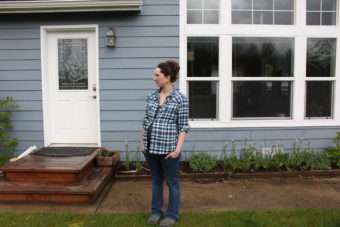
Rebecca and Mark Dundore say they want to give their employees pay raises and increased hours, but they say it's caused anxiety for some of their staff. (Photo by Elizabeth Jenkins/KTOO)
Rebecca and Mark Dundore want to give their employees pay raises and increased hours, but they say it’s caused anxiety for some of their staff. (Photo by Elizabeth Jenkins/KTOO)

A pay increase should be a happy event in a person’s life, but for some it can evoke fear. That’s because more money earned could mean less money overall when public assistance programs get cut off.
Rebecca and her husband Mark Dundore own Juneau Treasures Thrift Store. A place that’s filled to the brim with eclectic used items. Their shop is doing well. So well they’re opening a second location that will sell mostly secondhand furniture. But in the course of running their business, they’ve run into some issues with staffing.

They have three employees right now, who make between $10 and $12 an hour. That’s more than Alaska’s minimum wage.

But when they’ve offered pay increases or more hours, they didn’t get the response they expected. One employee was worried she would lose her public assistance.

“We wanted her to work almost full time, and she couldn’t do it because she has six children, and they’re on food stamps,” Rebecca said. “We wouldn’t be able to give enough to get her off the food stamps support entirely, and she wasn’t able to take anymore ‘cause she was afraid she would lose the food stamps.”

Rebecca says it was an awkward situation. They’ve even had employees volunteer to work for free, so as not to make too much money and wind up going over.

“That’s a really serious concern for a lot of people around here,” Rebecca said.

Per capita, Alaska has the most households on public assistance in the nation. That’s according to statistics from the U.S. Census Bureau.

Anna Schetky and her husband live in one of those households. Anna works for Rebecca at Juneau Treasures. She decided to transition to the part-time job after learning of her pregnancy. Before she worked in a stressful environment with at-risk kids, and she hoped the move would be good for her and the baby.

But it meant losing the family’s insurance. So she signed up for Denali KidCare, a Medicaid program.

“Due to the major drop in income, we also were trying to get on WIC,” Schetky said.

That’s food and nutrition assistance for women, infants and children.

“All of those things were kind of looming over us. And we had to sit down and start crunching some numbers,” Schetky said.

She says with that first WIC voucher, she was able to stock up on perishable items, milk and some veggies. It helped supplement what they got at the food bank.

When she first started at Juneau Treasures, she was making about $10 an hour.

“All of a sudden they’re like, ‘Hey, you’re doing a great job, we want to offer you more hours and more pay,’ and I just kind of looked at them and I was like, ‘I don’t know if I can do this,’” Schetky said. “I had to sit down again and start crunching pennies basically, to see if we could still keep these benefits to see if we could make enough money to survive.”

She says the WIC office advised she would be on the cusp of making too much. To be eligible, she couldn’t make more than about $3,800. Her gross household income would be about $4,000 a month. So she decided to drop WIC.

“For right now we’ve had to find our little groove and not really swerve one way or the other because we want our baby to be covered,” Schetky said.

She is still covered by Denali KidCare. The income limit for that is $400 higher.

Anna Schetky. Chasing the Dream. (Photo by Elizbeth Jenkins/KTOO)
Anna Schetky at her home in Juneau. (Photo by Elizbeth Jenkins/KTOO)

A WIC representative thought Schetky might still qualify. Being eligible for one might automatically qualify her for the other. But for the past few months, she’s bee paying for the expense out-of-pocket. She wants to grow a garden to help offset some of the cost.

Rebecca and her husband Mark Dundore say they make enough to keep the doors open at Juneau Treasures but not enough to pay more than $12 an hour.

“I think to bridge that gap, we’d have to pay almost $15 or $16 an hour. It’s a small business, with all the other taxes and fees and stuff, we just can’t do that right now,” Mark said.

One of the solutions they’ve come up with is having a bunch of part-time employees, but they realize there’s no easy fix. The problem isn’t as simple as having employees who don’t want to work.

“I would say that’s probably the exception.” Rebecca said. “Everybody we’ve encountered anyway has just worked really hard and been energetic and we’ve really appreciated that.”

For now, they might have to show that appreciation in a weird way: by offering their employees less.

Funding for Chasing the Dream is provided by the JPB Foundation and the Ford Foundation. It’s part of an ongoing series about poverty and opportunity in America. 

CtD-Logo2 for Web & Print

In Quest For Happier Chickens, Perdue Shifts How Birds Live And Die

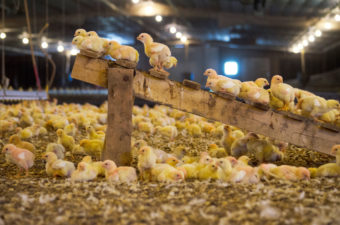
Perdue will study the effects of features such as perches in chicken houses. It hopes to double the activity levels of its chickens in the next three years. Business Wire
Perdue will study the effects of features such as perches in chicken houses. It hopes to double the activity levels of its chickens in the next three years.
Business Wire

One of the country’s leading poultry companies, Perdue Farms, announced plans Monday to make both life and death a little easier for its chickens.

The changes are a break with current standard practices in the industry, and animal welfare groups are cheering.

Jim Perdue, chairman of Perdue Farms, says there’s a simple motivation behind the new initiative. Consumers, especially millennials, “want to make sure that animals are raised in as caring a way as possible. With the least stress, the least discomfort.”

On that score, his industry is under pressure. Animal rights groups have released videos recorded inside poultry houses that show chickens with broken legs or with breasts dragging on the floor.

A year or so ago, Perdue Farms invited one of those groups, the Humane Society of the United States, to visit the company and lay out its critique.

“We went through the top issues regarding the poor treatment of animals in the chicken industry,” says Josh Balk, senior food policy director at the Humane Society. “Some of the issues, the company saw themselves as a problem.”

Attitudes were shifting inside the corporate headquarters at Perdue Farms, in part because of the company’s decision to acquire Coleman Natural, an organic chicken producer, in 2011.

Bruce Stewart-Brown, a veterinarian and senior vice president of Perdue, says his company started to appreciate some of the advantages of organic production methods. “You go into those chicken houses and … there’s several things that really jump out at you,” he tells The Salt. “The chickens are more active. You enjoy being in the chicken house. And you come back and you go, ‘Look, maybe we can transfer some of these techniques to the rest of our chickens.”

One result was an industry-leading initiative to drop the use of antibiotics in conventionally raised chickens.

Perdue is now announcing a new initiative focused on animal welfare. Balk, from the Humane Society, calls it “precedent-setting.”

One part involves procedures for slaughtering chickens and turkeys. Currently, when birds arrive at a typical poultry processing plant, they’re hung upside down in moving shackles. Their heads then go into a water bath that contains an electrical current, which stuns them and renders them unconscious before they’re slaughtered.

Perdue is now promising to abolish the shackles and knock the birds out with gas instead. “It’s a dramatically less cruel way to kill these animals,” says Balk.

Perdue is also planning to change the poultry houses, adding windows to provide natural light and perches for chickens to sit on. This is supposed to encourage chickens to be more active.

And Perdue says it will at least study the idea of using breeds of chickens that grow a little more slowly. That could allow birds to support their weight a little better and walk around more easily. Whole Foods recently announced that it will shift to selling slower-growing breeds of chickens.

Slower growth rates currently come at a cost, though. A slow-growing chicken requires more feed — and thus more money — to accumulate the same amount of meat. Bruce Stewart-Brown admits that this is a “critical” consideration. He’s hoping research will allow the company to minimize the additional cost.

The company is also hoping that any additional costs will be outweighed by increased sales. Jim Perdue says he’s encouraged by the company’s experience so far with its antibiotic-reduction initiative. “We feel that as long as we stay in tune with the consumer, we’ll be OK,” he says.

Copyright 2016 NPR. To see more, visit http://www.npr.org/.

Nenana runs out of money to complete bridge intended to open agricultural lands

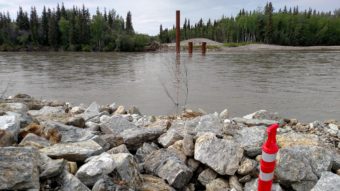
Nenana Mayor Jason Mayrand says the city has bought all the materials needed to build the Nenana River bridge, such as these enormous cast-concrete girders, and stockpiled them near the construction site. (Photo by Tim Ellis/KUAC)

An ambitious plan to develop agricultural land west of Nenana is on hold until the town can find another $5 million to complete work to build a bridge across the Nenana River.

Jason Mayrand scampers over a rock pile on the eastern bank of the Nenana River and points to a row of steel pilings hammered into the riverbed near opposite bank, about 400 feet away.

That’s where work stopped last year on a project to build a 14-mile road to access lands west of the river for agricultural development. Mayrand and other local officials have for decades been pursuing the project, which he said would give a huge boost to the area’s economy.

“There (are) hundreds of thousands of acres of ag land out there,” Mayrand said. “There’s a lot of property.”

Mayrand said Nenana spent about $3 million on the project for design and other preliminary work before getting $6.5 million in 2012 from a statewide transportation bond package. The money paid for improvements to the gravel road that leads to and from the river and construction of a small bridge across a nearby slough. But the mayor said the town ran out of money for the project last fall, soon after work began on a big bridge to span the main river channel.

“We had originally budgeted this project years before it got funded,” Mayrand said. “And the expenses have slowly climbed up over time, just due to the economy and some other things that have come up. The price of fuel has gone up, the price of insurance has gone up, the price of materials has gone up, labor has gone up…”

The mayor says it’ll take another $5 million to finish the bridge.

“We’re still pursuing extra sources of funding to finish the project,” Mayrand said. “But the state has no money, the feds have no money. There aren’t grant opportunities like there used to be. So, we’re doing the best we can with what we have.

Nenana’s contractor was able to accomplish some work on the big bridge, including driving pilings into the riverbed near the opposite side, before money for the project ran out. (Photo by Tim Ellis, KUAC)

The bridge is part of Totchaket Resource Development Corridor Access project, which Nenana officials estimated would cost $17 million. Mayrand said city officials requested only $6.5 million from the bond package because they’d been trying to keep costs low and because they assumed more funding would follow once the state started selling land opened up by the project.

“We’ve had inquiries from even farmers in the Lower 48 (that have) flown to Alaska to look at the land because they’re interested in farming it,” Mayrand said.

A state Agriculture Division official who’s been working with the city on the project since 2008 agrees there’s still a lot of interest in the land. But Dan Proulx said the state won’t try to sell much of it until after the bridge is built.

“With no bridge, it’s going to be really hard to sell 40 or 50 lots, or parcels, encompassing 10,000 acres. But if the bridge goes in, we can have a much larger sale,” Proulx said.

Proulx said much of the area is has not been surveyed or appraised. He said the state’s fiscal crisis makes it unlikely it’ll pay the costs of ferrying surveyors and appraisers into and out of the area by boat or aircraft.

“The cost of preparing (the land) is exponentially larger without a bridge,” Proulx said.

Longtime Nenana-area farmer Sven Ebbeson said he’s seen this problem many times. He said it’s one of the biggest obstacles to promoting the agriculture industry in Alaska.

“One of the problems has been with agriculture parcels has been that the land has been sold without developing the infrastructure that you need for farming. Including access roads and so on,” Ebbeson said.

It’s an all-too-common problem, said Katherine Eldemar, director of the state Division of Community and Regional Affairs.

“It’s like anything in Alaska – building the infrastructure is something that is painfully neglected,” Eldemar said.

Eldemar also said it’s unlikely the state will provide more funding for the bridge anytime soon. But she said her agency stands ready to help Nenana move ahead on the project.

Yukon subsistence fisherman get first targeted opening for Yukon salmon in 5 years

Chinook salmon, otherwise known as a king. (Photo courtesy U.S. Fish and Wildlife Service)

Subsistence fishermen on the Yukon are getting some rare gillnet openings during the middle of the summer season, and will be allowed to keep any king salmon they catch.
Targeted openings for Yukon king salmon have not occurred in more than 5 years, though occasionally subsistence users are allowed to keep kings taken as bycatch in the summer chum fishery.

Fish and Game Yukon River Summer Season Manager Holly Carroll said the idea of allowing gillnets during the heart of the summer run has been developing since the end of the 2015 fishing season when subsistence users up and down the Yukon repeatedly criticized managers for not enabling people to meet their subsistence needs.

When it came time to discuss the 2016 management plans last winter, Carroll said that subsistence users and fishery managers came to a consensus.

“We told them that we would rather, if the run looks strong enough, provide a little bit more subsistence harvest than last year,” Carroll said. “And most people gave us feedback on how they would want that. They want it soon enough to be able to dry their fish. They want it before all of the kings are old or unusable upriver. They also wanted chums when they were fresher, for the people that harvest chums. Basically at those meetings, we present our management strategy, and then we take all of the feedback we are given and try to incorporate what say they actually want.”

The openings are being timed to fall after a large second pulse of kings moves upriver, in order to minimize the impact that the more efficient gillnet gear could have on the struggling king salmon stock.

The 2016 king run appears to be similar in size to last year’s run, when over 85 thousand kings crossed into Canada – almost twice as much as required by a treaty between the U.S and Canada.

Fish and Wildlife Service Yukon River In-Season Manager Fred Bue acknowledges that managers achieved that high level of escapement, in part, by virtually eliminating subsistence fishing time. But this year, Bue said, managers want to provide better subsistence opportunities on the river.

“There’s no way we are going to meet people’s needs,” Bue said. “But we do hope to get a little bit of fish for people to use, and we hope to have it not right on the back end of the run when the quality of fish kind of deteriorates. It’s not as good as those first, fresh fish. If you are going to harvest a fish, we would like you to get the maximum benefit out of it.”

A series of 18-hour openings utilizing gillnets with a maximum mesh size of 6 inches have occurred in lower river districts 1 and 2, and similar opportunities will be afforded to middle and upper river districts over the next few weeks.

A 6-inch mesh restriction for gillnets is intended to select the smaller males, while allowing spawning females to escape.

Middle and upper river fishermen are more likely to harvest kings as the runs separate, and chum turn off into tributaries to spawn.

The Pilot Station sonar estimate for kings on Tuesday was just over 91 thousand fish – about 18 thousand fish above the 10-year average for that date. Managers attribute some of that high number to the early run timing this year.

Senators Reach Deal On National GMO Labeling Bill

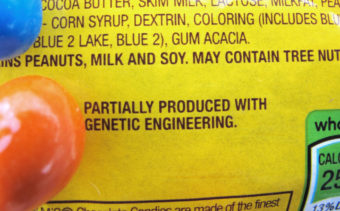
A new disclosure statement on a package of peanut M&Ms candy notes they are "partially produced with genetic engineering." (Photo by Lisa Rathke/AP)
A new disclosure statement on a package of peanut M&Ms candy notes they are “partially produced with genetic engineering.” (Photo by Lisa Rathke/AP)

Just a week before a Vermont law kicks in requiring labels on food containing genetically modified ingredients, U.S. Senate agriculture leaders announced a deal Thursday that takes the power out of states’ hands — and sets a mandatory national system for GM disclosures on food products.

Sen. Pat Roberts, R-Kansas, the chairman of the U.S. Senate Committee on Agriculture, Nutrition, and Forestry, unveiled the plan that had been negotiated for weeks with U.S. Sen. Debbie Stabenow, D-Michigan.

Senate Democrats from farm country called it a win for consumers and families, while Roberts said it would end “denigrating biotechnology and causing confusion in the marketplace” brought on by Vermont’s state law.

But it was clearly an uneasy compromise, with critics of the plan making for strange bedfellows on opposite ends of the political spectrum. Both Sen. Bernie Sanders, the Vermont Democrat who supports his state’s mandatory law, and the American Farm Bureau Federation, which wants a voluntary GMO labeling standard, announced their opposition to the Roberts-Stabenow deal.

Under the plan, food companies would be required to disclose which products contain genetically modified ingredients. But companies would have a range of options in just how they make that disclosure: They could place text on food packaging, provide a QR (Quick Response) code, or direct consumers to a phone number or a website with more information.

News of the deal comes as many large food companies, including Campbell Soup Co., Kellogg’s and General Mills, have already begun labeling some of their products in anticipation of the Vermont law. Roughly 75 percent of processed foods in the U.S. contain genetically modified ingredients, according to estimates from the Center for Food Safety.

The deal falls short for those who wanted a national standard much like Vermont’s.

Gary Hirshberg of Stonyfield Farm, the maker of organic yogurt, and chairman of the Just Label It campaign, released an announcement saying he was pleased that the new plan will create a national, mandatory labeling system and even cover more products than the Vermont law. But, he said he’s disappointed that consumers will now have to rely on smartphones to learn about their food.

“This proposal falls short of what consumers rightly expect — a simple at-a-glance disclosure on the package,” Hirshberg said.

The deal also was a tough sell for U.S. Sen. Chuck Grassley, an Iowa Republican, who said he was glad it would solve the problem of a patchwork of state labeling laws. But, while he will support the plan, he said he hopes lawmakers would move away from “a non-science based agenda driving law and rules.”

“The science has proven that GMO foods are safe and equivalent to non-GMO foods from a safety perspective,” Grassley said. “Giving consumers a choice is a good thing, and it’s time to realize that there’s a place for all types of food in our consumer-driven economy without stigmatizing another scientifically safe alternative.”

Pamela Bailey, president and CEO of the Grocery Manufacturers Association, said she was pleased with the bill and hopes the Senate passes it quickly.

“This bipartisan agreement ensures consumers across the nation can get clear, consistent information about their food and beverage ingredients and prevents a patchwork of confusing and costly state labeling laws,” she said.

Zippy Duvall, president of the American Farm Bureau Federation, said his group will take some time to review the plan as it opposes mandatory food labels.

“There are no – and never have been any – documented health risks from genetically engineered food in the marketplace,” he said.

Meanwhile, the Vermont law will go into effect on July 1 but would presumably be nullified when Congress finalizes a bill. Just how long that will take is uncertain. Roberts and Stabenow are working on the bill and haven’t yet set a time to bring it to a vote, said Sarah Little, a Roberts spokeswoman.

Should it pass the Agriculture Committee and the full Senate, the plan will also have to be run through the U.S. House, which passed a bill last July that barred states from creating such laws but established a voluntary labeling system.

Copyright 2016 NPR. To see more, visit http://www.npr.org/.

Silicon Valley’s Bloody Plant Burger Smells, Tastes And Sizzles Like Meat

Silicon Valley-based Impossible Foods has taken a high-tech approach to creating a plant-based burger that smells and tastes like real meat. At the company's headquarters in Redwood City, Calif., chef Traci Des Jardins served the Impossible Burger (pictured uncooked) with vegan mayo, Dijon mustard, mashed avocado, caramelized onions, chopped cornichon, tomato and lettuce on a pretzel bun.
Silicon Valley-based Impossible Foods has taken a high-tech approach to creating a plant-based burger that smells and tastes like real meat. At the company’s headquarters in Redwood City, California, chef Traci Des Jardins served the Impossible Burger (pictured uncooked) with vegan mayo, Dijon mustard, mashed avocado, caramelized onions, chopped cornichon, tomato and lettuce on a pretzel bun. (Photo by Maggie Carson Jurow)

This summer, diners in New York, San Francisco and Los Angeles will get their hands on a hamburger that has been five years in the making.

The burger looks, tastes and smells like beef — except it’s made entirely from plants. It sizzles on the grill and even browns and oozes fat when it cooks. It’s the brainchild of former Stanford biochemist Patrick Brown and his research team at Northern California-based Impossible Foods.

The startup’s goal is like many in Silicon Valley — to create a product that will change the world.

“The demand for meat is going through the roof, and the world is not going to be able to satisfy that using animals — there’s just not enough space, not enough water,” says Brown, Impossible Foods’ founder and CEO.

Global meat production is expected to increase by 612,000 tons, or 1 percent, this year, according to the United States Department of Agriculture.

So Impossible Foods has developed a burger that it says is less resource-intensive, healthier and will eventually be cheaper to produce than red meat.

It’s not the only faux meat company selling bloody plant patties. Last month, Los Angeles-based Beyond Meat made headlines when it released the Beyond Burger, its pea protein burger that sizzles like real meat and “bleeds” beet juice. The burgers quickly sold out after debuting at a Whole Foods in Boulder, Colo.

Beyond Meat’s investors include Microsoft founder Bill Gates. Gates is also backing Impossible Foods. So is billionaire venture capitalist Vinod Khosla and Google Ventures. All told, the company has raised some $182 million in seed funding. Last year, Impossible Foods turned down Google’s offer to buy the company for $200 million to $300 million.

The Impossible Burger is more than just peas and carrots smashed together: It’s the result of some pretty high-tech research.

Brown’s team analyzes meat at a molecular level to determine what makes a burger taste, smell and cook the way it does. He wants his burgers to be squishy while raw, then firm up and brown on the grill. He believes everything from an animal’s fat tissue to muscle cells can be replicated using plant compounds.

Before starting the company, Brown had a hunch that a certain ingredient made meat taste different than other foods. “I had a very strong suspicion early on that heme would be the magic ingredient for flavor,” said Brown.

Heme is an iron-containing molecule in blood that carries oxygen. It’s heme that makes your blood red and makes meat look pink and taste slightly metallic.

It’s highly concentrated in red meat, but it can also be found in plants. And that was the trick to giving Brown’s meat-free burgers that blood-pink look when raw and meaty taste once cooked.

Brown could have extracted heme from legumes like soybeans, which contain leghemoglobin in nodules on their roots. Except, that would have been expensive and time consuming, and unearthing the plants would release carbon into the atmosphere.

So, he decided to use yeast instead. By taking the soybean gene that encodes the heme protein and transferring it to yeast, the company has been able to produce vast quantities of the bloodlike compound. Each vat of frothy red liquid in the lab holds enough heme to make about 20,000 quarter-pound Impossible Burgers. “We have to be able to produce this on a gigantic scale,” says Brown.

“Ultimately, we want it to be practical to produce enough of our product to match what’s currently consumed in the U.S. or the world. Well, that’s a lot of heme,” he says.

Because Impossible Foods isn’t targeting vegetarians; it wants to woo carnivores. Brown thinks meat lovers would opt for veggie patties more often if they had an option that really replicated the burger-eating experience. So he’s trying to pin down what accounts for the mouthfeel of beef.

To replicate fat, researchers mix flecks of coconut oil into ground “plant meat” made from textured wheat protein and potato protein. The potato protein provides a firm exterior when the meat is seared. And the coconut oil stays solid until it hits the frying pan, where it begins to melt, just like beef fat.

To mimic beef fat, Impossible Foods' meat-free burger uses flecks of coconut oil that are solid at room temperature and melt when cooked.
To mimic beef fat, Impossible Foods’ meat-free burger uses flecks of coconut oil that are solid at room temperature and melt when cooked. (Photo by Maggie Carson Jurow)

The burger has more protein, less fat and fewer calories than a patty that’s 80 percent lean meat and 20 percent fat. And because it’s plant-based, this “meat” has no cholesterol.

The taste is unreal. When I tried a mini burger slathered in vegan mayo, mashed avocado, caramelized onions and Dijon prepared by San Francisco chef Traci Des Jardin at the company’s headquarters in Redwood City, I was floored. The flavor was slightly less potent than meat, but if I didn’t already know this burger was made from plants, I wouldn’t have guessed it. The texture as I chewed was just like ground beef. I tried to get my hands on Beyond Meat’s Beyond Burger for a comparison, but so far it’s only available in Boulder.

The aroma of Impossible’s sizzling patty is also unmistakably meatlike. As it wafted through the office, the photographer I’d brought along for this story (a self-described cheeseburger enthusiast) cooed, “the smell!”

Brown’s team engineered that smell. First, the researchers put cooked meat in a gas chromatography mass spectrometry machine, which separates thousands of compounds. Then, they sniffed the meat via a tube, so they could identify the specific individual components of that meat scent.

Brown says the researchers encountered smells like butter, maple syrup, a diaper pail, smoke, grass — even a raspberry bug. That last one was from a researcher who grew up on a raspberry farm in Vermont.

“The smell of meat is the simultaneous exposure to these hundreds of different smells, and the smell of meat happens up here,” Brown says as he points to his head.

Food analyst Jeffrey Landsman says consumers love that sensory experience. “There is a real opportunity for food alternatives that taste, look and sound like the real thing and appeal to all five senses,” says Landsman, a vice president at Specialty Food Sales, a company that markets and sells innovative food products to supermarkets.

He says there’s definitely room on the market for both Impossible’s burger and Beyond Meat’s Beast Burger, which he called “a home run.”

“The market has changed dramatically over the past 35 years and we’ve seen more and more meat substitutes,” says Landsman. “Millennials especially tend to eat healthier, and in five years, they’ll have families and will be the target market.”

But he says neither burger-substitute-maker should necessarily count on carnivore customers to drive sales. “I don’t see it as a beef-eater market. I see it as an opportunity for the vegetarian market,” says Landsman.

“I don’t think you’re going to get people to convert over” and give up meat completely, he says.

He adds, “As long as animal proteins are available at a reasonable price, people will not fully replace their meat with a plant-based alternative.”

Impossible’s plant burger is still more expensive to produce than beef patties. But Brown says the goal is to increase production so the “meat” becomes less expensive than ground chuck. The company is already leasing a 66,913-square-foot manufacturing facility in Oakland to ramp up production.

It will be several years before the startup makes enough meat to supply grocery stores, so right now it’s focusing on select restaurants. (Beyond Meat, by contrast, is targeting grocery store shoppers with its Beyond Burger.) Impossible Foods wouldn’t disclose which restaurants or say how much it’ll charge for the burger. Brown says they are hoping that skilled chefs can devise complimentary flavors and help redefine what it means to order a hamburger.

“If people are going to be eating burgers in 50 years, they’re not going to be made from cows,” said Brown. “We’re saving the burger.”

Copyright 2016 KQED Public Media. To see more, visit KQED Public Media.
Site notifications
Update notification options
Subscribe to notifications