The U.S. Senate Thursday passed a bill that is said to require consumer labeling of genetically modified foods, but opponents say it is too weak to be called a requirement. Alaska U.S Sen. Lisa Murkowski said the legislation would not obligate the makers of genetically engineered salmon to clearly distinguish their product from a natural salmon.
U.S. Sen. Lisa Murkowski in 2013.
“The reality is we will not see the labeling that I, as an Alaskan, who is putting fish on the dinner table for my family, would require and would want,” Murkowski said.
The bill would allow GMO food manufacturers to satisfy the mandate by placing a QR code on their labels. To get information, a consumer would scan the code with a smart phone, which would lead to a web page. The legislation was sponsored by farm-state lawmakers. If it becomes law, it would pre-empt states from enforcing their own GMO labeling mandates and block an Alaska law requiring labels for engineered salmon.
The measure passed by a vote of 63-30, with both Alaska senators voting no. It now goes to the House.
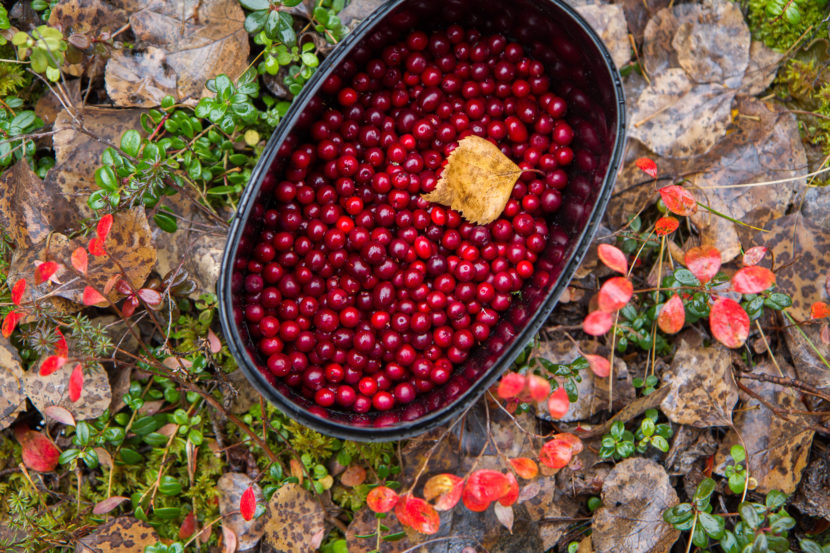
Foraged low-bush cranberries. (Creative Commons photo by Arthur T. LaBar)
The National Park Service Wednesday announced it will allow Native Americans to gather plants on federal land managed by the agency.
U.S. Secretary of the Interior Sally Jewell announced the rule change during a speech to the National Congress of American Indians. She pointed to an agreement between Washington’s Nisqually and Tulalip tribes and Mt. Rainier National Park that allows tribal members to collect bear grass and prairie pine for traditional handicrafts.
Mel Sheldon chairs the Tulalip tribes. He said the new rules helps preserve traditional knowledge.
“Whether there be root gathering, picking blackberries, or getting cedar off the trees for making hats and such things, this is who we are, this is our culture,” he said.
Sheldon uses nettles and other plants for medicinal and naturopathic purposes.
The Park Service first proposed the rule change in April 2015. Commercial gathering of plants on Park Service lands is still prohibited.
The Chilkat Range from Eagle Beach, Nov. 21, 2010. (Creative Commons photo by Joseph)
Four beaches in the Juneau-Douglas area have elevated levels of toxins that can cause paralytic shellfish poisoning.
Eagle Beach, Amalga Harbor, Auke Recreational Area and Outer Point all have toxin levels that exceed the Food and Drug Administration’s limit for safe consumption.
Elizabeth Tobin is a post-doctoral researcher. She and her team collected the data last month. She said it’s not abnormal to see high levels of PSP-causing toxins this time of year.
“Typically we see elevated levels of these toxic algae in May and June, and that’s why we’re having a lot of PSP notifications in the region,” Tobin said.
Tobin is a researcher for the University of Alaska Fairbanks School of Fisheries and Ocean Sciences. They collaborate with the Southeast Alaska Tribal Toxins network, which published the advisory earlier this week on its website.
Tobin’s team tests areas around Juneau and Douglas weekly. She said the only way to know if shellfish is toxic is to conduct lab tests. There are no testing facilities in the region that check noncommercial catches.
“It’s very, very difficult to tell, or to taste, or to eat a small bit and see if you feel funny,” she said. “That’s kind of gambling a bit. So, while some people, that’s the method they use, I tend not to recommend that, it’s not safe.”
Some people associate unsafe areas with red tides caused by certain algae blooms.
“But it’s kind of misleading, actually,” Tobin said. “Specifically for the algae, it’s called alexandrium, that cause the saxitoxins that cause paralytic shellfish poisoning—kind of a mouthful— but that specific species of algae doesn’t produce a red discoloration of the water.”
Tobin said that’s why the advisories are so helpful.
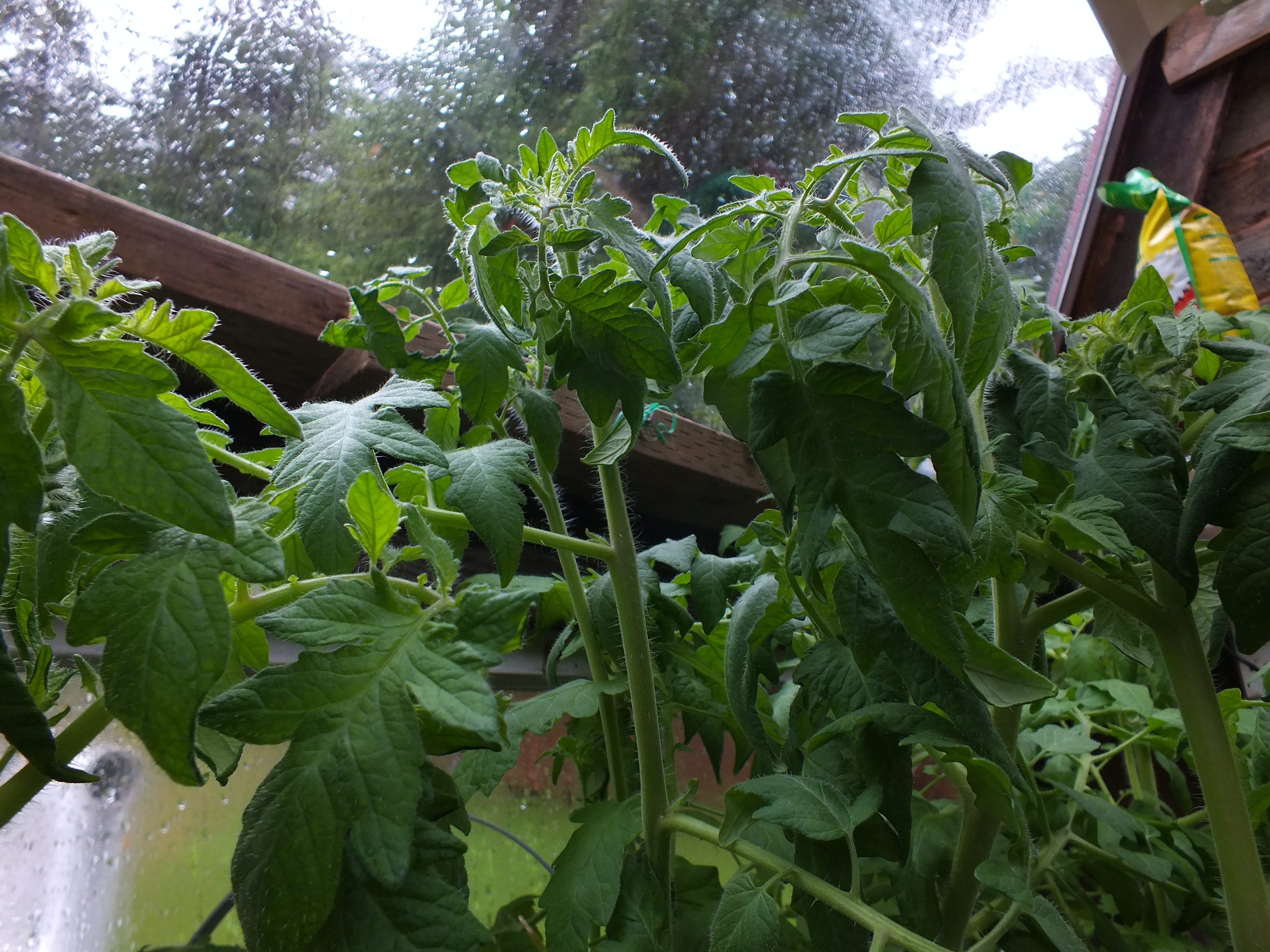
These tomato plants desperately need thinning. (Photo by Matt Miller/KTOO)
Humid, stagnant air is the enemy of the greenhouse gardener.
Master Gardener Ed Buyarski said he keeps his greenhouse as dry as possible. That means frequently leaving the doors and vents wide open, and regularly trimming his tomato plants.
“I’ve talked to whole bunch of folks who commented over the weekend,” Buyarski said. “”Gee, this is a pretty nice dry greenhouse. Not like mine that’s damp, moldy and all that.””
Buyarski said careful watering and getting rid of yellowing leaves also helps keep fungus and disease at bay.
In addition to promoting ventilation, pinching extra tomato stems and thinning the plant should push enough energy to the flowers that will become fruit. Buyarski suggests leaving three to five flower stems on each leaf stem, depending on the type of flower plant.
Listen to the June 30 edition of Gardentalk about tomatoes and greenhouse maintanence:
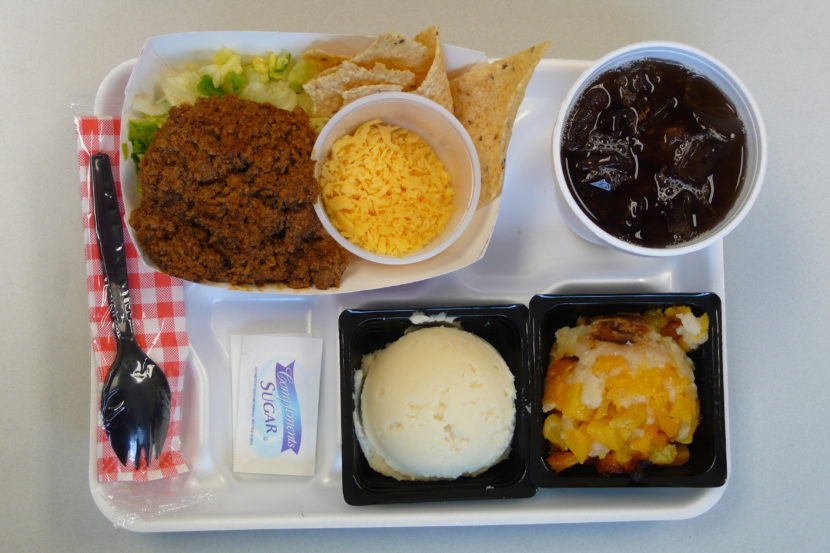
A school lunch of turkey taco salad, iced tea, mashed potatoes and peach cobbler. (Creative Commons photo by Laura Taylor)
Seven million dollars for a brand new kitchen and cafeteria at the Bethel Regional High School survived the governor’s veto pen this week.
BRHS does not have a cafeteria. At lunch, some students sit at tables in the gym while they eat, and others wander the halls.
“But the trouble is the gym at BRHS is used from 6 p.m. in the morning until 8 p.m. at night, including lunch time,” said Susan Murphy, who chairs the Lower Kuskokwim School Board.
At lunch, the gym is split into two sections. And while some students are eating, some have class on the other side. Murphy said this arrangement is not working for kids.
But the biggest reason for building a new kitchen is to consolidate all the different kitchens the district is presently using.
“You have to have store rooms at each of the facilities. You have to have cooks at each of the facilities. It’s much cheaper to have one central kitchen, with one storage area, where all the meals are prepared and then sent out,” said Murphy.
Some of these kitchens may not even be available for the school district’s use for much longer, Murphy said.
“We are now leasing space from BNC for our immersion school Ayaprun. And that lease includes the lease of the kitchen in the BNC building. However, when that lease is up, we won’t have access to that kitchen anymore. And we need a kitchen,” she said.
Murphy said the construction of the building probably won’t happen until next year, but when it does, maybe lunchtime will feel more like a lunch break for Bethel students.
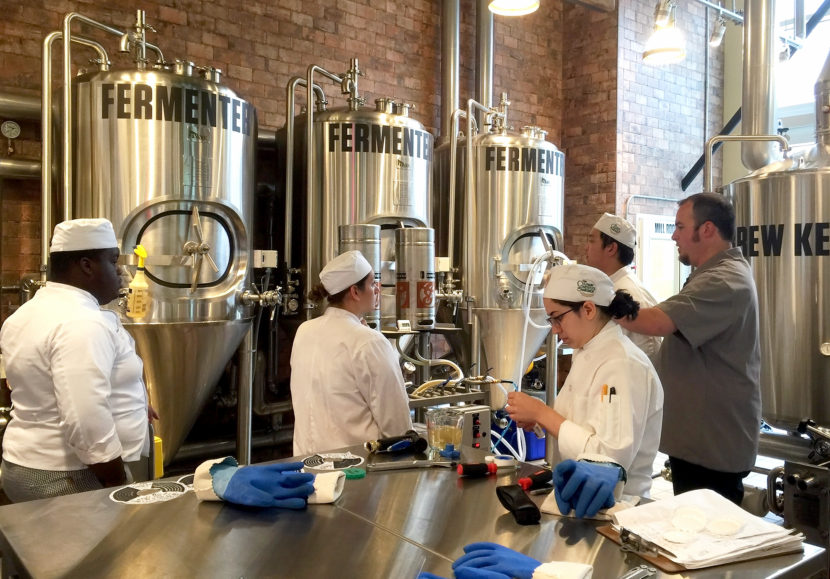
The new brewery at Culinary Institute of America in Hyde Park, N.Y. The school now teaches the art and science of brewing, an elective course. Allison Aubrey/NPR
There’s an explosion of interest in friendly bacteria.
Beneficial microorganisms, as we’ve reported, can help us digest food, make vitamins, and protect us against harmful pathogens.
As this idea gains traction, so too does the popularity of fermented foods such as yogurt, sauerkraut and kimchi.
Though the science is tricky, researchers are learning more about how this ancient technique for preserving food may also promote good health.
For instance, the bacteria in yogurt have been shown to aid digestion, and making cabbage into sauerkraut by fermenting it “increases glucosinolate compounds believed to fight cancer,” explains a Tufts University Health & Nutrition publication.
So, what’s next in fermentation? Chefs and do-it-yourself enthusiasts are using microorganisms to coax new, complex flavors out of foods.
“Cooks around the world have begun to discover (or, more accurately, to rediscover) the possibilities of using fermentation processes in the kitchen,” writes Arielle Johnson, a flavor chemist, in an article titled “Artisanal Food Microbiology” published in Nature Microbiology this spring.
Johnson works for MAD, a nonprofit food organization based in Copenhagen that was founded by Rene Redzepi, the chef-patron of the acclaimed restaurant Noma.
Fermentation, she explains, is loosely defined as the transformation of food by microorganisms. “When you ferment something, you create flavour,” Johnson writes.
From soy sauces to vinegars, breads, cheeses, and, of course, wines and beers, “fermentation processes are key to elaborate well-known delicacies,” Johnson says.
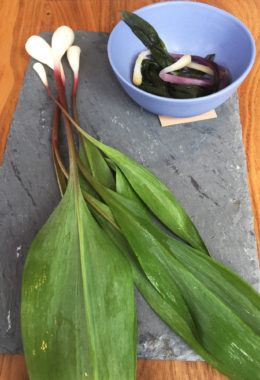
Chef Rob Weland fermented ramps to make a ramp kimchi, which was featured on his menu this spring at Garrison restaurant in Washington, D.C. Allison Aubrey/NPR
Food is biologically transformed by the bacteria and other microorganisms that live in or on it. “In general, a pool of larger-molecular-weight, and usually less flavor-active molecules … are transformed into a more diverse group of tastier, smaller molecules, such as amino acids, organic acids, esters … and aromatic compounds,” Johnson explains.
As more chefs experiment with microorganisms “to transform ingredients and create new flavors,” fermentation has gone from preservation technique to culinary tool — one that’s “every bit as essential as a paring knife or frying pan,” Johnson argues.
In addition to the innovations at Noma in Copenhagen, Johnson points to kitchens around the world, such as Sean Brock’s restaurant Husk in Charleston, S.C., Momofuku in New York, and Bar Tartine in San Francisco, that are experimenting with these techniques.
I visited the kitchen of chef Rob Weland at Garrison restaurant in Washington, D.C. He’s caught the fermentation experimentation bug, too.
During the spring, he fermented ramps to make a ramp kimchi and made an exquisite black garlic aioli.
If you listen to the audio of my conversation with David Greene on Morning Edition, you’ll hear Weland describe how he transformed a simple bulb of garlic into something extraordinary. (Hint: The garlic cooks at low heat in a humid environment for six to eight weeks.) “What comes out, [the] flavors, works wonders,” Weland told us.
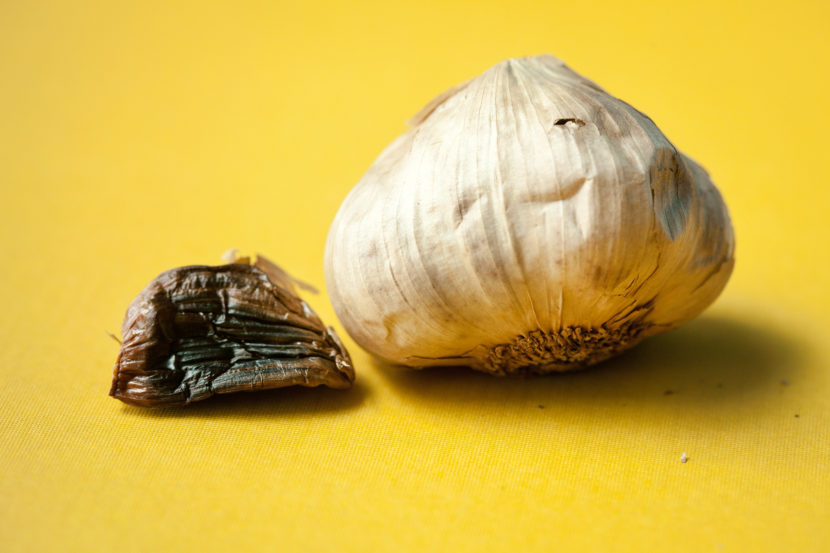
During this aging, a number of chemical processes transform this humble ingredient. For instance, the garlic picks up caramel notes during browning. Hints of dried fruit come out. Also, natural microbes on the garlic bulb can ferment, creating more distinct flavors.
Black garlic: A number of chemical processes transform this humble ingredient during aging. For instance, the garlic picks up caramel notes during browning. Hints of dried fruit come out. And natural microbes on the garlic bulb can ferment, creating more distinct flavors. Morgan McCloy/NPR
“I’m a huge fan of black garlic,” chef Dan Barber of Blue Hill told me. “We serve it with vegetables mostly.” Barber says he’s made his own, but he also imports black garlic from Japan, where it’s marketed under the name Fruit Garlic of Japan. It’s “insanely good,” Barber says.
So, as chefs catch the bug, academics are elevating fermentation to a higher level, too. For instance, there’s now a fermentation certificate program at the University of Wisconsin-Milwaukee.
And, at the Culinary Institute of America in Hyde Park, N.Y., there’s a new focus on the fermented product that has perhaps the widest appeal in our culture: beer. The school now offers an elective course, the art and science of brewing, taught in the newly built brewery on campus.
Students are taught the basics of brewing, with a focus on science. “I would say the most exciting development has been the ready use of wild yeast and bacteria in beer fermentation,” says Hutch Kugeman, head brewer at the CIA.
Using wild yeast and bacteria “allows a range of really interesting flavors in beers, from the tart lemon of lactobacillus to the funky barnyard aromas of brettanomyces,” Kugeman says.
So it seems from chefs to brewers, foodies are turning to microorganisms to amp up flavor.
If you’d like to try this at home, check out DIY sites or a fermentation festival. Sandor Katz, a fermenting enthusiast and author of The Art of Fermentation, keeps fellow enthusiasts in the loop.
Copyright 2016 NPR. To see more, visit http://www.npr.org/.
Close
Update notification options
Subscribe to notifications
Subscribe
Get notifications about news related to the topics you care about. You can unsubscribe anytime.



9(MDEwMjQ0ODM1MDEzNDk4MTEzNjU3NTRhYg004))