Mental Health

House Judiciary chair says there won’t be a gun control law this session

Rep. Matt Claman, D-Anchorage talks to reporters at a House Majority press availability, March 20, 2018. (Photo by Skip Gray/360 North)
Rep. Matt Claman, D-Anchorage, talks to reporters at a House Majority press availability in March. Claman said Thursday that House Bill 75 will not pass this legislative session. The bill is intended to allow Alaska judges to order temporary seizures of guns from people they find likely to be threats to themselves or others.  (Photo by Skip Gray/360 North)

The only gun control measure the Alaska Legislature was debating will not pass this legislative session.

The bill is intended to allow Alaska judges to order temporary seizures of guns from people they find likely to be threats to themselves or others.

House Judiciary Committee Chairman Matt Claman said Thursday that not enough committee members supported House Bill 75.

Claman said the bill foundered on disagreements with the National Rifle Association. Especially over not requiring the subject of the gun violence protective order to be present for the judge’s hearing. These are known as ex parte hearings.

“The bottom line was the National Rifle Association wasn’t willing to support a bill that allowed the ex-parte order to seize weapons,” he said.

Claman said it’s not practical.

“If you call them up and say, ‘Well, let’s go down to court and talk about what’s going on,’ you’re kind of inviting somebody who’s not acting rationally, who may have significant psychiatric issues, and has a gun, you’re kind of inviting them to go off and start doing tragic things, just because we’re trying to give them a chance to be heard in court,” Claman said.

The NRA could not immediately be reached for comment.

Claman said he would continue to work on the issue after the session. This could lay the groundwork for revisiting the legislation next session. Other state legislatures are considering similar bills.

To prevent suicide, little words can make a big difference

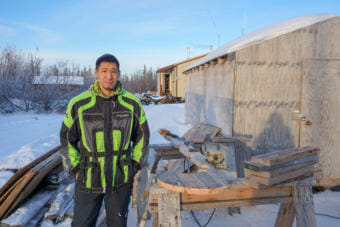
Ben Sherman Jr. stands outside his home in Noatak where he builds sleds. (Hillman/Alaska Public Media)

Noatak is a northwest Arctic village of about 500 people that’s got a lot going for it.

People look out for each other.

Families go fishing, hunting and berry-picking, then share with neighbors.

And within this community safety net, family ties help people who are considering suicide decide to live instead.

Ben “BJ” Sherman Jr. learned that when you’re in that situation, small words can make a big difference.

Bundled in a thick winter jacket, BJ cut wood into thin pieces with his electric saw. He was building a sled outside the small house he shares with his parents and his son.

“I have a few more to cut,” he said, pointing to the slats. “But these are the cross pieces. That’ll lay in between these notches.”

He explained how to make a sled the way his grandfather and uncle taught him, with precision and attention to detail.

Tie the twine tightly. Sand everything down perfectly.

He said they were strict with him, but it was really helpful.

“That just helped me to learn more do things right. You have to take pride in whatever you do, and you have to be taught right.”

BJ didn’t always take pride in his work or in his life.

When he was in his late teens and early 20s, he seriously considered suicide.

“‘Maybe I should just, you know, take my life away,’” he recalled thinking. “‘Maybe I’m not important…’ Once you start thinking negative, it just snowballs and eats up at you. It becomes more and takes hold of you.”

BJ said it wasn’t just one thing.

He and his girlfriend broke up.

Even though he was valedictorian of his high school, he was having trouble finding a job.

He never fully grieved the loss of his older brother, who died in a snowmachine accident years before.

He felt alone.

“I just kept looking down the tunnel,” he said. “Like I don’t have friends. That’s how I kind of saw it, you know because I couldn’t reach out to them.”

Then he got a message from his sister.

She knew he was struggling.

He said he felt ashamed, but he reached out.

Then he talked to the rest of his family, too. They reminded him of something crucial:

“They all told me who I am. What I did. You know, that I did a lot in the past. That I do good things, and I should just keep going,” he said. “‘Don’t think like that,’ they just kept telling me. ‘You’re a special person. We love you, even though if we don’t say it a lot, you know, but through our actions and whatnot.’”

There are a couple of things going on here that are important.

The first is obvious — his family was telling him that they cared about him.

The significance of the other message is a bit more complicated.

“They all told me who I am.”

Some social science shows that young people are more at risk for suicide because they are still figuring out their identities.

Without knowing who you are, it’s hard to picture yourself living into the future.

If you can’t picture yourself in the future, then dying doesn’t seem like as big of a deal.

Being reminded of who you are and what role you play in the community makes a difference.

BJ remembered being told, “I am part of this world. I’m an uncle, a brother” — his roles in his family.

BJ’s ties to his cultural identity through his work and his family are a big part of this.

Cultural identity, especially in indigenous communities, helps people understand their place in a larger context.

With family and community support, BJ worked through his thoughts about suicide. Now he’s an adult. A father.

As he stood over the wooden sled outside of his home, he took on another identity.

“I love teaching, also, when I’m making something because… what I believe is you shouldn’t keep things that you know (to yourself) because someone did teach you and you have to pass it on,” he said.

He tries to pass these lessons on to his son and to other young people who ask about sled building.

He encourages them as his relatives did for him, trying to keep them healthy, engaged, and alive.

If you or someone you know is thinking about suicide or just needs someone to talk to, you can call the Alaska Careline at 1-877-266-4357 (HELP). Outside of Alaska call the National Suicide Prevention Lifeline at 1-800-273-8255.

Want to hear more Solutions Desk stories? Subscribe to the podcast on iTunesStitcherGoogle Play, or NPR.

Building resilience through basketballs and berries

Photos of local elders line a classroom wall at Napaaqtugmiut School in Noatak. (Photo by Anne Hillman/Alaska Public Media)

What makes a healthy community? What makes young people in a village thrive? The young people in Noatak have some good ideas.

High School Junior Esther Barger bends her knees and vaults off the bare gym floor onto a two-foot tall wooden box. Her teammates sprint by and run through short obstacle courses. No chatter, no complaining. Just intensive focus.

Basketball players run drills at Napaaqtugmiut School in Noatak. (Photo by Anne Hillman/Alaska Public Media)

Esther grimaces as she completes the drills, but she says she likes it. “It’s only fun to me because I get to challenge myself, and I get to improve.”

And she’s not just improving her athletic abilities. Esther says being on the team has helped her overcome her shyness with teammates and everyone else.

“I’m not very social but since we get to know each other, it helps me talk more,” she says. “And it helps outside of the sport, too.”

Noatak stands out as a healthy village. People who live there know it, and so do researchers who study things like resilience.

Community members show up to support the kids and encourage them to do well at school, she says. And not just at basketball games, which are very popular. Elders and adults, like Thurston Boots, are in the school everyday.

Thurston drops off his granddaughter, then just sits in the entry for over an hour, watching and chatting. Every morning.

“Oh, I like to be around the kids, too,” he explains. “You know, we got lots of kids out here, and I just make sure they have good discipline for the teachers.”

Thurston says discipline, respect, and sharing are key values in the village. Dozens of people repeated the same sentiment — it’s the kind of place where if someone has extra food from dinner or a hunt to share, they announce it over the VHF radio.

Thurston says his elders taught him those values, so he teaches the young people.

Thurston Boots, 62, visits the school in Noatak every day. (Photo by Anne Hillman/Alaska Public Media)

“Everybody works together, and when somebody needs something we pass it on,” he says. “Everybody here in this community, there are just like one big family. They all share everything every. As we learned from our grandfather and grandmother (that’s who) shows us how to do it.”

On the surface it seems like these things are just typical parts of a pleasant community. Kids are involved with sports. Adults play active roles in their lives.

But really — it’s these little things that matter. Researchers say that its these connections that create a safe and supportive environment that allows young people to take risks and mature in healthy ways. They learn their strengths, understand their roles in the community, and figure out who they are.

Noatak is not perfect. Brianna Kirk will tell you that. She grew up in the village, left for college, then recently came back to work as the school counselor. She says she can tell which kids come from families that participate in village life and in subsistence activities, and which kids don’t.

“We do lack a lot of things,” she says. “Like I deal with kids that sometimes have home issues that they bring into the school, and it affects their ability to perform in the classroom. It affects their friendships. There’s so many stresses and things that affect students and all the way from kindergarten to high school.”

Brianna was in middle school when about 10 years ago, a community member died by suicide. She says she still remembers how that felt, and it shapes her work today.

That means helping everyone know what signs to look for, how to jump in when someone is struggling, and how to keep kids engaged.

Community members wait for the plane to land at the airstrip in Noatak, a village in the Northwest Arctic. (Photo by Anne Hillman/Alaska Public Media)

“It’s taught us a lot about how much one life being taken from us can affect everybody, I think,” she says. “With someone like myself and the other staff in the school that were here when it happened, we always have it at the back of our head. And we want to keep our students safe as much as possible.”

For Esther, from the basketball team, engagement goes well beyond the court. Every year she goes fishing and caribou hunting with her family. But her favorite thing to do is berry picking.

“I like to race my mom because she’s been berry picking a lot more than me. So I’m very competitive,” she says, laughing.

They fill their freezers and build their relationships all at the same time.

Noatak is not the only community in Alaska that successfully supports their young people and families. Over the next few weeks on the Solutions Desk, we’ll be exploring different ways individuals and communities are becoming more resilient. Follow along by subscribing to the podcast on iTunesStitcherGoogle Play, or NPR.

Alaska Ocean Center loses out to state parking lot

Conceptual plans for a future “Juneau Marina District” would include a yacht marina, berth for small cruise ships and the Alaska Ocean Center on land that includes a 2.8-acre parcel owned by the Alaska Mental Health Trust. (Courtesy of MRV Architects)

Developers behind the proposed Alaska Ocean Center say their project is likely dead in the water.

The Alaska Mental Health Trust Land Office agents have decided to lease the waterfront parcel the developers were interested in for a parking lot.

The Alaska Ocean Center is a proposed marine science visitor attraction and research facility on the waterfront.

The key to the project is a 2.8-acre parcel owned by the Alaska Mental Health Trust. The land was the site of a homeless encampment last summer until the Trust Authority served trespassing notices and cleared the land.

Juneau developer Doug Trucano offered $3.24 million after the Trust Land Office put the parcel up for sale in 2016. He proposed partnering with the Alaska Ocean Center and sharing space.

One of the organizers behind the ocean center, Bob Janes and his business partner thought they had a deal – up until Jan. 31.

That’s the date the state Department of Administration awarded the Trust Land Office a tender to convert the vacant parcel into 102 parking spaces for state workers.

“This came right out of the blue without any indication that it was going to come at all,” Janes said Thursday. “We were ready to sit down and complete the deal with them at that point in time.”

Juneau City Manager Rorie Watt said the Trust Land Office’s decision to go with a parking lot is confounding.

“We’re really disappointed, we sent a resolution encouraging them to proceed with the sale of the property,” Watt said. “We think it’s in their economic best interests and the money they would get from a parking lot is substantially less than what they would get from sale of the property.”

How much less? The ocean center’s board asked analysts at the McDowell Group to answer that question.

The firm did the work gratis and its findings were clear: investing the $3.24 million from the sale over 20 years would have a far greater return than the approximately $83,000 a year the state will pay to lease the land for parking.

“The Trust could realize about twice as much income from sale of the property as they could from leasing the property for parking,” analyst Jim Calvin said.

(Photo by Rashah McChesney/Alaska's Energy Desk)
Waterfront land owned by the Alaska Mental Health Trust Land Office seen here on Nov. 8 would be key to Trucano Construction’s plans for a new yacht marina and berth. (Photo by Rashah McChesney/Alaska’s Energy Desk)

The Trust Land Office doesn’t see it that way.

Leasing the parcel is a short-term arrangement that doesn’t preclude future deals, Executive Director Wyn Menefee said.

“We are not comparing this short-term lease with those other offers,” Menefee said. “That’s not a comparison we’re making, because we see this as short-term, the other ones are long term. And so this does not discount our consideration of other offers.”

But there’s a question of whether the ocean center and its partners can wait at least another two years.

“If this lease occurs, the ocean center project will probably die on the vine,” Janes said. “Doug Trucano, who is putting in the small cruise ship and visiting yacht harbor, will pull out and move to other projects in other places. This is going to be a big loss for Juneau in many ways.”

In recent years, the Alaska Mental Health Trust Authority has undergone turnover in staff and leadership as it undergoes a legislative audit examining its business and investment decisions.

Correction: An earlier version of the story misidentified the proposed marine center attraction. It’s to be the Alaska Ocean Center, not the Juneau Ocean Center.

Editor’s note: KTOO’s building sits on land leased from the Alaska Mental Health Trust Authority. KTOO has also applied for and received occasional grants for special reporting projects from the authority.

Man who feared Nazi SS officers, led police on high-speed chase sentenced to probation

Assistant District Attorney Bailey Woolfstead, left, walks past Cecil Trent Yeisley and his aunt Monday, January 8, 2018, after Yeisley's sentencing before Judge Philip M. Pallenberg in Juneau Superior Court. Yeisley was sentenced to probation as part of a plea agreement. (Photo by Matt Miller/KTOO)
Assistant District Attorney Bailey Woolfstead, left, walks past Cecil Trent Yeisley and his aunt Monday, Jan. 8, 2018, after Yeisley’s sentencing before Judge Philip M. Pallenberg in Juneau Superior Court. Yeisley was sentenced to probation as part of a plea agreement. (Photo by Matt Miller/KTOO)

A man who led Juneau police on a high-speed car chase in late 2016 claimed he was frightened by Nazi SS officers. He was sentenced to probation Monday in Juneau Superior Court as part of a plea deal.

Cecil Trent Yeisley, 24, must serve three years on probation for felony assault and a misdemeanor charge of failure to stop for a police officer.

The night before the police chase, Yeisley allegedly threatened property with a machete. Police responded, Tasered him and took him to Bartlett Regional Hospital for a mental health emergency.

Yeisley’s public defender, Eric Hedland, said that incident lead to the underlying arrest. Hedland read from a prepared statement.

“He was not supervised properly and was able to simply walk away. Eventually he arrived at his father’s residence downtown,” Hedland read. “His mother picked him up the following morning to bring him back to Bartlett.”

Hedland said when he saw an officer, his client feared being arrested and Tasered again. Yeisley’s mother tried to stop him from driving away, and even reached into the car to hold him.

Assistant District Attorney Bailey Woolfstead said the defendant was experiencing extreme mental health difficulties.

“She was trying to get him help. His reaction was to push her out of a moving vehicle to lead police officers on a high-speed chase … because according to him — this man, this SS officer who had a gun and was threatening him — he had to kill someone, or he was going to die,” Woolfstead said.

Superior Court Judge Philip M. Pallenberg said it was a scary and serious situation for all parties, including the defendant.

“Whether it’s a mental health problem whether it’s an addiction drug problem, or whether it’s something else … the people who were frightened or placed at risk, it doesn’t make them feel any better about what happened to know that you were not in your right mind at the time.”

Yeisley’s lawyer said his client plans to move to Ketchikan to live with his grandmother and seek mental health counseling. Other family members sat in court during the sentencing.

He must have a mental health evaluation within 90 days and mental health counseling or treatment. He was also ordered to not drink alcohol, or go into a bar or liquor store without permission from his probation officer.

If he violates his probation, he may have to serve the remainder of a four-and-a-half-year sentence. Yeisley has already served a  year and a half jail time.

Other charges were dismissed as part of the plea agreement.

KTOO’s Matt Miller contributed to this report.

Wrangell schools roll out anonymous, anti-bullying app

Anti-bullying campaigns are increasing across the nation, bringing to light the scale and impact of harassment in schools.

Wrangell Public Schools just rolled out an app to help address that issue. Students can now anonymously report incidents of bullying.

Riley Hall, a behavioral health clinician at Alaska Island Community Services in Wrangell, spends 10 hours a week at the middle and high schools offering counseling.

He said bullying is a common concern for his student clients.

“It can look like getting pushed around in the hallway, getting called names,” Hall said. “It can become more violent both, physically or sexually. And now, in this wonderful era of technology, people can send out damaging emails or Facebook posts or tweets.”

Hall also is part of the Wrangell Early Prevention Coalition, made up of coaches, pastors, all sorts of folks who work with youths.

The group says bullying is an issue they want to tackle.

One way they are doing that is with a new app for students to report incidents of bullying.

The app is called Anonymous Alerts.

The company that owns the app claims more than 5,000 schools already are using this product.

Grants and school insurance are paying for the service.

Hall and school counselors can offer support to anonymous students entirely through the app.

“It’s not really they send it and they’re done. It’s more that it starts a conversation with a counselor at the high school,” Hall said. “And then we can follow up and ask if they are currently in danger, where is it happening. They can tell us a little bit about who’s causing the problem for them. And we can offer them help or support while they remain anonymous.”

Almost a quarter of high school students in Alaska say they were bullied at school in the past year, according to an Alaska Department of Public Health survey released this year.

The Southeast Alaska Regional Health Consortium conducted its own survey within Wrangell Public Schools. and got similar, but sometimes worse, results.

Close to 40 percent of secondary students say they were bullied in the past month.

“Research is showing that there is a link between kids that get bullied at school and other psychiatric mood disorders like depression or anxiety,” Hall said. “In extreme cases there can be trauma symptoms.”

The same state survey reports a third of all high schoolers have felt hopeless consistently for two weeks or more.

And a fifth of students have suicide plans.

“Bullying, there’s kind of the conventional wisdom that it’s a phase that kids go through, and they get over it,” Hall said. “While that is true for some kids, there is quite a bit of evidence that for some kids this can have some pretty long-reaching, devastating effects.”

In-person counselling sessions can curb the emotional impact.

But Hall said the anonymous app gives students an extra layer of protection.

Maybe they fear retaliation from the bully, and want to take all precautions.

Plus, it can be awkward to go to an adult and tell them about personal stuff they’re going through.

“We’re not predicting that this is something kids are going to be using every day,” Hall said. “It’s more like a tsunami evacuation plan. In the case a kid really needs it, it’s there for them.”

Petersburg School District secondary principal Rick Dormer agrees. His district rolled out a similar system in 2013.

Dormer said in a small town like Petersburg or Wrangell, teachers and administrators have a good pulse on what’s happening at school. But it also means the communities are so close-knit, it can be hard to come forward with a complaint.

Dormer said school staff tiptoe around this. They won’t just go up to Johnny and say “we’ve gotten reports that you’re up to no good.” They just keep a closer eye on suspected students, seeing if they catch anything on their own watch.

“Then teachers can jump in and it isn’t, you now, someone ratted on their friend,” Dormer said. “It was ‘Hey I just saw you push that kid.’ Instead of the roundabout playing into the social dynamics or drama of kids, which is always tricky.”

Wrangell’s secondary school principal Bill Schwan said it’s too early to tell how his administration will address the reports.

He’ll keep it on a case-by-case basis as they start coming in.

Site notifications
Update notification options
Subscribe to notifications