The Alaska Psychiatric Institute in Anchorage. (Photo courtesy of the Alaska Department of Health and Human Services)
A small number of Alaskans experiencing psychiatric crises are being diverted from healthcare facilities to custody within the Department of Corrections. Critics worry the emergency measure is not only unlawful, but putting patients in jeopardy.

Since Oct. 5, the Alaska Psychiatric Institute has had to reduce the number of available beds due to staffing and safety concerns.
With fewer beds available, individuals involuntarily committed under the state’s Title 47 law are being brought to private hospitals, but also to state-run correctional facilities for holding.
So far, four patients in need of acute mental care have been placed inside jail or prison buildings.
Duane Mayes is the CEO of API and said right now the facility has several high-need patients who require multiple staffers to be on-hand out of safety concerns. That, according to Mayes, has reduced the number of available beds from 58 to 49.
“When we realize we cannot take more (patients), we inform those entities such as the hospital, DOC, that we’re not able to do that, because of the capacity issue,” Mayes said.
Only a few weeks into his new role as the head of API, Mayes said he had been informed by staff that shifting patients over to correctional facilities amid psychiatric emergencies is not unprecedented, and has happened in the past.
But that might not be accurate.
Laura Brooks, who works with DOC’s Division of Health and Rehabilitation, said the Department is not accustomed to absorbing mental health patients who have no criminal charges against them.
“This is a new process for us,” Brooks said.
In the Anchorage area, those committed involuntarily under Title 47 because of substance abuse issues severe enough to pose a threat to themselves or others are being sent to the Anchorage Correctional Complex or Hiland Mountain Correctional Center.
“We have mental health units for the criminal population and so we are going to house them on those units, in separate cells, but we will house them on those units,” Brooks said. “We will not be putting these individuals in our general population areas.”
Of the four Title 47 patients put into DOC custody during the last week, one has since been released.
Retired mental health court judge Stephanie Rhoades thinks this practice is a misapplication of involuntary commitment laws and puts patients in jeopardy.
In an email, Rhoades wrote that laws governing Title 47 allow individuals to be held in jails only as a last resort.
She pointed to a section in the code that reads, “A person taken into custody for emergency evaluation may not be placed in a jail or other correctional facility except for protective custody purposes and only while awaiting transportation to a treatment facility.”
According to Rhoades, that provision was meant to be applied in rural areas when inclement weather or a delay in a plane arriving necessitated keeping people in small community jails. Use of correctional facilities as an overflow option for API was never the intention, and Rhoades believes it is a violation of patients’ rights.
David Flourant with the Disability Law Center agrees, and thinks housing psychiatric patients in correctional facilities could hinder recovery.
“There’s a significant difference between being placed in jail and being placed in a psychiatric facility that provides treatment and care for someone that has a mental illness,” Flourant said. He cited a case where individuals placed in jail instead of a therapeutic environment demonstrated “aggravated symptoms as a result of that placement.”
Flourant feels the state has not been adequately transparent about why it decided to put patients in correctional facilities rather than in nearby hospitals.
The Alaska Psychiatric Institute says each day it is evaluating whether it can open more bed space for new patients. In the meantime, DOC says correctional centers around the state are preparing to potentially house patients needing urgent mental healthcare.
“The way that I have conversations with people, instead of saying ‘Me too,’ sometimes I’ll say ‘Same.’” Holtkamp explained.
She says the idea of the show happened out of conversations with her friends and colleagues who were angry that stories about gender-based violence weren’t being heard.
The show isn’t based on a script, like a play. There are 10 stories that will be 6-7 minutes each.
“If people are familiar with Mudrooms, it’s a lot like that. What makes it a little bit different than Mudrooms is every story is directed. So they’ll be prepared pieces, everyone will come in with a prepared piece. Some of them will be memorized, some of them will be read, some of them are poetry, some of them have theatrical elements,” Holtkamp said.
She says the staff at AWARE, a local shelter and support center for survivors of gender-based violence, helped guide her through one of the most important parts of the process – coming up with a good title.
“It was going to be called Bloodrooms…they [AWARE] steered me a little bit away from the scarier name, for a few different reasons, because it’s kinda scary subject matter to begin with, and also I wanted people to attend,” she said.
Actor Doniece Gott will read her own story as part of the performance. Gott is an experienced actor, but this project is different.
“I am excited, I’m scared, I hope I can get through it without crying, and I hope that I can reach someone in the audience to help them have that feeling of same, or that feeling of solidarity, then maybe healing,” Gott said.
Visual artist Christine Carpenter will also share her own story on Saturday. In addition, her artwork based on diary entries she wrote about her own experiences will be on display in the theater.
“I took those and used them as a way to share my story and a way to heal and a way to visually communicate my internal pain that I was feeling, and my internal healing process.”
The team has worked hard to make both the audience and performers feel safe as these real life experiences are shared on stage. Including making a representative from AWARE available to anyone who needs support immediately.
Ultimately Holtkamp wants the audience and performers to experience catharsis, hope, and a sense of togetherness by the end of show.
“Live theater…it is a lot like church. There’s so much healing that can come in live performance.”
“SAME: Local Stories of Gender-Based Violence” premieres this Saturday evening, September 22, 7:30pm on the Main Stage at Perseverance Theater. All proceeds from admission will benefit AWARE.
Correction: In an earlier version of this story, we indicated incorrectly that AWARE co-produced this show. AWARE services are completely confidential and they do not share any information with outside sources. They offered advice to the director about trauma informed practices and strategies to address secondary trauma, and support to the performers and audience members.
Actor and AWARE Equity Coordinator Austin Tagaban performs the anonymously submitted monologue “Consent” as part of the production Same. (Photo by Annie Bartholomew/KTOO)
Hear Juneau actor and AWARE Equity Coordinator Austin Tagaban perform the anonymously submitted story “Consent” from “Same.”
Listener warning: this audio clip contains explicit language and descriptions of sexual assault.
This version has been edited for explicit language, but does contain descriptions of sexual assault.
The Dimond Courthouse in Juneau in February 2017. An Aug. 6 assault in a courtroom has raised concerns about security. (Photo by Jeremy Hsieh/KTOO)
A 26-year-old Juneau man spent roughly six months in jail for allegedly assaulting his grandmother. Then the man, who’s diagnosed with paranoid schizophrenia, is alleged to have done it again — this time in a Juneau courtroom. And it took 11 minutes for a law enforcement officer to arrive.
The incident is raising questions about courthouse security.
On Aug. 6, Konnie Chitty was testifying in a closed guardianship hearing for her grandson Tyler Leatham on the third floor of the Dimond Courthouse. The hearing would help determine if the state would become the guardian for Leatham.
“While I was standing just like this, speaking directly to the judge, my eyes not wavering, my grandson jumped from right here, beside his attorney, and knocked me out in one punch,” Chitty said.
While Leatham stopped the assault after his mother and others in the courtroom urged him to stop, it took time for help to arrive.
“There was only two of us in this, beside his attorney, the judge (and) his secretary, both pushing a panic button inside a locked room and no one came,” she said.
The courthouse had two judicial services officers, who would have been responsible for responding, but both were guarding prisoners at the time. A Juneau police officer outside of the courthouse responded and arrived 11 minutes after the alarm.
For Chitty, the incident raises two concerns. One is about courthouse security. The other is about whether the state provides enough mental health treatment to those like Leatham who need it.
Chitty said the statewide need for in-patient mental health treatment far exceeds the capacity of the Alaska Psychiatric Institute.
“He does not particularly need prison, but a mental health institution,” Chitty said.
Chitty had this concern before the August incident. After Leatham’s first alleged assault against her in February, he was first jailed, then flown to Anchorage. His family understood that the state was seeking to move him to the state psychiatric institute. However, Chitty said that never happened and he spent much of his time in solitary confinement.
“I don’t know if we’re going to get help for our Tyler,” Chitty said.
Neil Nesheim is the area court administrator for Southeast Alaska. He was working nearby when the incident occurred. He said judicial services or Juneau Police Department officers are generally in courtrooms at the request of one of the parties or the judge.
“If somebody would be considered dangerous and a threat in the courtroom, certainly either party or either attorney could ask the court to provide some sort of JS officer or JPD officer or state trooper to be present, if that were the case,” he said. “To my knowledge, we haven’t received anything along those lines.”
Nesheim said those who work in the courthouse learned from the August incident.
“It was an unusual incident,” he said. “I don’t think anybody expected that really to happen. Certainly it’s one of those things where it’s one for the learning books in terms of what to look out for in terms of: Does someone have any mental health issues and would they be considered a danger to society or those people in the courtroom?”
Nesheim said the incident may lead to having more security in the courthouse.
“I would expect that the change would primarily result with the additional staff of judicial services officers,” he said. “Right now, they only have two. Typically in the past they’ve had three. I don’t know if that’s because of budget cuts or just the inability of being able to find somebody. But simply the presence of another judicial service officer would certainly help.”
Chitty flew down to Seattle last week to have her injuries from the incident checked out.
“It’s been horrible for our family, but we are moving forward,” she said.
Leatham has been in Juneau’s Lemon Creek Correctional Center since the incident. And Chitty said the state has been granted guardianship over him. That means the state will provide for his treatment and everyday living needs.
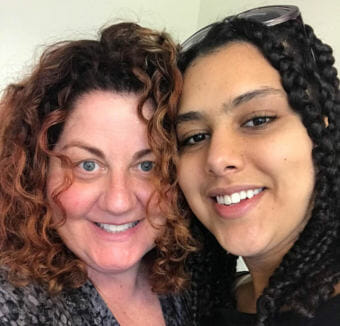
Regina Ibrahim and her daughter, Nadja, take a selfie together during a recent visit to Western State Hospital (Photo courtesy Regina Ibrahim)
On the evening of August 14, 2010, Steve and Laurie Jenks were returning to their motel from a wedding in Walla Walla. It was dark and Steve, who was driving, had been warned to watch for deer along Highway 124.
Just outside the town of Prescott, Steve said he thought he saw a deer coming out of the ditch onto the two-lane road. As he slammed on the brakes, the car veered across the center line into the path of an oncoming Jeep.
The two vehicles smashed nearly head-on — glass, metal and plastic exploding the quiet summer night.
Everyone survived, but Laurie would never be the same again. She had suffered a severe brain injury that left her in a coma-like state for nearly a month. When Laurie emerged from the coma, her personality had changed — a common effect of traumatic brain injuries. According to Steve, Laurie became erratic, angry and difficult to control. She would yell and swear and also bite, kick and slap.
Because of these behaviors, Steve struggled to find care for his wife. He quickly discovered Washington state lacks facilities to treat brain injury victims with behavioral issues — especially those like Laurie who are on Medicaid, the state’s insurance program for the poor and disabled.
By 2015, nearly five years after the accident, Laurie had cycled in and out of several group homes and was placed in a hospital unit where older patients with mental disorders are treated.
Desperate to find Laurie help, Steve heard about a neurologic rehabilitation facility called Brookhaven Hospital two-thousand miles away, in Tulsa, Oklahoma. Washington’s Medicaid program, he discovered, would pick up the $1,000 a day tab.
“I really wanted to get her out of hospital, but I didn’t want her halfway across the country either,” Jenks said.
Laurie Jenks was not the first, nor the last Washingtonian to go to Brookhaven. Between 2014 and 2017, Washington’s Medicaid program sent 16 brain-injured patients to Oklahoma. In each case, the patient flew by air ambulance at a cost of $230,000 per flight.
But there was one problem. The state didn’t have any plan to get them back.
In fact, once the patients got to Brookhaven they fell between the cracks of two state agencies. As a result, some of them stayed in Oklahoma for years during which time no official from the state’s Medicaid program went to visit them. In the end, what began as hospital-level rehabilitation care morphed into a very expensive form of long-term care. It wasn’t until a doctor at the state’s Medicaid program sounded the alarm that efforts began to bring the patients home.
The ‘total package’
In 2014, Washington’s Medicaid program had signed a contract with Brookhaven to provide care to hard-to-place brain injury patients.
According to Nancy Hite, a nurse with the Medicaid program, Brookhaven offered a “total package” to help these clients with their neurobehavioral needs. They would get one-to-one care and access to five to six hours a day of therapy.
Jenks was under the impression Laurie would stay at Brookhaven for a few months and then return to Washington more stable and ready for a long-term placement. But months stretched to years. Laurie Jenks is one of three patients from Washington who remain at Brookhaven — although all three are expected to be relocated to other facilities this month.
While at Brookhaven, Jenks said Laurie’s behavior improved. But physically, she declined. When Laurie first got to Brookhaven she could walk with help. Over time, she became confined to a wheelchair.
Several months ago, Jenks said Brookhaven staff informed him they didn’t expect to see any significant progress in Laurie’s condition.
“They’ve told me they’ve given up on trying to do any substantive rehab, they’re just basically trying to keep her from declining, which they’re not really doing all that well,” Jenks said.
Brookhaven CEO Rolf Gainer declined to comment on Laurie Jenks, citing patient privacy, but said it’s common for people with brain injuries to age more quickly.
“They’re going to experience some deterioration in their functional skills at an earlier rate than individuals without a brain injury,” Gainer said.
Jenks isn’t the only relative to question the quality of care at Brookhaven.
Nadja’s story
In March 2016, Regina Ibrahim traveled with her then 22-year-old daughter Nadja via air ambulance to Tulsa from Seattle. Like Laurie Jenks, Nadja, who had suffered an infection after brain surgery, had been approved by Washington’s Medicaid program to go to Brookhaven Hospital.
But when they arrived by ambulance at the single-story facility in east Tulsa, Ibrahim said she was told she couldn’t accompany Nadja past the front lobby. It was not the welcome she had expected.
“I looked at the lady, I said, ‘Do you really think that I’m going to take my kid someplace and drop them off and not see where they’re going to be living? Are you kidding me?’” Ibrahim said.
Steve and Laurie Jenks at a wedding in 2010 shortly before a head-on car crash left Laurie severely brain injured. (Photo courtesy Steve Jenks)
Gainer, the Brookhaven CEO, said visitors generally are not allowed on to the treatment units for privacy and confidentiality reasons.
Eventually, Ibrahim said, they relented and let her into the locked unit. Ibrahim helped Nadja get settled, filled out some paperwork and met with the director of neurologic rehabilitation. When it was time to say goodbye, Nadja didn’t want her mother to leave.
“She goes, ‘You can’t leave me here, you can’t,’” Ibrahim recalled in a recent interview. “And I said ‘Nadja.’ I said, ‘I have to leave you here,’ I said, ‘because we have to get you better’ and I left.”
Nadja’s case was complex. Beginning at 19, she’d experienced delusions and been diagnosed with schizophrenia. Later, doctors discovered a benign brain tumor. But after she had surgery to remove it, Nadja developed an infection. Her mother believes that infection caused permanent damage to Nadja’s brain, although she’s never been formally diagnosed with a brain injury.
It was Nadja’s history of hospitalizations and increasingly difficult to manage behaviors that eventually resulted in her going to Brookhaven. Six months after she arrived, Ibrahim returned to Tulsa for a visit. What she found alarmed her.
“It wasn’t the child that I left there, let’s put it that way,” Ibrahim said.
She said Nadja was aggressive and erratic. She would yell expletives and wouldn’t let her mother touch her. “She was like animalistic, in survival mode,” Ibrahim said. “Nadja was not like that before.”
When Ibrahim returned home after visiting Najda, she said she called Washington’s Medicaid program.
“I said, ‘I’m not really sure what’s going on down there,’ I said, ‘But I’m telling you there’s something not right going on down there and I think you guys need to go pay attention to it and look at it,’” Ibrahim said.
Quality of care
Brookhaven Hospital describes itself as a “comprehensive mental health center” that serves patients with psychiatric diagnoses, chemical dependency, eating disorders and traumatic brain injury.
The Neurologic Rehabilitation Institute at Brookhaven is an accredited, 36-bed unit in a separate wing of the facility that offers a range of services to severely brain-injured patients with “neurobehavioral, psychiatric or substance abuse problems,” according to Brookhaven’s website.
Brookhaven offers its brain injury program to state Medicaid administrators as a solution for the hardest-to-place patients.
“Often, these individuals have long histories of violent and aggressive behaviors,” reads a promotional page on the NRI website. “Many of them have had numerous encounters with law enforcement — or may even be currently incarcerated.”
According to brain injury experts, the best outcomes are achieved when a severely brain-injured patient receives inpatient, acute care rehabilitation immediately following their hospitalization for their injury. But Brookhaven targets a different clientele — individuals who are often many years past their injury but have not been successful in community-based settings.
“The type of patients that we see at (Brookhaven) are unique and there’s a real gap in services for these individuals,” said Gainer, the CEO of Brookhaven, during a May visit to Tacoma to attend the Brain Injury Alliance of Washington annual conference.
Because of patient privacy, Gainer wouldn’t speak directly to the care Regina Ibrahim’s daughter Nadja received at Brookhaven. But he defended his program’s track record, noting that the hospital is required to document all care and services provided and files monthly progress reports on each patient.
Brookhaven Hospital CEO Rolf Gainer said his facility has a track record of good results with patients and positive ratings with families. (Photo by Austin Jenkins/Northwest News Network)
“We provide a very high level of service,” Gainer said. “We have an outcomes study that’s been running for many, many years tracking our outcomes and comparing it to benchmark studies and our outcomes are consistently very, very high.”
Gainer added that Brookhaven earns “high and positive” ratings with families and referral sources.
One person offering praise for Brookhaven: Paul Linnes, whose longtime partner Michael Oakley was the first Medicaid patient from Washington to go to Brookhaven.
In November 2013, Oakley had collapsed at home. Linnes called 911 and began CPR before the paramedics arrived and took over. During the several minutes it took to get his heart beating again, Oakley’s brain was deprived of oxygen resulting in what’s known as a severe anoxic brain injury. As a result, Linnes said Oakley was often disoriented and could be aggressive. Oakley wound up in the hospital because no long-term facility would take him because of his behaviors.
Linnes found Brookhaven Hospital while doing an internet search for neurologic rehabilitation facilities that took Medicaid. And it was Michael Oakley’s case that led Medicaid to meet with Brookhaven representatives, and ultimately sign the contract to send patients there.
Linnes said once Oakley was approved to go to Brookhaven, things moved quickly. In March 2014, Oakley was discharged from the hospital and put on the medical flight to Tulsa with Linnes at his side.
“The hardest day of my life was having to fly home from Tulsa the very first time,” Linnes said.
But he took comfort knowing Oakley was now at a facility where he would get one-on-one care for his brain injury and related behaviors. It didn’t take long to see signs of progress.
“Michael began to thrive,” Linnes said. “He really, really took well to their therapeutic techniques.”
Paul Linnes, left, and his partner Michael Oakley, a patient at Brookhaven Hospital, at a Tulsa, Oklahoma, restaurant they often frequented for lunch. (Photo courtesy Paul Linnes)
Oakley stayed at Brookhaven the longest of all the patients — more than three-and-a-half years. He returned home last November after developing serious medical complications related to his injury. In May, six months after returning home to Washington, Oakley died.
“I look at those months as a gift,” Linnes said. “I used to tell him, ‘You’re back home now and I’m so happy you’re closer to home and I get to see you more often and that makes me really happy.’”
Once Washington’s Medicaid program had a contract with Brookhaven, word got out in the brain injury community. One of the people spreading the word was Janet Mott, a clinical case manager on contract with the Brain Injury Alliance of Washington State. Mott said until that point there were few, if any, options for brain-injured patients with severe behavior issues. Now there was a place to go.
“People began to say, ‘Oh there is some hope,’” Mott said.
Janet Mott of the Brain Injury Alliance of Washington visited Brookhaven Hospital several times and was impressed with the care. (Photo by Austin Jenkins/Northwest News Network)
Later, Mott became a regular visitor to Brookhaven. In fact, between 2014 and 2017, Mott said she made at least half a dozen trips to Tulsa. She’d become a guardian for one of the Washington patients.
Like Linnes, Mott was impressed with the care.
“I observed staff being respectful and appropriate with the patients and in general people were making progress, but slowly,” Mott said in an interview.
Mott said she didn’t expect the patients from Washington to remain at Brookhaven forever, but she wasn’t alarmed that their stay extended from months to years. “I never anticipated that they’d be back home to the state of Washington quickly,” Mott said. “These were people with multiple needs, complex needs, very severe limitations or deficits.”
If anything, the fact the Washington patients stayed in Oklahoma so long was, from Mott’s perspective, a commentary on the lack of brain injury care back home. “We have a long ways to go to offer the full spectrum of needed services for people with traumatic brain injury in the state,” Mott said.
The final flight
The final patient to go to Brookhaven departed Washington aboard an air ambulance flight in February 2017. A couple of months later, Dr. Shanna Johnson, a rehabilitation specialist with Washington’s Medicaid program began to look more closely at the Brookhaven patient charts.
“I started seeing things that didn’t make sense to me,” said Johnson, who had recently been promoted into more of an oversight role.
As she studied the patient charts she realized most of the patients were receiving one-to-one care and were scheduled for multiple hours of therapy per day.
“So then I started being like, ‘Why are we sending these chronic patients to acute, inpatient rehab in another state?’” Johnson said.
As Johnson continued to review the patient charts she discovered something else.
“Nobody was ever being discharged, and there was no discharge plan,” Johnson said.
That’s when Johnson said she realized the state had a problem.
As she explained in a March email to her bosses, “There is no process for discharging post-acute patients … which is resulting in length of stays months longer than necessary which is driving up the cost of care at this facility.”
Johnson noted that the state was paying Brookhaven $1,000 a day, per patient while a skilled nursing facility back home would cost $200 a day.
It turned out, the patients at Brookhaven had slipped between the cracks of two massive state agencies—Washington’s Health Care Authority, which runs the Medicaid program, and the Department of Social and Health Services which manages long-term care.
In the end, it cost Washington’s Medicaid program more than $12 million to send the patients to Brookhaven.
By summer 2017, getting the 11 remaining patients at Brookhaven back home to Washington had become a top priority at both agencies. But it wasn’t going to happen overnight.
That July, there was a growing concern within the Health Care Authority about how long it was taking to develop a discharge plan.
“[T]his is money we should not be spending,” wrote a Medicaid official in an email obtained through a public records request. “What can we do to move this along?”
At the Department of Social and Health Services, the job of finding placements in Washington for the Brookhaven 11 had fallen to Betsy Jansen, a program manager in the Aging and Long-Term Support Administration who had a background in working with brain injury clients.
“My first reaction was surprise,” Jansen said of learning the state had 11 patients at Brookhaven. “And then my second was, ‘Why do we need to send people out of the state of Washington?’”
Betsy Jansen of the Department of Social and Health Services was given the job of bringing home the remaining 11 patients at Brookhaven Hospital in Tulsa. (Photo by Austin Jenkins/Northwest News Network)
The first thing Jansen did was contact the families and guardians of the patients.
“Everybody wanted their loved one to come home, but didn’t quite know how to make that happen,” Jansen said.
In August of last year, Jansen and a colleague flew to Tulsa to evaluate all of the patients to find out what their needs were.
As the first state official to lay eyes on Brookhaven, Jansen said her impression was that it felt institutional. She noted that the patients had to be escorted in and out of the locked units. But she said the staff was helpful and she and her colleague were well received as visitors.
“I did not have any concerns at the time at all of what I saw or what I heard,” Jansen said.
After she returned to Washington, Jansen began the arduous process of trying to find long-term placements for the Brookhaven patients. As had been the case when the patients first went to Brookhaven, good options were few and far between.
Now, a year later, Jansen said she’s been able to bring eight of the 11 patients back to Washington.
“I’m really glad that we can bring people home and serve them here,” Jansen said. “That was my primary goal and mission and we’re in the process of doing that and I feel really proud of that work.”
According to Jansen, four of the eight have gone into one of two adult family homes that specialize in managing difficult behaviors. Another patient was discharged back into the community, but with support from the Developmental Disabilities Administration.
Regina Ibrahim’s daughter Nadja returned to Washington in January. She immediately went into Harborview Medical Center’s psychiatric unit. In May, she was moved to Western State Hospital—the state’s largest mental hospital. Her mom is trying to open a group home in southwest Washington to care for brain-injured patients, including her daughter.
Steve Jenks’ wife Laurie is one of the three patients still at Brookhaven after he rejected the state’s plan to put her in an adult family home in Spokane. Since then, he’s been looking for long-term care facilities in the Northeast where his daughter lives. In a recent email, he said he was days away from getting Laurie moved to a nursing home in Massachusetts.
Lessons learned
The return of the Brookhaven patients signals the end of an unsettling chapter in the story of brain injury care for Medicaid clients in Washington state. Patients were moved thousands of miles away from their families and placed in a locked-down facility, some for years. While they were there, the state didn’t have the systems in place to adequately monitor their care and progress. And there was no plan or mechanism in place to eventually bring them home.
“It’s just crazy,” said Dr. Kathleen Bell, a brain injury rehabilitation specialist at the University of Texas Southwestern Medical Center upon hearing about the Brookhaven patients. “Somebody obviously lost track of what was going on.”
Previously, Bell was the medical director of the Brain Injury Rehabilitation Program at the University of Washington. While she couldn’t comment specifically on the decision to send Medicaid patients from Washington to Brookhaven, she could see how it happened.
“Washington state has never had a good system for taking care of people with severe behavioral problems,” Bell said.
That was the gap Brookhaven filled.
But this past March, more information about Brookhaven’s quality of care came to light. The Oklahoma Department of Health conducted an unannounced inspection of Brookhaven Hospital and found serious deficiencies regarding patient rights, nursing care and quality performance.
In one instance, the report found that Brookhaven’s failure to maintain an ongoing quality improvement program may have resulted in delayed “care decisions” for a 34-year-old patient who died unexpectedly in February of this year. That patient was in Brookhaven’s behavioral health unit, not the neurologic unit.
In an interview, Gainer said he was confident the issues identified in the report had been addressed and that the hospital would pass its next inspection.
Gainer stood by the care the Washington patients received at his hospital and said their length of stay was not unusual for his program.
“We served patients, we provided the services they needed,” Gainer said. “I wish there were community services that we could have moved them into at an earlier time.”
The Trust Authority Building in Anchorage houses their main offices. (Photo by Anne Hillman/Alaska Public Media)
The Alaska Mental Health Trust Authority violated state statutes by investing $44.4 million in commercial real estate, acccording to a special audit of the trust released Tuesday by the Alaska Division of Legislative Audit.
The audit also says the trust’s board violated the Opening Meetings Act and the Alaska Executive Branch Ethics Act by purposely trying to keep some board issues out of the public eye.
The Mental Health trust was established in 1956 to fund services for people with mental illnesses, developmental disabilities, traumatic brain injuries, and memory loss.
In 1982 trust beneficiaries sued the State saying they had mismanaged the trust’s land and resources. After a decade, a new settlement was reached and the trust was reconstituted with $200 million and one million acres of land.
Provisions were put in place to try to safeguard the trust and prevent mismanagement in the future.
According to state statute, the principal funds were to be managed by the Alaska Permanent Fund Corporation.
Since November 2008, the board of trustees has not given the money to APFC and has instead held it in a separate account and invested in commercial real estate around the country.
Legislative auditors found this to be in violation of five different state statutes, one of which reads, “The cash principal of the mental health trust fund shall be retained perpetually in the fund for investment by the Alaska Permanent Fund Corporation.”
The trust authority disagrees with this finding saying the law is more ambiguous.
“We believe that there are several other guiding authorities that the trustees were required to follow in making investment choices,” trust authority CEO Mike Abbott said. “The fact that the statute doesn’t clearly identify alternative investment opportunities, other guiding authorities do.”
He said that state and federal statutes regarding trusts in general allow for the actions.
In a written response to a preliminary audit report, the trust authority wrote that “The Trust’s investment decisions were authorized by and consistent with applicable regulations and legal advice.”
The trust’s board cited attorney-client privilege and refused to give auditors access to those legal opinions.
Abbott said the board decided to invest in commercial real estate outside of the APFC “specifically with the goal of increasing the amount of spendable income available for our beneficiaries.” The trust reports that the real estate investments earned about $3 million more for programs than would have been available through the traditional distribution from the APFC.
Though the audit acknowledges that the individual investments made by the trust were sound, the outside contractors hired by auditors, RVK Inc., found that the trust’s overall investment strategy aimed at aggressively increasing their income was not. The contractors concluded that the strategy would decrease diversification and increase risk in the long term.
A consultant hired by the trust in 2016 also identified deficiencies with the investing strategy, but the audit report reads some board members chose to disregard the report and did not share it with the entire board nor release it to the public. Board member and staff names were not included in the report.
The auditors concluded, “Trust asset management policies do not fully comply with State investment laws and industry best practices.”
“The trust has sought advice from a variety of subjects on what the appropriate level of diversification of investment of trust assets is,” Abbott said in response to questions about this conclusion. “We’ve heard a variety of recommendations, including guidance that saying that relying solely on the Permanent Fund, which is managed for different purposes than is the Mental Health Trust Fund, is not necessarily the best option as a sole investment choice for Trust assets.”
The audit recommends that the trust stop investing in commercial real estate, consult with the APFC to determine with to do with their current investments, and restart transferring cash principal to the APFC. The trust is following these recommendations while also pursuing legislative changes that would allow them more latitude in their investment strategies.
Another finding of the audit was that the board of trustees violated the Open Meetings Act on multiple occasions and purposely kept information from the public and from other board members.
“Evidence showed that multiple trustees were, at times, intentionally trying to avoid discussing board business in a public manner,” the audit reads.
The audit report cites emails where board members set up retreats and held meetings without properly noticing the public. The audit quoted one redacted email, “…it would be useful to have a meeting […] to discuss a couple of other options we have for taking action. It isn’t clear to me that we need to notice the meeting and it should be held privately…”
In other instances, some board members conducted business via email without noticing the entire board. Board members issued a $1.375 million Request for Proposal for a multi-year project without consulting the entire board. In another instance, a small group of trustees communicated to arrange the demotion of long-time CEO Jeff Jessee and the hiring of interim CEO Greg Jones. The other trustees only learned of the action during a board meeting.
The board also considered 24 hours to be sufficient public notice for meetings, a conclusion that auditors disagreed with.
Trust CEO Abbott acknowledges that the board has had problems with openness and transparency.
“I think we agree that the trust has not met the community’s expectations regarding open meetings and public notifications in the past,” he said. “I know the trustees are committed to earning back the trust. They can be counted on to behave in a manner that that’s consistent with Alaska values.”
Abbott said that over the past few months the board has re-written their bylaws, written guiding documents for the board’s officers and committees, and received more training on the Open Meetings Act, ethics, and conflicts of interest.
Editor’s note: KTOO’s building sits on land leased from the Alaska Mental Health Trust Authority. KTOO has also applied for and received occasional grants for special reporting projects from the authority. Also, Alaska Public Media has applied for and received a grant in support of health-related educational content and civic engagement activities from the Alaska Mental Health Trust Authority.
The Hooper Bay youth dancers practice in late winter. A memorial to one of their members adorns the wall. (Photo by Anne Hillman/Alaska Public Media)
About six years ago community members in Hooper Bay worked together to revive a Yup’ik dance group for young people.
The idea was to help reconnect kids to their culture, teach about the effects of alcohol and drugs, and prevent suicide.
And it has worked – but not with every kid.
In early March, the youth group gathered at the Youth and Elders Building in Hooper Bay for dance practice for the first time in a long while.
One of their members died by suicide in the fall.
Memorials to the young man named Patrick adorned the walls of the one-room building.
A psalm and a drawing of a brightly colored rainbow were dedicated to him.
On the opposite wall, a butcher-paper banner was covered in handprints and notes saying how he helped everyone and had a wonderful laugh.
That evening, the dance group started their practice with one of his favorite songs. His friend, Gideon Green, led the group, saying practice isn’t the same without him.
“He was like my right-hand man,” he said between songs. “Like, if he was still here, our voices would have been louder. It would have been more fun. I almost didn’t want to come back to the group after what happened, but then it just –something told me to.”
Hooper Bay youth dancers practice in late winter. (Photo by Anne Hillman/Alaska Public Media)
Gideon is a leader in the dance group and one of the main singers.
He and Patrick were some of the first kids to join about six years ago. Community members started the group after a couple of local people died by suicide to help support the youth and give them hope and something to do.
People around town, they say it has helped. One young woman said it stopped her from misbehaving and spending too much time with TV and video games. Now, she teaches the little ones to dance and sew. Gideon passes on the songs he learned from the elders and teaches the boys to drum.
Drumming helps him relax, he said. “It releases stress. It makes you feel better.”
And that’s part of the reason why people dance. There’s an adult dance group in town as well as the youth group. Hooper Bay elder and dance leader Margie Bell participates in both. She explained through a story that dancing heals. One Sunday her body was aching but she went to dance practice anyhow, not intending to participate.
“While they were dancing the elders were saying, ‘Come on. We don’t know some of the songs. We need you.’ So even I was having body ache I just danced. I got healed.”
Joe and Margie Bell, two elders from Hooper Bay. (Photo by Anne Hillman/Alaska Public Media)
Margie said it’s not just the physical movements and the connections with history that help. Dancing is nourishing because people are together to share their feelings, talk through what’s troubling them, and connect on a spiritual level.
Since becoming involved with the youth dance group over the past six years, she said she has seen changes in some of the young people. “Through dancing — Eskimo dancing — we could see that difference. They’re more lively and more willing and really pushing.”
But that doesn’t mean a youth dance group is a cure-all for the entire community. Being in a dance group won’t fix everything. Adolescence, life, and suicide are complicated. But it provides support that keeps young people, like Gideon, coming back. And on the days he doesn’t feel up to it, he said he doesn’t really have a choice.
“Because if I don’t come, my phone’s gonna be crazy. They’re gonna be like ‘Come to practice. We need you!’ ‘Hurry up and get up here!’ They’ll start texting me like crazy,” Gideon said, laughing.
A child practices her photography skills during dance practice for the Hooper Bay youth group. (Photo by Anne Hillman/Alaska Public Media)
Gideon misses his friend. They grew up together. They drummed together. He’s coming to accept that his friend has passed.
“But you know, things happen for a reason,” he said. “I know he’s here with us. Watching us. Laughing with us. Smiling at us.”
And with that, he and the other young men started singing another song.
If you or someone you know is thinking about suicide, call Alaska’s Careline at 1-877-266-4357. You can ask for help.
Close
Update notification options
Subscribe to notifications
Subscribe
Get notifications about news related to the topics you care about. You can unsubscribe anytime.