Mental Health

Public health data shows 13 percent rise in Alaska suicides

new report by state public health officials shows an increase in the number of suicides across Alaska.

Researchers also looked into the role of drugs and alcohol in such incidents, information they hope will give clinicians and behavioral health providers better data for treatment.

From 2012 to 2017, Alaska has alternated in having either the first- or second-highest rates of suicide nationwide.
“We had a 13 percent increase in the rate,” said Deborah Hull-Jilly, an epidemiologist with the state who worked on the study. That rise is measured against a similar time period assessed by researchers from 2007 to 2011.

According to the latest report, suicide “was the leading cause of death” among Alaskans aged 10 to 64 years old. The rates are highest in rural southwestern and northern communities, but the largest upticks during the last few years were along parts of the Railbelt. The region encompassing Anchorage and Matanuska-Susitna Borough saw a 61 percent increase in the suicide rate over the previous five-year period.

What the data does not explain is why the number of self-inflicted deaths in Alaska is climbing after several years of gradual declines. Hull-Jilly and other researchers with the state are beginning a 12-month project to try to answer that question. One major area of examination is substance abuse. The new state report was accompanied by a separate document outlining toxicology reports conducted after individuals killed themselves. Those examinations only started in 2015, but 70 percent of the individuals tested positive for one or more substances — most commonly alcohol.

“That is a question that we’re going to have to answer: Are we seeing substance misuse impacting persons that are already at risk for self harm?” Hull-Jilly posed.

More granular data on how drugs and alcohol contribute to suicides can help clinicians, behavioral health specialists and therapy providers offer better treatment, Hull-Jilly explained. She believes toxicology results can ultimately become a tool for prevention strategies.

“We need to track those a little bit better so that we can understand how these drugs might be influencing people who are either contemplating self-harm, or something is occurring in their lives and it’s a very impulsive act,” Hull-Jilly said.

If you or someone you know is in crisis, you can:

  • Call the National Suicide Prevention Lifeline at 1-800-273-TALK (8255).
  • Text 741-741.
  • Find more resources here.

Shooting death continues to raise questions

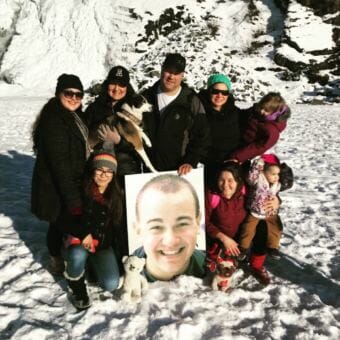
Family members pose with a portrait of Cody Eyre near the Mendenhall Glacier in Juneau in February 2018. Cody Eyre was killed by law enforcement in Fairbanks on Dec. 24, 2017, and his family is seeking more information about the incident.
Family members pose with a portrait of Cody Eyre near the Mendenhall Glacier in Juneau in February 2018. Cody Eyre, originally from Juneau, was killed by law enforcement in Fairbanks on Dec. 24, 2017, and his family is seeking more information about the incident. (Photo courtesy Samantha Eyre Harrison)

Christmas Eve marks one year since the death of 20-year-old Cody Eyre, originally from Juneau. Eyre was fatally shot by Fairbanks Police and Alaska State Troopers. Eyre’s family is holding Christmas Eve events to remember him and to raise awareness about what they see as law enforcement’s poor handling of a mental health crisis.

City police and Alaska State Troopers were called to do a welfare check on Eyre on Christmas Eve, 2017. Eyre, who was walking along Steese Highway in Fairbanks, was distraught, had a handgun, and refused to obey responding officers.

At an October press conference when some police video of the interaction was released, Chief Eric Jewkes described officers’ repeated efforts to resolve the situation peacefully.

“They called out to Cody approximately 78 times,” said Jewkes. “Seventy-eight times they said something like, ‘Drop the gun. Cody, you gotta stop moving, gotta stop walking. Don’t do it. Cody don’t do it. Let’s talk. We can get you help.’ Some other affirmative attempt to let him know there’s another way out of this.”

Chief Jewkes said officers, two of whom had crisis intervention training, fired when Eyre pointed his gun toward them and made a threatening comment. An investigation found the officers’ use of deadly force was lawful, but Eyre’s family disagrees.

Eyre’s sister, Samantha Eyre-Harrison, questions the law enforcement approached the situation from the start.

“It’s really important to be able to differentiate between someone who is having a mental health emergency and someone who is acting with criminal intent. And to make that decision, to make that differentiation right there in the beginning and to employ two different protocols that don’t look the same,” said Eyre-Harrison.

Cody Eyre’s father Kyle points out that some of the responding officers carried assault-style rifles characteristic of what he describes as the militarization of law enforcement.

“For lack of better words, it’s almost like law enforcement has declared war on the American people,” he said.

The Eyres say they are trying to file a lawsuit but continue to struggle to access case evidence, including complete video and audio recordings of the incident.

“The general public has kind of viewed it as like, oh great they released the bodycam footage, you know, it’s a done deal. No, it’s not a deal,” said Eyre-Harrison.

Cody Eyre was Alaska Native, and his family is pushing for more robust culturally sensitive crisis intervention training for law enforcement.

The family is divided between Fairbanks and Juneau, and Cody Eyre’s grandmother, Linda Downs, says she plans to stage a rally on the Capitol steps in Juneau on Christmas Eve to raise awareness about the need for better training.

“Being able to do anything you can to prevent young people from dying is critical I think,” Downs said.

Events are also planned for Fairbanks on Christmas Eve. Eyre-Harrison says the family will retrace the four-mile route Cody walked before his death. Promotion of the walk and other events are part of an ongoing social media campaign.

“We call it #keepwalkingwithcody, and the reason is on the night of his death he was choosing life. he was choosing to go on a walk,” said Eyre-Harrison.

The Eyre family invites the public in Fairbanks to join them for the last mile of the Christmas Eve walk, a candlelight vigil, and a party to follow.

When a step back into prison is really a jump forward on the road to recovery

Community members gathered for a conversation at Anvil Mountain Correctional Center.
Community members gathered for a conversation at Anvil Mountain Correctional Center. (Photo courtesy of Danielle Slingsby)

Alexandria Niksik has been in and out of prison for seven years. Her most recent return home only lasted 16 days. But what might look like failure from the outside is actually a key step toward success and recovery from alcohol misuse.

When Niksik was a kid in St. Michael, a village in western Alaska, she learned some lessons pretty quickly.

“With just violence being a part of growing up in my childhood, it was always my first instinct to react violently,” she said during an interview at Anvil Mountain Correctional Center in Nome in the late summer. “Because I never knew any other way to express my emotions properly.”

Niksik saw some of the adults in her life using alcohol as a way to cope with their trauma from childhood, she said, so she started doing the same thing.

“Either numbing or enhancing my emotions, whether they were negative or positive, I’d always turned to alcohol to express my emotions,” she explained.

By 18, Niksik was involved with the criminal justice system. For a few years, she moved between Anvil Mountain Correctional Center and her village where she stayed with her family and her children. Eventually, she was sent to Hiland Mountain Correctional Center, the women’s prison in Eagle River — a huge change for her. There she received intensive outpatient treatment for alcohol misuse.

“I learned things that my parents didn’t have a chance to learn, and it played a role with how I should be a better person,” Niksik reflected.

She learned things like coping skills and ways to deal with her emotions. And then she was released. Niksik went back to St. Michael, back to her old friends and her old life. She said she was OK when she was with her children because they motivated her to stay sober. But when they left to stay with other family members, “When they weren’t with me, I felt lost completely.”

“I didn’t know what to do with myself when I didn’t have my children around,” Niksik said.

Niksik said she starting hanging out with the same people as before, and she gave in to peer pressure to start drinking again.

“It’s hard to change when you’re the only one who knows the steps to change and want to change,” she said. “Because those guys in St. Michael, they don’t have the opportunity that I did. And I was very overwhelmed with the step-up of showing them how to be there for them in the proper way that people were for me.”

After 16 days, state troopers took her back to Anvil Mountain.

David Patterson Silver Wolf, a professor of social work at Washington University in St. Louis, said Niksik’s situation is common. He has worked as a treatment provider and a researcher.

“Behavior changes is hard, right?” Patterson Silver Wolf said. “And it’s really hard to do when you have people who are convincing you that you don’t need a change.”

Patterson Silver Wolf is also a person in long-term recovery. He said having a support system of people who understand the changes you are trying to make is essential.

“I had these routines of using alcohol and drugs and doing those things,” Patterson Silver Wolf said. “I had to reinvent my whole self, which required that I had to make new friends and go to another community and oftentimes avoid the community where I gave in, where it was easy to give in.”

He said he also needed hope and motivation for change, just as Niksik needed the motivation of supporting her children.

Finding new people to hang out with is easier said than done in a village of 400, but Niksik said that her brief trip back to her village this summer actually gave her hope that she could do that.

“With the time that I was home, I learned who to avoid and who I was most vulnerable against when it came to questioning on whether I wanted to party with them or not,” Niksik said.

The experience was a reality check about what she needs to do in the future.

“I not only hurt myself or my parents, but I hurt my son. That hurts me the most because the look in his eyes when the troopers came to pick me up again. It’s still tearing at my heart,” Niksik said, her voice catching. “He still questions on why I had to come back to jail.”

Now, Niksik is heading to a long-term residential treatment program where she can live with her son. She said she’s ready to focus on her sobriety and prepare herself to return home.

She has plans for her future in St. Michael. She’s going to care for her parents and open a restaurant. And she’s going to be a supportive mother for her children.

State asks for new housing units to help Alaskans in recovery

The state of Alaska wants more housing for residents recovering from opioid abuse.

The Department of Health and Social Services is asking for bids to set up as many as 10 residential facilities across different areas of the state. The federal funds will bring up to $2.042 million over two years for what are called “recovery residences.” The term applies to peer-supported homes for people in outpatient treatment or long-term recovery from addiction. As it’s laid out, the grant would serve up to 100 people over two years.

“What these funds are aiming to do is to really further develop the recovery support services that are needed across the state,” said Katie Chapman, who works on opioid treatment for the state’s Division of Behavioral Health.

The money can’t be used for new construction or significant renovations. Instead, the state is hoping to expand existing treatment resources or establish new recovery residences by paying operating costs. Part of the selection criteria is a sustainability plan. According to Chapman, there are already a small number of similar facilities up and running, but the state hopes to expand its capacity offering treatment in ways that differ from older models like halfway houses.

“These types of programs are generally peer-run,” Chapman said. “There’s an emphasis on recovery support activities, and so they’re doing things that involve them in the community and building connection.”

The areas targeted for new residences are Anchorage, the Fairbanks North Star Borrow, Matanuska-Susitna Borough, Kenai Peninsula Borough, Southeast and Southwest regions.

Alaska has seen a dramatic rise in opioid abuse over the last several years, with over 100 fatal overdoses attributed to opioids last year.

Report: Suicide is Alaska’s fifth-leading cause of death

Every year, the Alaska Department of Health and Social Services releases a Vital Statistics Report: a breakdown of data gathered the previous year. That report provides all kinds of statistics, including marriages, divorces, births and deaths.

Yet again, Alaska has a higher-than-average rate of suicide. The report shows that for 2017, suicide was the fifth-leading cause of death in the state. Nationally, it’s the 10th-leading cause.

Danny Gladden is chief clinical officer for Akeela, a statewide agency that runs Ketchikan’s Gateway Center for Human Services. He said there are a number of reasons why people die from suicide.

“A leading contributor to suicide death would be accessibility of alcohol, the accessibility of guns, and the underutilization or lack of access or, frankly, the complicated process for early intervention, prevention and treatment of mental illness,” he said.

In terms of actual numbers, 197 Alaskans died from suicide in 2017. Of those, 118 used a gun, according to the state report. The report doesn’t indicate how many may have consumed alcohol beforehand.

Alaska has some additional unique variables. People in remote areas might have few if any treatment and intervention options, for example. And then there are Alaska’s extra-dark, extra-cold winters – especially farther north.

Gladden said anyone can call the National Suicide Prevention Lifeline, 1-800-273-8255 (1-800-273-TALK). He said callers can be anonymous, and will be able to talk to a trained, compassionate person who will give advice and direct callers to a local provider.

Gladden said there are options in Ketchikan and throughout Southeast Alaska for those seeking help with any kind of mental health or substance abuse treatment. Akeela-Gateway offers both.

“But there are a number of wonderful providers. In Southeast Alaska, we have SEARHC, based out of Juneau but serving a number of surrounding areas. SEARHC is a Native provider. We have KIC, which is providing both mental health and substance abuse services in Ketchikan, and then in Juneau, there’s also JAMHI, which is the community mental health center for Juneau,” Gladden said.

He said there also are private providers.

“And I can tell you, any one of these providers, if you arrived and maybe they weren’t the best fit for you, would direct you to the right location,” he said. “All of us are committed to getting folks connected to care. There’s no wrong point of entry.”

Gladden said different approaches to treatment allow individuals to choose what works best for them. Opioid addiction, for example, can be treated with a combination of behavioral modification and medication to curb withdrawal symptoms.

According to the state report, unintentional injuries and poisonings, which includes drug overdoses, was the third-leading cause of death in Alaska in 2017. The report shows 143 Alaskans died last year from overdoses. Of those, the majority were from opioids.

Gladden said the Ketchikan Public Health Center offers Narcan, which can save the life of someone overdosing from opioid abuse. He said any entity that has a first-aid kit also should have a Narcan kit.

“Go up to Public Health, let them train you, and have a Narcan kit at your organization,” he advised. “You never know when you’re going to encounter someone who’s needs that life-saving opioid reversal.”

The kits are free, Gladden said, including the training.

According to the Department of Health and Social Services report, 4,415 Alaskans died in 2017. The top 10 causes, in order, were cancer; heart disease; unintentional injuries and poisonings including overdoses; chronic lower respiratory disease; suicide; stroke; diabetes; chronic liver disease and cirrhosis; Alzheimer’s disease; and homicide.


Self-harm and suicide are complex. Most people who consider suicide do not ultimately kill themselves.

If you or someone you know is thinking about suicide or just needs someone to talk to, you can call the Alaska Careline at 1-877-266-4357 (HELP) or text 4help to 839863 Tuesday-Saturday 3-11 p.m. Outside of Alaska call the National Suicide Prevention Lifeline at 1-800-273-8255.


Addiction treatment community reacts to new clinic in Juneau

Medical assistant Sarah Martin sits at the reception desk of Ideal Option, a medication assisted addiction treatment clinic in Juneau. (Photo by Kavitha George/KTOO)

A new medication-assisted treatment clinic called Ideal Option opened near Nugget Mall earlier this month. Existing addiction treatment facilities in Juneau are encouraged that there is a new player in town to help tackle the substance abuse problem, but Ideal Option is different in a few ways.

For one, it’s a for-profit company, and was advertised on Instagram and Facebook prior to opening. Also, Ideal Option doesn’t currently offer in-house counseling — and that has some in providers in the community worried.

“To be frank with you, the addiction problem we have is significant,” said Bradley Grigg, chief behavioral health officer at Bartlett Regional Hospital. “Having multiple providers in our community like we already do is essential to ensuring that people get served and people have options.”

Ideal Option in Juneau is part of a chain of medication assisted treatment clinics. There are more than 50 locations in the lower 48, as well as branches in Anchorage, Fairbanks, Kenai, and Wasilla. The Juneau facility offers a wide range of treatment services, but currently does not offer in-house counseling.

Counseling is not a mandated part of treatment. Addiction specialists say it’s best to start a new patient on medication, even if they don’t want counseling, and hopefully add it in later. But Grigg and other health experts say it is an essential part of helping facilitate recovery.

Jeff Allgaier is the CEO of Ideal Option. He recognizes that there’s suspicion around medication-assisted treatment, including the perception that it just replaces one drug with another, as in the case of Suboxone treatment for opioid addiction. But he says Ideal Option clinics follow the most up-to-date professional practices put out by the American Society of Addiction Medicine and the federal Substance Abuse and Mental Health Services Administration.

“Our goal has always been to try to follow the most up to date evidence-based guidelines, and not sway from it,” Allgaier said over the phone.

The entrance to Ideal Option’s Juneau clinic, located near Nugget Mall. (Photo by Kavitha George/KTOO)

At their clinic near the Nugget Mall, Ideal Option staff seem eager to start helping Juneauites struggling with addiction. Sarah Martin, who works as a medical assistant, moved down from Kenai to help open the Juneau clinic.

“The company in general, what they’re doing is just amazing,” Martin said. “I love it, I’m like ‘Yeah I’m gonna go open this clinic, yeah I want to go work in this clinic,’ just because new patients are my favorite. I love getting people in… the excitement of ‘I want to get better,’ and we can offer that for them.”

Each visit to Ideal Option starts with a urine test, processed by an Ideal Option lab, to ensure patients are taking their medication and no other drugs. Martin says providers then work with their patient to determine appropriate medication dosages.

“It’s all exactly what you need, there’s no set standard of ‘Oh you only get this,'” she said. “It’s whatever the provider and the patient decide what’s best for each person.”

In addition to individualized medicated treatment, CEO Allgaier says every Ideal Option location offers case management services to help patients with things like finding legal services, housing and employment.

James Belardi is a new patient at the Juneau clinic. He said staff told him, “if I’m having problems in certain areas of my life, then we’ll address those problems with them, and they’ll help me work through anything that I need to.”

Belardi says he’s been in and out of emergency rooms and treatment facilities for years, where he faced judgment for his addiction, but Ideal Option feels different. For him, the Juneau clinic’s staff are a welcome change from the stigmatized attitudes he’s faced elsewhere.

“They all wanted to get to know me,” he said. “Which is cool, because I’m not used to that, you know. Usually we’re looked down upon by society. I don’t know, this has just been great. I’m usually real shy, and I come in here and I’m really comfortable.”

As far as counseling goes, Ideal Option clinics in other states have integrated departments they call Ideal Balance to provide behavioral health services, and they’re working with the state to bring that to Alaska. “If I could add it tomorrow, I would,” CEO Allgaier said. “But there are hoops that you have to go through.”

Unlike medical practices which employ individually licensed providers, a counseling agency has to be licensed as a unit, under the company’s name. That process could take two to six months, according to Ideal Balance’s executive director Penny Bell. In the meantime, the clinic is referring patients out to the community for counseling — but this approach has other providers in Juneau concerned.

Registered nurse Claire Suzanne Geldhof says that it’s a big ask to send someone struggling with addiction to a second appointment for counseling.

“It seems like very fragmented care,” she said. “I think it’s in the client’s best interest to receive a robust model under one roof, if possible, like many other options are in Juneau.”

Geldhof organizes regular meetings for the multiple addiction treatment facilities in town, including Rainforest Recovery, JAMHI, SEARHC, and Front St. Clinic. Despite her reservations, she says she’s still looking forward to building a relationship with Ideal Option.

“I’m not trying to shun them by any means,” she said. “I think that something new like this just requires further conversations, and I’m eager to talk more and figure out different ways that we can work together.”

Other providers in town have also expressed plans to reach out to Ideal Option to collaborate in addressing Juneau’s opioid crisis.

Site notifications
Update notification options
Subscribe to notifications