Mental Health

Lawmakers seek competitive contract to run psychiatric institute

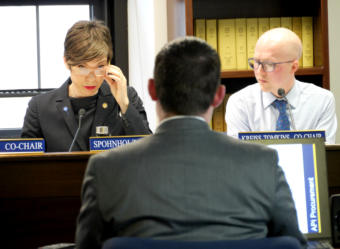
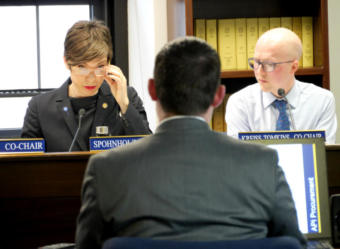
House Health and Social Services Committee co-chair Rep. Ivy Spohnholz, D-Anchorage, questions Chief Procurement Officer Jason Soza of the Department of Administration in a joint meeting with the House State Affairs Committee in Juneau on April 2, 2019. The committee was examining procurement procedures that led to a controversial contract to manage the Alaska Psychiatric Institute. Rep. Jonathan Kreiss-Tomkins, D-Sitka, co-chair of the House State Affairs Committee is on the right.
House Health and Social Services Committee co-chair Rep. Ivy Spohnholz, D-Anchorage, questions Chief Procurement Officer Jason Soza of the Department of Administration in a joint meeting with the House State Affairs Committee in Juneau on Tuesday. The committee was examining procurement procedures that led to a controversial contract to manage the Alaska Psychiatric Institute. Rep. Jonathan Kreiss-Tomkins, D-Sitka, co-chair of the House State Affairs Committee is on the right. (Photo by Skip Gray/360 North)

Five House members who chair committees have urged the state’s chief procurement officer to halt the state’s contract with Wellpath to operate the Alaska Psychiatric Institute.

In a letter, the lawmakers — Health and Social Services Co-chairs Ivy Spohnholz of Anchorage and Tiffany Zulkosky of Bethel; State Affairs Co-chairs Zack Fields and Jonathan Kreiss-Tomkins; and Judiciary Committee Chairman Matt Claman — said the state Department of Health and Social Services should seek a competitive contract to operate the facility.

Department of Health and Social Services Deputy Commissioner Albert Wall, left, and Department of Administration Chief Procurement Officer Jason Soza field questions from members of the Health and Social Services and State Affairs committees in Juneau on April 2, 2019. The committees were examining procurement procedures that led to a controversial contract to manage the Alaska Psychiatric Institute.
Department of Health and Social Services Deputy Commissioner Albert Wall, left, and Department of Administration Chief Procurement Officer Jason Soza field questions from members of the Health and Social Services and State Affairs committees in Juneau on Tuesday. (Photo by Skip Gray/360 North)

House Health and Social Services Co-chairwoman Ivy Spohnholz co-wrote the letter. She said the department didn’t provide enough information to Chief Procurement Officer Jason Soza for him to be able to adequately review the contract, which would pay Wellpath $225 million over five years.
“The department did not properly educate or inform our state’s chief procurement officer about the scope of this contract, the other alternatives that were available, and about the potential risks in awarding this contract,” she said.

Wellpath critics have said the company has had too many health and safety violations across the country and noted it’s been sued 1,400 times.

Soza said on Tuesday in a joint committee meeting that he would have sought more information if the department had told him about the lawsuits.

“The evidence presented to me described the awarded vendor as the only one capable of performing these services,” he said.

Wellpath divisional president Jeremy Barr said in a statement that more than 90 percent of the lawsuits were dismissed. Barr said the company is making improvements at API, including hiring four new psychiatrists.

The state hired Wellpath in February, after the federal Centers for Medicare and Medicaid Services said it planned to revoke API’s certification. This could have forced the hospital to close.

Providence hospital has expressed an interest in operating API. But department leaders said Providence wasn’t in as good a position as Wellpath to take over in February.

State Deputy Commissioner Albert Wall said in the committee meeting that it would make sense to keep Wellpath if it’s making the benchmarks the state set for it.

“If they can stabilize the hospital, if they can maintain our certification, our licensure, if they can open more beds and bring on more providers, and if the safety of our patients and staff has increased, then why would we destabilize the hospital for any period time and put it back into chaos that it was back in, in order to go out and find another provider who could maybe do it a different way?” Wall said.

The state is scheduled to decide whether to keep Wellpath for the rest of its contract by June 15. The state must study the feasibility of privatizing API under its union contract before permanently privatizing the hospital.


Two Juneauites go from anger to consensus on the criminal justice reform debate

When they first interacted at Juneau Reentry Coalition meetings, Sol Neely (left) and Kris Sell (right) couldn’t stand each other. (Photo by Scott Burton/KTOO)

How do adversaries become allies? For University of Alaska Southeast associate professor Sol Neely and retired Juneau police Lt. Kris Sell, it wasn’t easy.

The two clashed profoundly over criminal justice: the lieutenant, a boots-on-the-ground, “tough on crime” pragmatist; the professor, a justice reform educator and idealist.

They recently sat down at KTOO for a conversation explaining how they found agreement on this contentious issue.

I learned about their once-adversarial relationship from a Facebook post Neely recently wrote about Sell. To begin the conversation at KTOO, I asked Neely to read the post aloud. Here’s one of the meatier sections.

“We clashed severely. I couldn’t stand her, and she couldn’t stand me. She was ‘tough on crime’ and didn’t have any patience for somebody like me. Absolutely every time we met, I would shake with some blend of anger and frustration,” said Neely.

Sol Neely’s Facebook post. (Screenshot by Scott Burton/KTOO)

Neely is an associate professor of English at UAS. He also teaches inside Juneau’s Lemon Creek Correctional Center. He brings students from the university into the prison and studies literature and philosophy — often works with social and criminal justice themes.

Neely is also involved with the Juneau Reentry Coalition (JREC) — an organization focused on reducing recidivism by helping formerly incarcerated people rejoin society once they get out of prison. It was at early JREC meetings that Neely and Sell clashed.

“(I) had to spend what felt like countless hours with irritating people like Sol Neely who, as a philosophy professor, is kind of at the different end of the spectrum from the pragmatic way I am trying to address things,” said Sell.

Sell’s pragmatic way often meant sending people to prison as the solution to public safety. But over her twenty years on the force, she started to question that approach.

“I was arresting the same people over and over again. I was arresting members of the same family through generations,” said Sell.

In Alaska, close to two-thirds of formerly-incarcerated people commit additional crimes that often lead back to jail. Each time Sell’s arrestees went back, they lost more of their lives, like their home, their family…

“By the fifth or sixth arrest, they’re living in a moldy camper or a car in Juneau,” said Sell.

Listen to the entire conversation here:

 
Sell began to suspect that some of these individuals suffered from underlying issues, like untreated addiction and mental illness. She became more interested in alternative pathways, like more treatment, education and community support — ideas she was hearing from people like Sol Neely.

“He just keeps working away at people, like a glacier wearing away mountains. He just is relentless and hopeful, and he keeps showing up,” said Sell.

Neely said the learning went both ways. From Sell, he learned about what it was like for police officers on the streets. Like how people can get increasingly violent with each arrest. And how that violence could affect officers and other community members.

“We were both working in trenches, but different kinds of trenches,” said Neely.

But over the years, they’ve come to see they’re in the same trench with a shared vision. They both say criminal justice is too complicated to have a simple solution, and they both call for a community approach. But getting the community involved — and getting people to agree on solutions — will be challenging.

Sell’s been retired for over a year now, but she has hope.

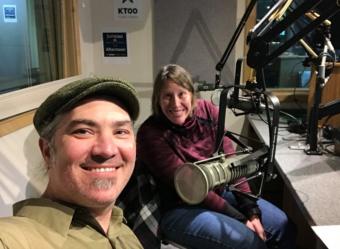
A selfie taken in the KTOO studios. (Photo courtesy Sol Neely)

“I think if there’s any town that can have respectful discourse about this, it’s Juneau,” said Sell.

As for Neely, he hopes this story — how he and Sell went from “shaking with anger and frustration” to consensus — might be an example for other contentious community debates.

At the end of the conversation at KTOO, the two took a selfie together.


KTOO Public Media produced this short documentary about Neely’s classes inside the Lemon Creek Correctional Center:

New report confirms major problems at Alaska Psychiatric Institute

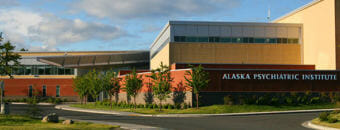
The Alaska Psychiatric Institute in Anchorage. (Photo courtesy of the Alaska Department of Health and Social Services)
The Alaska Psychiatric Institute in Anchorage. (Photo courtesy Alaska Department of Health and Social Services)

A new report released Monday substantiates major problems at Alaska’s only psychiatric hospital.

The state Ombudsman’s Office conducted an investigation into complaints about treatment of patients at the Alaska Psychiatric Institute in Anchorage.

“In this case, the evidence did support the allegations that API was not acting to prevent or mitigate violence toward patients from staff or other patients,” said Alaska State Ombudsman Kate Burkhart.

The investigation was prompted by complaints in June 2018 by a hospital safety officer warning that API staff members were excessively restraining and isolating patients, as well as using force in ways that are unlawful under the facility’s own guidelines. Since 2015, Burkhart’s office has received 42 complaints about API, 31 percent of them related to patient neglect and mistreatment.

“There were significant instances where staff caused harm to patients, where patients caused harm to other patients, and API did not respond proactively to prevent or to mitigate the results of that harm,” Burkhart said.

There were other findings that the use of seclusion and restraint were used in situations where there wasn’t an imminent threat to safety.

“That is impermissible under federal law and API policy,” Burkhart added.

The report is comprised of interviews with staff over several months, as well as an extensive review of documents. It details upsetting incidents, such as one patient sexually assaulting another in view of a nursing station. The report documents how employees mishandled procedures for dealing with those cases after the fact.

This report comes several months after a different investigation looked into unsafe working conditions for staff at API. That document was released by a private law group, and it found significant problems faced by employees at the facility connected to under-staffing, inconsistent training and taxing work loads.

Burkhart’s office made 11 recommendations to the state’s Department of Health and Social Services, which oversees API.

In February, the Dunleavy administration introduced a plan that could eventually privatize the facility. Burkhart said her office began its investigation prior to that decision, and that the report’s recommendations could be incorporated regardless of who is managing the facility.

A new men’s group in Homer aims to foster healthy masculinity. But getting new members is a challenge.

Men wait their turn to shoot at the Kachemak Gun Club and Range.
Men wait their turn to shoot at the Kachemak Gun Club and Range. (Photo by Renee Gross/KBBI)

There’s a new group in Homer just for men. The Homer Men’s Leadership Forum began late last year in part to address concerns brought up by the #MeToo movement.

The leader of the group hopes the discussions will attract men from all different parts of the community to talk about issues such as toxic masculinity. He hasn’t achieved that goal yet, but he’s going to keep trying.

On a Saturday morning at the Kachemak Gun Club and Range, about 10 guys are taking turns aiming at clay pigeons. The Homer Men’s Leadership Forum is putting on the event partly to encourage more men to get involved in the group. But some, like Doug Koester, have been a part of it since the beginning.

“Well so far, it’s been really great for me just to get together with people and maybe talk about things that are a little bit outside of the ‘man box’ that often society or social norms put us in,” he said.

He added that the group doesn’t have an agenda, and mostly he enjoys having a place to talk with other guys without judgment. Still, he’s passionate about discussing certain topics. Koester works for the domestic violence shelter in town.

“For me, that’s what I love to talk about, is like what is our role as men in our society, and why is (it) sometimes men perpetuating that violence,” he said.

Addressing that is one of the reasons that Erik Schreier began the group. He said he wanted to address issues raised by the #MeToo movement.

“Some people in my sphere had been asking me for advice — men and women — on relating to each other, and how men are relating to themselves and men and boys in the community and at large in society,” Schreier said.

He said his goal was to get different men together to start a dialogue about change. At the first meeting, about 15 guys showed up. Schreier showed a TED Talk about consent and “locker room talk.”

“It was great,” Schreier said. “It was a huge outpouring of guys coming together, talking about it. Some guys were confused. Some guys were like, ‘I don’t want to feel bad for being a guy. I don’t think I’ve ever done this, and here I’m being kind of vilified for being a man.’ So that’s fine. Let’s talk about it.”

Now about a handful of men attend the monthly discussions, and topics range from artificial intelligence to self-care. But most of the attendees are like Koester and are already committed to addressing issues of toxic masculinity.

“It’s like the guys who really need to talk about this stuff aren’t in here,” Schreier said.

That’s partly why he’s expanding the group beyond just discussions into monthly activities like volunteering and the shooting event at the gun range. Schreier said that event was successful at getting a variety of folks involved.

“(I came to) meet up with other guys and shoot a little bit,” John Carrico said at the range. “Haven’t been out to the range in about three and a half years, and it sounded like a good time.”

Carrico has volunteered with the men’s leadership group but has never gone to a discussion. He said he’s not sure he’ll attend one and doesn’t know if it’s important to have a space for men to be vulnerable.

“I think that friendships do a lot of that,” he said. “To go outside of that circle takes a little bit of trust.”

Schreier said the shooting event didn’t inspire any new members to join the last discussion group, but he partly blames the low attendance on lack of advertising. He adds that words like “vulnerability” and “feelings” usually turn guys off. But he said he’s happy with the regulars in the group and believes they are effecting positive change.

Still, he’s trying to figure out the magical words to get more men to come.

“Free coffee,” he said, laughing. “I try to get the guys to just want to come together and hang out. I want to let them know that there’s no obligation. You don’t have to come and hold hands and cry. We’re not trying to do that. Not a requirement.”

He said if his group just inspires one guy to make a change, it’s a success.

In Anchorage, emotionally preparing students for the scary prospect of climate change

xx
Bryan Smith has a PhD in chemical engineering. He says he always liked teaching in graduate school. So when it came time to move back to Anchorage, he decided to make it his career. (Photo by Elizabeth Jenkins/Alaska’s Energy Desk)

The Alaska Department of Education and Early Development is in the process of revamping its science standards. It hopes to have a draft released by March. But for the past 13 years, teachers have been working with a curriculum that gives little guidance on how to explain the science behind one of Alaska’s most pressing problems: climate change.

This week, we’re going inside two Alaska classrooms to learn how teachers and students are navigating these difficult conversations.

Bryan Smith is the kind of teacher who goes by his first name in his classroom at Polaris K-12 School in Anchorage. You could call his teaching style eclectic.

Today, his class of high school students are learning about resource extraction by competing to grab Goldfish crackers off of a row of tables. Snatch too many goldfish and you deplete the fishery.

“As soon as I saw people taking more than three fish, I knew it was over for me,” Kadi LeBlanc, a ninth-grader, says with a laugh.

She says not everyone is playing fair. But she understands the point.

“If people are greedy and take more than an ecosystem can handle, by the end no one be able to use that resource,” LeBlanc said. “It’ll be gone.”

Later, the class brainstorms helpful values for solving the problem. They list things like communication, planning and following rules or regulations.

It sounds like students are having a good time. But Bryan acknowledges these are tough things to talk about, especially in a resource-dependent state.

“I’ve got this Upton Sinclair quote above my door: ‘It’s difficult to get a man to understand something when his salary depends on his not understanding it.'”

That quote alludes to the tightrope discussions Bryan has to have with his students. Some of their parents are employed by the oil and gas industry. Bryan says it can be a sensitive topic; the business that’s feeding some families is also contributing to an increase in carbon emissions.

So there are the social complexities of teaching about climate change in an oil state, and then there are the emotional ones.

“One of the reasons why I suspect other teachers might not want to jump into this, besides it being a political hot topic … it’s heavy and it’s a real downer,” Bryan says.

Bryan says the future can appear increasingly uncertain, dangerous and even scary for kids.

He describes it as taking an unblinking look into the void. Alaska is warming twice as fast as the global average temperature.

So the students in his classroom are given a choice.

And this is where Bryan takes another page from one of the great contemporary works: “The Matrix.”

He uses an iconic scene from the dystopian sci-fi thriller in class. In the movie, Morpheus tells the protagonist Neo that there’s no turning back.

“You take the blue pill, the story ends, you wake up in your bed and believe whatever you want to believe,” Morpheus explains. “You take the red pill, you stay in wonderland, and I show you how deep the rabbit hole goes.”

Bryan says he has had one student tell a counselor, “I don’t want want to take this class.”

Of course, Bryan’s not presenting his class of middle and high school students with real pharmaceuticals. It’s a metaphor. Take the blue pill and drop the elective science class. Or, take the red pill and learn more about the leading causes of climate change and its effects.

Bryan believes the student who opted out felt like the subject was just too much to handle, and he says that’s OK. He wants his classroom to be intellectually and emotionally prepared for the things they’re about to hear.

“The projections are grim,” Bryan says. “That’s why in the past couple of decades scientists have started speaking out publicly.”

Bryan admits he’s struggled to explain this to his own kids, who are 11 and 14 years old. He feels conflicted, like he’s stealing away a piece of their childhood by telling them the truth.

The concern is somewhat valid. The state’s former Department of Health and Social Services commissioner even put out a report warning about increased anxiety and depression as Alaskans grapple with a changing environment.

Some of Bryan’s younger students have asked him to dial it back.

“They were kids, and they just wanted to go play on the swings and that’s fine,” he said.

But like Morpheus and Neo in “The Matrix,” if a student is ready, Bryan wants to them have all the information: Climate change is happening. The future, as projected, looks pretty bleak. Our carbon emissions are a major contributing factor.

But he assures them there are things they can do. The antidote to despair is action, he says.

Still, Bryan has received some push back from at least one of the teens in his class.

It was for an assignment where he asked students to engage in some kind of activity, applying their values to what they learned. So a student made a flyer for an Anchorage neighborhood.

“The gist of it was climate change wasn’t happening,” Bryan says.

But he didn’t fail that student because he completed the assignment and applied his values to the task. Unlike carbon emissions, beliefs can be harder to measure.

“Some people you won’t be able to reach,” Bryan says.

But that was one isolated event over the course of seven years of teaching about climate change.

Bryan says most of his students know it’s occurring, and they genuinely want to do something about it.

What’s the biggest takeaway he wants his classroom to leave with? After a pause, he says he wants them to feel empowered to take some action, whatever that means to them, and then stop thinking about the rabbit hole. Go out and enjoy the sunshine.

Transforming perspectives on trauma through paintings of hope

The Solutions Desk looks beyond Alaska’s problems and reports on its solutions — the people and programs working to make Alaska communities stronger. Listen to more solutions journalism stories and conversations, and share your own ideas here.

Tarah Hargrove stands before a massive painting. One side is dominated by gray cinder blocks and stencils of guns, the other by a yellow sky filled with birds. And in the center is a giant portrait of Hargrove herself. Her chin is lifted, and she looks defiantly at the viewer, magenta radiating from her hair.

“So my inner narcissist was like, ‘Yay! My face!” Hargrove said, laughing about her first impression of the four-panel mural painted by University of Alaska Anchorage students. Though she’s lighthearted, she knows that sharing her story — her truth — through the artwork is essential.

Last fall she was invited by a professor, Steve Gordon, to tell a group of beginning art students about her life. She started with her unstable childhood: Her abusive stepfather had substance misuse problems, she was raped and she attempted suicide. Despite that, as a young adult she did well in school, started her own business and helped raise her younger sister.

Tarah Hargrove poses in front of the mural depicting her story created by students at University of Alaska Anchorage.
Tarah Hargrove poses in front of the mural depicting her story created by students at the University of Alaska Anchorage. (Photo by Joey Mendolia/Alaska Public Media)

Things got rocky again in her early 20s, and eventually she started using and selling street drugs and ended up in prison. Hargrove said she feels like being open and honest about her decisions, both good and bad, has ripple effects.

“When we’re being honest, and we’re being vulnerable, and we’re being intimate — intimacy is the key to having connection,” she said. And through those connections, people are more likely to care about others and take time to stop and help people. To engage with them.

Hargrove wasn’t always so willing to engage with others or with herself. She said her turning point is illustrated on the mural with the overlapping, seemingly endless images of guns. Before going to prison, she was violently beaten by her ex-boyfriend.

“Like, I got my ass beat so bad it changed my life,” she explained. “And my gun was involved. It was my gun that they used on me, on my head. So it was, I mean, it’s kind of pinnacle (for me).”

She permanently lost hearing in one ear and realized she needed a dramatic change in her life. When she went to prison, she participated in different programs that helped her deconstruct the way she looked at the world and start her path to recovery. She said she started removing the layers of dishonesty and bitterness she used to justify her actions. She wanted to be candid and straightforward.

A mural created by students at University of Alaska Anchorage about Adverse Childhood Experiences.
A mural created by students at the University of Alaska Anchorage about adverse childhood experiences. (Photo by Joey Mendolia/Alaska Public Media)

And those are some of the traits that struck Arlitia Jones when the two women first met for the mural project. Jones is a playwright who took the nighttime art class at UAA because she wanted to learn to paint. She thought she’d be painting flowers and still lifes, not someone’s intimate story of trauma. It made her nervous because she wasn’t sure someone could be truly open about their difficult past.

Jones said Hargrove was not what she expected. “My first reaction to Tarah was when she walked in and I saw this woman, I was like, ‘Wow. That woman doesn’t look like she’s had anything happen. She’s very physically beautiful, and so strong.’”

And then Hargrove opened up about her story and laid out all of the details.

Meeting Hargrove made Jones re-evaluate some of the assumptions she makes about people and their life experiences.

“Now walking around, I’m not going to say that, ‘Oh, I never judge people anymore,’ because I do. Every day,” Jones said. “But just there’s this little voice in the back like, ‘Wait a minute, you know, you don’t know that whole story and how we cover up.’”

Jones said she hopes that when people see the mural, they’ll see Hargrove’s strength and determination. That she has to work hard every day to keep her relationships strong and to care for her daughter, but that she’s doing it. Her story, like the painting, has moved from dark to light.

A mural created by students at the University of Alaska Anchorage about adverse childhood experiences.
A mural created by students at the University of Alaska Anchorage about adverse childhood experiences. (Photo by Joey Mendolia/Alaska Public Media)

Hargrove wants people who see the piece to think about all of the young people they meet.

“So you’re going to Christmas and there’s like that one kid who acts like an a˗˗˗˗˗˗, and you’re like, ‘What’s wrong with you?’ There’s probably something really wrong with them,” Hargrove said.

She asks that people don’t just write the kid off — like adults did with her.

Hargrove never says her life was hard. She likens her experiences to special access to extra information about the world that helps her connect with others.

“I’m not trying to be like, ‘The quality of my life is better than other people’s,’ but the quality of my life is better than other people’s,” she said matter-of-factly. “Because I’m aware, and I get to love people for real. I have no qualms about that.” She said she’ll take extra steps to help people, even if others judge her for it.

The two women hope this mural and the six others that will be on display around town will change perceptions about the effects of childhood trauma. Because if people receive love and support, their stories don’t have to end with more pain. They can begin again — with hope.

The murals will be on display from Feb. 8 to March 8 by the Downtown Transit Center in Anchorage. In April, they’ll be at the Loussac Library before moving to the Mat-Su Health Foundation in May.

Site notifications
Update notification options
Subscribe to notifications