Mental Health

As the Juneau School District responds to online monitoring concerns, student questions remain

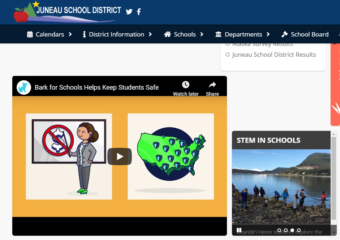
The Juneau School District posted information about Bark for Schools on its homepage, as it appears here on Oct. 31, 2019, including FAQs and an informational video produced by Bark.
The Juneau School District posted information about Bark for Schools on its homepage, as it appears here on Oct. 31, 2019, including FAQs and an informational video produced by Bark. (KTOO screenshot)

This fall, the Juneau School District began using a third-party service to monitor emails and messages sent on school accounts, hoping to increase student safety.

Students and parents have raised concerns about privacy and data control. The district has made adjustments, but there’s still plenty of confusion.

The first time Toby Minick heard about it, he was at school. He’s a senior at Juneau-Douglas High School: Yadaa.at Kalé.

“I think it was probably in calculus class, which is my first class of the day. And a lot of people were kind of, like, murmuring and talking about it.”

Minick’s classmates were talking about Bark for Schools. Provided by a tech monitoring company called Bark, it’s a service the Juneau School District started using this fall to monitor what passes through student accounts. It screens for mentions of violence, self-harm, drug use, sexual content and cyberbullying — flagging messages for school administrators to review.

Parents can sign up to receive those alerts, but they’ll only get them right away if a message is flagged outside of school hours. Otherwise, they’ll receive them in weekly updates on their students’ accounts.

The district’s goal in using Bark for Schools is student safety, but many were unhappy to learn about the service. A handful of students, parents and teachers — and one outgoing member of the Juneau School District Board of Education, Steve Whitney — shared their concerns at the Oct. 8 school board meeting. Most pointed to a lack of communication about exactly what Bark for Schools is and what it does.

Since then, the district has shared more information on its website and directly with families. But weeks later, students like Minick still have questions.

“Until we get answers, I’m super against it. And probably when we get answers, I’ll still be super against it. It just seems like an invasion of privacy,” said Minick.

The school district sees things a little differently.

Bridget Weiss smiles as she's congratulated on her appointment to interim superintendent of the Juneau School District at a meeting of the Juneau School Board on Aug. 6, 2018. (Photo by Jeremy Hsieh/KTOO)
Juneau School District Superintendent Bridget Weiss on Aug. 6, 2018. (Photo by Jeremy Hsieh/KTOO)

“We have no desire to monitor anything private. We are monitoring an academic environment that we are providing,” said Juneau schools Superintendent Bridget Weiss.

Many students and parents still aren’t sure about Bark’s reach.

According to the company and the Juneau School District, Bark only monitors messages sent from — or to — school-issued email addresses and Gmail chat, as well as anything stored in student Google Drive folders or posted in Google Classroom.

Bark does monitor those accounts when a student uses them on a personal phone or computer, but it does not monitor anything else on the device. It doesn’t track internet searches, and it has nothing to do with school Wi-Fi networks.

Weiss said if a student talks about an unsafe situation on a school platform, administrators should be able to respond. She said they treat the alerts just as they would if a teacher or parent overheard something concerning and reported it.

The district has always had the ability — and a legal responsibility under the Children’s Internet Protection Act — to monitor school platforms. But with 2,500 students, Weiss said the district didn’t have an effective way to do it.

“What this is allowing us to do is to have a shield of protection for students that we didn’t have the manpower — would never have. It would be impossible to do a literal monitoring by a human being in the same way,” said Weiss.

For some parents and students, that is their biggest concern: that the monitoring is being done by a third-party company.

Minick shares that reservation.

“It is weird that our schools are monitoring us, but I feel like that’s more acceptable to me than if a company is taking our data or scanning our data and that kind of stuff,” Minick said. “I trust my school more than I trust this ethereal other company, Bark, that I don’t know anything about.”

Bark doesn’t make any money off Bark for Schools, at least not directly. It provides the free service to over 1,500 school districts in the country. According to the company’s website, its motivation was the Parkland school shooting. Through that partnership, Bark hopes to build trust and interest in its main product: a service that parents — not schools — can buy to monitor their kids’ personal messages and social media accounts.

Another complaint raised by parents at the October school board meeting was the influx of advertising for Bark’s parent product sent to parent email addresses since the service’s implementation. In response, the school district has requested Bark to stop sending solicitations, unless a parent has signed up to receive Bark notifications.

Students at the school board meeting also questioned how Bark might use the data it collects. In a phone interview with KTOO, Bark’s Chief Parent Officer Titania Jordan said data is never shared with other companies.

“We are not looking to monetize or sell your children’s personal data,” Jordan said. “Our goal as a company is to protect your family and empower you with the knowledge to protect your family.”

Jordan encouraged anyone with questions or concerns about Bark to contact the company directly at help@bark.us.

Normally, Bark deletes all data 30 days after it’s collected. The Juneau School District requested that period be reduced to 15 days.

Jordan said Bark tries to provide tools to keep kids safe at a time when technology is changing rapidly

“This is a whole new landscape, right? Kids have never had this sort of access before in human history. And schools and parents have never had to school or parent kids in this sort of environment ever,” said Jordan.

Minick, 17, said growing up in that environment doesn’t mean his peers take any of it for granted.

“I don’t think a lot of people have that opinion that, like, our privacy in a new, digitalized age is something that we should assume is already, you know, forfeit or whatever,” Minick said. “We should know where our information is going, who has it, what they’re doing with it.”

In response to concerns from students and parents, Weiss said the district is providing options.

Families have three choices. One is to stick with the status quo and use all school-provided platforms, monitored by Bark. Another is to completely opt out of school platforms — but a lot of classes rely on online tools, and it’s not clear how students and teachers will have to adjust. The third option is restricted access: Students will be able to use Google Classroom and Google Docs, but they won’t have a school-issued email address or Gmail chat. However, any messages sent to school accounts will still be monitored by Bark.

Families interested in restricted access or opting out should contact their principal.

District administrators hope they can answer remaining questions about Bark and move forward with the school year. But district chief of staff Kristin Bartlett said she’s pleased to see students engaged and thinking critically.

“All of the questions that the students have been asking are the questions that we have taught them to ask — about their privacy, and their footprint and how their information is being used. So the fact that they’re asking these questions is exactly what we would want them to do,” said Bartlett.

Bark won’t officially be on the agenda of the next school board meeting — it’s not an action item the board can vote on — but Weiss will give an update.

Members of the public can speak about Bark or any other topic during the public comment period. The board meets on Tuesday, Nov. 12, at 6 p.m. in the library of Juneau-Douglas High School: Yadaa.at Kalé.

With art exhibit, former Nome resident addresses the ‘collective trauma’ of indigenous suicide

Sonya Kelliher-Combs’ exhibit “Goodbye” at the Anchorage Museum in 2007. (Photo courtesy Sonya Kelliher-Combs)

The following profile addresses the topic of suicide in Northwest Alaska and may be distressing to some readers. If you feel you are in crisis or just need someone to talk to, call the Alaska Careline at 1-877-266-4357.

Fifty two pairs of gloves and mittens are clustered on a pedestal in the Yukon Arts Centre in Whitehorse, Canada.

“People come up to me afterwards and… They haven’t read the statement yet, but they know what it is, you know?” said Sonya Kelliher-Combs, the artist behind the exhibit. “They might not know it’s specifically about suicide, but they know it’s about loss.”

Kelliher-Combs, from Nome and based in Anchorage, calls the exhibit “Goodbye.” She says the goal is to open dialogue on a subject that is increasingly prevalent, but “often taboo” to talk about.

The age-adjusted suicide rate among Americans in 2017 was 14.0 deaths per 100,000. Almost double that and you get Alaska’s rate: 26.9 deaths per 100,000. Almost double that number and it equals the rate among Alaska Natives: 51.9 deaths per 100,000.

Kelliher-Combs says that for “Goodbye,” she chose to focus on that last statistic.

“A big issue within indigenous communities, in particular in the North in Alaska Native rural communities, is suicide. And so, ‘Goodbye’ is a piece that dialogues that… speaks to the huge epidemic of suicide in our rural communities,” she said.

The gloves and mittens used in the art exhibit “Goodbye” are all handmade. Many are made with seal skin or furs; some are beaded.

“I think that there is memory and history that’s connected to everything that is made by hand,” Kelliher-Combs said. “I feel like historically an object would be made to last for a long time, and would be passed from generation to generation, even my grandparents’ couch and their table and things like that. I think that these objects have a history and a memory that somebody’s hands have put into it… and not only that, but also the materials they’re made from, and how they’re imbued with a kind of spirit. There’s an honesty to this material.”

Adding to that spirit is that each pair was loaned to the exhibit by an Alaskan or member of the local Whitehorse community. Kelliher-Combs says there’s a story behind each pair of mittens, even if it’s not immediately visible to the installation. Mary Bradshaw, the director of visual arts at the Yukon Arts Center, agrees.

“We’re borrowing their mittens over the summer. Everyone will get their mittens back in September, which is kind of right in time,” Bradshaw said. “But it was a really lovely opportunity for our community to be involved, and I know we had a number of people who drove in their mits partly in memory of a family member.”

She says visiting “Goodbye” looks something like this: “As you walk in the room itself, it’s quite quiet and kind of darkened otherwise. The lights are just on the mittens and the platform. You’re able to walk the whole way around, and as you walk to the back, you can see the back of the mittens… it’s quite something, you know, seeing these open palms as you walk in, and then as you go around, you kind of get to see the full beauty that’s been put into all of these mittens.”

Bradshaw says the message behind “Goodbye” extends to her corner of the far north.

“Canada’s north is also really affected by indigenous suicides,” she said. “The Yukon doesn’t have the same statistics captured as Alaska; we actually found it very hard to see what the numbers would reflect in our territory… We have 52 and a half pairs… We added an extra pair knowing that these numbers, of course, are just kind of the tip of the iceberg of what was actually recorded and self-identified.”

Paired with the main exhibit is a series Sonya Kelliher-Combs has been doing for over ten years, “Idiot Strings.” She started the series years ago as a memorial to her three uncles who had taken their lives. “Idiot strings” are pieces of string that tether a pair of mittens or gloves together.

“At least, that’s what my mom called them when I was a kid, so you wouldn’t lose your mittens,” she said. “There’s a piece that people can write a message, or a thought, or draw a picture, and then tether it to these ‘idiot strings’; you can tie it onto there. And at some point we’ll have a ceremony, or kind of transform those messages and let them go. Haven’t quite figured that part out yet, because this is the second place it’s gone to, this piece. So it continues to fill up with more messages.”

Mary Bradshaw says there’s been a flood of people sharing and connecting with the “Idiot Strings” part of the exhibit.

“I’ve had to refill the basket of Tyvek over and over because people are really taking the time to send a message,” she said.

It’s messages like these that encourage the connection Kelliher-Combs aims to foster through the exhibit.

“The idea is it’s not just an individual, personal trauma, but it’s a collective trauma that we carry with us,” Kelliher-Combs said. “And to bring to light, to open it up so that people don’t feel afraid to express and deal with, and discuss these kinds of historical traumas.”

She says she thinks the exhibit is helping to bring awareness to statistics around suicide, while opening a dialogue around the topic as well. She’s anticipating that conversation to continue at a fish processing workshop and lecture that will close out the exhibit on August 23-25.

“We’re making fish rawhide,” she said, “and then, we will be beading it and making these little amulets, I call them ‘portable secrets.’”

Kelliher-Combs says participants can wear their “portable secrets” as a reminder of something or someone they’ve lost.

“I’d put a healing stone in there, or maybe your pet’s dog hair, or whatever you were heartbroken from, and you can have that with you and carry it with you,” she said.

“Goodbye” is open to the public in Whitehorse, Canada, until Saturday, August 24.

If you feel you or someone you know are in crisis or just need someone to talk to, please reach out 24 hours a day to the Alaska Careline at 1-877-266-4357. 

State seeks new study of Alaska Psychiatric Institute privatization

Gov. Mike Dunleavy speaks at a press conference at the Alaska Psychiatric Institute on Monday, Aug. 5, 2019. Alaska Department of Health and Social Services Commissioner Adam Crum (center) and Dunleavy’s press secretary Matt Shuckerow stand in the background. (Photo by Kirsten Swann/Alaska Public Media)

Federal authorities have restored certifications for the Alaska Psychiatric Institute, and state health officials are now re-evaluating privatizing the state-owned hospital.

A state request for proposals issued Monday solicits bids “for a study of the feasibility of privatizing the Alaska Psychiatric Institute.” On the same day, state executives and hospital administrators gathered in the API lobby for a press conference announcing the hospital’s recent re-accreditation by the federal Centers for Medicare and Medicaid Services. The facility’s status was thrown into jeopardy last year, following the discovery of dozens of regulatory violations.

Now, according to state officials, API has a reinstated state license and renewed federal certifications, and is therefore eligible to continue receiving federal funds.

“Things are headed in the right direction,” said Gov. Mike Dunleavy, speaking at Monday’s press conference alongside officials from the Alaska Department of Health and Social Services.

But there’s still work to do, he added. The 80-bed hospital is operating at below 60% capacity, and health department officials said it’s been a struggle to hire the staff needed to reach full capacity.

“One of the issues we have in hiring both psychiatric nurses and psychiatric nurse assistants is the compensation level,” said DHSS Commissioner Adam Crum. “We have to make sure that we can work toward getting competitive.”

As of October 2018, the hospital had 49 beds available, and former director Duane Mayes said he planned to use an infusion of state funding to hire close to 50 new psychiatric nurse assistants, bringing APl to full capacity within 3-6 months, the Anchorage Daily News reported.

In January, Crum invoked his statutory authority to assume management of the hospital, citing ongoing problems with safety, regulatory compliance and staffing. A private company, Wellpath Recovery Solutions, received a contract to provide administrative support to API in two phases through 2024, with the intent of helping the hospital “return to its full capacity by June 30, 2019,” according to DHSS. In May, the contract was amended to continue on a month-to-month basis through the end of the year; the requirement to make all 80 beds available remained.

As of Monday, the facility had 46 beds available, and Deputy Commissioner Albert Wall said Wellpath had accomplished everything the state had asked of it.

There’s currently no timeline for reaching full capacity at API, Crum said. Hiring remains a challenge.

“This is something that’s an ongoing issue,” he said. “Getting individuals to fill those roles has been the most difficult aspect.”

Meanwhile, the state is moving forward with plans to explore privatizing the state-owned hospital. A 2017 study examining the same thing concluded that privatizing API would likely increase costs. Instead of full privatization, the 2017 report recommended a blended approach, privatizing certain non-core services while maintaining direct care under state management.

But a lot has happened since 2017, Wall said. DHSS believes a new feasibility study is necessary to evaluate privatization in the current context.

Deputy Commissioner of the Department of Health and Social Services, Albert Wall, fields questions from members of the Health and Social Services and State Affairs committees in Juneau on April 2, 2019. The committees were examining procurement procedures that led to a controversial contract to manage the Alaska Psychiatric Institute.
Alaska Department of Health and Social Services Deputy Commissioner Albert Wall. (Photo by Skip Gray/360 North)

“They’ll look at staffing levels, they’ll look at curriculum, or what their modality of treatment is for different types of patients, they’ll look at acuity level of patients, they’ll look at cash flow, they’ll look at everything,” Wall said Monday. “And then they’ll make recommendations.”

The decision to explore privatization was criticized by the Democratic co-chairs of the House Health and Social Services Committee. In a statement, Bethel Rep. Tiffany Zulkosky called the new study a waste of resources, while Anchorage Rep. Ivy Spohnholz said the potential for privatization made it “difficult to recruit and retain qualified staff.”

“If the administration is serious about getting the hospital back to full capacity, they should take privatization off the table and aggressively recruit to fill funded but vacant positions at API,” Spohnholz said in a written statement.

The state is accepting proposals on the privatization evaluation through Aug. 26.

Correction: This story has been updated to clarify that Wellpath Recovery Solutions received a contract to provide administrative support at API, not to manage it.

How hospital ERs in Alaska are helping patients with opioid use disorder

xx
Justin and his mother, Vicki Brokken, at their home in Juneau. (Photo by Elizabeth Jenkins/KTOO)

Some hospitals in Alaska are changing the way they treat patients with opioid use disorder. A trip to the emergency room can be a crucial window to help people in their recovery.

Now some providers are giving patients a medicine to ease the transition so they can seek additional care.

Recently, a hospital in Juneau completed one year of this program with encouraging results.

Justin Brokken, 33, has a ritual with his parents. They regularly engage in friendly competition with handmade cornhole set. Earlier in the day, his mom, Vicki Brokken, beat him 21-1.

“Now, I’m not even going to be able to hit the board. The pressure is on,” Justin Brokken said with a laugh.

The Brokkens are enjoying this new family dynamic. For years, Vicki said her relationship with Justin wasn’t like this.

“Every single time he walked out that front door. I knew, and it went through my head, that could be the last time I ever saw my son,” Vicki Brokken said.

Justin Brokken was first introduced to opioids like a lot of Americans: at the doctor’s office.

At 14, he was given a prescription for painkillers after badly burning his hand in an accident. His injury left him with a permanent scar, and he said the craving for opioids didn’t go away.

“Anybody who’s had an addiction knows it’s hard to say no to something that makes you feel better,” Justin Brokken said.

For more than a decade, he said he felt like he was stuck in a volatile cycle. He was in and out of jail on drug-related charges. He started using heroin. He had moments when he wanted to quit, but they were fleeting.

Then, earlier this year, he experienced a huge turning point.

He checked himself into the emergency room at Bartlett Regional Hospital in Juneau, prompted by swollen ankles.

“Fairly certain I was dead,” he said. “But nope. I got lucky.”

Justin Brokken learned he qualified for a new program that’s becoming the standard for how to treat opioid addiction in hospital emergency rooms across Alaska — from Petersburg to Anchorage. He hadn’t used opioids the day he visited the ER. He was in what medical staff call “acute withdrawal.” So they could give him a pill to help block the cravings.

Next, they’d connect him with a network of providers to continue medication-assisted treatment.

“It gives you time to change your life,” he said.

xx
Justin Brokken said he likes to stay busy spending time with family and going fishing. (Photo by Elizabeth Jenkins/KTOO)

In 2016, federal legislation made it possible for a wider array of medical providers to prescribe buprenorphine, also known by the brand name: Suboxone. And since then, the numbers of prescribers in Alaska has more than doubled, according to the state.

As a result, more clinics are able to offer medication-assisted treatment, and some hospital ERs are acting as a point of contact.

Before working in the Bartlett emergency room, Dr. Lindy Jones was one of only a handful of providers in Juneau who prescribed buprenorphine.

“Initially, there was resistance because it was something new,” Jones said.

He said there’s been a shift in the way the medical community views medication-assisted treatment. In the past, there could be a misconception that it was trading one addiction for another.

Jones said more and more providers recognize it helps stabilize patients. They typically receive counseling and can eventually go back to school or work.

“I find it one of the most effective interventions for the right person that there is,” Jones said.

Claire Geldhof, a case manager at Bartlett, checks in with the same 15 former patients or their families on the phone at least once a month. Up until last summer, the emergency department was limited in how it could treat people with opioid addiction.

Emergency providers tried to make their patients comfortable.

“But it wasn’t necessarily the right medicines to be giving patients with acute opioid withdrawal,” Geldhof said.

Geldhof thinks the buprenorphine has made a big difference in the life of the ER patients.

Of those 15 people she calls regularly, 11 of them — including Justin Brokken — have continued to access services or medication-assisted treatment.

Shortly after his visit to the ER, Justin Brokken had surgery to repair a valve in his heart damaged from a bacterial infection by injecting heroin. He said he took pain medicine for a couple of days. But after that, he stopped. He talks to counselors and takes a Suboxone pill to help block the craving for opioids.

Justin Brokken credits that initial meeting in the emergency room with helping him navigate his recovery. But he thinks these new treatment options in Alaska are just the beginning.

“I think there’s still a lot more progress that needs to be done,” he said. “I think there’s a lot more spending that needs to be put into it and give it an actual shot.”

The Alaska State Hospital and Nursing Home Association is concerned Gov. Mike Dunleavy’s cuts to Medicaid could affect these kinds of programs down the line. The cuts could impact providers ability to offer services.

As for Justin Brokken, he’s adjusting to life at home and healing from his surgery. Recently, he was able to tell his mom about a big improvement: He no longer has to take blood thinners.

“The lady just called a minute ago and told me I’m off of them,” he said. “I don’t have to take them. Not even tonight. I’m done. That’s a big step!”

And that’s how Justin is approaching his recovery: one day at a time. Tonight, maybe another game of cornhole and sloppy Joes for dinner.

‘Who are the 100?’ If budget vetoes stand, Anchorage shelter says it must choose who stays and who leaves.

Brother Francis Shelter near downtown Anchorage. (Photo By Anne Hillman/Alaska Public Media)

On Wednesday, a few hours before the Alaska Legislature’s vote to override Gov. Mike Dunleavy’s budget vetoes would fail, Catholic Social Services executive director Lisa Aquino was all smiles as she greeted volunteers at the St. Francis House Food Pantry in Anchorage.

But alone in a conference room upstairs, it was clear that this was not a good day.

“I don’t have a lot of hope,” Aquino said. “There’s just a real impasse, and I don’t know what our chances are.”

As prospects for a veto override look increasingly slim, organizations that provide aid to low-income, homeless and other needy Alaskans say they have already had to make tough choices. But some of the choices ahead, they say, will be even more difficult.

Catholic Social Services runs Brother Francis Shelter — the biggest homeless shelter for adults in the state — and Clare House, a shelter for women and children. Both face significant funding reductions under the governor’s budget vetoes.

For example, Clare House could lose close to $200,000 in grants. Aquino said that probably means the shelter will only be able to open its doors at night.

“Instead of letting our moms and their children stay in the shelter all day and night, they would need to leave every day,” Aquino said.

Lisa Aquino, executive director of Catholic Social Services
Catholic Social Services executive director Lisa Aquino in the storage area of the St. Francis House Food Pantry. (Photo by Elizabeth Harball/Alaska Public Media)

“So there will be new moms, and moms with little toddlers, out in front of the library waiting for it to open at 10, because there’s nowhere else they can go,” she said. “To me that’s just … it’s monstrous. These are children, and they shouldn’t be outside.”

Dunleavy’s budget vetoed millions in funding that goes to serve Alaska’s needy, including $1.4 million from Human Services Community Matching Grants and $7.2 million from the Alaska Housing Finance Corporation’s homeless assistance program.

Catholic Social Services projects that without state funding for their services alone, homelessness in Anchorage could increase by 48%. In total, the Anchorage Coalition to End Homelessness predicts close to 800 more homeless individuals in Alaska’s biggest city will go without shelter.

In addition to the impact on shelters, Aquino said she is concerned about the reduction in funding for case management services, which help people transition from homelessness to permanent housing.

For many, she said, “that ladder up, that foothold to take that next step, that’s gone with these cuts.”

Other organizations that aid Anchorage’s homeless population are also looking at making drastic changes. Rural Alaska Community Action Program CEO Patrick Anderson said that if the Legislature fails to override the budget vetoes, two supportive housing facilities in Anchorage — Safe Harbor Muldoon and Sitka Place — “absolutely” will have to entirely close their doors.

Anderson said he doesn’t know where the people living there now will go.

“We don’t have the resources to be able to find them alternate housing. In fact, they’re with us because there was no alternate housing for them,” he said.

Anderson said this will impact about 350 people, including families and individuals with mental illnesses.

“We have hundreds of people who have made it off of the street despite their circumstances,” Anderson said. “It is distressing that instead of moving forward, all of a sudden, we are dealing with this huge step backwards.”

Gov. Mike Dunleavy’s Press Secretary Matt Shuckerow answers reporters' questions after a briefing in the governor’s cabinet room in the Capitol in Juneau on March 21, 2019.
Gov. Mike Dunleavy’s Press Secretary Matt Shuckerow answers reporters’ questions after a briefing in the governor’s cabinet room in the Capitol in Juneau on March 21, 2019. (Photo by Skip Gray/360 North)

Matt Shuckerow, Dunleavy’s press secretary, said he recognizes that some of the programs facing cuts have had “meaningful impacts.”

“A lot of times, this isn’t solely an evaluation of whether a program has been successful,” Shuckerow said.

But he maintained the vetoes are vital to addressing the state’s deficit.

“Part of that is evaluating what falls under a core service of the government,” Shuckerow said. “The governor in his office had to make tough decisions based on the fiscal reality that we have today.”

At Catholic Social Services, Aquino said they, too, are making tough decisions.

She said the organization has known for a while what the changes could be, like reducing the number of beds available at Brother Francis, the homeless shelter for adults.

“But now we’re in the point where we are trying to make those real. So having these discussions of, how do you go from 240 to 100 at Brother Francis Shelter?

“Who are the 100? I don’t know,” Aquino said.

Aquino said she has reached out to the governor’s office multiple times and hasn’t heard back. But she said she’s happy to take a call any time.

Alaska state budget vetoes reduce funding for homeless shelters and services

The Brother Francis Shelter in Anchorage in 2015. (Video still by Mikko Wilson/360 North)

Anchorage homeless shelters and services are bracing for cutbacks and closures after Gov. Mike Dunleavy announced about $400 million in line-item state budget vetoes Friday.

The Brother Francis Shelter, an emergency shelter for adult men and women, will have to reduce its capacity from 240 to approximately 100 people, according to Catholic Social Services. The Clare House, Catholic Social Services’ emergency shelter for women with children and expectant mothers, may have to close during the day. Safe Harbor Muldoon, a transitional housing facility sheltering dozens of families facing homelessness, faces closure.

So does Sitka Place, a supportive housing facility serving homeless people with serious mental illnesses, according to Patrick Anderson, CEO of Rural Alaska Community Action Program, the statewide nonprofit operating both Sitka Place and Safe Harbor Muldoon.

“That’s devastating,” Anderson said of the budget cuts.

As of Friday evening, Anderson said his organization was still assessing the full impact of the governor’s vetoes. So were other shelters and social service organizations around Anchorage. Lisa Aquino, executive director of Catholic Social Services, said the nonprofit had relied on more than $1.3 million in vetoed state funding. She said its board of directors plans to hold an emergency meeting this week to determine the next steps. One thing was immediately clear, she said.

“It’ll be devastating,” Aquino said. “And it will have big financial implications for so many in the community.”

Statewide, homeless shelters and housing services received funding through four grant programs: the Homeless Assistance Program, the Special Needs Housing Grant, the Human Services Community Matching Grant and the Community Initiative Matching Grant. The governor’s recent vetoes sharply reduced the first two programs and zeroed out the latter two.

“The State’s fiscal reality dictates a reduction in expenditures across all agencies,” read the fiscal note for the cuts.

Jasmine Khan, executive director of the Anchorage Coalition to End Homelessness, said overall state funding for homelessness services fell from approximately $13.7 million to about $2.6 million. The money funded 50 programs around the state and at least five shelters in Anchorage, Khan said. Ending the programs would have an immediate negative effect on homelessness in Anchorage, she said. The extent has yet to be realized.

“If anything shuts down, we will see more people on the streets,” Khan said.

Site notifications
Update notification options
Subscribe to notifications