Mental Health

From her home office yurt, Alaska’s chief medical officer navigates ‘uncharted territory’

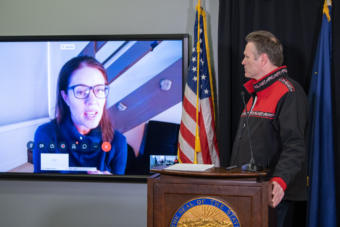
Anne Zink, Alaska’s chief medical officer, now works from a repurposed yurt beside her family’s home in Palmer, where she appears with Governor Dunleavy in webcam teleconferences. (Anne Zink)

When Anne Zink was 15, she was hiking in Wyoming with a few other teenagers at the end of an outdoor leadership course, without adults, when a storm moved in. As they retreated toward a ravine, a boy stepped on an unbalanced rock and went tumbling with it down a field of boulders.

The group thought the boy was dead. But when he regained consciousness, he started complaining about his foot, and they pulled off his boot.

A toe came off with it. And another was dangling.

Zink had first-aid training, which included a lesson on amputations, but no practical experience. The group set up a shelter, put the toe in a water bottle and hunkered down in the boulder field for two stormy nights before rescuers arrived.

Her mother, Carol Braun, found out only afterwards, and she said it was the only time she ever suggested that Zink become a doctor.

“I was just impressed at how she used all of her first aid that they had taught her, her ability to calm people down and see through the problems and figure it out — and did it with quite a bit of equanimity and care,” Braun said. “Ever since she was a little kid, she’s been somebody that could persuade anybody to do anything.”

Zink, 42, chose a career in medicine, as an emergency room doctor and director, and has settled in Palmer with her husband and 12- and 15-year-old daughters. And last year, she took a new job as Alaska’s chief medical officer.

Now, through her appearances at Gov. Mike Dunleavy’s nightly briefings, she’s become a trusted voice as she appeals to Alaskans to follow strict social distancing and other public health guidelines adopted by the administration, which have helped keep the state’s COVID-19 numbers among the lowest in the country.

She’s also been widely praised for the same qualities she showed as a teenager in that boulder field: her ability to work with others, project calm under pressure and communicate in a clear and relatable way.

“We’re doing what she’s asked us to do, because she’s encouraging us — she’s not threatening us,” said Sarah Erkmann Ward, an Anchorage communications consultant who recently published a blog post headlined: “Five reasons Dr. Zink is crushing it as a crisis communicator.

“She is the right person at the right moment that we never knew existed,” Erkmann said.

After initially participating in the nightly news conferences in-person, Zink spent two weeks in quarantine and now works from a repurposed yurt beside her family’s home, where she appears with Dunleavy by webcam. In a phone interview, she called the attention “a little surreal.”

“I sit by myself at a computer talking to the computer — all sorts of people see it, hear it in a way that I’m not always expecting,” she said.

“It’s been a struggle with each of these decisions, and this is definitely uncharted territory for all of us,” Zink added. “At the end of the day, what matters is how well Alaskans do.”

Patients and policy

Zink grew up in the Denver area, where both her parents were doctors.

Her maternal grandfather, Al Bartlett, was a University of Colorado Boulder physics professor and a nationally recognized speaker on exponential growth and humans’ inability to comprehend it — a lesson not lost on Zink as she navigates the COVID-19 pandemic.

“I think about him all the time,” she said. “Particularly in this world of trying to understand exponential growth, and trying to keep our state from getting into a place of exponential growth.”

Bartlett delivered his most famous lecture more than 1,700 times, in 49 states and seven countries, and one segment has more than 5 million views on YouTube. Like Zink, he was known for translating scientific concepts in ways that a broad audience could grasp.

During college, Zink spent summers in Alaska as an instructor for the National Outdoor Leadership School. After finishing her medical degree at Stanford University and her residency in Utah, she and her husband moved to Palmer, and Zink started work as an emergency room doctor at Mat-Su Regional hospital — where she was still working weekly shifts until the pandemic took hold.

Zink rides a bicycle next to the Knik Glacier, not far from her home in the Mat-Su. (Courtesy Anne Zink)

Zink said she was initially leery of the emergency room; it seemed to her like a job that allowed doctors to check in and check out, rather than fully engage with their work. But she came to appreciate how democratic it was, with opportunities to treat homeless people, chief executives and children.

The emergency room also gave Zink a firsthand view of the policy failures of Alaska’s social safety net, like its limited treatment options for drug addiction and mental health problems. At one point, she was punched in the face by a disturbed patient, leaving her with a black eye.

“I realized that if I wanted to care about my patients, I had to care about the policies in the hospital,” Zink said in a December episode of the Alaska Landmine podcast.

Zink and a group of her peers worked to reinvigorate Alaska’s chapter of an emergency room doctors advocacy group, the American College of Emergency Physicians. Her work with ACEP took her to lobby at Alaska’s Capitol in Juneau, and to Washington, D.C., where she made an impression on U.S. Sen. Lisa Murkowski.

“She was this young, articulate, hard-charging woman that you just think, ‘Man, TV shows should revolve around people just like her,’” said Murkowski, who’s friendly with Zink and calls herself a “huge fan.”

The political work appealed to Zink in part, she said, because she could actually see it produce change. Working with the state health department, ACEP developed guidelines for prescribing opioids to emergency room patients, with the aim of using the drugs more carefully.

The group also helped adjust computer systems to better guide the prescription of opioids. And it worked with different hospitals and other providers to launch a system to better coordinate the care of patients with complex medical and mental health problems.

Ask a question, “she’s all facts”

Zink with her daughters and husband in Bhutan during her recent sabbatical. (Courtesy Anne Zink)

Zink’s advocacy connected her with Jay Butler, who was then Alaska’s chief medical officer. When Butler was named to a top job at the Centers for Disease Control and Prevention, he suggested that Zink consider replacing him. She was ultimately offered the job by Adam Crum, the new health and social services commission.

It was not long after Dunleavy had been elected. Zink was in Bhutan with her husband and her daughters — one of a number of countries where the family lived during a year-long sabbatical.

Dunleavy, in his first months in office, was proposing deep cuts to health care, homeless services and other safety net programs — moves that drew sharp criticism from many providers. Some of Zink’s emergency room peers were surprised she took the job, and thought she would face obstacles in Dunleavy’s administration, said Nathan Peimann, the current president of Alaska’s ACEP chapter.

“There were, on so many levels, so many affronts to so much of what we were taking for granted that we thought there was no way to stem this tide,” he said. “As one voice, the influence you can have is probably small.”

Zink is not registered with a political party and describes her affiliation as the “party of health.” She said she didn’t really know the governor or Crum, or what it would be like to work with them. “But I just also felt like I wouldn’t know unless I tried,” she said.

Dunleavy, in a phone interview, said he’s come to trust Zink as an “honest broker” who presents him with information and choices, without advocating for a specific position.

“You get to me by using data. You don’t get to me by using emotion or threats,” Dunleavy said. “You ask her a question, she’s all facts.”

The Dunleavy administration’s aggressive measures to contain the coronavirus have undercut emergency room doctors’ initial skepticism about Zink taking the job, and so has the state’s low number of cases, said Peimann.

“That was because of the actions of the administration,” he said. “I give Anne and the governor credit.”

Alaska Chief Medical Officer Anne Zink talks to reporters at a press conference about the coronavirus on Monday, March 9, 2020, while Gov. Mike Dunleavy looks on in the background. (Joey Mendolia/Alaska Public Media)

After more than a month of frenetic work organizing Alaska’s initial response to the pandemic, Zink and other top administration officials now face a different and more prolonged challenge: trying to revive the state’s devastated economy while keeping the virus at bay, as residents grow increasingly impatient with the limitations on their lives.

Zink is working from her yurt with three phones and three laptops, sometimes starting at 4 a.m. She said she still makes time for runs or walks with her two daughters, but spends most of her days on conference calls and in videoconference meetings — sometimes two or three at once.

In her first several months on the job, Zink said she felt like the state was making progress toward fixing some of the systemic problems she saw as an emergency room doctor. But since January, the work demanded by the coronavirus just “grew and grew and grew,” she said.

Murkowski said she called Zink early on a recent Saturday morning, just to remind her to take care of herself.

“We exchanged the pleasantries, going back and forth. But then she wanted to spend the next half hour with me, updating me on everything that was going on, and all the good things and where the challenges were,” Murkowski said. “She’s just that type of person.”

Please stay on the (punch)line: Callers overwhelm Juneau’s new joke hotline

A gag a day keeps the virus away — or, at least it’ll brighten up your day.

Juneau’s parks and recreation department recently started a joke hotline for residents to call in case they need a quick laugh.

Recreation coordinator Dawn Welch said the department got the idea from a parks-and-rec group page.

“It’s just a joke a day,” said Welch. “Call the number and you’ll hear a joke, and it will get updated every day before 10 a.m. It is seven days a week.”

The phone line was originally used as the hiking hotline, but the department is trying to innovate because that program is suspended. Whether or not it will stick around is up in the air.

“I think that is yet to be determined,” said Welch. “I guess we’ll see how it goes.”

Welch also said the line hit a snag on the second day — she thinks it’s because too many people called in. But hopefully, they’ll get the line back up soon.


Advice from a life coach: How to develop a ‘resilience mindset’ in times of adversity

(Photo courtesy of Brandee Gerke)

“How can you make this obstacle your greatest gift?”
— Brandee Gerke

“As a life coach, I help people become clear about desired changes they want in their life,” said Brandee Gerke on Wednesday’s Juneau Afternoon. “The first thing we want to do is get people into a resourceful and positive place.”

Gerke is a Juneau-based life coach who runs Thrive Life Coaching. Gerke frames her coaching strategies around what she calls a “resilience mindset,” or the capacity to navigate change and adversity.
“We can keep moving forward in life in spite of all of these uncertainties,” said Gerke. “I’d love to see all of us come out on the other side of this experience with a stronger resilience mindset which will serve us for the rest of our lives.”

Here are two of Gerke’s strategies for reframing adversity and cultivating a resilience mindset.

Practice redirecting attention toward the good in your life

“What we think about expands,” Gerke explained.

She shared her own practice to expand joy in her life, working against the pervasive anxiety that comes from only attending to bad news.

“I would invite people to place focus on what is going right. A very common practice is a gratitude practice: Look around, pause, take a second to remember what you’re grateful for in the moment. A way to really expand the benefits of that is to share with someone else and to get their perspectives on what they’re grateful for. Those conversations will be really reinforcing on finding what’s going right,” said Gerke.

Equip yourself for the challenge of social isolation and distancing

Referring to a previous Juneau Afternoon interview with therapist Dr. Elaine Schroeder, Gerke emphasized the importance of setting up structures and resources to move through social isolation.

(Creative Commons illustration by Michael Driver)

“I have an item on my to-do list to connect with a friend every day via phone. Most people are home and more available than ever,” said Gerke.

Gerke caveats that there are limits to life coaching and self-advocacy, urging those who feel paralyzed by anxiety or depression to access a therapist.

There are also many free online resources for mental health:

  • For online therapy: BetterHelp and Talkspace.
  • For educational content: Sounds True, an online learning platform for spiritual healing, meditation and working through emotional uncertainty.

Gerke encouraged listeners to ask themselves, “How can you make this obstacle your greatest gift? Just explore that. See if there are things you can do in this time to make this time work for you,” said Gerke.

Listen to the full interview here:

How to maintain mental wellness — for yourself and others — during social isolation

Dr. Elaine Schroeder, host of KTOO’s “Mind Over Matter.” (Photo by Sheli DeLaney/KTOO)

“We often say that Juneau is an amazing community. I think this is going to prove it.”
— Dr. Elaine Schroeder

On Tuesday, Juneau Afternoon host Scott Burton interviewed psychotherapist Dr. Elaine Schroeder. Schroeder explored ways to maintain mental wellness during the pandemic and social isolation.

She is also the host of KTOO’s Mind over Matter, a program focused on social justice and mental health, and has lived in Juneau for over 30 years.

Before delving into mental wellness, Schroeder emphasized the unprecedented nature of the pandemic and being patient with the feelings that it evokes: “Like everybody else, I’m scared. It’s human. This is a pandemic that has never occurred in the history of our lives,” said Schroeder.

Some of the strategies for mental wellness that Schroeder recommended include:

  • Grounding oneself in trusted, reputable sources rather than consuming information in passing. “WHO (World Health Organization), reputable scientists, and research intuitions we can trust,” said Schroeder.
  • Finding creative ways to stay connected with others, while upholding a responsibility to practice social distancing and isolation.
  • Building routine and structure, such as making sure to get outside everyday. “I try to get out, rain or shine!” said Schroeder.
  • Taking preventative measures to prepare for isolation — especially for those with depression or other pre-existing psychological conditions. These include setting up calls with a therapist, establishing routine, or unearthing old creative projects.
  • Figuring out ways to help and receive help from others, whether that’s through engaging with online mutual aid groups. The new Juneau Mutual Aid group on Facebook is one example.
(Creative Commons illustration by The People Speak!)

“Social isolation is going to be a challenge for all of us,” said Schroeder. “Offering to help others can really help create a sense of community. Loneliness is a very serious health risk for older people living alone, for anyone living alone. I’m sure that in Juneau, because of the strength of our community, that there will be remedies for things that individuals may be worried about: How am I going to get groceries? How am I doing to do this, how am I going to do that?” said Schroeder.

The measure of these next uncertain months will be about how individuals and communities respond to crisis, taking care of themselves and one another.

Schroeder ended her interview with an eye toward hope: “We often say that Juneau is an amazing community. I think this is going to prove it,” said Schroeder.

Listen to the full interview here:

Is your Alaska doctor as worried about coronavirus as you are? Maybe not.

Inlet View Elementary sixth grader Ilsa Robinson, second from left, at the Anchorage airport for a trip to Washington, D.C., Feb. 28. Her mother, Julie Robinson, an Anchorage doctor, said she didn’t have anxiety about sending her daughter on the trip despite coronavirus concerns. (Photo courtesy of Dr. Julie Robinson)

When Dr. Julie Robinson of Anchorage dropped her 11-year-old daughter at the airport for a class trip to Washington, D.C., last week, she made sure the group boarded the plane with a few extra items.

“I met the group at the airport with a bag of wet wipes and bottles of hand sanitizer,” Robinson said.

Robinson felt good about letting her daughter travel across the country. For her, it wasn’t a tough call. But at Arete Family Medicine in Anchorage, where she’s a family practice physician, many of her patients are anxiously grappling with similar decisions.

“Especially with spring break next week, we’re just getting a lot of questions about travel,” Robinson said.

There are no confirmed cases of coronavirus in Alaska. The state is testing more patients every day and medical experts say the virus is likely to be discovered in the state soon. At local clinics and hospitals, doctors are fielding lots of questions. Many say they’re counseling patients to take COVID-19 seriously, but not to panic.

When addressing travel questions, Robinson tells each patient to think about their own health. Do they have chronic respiratory issues or another underlying health problem that could make them more susceptible to coronavirus, and more likely to contract severe symptoms if they do get the disease?

“And then also, do they have anxiety? A lot of patients who have underlying anxiety are really struggling with this decision about travel. And so if they’re otherwise a low-risk traveler, but they feel really anxious about it, that’s maybe a reason to stay home,” Robinson said.

For younger and healthy individuals, Robinson isn’t much more worried about coronavirus than she is about influenza, a more familiar virus that can be deadly for people in fragile health. She acknowledges there are a lot of unknowns. And she suspects Alaska cases will be confirmed soon, but tells her patients to be pragmatic.

Michelle Laufer, a pediatrician at Medical Park Pediatrics in Anchorage, gives similar advice.

“I don’t think we should walk around necessarily being worried,” she said. “For the most part we just need to be conscious about preventing illness and then caring for ourselves if we become ill.”

Laufer said the hardest part for most patients is that there’s still a lot of uncertainty surrounding the coronavirus. She said reliable data is limited.

“We know that it’s a virus, we know that it’s relatively transmissible and that it can cause severe illness and even death. But the numbers around that and risk of that — it’s just unclear at this point,” she said.

Laufer said she expects the virus is already in Alaska, but hasn’t yet been detected. Her biggest frustration is that the state doesn’t have more capacity to test. The state has capacity to conduct fewer than 200 tests and doesn’t know when the Centers for Disease Control and Prevention will ship more. Laufer expects private labs will be able to test for coronavirus soon, but said it’s unclear if insurance will cover the cost.

At Providence Hospital this week, the state approved testing for two intensive care patients who didn’t have a travel history, according to regional chief medical officer Michael Bernstein. He said both tests came back negative. Bernstein describes the level of worry in Anchorage over coronavirus as moderate, which he said is appropriate.

“My sense within our community, honestly, is that the sense of concern is probably about where it needs to be,” he said. “It’s enough to get us to do a lot of preparation.”

Bernstein said the Providence Health System has canceled all travel meetings for at least the next month to ensure there are enough workers to address coronavirus.

Bernstein asks people wash their hands, refrain from touching their face and to get a flu vaccine if they haven’t already.

Julie Robinson, the family practice doctor, adds that Alaskans should eat healthy and exercise. She said people also tend to underestimate the importance of getting a good night of sleep for warding off any illness.

Other than that, she said, it’s a waiting game.

“I think people need to take a big breath and try to relax and we’ll see what happens,” she said.

See all of KTOO’s Alaska coronavirus coverage

Anchorage schools are pioneering a new ‘social-emotional learning’ model. Is it working?

Mandy Casurella leads a group of third graders and fourth graders at Chugach Optional Elementary School through social-emotional learning exercises. (Photo by Zachariah Hughes/Alaska Public Media)

On a cold Friday morning, Mandy Casurella asked a group of 19 elementary schoolers to practice “hot chocolate breathing.”

“Smell the hot chocolate,” Casurella gently commanded as the third and fourth graders lifted imaginary mugs with deep inhalations.

“And cool it down,” Casurella added to a wave of heavy sighs.

It’s a set of breathing exercises to help the students practice calming down if they find themselves flooded with frustrated feelings, one small part of the Anchorage School District’s effort to instill what’s called “social-emotional learning” in tens of thousands of pupils.

For around 20 years, ASD has been gradually implementing and refining its SEL pedagogy. Educators inside and outside the district say that the emphasis on social skills and emotional management are critical for academic success and subsequent occupational achievement.

Across the country, more schools, school districts and states are implementing SEL curricula. ASD was an early pioneer, and a recent initiative at Harvard University’s Graduate School of Education backed up a lot of the district’s practices.

But SEL is notoriously abstract and hard to measure. Even its champions lament that there are huge inconsistencies in basic terminology. What one set of guidelines label “empathy,” might be indexed elsewhere as “self-awareness” or “active listening.”

The new Harvard initiative aims to solve some of those discrepancies, and it picked ASD’s framework for teaching SEL as one of its primary models.

Professionally, Casurella is a counselor who works with both adults and kids. As a parent at Chugach Optional Elementary School in Anchorage, she regularly volunteers with her son’s class doing social-emotional learning exercises. For about an hour, the students practice their hot chocolate breaths, label emotional reactions and navigate hurtful feelings by enacting short skits: First the kids are purposefully mean to one another, then they have to apologize and move forward.

“Ha ha, you didn’t get the quiz right, and I did!” teased one little boy, very convincingly. Then he course-corrected: “Oh, sorry, you did good on the quiz, sorry you didn’t get all the questions right.”

“I saw that,” Casurella said amid scattered applause. “Catch it, own it, redo it. That takes character, guys, and that’s what you’re practicing, so great job today. I’m really proud of you.”

Casurella believes these kinds of lessons teach children to be fluent in a lot of the same emotional and social skills that many adults don’t learn until later in life, often in therapy or counseling.

“Social-emotional learning is about giving children guidance in the world of emotions and relationships. And those are everywhere you go,” she said after the lesson was over.

According to Casurella, an emerging body of research on SEL validates its efficacy in the classroom.

That perspective is shared by the Anchorage School District. In hundreds of classrooms and among 48,500 students, ASD is implementing a standardized framework for SEL. That’s no easy task, not only because it’s a relatively new set of tools: They are hard to measure and even harder to consistently define.

“We’re all talking about these non-academic or soft skills, but we’re calling them different things, so translating them across has been really difficult,” said Jennifer Knutson, ASD’s senior director of teaching and learning.

SEL lessons in the district started at the grassroots level around 20 years ago by individual teachers, according to Knutson. In 2011, ASD became one of the first school districts in the country to adopt a defined framework.

“Some of those standards would be like: A student demonstrates awareness of their emotions,” Knutson said. “So, just like we have reading standards, we have social-emotional learning standards.”

As SEL has caught on, so have efforts to standardize and systematize it. The Harvard team recently analyzed how different institutions have developed SEL frameworks, indexed their terminologies and provided a rubric for assessing them against one another to compare emphases. Their new hub takes independently-crafted pedagogies and lets educators and parents see how they stack up against each other.

“Our goal is to allow people to navigate between those different frameworks in a way that’s very similar to a Rosetta Stone,” said Bryan Nelson, a researcher at Harvard’s Ecological Approaches to Social Emotional Learning Laboratory.

Of the 40 sets of curricula they assessed, ASD’s was the only school district with a framework for SEL education.

According to Knutson, the district is committed to SEL because it’s helping kids learn.

“It is working,” she said, though adding the caveat that “it goes up and down, and school’s vary from year to year, depending on which situations are happening.”

Knutson called the district’s current research method into SEL measures “informal,” relying on annual surveys, reports from school administrators and other performance indicators. But in schools that have focused SEL initiatives, she said there are decreases in behavior problems, higher attendance and more teacher involvement. Students who demonstrate high SEL performance tend to have better grade point averages and a greater proficiency in language arts and math, although correlation is not necessarily causation.

Chugach Optional is one of the least traditional schools in Anchorage, and the kind of free-form environment where you’d expect to see an emphasis on feelings and self-awareness. Teachers go by their first names. Students dance in the hallways before class. There’s a chicken coop near the front entrance, as well as an organic gardening club.

But SEL is not confined just to Anchorage’s progressive alternative schools: It is a district-wide set of standards.

Across town, in one of the most ethnically-diverse and socioeconomically-challenged high schools in the municipality, administrators are big SEL fans.

Each day, Principal Sean Prince and his deputies stand at the front entrance of Bartlett High School to greet every single student with a handshake, a fist-bump, a smile and the occasional side-hug.

As we spoke, Prince repeatedly stopped mid-sentence to hail kids as they passed by.

“Hey Cam!” he shouted. “Thought you were going to sneak by me?”

Bartlett High School in Anchorage. (Alaska Public Media file photo)

Among a student body of more than 1,400, Prince knows almost every student’s name. Bartlett has a lot of challenges. Seventy-five percent of its students come from low-income households, and the high school consistently ranks among the lowest in Anchorage for academic achievement, according to data from the state’s Department of Education and Early Development.

Three years ago, Bartlett started a new SEL initiative that includes steps like greeting students individually each morning. There are also efforts to give students more of a say in school culture, by having pupils rewrite the school’s mission statement and setting aside classroom time for teachers and students to negotiate a social contract. Prince also banned headphones and earbuds during the entire school day — he wanted more people talking to one another.

A former Marine who graduated from high school in Palmer, Prince said discipline was strict and sometimes arbitrary when he was a student.

“I graduated 25 years ago, and I think that those times were very different,” he said in his office.

Bartlett started implementing reforms shortly after 51% of students reported in a survey that they didn’t believe a teacher or administrator would miss them if they were gone from school. That same year, Prince said, a freshman student took his life. Not long after, efforts got under way to improve the school’s climate of connectedness. In the time since, Prince attests to a better environment at Bartlett, with performance indicators beginning to move in the same direction.

A lot of Prince’s work is with faculty and staff, training them to buy into and practice many of the same things they are tasked with guiding students through. If the SEL stuff is going to be taken seriously, Prince said, teachers have to believe it has value.

In part, because high schoolers can tell when an adult isn’t sincere.

“They have a really good BS meter. They can smell authenticity like a fresh donut,” he said. “If someone is being disingenuous in the application of an SEL thing, they’ll know it’s fake right away.”

Among the posters papering Prince’s office are big ones outlining the eight character traits his team want to inculcate in their students. There are character-building standbys like “grit” and “self-control,” right beside less traditional qualities like “social intelligence,” “gratitude,” and “zest.”

In a school contending with a lot of challenges, he says the positive impacts of SEL initiatives on Bartlett’s culture and climate are undeniable.

Site notifications
Update notification options
Subscribe to notifications