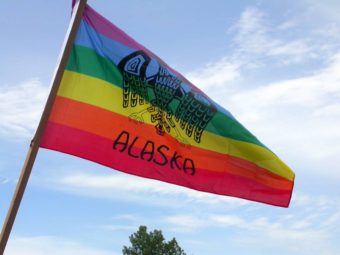
An Alaska Pride flag. The image is based on a double-faced eagle design from Alaska before Russian contact. (Creative Commons photo by Mel Green)
The Anchorage Assembly voted to ban conversion therapy for minors on Wednesday after a two-day public hearing. Conversion therapy, as defined in the ordinance, is a practice that seeks to change a person’s sexual orientation or gender identity. It has been discredited and condemned by the American Psychological Association and many other medical and civil rights organizations.
The Assembly passed the ban 9 to 2, with Chugiak/Eagle River assemblywomen Jamie Allard and Crystal Kennedy voting against.
During two days of public hearing this week, the majority of call-in testifiers were against the ban. They cited concerns about the ban encroaching on freedoms of speech and religion and parental rights. Some called it overreach of the assembly’s powers.
Those who testified in favor of the ban called conversion therapy child abuse and pointed out that it results in higher suicide rates among LGBTQ youth. Some had experienced the practice themselves and detailed the lifelong traumatic effects of the conversion therapy they said they were forced to undergo as children.
The ordinance prevents licensed professionals such as therapists or school counselors from engaging in efforts to change a minor’s sexual orientation or gender identity. It passed with two amendments — one to reinforce the rights of parents to provide counsel to their children, and another that exempts clergy members who are acting in a religious capacity.
Anchorage joins 20 states and dozens of cities across the country that have passed conversion therapy bans in the past ten years.
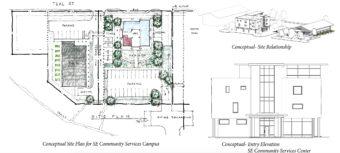
The conceptual site plan of the Southeast Community Services Campus, featuring The Glory Hall’s new building (TGH) and the nonprofit center (UHS) (Courtesy of United Human Services)
About a year ago, Glory Hall director Mariya Lovishchuk was figuring out the relocation of Juneau’s downtown homeless shelter when she got a call from Joan O’ Keefe, executive director of both United Human Services and Southeast Alaska Independent Living, to collaborate on the creation of a social services campus. The campus would be a space where people could access a variety of social services in one location, cutting costs and increasing accessibility for all involved. It’s a vision service providers have held for almost a decade.
United Human Services, in collaboration with The Glory Hall and other service providers, is coordinating the development of the Southeast Community Services Campus.

“It’s a one-stop-shop model for people who need services,” O’Keefe said.
The Southeast Community Services Campus will consist of two buildings: the Glory Hall’s new shelter and a nonprofit center.
The nonprofit center will house organizations like National Alliance on Mental Illness, United Way, Southeast Alaska Independent Living, Alaska Legal Services, Big Brother Big Sister, The Disability Law Center and United Human Services — all of which have a 10-year commitment to be on the campus. There will also be a garden and a pedestrian walkway connecting the buildings.
The campus will be located near the airport, at the intersection of Teal St. and Alpine Ave., conveniently placed near Juneau Youth Services, Tlingit and Haida Central Council and St. Vincent de Paul Society.
There are more than 200 multi-tenant nonprofit centers already across the U.S., O’Keefe says. The one-stop-shop model allows for local service providers, who often share clients, to collaborate while making it easier for anyone to access services by mitigating the costs of transportation, resources and the time it would usually take to shuttle from appointment to appointment around the city.
“It’s hard to connect to services, and you really need a lot of resources to get out of homelessness,” Lovishchuk said. “Having a nonprofit center right next door, not worrying about getting people to services — I can’t imagine anything better.”
It’s the right time for this to come to fruition, Lovishchuk said. With COVID-19, there is an even greater strain on service providers: the Glory Hall has lost three-fourths of their capacity, and staff at SAIL are busier than ever.
“There’s a lot of need out there, and unfortunately I think it’s going to get worse than better,” O’Keefe said.
The Southeast Community Services Campus is currently in the fundraising phase of development. The Glory Hall has completed its architectural design and is aiming to complete the construction of its new shelter in the next year.
Listen to the entire interview featuring Mariya Lovishchuk and Joan O’ Keefe:
Like many around the country, Juneau’s recent high school graduates have had to navigate online classes, separation from their peers and a socially-distant graduation ceremony without precedent. Though not all seniors have experienced the pandemic in the same way.
Zakia McCorkle, a graduate from Juneau-Douglas High School: Yadaa.at Kalé, has prioritized her health during her last semester, staying socially isolated with her family.
(Courtesy of Zakia McCorkle)
“I’ve a bad immune system, so I’ve been really locking down and holding up and kind of, like, borderline paranoid, but I know it’s for the best,” McCorkle said.
Some students are dealing with housing and health insecurity. Others have struggled with online classes and mental health. And many have been floundering with their endless free time.
Monie Dunlap, a graduate from Yaakoosge Daakahidi High School, had just finished up all their school credits before they were told to stay home.
Dunlap also had plans to make their own regalia to dance at Celebration before the event was canceled. They’ve managed these changes by pouring energy into other activities, like learning Tlingit and making masks at Elizabeth Pretatrovich hall to send to other Alaska communities.
Max Wheat, a graduate at Yaakoosge Daakahidi High School, said on Juneau Afternoon that he and his friends have mainly been “bored out of their minds” while finishing their senior year at home. He says that’s a relief since he had expected mental health issues in his community to soar.
Wheat remains optimistic and is looking forward to the day he can hug people again.
(Courtesy of Max Wheat)
“You see a friend, give him a hug. You see an uncle you haven’t seen in forever, give him a hug. You know what I mean? It’s going to be good,” Wheat said.
The pandemic has brought immense uncertainty for students, but for some, it has brought a renewed sense of purpose.
For McCorkle, the pandemic has reaffirmed her commitment to tackling social inequality after graduation. She intends to work at Job Corp, a free vocational training program by the United States Department of Labor, and wants to one day open a domestic violence shelter.
“The rates have drastically shot up for domestic violence,” McCorkle explained, ”I feel like it’s something that we’re becoming more aware of, but we still don’t have enough resources for those that are in need … In most of high school, it was me trying to pursue how to help others … so I can better address everything from domestic violence to LGBTQ circumstances and other bad situations.”
As for what she’s looking forward to after graduating, she said without hesitation: “Freedom.”
A little abashed, she clarified, “You know it’s the little things!… From going to classes that I choose to go to or eating ice cream when I want to. ”
As she and other graduates pack and prepare for life after high school, McCorkle thinks that the pandemic shouldn’t stop them from staying hopeful.
“I think time is really precious. And I don’t think we should be wasting it on anything that you think is not worth it, whether that’s friends you have or jobs you’re pursuing,” McCorkle said. “If you don’t see yourself loving it or you’re not enjoying what you’re doing, why do it?…That could just be me sounding young, but I don’t see the point.”
Across the state this week, in cities and small towns, Alaskans peacefully protested the death of George Floyd, a black man who died in Minneapolis on Memorial Day after a white police officer pinned him to the ground with his knee on Floyd’s neck. In a widely-shared video, Floyd can be heard saying “I can’t breathe.”
Four Minnesota Police officers were initially fired one day after Floyd’s death. One officer, Derek Chauvin, was arrested and charged with murder. Since then, nightly demonstrations, some of which have turned violent, filled streets in cities across the country. The other three officers involved have since been arrested and charged. Activists across the globe continue to protest.
Since last Saturday, Alaskans from Kotzebue to Ketchikan joined other communities in the call for an end to police brutality. Many also had signs calling out acts of institutional and systemic racism. Here’s a look at how protests took shape across the state:
Anchorage
Nykia Johnson, JD Conley, and Zakia Thornton attend the “I Can’t Breathe Rally” in Anchorage on May 29, 2020 (Mayowa Aina/Alaska Public Media)
“I’m fed up. I’m fighting against the police brutality. We got to stand together. If we don’t come together who’s gonna stop it?,” said Zakia Thornton at the “I Can’t Breathe” rally in Anchorage.
Juneau
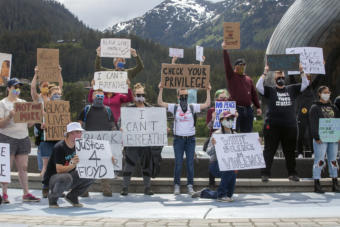
People held signs decrying violence against black people and calling out institutional racism, many supporting the Black Lives Matter movement on Saturday, May 30, 2020 in Juneau, Alaska. (Photo by Rashah McChesney/KTOO)
In Juneau, chants of “Silence is violence,” and “If you see something say something,” urged white protestors and allies of the Black Lives Matter movement to take tangible steps toward preventing violence against black people.
Kotzebue
Organizers of the protest come together after marching through Kotzebue on June 2, 2020 (Photo by Berett Wilber/KOTZ)
“I was surprised. I even told Camille, because it was so last minute, I even told Camille if it’s just you and I, we’re going to walk,” said Stepheena Smith who helped organize the event in Kotzebue.
Sitka
Louise Brady and Dionne Brady-Howard led a group in singing two Tlingit songs- Aakwtaatseen, followed by Xwaal’, the Peace Hat Song on June 1, 2020 (Katherine Rose/KCAW)
“These are really heartbreaking times that we’re living in right now, and I really would like to thank the organizers for putting this together because I think sometimes it’s really difficult if we don’t have an outlet for all this pain. I think with the turnout and all the people here we can see that there’s a lot of people who care,” Louise Brady said at the event in Sitka.
Bethel
Community members marched from the Yupiit Piciryarait Cultural Center to Watson’s Corner and back in solidarity with the Black Lives Matter movement in the wake of the murder of George Floyd in Bethel, Alaska on June 2, 2020. (Katie Basile/KYUK)
“I mean, it’s great that everyone’s coming together to try to make a change, but I’ve seen this a lot,” said Garry Howard at the event in Bethel. “Hoping for a change, but we’ll see.”
Ketchikan
From left to right, Audrey Daniels, Isabel Morris and Rosie Daniels were among a handful of protesters demonstrating at the corner of Tongass Avenue and Jefferson Street June 3, 2020 (Eric Stone/KRBD)
“It just makes me feel uncomfortable to live in this town, because this is a Native town and we have racist people like that here and it just doesn’t make sense,” said teenager Rosie Daniels of motorists who flipped her off or displayed a thumbs down at the event in Ketchikan.
Kodiak
Ron Jackson holds a sign in support of the Black Lives Matter movement in downtown Kodiak. (Photo by Kavitha George/KMXT)
“I think that a lot of the issues that we’re facing now are not issues that we see here. So maybe Kodiak doesn’t know how to respond to those types of movements. Kodiak can respond to climate change because it directly affects us. Kodiak can respond to Pebble Mine because it directly affects us. And so I think that what doesn’t affect us, we’re not quite so sure how to respond to,” said Tyler Barnes at the event in Kodiak.
Haines
Haines residents gather at the Fort Seward parade grounds for a vigil in memory of George Floyd on June 1, 2020 (Photo by Henry Leasia)
“Half of me feels safe up here in a weird way like we’re very sheltered from what’s going on in the Lower 48, just as far as the violence and the intense police state, but I also feel very guilty for not being there,” said Megan Mcgrail, one of the events organizers in Haines.
There have been more demonstrations too. On social media, Alaskans have posted about marches and rallies in communities including Unalakleet and Soldotna.
While Alaska’s rallies and protests have remained peaceful some Alaskans have reported instances of intimidation, backlash, or resistance. More demonstrations are planned for this weekend.
Send photos of the demonstrations in your Alaska communities to news@alaskapublic.org.
A family testing out a new way to have contact at Wildflower Court. (Photo courtesy of Wildflower Court)
Alaska has lifted restrictions on businesses and some people are getting out more after the pandemic radically altered social life in March and April. But for nursing homes, there’s no set date for when families can safely reunite. The state has set up a task force to look into how to reintegrate visits. However, there’s still a lot of unknowns about when that’s going to happen. In the meantime, families are coping with the distance.
Jodi Mitchell’s brother, Donnie, lives at Wildflower Court, a nursing home in Juneau. She sees him at least once a week or more through a computer screen. Usually, it’s a big family gathering. On the Zoom conference, there were family from Hawaii and California. Mitchell called in from Juneau.
There was talk of the weather, the pandemic and what Donnie’s been up to. He hasn’t been winning at bingo, but he smiles at a joke a family member makes about the winning prize being a new car.
It’s been over three months since Mitchell has seen her brother in-person. Wildflower Court closed its door to visitors in early March, around the time COVID-19 outbreaks struck nursing homes in Washington state. Normally, Mitchell brings her brother home on the weekends. He likes helping her pick weeds in the garden and going on shopping trips. It’s precious time they have together.
“As soon as they allow you out, believe me, I’m going to come and get you,” Mitchell tells her brother on the Zoom call.
“Oh, gosh. I can’t wait until that happens,” he replies.
At 57 years-old, Mitchell’s brother is one of the younger residents at Wildflower Court. He lives there because of short term memory loss. Mitchell says the pandemic has been disruptive to his routine. He has his ups and downs.
Wildflower Court has the option to visit through a window, but Mitchell’s not sure if that would be a good fit for her brother.
“If I had gone there and he saw me, he wouldn’t be able to understand why he can’t just come with me,” Mitchell said.
Last week, there were only nine cases of COVID-19 reported in nursing homes in Alaska and all of those cases had recovered. But that number jumped up over the weekend, after a cluster of tests came back positive in Anchorage.
It’s unknown when nursing homes can safely allow families back in. So, facilities are having to come up with solutions to help close the emotional gap. That can look like video chats, like the one Mitchell has with her brother, window visits or holding hands through an arm-shaped hole.
Ruth Johnson, who oversees operations at Wildflower Court, says the nursing home constructed the setup, which allows families to touch with a long disposable glove that covers the arm.
She says, of course keeping residents safe during the pandemic has been a major concern — so has the psychological toll of people not being able to see their families in their typical way. It’s something that hits home for Johnson. Her father had to go into a nursing facility in Washington state in the spring — where later, dozens of people contracted the virus.
“I feel like my father may not die of COVID, but he may be part of the collateral damage: The isolation and loneliness … He has not seen anyone he loves in three months.”
Johnson says this is why she cares so much: She knows how Juneau families are feeling.
Not all nursing homes are equipped for video calls. But Wildflower Court was able to get video chats up and running in a matter of weeks. People donated electronic devices and staff set up a way for families to schedule time to talk.
Johnson wondered if communicating like this would be confusing for residents who can have difficulty recognizing faces or adjusting to sudden change. But overall, people seem to be adapting. She recalls a resident she saw recently with an iPad.
“She’s just of that age where she wouldn’t have used the technology,” Johnson said. “And she was sitting there with a pair of earphones on, plugged into the device, it was a private conversation, with just the most beautiful smile on her face talking to a family member.”
Jackie Pata says that’s been her experience, too. On video calls to Wildflower Court, her mom looks happy and calm. At first, she was reluctant to try video chatting. She worried her mom wouldn’t understand why she couldn’t be there in-person, and it would be upsetting.
But as social distancing measures continued, she decided to try it out. There were some technical issues when they first tried to connect.
“At that moment, my emotions got so real because I felt like, I’m so close to be able to talk to my mom. And now, I’m not going to be able to and that fear, that fear that you get was, like, overwhelming,” Pata said. “I realized in that moment how much I missed her and how much I needed to talk to her.”
But they were able to work it out, and she saw her mom for the first time in weeks.
Pata thinks her mother could sense that she was nervous and a little flustered. So her mom did what good mothers do: She says her mom told her exactly what she needed to hear in that moment.
“‘I love you. I think about you guys all the time. I miss you everyday. It hurts inside how much I miss you,’ and then she’d say, ‘But it’s all going to be OK. We’re going to be together again.'”
Pata says communicating like this has revealed a “blessing in disguise.” Her mom has been able to see grandkids from across the country on video calls. That’s not something that regularly happened before, but it’s something she hopes continues after nursing homes are able to welcome families back inside again.
Graphic from the 2019 Alaska Youth Risk Behavior Survey showing an increase in use of e-cigarettes among Alaska high school students.
A recent survey from the state Department of Health and Social Services shows a sharp increase in vaping and suicide attempts among high school students in Alaska.
The Youth Risk Behavior Survey is conducted every two years among almost 2,000 high school students across the state.
The survey says one in four students reported “currently vaping” in 2019. “Currently” means at least once in the past 30 days. That’s an increase from one in six from 2017.
Christy Knight is with the department’s tobacco prevention and control program. She says the cost of vaping for teens is the impact on brain development.
“So there are many youth who are not necessarily aware when they use the products that they contain nicotine, which is highly addictive,” she said.
Just like in combustible cigarettes, nicotine impacts attention and learning memory.
“We have over 50 years of research on combustible cigarettes, whereas e-cigarettes are still fairly new and we’re still learning the long term and short term health impacts of e-cigarettes,” she said.
Graphic from the 2019 Alaska Youth Risk Behavior Survey showing an increase in suicidal thoughts and attempts among Alaska high school students.
The risk survey also reported an increase in mental health distress among high school students. One in five (19%) of students surveyed reported having attempted suicide at least once.
That’s higher than the last survey in 2017.
Leah Van Kirk is the suicide prevention coordinator with the DHSS.
“What that really tells us is that it’s really important for us to continue working to support youth and to really promote protective factors that help us be resilient and reach out and get help when they need it,” she said.
Van Kirk says along with the increase in suicide attempts, it’s important to emphasize that many students have access to lethal means.
For the first time the survey asked if students have access to firearms.
“Almost 50% of our youth have access to a loaded gun,” she said. “So that means if your child or friend’s child is experiencing a difficult time or crisis, have your firearms stored off site, maybe ask a friend ‘Hey, can you hold on to my firearms for a little while our family’s going through a hard time right now.’”
For individual families, it’s important to take preventative measures. Van Kirk says it’s okay to ask if a loved one is having thoughts of suicide.
Anyone in distress can also call the Alaska Care Line at 877-266-4357.
Editor’s note: A previous version of this story misspelled Leah Van Kirk’s name. The story has been corrected.
Close
Update notification options
Subscribe to notifications
Subscribe
Get notifications about news related to the topics you care about. You can unsubscribe anytime.