Mental Health

Construction begins at Juneau’s Bartlett Hospital, $14 million behavioral health building to come by next winter


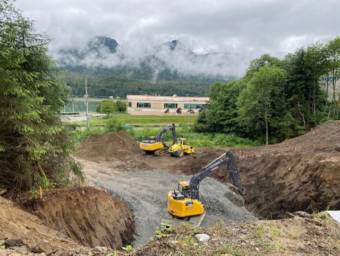
The remains of the Bartlett Outpatient Psychiatric Services building on July 8, in Juneau. (Claire Stremple/KTOO)

Contractors for Juneau’s Bartlett Regional Hospital broke ground on a multi-million dollar expansion project last month. The new building will hold the regional hub’s ballooning behavioral health program.

There’s a rubble strewn hole where Bartlett’s Outpatient Psychiatric Services used to be. Downhill, an excavator moves new rock into what will be the foundation for a $14 million dollar upgrade.

But when Bartlett’s Chief Behavioral Health Officer Bradley Grigg looks at the construction site, he sees a four story building that will house the hospital’s fastest growing department.

“So the patient rooms from crisis will be on the back of the facility facing the channel,” Grigg says, gesturing over Glacier Highway towards Gastineau Channel.

He’s not just excited about therapeutic views of Juneau’s waterfront. The behavioral health department has more than 10 times as many patients now as it did in September of 2019.

So, the building that will fill the space on the hillside below him will be nearly ten times the size of what was here before. It will house the 150-person behavioral health staff already working in the hospital and ideally have enough patient capacity to eliminate or reduce wait lists.

“This is really going to be a game changer in terms of access to treatment for people as they walk in. It’s on demand. It’s 24/7, it’s staffed 24/7. Psychiatry, therapist, behavioral health associates, nursing staff,” he said.

The hospital is taking on its biggest capital project in a decade because it doesn’t have enough room to house what Grigg calls an “unrelenting” influx of patients.

Right now, the behavioral health department has only one inpatient bed for youth—it has about 2 dozen for adults. The new facility will add 8 beds that can be used for adults or children. Currently, behavioral health patients who need to stay in a hospital must travel to Anchorage.
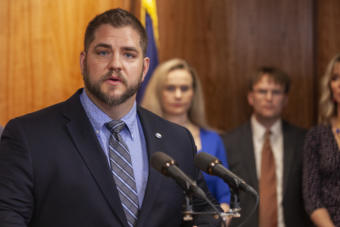
“We don’t want to be shipping them out north, doesn’t mean that it still won’t happen on occasion. But our ultimate goal is to serve any kid from Juneau and Southeast to come to our unit. In an effort to keep them as close to home community as possible. We know that if they’re closer, they’ll get better treatment,” said Grigg.

Even as hospital administration sat down with the final plans for the new building this year, they realized the hospital had already outgrown the unbuilt structure. They decided to add an entire floor. The cost of the additional floor was quickly accepted by the assembly and the hospital board. It will house 15 offices for therapists, nursing staff, and a case manager.

Jeanne Rynn is the city architect with the City and Borough of Juneau’s Engineering Department. Contractors broke ground on the project last month.

“The architectural team is working on the drawings right now to add the third floor. So you know, it’s very unusual to be designing the building while you’re building part of it, and they’re trying to stay ahead of the construction schedule,” she said.

Sky-high lumber prices precipitated another last minute change to the final plan. Architects finished designing the foundation footprint for what is now a steel structure in early July. Rynn says it’s been a little stressful, but the finished building will be worth the effort.

“I think the end result is going to serve the community well, so it’s a worthwhile cause for a good long term goal. And once the building is there, nobody’s going to care about what we went through to get it there. You know, that’s history. It takes on a life of its own at that point,” said Rynn.

The cost of the additional floor was quickly accepted by the assembly and the hospital board. It will house 15 offices for therapists, nursing staff, and a case management manager.

Grigg and his team secured about $5 million in outside funding for the project. The hospital will foot the bill for the remaining $9 million dollars, with approval from the Juneau assembly and its own board.

The goal is to have the exterior of the building up by the end of this season, so work can continue inside through the winter. Construction on the building is tentatively slated to be complete by winter of next year.


Clarification: This article has been updated to include the total bed count for the behavioral health department.

Alaska Medicaid must cover gender-affirming care following Homer woman’s lawsuit

Adam Crum, Commissioner of Alaska’s Department of Health and Social Services, answers a question during a 2019 press conference. Crum was named in a class action lawsuit after Alaska Medicaid refused to cover costs related to hormone treatment in 2019. (Rashah McChesney/KTOO)

Starting this month, Alaska Medicaid can no longer deny coverage to transgender Alaskans undergoing gender-affirming treatment.
That’s following the January settlement of a class action lawsuit filed by Swan Being, a transgender woman from Homer who said Alaska Medicaid refused to cover costs related to hormone treatment in 2019.

Being sued the Alaska Department of Health and Social Services, which oversees Alaska’s Medicaid program, and department commissioner Adam Crum. She alleged the state’s policies discriminated against transgender Alaskans and violated the 14th Amendment, which grants all Americans equal treatment under the law.

Being was the first to file the case. Robin Black and Austin Reed, both of Anchorage, joined as plaintiffs in 2020.

Up until now, Alaska was one of 10 states that still explicitly denied Medicaid coverage for gender-affirming treatment, including surgery, hormone treatment and therapy. Similar lawsuits are currently in motion in West Virginia and Georgia, said Carl Charles, an attorney with Lambda Legal. He co-counseled the case alongside the Anchorage-based Northern Justice Project.

Charles said that kind of gender-affirming health care is life-saving for transgender people. And he said it’s particularly important to protect access to that health care when it’s contingent upon employment.

“When you consider the transgender people as a group, when you take into consideration that we are chronically underemployed as a result of anti-trans discrimination, that makes health care that much more difficult,” Charles said.

Being relied on Medicaid for her health care and was diagnosed by her doctor with gender dysphoria — a conflict between a person’s assigned gender and the gender with which they identify.

The American Medical Association identifies gender dysphoria as a “serious medical condition,” the lawsuit said, with dire health implications if left untreated. The association said gender-affirming care is linked to a lower rate of suicide attempts among transgender people and overall higher quality of mental health.

Being received hormone replacement therapy and, in 2019, planned to travel from Homer to Anchorage for further treatment.

Alaska Medicaid typically covers travel for medical expenses. But because it didn’t cover the hormone injections and lab work Being sought, it denied her doctor’s request to cover the trip.

The other plaintiffs both reported a lack of coverage for gender-affirming surgery and hormones, according to the lawsuit.

A spokesperson from the Department of Health and Social Services said the changes go into effect July 25. The spokesperson also said the settlement is a result of both the Affordable Care Act and a 2020 Supreme Court Case, Bostock v. Clayton County, that upheld gay and transgender workers are protected under existing civil rights legislation.

The state estimated the regulation change will cost the department an additional $28,000 each year, Charles said.

“Which, if I may say, is a real drop in the bucket,” he said.

He said that’s partly because there are not as many transgender people living in Alaska as in other states. Even fewer are Alaska Medicaid recipients.

“But it is going to be lifesaving,” Charles said. “It will cost the state very little to make these people’s lives really measurably improved.”

2015 survey of transgender Americans, including 84 Alaskans, found a third of transgender Alaskans had had issues in that past year with insurance coverage related to being transgender.

Nationwide, the American Medical Association found in 2019 about a quarter of transgender patients seeking coverage for hormones were denied in the year prior. That was true for over half of those who sought coverage for gender-affirming surgery.

Health care costs are compounded for people living in remote communities in Alaska. Goriune Dudukgian, an attorney with the Northern Justice Project, said that was just one manifestation of the discrimination challenged in the suit.

“For folks who are living in the off-the-road-system communities, or where they can’t get care within their own communities, the travel component is a really big deal,” he said.

When it comes to private insurance, however, there is no law barring insurers in Alaska and about half of all other states from excluding transgender-related health care coverage.

All the plaintiffs in the case will also receive $60,000 for damages, according to the settlement agreement.

‘I thought my name was my number’: Survivors recount Alaska boarding school experiences

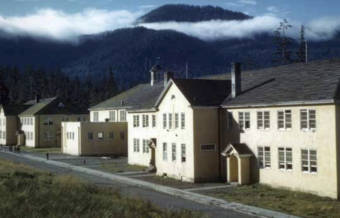
Students stroll the sidewalk behind the Wrangell Institute school and dorms, looking south, probably in the early 1960s. The boys dormitory is at right, the school (with bell-tower) is left of center, and the girls dormitory is at the far left. (National Park Service photo)

The recent discovery of the remains of hundreds of Indigenous children at a residential school in Canada has prompted discussion, grief and memories of past trauma in Alaska. Thousands of Alaska Native children were sent to boarding schools in and outside the state. The effects of forced assimilation continue to impact the lives of Native people.

Cultural expert Paul Ongtooguk and two boarding school survivors, Jim Aqpayuk LaBelle and Fred John Jr., shared their perspectives with Talk of Alaska on the legacy of boarding schools in Alaska.
Here are some highlights of what they shared, edited for length and clarity.

Paul Ongtooguk, former director of UAF’s Alaska Native Studies Department, on the origin of U.S. boarding school policy as labor development

In the early era, one of the strategies that were developed was to end the Indian Wars by ending Indianness. One of the venues for doing that was missionaries — converting people not only to Christianity but away from being Indian. That was not completely successful.

Paul Ongtooguk, a UAA professor of Native Studies at the KSKA studio in 2016 (Wesley Early/Alaska Public Media)

In the summertime, the students were essentially loaned out or sold, leased to members of the white community to serve as labor servants or maids, whatever manual labor that was available for them. So there was a very high attrition rate. There was a very high number of students who died from probably the geographic shift, probably from the population shift and from loneliness, from abuse and from malnutrition. There were also multiple reasons for accidents, given the kind of labor that they were involved in — this was all pre-OSHA.

Boarding school survivor Jim Aqpayuk LaBelle on his memories of being sent to the Wrangell Institute

My mother took us to the airport and our mom in Fairbanks left my younger brother and me there at the hands of the BIA officials. The first thing that they did was they tied us together with other children with ropes at the Fairbanks airport. There were dozens of other children that were already tied there.

I remember this so well, even though it happened 67 years ago. I can still recall some of the younger children as young as five were there. I was eight, my brother was six and we were thrust into just an alien situation where there was a lot of barking of orders. We were given yellow name tags to affix to our clothing that had our names or destination written on it, that kind of thing. And then it took almost a half a day sometimes longer, to get to Wrangell.

Jim LaBelle, his wife Susan LaBelle and Bob Sam at the 2016 Elders and Youth conference in Fairbanks. (Photo by Jennifer Canfield)

The first thing they had us do was to strip completely naked on this receiving room concrete floor. A lot of children did not understand the commands that the directions and oftentimes in frustration a lot of matrons ran over to these little guys and just kind of ripped their clothing off.

We were all told to get in a line to get her haircuts. These were done in a way that was kind of like being sheared — ever see these videos of sheep being sheared off? Well that’s what happened to us.

We were given clothing. The government issued clothing with our numbers. Our number was on our clothing and on our bedding. Children who had difficult names were often referred to only by their number by many matrons. And I can still remember years later as children who were much older, saying “I thought my name was my number.”

215 feathers were placed on the lawn of Sitka’s former residential school, Sheldon Jackson, in remembrance of the 215 children whose remains were discovered at a former residential school in Canada, drawing (KCAW/Tash Kimmell)

Fred John Jr. on the punishment given at Wrangell Institute

My younger sister was five and I was seven when we went. We were there almost seven years.

It was like a military thing…If we do the smallest thing we would get punished. Like our coat be on the floor, or if we were late getting up. On Saturday morning the big kids would line up for spanking with their pants would be around their knees in the barbershop. They get I think 12 swats, I don’t remember now. But it was lots.

The Wrangell Institute in 1938. (National Archives Pacific Alaska Region)

The big kids wouldn’t cry. But as little ones, we get the same amount of spankings and we are all lined up beside them. The big ones could get spanking before the smaller ones. But we’d be crying before when we saw the big guys get their spanking and we watch them.

When it was our turn, the only good thing about that is the big boys could take our place if they wanted to — a lot of them did. They took their second spanking. My brothers would take two spankings for me.

Another one is the gauntlet. They’d strip us down if we behaved like what they call really bad, if we were bad boys. And they would have two lines to line up and down beside the beds. And the guys that tattletale were standing on a bed and watch the whole thing. The boy — they stripped them down naked and let them run down through the complex. The boys on both sides pulled their belt out and hit them with the hard end — the buckle end as he ran. Sometimes they fall down and cry and everything and they’d be really beat up by time they make it to the end.

Whoever don’t hit hard would be stripped down and then run down the gauntlet.

Even though I don’t want to, I even hit my friends. Luke Titus was one of them, my friend from Minto. He was one of them that I ran down that thing and I hit him hard. And he did the same to me. About 60 some years later, we met in Old Minto Recovery Camp. We apologized to each other for hitting each other. We didn’t — we didn’t have any choice.

Paul Ongtooguk on the whether the government has apologized for its role in boarding schools

The short answer is no, nothing that I’m aware of. There have been individual communities that have apologized for their role. Some of the churches have apologized for the role that their boarding schools have played in this, but it’s been very uneven. And there’s certainly nothing on the federal or state level that represents a formal apology or compensation.

Fred John Jr. on how he started telling his story

I got four girls and a son. And I didn’t really talk to them for years. I never talked about my boarding school experience probably for about 15 years. I kept a wall around me — an imaginary wall so I wouldn’t ever get hurt again. So I never talked about it.

I became an alcoholic. My family kept me together. And when I came back from recovery camp, I told my story there the first time, my whole life story, and it took about three weeks before I start feeling this freedom of telling my story. My kids, they cared about my story. And they know my experience and everything.

People ask me what do you tell your children, I tell them, forgive us. Forgive us for not learning how to make sleds. Forgive us for not making snowshoes and boats and canoes, and all those things that our uncle and our aunties taught us.

Lex Treinen contributed to this report.

‘We need to be doing this work’: Tlingit and Haida takes on mental health and wellness with new division

Tlingit and Haida President Chalyee Éesh Richard Peterson in his office. (Claire Stremple/KTOO)

The Central Council of the Tlingit and Haida Indian Tribes already offers some social services, but it’s ready to expand. It launched the new Community and Behavioral Services Division this spring. The move marks a shift towards stronger tribal support for wellness.

Tlingit and Haida President Chalyee Éesh Richard Peterson says COVID-19 was the catalyst to creating a wellness division that’s been urged by the tribal delegation — that’s the legislative branch of the government — for years.

He said there’s been hesitancy to step into the wellness role because Southeast Regional Health Consortium and other medical providers already offer those services. But he says the demand is so great, that everyone needs to work together.

“For me, I’m not so worried about stepping on toes, step away, step on mine — we’ll figure it out. What we need to do is we need to jump in. We need to be doing this work,” he said.

Peterson says generational trauma — from colonization, residential schools and forced assimilation — underlies mental health and addiction challenges.

“That scar, that hurt, that trauma is passed down, you know, and you don’t even understand necessarily why. But it surfaces, and we want to take a more direct approach to working and providing the service to our citizens so that we can be the hand up, you know, we can be there,” Peterson said.

The new division will offer programs aimed at prevention, treatment and recovery, as well as providing regular mental health care to tribal citizens. The goal is to create a system of “wraparound services.”

Dr. Tina Woods (Photo courtesy of Central Council of Tlingit & Haida Indian Tribes of Alaska)

The tribe hired Dr. Tina Woods to lead the new division. She is a licensed clinical psychologist originally from St. Paul Island. She supported the administration with self care and mental wellness courses during the pandemic.

“I am a trained Western psychologist. However, I’ve also been trained by Alaska Native elders throughout the state. And to me, there’s nothing more powerful than blending two worlds together to provide the highest quality of services to our tribal citizens,” Woods said.

Woods earned her master’s degree and Ph.D. from the University of Alaska Anchorage and Fairbanks. The bulk of Woods’ career has been in the Alaska tribal health system, in both clinical practice and administration. Her studies and her work have a rural and Indigenous emphasis. She will lead the tribe’s existing programs but also expand the kind of care tribal members have been getting.

Woods says one of her main goals is to break down stigma around mental health issues and drug use so that people will seek help. And she says that while the pandemic caused a surge in cases of anxiety, depression and stress, it’s that same surge that has helped normalize the issues.

“As we all experienced this shared trauma of dealing with high stress of the unknown, unpredictable times, we can share that together and understand what anxiety really is. Grief is huge right now,” she said. “The pandemic has created a lot of grief in many ways. It has taken away our norm.”

Peterson says Dr. Woods’ clinical credentials speak for themselves, and he knows her focus on culture as a healer will keep the tribe moving in the right direction.


We updated to this story to include the name of the new division.

‘This is creating havoc’: Juneau regional hospital’s mental health surge continues

In 2020, Bartlett Regional Hospital braced for a surge of COVID-19 patients. It got a surge of mental health crises instead.

Bartlett behavioral health staff tie the surge in patients to spring break 2020. Students left the classroom for vacation and returned to a whole new reality. COVID-19 cases were increasing statewide and remote learning suddenly replaced their school day routines.

“We started to see kids and families and adults coming in struggling with the immediate changes that we as a community took on,” said Bradley Grigg, who leads the behavioral health arm of the regional hospital.

He says those social restrictions are causing spikes in anxiety, depression, substance use, and self-harm — for students, parents and just about everyone experiencing the disruption of the pandemic.

Bradley Grigg in his office on April 15, 2021. (Claire Stremple/KTOO)

Since last March, Grigg says patient visits have doubled to a thousand a month. And of those, he says more than 100 come to the emergency room. It works out to four people in crisis in Juneau per day.

“I hope that no one deals with what we’re seeing,” he said. “It’s a pandemic all within itself. And it’s creating more havoc — yes. COVID has created inconveniences for us. This is creating havoc.”

Juneau isn’t an outlier. Kristina Weltzin is a mental health clinician for the state’s health department.

“In all of our communities, the information that we’re getting is that absolutely, you know, behavioral health issues have increased dramatically,” Weltzin said.

In a state survey, most adults reported their mental health has worsened over the last year. More than half of parents reported that their child was more anxious or sad than usual.

Grigg says in the last year, he’s hired about 35 mental health staff to keep up with demand. He now manages a staff of 150. CARES money helps fund those new positions now, but Grigg says they will be permanent roles that reflect a new normal in Bartlett’s Behavioral Health program.

“When people are in crisis, whether it’s even if it’s just outpatient, we don’t want to waitlist them,” he said.

Even with increased staff, there’s still a waitlist for non-emergency patients.

The hospital started a Crisis Intervention Services team this spring. It provides follow-up support to patients after they are discharged from the emergency department. That team is available for in-home visits seven days a week and works with patients until they’re stable.

Grigg got emotional when he talked about how this affects kids. Prior to COVID-19, kids were only about a third of the patients in the behavioral health department. Now, children make up the majority of the hospital’s behavioral health patients and a quarter of the department’s emergency room traffic.

Hospital-recorded suicide attempts have quadrupled among teenagers. For children 13 and younger the hospital recorded one suicide attempt in 2019. In 2020, there were seven.

“The devastation that we’re seeing with kids, with families, when they can’t survive this because their anxiety or their depression or their substance use is so out of control … It’s an effect that, unless you’re seeing it every day, you don’t know how infiltrated it has been in our community,” Grigg said.

Restrictions have eased and more than 70% of Juneau’s eligible population has had its first dose of a COVID-19 vaccine. But Grigg said the patient load hasn’t decreased, it’s just leveled off. “It’s unrelenting,” he said. “It’s not stopping.”

If you or someone you know is struggling with thoughts of suicide or in need of care, help is available:

  • Alaska’s Careline: 1-877-266-4357 (HELP)
  • AK First Responders Relief Line: 844-985-8275 
  • JAMHI Health and Wellness: 907-463-3303
  • Bartlett Regional Hospital: 907-796-8900
  • 24/7 SEARHC Care Line: 1-877-294-0074


A tiny home community could be a new start for Sitka’s chronically homeless

Cathy Carlson stands outside the Sitka Laundry Center, where she volunteers weekly as part of a Sitka Homeless Coalition program to provide laundry and showers to people facing housing insecurity. The program also helped Carlson connect with services when she was homeless herself, and she still uses it to do her own laundry. (Erin McKinstry/KCAW)

Before last year, Cathy Carlson never imagined she could end up homeless.

“I was born and raised here. And I was kind of in shock that I was homeless. I didn’t have a car. I didn’t have anything,” she said.

She’d lived in public housing but was evicted for failure to pay her rent. She said she didn’t have an income, and she didn’t know where to turn.

“‘Cause I was not on my medication. I’d had three strokes. And I have to be on antidepressants, and I wasn’t, and I couldn’t say two words without crying,” Carlson said.

Eventually, the Sitka Homeless Coalition and the SOS: Lifeline group helped her find and rent a room in someone’s house. She said she’s back on her medication, and she’s re-applying for disability and public housing. All of that has been a lot easier with a roof over her head.

“I got my place, and I was able to see my doctor. I mean, I could have when I was homeless, but they always ask you where you live and it was embarrassing to say ‘in my car, Crescent Harbor, usually,’” she said.

Still, Carlson was homeless for a year. If Sitka had a local homeless shelter or temporary housing, she could’ve gotten back on her feet a lot sooner. But despite decades of efforts by various organizations, Sitka has no homeless shelter. In Sitka’s 2020 Point-in-Time Count, 17 people identified as experiencing homelessness, although the number is likely higher if you include people sleeping in their cars or on friend’s couches.

Gayle Young, who heads up the Sitka Homeless Coalition, puts the number of people who are chronically unhoused at around 15.

“And I think other people are probably fascinated by the fact that we’re just looking to house around 15 people when they have thousands to house,” Young said.

After trying for years to open a shelter in Sitka, the Sitka Homeless Coalition is now turning to a possible tiny home community to help tackle chronic homelessness, a project that could provide crucial support and shelter for people like Carlson who’ve faced housing insecurity. Agnew Beck Consulting completed an initial planning report for the Coalition in August, but there’s still a lot of work to be done before the project gets off the ground.

So far, Young said, there hasn’t been any pushback.

“I feel like we’re doing it in a way that’s helpful to our town, like slow enough and low enough,” she said. “We have a little thing where we say ‘enough, not more than what is needed.’ That’s what we want for the men: enough, not more than what is needed.”

Housing first

Back in 2017, Young and a friend started working to open a winter night shelter in Sitka. During her frequent walks around town, Young had gotten to know many of the people who are chronically homeless.

“We actually fell in love with them. That’s the basic stuff, we fell in love with them,” Young said. “They tend to be humble, grateful, appreciative of anything that’s done. It’s pretty hard not to love those kind of people.”

Young started the Sitka Homeless Coalition, and went looking for a space. But the going wasn’t easy. At one point, the Coalition partnered with the Presbyterian Church but faced pushback from the neighborhood, and then the church closed. Other times, it secured grant funds to lease a space but had to return the money when the place fell through.

“And no one would allow us the use of their building. They wouldn’t rent to us. They wouldn’t rent to us for just two weeks trial,” Young said. “Every answer was no.”

Young was determined not to give up. So the organization started a laundry and showers program to help anyone in Sitka facing housing insecurity. And as they continued building relationships with those they serve, Young started to realize that a shelter might not be the right solution anyway.

Many of the people the Sitka Homeless Coalition serves are older men. They have disabilities and substance use disorders. A lot of them are constantly in need of basic supplies because they don’t have a place to lock up their things.

“As we got to know them more, we realized that a winter shelter would not solve the problem,” Young said. “They needed the whole home situation, not just a night six months out of the year on the floor.”

Young and Coalition volunteer Hannah Green started scouring the web and making phone calls.

“And we were looking at big cities, small cities, rural communities like — how did you start? How did it work? What doesn’t work?” Green said.

A possible design for the tiny home project that the Sitka Homeless Coalition is hoping to build to help people facing chronic homelessness in Sitka. The simple design is meant to provide “enough, not more than what is needed,” Young said. (Design by Agnew Beck Consulting)

Two pieces of advice stood out. The first was to implement a housing first model. The idea is to get someone into housing as quickly as possible and then offer them supportive services onsite. There’s no time limit to how long someone can stay and very few requirements.

“What they found is that after someone has a place and maybe a lock on the door and all their stuff in one spot, then they can start thinking about other things in their life like a job and sobriety and reconnecting with their families and all of that,” Young said.

A handful of Alaska cities are already using the model. A 2011 University of Alaska Anchorage study of Anchorage and Fairbanks housing first projects found that the programs had significant health benefits to people who otherwise would’ve been sleeping in shelters or on the street. The programs reduced alcohol consumption, kept previously unsheltered people housed and increased consistent use of important medications. Another study of a Juneau facility found that people’s use of emergency services reduced dramatically once they moved in.

Mariya Lovishchuk is the executive director of the Juneau Housing First Collaborative, which owns 64 units of permanent supportive housing for people facing chronic homelessness.

“Housing first is a model that I really like a lot because it provides housing to people, regardless of where they are in life, so no barriers to housing, and they are also no strings attached,” she said.

Lovishchuk said a big part of what’s made their project successful is bringing all of the stakeholders to the table.

“It just so happened that Juneau had really the right combination of stakeholders, who really cared and also had really amazing statewide partners, who also were funders, and who really understood what was needed, and were willing to work with our community to make sure that this project succeeded,” she said.

The second main piece of advice was to build individual units rather than group housing, so everyone has a space of their own, which can alleviate safety concerns. Young and Green envisioned a community of 12 tiny homes. Each one would have a small kitchen and bed. There’d be a communal shower and laundry facility, and an employee onsite to help connect people with services, if they want them.

The next question was where to put it.

The land

Young, Green and Carlson dodged branches as they hunted for pink flagging in a wooded lot at the end of Jarvis Street. The undeveloped land belongs to the Alaska Mental Health Trust Authority. The Trust recently sent a surveyor to mark a section for the potential tiny home project.

“That gives us an idea,” Green said. “I mean, it’s a good sized plot.”

Sitka Homeless Coalition volunteers Hannah Green, Cathy Carlson and Gayle Young stop at a possible spot for the tiny home project in a lot at the end of Jarvis Street. (Erin McKinstry/KCAW)

They’re hoping to use just one to two acres of the 16-acre lot and expand later if needed. After struggling to find a good location for the project and earlier iterations, Young says she thinks they’ve finally found the right spot.

“This land traditionally has been where homeless people have had camps,” she said.

Young first set her eyes on this land when she was looking at a map in the city planning office. “On this piece of property it said ‘MH,’ and ‘MH’ to me means mental health,” she said. “And I thought, bingo, that’s it.”

The Trust serves people with mental illnesses, substance use disorders, developmental disabilities, Alzheimer’s and traumatic brain injuries. That’s why the organization has been supportive of the project, said CEO Mike Abbott.

“Although homelessness itself is not a qualifying condition, you know, in terms of qualifying you to be a trust beneficiary, it is highly likely that if you are in fact chronically homeless, that you suffer from one or more of those conditions,” Abbott said.

The trust’s million acres of land is typically used to generate revenue for their programs — things like logging, mining or oil and gas development. But when Young approached them about leasing land for a project that directly benefits those they serve, they were receptive.

“So that’s a little bit different, but it’s a welcomed difference as far as we’re concerned,” Abbott said.

Nothing is finalized. Abbott said the coalition will need to demonstrate a feasible financial plan before they’ll consider a formal grant proposal. The Trust-funded planning report puts startup costs at just over $1 million. That doesn’t include ongoing operating expenses.

They’ll also want to see strong community support, which City Planning Director Amy Ainslie said has been an issue in the past.

“You know, sometimes finding an ideal location can be difficult. Because it’s one of those things that people can support in abstract but might have strong opinions about where is the appropriate place,” Ainslie said.

She said they’ll also need to bring utilities to the lot and meet any building code and zoning standards.

“I think this will be an interesting case from a zoning perspective because I don’t know that it neatly fits under any of our predefined uses that we have in our code. So, to some extent, there might need to be some interpretation about, you know, what do we classify this type of use as,” Ainslie said. “That will probably take a little bit of work, but I don’t anticipate that it would be an insurmountable barrier.”

The planning document also recommends building partnerships, securing long-term funding and creating policies and procedures for the tiny home community.

The challenges are endless, but Young is unfazed. She hopes to raise the money and build the houses locally.

“Things have just worked out just in an amazing way. So I’ve learned to just not go there until it’s time to be there. And then see what’s going to happen for a particular situation,” Young said.

She said eventually they could add more services like a community garden, life skills classes, and employment opportunities. But the first priority is to get people out of the rain and sleeping on mattresses.

Site notifications
Update notification options
Subscribe to notifications