Mental Health

Climate change is bad for your health. And plans to boost economies may make it worse

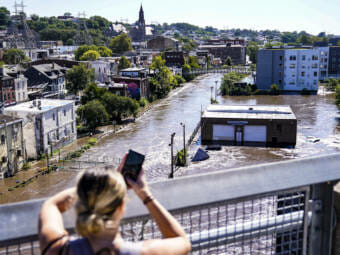
The Schuylkill River floods Philadelphia in the aftermath of Hurricane Ida in September. The extreme rain caught many by surprise, trapping people in basements and cars and killing dozens. (Matt Rourke/AP)

It may seem obvious: Heat kills. Wildfires burn. Flooding drowns.

But the sprawling health effects of a rapidly warming world can also be subtle. Heat sparks violence and disrupts sleep. Wildfire smoke can trigger respiratory events thousands of miles away. Flooding can increase rates of suicide and mental health problems. Warmer winters expand the range of disease-carrying mosquitoes and ticks.

A new report from the medical journal The Lancet finds that human-caused climate change is worsening human health in just about every measurable way, and world leaders are missing an opportunity to address it.

Trillions of dollars are being spent worldwide to help economies recover from the COVID-19 pandemic, but less than 1 in 5 of those dollars are expected to reduce climate-warming greenhouse gas emissions. In fact, the overall impact of those recovery plans is likely to be negative for the world’s climate, says Marina Romanello, the lead author of the annual report.

“We are recovering from a health crisis in a way that’s putting our health at risk,” she says.

Climate-fueled extreme weather is killing people across the U.S. and around the globe

Climate change is already directly affecting hundreds of millions of people around the planet.

Flooding is getting worse; people were trapped in their homes, cars and subways during recent storms. Wildfires are growing in intensity and frequency. Last year, 22 climate-related disasters caused more than a billion dollars in damage in the U.S. alone.

The trend continued into this year. Earlier this summer, hundreds of people were killed during a record-breaking heat wave in the Pacific Northwest that scientists say would have been virtually impossible without human-caused climate change. Globally, the Lancet’s Countdown report found, people over the age of 65 experienced roughly 3 billion more combined days of dangerous heat exposure compared with a baseline established just 16 years ago.

“Unfortunately, this was the first year where I can say confidently that I and my patients very clearly experienced the impacts of climate change,” says Jeremy Hess, a doctor and professor of environmental and occupational health sciences at the University of Washington. “I saw paramedics who had burns on their knees from kneeling down [on hot pavement] to care for patients with acute [heat] stroke and I saw far too many patients die as a result of their heat exposure.”

Earlier this year, more than 200 medical journals put out an unprecedented joint statement, calling climate change the “greatest threat” to global public health and urging the world’s top economies to do more to slow it.

Urgent action is needed to “ensure a more suitable future”

Later this month, world leaders, climate groups and financiers will meet in Glasgow, Scotland, to try to agree on a path toward a more sustainable future. The Biden administration’s climate envoy, John Kerry, is calling the summit “the last best hope for the world to get its act together,” even as U.S. efforts to curb climate change are faltering in a divided Congress.

Without rapid reductions in climate-warming greenhouse gas emissions, the planet is expected to warm to a point where large parts of it become barely habitable, with seas overtaking cities and devastating natural disasters becoming commonplace.

The goal is to keep global temperatures from rising above 1.5 degrees Celsius. The world has already warmed 1.1 degrees Celsius (or 2 degrees Fahrenheit) on average compared with pre-industrial times.

The authors of the Lancet Countdown report warn that “there is no safe global temperature rise from a health perspective” and that the most vulnerable — low-income individuals, people of color and the elderly — are most at risk.

Urgent investments in research and adaptation, they write, are needed to protect those populations. And actions need to be taken to quickly reduce greenhouse gas emissions to “ensure a more suitable future for all.”

Copyright 2021 NPR. To see more, visit https://www.npr.org.

COVID deaths leave thousands of U.S. kids grieving parents or primary caregivers

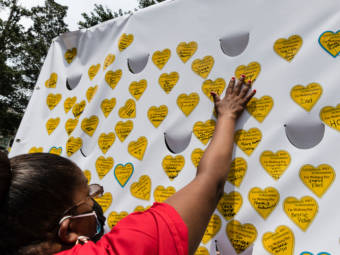
COVID-19 survivors gather in New York and place stickers representing lost relatives on a wall in remembrance of those who have died during the pandemic. (Stefan Jeremiah/AP)

Of all the sad statistics the U.S. has dealt with this past year and a half, here is a particularly difficult one: A new study estimates that more than 140,000 children in the U.S. have lost a parent or a grandparent caregiver to COVID-19. The majority of these children come from racial and ethnic minority groups.
“This means that for every four COVID-19 deaths, one child was left behind without a mother, father and/or a grandparent who provided for that child’s home needs and nurture — needs such as love, security and daily care,” says Susan Hillis, an epidemiologist at the Centers for Disease Control and Prevention and lead author of the new study.

The study, which was published Thursday in the journal Pediatrics, estimated the number of losses from April 1, 2020, through the end of June 2021 at 140,000. And that number has risen in the past three months: Hillis estimates it is around 175,000 today.

“This number will continue to grow as long as our pandemic deaths increase,” Hillis says.

These children are going to need support

Once a child loses their parent or primary caregiver, Hillis says, the tragedy is something they live with for “the entire duration of their childhoods.”

It’s a situation that calls for urgent action, Hillis notes. These children need “understanding, help, support,” she says. And it’s important “to ensure that they have a safe and loving family to continue to support their needs and nurture.”

And, just as COVID-19 has killed more people in communities of color, children in these communities are the most impacted by the loss of parents and primary caregivers.

“Sixty-five percent of all children experiencing COVID-associated orphanhood or death of their primary caregiver are of racial and ethnic minority,” says Hillis. “That is such an extreme disparity.”

The study defines orphanhood as the death of one or both parents. The study also tracked the loss of caregiving grandparents.

And if you look more closely at individual groups, American Indian and Alaska Native children were 4.5 times more likely to have lost a primary caregiver compared with white children. Black children were 2.4 times more likely and Hispanic children almost twice as likely.

Losing a parent or caregiver in childhood is a significant trauma. The study notes that this type of adverse childhood experience “may result in profound long-term impact on health and well-being for children.”

“Adverse childhood experiences are associated with increased risks of every major cause of death in adulthood,” says Hillis.

Losing a parent has other long-term effects

And in the short term, the impact of losing a parent or primary caregiver can lead to mental health crises for kids, including increased suicide risk, Hillis says, and “increased exposure to sexual, physical and emotional violence and exploitation.”

And in terms of life outcomes, a body of earlier research shows that losing a parent can put kids at a higher risk of economic, food and housing insecurity.

This adds a new layer of risk to kids in communities of color, which are already disadvantaged.

These communities experience inequities in access to health care, housing, education, and other factors that contribute to children’s well-being, says Dr. Warren Ng, a psychiatrist at Columbia University who primarily works with kids in communities of color.

“The numbers don’t tell the full stories,” he says. “The full story is really in the lives and the affected future of these children and adolescents and their families.”

Many children didn’t even get to say goodbye

Mental health care providers who are seeing the mental health effects of the pandemic on kids say these losses are particularly traumatic. Ng says even grieving has been difficult for them — many didn’t even get to see their parents or grandparents in the hospital, or say goodbye.

“One of the things that’s unique about the pandemic is that it’s also not only deprived us of a loved one, but it’s also deprived us of our opportunities that come together, so that families can heal, [and] support one another in order to really get through the most difficult times of life,” he says.

The study authors also call for policy action. “What we are proposing is that there be serious consideration to adding a fourth pillar to our COVID response, and that fourth pillar would be called care for children,” says Hillis.

This would involve finding resources and coming up with systems for “finding the children, assessing how they are doing and linking them to appropriate care,” she says, and strengthening economic support for families who care for the children.

The data highlighted here, especially the racial and ethnic inequities, “really does demand an urgent and effective response for all children,” Hillis says.

Copyright 2021 NPR. To see more, visit https://www.npr.org.

Sullivan suggests US could protect teens from Facebook with Chinese-style screen-time mandates

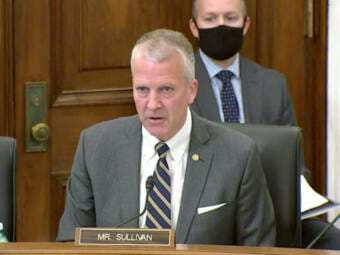
Sen. Dan Sullivan at a Senate Commerce Committee hearing in January. The committee has held two hearings in as many weeks to discuss Facebook’s impact on teens’ mental health (Still from U.S. Senate video)

While Congress debates the harm Facebook does to kids, Alaska U.S. Sen. Dan Sullivan suggests the federal government should borrow an idea from the Chinese regime and impose limits on screen time.

“I personally believe that we’re going to look back, like 20 years from now, and see the massive social, mental health challenges that were created by this era when teenagers had phones in their faces, starting in seventh and eighth grade and continuing,” Sullivan said at a recent Senate hearing about Facebook. “And we’re going to look back and we’re going to go, ‘What in the hell were we thinking?’”

The Chinese government has imposed tighter time limits for minors to play online video games, the New York Times and other news outlets reported in August. The new limit amounts to three hours a week. China has also cracked down on celebrity fan sites.

Sullivan, at a hearing last week, said he doesn’t usually agree with the Chinese Communist Party, but he thinks they’re on to something.

“Maybe it might be the one time where we say, ‘Why didn’t we, like the Chinese Communist Party, say, ‘Take a break?’” Sullivan said.

At a Senate hearing Tuesday, a Facebook whistleblower discussed documents she leaked showing the social media company knows its apps amplify misinformation and that Instagram, in particular, damages the mental health of girls.

Sullivan suggested to her that Facebook doesn’t want to impose time limits for young people because it would hurt profits. He said much the same at a hearing last week, where he confronted Facebook Head of Safety Antigone Davis.
“Can you really, on your own, help people take a break?” Sullivan asked. “Or do we, the U.S. government, have to help people take a break, like the Chinese are doing right now?”

Davis said that as a parent, she wants to determine how much time her child spends online, rather than have the government decide.

Sullivan’s endorsement of a Chinese-style screen-time mandate caught the attention of the Chamber of Progress, a tech industry advocacy group whose sponsors include Facebook.

The CEO of the group, Adam Kovacevich, said Sullivan’s proposal is out of touch.

“Parents are looking for real help from policymakers about how to make social media safe and healthy for kids,” he said in an email, “and turning to authoritarian measures like this is a little unhinged.”

A spokesman for Sullivan said the proposal was offered to highlight the need for Facebook to make its products safer for users.

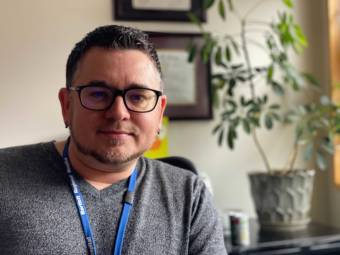
A second top-level Bartlett hospital staff member resigned

Bradley Grigg in his office on April 15, 2021. (Claire Stremple/KTOO)

A second top-level employee abruptly resigned from Juneau’s Bartlett Regional Hospital late last week. Chief Behavioral Health Officer Bradley Grigg tendered his resignation on Friday, after four years with the city-owned hospital. Neither the city or the hospital board acknowledged publicly that he’d left until Monday.  

In his letter to the hospital’s Board of Directors, he wrote that his position is no longer a good fit due to “personal issues.” 

Grigg’s letter came just after CEO Rose Lawhorne stepped down. Lawhorne left her role after six months and was subsequently fired for having an “inappropriate relationship” with a subordinate employee. City manager Rorie Watt declined to comment on whether the resignations are related.

Grigg’s resignation comes at a time when the hospital is inundated with behavioral health patients. He was also helming a $14 million expansion of the behavioral health department building.

The volunteer-run hospital board will meet on Friday to discuss a plan for hiring a permanent CEO. It is unclear whether the interim CEO, Kathy Callahan or the yet-to-be-hired permanent CEO will hire Grigg’s replacement.

This is a breaking news story that will be updated.

A previous version of the story misspelled Rose Lawhorne’s surname.

Watching COVID patients die takes toll on Alaska’s hospital workers

Dr Javid Kamali, an intensive care physician at Providence Hospital says that he’s watching unvaccinated patients in their 30s and 40s die. (Matt Faubion/Alaska Public Media)

As COVID-19 hospitalizations continue to break records in Alaska, health care workers in the state’s emergency rooms and ICUs say watching patients die is becoming routine, and it’s taking a toll on their mental health.

“The range of emotions that I go through in an ER shift now is unbelievable: anger, sadness, compassion, empathy, disappointment,” said Matthew Kinsler, an emergency room nurse at Alaska Regional Hospital in Anchorage.

He said lately he’s taken to venting in the hospital’s supply rooms, where he’ll go to swear out loud to himself and throw things around until he’s comforted by coworkers.

At the ICU, where the sickest patients come, providers are used to losing patients, but the most recent wave of COVID-19 deaths is unprecedented.

As of Friday, 208 Alaskans were in the hospital with COVID. A significant percentage of those people will die. For the 27 of them who are on ventilators, the Centers for Disease Control and Prevention says about 50% die.

“I’ve heard many of our therapists say, ‘I feel like a failure working in this unit, because everything I know to do doesn’t work, it doesn’t make a difference,’” said Karen Good, who oversees respiratory care at Providence.

Good said it’s stressing family relationships and testing the patience of hospital workers who say that the suffering is largely preventable through vaccination.

Heidi Decaro, a respiratory technician at Providence’s ICU, said she’s had patients who don’t take COVID-19 precautions seriously or deny that the coronavirus is real, even as they are dying. It’s stretching her professionalism.

“You really do have to bite your tongue, because you are a professional first of all, but you are there to help them and so you have to work on building a relationship,” she said. “Because there’s already a barrier of: This isn’t real versus this is real.”

Decaro said it’s making her more irritable at home. After losing patients — she says four patients under her care died last week — she’ll snap at her family for small annoyances.

“People are dying out there — just do the dishes!” she said. “It’s the little things.”

Decaro said workers at the ICU say they feel isolated from the rest of the city, where life is going on as normal.

Doctors and nurses have publicly implored political leaders to impose restrictions like masking, but so far the governor and Anchorage’s mayor have said they’re doing everything they can.

“Everybody in the health care system feels helpless because we see the end result of something that could have been preventable,” said Javid Kamali, an intensive care physician at Providence.

Kamali, 56, has been a doctor for 20 years, and said that aside from seeing sicker COVID-19 patients in the hospitals, he’s also seeing younger patients.

“For the first time in my entire career, which spans about 20 years, I’ve had a whole ICU filled with patients who are younger than me,” he said. “That has never happened before”

He said unvaccinated patients in their 30s and 40s have died from COVID-19 in recent weeks.

Hospitals have been forced to keep people being treated for COVID-19 in emergency rooms instead of ICUs, where they could get better care. They’re being held for hours, or even days, taking up space for new patients who come in with less serious issues.

“You see your family, your loved ones, your friends, waiting in the emergency department waiting room with really bad abdominal pain, chest pain, shortness of breath — all of these awful symptoms that you’d want to get addressed immediately — are generally getting pushed to the backburner,” Kinsler said.

Kinsler said that ER nurses are used to stabilizing patients and moving them out of the beds. With COVID-19, he said, they’re forced to do a job they’re not as well trained for.

Nationwide, news outlets have reported patients dying while waiting for a bed in the ER, as the latest surge in cases keeps hospitals at or near capacity. When asked whether Alaska has gotten to that point, Kinsler gave an unequivocal “yes.”

“It’s there, absolutely. 100% there,” he said.

It’s especially hard to see patients come in one day and have their parents come in a few days later and die from the disease.

He said those patients often blame themselves.

“It’s pretty jacked up to say, you caused your parents to die because of the decisions that you made. But it’s an easy leap to make in the brain,” he said. “That is the most heartbreaking thing and I’ve seen it multiple times.”

One of the few comforts health care providers have is one another. They say they’re forging tighter bonds through after-work beers or hikes on days off, or bringing cookies to work to share.

Good said that if nurses or technicians blame themselves for losing a patient, physicians will often round up the staff to remind them of everything they did do.

“We help each other the best we can. We bring them snacks, we sit down with them, we wipe off the tears,” said Kamali. “But that’s pretty much all we can do.”

He said there’s something the public can do to help: get vaccinated.

Juneau nonprofit hands out yard signs with positive messages to comfort the community

Two Juneau high school students pose with signs displaying positive messages during a 'Take a Time Out to Talk' event in 2020.
Two Juneau high school students pose with signs displaying positive messages during a ‘Take a Time Out to Talk’ event in 2020. (Photo courtesy of Melissa McCormick)

The social isolation caused by COVID-19 has many people feeling Zoom fatigue and yearning for real-life interactions. But for those who struggle with mental health disorders, the isolation can feel amplified. 

September is also Suicide Prevention Awareness Month, so one Juneau resident is focused on spreading positive messages throughout the community. 

Melissa McCormick spends a lot of her time trying to lift people up, in part because she knows what it’s like to experience loss.

Speier McCormick (Photo courtesy of the McCormick family)

Her son, Speier, struggled with bipolar disorder for years before taking his own life in October of 2017. 

“We always said that Speier had a fire inside of him,” she said. “He had a lot of passion about a lot of things that he was working on.”

With that sentiment as her inspiration, McCormick founded a nonprofit in 2018 called Find Your Fire. The organization aims to help young adults find their passions, learn life skills and develop strong mental health foundations.

“We tell them to be you and not anybody else,” McCormick said. “You’re basically already enough.”

Timi Tullis and Melissa McCormick pose with 'don't give up' signs during an event at the University of Alaska Southeast.
Timi Tullis and Melissa McCormick pose with ‘don’t give up’ signs during an event at the University of Alaska Southeast. (Photo courtesy of Melissa McCormick)

Now McCormick is distributing yard signs with similar sentiments to homes all over Juneau, in hopes of reminding others that they’re not alone.

“The more popular ones are ‘we’re all in this together,’ ‘you matter,’ ‘don’t give up,’ ‘you are enough,’ ‘you are worthy of love,'” McCormick said.

Although she’s had the signs since 2018, they grew in popularity during the COVID-19 pandemic. So far this year, McCormick has distributed more than 400 signs to people who requested them.

“One gentleman, in particular, came up to me and asked me if I was the one who helped put the signs up in Juneau and I said ‘yes’ and he said ‘well your sign just saved my life,’” McCormick said.

The man had been struggling with his mental health and after seeing the sign, sought help from JAMHI.

“So it was one of those moments where you just get those chills and think, ‘Wow, I may have made a difference in one person’s life with just a simple message,'” McCormick said.

Jaeleen Kookesh poses with a 'you are worthy of love sign' provided by the Find Your Fire organization.
Jaeleen Kookesh poses with a ‘you are worthy of love sign’ provided by the Find Your Fire organization. (Photo courtesy of Melissa McCormick)

Last month, McCormick took to Facebook to promote the signs for Suicide Prevention Awareness Month. The response was overwhelming and she’s had to beef up her sign orders.

“We do give [the signs] away,” she said. “There’s not a charge. Occasionally people will make a donation but it’s not required. We are a little bit low on our funding, but it’s always nice to see them in the community.”

For the most part, McCormick has used the money she’d set aside for Speier’s college fund to pay for the signs. 

Juneau resident Casey DenAdel asked McCormick for a ‘you matter’ sign to put in her window.

Juneau resident Casey DenAdel poses with a 'you matter' sign she displays in her window.
Juneau resident Casey DenAdel poses with a ‘you matter’ sign she displays in her window. (Photo courtesy of Casey DenAdel)

“I am somebody who lived through a suicide attempt and I have two really close family members who also lived through attempts,” DenAdel said. “So it’s a subject that’s really near and dear to my heart.”

The other side of her sign says ‘don’t give up,’ so DenAdel flips it over from time to time, alternating messages. 

“By putting signs up, it gets it out there that it’s okay to talk about mental health issues and that people aren’t alone in this,” she said. “There are so many of us who think that there’s something wrong with us when there are just so many more of us than you think there are – we’re normal people.”

DenAdel plans to keep the sign in her window, not just for September, but for the foreseeable future. 

Those who’d like to order a sign can visit findyourfire.net or email findyourfire907@gmail.com.

If you or someone you know is dealing with thoughts of suicide, you can call the National Suicide Prevention Lifeline at 800-273-8255 or the Alaska Careline any time of day or night at 877-266-HELP. 

Site notifications
Update notification options
Subscribe to notifications