Mental Health

From breakfast to BFF’s, school counselors tackle barriers to student success

Prior to Monday night’s (12-4-17) session on school counseling, members of the Sitka High student government met with board members. The students agreed to continue advocating for school funding in the legislature. But they also had a request of their own: Water fountains that can fill bottles. (Photo by Robert Woolsey/KCAW)

The Sitka School District’s counselors are taking the offensive as the administration begins to outline next year’s budget.

Counselors from every building shared an hour-by-hour look into their work days on Dec. 4 for the Sitka School Board, and the range of emotional and behavioral issues they typically address.

For Jeanine Brooks things start before her official work day when she checks in with teachers about students who might be struggling, and they develop strategies to help those students be successful.

It’s far from what you might expect, like tardiness, or forgetting a lunch box.

“Last year I had six students out of a very small population at Wooch.een Yei (preschool) and Baranof who had lost a parent to death due to substance abuse,” Brooks said. “There are 33 kids in foster care or kinship care. All of those children are bringing to school intense grief that gets in the way of their learning.”

Brooks described for the board how she feeds, clothes, counsels — and drives to school, if necessary — up to half of all students in elementary school over the course of a year.

Brooks has a master’s degree in social work from University of California Berkeley, and 28 years experience in social work, 18 of them at Baranof Elementary and Wooch.een Yei preschool.

She’s one of the district’s six counselors — most of whom share her level of academic qualification, if not her years.

In fact, one Sitka School Board members, Quinlynn Holder, even remembers Brooks in action.

“I didn’t even mention the fun part, Quinlynn… Then there’s my puppet work that I get to do, which is totally fun. I’m still doing Kelso the Frog, who is in his 24th year at Baranof Elementary. He’s been there longer than I have.”

Except for Kelso the Frog, not much in the daily life of a school counselor sounds like fun.

The problems students face reflect the problems of society: Psychological abuse, physical abuse, sexual abuse and emotional neglect are only 4 of 10 areas of trauma experienced by a portion of Sitka’s student population.

Keet Gooshi Heen counselor Ramon Quevedo has a litany of crises he’s managing.

“Some examples of what I’m seeing students for are: Death of a parent, terminally-ill parent; some of the students have depression and anxiety; there are some divorces. Some of the students just have an inability to self-regulate their emotions, so we work on some skills to do that. And then we have the students with ADD or ADHD, and we work on skills to help focus and relax in class.”

Like Brooks, Quevedo regularly sees about 35 of the 412 students in second through fifth grade, but can be called in to assist with behavioral problems anywhere in the school.

As students grow older, so do some of the issues.

At Keet, students are beginning to reckon with not just making friends, but keeping them.

“I help coordinate a restorative practice where friends will come to the counseling room and we’ll do a circle to try and figure out how they can be friends again,” Quevedo said.

In middle school, friendships are complicated by hormones.

Blatchley counselor Jael McCarty has to manage that — both in the real world, and in the digital world where students spend so much time interacting. And she has to teach two periods a day of P.E.

“We deal with the cyber-stuff: Cyberbullying, Snapchat, all the stuff that goes on there. This is all stuff that comes up in middle school. On top of that I do all the scheduling, and the changes of schedules. I field a lot of parent phone calls, “My kid doesn’t like this class, can he take this class, why not?, why is it too full?” I do the migrant ed programming, trying to figure out what our migrant ed students can benefit from and trying to figure out how to implement that into our school. I’m also a member of the district TIPS team — team initiated problem solving. So I’ve got my hands in a lot of different things. On top of that I teach the last two periods of the day. At the end of the day I go check in with Ben (White) to make sure I didn’t miss anything during those times that I taught so I don’t need to catch up. Other than that… it’s crazy! (audience laughs) I’m going to go gray by the end!”

At the high school level, counseling splits into two tracks — Ben Cordero provides academic counseling and career guidance, and Cory Schumejda tackles issues that have now taken on a more adult character, like substance abuse and intimate partner violence among others.

Sitka School District student representative Holder thanked the high school counselors for their work, saying that she’d “cried many times in their office since freshman year.”

Holder said she first recognized the importance — and the availability — of school counseling when she was having a tough time in eighth grade.

“I hadn’t built up the courage to talk to my parents about seeing a therapist or someone like that. And it was crazy talking to her,” Holder said. “It’s so different from talking to your parents or your friends or a different community member because it’s someone who’s trained to talk to you about your feelings and how to work out what you’re feeling.”

The school board won’t begin hammering out next year’s budget until after the New Year, but president Jen McNichol warned that there were some who considered the district’s counseling program to be “low-hanging fruit.”

Hence almost an entire school board meeting devoted to learning exactly how counselors spend their time.

“We want this conversation to be out in the community, so that the community values this resource that we are so fortunate to currently have,” McNichol said. “But it’s not guaranteed — as is nothing guaranteed — at this point in this economic climate we face. So we need community support.”

Pacific High counselor Maggie Gallin is a professional social worker with a graduate degree from Columbia. Gallin urged the board to continue her position after federal grant funding ended next year.

Without counseling, Gallin suggested that the district would never achieve its goal of 100-percent student success.

“Because expecting a student to perform academically, or expecting the dropout rate to decline, when we’re not helping students and families meet their basic needs, is going to be a dead end.”

Mental Health Trust bides its time on sale of Juneau waterfront parcel

(Photo by Rashah McChesney/Alaska's Energy Desk)
Waterfront land owned by the Alaska Mental Health Trust Authority seen here Nov. 8 would be key to Trucano Construction’s plans for a new yacht marina and berth. (Photo by Rashah McChesney/Alaska’s Energy Desk)

A prominent Juneau builder has doubled down on his offer to buy a vacant waterfront parcel owned by the Alaska Mental Health Trust.

The property would be used for the proposed Alaska Ocean Center and a new marina near downtown.

The Trust Authority advertised two Juneau waterfront parcels for sale late last year: one of those was sold this summer, and the other sits vacant and had hosted an encampment of homeless residents.

Trucano Construction had offered $3.24 million for the second lot. Trucano president Doug Trucano said the land would be part of a larger plan to build a yacht marina and berth for small cruise ships.

He said the Trust Land Office cashed his $500 check for the application fee in December.

“They’ve never responded,” Trucano told KTOO. “We have gone here and there to find out what is going on. We talked to members of the board and nobody really seems to give any inclination as to what they’re doing.”

Trucano’s offer wasn’t the only one.

The Alaska Ocean Center, a proposed North Pacific-themed science complex, also put in a bid for the 2.8-acre property. Its $500 check also was cashed but the board says it never heard back.

Trucano submitted a revised offer this week that includes the backing of the Alaska Ocean Center, to which he’d lease land.

The ocean center’s board elected to join forces with Trucano this summer and support his bid.

The ocean center’s plans are in a holding pattern until the sale goes through.

“We are waiting for the closing on the land so that we can begin our national fundraising campaign,” said Bob Janes, who sits on the ocean center’s board.

Trucano also is offering to pay 5 percent of his offer – $162,000 – into an escrow account.

“They’ve got money in their hand, they cashed both of our $500 checks eight months ago,” Janes said of the Trust. “But I think they’d be a little bit more leery of cashing a $160,000 check without a dialogue coming up in terms of that offer.”

The Juneau Assembly passed a resolution in late June supporting the deal.

The property off Egan Drive was host to a conspicuous homeless encampment this summer.

In late August, the Trust Land Office filed a trespassing complaint and Juneau police evicted the people living in tents.

Contract crews razed the vegetation to deter people from moving back and there hasn’t been any visible activity since.

Conceptual plans for a future “Juneau Marina District” would include a yacht marina, berth for small cruise ships and the Alaska Ocean Center on land that includes a 2.8-acre parcel owned by the Alaska Mental Health Trust. (Courtesy of MRV Architects)

City Manager Rorie Watt sent a letter dated Sept. 1 that urged the Trust Authority to accept the above-market offer it’s had in hand since late last year.

“From the city’s standpoint we’re interested, and we have been interested for many years, in developing all of the waterfront,” Watt said. “It appears to me that the best way to move forward with that piece of property is to get it transferred into private ownership.”

To date there’s been no Trust response to the city, either.

Trucano said he doesn’t understand why he can’t get an answer.

“If they get an offer, they should either say, ‘Yes we’ll sell it to you’ or ‘No we won’t,’ and then you can move on,” Trucano said.

The Alaska Mental Health Trust Authority’s leadership has been in flux.

Its top three officers resigned this fall while the authority undergoes a Legislative Audit into its investments and asset management.

The Trust Land Office’s Wyn Menefee has been pulling double duty as both executive and deputy director since his predecessor resigned in September.

He said prospective buyers have been kept in the loop.

“We’ve informed the different offerers and such that we are further examining to see which way we’re going to go on this parcel to make sure that it’s in the best interests of the trust and hopefully it’ll also be a good outcome for the community,” Menefee said Thursday. “But it’s likely that as we do that that it will be several months until we actually finalize this.”

It’ll ultimately be up to the Trust’s new CEO and board of directors to decide what it will do with this piece of Juneau’s waterfront property, he said.

Editor’s note: KTOO’s building sits on land leased from the Alaska Mental Health Trust Authority. KTOO has also applied for and received occasional grants for special reporting projects from the authority.

Gov. Walker announces public safety plan

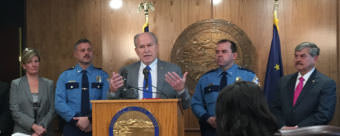
Gov. Bill Walker speaks about his public safety plan. Listening to him are: Alaska Attorney General Jahna Lindemuth, Alaska State Troopers Director Col. Hans Brinke, Alaska Wildlife Troopers Director Col. Steve Hall, and Public Safety Commissioner Walt Monegan, on Oct. 30, 2017. (Photo by Andrew Kitchenman/KTOO)
Gov. Bill Walker speaks about his public safety plan in the Capitol on Monday. Listening to him are: Alaska Attorney General Jahna Lindemuth, Alaska State Troopers Director Col. Hans Brinke, Alaska Wildlife Troopers Director Col. Steve Hall, and Public Safety Commissioner Walt Monegan. (Photo by Andrew Kitchenman/KTOO)

Gov. Bill Walker and four of his cabinet members announced a series of steps today to reduce crime. They include more spending on public safety and improved access to mental health and substance abuse treatment.

Walker said reducing crime will require more state government spending in some areas.

“Rather than focusing on fixing the blame, we need to be focused on fixing the problem,” Walker said. “One thing we have found out over the past several years: We cannot cut our way into a safer Alaska.”

Walker put Attorney General Jahna Lindemuth in charge of developing a plan to reduce crime. She said it will take enhanced collaboration across different departments, along with closer work with tribal and municipal law enforcement.

“We can each be doing our own thing, but what this is all about is working together better, in doing more with what we have,” Lindemuth said.

Lindemuth also said she will seek state funding for five more prosecutors, including one focused specifically on drugs statewide.

Public Safety Commissioner Walt Monegan said the department is working to improve recruitment to fill 43 open state trooper positions and 34 vacant village public safety officer jobs.

Monegan said one barrier to attracting applicants is the annual cycle of layoff notices sent to public workers during disagreements among lawmakers over the state budget.

“We don’t want to have any pink slips. And the state right now doesn’t attract a lot of good people as it should,” Monegan said. “But we are working on a huge plan.”

The administration also is hoping to fund more treatment of opioid addiction as a way of reducing thefts caused by drug use.

The Department of Health and Social Services is aiming to add space at drug treatment facilities and to increase treatment using medication.

Health Commissioner Valerie Davidson said the state’s Medicaid expansion is central to the treatment efforts. She said the largely federally funded expansion is helping people who are addicted to drugs when they leave jail.

“When someone is leaving a correctional facility, if they have the opportunity to be able to go into treatment or better after-care, to be able to support the services that they received in a correctional facility, we know we’re going to have better outcomes as a state,” she said.

Senate President Pete Kelly said he expects the Senate to support efforts to improve public safety, but was skeptical of the governor’s proposal to introduce a payroll tax.

“Addressing public safety is obviously very important and he’s going to find a lot of support from the Senate to do that,” Kelly said. “Some of the proposals he’ll make I’m sure we’ll jump on because they’re good ideas. I don’t like the idea of politicizing public safety for what appears in my book to be a philosophical desire by the administration and others to impose a tax on Alaskans.”

Walker administration officials have said a payroll tax would help bring the state budget into balance.

Mental health clinicians work to keep students safe in Kodiak schools

Kodiak Police Department vehicles in front of Kodiak High School. (Photo by Kayla Desroches/KMXT
Kodiak Police Department vehicles park October 10, 2017, in front of Kodiak High School. (Photo by Kayla Desroches/KMXT

It’s been at least nine years since a student in the Kodiak Island Borough School District has taken his or her own life.

The Kodiak Island Borough School District and the Providence Kodiak Island Counseling Center have partnered for years to provide mental health services to the region’s schools.

For at least nine years, the Alaska Department of Health and Social Services says, not a single person between the ages of 5 and 19 has taken his or her life in the Kodiak Island Borough.

It also says from 2012 to 2016, the Kodiak region had one of the lowest rates of suicide in the state.

District superintendent Larry LeDoux said he’s lost students to suicide in the past, so he’s grateful for this reprieve.

“Sometimes I don’t know why we haven’t had any,” he said. “I’m just thankful we haven’t had any.”

The school district includes about a dozen schools across the Kodiak archipelago.

The recent lull can’t be attributed to any one thing, LeDoux said.

“If I were to point a finger at why do we have fewer suicides it’s because we have a community working together to keep kids safe,” he said. “We can do our best as a school system as a community just to make sure that people have services readily available and that’s what we’re doing.”

That community,  LeDoux said, includes mental health professionals. The district partners with the Providence Kodiak Island Counseling Center, or PKICC, to bring mental health clinicians into schools.

“Our clinicians have their fingers on the pulses on what’s going on in the school.”

Counseling Center director Mary Guillas-Hawver thinks the lack of suicides over the last nine years has a lot to do with the counseling center’s relationship with the district.

The counseling center has worked with the school district to keep students safe for over 20 years.

Four clinicians are embedded in Kodiak’s public schools: two serve the city’s elementary schools and two serve its middle and high school.

As for rural schools, they, also get regular visits from clinicians, who are constantly on the lookout for signs of distress in students. Among the red flags are thoughts of suicide.

“They are trained to watch for any behavior or anything that might indicate that child may be in need of additional help.”

The clinicians work with students on issues ranging from learning disabilities, addiction and trauma.

Guillas-Hawver thinks their interventions have been key to preventing tragedies in Kodiak communities. That’s especially important in Alaska, which had the second highest suicide rate in the U.S. in 2015 according to the Center for Disease Control and Prevention.

“Alaska is a vast, vast, geographical place, but when it comes to population we’re really are very small,” Guillas-Hawver said. “One person lost affects the community very, very badly.”

“It’s catching kids that are falling through the cracks,” said Jolene Rogers, who has worked as a clinician in Kodiak Schools for two years. “That might get overlooked and it’s giving them a place where they feel like they belong.”

Rogers now works with older teens and adults, but she said she loved working with students.

As a clinician, she got to see kids grow and feel more confident. She says it was also good to work with school counselors and teachers to figure out what it would take to make a student feel supported.

“Do they need a snack at this part of the day? Do they just need a high five from a certain adult figure in the school? Do they need a positive male figure in their life? Who can we use to fill that need? And I think at the end of the day our goal is to have our kids learn and thrive in their classrooms.”

Counseling center clinicians don’t stop treating students when the school year is over. They stay in contact with them over summer breaks as well.

It’s this kind of attention that makes the program so effective.

The district plans to continue improving and revising its partnership with the Providence Kodiak Island Counseling Center to keep students safe — and successful.

—–

If you or someone you know is having suicidal thoughts please call the Alaska Careline at 1-877-266-4357. That’s 1-877-266-4357. You can call 24 hours a day, seven days a week. You’ll be connected with someone who you talk to about what you’re going through. It’s free and confidential. They can help, really. Call the Alaska Careline at 1-877-266-4357.

Elders And Youth Conference takes a look at healing with film ‘We Breathe Again’

Keggulluk Earl Polk is featured in "We Breathe Again," a documentary that follows four Alaska Natives on their path through the healing process. Polk attended a screening of the film in Bethel in September. (Photo by Christine Trudeau/KYUK)
Keggulluk Earl Polk is featured in “We Breathe Again,” a documentary that follows four Alaska Natives on their path through the healing process. Polk attended a screening of the film in Bethel in September. (Photo by Christine Trudeau/KYUK)

Native communities across Alaska are seeking a key to understanding the epidemic of suicide.

The film screened Tuesday last week during the First Alaskans Institute 2017 Elders and Youth Conference.

It was a prominent theme at the conference held prior to the Alaska Federation of Natives Convention in Anchorage last week

“Part Land, Part Water – Always Native” was the theme, and much of the Conference focused on healing cultural trauma by reconnecting to traditional knowledge and values.

One documentary takes viewers on a journey to finding that connection again.

Keggulluk Earl Polk is featured in “We Breathe Again,” a documentary that follows four Alaska Natives on their path through the healing process.

“Sing. Go back to your roots. Dig deep. Hit your knees, become humble,” Polk said. “Realize that you’re stronger than what it is that’s trying to take you away, and the only reason you’re strong is because you’re weak enough to ask for help.”

A traditional Yup’ik teacher, Polk has traveled all over Alaska as a speaker and host to many culturally based youth programs.

He currently works as a senior psychiatric technician at the McCann Treatment Center in Bethel.

The film’s producer Evon Peter hopes that the broader Native community will see the film as a valuable tool.

“It can be used as a teaching and healing tool to help open conversations at the community level,” Peter said.

So far, health care providers have contacted Peter and filmmakers to use the film as a teaching tool in training their staff members.

“Saying, ‘Wow. Can we use this as a tool for new orientation for medical staff that are coming into our communities and our organizations?’” Peter said. “Because it really sheds some light in a positive way that I think can help people to understand that we can navigate through challenging moments in our life, and that we can build a strong foundation under us again.”

Alaska Mental Health Trust Authority hires new CEO

The Alaska Mental Health Trust Authority has hired a new CEO almost a year after the ousting of its long-time leader.

Mike Abbott will take over the trust on November 1. He currently serves as the Municipal Manager of Anchorage and previously worked as the chief operating officer for the Anchorage School District.

He will oversee both the mental health programming side of the trust as well as the Trust Land Office, which manages the organization’s properties and land.

The trust funds programs for people with mental illnesses, substance use disorders and other cognitive disabilities.

It has been roiled by major leadership changes in the past year and is currently undergoing a special legislative audit.

Editor’s note: KTOO’s building sits on land leased from the Alaska Mental Health Trust Authority. KTOO has also applied for and received occasional grants for special reporting projects from the authority.

Site notifications
Update notification options
Subscribe to notifications