Mental Health

Experimental Oasis project gives inmates ‘something different in prison’

Spring Creek Superintendent Bill Lapinskas poses with one of the murals in the segregation housing at the Correctional Center. (Photo by Anne Hillman/Alaska Public Media)

The Department of Corrections is the largest mental health care provider in the state, and the administrators at Spring Creek Correctional Center want to make it one of the most effective, too.

They’re treating inmates who have mental illnesses with new innovations — porches and paintings.

During his three years at Spring Creek, inmate Kaleb Summitt has been in and out of segregation because of fighting.

“I’ve been out of seg for seven months. My new record!” he said excitedly one afternoon.

Summitt said it used to be really hard to rejoin the prison community every time he left segregation, where he was locked in a cell for 23 hours per day.

“’Cause you’re locked down and you’re nervous being around people,” he said.

Interacting with other people was already a challenge because he has bipolar schizoaffective disorder and his medications weren’t adjusted correctly.

But this time when he left, instead of going straight from segregation to open housing, called a mod, he first transitioned to a room with an indoor “porch” in the mental health mod.

In Spring Creek, the cells line the edges of one main room. The porches are like large cages around the doors of the cells. They provide a space for inmates to leave their rooms, walk around, and talk to people, but they can’t just wander freely in the communal area or have much physical interaction.

Inmates are allowed out of their cells and onto the porches for at least three hours a day and eventually more.

It may not sound like much, but Summit said it gave him time to adjust to social interactions. “It’s a lot better to interact you with the mod, not just throw you out the door.”

It also gave him the chance to talk to the mental health mod mentors.

The mentors are inmates from the general population who live in the mental health mod and are paid to provide guidance and support.

It’s a pilot program for Spring Creek.

Originally three people filled the role, but two were dismissed because they caused problems.

Kent Matte is an inmate mentor in the mental health housing unit at Spring Creek Correctional Center. (Photo by Anne Hillman/Alaska Public Media)

One mentor, Kent Matte said he understands what people leaving segregation are going through – he once spent three years in solitary confinement.

Every time he left his cell he was fully restrained with two guards.

“I’m an outgoing person and it affected me enough to where I thought I was starting to get a little crazy in my head,” he said.

When Matte speaks with people on their porches and other inmates in the mod, he tries to be a role model and help them learn to trust people.

“The best way to reach them is to talk to them,” he said. “Communicate like they’re real. Not like they’re below you.”

Summitt said it helps him to talk to Matte.

He tells Matte about problems that he doesn’t feel comfortable reporting to staff.

But sometimes just chatting with Matte or even the mental health counselors isn’t enough to calm him down.

Then he turns to another innovation at the prison – the Oasis.

“I love that room,” Summitt said. “It is awesome. It takes me out of the zone, like I’m not in jail anymore for a while.”

Inmates painted a room in the mental health housing unit at Spring Creek Correctional Center called the Oasis. It helps people calm down and regroup. (Photo courtesy of Department of Corrections)

The Oasis is a regular cell with no bunks or toilet. The walls are painted with brightly colored murals of beach scenes. Waves lap onto sandy shores next to dense, flower-filled bamboo forests.

Inmates can take a sound machine with them and sit on soft couches.

When Summitt said when he leaves the room he feels “refreshed. Ready to try again. I get stressed out sometimes so I just press a button – even at night- and the officer will take me over.”

Superintendent Bill Lapinskas decided to create the Oasis as an experiment.

The institution didn’t have money to do anything fancy, but he wanted to have a place where prisoners could just be people for a while.

A team of inmate artists worked together to paint the room.

“This is what we could do here, right now to see if we could enact a change in behaviors and in mindsets,” he said. “Just give them something different than prison.”

A similar project is being tested for inmates in segregation at the Anchorage Correctional Complex, but it includes a large screen TV showing nature videos in a room painted green.

Spring Creek inmates have painted murals in other parts of the prison as well, making some areas look like living rooms or storefronts.

The intake area for seg has a large painting of a bird and flower that helps calm people down.

The porches, the paintings, and the mentors are all part of Lapinskas’ larger mission for Spring Creek: to imbue the institution with more humanity and try to help the inmates, not just punish them.

Want to hear more Solutions Desk stories? Subscribe to the podcast on iTunes, Stitcher, orNPR.

Have ideas to share? Text “hello” to 907-885-6055 and join the conversation.

Alaska Mental Health Trust funds city homeless coordinator for Juneau

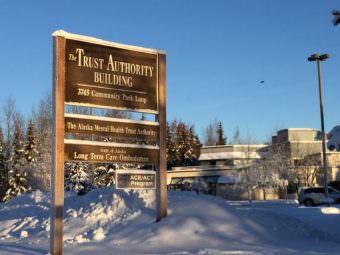
The Trust Authority Building in Anchorage houses their main offices. (File photo by Anne Hillman/Alaska Public Media)

Thanks to a $100,000 grant from the Alaska Mental Health Trust Authority, the City and Borough of Juneau will hire a coordinator for housing and homeless services.

Earlier this month, the Trust Land Office cleared a downtown waterfront lot that homeless campers had occupied. Most campers had left the property by the time police arrived to enforce a trespassing order.

The trust authority’s acting CEO Steve Williams said the trust’s board recognizes that many homeless people are also its beneficiaries with mental illness. The trust funds a similar position in Anchorage and Fairbanks.

“The trustees and the trust felt this was an important project given the homelessness issues that are happening not only down in Juneau but in other areas of the state,” Williams said. “And really trying to provide a resource to the city and borough to have a person on-point to help coordinate the local services so that we can get some better outcomes for the homeless population there in Juneau.”

Juneau’s housing officer requested the grant. The trust authority’s board approved it earlier this month. Williams said it envisions funding the position for three years.

“The second and third year the city will have to come back to the trust for the request, at which point they will review the request again,” he said. “It’s expected that the trustees would continue the funding for the second year and then the third.”

The Juneau Assembly is expected to formally accept the funds next month. The Assembly also is working towards establishing a warming center for mid-November when the seasonal city-run Thane Campground closes.

At this week’s meeting, city staff said $75,000, the bulk of which is drawn from the city’s tobacco tax, could be made available for a warming center to operate for about 100 days this winter.

City staff said time is short and that funding is scheduled to go to public hearing in the first week of November.

The city’s homelessness task force chaired by Assembly member Debbie White is still reviewing potential locations for a warming center. Its recommendations will be brought before the full Assembly.

Editor’s note: KTOO’s building sits on land leased from the Alaska Mental Health Trust Authority. KTOO has also applied for and received occasional grants for special reporting projects from the authority.

Juneau police clear downtown homeless camp

A man hauls belongings from a homeless encampment off Egan Drive on Wednesday in Juneau. The property is owned by the Alaska Mental Health Trust. (Photo by Rashah McChesney/Alaska’s Energy Desk)

Authorities cleared a downtown homeless encampment without incident this week. This comes as the City and Borough of Juneau looks to develop its strategy for tackling its homeless crisis.

Tents began sprouting up this summer on the former subport property off Egan Drive that’s owned by the Alaska Mental Health Trust. The Trust Land Office posted a trespassing notice two weeks ago and Tuesday was the deadline to vacate.

Police reported clearing the remaining people from the homeless encampment without incident.

“I think it went very smoothly,” said Wyn Menefee, acting executive director of the Trust Land Office. “We were very pleased to see that we had cooperation from all the campers that had been on the property. Most of them had already moved off and as of about 10 a.m. we had just two remaining camp groups that were in the process of packing and by noon they were off the property.”

His office last month closed on the sale of an adjacent parcel for $1.3 million to Juneau Hydropower. The energy startup has plans for a district heating and cooling plant.

Social care agencies were also on the ground during Tuesday’s sweep by police. The nonprofit Polaris House donated a van and driver to help people move their belongings, A case worker from the Juneau Alliance for Mental Health, Inc. also assisted.

This comes as a city task force is working to craft a strategy to tackle the community’s homelessness crisis – Juneau’s homeless population is the third largest in the state.

Some ideas are short-term: a sanctioned winter campground and a warming station for when temperatures drop below freezing.

Polaris House’s Executive Director Bruce Van Dusen said campgrounds, whether sanctioned or not, are not a long-term solution.

“Providing camping space for persons that are homeless is not a way to end homelessness,” Van Dusen said. “If we continue to provide supports and services that allow people to stay homeless then we’re going to continue to have a homeless problem.”

Nonetheless, City Housing Officer Scott Ciambor said several city-owned sites are still under consideration by the city’s task force.

“They didn’t necessarily settle on the idea that they liked the idea of a winter campground anyway but they just wanted to talk about it some more,” Ciambor said.

Additionally, the task force is looking at similar models to Juneau Housing First, a 32-unit apartment complex, slated to open next week. That will house some of the community’s most vulnerable homeless residents.

Initiatives like these, ones that help provide a roof over one’s head, are finding favor on the task force, he said.

“What they were more enthusiastic about was getting more details on the Juneau Coalition on Housing and Homelessness proposals,” Ciambor said, “so I’m getting some additional details on each of those.”

Those proposals include rental assistance for people unable to keep up with payments. Another model is scattered site housing which would be city-subsidized rentals scattered throughout the community. All of these proposals would cost money. The scattered site housing program could cost about $12,000 per unit, per year.

The city has also applied to the board of the Alaska Mental Health Trust Authority to fund a full-time coordinator for homeless services for the next three years. That request is being considered at the authority’s board meeting this week.

As for the displaced, a few have ended up at the Glory Hole downtown shelter and soup kitchen, though none wanted to comment.

Editor’s note: Scott Ciambor’s spouse is a CoastAlaska employee.

KTOO’s building sits on land leased from the Alaska Mental Health Trust Authority. KTOO has also applied for and received occasional grants for special reporting projects from the authority.

Potential initiatives would enshrine Medicaid expansion, ACA provisions in state law

Supporters of Medicaid expansion braved foul weather in Juneau to express their views at the state Capitol, April 16, 2015. (Photo by Skip Gray/360 North)
Supporters of Medicaid expansion express their views at the state Capitol in April 2015. Doctors are sponsoring two initiatives that may appear on the 2018 ballot, one of which would enshrine the expansion in state law. (Photo by Skip Gray/360 North)

While Congress has debated repealing the Affordable Care Act, some doctors want to make sure that at least parts of the law remain in place in Alaska. They’re sponsoring two initiatives that could be on the ballot next year.  


One initiative would enshrine in state law the Medicaid expansion that Gov. Bill Walker executed. The other initiative would include several other provisions of the Affordable Care Act in state law. 

Anchorage Dr. Graham Glass is one of the sponsors of the Medicaid expansion initiative. His neurology and sleep medicine practice has seen a difference from the expansion. 

“We see patients that otherwise we probably would have never seen,” he said. “We’re able to do things such as treat their sleep apnea earlier on, before they have heart attacks and strokes and then end up being seen in the hospital as uninsured patients.” 

He noted that if Medicaid didn’t cover those patients, the cost to provide emergency care to them would be shifted to patients with insurance. 

The Medicaid expansion has covered 35,390 more Alaskans. Another 31,096 signed up for Medicaid or Denali KidCare since the ACA went into effect.  

Glass said the political support for federal funding for the expansion means the state should be able to afford it. 

“The fact that we have a Republican president and a Republican Congress, and they were still unable to pass that repeal in any way, shape or form, makes me fairly comfortable that moving forward in the next administrations for years in the future, it’s very unlikely that that federal money will go away,” Glass said.

The other initiative would require insurers to cover people with pre-existing conditions. It also would allow parents to cover their children until they turn 26. And it would require health plans to have 10 essential benefits, including mental health care and prescriptions. 

Both initiatives are being reviewed by Lt. Gov. Byron Mallott’s office to ensure they’re eligible to be placed on the ballot. For instance, they can’t require the state to appropriate money.  

Andrea Nutty with the Alaska Nurses Association said the union’s members will support gathering signatures for the petitions. She said it’s important that the ACA protections remain in place.  

“With the current instability in Washington, D.C., it’s vitally important to establish patient protections on a state level,” Nutty said.

Some Alaskans, including U.S. Sen. Dan Sullivan, have called for ACA mandates to be scaled back in order to make insurance more affordable. Twenty-two hundred Alaskans buy individual insurance or family insurance costing roughly $1,000 a month, because they don’t receive subsidies based on income. But another 14,000 Alaskans who are subsidized pay an average of $93 a month. 

Nutty said there are other ways to reduce the cost of health care, beginning with making prices more transparent to the public. 

“It’s still vitally important that all of those essential health benefits are included in all insurance plans, because you can’t predict when life is going to throw you a curve ball,” she said. 

Mallott has until early October to review the initiatives. If he approves them, the sponsors must gather 32,127 signatures to petition to place each initiative on the ballot.  

Mental Health Trust leaders resign while organization undergoes special audit

The Trust Authority Building in Anchorage houses their main offices. (Photo by Anne Hillman/Alaska Public Media)

In the past month, the top three leaders at the Alaska Mental Health Trust Authority have submitted letters of resignation.

The shake up comes at a time when the organization, which manages funds for mental health and substance abuse programming across the state, is undergoing a special legislative audit over concerns about financial mismanagement.

Interim CEO Greg Jones was appointed in November to lead the organization after long-time CEO Jeff Jessee was ousted.

Jones declined a request for an interview, but in his resignation letter he wrote his action “comes at the request of my family and recommendation of friends.”

Chief Operating Officer Steve Williams will be acting CEO as of September 1. The Trust started seeking a permanent CEO in July.

John Morrison, the executive director of the Trust Land Office, has also resigned and will leave his job in September. Morrison, at the direction of the Board, helped the TLO pursue a controversial strategy of investing in commercial real estate as a way to increase income for the Trust. Deputy director Wyn Menefee will begin as acting executive director on September 8.

Board Chair Russ Webb will also leave his position in September. The Trust Authority has started recruiting for his replacement.

A special legislative audit of the Trust was authorized in December after allegations the Board “is not managing its assets in compliance with state and federal law,” the audit request says.

In an email, Legislative Auditor Kris Curtis wrote, “The audit is through the planning phase and beginning fieldwork. We hope to have it completed some time in November.”

Walker signs SB 88, Mental Health Trust land exchange

Gov. Bill Walker hold up a signed Senate Bill 88, the Alaska Mental Health Trust land exchange. (Photo by Leila Kheiry/KRBD)

Alaska Gov. Bill Walker was joined in Ketchikan on Thursday by U.S. Sen. Lisa Murkowski, state Sen. Bert Stedman and state Rep. Dan Ortiz to sign a bill accepting a land trade between the U.S. Forest Service and Alaska Mental Health Trust.

The trade puts parcels of Trust land close to communities in Ketchikan and Petersburg into Forest Service ownership, in exchange for federal land that the Trust plans to log.

The Ketchikan Public Library has a huge picture window in its large activities room. The view is Deer Mountain – the iconic backdrop to Alaska’s First City.

Walker pointed to the mountain, clear against a bright blue sky, noting to the small audience gathered for the signing that they picked this spot on purpose.

“This couldn’t be a better location,” he said. “You’re really looking out at the fruits of your labor.”

Until Walker penned his name to Senate Bill 88, a large chunk of that mountain belonged to Alaska Mental Health Trust, which uses its land to make money for mental health services.

In Southeast, the easiest way to make money from the land is resource extraction. Logging.

But, nobody wants Deer Mountain logged.

The Trust and the U.S. Forest Service have been working on a plan for about 10 years to get Deer Mountain and other sensitive parcels close to Southeast neighborhoods exchanged for more remote Forest Service sites.

That was moving slowly, though. And so, following threats last summer from Mental Health Trust officials that they would log Deer Mountain, lawmakers sped the process up.

Walker noted that the exchange required action from the House and Senate in Washington, D.C., and Juneau.

“It took all four bodies to make this happen,” he said. “It’s one of those things that, everybody knew it was the right thing to do, but it just took a while to get there.”

Murkowski was on hand for the signing. She said the land trade will benefit all the stakeholders.

Mental Health Trust will be able to make money off its land; the timber industry will get a source of trees to keep them in business; and the communities of Ketchikan and Petersburg will not be harmed by logging activity close to homes.

“It’s really one of those win-win-win situations,” she said.

Stedman represents much of Southeast Alaska. He thanked Walker for his work on this bill, and other efforts for the region.

“He’s been very dogmatic in helping us create and maintain jobs in Southeast,” Stedman said. “I really appreciate that. It’s definitely made a difference. We see it all across Southeast, and we’re particularly going to see it on Prince of Wales coming up here.”

Viking Lumber on Prince of Wales will be a big beneficiary of the logging activity that the Trust now can move forward with.

The federal land that now belongs to the Trust includes parcels on Prince of Wales and in the Shelter Cove area of Revilla Island.

Ortiz noted the hard work that legislative staff members put in to getting the various bills passed, and local efforts organized by residents of Ketchikan and Petersburg.

A Ketchikan group called Save Deer Mountain was founded by Ray Troll and Bob Weinstein. Both were there to witness the successful end to their efforts.

“This is an example of how local communities, local governments, state governments and federal governments can all work together on an issue and agree,” Weinstein said. “When they do, it’s a success.”

He said it’s nice to know that the beautiful view out the library window will be preserved for future generations.

Also on Thursday, Walker signed another bill at the Ketchikan shipyard.

On the deck of the not-yet-finished state ferry Tazlina, surrounded by shipyard employees, Walker signed a bill officially naming the ferry and its sister ship, the Hubbard, which will be built by Vigor Alaska after the Tazlina is complete.

Site notifications
Update notification options
Subscribe to notifications