Mental Health

Juneau city manager: ‘People genuinely don’t have somewhere to go’

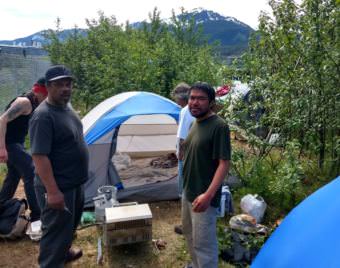
Campers gather near a small group of tents about noon Thursday, June 8, 2017, near the 300 block of Egan Drive in Juneau. (Photo by Tripp J Crouse/KTOO)
Campers gather near a small group of tents about noon Thursday near the 300 block of Egan Drive in Juneau. (Photo by Tripp J Crouse/KTOO)

A tent village has sprang up near the abandoned subport in recent weeks. Juneau continues to struggle with a housing and homelessness crisis that’s culminated in a new community on the edge of downtown.

In the encampment, there’s steak grilling on a propane stove. Tents began appearing in this wooded area about three weeks ago.

“I set up mine and then I woke up and there were three or four next to me. They followed, it just kind of came in waves,” said Kevin Howard, 44.

He looks around and sees community among the cluster of tents.

“Everybody here looks after each other and nobody does nothing to nobody. … (We) make sure everybody’s OK in the morning. Need something to eat? Need some water? We look after each other here.”

Juneau has been wrestling with a rising homeless population. Responding to complaints from downtown merchants, the Juneau Assembly passed an ordinance this winter banning camping on private property in the downtown core.

After it took effect in April, many homeless moved onto public property namely, Marine Park where cruise ships dock. Then in May, the city directed police to ticket anyone in the park after hours.

Kevin Howard and his friend David Waits recall officers telling homeless people in the park, “You guys get your s— out of here or otherwise it’s going in the trash,” Howard recalled.

“Somebody got a ticket, too,” Waits said. “We were like, ‘Aw, dude you can come down here and hang with us. We got our, you know, set up.’”

Howard added: “They threw everybody out of the doorways and threw everybody out of the park and now we’re all down here.”

Lorenzo Jefferson, left, and Kevin Howard grill steak on a propane stove in an encampment near the former subport off Egan Drive on June 6, 2017. (Photo by Jacob Resneck/KTOO)

Critics of the anti-camping ordinance had warned that a crackdown would just move the problem around.

“What happened is what we’ve seen happen in other communities that have similar ordinances is they’re displacing homeless individuals,” said Brian Wilson, executive director of the Alaska Coalition on Housing and Homelessness. “If we displace these individuals again, I’m not really sure where they’re going to go.”

The city of Juneau is coming around to this reality. City Manager Rorie Watt said a new Assembly-appointed task force is looking for a new strategy.

“People genuinely don’t have somewhere to go,” Watt said. “So if people got trespassed repeatedly they would be moving around. And if a situation is quiet and not causing issues that likely could be better than a lot of alternatives if those people got moved along.”

Juneau police won’t move on the camp without a trespassing complaint from the landowner. In this case that’s the Alaska Mental Health Trust Authority.
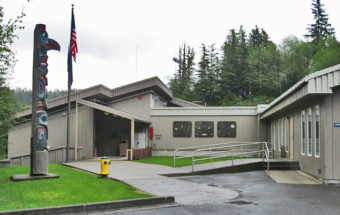
Wyn Menefee, deputy director of the trust’s land office, said the waterfront acreage is in the process of being sold to private developers. But for now there’s no plan to try and move the camp.

“If it were to get into a situation where it started in hindering the ability to make revenue off of the trust, we may have to do something further about it,” Menefee said. “But right now it hasn’t stopped us from doing what we intend to do with the parcel.”

About half of Juneau’s homeless population report suffering from mental illness. That’s according to a spring survey conducted by social workers who canvassed the community.

Brian Wilson said of the 96 unsheltered people that social workers interviewed, 45 people self-reported mental health issues or concerns.

“That’s typically an under-reported number as well,” Wilson said.

The irony of the mentally ill trespassing on Mental Health Trust Authority land is not lost on the organization.

“We’re actively engaged in the community on a number of different levels and probably target this population in one way or the other,” said Steve Williams, the authority’s chief of operations.

One of the projects the trust is helping fund is the 32-unit Juneau Housing First slated to open this summer.

“The folks that we’re seeing down at the camp are candidates for Housing First interventions,” Brian Wilson said, “but at the current state of our capacity, we don’t have that here locally. We need a lot more units.”

The city and the trust authority have received at least one complaint from the public concerned about health and sanitation. That will inevitably be an issue if the camp remains here long term.

David Waits said there’s a sense of pride about making the best out of what little you have.

“It doesn’t matter how much money you make or how much you have or anything else,” Waits said. “We’re all common people. I’m a Lakota Sioux Indian and we believe everybody’s related. Nobody’s higher or lower than the next person.”

So with few options available for Juneau’s homeless population, it appears a cluster of tents on the edge of town has become the status quo.

Editor’s note: KTOO’s building sits on land leased from the Alaska Mental Health Trust Authority. KTOO has also applied for and received occasional grants for special reporting projects from the authority.

State grant to help Ketchikan agencies reduce recidivism

Hayward is begin kept at the Ketchikan Correctional Center. (Photo courtesy Alaska Department of Corrections)
Ketchikan Correctional Center. (Photo courtesy Alaska Department of Corrections)

A coalition of Ketchikan agencies is gathering to explore how to help people getting out of jail stay out of jail with the help of a state grant.
Akeela Gateway and Ketchikan Indian Community were awarded the grant through the Alaska Department of Health and Human Services Division of Behavioral Health.

The organizations plan to pull together representatives from state and local law enforcement, and social services groups to address that question.

Janalee Gage, who works with the substance abuse program at Akeela Gateway, said the state jail system is overcrowded.

Many of the people in jail are repeat offenders, which indicates that incarceration alone is not working.

“The idea is that instead of throwing people back in jail, we need to find a way to have them come back into society and invested in the communities they’re from or live in, and develop a productive lifestyle so they can actually be productive in their life versus in and out of the rotating door of the jail system,” she said.

Gage added that keeping people in jail costs a lot of money, and it’s more cost effective to help people stay out.

The effort is in the early stages now.

The first task is to identify what’s needed.

“We’re going to look at everything we have, what we do well, what are our strengths, what are the areas where we’re weakest in,” Gage said.

She said the goal is to provide people getting out of jail with some basic tools to help them stay on a law-abiding path, which includes signing them up for Medicaid so they can get substance abuse treatment, or helping them find safe, affordable housing.

But it’s still up to the individual to use those tools, she said.

Gage said after the group identifies what’s needed in the community, it will work on getting the community at large to help plan ways to implement any needed improvements.

A big role the community can play is a willingness to hire non-violent offenders who have recently gotten out of jail, or to not fire an employee who has made a mistake.

“We all make mistakes. We all screw up,” Gage said. “Some of us do it on a large scale. (But) we’re going to take the time to give you that chance.”

That can include requiring substance abuse treatment for an employee.

Gage said even if this effort helps only 30 percent of offenders stay out of jail in the future, that would be a huge improvement.

She said the initial planning and brainstorming effort will take place by the end of June. Community outreach will be scheduled later.

Why brain scientists are still obsessed with the curious case of Phineas Gage

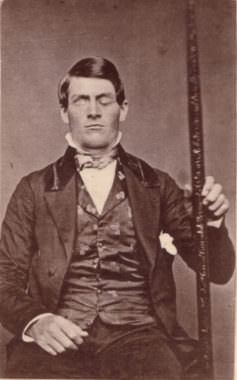
Cabinet-card portrait of brain-injury survivor Phineas Gage (1823–1860), shown holding the tamping iron which injured him.
Cabinet-card portrait of brain-injury survivor Phineas Gage (1823–1860), shown holding the tamping iron which injured him. Wikimedia

It took an explosion and 13 pounds of iron to usher in the modern era of neuroscience.

In 1848, a 25-year-old railroad worker named Phineas Gage was blowing up rocks to clear the way for a new rail line in Cavendish, Vt. He would drill a hole, place an explosive charge, then pack in sand using a 13-pound metal bar known as a tamping iron.

But in this instance, the metal bar created a spark that touched off the charge. That, in turn, “drove this tamping iron up and out of the hole, through his left cheek, behind his eye socket, and out of the top of his head,” says Jack Van Horn, an associate professor of neurology at the Keck School of Medicine at the University of Southern California.

Gage didn’t die. But the tamping iron destroyed much of his brain’s left frontal lobe, and Gage’s once even-tempered personality changed dramatically.

“He is fitful, irreverent, indulging at times in the grossest profanity, which was not previously his custom,” wrote John Martyn Harlow, the physician who treated Gage after the accident.

This sudden personality transformation is why Gage shows up in so many medical textbooks, says Malcolm Macmillan, an honorary professor at the Melbourne School of Psychological Sciences and the author of An Odd Kind of Fame: Stories of Phineas Gage.

“He was the first case where you could say fairly definitely that injury to the brain produced some kind of change in personality,” Macmillan says.

And that was a big deal in the mid-1800s, when the brain’s purpose and inner workings were largely a mystery. At the time, phrenologists were still assessing people’s personalities by measuring bumps on their skull.

Gage’s famous case would help establish brain science as a field, says Allan Ropper, a neurologist at Harvard Medical School and Brigham and Women’s Hospital.

Dr. John Harlow, who treated Gage following the accident, noted his personality change in an 1851 edition of the American Phrenological Journal and Repository of Science.
Dr. John Harlow, who treated Gage following the accident, noted his personality change in an 1851 edition of the American Phrenological Journal and Repository of Science. (Courtesy the American Phrenological Journal and Repository of Science, Literature and General Intelligence, Volumes 13-14)

“If you talk about hard core neurology and the relationship between structural damage to the brain and particular changes in behavior, this is ground zero,” Ropper says. It was an ideal case because “it’s one region [of the brain], it’s really obvious, and the changes in personality were stunning.”

So, perhaps it’s not surprising that every generation of brain scientists seems compelled to revisit Gage’s case.

For example:

  • In the 1940s, a famous neurologist named Stanley Cobb diagrammed the skull in an effort to determine the exact path of the tamping iron.
  • In the 1980s, scientists repeated the exercise using CT scans.
  • In the 1990s, researchers applied 3-D computer modeling to the problem.

And, in 2012, Van Horn led a team that combined CT scans of Gage’s skull with MRI scans of typical brains to show how the wiring of Gage’s brain could have been affected.

“Neuroscientists like to always go back and say, ‘we’re relating our work in the present day to these older famous cases which really defined the field,’ ” Van Horn says.

And it’s not just researchers who keep coming back to Gage. Medical and psychology students still learn his story. And neurosurgeons and neurologists still sometimes reference Gage when assessing certain patients, Van Horn says.

“Every six months or so you’ll see something like that, where somebody has been shot in the head with an arrow, or falls off a ladder and lands on a piece of rebar,” Van Horn says. “So you do have these modern kind of Phineas Gage-like cases.”

Two renderings of Gage's skull show the likely path of the iron rod and the nerve fibers that were probably damaged as it passed through.
Two renderings of Gage’s skull show the likely path of the iron rod and the nerve fibers that were probably damaged as it passed through. Van Horn JD, Irimia A, Torgerson CM, Chambers MC, Kikinis R, et al./Wikimedia

There is something about Gage that most people don’t know, Macmillan says. “That personality change, which undoubtedly occurred, did not last much longer than about two to three years.”

Gage went on to work as a long-distance stagecoach driver in Chile, a job that required considerable planning skills and focus, Macmillan says.

This chapter of Gage’s life offers a powerful message for present day patients, he says. “Even in cases of massive brain damage and massive incapacity, rehabilitation is always possible.”

Gage lived for a dozen years after his accident. But ultimately, the brain damage he’d sustained probably led to his death.

He died on May 21, 1860, of an epileptic seizure that was almost certainly related to his brain injury.

Gage’s skull, and the tamping iron that passed through it, are on display at the Warren Anatomical Museum in Boston, Mass.

Copyright 2017 NPR. To see more, visit http://www.npr.org/.

Juneau’s homeless population prefers Marine Park over Thane campground

Lorraine Paul, 42, wakes up the morning of May 17, 2017, in Marine Park, Juneau. The city wants to begin enforcing the park’s posted hours of midnight to 7 a.m.

Juneau’s controversial anti-camping ordinance has been in effect for more than a month. The result has been more people are sleeping in downtown’s Marine Park.  Now the city is looking to empty the park of overnight campers.

It’s just after 8 a.m. on Juneau’s downtown waterfront. The Emerald Princess cruise ship empties of tourists as people sprawled out on the soft grass begin to stir inside their sleeping bags.

Lorraine Paul is one of those early risers. The 42-year-old and others often sleep in Marine Park though police sometimes try to move them on.

“Some of us sleep in the booth over here and have to be out by 5:30 a.m. to be respectful,” she said. “We get up to try and come over here and lay down and then here comes JPD and they’re like: ‘You need to get up and pick your stuff up.'”

The reason she chooses to sleep out in the open, in a public park, is security. There are aggressive drug addicts around who can be threatening.

“I hate to say this but because some of these people do meth, you know. I feel like they ruin it for us,” she said. “It’s really hard to find somewhere to sleep. I mean, I’m an alcoholic. Some of us try to stick together — how do I say it — pack off to ourselves.”

Juneau has one of the largest homeless populations in Alaska. A statewide survey in January found the capital city had 215 homeless people — 59 of them unsheltered.

Earlier this year the Assembly passed a controversial ordinance banning sleeping on private property in the downtown core.

Juneau Police Lt. David Campbell says officers have been able to coax people away from storefronts without serious conflict.

“Since the initiation of the ordinance, no citations have been issued,” Campbell said. “Which means that people are basically moving on if requested to and it hasn’t gotten to the level were the officers feel like they have to write a citation.”

Federal judges have ruled cities can’t pass laws that criminalize homelessness. That’s why the city’s recent ordinance is limited to private property. Many people moved to public property, like Marine Park, where Campbell says police were instructed to be more lenient about restricted hours.

“With the new camping ordinance and the directions to the officers we were told not to enforce that in Marine Park,” he said.

But soon the city will try to make Marine Park off-limits after midnight.

“We think that making sure that the park remains open as a park and not as a camping areas is best for everyone,” Deputy City Manager Mila Cosgrove said.

She says the decision was made Tuesday at a meeting of city department heads. The logic is to close the downtown parks to drive people toward alternatives, such as the seasonal campground near Thane.

“The thought was people would naturally migrate up to Thane as the weather got a little bit warmer, which it certainly has, and that hasn’t been happening. We want people to know that that’s a designated option for them.”

Unidentified sleepers sprawl out in Marine Park on May 17, 2017. (Photo by Jacob Resneck/KTOO)

Complaints in recent weeks about rowdy behavior in Marine Park is what led the city to take action.

“At times people don’t feel safe transiting through that area and that’s just not acceptable — everyone has the right to feel safe in their community,” she said.

The Tuesday afternoon directive to clear Marine Park after hours hadn’t filtered down to the police lieutenant on Wednesday morning.

But Campbell says it could be done.

“When we encounter someone it gives us the ability to legally justify contact with them to identify them and see who they are and then ask them to go out of the park,” Campbell said. “Because it’s after hours and if they refuse then to issue them a citation.”

Back in Marine Park, this is not welcome news to Lorraine Paul.

“Now that I hear that we can’t be sleeping out here — it sucks,” Paul said. “Wish they’d have somewhere for us to camp.”

What about Thane campground? She says it’s 2-miles from downtown on an unlit road. Not safe for a single woman.

“You hear a lot of stories. For example, if I walked out there myself — I’m told there’s guys out that way that camp that would hurt you and rape you,” she said. “It’s kind of hard because I’ve been on the streets off-and-on all my life.”

It’s unclear whether the city would be able penalize anyone caught in the park after hours, because there’s a typo in the city’s code that likely would need amending before a court could impose the $25 fine.

Murkowski: Senate had duty to approve spending bill, avoid government shutdown

Sen. Lisa Murkowski speaks with reporters at a press availability following her annual address to the Alaska Legislature on Feb. 22, 2017. (Photo by Skip Gray/360 North)
U.S. Sen. Lisa Murkowski speaks with reporters at a press availability following her annual address to the Alaska Legislature on Feb. 22, 2017. (Photo by Skip Gray/360 North)

U.S. Sen. Lisa Murkowski on Thursday touted the Senate’s passing of a spending bill, avoiding a possible government shutdown.

The $1 trillion omnibus appropriations legislation would keep the government running until September. It passed the Senate 79-18.

Murkowski is a member of the Appropriations Committee and chair of the Interior, Environment, and Related Agencies Subcommittee. She said the bill addresses Alaskans’ needs and that a shutdown would have been disastrous, even if President Donald Trump seemed to welcome the possibility earlier this week in a tweet.

“I don’t think that there is ever a good time to say that we should shut the government down,” Murkowski said. “I think our responsibility, our obligation, is to govern. It’s to keep the wheels on the bus.”

The bill continues funding for Essential Air Service and to keep the 4-25 Airborne Brigade Combat Team intact at Joint Base Elmendorf-Richardson near Anchorage. It also includes an Alaska Mental Health Trust land exchange in Southeast.

The spending bill lacks the steep domestic spending cuts President Trump proposed for 2018, but Murkowski said it’s still a responsible use of taxpayer dollars.

The bill now goes to the president.

What does recidivism mean anyway?

Ideally, when someone gets out of prison, they don’t go back.

In reality, nearly two out of every three offenders in Alaska go back inside within three years.

Some call this the revolving door. The technical term is recidivism.

Elasonga Milligrock and Dani Cashen visit outside KTOO. Cashen says felons can be stigmatized by the community. (Photo by Scott Burton/KTOO)

I’ve been through Alaska’s revolving door myself, and hope to bridge the gap between convicts, ex-cons and the communities they’re trying to re-enter.

The Alaska Judicial Council defines a case of recidivism as when an offender is re-arrested, has a new court case filed or is remanded to custody for new charges or for probation/parole violations.

Listen to the story here:

For 25 years, I found just about all of the ways in and out of prison — more times than I care to count. Ironically, I’d never heard the word recidivism. I found I was not alone, so I hit the streets and asked about it.

After asking three random people, not one knew what the word recidivism meant.

At a Juneau Reentry Coalition gathering, it was better understood.

The coalition is a group of people and organizations dedicated to reducing recidivism, among other justice reforms.

I met Logan Henkins, a carpenter and ex-convict, who got it.

Logan Henkins and his girlfriend, LauraLee Peters. (Photo by Elasonga Milligrock/KTOO)

“Recidivism to me is the percentage of people that go into prison and continue to go back after they’re released because of not changing,” Henkins said.

The part about not changing was right on the money for me.

Eventually, I decided to change my ways, got treatment for my alcohol and drug abuse, and now I am staying out of jail.

But, that personal change, was only part of the equation.

When a person gets out of jail, the process is called re-entry — they’re re-entering society.

And I’ll tell you what, it isn’t easy.

It can be like starting a life in a foreign land where the people don’t want you there.

“I am a felon, yes, and I am a recovering addict after five years,” said Dani Cashen, who’s starting a house cleaning business. “I’m still a felon and it still tracks me and haunts me and follows me wherever I go.”

That stigma is something all felons and ex-convicts experience.

Unlike me, with my tattoos, you might not know Cashen had been to prison – unless you’re an employer.

By law, she has to check the felon box on things like job applications.

And then there’s the rest of life’s challenges, like getting housing and keeping up with the conditions of your release.

I’ve been on parole for three years. I check in with my parole officer downtown once a month, can’t leave town unless approved, can’t go into bars, and, I take random drug tests at my PO meetings. I have to obey all state and federal laws.

If I miss or fail any stipulations, it’s back to prison.

If that isn’t hard enough, imagine adding on mental health issues, which might go undiagnosed and untreated in prison.

Bruce Van Dusen is the executive director at Polaris House, an organization dedicated to supporting people with mental illness. (Photo by Elasonga Milligrock/KTOO)

“In general, the story is around the whole country is that the prisons have become the mental health providers,” said Bruce Van Dusen, who is an ex-convict and executive director of Polaris House, an organization dedicated to supporting people with mental illness.

It’s also part of the re-entry coalition trying to stop the revolving door.

“Because they have so many people who are incarcerated who have schizophrenia, or depression, or bipolar,” Van Dusen said.

Thankfully, people like Van Dusen are helping.

And then there’s Ramona Wigg who is a volunteer advocate for people going through reentry. Despite the many challenges, Wigg says she has seen attitudes around reentry shift for the better.

Despite the many challenges, Wigg said she has seen attitudes around re-entry shift for the better.

“It’s just now coming out in the public, so now it’s popular I guess. But it’s important and it should have been popular years ago,” Wigg said. “Think of all the lives we could have saved.”

Confronting and sharing these experiences, including my own, are just a few steps toward understanding and reducing recidivism as a community.

In my next story, I’ll profile a few people staying out of trouble and try to identify why.

This story is part of an ongoing project on re-entry and recidivism. 360 North is also producing a television documentary on the topic slated for June.

KTOO’s project focusing on recidivism is funded, in part, by a grant from the Alaska Mental Health Trust Authority.

Correction: In a previous version of this story Ramona Wigg was misidentified as a mother of a person going through the revolving door. She is a volunteer advocate for people going through reentry. 

Site notifications
Update notification options
Subscribe to notifications