Mental Health

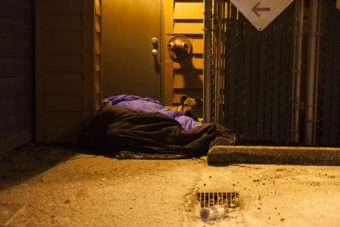
Juneau Assembly bans homeless from sleeping downtown

Homeless resident Catherine Duncan, far left, appeals to the Juneau Assembly not to pass a camping ordinance that would ban homeless from sleeping downtown on Feb. 13, 2017. (Photo by Jacob Resneck/KTOO)

A divided Juneau Assembly passed a controversial anti-camping ordinance Monday to ban homeless people from sleeping near downtown businesses.

In the end, the controversial ordinance passed by a single vote. It will allow police to cite anyone caught sleeping on private property in the downtown core between midnight and 7 a.m.

The ordinance passed in a 5-4 vote. Supporters were: Mayor Ken Koelsch, Jerry Nankervis, Debbie White, Mary Becker and Beth Weldon. Opposed were: Norton Gregory, Jesse Kiehl, Loren Jones and Maria Gladziszewski.

Many downtown merchants have complained of people using shuttered storefronts to shelter from the cold. Those concerns were heard by a majority of the Assembly.

“This isn’t about the people who sleep on the sidewalk. This isn’t about people in Marine Park,” Assembly member Debbie White said. “This is about people who have invested in our downtown community, who employ our neighbors.”

Assembly member Jerry Nankervis echoed that it was a matter of rights of business owners.

“We are trying to reinforce — at least in my mind — that I believe people have private property rights,” he said, “and just because you’re homeless doesn’t supersede somebody else’s private property rights.”

Juneau Police Chief Bryce Johnson said the ordinance would be a tool which would give us the option of either writing a ticket or taking someone to jail for disorderly conduct.”

It takes effect in mid-April when the city-run Thane Campground reopens.

Opposition came from four Assembly members including Norton Gregory, who noted that many homeless people suffer from substance abuse and mental illness.

“Those are the discussions that I wish we were having tonight and we were talking about rather than passing an ordinance about pushing these people out of the downtown area,” Gregory said.

Assemblyman Jesse Kiehl disputed the police chief’s argument it would improve overall public safety.

Are people better off now in doorways? You bet they are,” he said. “Because those abandoned mine buildings above Gastineau Avenue are scary places and there are no lights and (the Juneau Police Department) doesn’t drive by and check.”

Merchants who had complained that homeless people had harassed and intimidated their customers and employees were pleased with the vote.

“I personally think this will help and I hope it’s the beginning of a longer process to address all the issues of the homeless in downtown Juneau,” said Eric Forst, owner of the downtown Red Dog Saloon.

Homeless residents reacted with dismay.

“I’m scared of what’s going to happen,” Lisa Williams, 27, said after the vote. “I don’t know where I’m going to go and I’m afraid to go up to the woods. I have no idea what it’s going to mean for me.”

The ordinance began as an initiative by Juneau Mayor Ken Koelsch, who proposed it after fielding complaints from merchants in December.

“I asked for the no camping ordinance to be drafted and introduced for action,” he said in prepared remarks. “I accept full responsibility. It speaks to a core value of mine regarding respect of property of others.”

The ACLU of Alaska has cautioned the city that a blanket ban on homeless people downtown would be unconstitutional.

Courts have ruled homelessness can’t be criminalized when the homeless population exceeds shelter space available.

For that reason City Attorney Amy Mead said this ordinance was drafted narrowly to only apply to private property.

So what if the homeless campers move to a public place like Juneau’s Marine Park?

My advice to (the Juneau Police Department) is that it would be potentially unconstitutional to enforce the camping ordinance against those people at that time,” the city attorney said in a brief interview.

The argument over this ordinance may be over.

But both sides here agree that the quandary over Juneau’s homeless problem continues.

Privatization could save some money at API, not at youth centers

brains
(Creative Commons photo by Neil Conway)

Alaska’s state government can save money by privatizing some services at the Alaska Psychiatric Institute, or API. But it doesn’t look like it would save if it privatized all services.

Consultants who studied the privatization for the state found that management of the institute, as well as operating the state’s juvenile justice detention centers, are better done by the state.
Savings depend on how many patients are at the psychiatric institute, said Coy Jones, senior consultant for Public Consulting Group.

“We definitely made some recommendations where there are some limited cases of privatization that we would recommend implementing,” Jones said. “They’re easy to do, and they will generate some cost savings.”

For example, the consultants recommend there could be savings in privatizing the institute’s communication center.

But a different consultant that looked at youth detention centers couldn’t find any opportunities for privatization.

Consultant Carl Becker of CGL – a consulting company that specializes in corrections — said local organizations operate juvenile facilities in other parts of the country. But local organizations weren’t interested in operating the facilities in Kenai, Nome and Palmer.

We found basically no private or governmental in any of these regions that had either the interest or the capability to operate standalone detention facilities for these youth,” Becker said.

The state also couldn’t find savings in privatizing pharmacy services at Pioneer Homes.

The state studied privatizing services as a result of a new law that overhauled Medicaid in Alaska. The Senate Health and Social Services Committee held a hearing on the studies Monday.

Bill would allow judges to order gun owners to forfeit weapons if found to be threat

Rep. Geran Tarr addresses the Alaska House of Representatives on April 7, 2014. Tarr and Andy Josephson will replace Benjamin Nageak (seated) and David Talerico as the co-chairs of the House Resources Committee. (Photo by Skip Gray/360 North)
Rep. Geran Tarr addresses the Alaska House of Representatives on April 7, 2014. Tarr has introduced a measure that would allow judges to issue protective orders against Alaskans who are deemed a threat to themselves or others, and would make them temporarily surrender their firearms. (Photo by Skip Gray/360 North)

Alaskans can have firearms even when family or law enforcement officers believe they are a threat to themselves or others.

But a new bill would allow judges to issue protective orders making them temporarily surrender their guns.

Bill sponsor Rep. Geran Tarr said the measure’s scope is limited.

“I’m not interested in taking guns from anyone,” she said. “I’m really interesting in helping someone in a crisis situation, who’s experiencing mental illness – and hoping that we can do something that prevents an innocent person from being killed.”

Tarr, an Anchorage Democrat, says she planned to introduce the bill before Anchorage resident Esteban Santiago allegedly killed five people in Fort Lauderdale, after he had been prosecuted for domestic violence.

Tarr said the bill’s timing is unrelated to the mass shooting, but she said she’s heard more interest in the idea since the incident.

The bill would allow an immediate family member or peace officer to petition a judge for a protective order.

A hearing would be held within 10 days, and if the judge finds clear-and-convincing evidence that a person is a danger to themselves or others, the judge could prohibit the person from owning or buying a gun.

Rep. David Eastman, a Wasilla Republican, is concerned about the proposal.

“As a military veteran, I would definitely be cautious before coming into a situation where another veteran might lose their Second Amendment rights,” Eastman said. “I would be also concerned if this type of legislation would have the effect of discouraging people from seeking help.”

Tarr’s said she’s interested in working with those concerned about the bill.

“We had record numbers of shootings last year in Anchorage,” she said. “So what are the other ideas? Let’s at least have a thoughtful conversation.”

The legislation, House Bill 75, was introduced on Monday.

Its next stop is the House Judiciary Committee, where it hasn’t been scheduled for a hearing.

Vote postponed over Juneau’s controversial ‘camping ordinance’

Juneau homeless resident Everett Johnson, far left, testifies about sleeping on the streets before the Juneau Assembly on Monday. (Photo by Jacob Resneck/KTOO)

Juneau’s controversial anti-camping ordinance that would empower police officers to crack down on homeless people sleeping downtown has been postponed until next month.

That’s following more than 90 minutes of testimony from dozens of residents including merchants, social workers and homeless people.

They all agreed on one thing: Juneau has a serious homeless problem.

But speakers had radically different viewpoints.

Douglas resident Greg Capito told the Juneau Assembly on Monday night that tensions are rising between increasingly desperate people sheltering downtown, and that employees and patrons are increasingly afraid.

“In the last three years, downtown Juneau has changed and, ladies and gentlemen, not for the better,” Capito said. “There’s fear in the eyes of everybody. When you look in somebody’s eyes and see fear you never forget it.”

Other speakers also testified that they were feeling increasingly unsafe downtown, especially after dark.

But 27-year-old homeless Juneau resident Lisa Williams said that if the proposed ordinance is passed, she doesn’t know what she’d do.

“We have nowhere to go. And we’re already homeless,” she said. “If we had money to pay for something we would pay for it. You guys are trying to give us tickets or whatever — but if we’re homeless how are we going to pay for it? We don’t have anything, we don’t have a home. We’re staying in cubbyholes and everyone is saying they’re scared but — we’re harmless.”

Daryl Miller, owner of a downtown commercial printing business, said he likes the idea of more shelter capacity and an emergency warming station. But he’s reached the breaking point with people sleeping downtown.

“I’m tired of babysitting and cleaning up on a daily basis,” Miller testified. “So much so that I will be moving my business in the next three months from its current location, and one of the main reasons is because of the daily cleanup.”

Another longtime homeless resident, Everett Johnson, said elected officials don’t know what it’s like to be destitute and challenged them to put themselves in his place.

For people like him it’s a matter of daily survival, he said.

“You want to get us off downtown? OK — build us another shelter. Don’t make it difficult. We’re already having a hard time,” Johnson said, his voice trembling with emotion. “As I look at every one of you you guys got a bed, a warm place. Not me, not me. As a matter of fact, I brought my bed with me and that’s my sleeping bag.”

The Juneau Assembly concluded the ordinance’s public hearing and is scheduled to revisit the issue at its Feb. 13 meeting.

Four Native institutions urge Juneau Assembly to abandon ‘camping’ ordinance

The heads of four Juneau-based Alaska Native institutions are urging the Juneau Assembly to abandon its proposal to make camping downtown a ticketable offense.

The proposed ordinance targets some of the homeless people who sleep in storefront nooks. It has the support of the Juneau Police Chief Bryce Johnson and some store owners. Mayor Ken Koelsch had the ordinance drafted.

In a letter to the Juneau Assembly, the leaders say removing campers from downtown district can be done in “a humane and compassionate” way by establishing a campsite elsewhere.

The letter of opposition was signed by Rosita Worl of Sealaska Heritage Institute, Richard Peterson of the Central Council of Tlingit and Haida Indian Tribes of Alaska, Anthony Mallott of Sealaska Corp., and Charles Clement of SEARHC.

Accused airport shooter assigned a public defender at first court appearance

The man charged with shooting 11 people at Fort Lauderdale’s airport Friday had his first court appearance Monday.

Esteban Santiago, 26, was escorted into federal court in Fort Lauderdale in manacles. He told U.S. magistrate Judge Alicia Valle he understood the seriousness of the crimes he is charged with. Federal authorities say Santiago flew to the airport from Anchorage, Alaska. Upon arrival, they say, he removed a semi-automatic handgun from his checked luggage, loaded it in a bathroom, and began shooting people in the airport’s baggage claim area. Five people were killed and six wounded.

Before appointing a public defender to represent him, Valle questioned Santiago on his finances and job history. Santiago said he worked at a security company in Anchorage until November. That’s around the time he walked into the FBI office there telling them he believed the government was forcing him to watch ISIS videos. His gun was confiscated and he was taken to a mental health facility before being released. A month later, consulting with the FBI, local police returned Santiago’s gun to him.

Santiago told Judge Valle he has only $5 or $10 in the bank. After appointing his attorney, Valle set his detention hearing for Jan. 17. He’ll be formally arraigned on Jan. 23, at which time he’ll enter a plea.

Santiago is charged with three counts: committing an act of violence at an airport with the intent of causing serious bodily harm, deadly use of a firearm, and using a firearm to commit a violent crime. The maximum penalty for the combined charges is death. So far none of the counts relate to terrorism, but the FBI said over the weekend it is not ruling that out. Additional charges could come later through an indictment.

So far, much of what investigators are learning about Santiago points to mental health issues. He grew up in Puerto Rico, served in the National Guard there and later in Alaska, service that included a tour of duty in Iraq. In August, he was discharged by the Alaska National Guard for poor performance, in part for episodes of being absent without leave. Army investigators at the time noted what they called “strange behavior.”

In South Florida, the shooting is leading some officials to call for a re-examination of mental health and firearms laws. On Miami’s WPLG-TV this weekend, Broward County Sheriff Scott Israel said, “People who are suffering from mental illness should not be allowed in my opinion to purchase or have firearms at any time.” Federal laws already prohibit anyone who has been adjudicated mentally ill from owning a gun.

Rep. Debbie Wasserman Schultz, D-Fla., whose district includes Fort Lauderdale-Hollywood International Airport, says Congress needs to look at whether people should be allowed to travel with their firearms, even in checked baggage. Wasserman Schultz says officials also “need to take a hard look at the security around baggage claim areas.”

Copyright 2017 NPR. To see more, visit http://www.npr.org/.
Site notifications
Update notification options
Subscribe to notifications