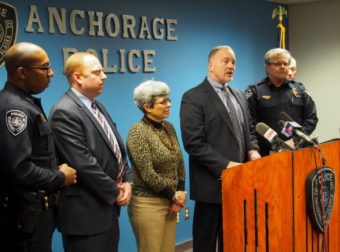
FBI Special Agent Marlon Ritzman addresses reporters at a press conference at Anchorage Police Department headquarters on January 7th, 2016. (Photo by Zachariah Hughes/ Alaska Public Media)
Officials in Anchorage held a press conference on Jan. 7 regarding what’s known about Esteban Santiago, the alleged shooter in the attack at the Fort Lauderdale airport on Jan. 6. In spite of known mental health concerns, police returned a firearm to Santiago in December, which may have been used in the attack.
Speaking at the Anchorage Police Department’s headquarters, FBI Special Agent Marlon Ritzman told a crowded room of reporters that in November of last year, Santiago came into the Bureau’s Anchorage office complaining a government agency was controlling his mind and making him watch ISIS videos.
“During our initial investigation we found no ties to terrorism,” Ritzman said, reading from prepared remarks.
Local officials laid out a detailed chronology of Santiago’s contact with law enforcement over the course of the last year. Beginning in January of 2016 and involving Santiago’s girlfriend at their Fairview home, a series of domestic violence incidents were reported to police. But few of them led to any arrests or charges.
By November of last year, Santiago had what Anchorage Police Chief Chris Tolley called a “mental health crisis,” and walked into the FBI’s office with complaints of “terroristic thoughts.”
“Santiago had a loaded magazine on him, but had left his firearm in his vehicle prior to contacting agents,” Tolley said. “Also in the vehicle was Santiago’s newborn child.”
APD officers later brought Santiago to a mental health facility in Anchorage, where he was admitted. The same day, APD confiscated his firearm for safe-keeping. But because Santiago was never “adjudicated mentally ill,” on December 8th APD returned the weapon, which may have been the one used in the Fort Lauderdale shooting.
“There’s speculation that this is the same gun,” Tolley said, adding quickly, “I have not received confirmation that it is, in fact, that same gun.”
The FBI believes Santiago acted alone when he planned and carried out the attack.
According to U.S. District Attorney Karen Loeffler, there’s no federal rule that would have prohibited Santiago from legally transporting a firearm on a commercial flight.
Santiago is a decorated former member of the Puerto Rico and Alaska national guards, and he was deployed to Iraq as a combat engineer from 2010 to 2011. He was given a general discharge from the Alaska National Guard in August of 2016, according to Lt. Col. Candis Olmstead.
Investigators haven’t yet determined a motive for why Santiago flew to South Florida for the attack.
The Trust Authority Building in Anchorage houses their main offices. (Photo by Anne Hillman/Alaska Public Media)
The Alaska Mental Health Trust Authority board met on Thursday to discuss the legality of its investment policy. The board’s decisions to independently invest $39 million of the Trust’s principal funds in real estate have recently been called into question, and the Trust will undergo a special legislative audit.
State statute reads the Trust’s principal is to be invested by the Permanent Fund Corporation, but the board and its legal counsel previously interpreted other statues and regulations to provide more leeway for investments. They say statues that apply to private trusts also apply to the public trust.
Income from the endowment funds mental health programs throughout the state.
Those legal opinions have not been made public, but the Trust’s legal counsel, Nelson Page, addressed the issue during a work session on Thursday.
“And general trust law in the state of Alaska allows and in fact, I think, clearly suggests that the Trust has the right and the obligation to make the endowment of the Trust be as productive as possible,” he told the board.
Page met with the director of the civil division of the Attorney General’s office to discuss the issue last month. Page said the Attorney General’s office had some serious questions about the Board’s investment strategy.
“How big are you (going to) get with this program? Where do you cross the line from enhancing revenue and enhancing the endowment of the trust to violating the statutes?” he cited representatives from the AG’s office as asking.
The Attorney General’s office declined to comment on the meeting because it has not issued an official opinion on the matter.
The board is working in a legal gray area, Page said.
He said the board is putting its aggressive real estate strategy on hold and will work with the Attorney General’s office, advisory boards, and others to develop a way forward.
Board chair Russ Webb said the Trustees need to meet in executive session to discuss the next steps as soon as possible.
“The ambiguity is clear. It’s out there,” he said. “The fact that it exists is clear, and we obviously need to resolve the issue as quickly as we can.”
The board will also begin recruiting for a new CEO as soon as a job description is ready.
Greg Jones was put in place as an interim leader when former long-time CEO Jeff Jessee was demoted last fall.
The organization will seek a new Chief Financial Officer as well. Kevin Buckland resigned in December.
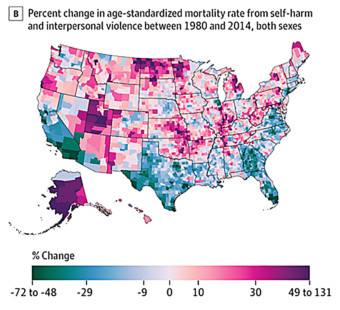
A graph showing the age standardized mortality rate from self-harm and interpersonal violence for both sexes in 2014 from a University of Washington study. The study showed the rate of suicide and homicide in Alaska’s Kusilvak Census Area more than doubled between 1980 and 2014; a 130 percent increase and the highest rate in the nation. (Graphic by Institute for Health Metrics and Evaluation at the University of Washington)
The rate of suicide and homicide in the Kusilvak Census Area, located along the lower Yukon River, more than doubled since 1980, a rate increase higher than anywhere else in the nation.

A study from the University of Washington mapped how people in the U.S. died during those years. Its finding for the area is disturbing.
It’s a sobering increase from 51 deaths per 100,000 people in 1980 to 181 per 100,000 by 2014.
The area’s small population numbers were adjusted to be able to compare rates with larger population areas.While the finding from the University of Washington does come with some caveats, Abraham Flaxman, an assistant professor at the University of Washington’s Global Health Department, says it raises a red flag.
“Let me start by saying that 130 percent increase is huge,” he said. “And anytime we see an increase like that, and it’s an increase in something bad, we want to know about that.”
The data came from death certificates from across the nation, and using this source brings a potential defect to the study.
Flaxman said that even though death certification has been improving since the 1980s, quality varies and coroners in many areas would often list an alternate cause of death to avoid the stigma of suicide.
Another limitation of the study is that it doesn’t show how much of that 130 percent increase is from suicide and how much is from homicide.
But according to the State of Alaska’s death statistics, since 1999, which is about halfway through the study’s timeframe, suicides in the Kusilvak area have far exceeded homicides.
For example, there were 13 suicides and four homicides between 1999 and 2001. Between 2011 and 2013, there were 24 suicides and six homicides.
Presumably suicides account for most of the 130 percent increase, and Flaxman hopes that the numbers help local officials take action.
“So now it is out there, and what happens from there, I really hope this is something people find helpful and can use to improve population health,” Flaxman said.
While the continued high rate of suicides in Natives communities took center stage at the Alaska Federation of Natives Meeting that year, one Native man underscored the issue by flinging himself off the balcony and dying in front of the delegates.
One of the people trying to plug the flow of Alaska Native despair is Ray Daw, head of Behavioral Health at the Yukon Kuskokwim Health Corporation.
“Our prevention department, which is about four years old, has done a lot of work at understanding the impact of boarding schools, the impact of the epidemics that occurred two generations ago upon families in the region,” Daw said.
Colonization disrupted the local culture by killing whole families and communities with epidemics and then taking children away from the survivors to educate them in white-run schools. This led to family dysfunction and substance abuse, conditions ripe for suicide because youth lose the capacity to see a viable future.
The YKHC suicide prevention department works to reverse these forces by strengthening the Yupik culture.
It bases its treatment on ways Yupik people lived healthy lives less than a century ago, before there were such high suicide rates.
The department is fully staffed by local Alaskan Natives who all speak Yupik, Daw said.
“Research says that if you’re going to have effective work in behavioral health, you have to have people who are closer to the culture in terms of how they think, feel and behave, and understand the dynamics of problems and solutions a lot more effectively than someone who isn’t,” Daw said.
To get more Alaska Natives providing behavioral health care to Alaska Natives, the department partners with Dr. Diane McEachern at University of Alaska Fairbanks Kuskokwim Campus.
McEachern teaches the rural human services certificate program, and the human services associate degree program. Both are paths to a degree in social work.
Two Yupik elders are always in the classroom with McEachern.
The classes work on how to counsel people and how to heal communities.
McEachern is convinced that these classes can make a real difference.
“So we’re looking at what does it mean for a whole community to experience more health and well-being? And if that happens, what are all the ways to help that happen? And then, what outcomes can we imagine from that in terms of the rates of all these issues? Well, they would plummet,” McEachern said.
Professionals are putting their hope in historical healing and resiliency, strengths the elders in the classroom embody; strengths that the students work to build in their communities; and strengths that, when they were present, the young did not to take their own lives, but instead grew up and became elders and leaders in their own right.
The classes are rooted in the understanding that the rates of suicide, domestic violence and substance abuse are ways that the fallout from colonization manifest when one culture violates another.
From there, the students can move beyond the past to create a viable future.
“It’s is a social condition that happened to the Yupik people,” McEachern said. “And that’s a powerful insight for people to have, because now they can sit back and go, ‘Oh, it really wasn’t us. So what is us that kept us safe before? And let’s embrace that.’”
But will that be enough to curb a trend that has built and increased over more than 30 years?
No one knows the answer to that question.
There have been efforts to bring highly visible discussion of the issue, such as the Pulitzer Prize-winning series “A People in Peril: A Generation of Despair” published in 1988 by the Anchorage Daily News.
There has also been controversy and discussion, both public and private, along with community and private healing sessions. But despite all of this, there is still no sign of a reversal in the trend of increasing suicides in Alaska Native youth.
Johanna Eurich and Steve Heimel contributed reporting to this story.
With a president-elect who has publicly supported the debunked claim that vaccines cause autism, suggested that climate change is a hoax dreamed up by the Chinese, and appointed to his Cabinet a retired neurosurgeon who doesn’t buy the theory of evolution, things might look grim for science.
Yet watching Patti Smith sing “A Hard Rain’s a-Gonna Fall” live streamed from the Nobel Prize ceremony in early December to a room full of physicists, chemists and physicians — watching her twice choke up, each time stopping the song altogether, only to push on through all seven wordy minutes of one of Bob Dylan’s most beloved songs — left me optimistic.
Taking nothing away from the very real anxieties about future funding and support for science, neuroscience in particular has had plenty of promising leads that could help fulfill Alfred Nobel’s mission to better humanity. In the spirit of optimism, and with input from the Society for Neuroscience, here are a few of the noteworthy neuroscientific achievements of 2016.
One of the more fascinating fields of neuroscience of late entails mapping the crosstalk between our biomes, brains and immune systems.
In July, a group from the University of Virginia published a study in Nature showing that the immune system, in addition to protecting us from a daily barrage of potentially infectious microbes, can also influence social behavior. The researchers had previously shown that a type of white blood cells called T cells influence learning behavior in mice by communicating with the brain. Now they’ve shown that blocking T cell access to the brain influences rodent social preferences.
It appears that interferon, an immune system factor released from T cells, is at least partly responsible for the findings. A single injection of interferon into the mice’s cerebrospinal fluid, the clear, protective fluid that bathes the brain and spinal cord, was enough to restore social behaviors. Lead author Jonathan Kipnis from the University of Virginia speculates that there might be an evolutionary linkage here — one protecting us from the increased pathogen exposure that comes with socializing. He also says the findings could help improve our understanding and treatment of brain disorders.
Of course these findings were in rodents, but earlier work by Kipnis suggests that the brain and immune system communicate in similar ways in humans.
Major advances were also made this year in joining human with machine.
In October 2015, Hanneke de Bruijne, a 58-year-old Dutch woman with Lou Gehrig’s disease, received a brain implant that would allow her to communicate simply by thinking.
Eighty percent of patients suffering from amyotrophic lateral sclerosis, as the condition is also known, ultimately have trouble communicating because of muscle paralysis. At its extreme, this paralysis results in a tragic state called locked-in syndrome, in which patients remain fully aware but can’t express themselves; they become locked inside their own bodies.
The new therapy, which comes on the heels of similar work out of East Tennessee State University, was developed by a team from the University Medical Center Utrecht in collaboration with Medtronic. It consists of four electrodes implanted over the motor region of the brain that connect to a wireless transmitter implanted in the chest. After 28 weeks of training, the device was able to recognize brain activity patterns that occur with thinking about typing a particular letter. Though de Bruijne’s muscles still can’t move, this brain-computer interface can now translate her brain waves — or her “thoughts” — into text.
Among the biggest neuroscience drug advances of the year was the Food and Drug Administration’s Dec. 23 approval of Biogen’s Spinraza, or nusinersen, the first treatment for spinal muscular atrophy.
Spinal muscular atrophy is the No. 1 genetic cause of death in infants. Those affected by the devastating disorder carry a gene mutation that renders them unable to produce a protein essential to survival of neurons in the spinal cord. Gradually stripped of their abilities to walk, eat and breathe, most children struck with the disease don’t make it past 2 years old.
Spinraza is a gene therapy that boosts the production of the essential protein. Despite possible side effects, which include bleeding complications, kidney toxicity and infection, the drug appears to work so well that two recent clinical trials were stopped early, as it was deemed unethical to withhold treatment from babies assigned to placebo groups. As with many other drugs for rare diseases, the price of Spinraza is expected to be high to help recoup research costs — perhaps as high as $250,000 per year.
The Alzheimer’s disease community also received welcome news this year. After hundreds of failed trials of potential treatments over the past couple of decades, the experimental drug aducanumab, also produced by Biogen, was found in early trials to slow the cognitive decline that comes with Alzheimer’s.
And then there was the ongoing resurgence of psychedelic medicine.
It’s been pretty well established that the hallucinogenic anesthetic ketamine may be an effective antidepressant. Now we have some potentially groundbreaking findings for psilocybin, the active compound in “magic mushrooms.” Two clinical trials found that just a single high dose of the drug is effective at treating symptoms of both depression and anxiety in late-stage-cancer patients.
Scientists are unsure just how psilocybin works to relieve mental duress. But one theory holds that it disrupts self-focused thought and fixation — common in those suffering from depression — allowing selfless cognition and experience to occur. In both trials the intensity of the patients’ “mystical experiences” correlated with the decrease in symptoms.
Both research groups strongly caution against recreational use or self-medicating with magic mushrooms, but the findings have many experts and institutions reconsidering the half-century of negative counterculture stigma surrounding psilocybin.
The list of neuroscientific advances from the past 12 months goes on: The Human Connectome Project gave us the most complete map of the cerebral cortex to date; a Canadian group revealed in part how fear memories are formed; scientists at Mount Sinai charted the neurocircuitry behind social aggression.
Still, the field of neuroscience remains, at best, in adolescence.
As British novelist Matt Haig wrote in The Telegraph in 2015, “Neuroscience is a baby science. … We know more about the moons of Jupiter than what is inside of our skulls.”
As the year’s abundant advances attest, there is plenty of room left for discoveries in the coming year and beyond — and plenty of creative, eager researchers to make them.
Bret Stetka is a writer based in New York and an editorial director atMedscape. His work has appeared in Wired, Scientific American and on The Atlantic.com. He graduated from University of Virginia School of Medicine in 2005. He’s also on Twitter: @BretStetka
Copyright 2016 NPR. To see more, visit http://www.npr.org/.
Ken Yeh thought his school was buying software to keep kids off of certain websites.
What he didn’t know was that it could help identify a student who might be considering suicide.
Yeh is the technology director at a private K-12 school near Los Angeles. Three years ago, the school began buying Chromebook laptops for students to use in class and at home. That, Yeh says, raised concerns from parents about what they’d be used for, especially outside of school.
He turned to a startup called GoGuardian, which helped the school create a list of off-limits sites: porn, hacking-related sites and “timewasters” like online games, TV and movie streaming. The software also has another feature: It tracks students’ browsing and their searches.
And that’s how Yeh was alerted that a student appeared to be in severe emotional distress.
He recalls getting an indicator at work that a student had been searching for suicide and several related terms. “I then went in to view the student’s browsing history around this time period.”
The more he saw, the more Yeh was convinced that this wasn’t an idle or isolated query.
There were other warning signs in the web browsing of this student as well: searchers for specific methods of self-harm and “terms that strongly suggested that the student was struggling with certain issues,” he says.
Yeh alerted the principals and the student was brought in to speak with a guidance counselor. That conversation, Yeh says, led to positive interventions. “It was a little unexpected. We weren’t thinking about this as a usage for GoGuardian.”
Yet in the nearly four years that GoGuardian has been in use at this school, this type of incident has happened four separate times, he says. And GoGuardian says that across the 2,000 districts where its software is in use, it has heard similar anecdotes dozens of times.
Rodney Griffin, the Chromebook coordinator for the Neosho School District in southwest Missouri, says it happens there an average of once a semester.
“Any time, day and night, I alert a school counselor or administrators,” he says. “I’ve had it happen when they contacted home at like 10 p.m. and said, ‘I think you need to check on your child.’ ”
So, these software programs are identifying students in distress, but they do so by effectively thrusting school IT directors such as Yeh into the role of eavesdroppers.
That can be problematic, says Elana Zeide, a research fellow at NYU’s Information Law Institute and an expert on student privacy and data.
“This is a growing trend where schools are monitoring students more and more for safety reasons,” she says. “I think student safety and saving lives is obviously important, and I don’t want to discount that. But I also think there’s a real possibility that this well-meaning attempt to protect students from themselves will result in overreach.”
A student who types “suicide” into a search box could be researching Sylvia Plath, Socrates or terrorist movements, Zeide points out. And there could be legitimate personal or educational reasons for students to search other flagged terms, from sexual anatomy to sexually transmitted diseases or drugs, without “sending immediate alerts to the powers that be.”
She points out that low-income students may be disproportionately subject to surveillance, as school-owned devices are more likely to provide their only access to the Internet. And she worries about the broader message: “Are we conditioning children to accept constant monitoring as the normal state of affairs in everyday life?”
This type of dilemma is almost certainly going to become more common, as school-owned devices and laptops proliferate. In 2015 alone, according to a report released this month, U.S. K-12 districts bought 10.5 million devices like laptops and tablets, a 17.5 percent increase over the year before.
Carolyn Stone, ethics chair of the American School Counselor Association, says that she was “taken aback” to hear that student Web searches done at home were triggering interventions by school staff. “It’s so intrusive,” she says.
On the one hand, she says, the issue of students thinking about suicide needs to be taken very seriously and treated differently from other types of disclosures. When guidance counselors hear anything about potential self-harm, even secondhand, she says, “We’re on it. We’re calling home. Privacy and confidentiality go out the window.”
On the other hand, she says, she worries about school staffers without mental health training having access to what are, essentially, students’ private thoughts.
“On the surface, it sounds like a very good idea to err on the side of caution when it comes to student suicide,” Stone says. “But this is something that sounds like it could spin out of control. … It’s a slippery slope.”
Cody Rice, the technical product manager at GoGuardian, says schools are given control over what search terms are flagged and what to do about them, and no client to date has raised privacy concerns.
“Schools and parents are the primary protectors of the students, and GoGuardian provides another tool to help them in their endeavors, but does not make decisions on which types of online activity may lead to alerts to the administration for the benefit of the student.”
Yeh says parents at his school have never complained about privacy violations. He adds that they’ve raised complaints only when the filtering has malfunctioned, allowing students temporary access to off-limits sites.
As for being asked, with no mental health training, to serve as a de facto mental health early warning system for the school community, he seems to accept it as a new part of his job.
“It is a way for us to proactively intervene when they are looking for help. And so we feel a good sense of responsibility in trying to look out for the welfare of our students.”
A version of this story was published on NPR Ed in March 2016.
Copyright 2016 NPR. To see more, visit http://www.npr.org/.
On Tuesday, a committee of state lawmakers unanimously voted to order an audit of The Alaska Mental Health Trust Authority. The Legislative Budget and Audit Committee vote came without discussion or questions.
Rep. Mike Hawker, chair of the Legislative Budget & Audit Committee, on Feb. 12, 2015. (Photo by Skip Gray/360 North)
In his introduction of the action, Rep. Mike Hawker, who chairs the committee, said “I have talked to folks over at Mental Health Trust who assure me they are also taking steps currently to remedy some apparent concerns. And the point of this audit is to document whether or not the concerns were valid and beyond that, of course, to document the process, procedures in place and being taken by the Mental Health Trust Authority to remedy any concerns that may be out there.”
The special audit will look at the trust’s investments and asset management. Lawmakers want to know if the trust’s board and employees are complying with statute. They are also looking into whether or not all of the transactions are “at arm’s length.” Meaning, none of the trust employees, trustees or their family members benefit from any of the transactions.
Bruce Botelho and Harry Noah, two former government officials who were involved in the settlement that reconstituted the trust in the 1990s, requested the audit. They raised concerns about the board of trustees’ decision to invest trust principal funds on their own rather than have the money invested by the Alaska Permanent Fund Corp., as required by statute. At the direction of the board, the Trust Land Office, which was established to manage the noncash assets of the trust, is using funds from the principal to buy real estate and has not transferred principal funds to the Permanent Fund since 2008.
According to the TLO’s 2016 Resource Management Plan, the legal authority to buy real estate and pursue investment comes both from the 1956 Alaska Mental Health Enabling Act and from Alaska Administrative Code. One code states that “from time to time, the board may determine that it is in the best interest of the trust and its beneficiaries to use receipts from the management of trust land to (1) acquire new trust land.” The board also cites a fiduciary responsibility to trust beneficiaries that includes diversifying the trust’s assets.
The TLO owns seven separate limited liability corporations for each of its real estate assets. That includes three different properties in Texas, one in Utah, one in Washington, and two in Anchorage. The TLO reports real estate investments total about $39.2 million with a 15.6 percent total return in fiscal year 2016.
At least $17 million of that, or nearly half, is invested in an office building in Tumwater, Washington, that houses the Washington State Parks and Recreation Commission. The trust’s management strategy states ,“Single investments should not be too large in relationship to the portfolio as a whole in order to maintain diversity.”
It is unclear if these properties are being audited on a yearly basis.
In an April 2015 memo, the trust’s Chief Financial Officer Kevin Buckland suggested that the board of trustees adopt an audit policy for the LLCs similar to the one the Alaska Permanent Fund has in place for its investments. The LLCs “are not within the scope of the trust’s existing external audit,” the memo read.
Minutes from the April 16, 2015, Resource Management Committee meeting show that Trust Land Office Executive Director John Morrison said the properties are under the umbrella of the current audit. Buckland disagreed.
“The $600 million portfolio, all the trust assets as a whole are audited, but these LLCs or the real estate portfolio are not included,” the minutes read. The statement is attributed to Buckland.
According to the minutes, trustee Larry Norene said calling for “audits on individual properties does not warrant the expense, at this point.”
An audit policy for the individual LLCs has never been adopted.
There is no cap on the TLO’s investments, and all decisions are made on a case-by-case basis.
Trust Chief Communications Officer Carley Lawrence wrote in an email, “In January 2016, the board of trustees unanimously voted and directed the TLO executive director to develop a plan to generate annually from the trust’s noncash assets an amount of spendable income equal to or exceeding the spendable income generated from the trust cash assets.”
Using revenue numbers from fiscal year 2016 as listed on that year’s cash management sheet, that means the TLO would have to quadruple its income from real estate, land management and other sources.
Lawrence wrote that the plan is still being developed.
The Resource Management Strategy gives some avenues, such as developing new properties. However, it states “Acquiring and developing land, or acquiring existing improvements for redevelopment are the highest risk options and should be expected to provide the highest returns.”
During a special meeting on May 2, 2016, the board voted to spend up to $11 million to enter a joint venture with Panattoni Development Co. to build a dock warehouse facility in Everett, Washington. According to meeting minutes, TLO director Morrison said that the property would bring in $725,000 per year with a 20-year hold. The trustees voted to allow Morrison to represent the trust in making decisions about the venture including modifying the project plan, leasing, financing and buying out the other investors.
During a telephone interview Lawrence said no money has been spent on the project to date.
The Monday morning meeting was publicly noticed at 4 p.m. the previous Friday. Lawrence said trust meetings are typically announced seven to 10 days before. Due to administrative oversight the board packet with details of the motions was not put online until this week.
The legislative audit will also look into potential violations of the state’s open meetings act, which applies to both the entire board and its committees.
Accusations of potential violations arose earlier this year.
One concern involves an email sent by board chair Russ Webb that directed a staff member to hire legal counsel to deal with personnel matters but not to tell any other board members or staff about the directive. The two other members of the executive committee were included in the email string. There were no public notices about the committee either holding a meeting or taking action in September when the action started.
Trustee Jerome Selby called the matter to attention during the November board meeting when Webb tried to dismiss the discussion of the attorney contract, which was worth up to $50,000.
“The whole issue begins and ends with a memo from you to a staff member who you do not supervise where you specifically directed the information be withheld from the board,” Selby said. “That, Mr. Chairman, is beyond the pale. It needs to never happen again.”
Webb declined to comment both during the meeting and during a follow-up interview.
The special audit could take months. Some audits have taken more than a year to complete.
Close
Update notification options
Subscribe to notifications
Subscribe
Get notifications about news related to the topics you care about. You can unsubscribe anytime.