Juneau police say a 23-year-old man threw his mother from a vehicle on Hospital Drive around midday Saturday, and then led authorities on a chaotic and brazen pursuit across town and back.
Facebook user Richard Koddi Moe posted this video of a speeding vehicle swerving into the median of Egan Drive toward a police officer on foot. The officer is trying to use a spike strip to pop the vehicle’s tires. The officer darts out of the way and narrowly avoids being struck.
The Juneau Police Department identified the driver as Cecil Trent Yeisley of Juneau. In a news release, the department said this near miss was one of several Yeisley was responsible for before his eventual arrest. Police say he also drove aggressively at an oncoming patrol vehicle out the road, rear ended another marked patrol car at the McNugget intersection, crossed the Egan Drive median to try to strike another police car in an oncoming lane and drove against traffic down Egan.
According to the release, he had been fighting with his mother, who was trying to get him to accept medical help. Online court records show Yeisley had been in mental health court proceedings in Juneau as recently as October. The proceedings were related to past criminal charges and probation violations.
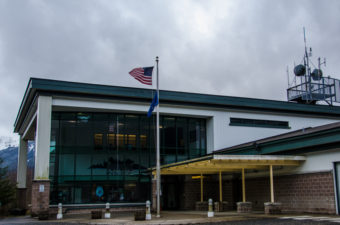
The pursuit eventually ended near where police reported it began. Police say Yeisley returned to the Hospital Drive area, fled on foot inside SEARHC’s Ethel Lund Medical Center where he surrendered at Taser-point. Police are seeking four felony assault charges against Yeisley and a fifth felony charge for failure to stop at the direction of a peace officer.
The department cautioned that the details in its release were based on preliminary investigation and are subject to change.
Police are seeking witnesses and possible victims of Saturday’s spree of dangerous driving. Call police at 586-0600.
The Juneau Police Department says this is the vehicle involved in Saturday’s reckless driving spree across Juneau. (Photo courtesy Juneau Police Department)
The Juneau Police Department reports one of its officers used a Taser on a 23-year-old man wielding a machete on Thursday night.
According to a police news release, several incidents led to the use of force.
The man’s stepfather had reported a fight between his wife and the 23-year-old man, and locking the stepson, who was carrying a machete, out of a home in the area of Radcliffe Road and Berners Avenue.
Then, police received multiple reports from other callers in the area of the man threatening to damage property, including two cars parked at a business in the 9300 block of Glacier Avenue.
According to the release, when police confronted him, the man ran and at one point “tossed” the machete toward the police officers. An officer shot the man with a Taser, and he was taken into custody.
He was checked for minor injuries at the hospital and put in protective custody for treatment of a mental health emergency. Police are seeking charges for assault and criminal mischief. They did not name the man.
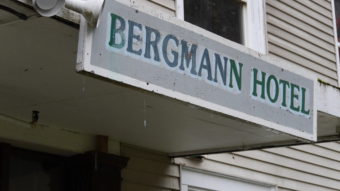
Brianna McCourt works the front desk at the Bergmann Hotel on Friday, Nov. 4. (Photo by Quinton Chandler/KTOO)
Brianna McCourt had a bad feeling when she walked outside the Bergmann Hotel and saw state troopers and police with their mobile command center at her doorstep.
“The mobile command center showed up and we’re like, ‘What’s really going on here,’” said McCourt, who works security at the Bergmann for a company called CPR Services that recently took over building management.
McCourt said when she got word the police were heading to the building, she thought the worst.
“It’s the Bergmann. I mean it’s been known for its riffraff and its drugs,” McCourt said.
Juneau police descended on the downtown housing development last Friday, but they didn’t come to make arrests. They wanted to help.
It’s not unusual for the police to be called to the hotel, but this time was different.
McCourt said the police weren’t alone.
“They came with the Department of Health and Social Services,” she said. “I believe that they had Front Street Clinic, and drug and alcohol treatment (officials to) speak with the residents that lived here.”
Residents got information on programs that could help them find work and opportunities to get counseling for substance abuse and mental health.
Service providers passed out sharps containers for safe disposal of used needles, and they gave her McCourts of Narcan – a medication that reverses the effects of an opioid overdose.
“Having sharp boxes in the bathroom and knowing that we have stuff to help people if we do run into an overdose is very helpful,” she said.
Boxes of Narcan given to employees of the Bergmann Hotel during a Juneau Police Department outreach effort on Friday, Nov. 4. (Photo by Quinton Chandler/KTOO)
Lt. Kris Sell with Juneau Police Department said their outreach to the hotel was part of a strategy to, once a month, give special attention to issues they’re especially worried about in Juneau.
“Part of the chief’s instruction for me is once a month he wants to know, ‘OK, what can we go do that’s a focused approach to some area or some problem?’” Sell explained.
The department has gotten a lot of complaints from people in the Bergmann’s neighborhood, Sell said.
“People that lived up there and people that worked up there were unhappy with noise and finding needles in the area,” Sell said.
She said not all of these problems were tied directly to the hotel, but it was the place people most often associated their complaints with.
Lt. Kris Sell of the Juneau Police Department speaks on A Juneau Afternoon, April 1, 2016. (Photo by Jeremy Hsieh/KTOO)
So Sell said JPD had a choice. They could have focused on one option: finding lawbreakers and arresting them, but they didn’t want to.
“Really, modern policing is also about, ‘How do you apply positive pressure so that you can work with the people that are having challenges and get them on a more law-abiding path so they can get along with their neighbors?’” Sell explained.
She said most of the residents were suspicious at first.
When they offered one guy help, he hesitated but eventually said he wanted a job.
“He probably asked two or three times before we introduced him with the gentleman from the job service if we were tricking him or if this was some sort of trap,” Sell said.
Some people turned them down flat, but most were receptive after they got over their surprise.
Brianna McCourt said it goes a long way when people from the community show up and say, “We want to help you.”
“I do sympathize with what the police and the community did today, with the outreach program,” she said. “It kind of shows people that there is help out there if you ask for it. A lot of problems a lot of times with being a recovering addict is you’re afraid to ask for that help.”
McCourt knows what she’s talking about.
She is in recovery right now for the second time.
She was sober for eight years before she relapsed. She said her drug of choice was methamphetamine.
She didn’t decide to get clean until she had a near fatal car accident this summer.
“I didn’t want to ask for help. I didn’t want to admit that it was indeed a problem,” McCourt said.
She admitted that it can be hard to help other people, especially addicts because they need to want to help themselves first.
But she said people shouldn’t turn anyone away if they do make the decision to help themselves.
Mental health advocates are expressing concern that the Alaska Mental Health Trust Authority is straying from its mission after the sudden resignation of its CEO, and several groups are calling for special audits of the trust.
Within days of the resignation of Alaska Mental Health Trust Authority CEO Jeff Jessee and allegations of Open Meetings Act violations by members of the Board of Trustees, four of the boards that advise the trust and look out for its beneficiaries have held special meetings calling for action.
The chair of the Governor’s Council on Developmental Disabilities and Special Education, Amy Simpson, attended last week’s trust board meeting and said the Trustees’ actions lacked transparency.
“It just appeared to me, just from the conversations between the trustees, that four members of the board were well informed of the discussion that was about to take place and three were not at all informed,” she said during a phone interview. “And that seemed odd and not very transparent to me.”
Simpson said her board is concerned with the legitimacy of the decision-making process.
Michael Horton with the Alaska Mental Health Board spoke during a joint special meeting with the Advisory Board on Alcoholism and Drug Abuse. He said the trust should have consulted its four advisory boards before taking drastic actions which could hurt beneficiaries.
“What happened was, I felt a little bit like an ambush,” he said. “And it’s not right that it be handled that way.”
The boards are asking Governor Bill Walker’s office to look into the trustee’s actions.
The Mental Health Board, the Advisory Board on Alcoholism and Drug Abuse, and the Governor’s Council on Developmental Disabilities and Special Education have all voted to support the call for a special audit of the Mental Health Trust. Former government officials have called into question the use of trust money for developing a mine and purchasing out-of-state property.
According to a statement by Walker spokesperson Grace Jang, “The governor’s office is taking seriously all of the concerns that have been brought forward. They are all currently under review.”
That includes concerns about potential Open Meetings Act violations, Jessee’s shifting role within the trust, and the need for a special audit of the trust. Jang said she does not know when any decisions will be made.
Jessee will remain CEO until the governor approves the change in leadership.
The Mental Health Trust has about $500 million in cash assets and manages a million acres of land. It serves approximately 73,000 people in Alaska who experience mental illness, developmental disabilities, chronic substance use, Alzheimer’s or traumatic brain injuries.
Editor’s note: KTOO’s building sits on land leased from the Alaska Mental Health Trust Authority. KTOO has also applied for and received occasional grants for special reporting projects from the authority.
Wade Rathke poses for a photo outside KTOO on Oct. 11, 2016. Rathke is an activist who founded ACORN and is president of the board of the Juneau-based Mental Health Consumer Action Network. (Photo by Jeremy Hsieh/KTOO)
A fledgling Juneau nonprofit formed to advocate for mental health consumers began a membership drive and door-knocking campaign this weekend.
Mental Health Consumer Action Network founder Greg Fitch said this follows the organization’s first official board meeting earlier this month, and getting MCAN’s charitable tax status and other organizational business in order.
MCAN’s new board president Wade Rathke has decades of experience with theonce-infamous organization ACORN International, which he founded in 1970. The progressive group has had its scandals, some real, some bogus, but that’s old news now. Rathke still works with many nonprofits and lives in New Orleans — he’d worked with Fitch at ACORN there in the ‘90s — but was recently in Juneau for the first board meeting and discussed his role and aspirations for the new organization.
Rathke said he hasn’t had mental health issues himself, but, “I think it’s important that people build an organization to give them voice and to allow them to empower themselves around their own grievances and issues to be able (to) act. Mental health consumers over the last, you know, 50 years … are people who’ve been marginalized without a voice in many cases.”
He said organizing the marginalized is exactly what he’s spent his life doing.
“Part of what’s so true about mental health issues, people see it as personal, their own private concern,” he said. “And don’t realize there are other people who are struggling in some cases with the same thing who they could unite with and not only find support but collective cause.”
For a long time, he said society has treated people with mental health issues like a “crazy aunt in the closet.”
“And that’s not appropriate,” he said. “And to have people increasingly willing to talk about issues they’ve faced, how they’ve met those challenges, and how they could have met those challenges in a better way both for themselves and our whole society is a radical new thing, and that’s why I think it’s so exciting to see what MCAN is going to be.”
Rathke said he expects challenges recruiting potential members, who may perceive risk in outing themselves as mental health consumers. But, he’s optimistic.
In a year’s time, Rathke said he’d like to see MCAN with a stable membership in Juneau and possibly start expanding to Fairbanks and Anchorage.
Jeff Jessee addresses reporters at a press conference in the Capitol, March 17, 2015. He was the CEO of the Alaska Mental Health Trust authority at the time, but resigned Wednesday. (Photo by Skip Gray/360 North)
Some trustees of the Alaska Mental Health Trust Authority are alleging that their CEO’s resignation indicates violations of the Alaska Open Meetings Act.
Jeff Jessee submitted his resignation letter during a special meeting of the board of trustees on Wednesday afternoon.
Trust board chair Russ Webb said Wednesday that the transition was under discussion for several years, though an unofficial transcript of the meeting shows that several board members were surprised by the decision.
When asked why he was changing roles, Jessee, who was accompanied by the trust’s chief communications officer, began reading from his resignation letter.
“It is clear that a majority of the board of trustees believes that significant changes in the trust’s organization and efforts must be made to meet these challenges,” he read. “And they believe ‘these changes will require new perspectives and ideas to ensure that the trust can meet the needs of the beneficiaries well into the future.’”
When asked if he agreed with this position he responded, “Well, I believe it’s in the best interest of the beneficiaries, the trust and myself that I take a position within the trust where I can continue to serve the beneficiaries, which is why I got into this field in the first place.”
When asked if he felt the best position he could be in would not be as the CEO, he paused for several seconds and declined to comment.
Jessee will transition to a new role focused on programming, ahead of his planned retirement in three years.
The Mental Health Trust was created to fund comprehensive care for people with mental health illnesses and other disabilities. It is a state-owned corporation with cash and land assets that are managed by different state agencies.
If the governor’s office approves, Greg Jones, who formerly served as the executive director of the Trust Land Office, will serve as the interim CEO. The board of trustees voted 4-3 for the switch in roles.
During the meeting, Mental Health Trustee Laraine Derr alleged that other trustees were holding secret meetings about the future structure of the trust.
“You’re trying to move Jeff out of his job, and you don’t know where you’re going,” Derr is quoted as saying in the transcript. “I mean, I assume you probably do, because you guys have had enough meetings, secret meetings that we don’t know what’s going on. … Until yesterday, I didn’t know what you guys were doing. We have not been included. You’re trying to remove the CEO. … There are three of us sitting here that don’t know — that have never been involved in a meeting.”
Fellow trustee Jerome Selby agreed. Speaking by phone, he said he did not receive any information about the resignation before the meeting. There was not a board packet either.
“The motion that was read that accepted Jeff’s resignation appointed this person I’ve never heard of as the interim CEO, and then gave instruction to that new interim CEO to put Jeff in this new position — had never been discussed at any meeting that I’m aware of. Official meeting,” he said. “So how did it get to the meeting yesterday, all written out? There must have been a fair amount of discussion going on among those four people which violated the Open Meetings Act of the State of Alaska.”
The board has been openly discussing hiring someone to look at the organizational structure of the trust.
Selby said it’s a bad time to lose someone like Jessee in the CEO position, especially because of his experience advocating on behalf of trust beneficiaries in the legislature.
“I think it’s the worst possible time for him to resign, personally. We’re facing what’s probably going to be one of the hardest legislative sessions budget-wise in the state of Alaska.”
The trust was also recently criticized in a letter written by former Attorney General Bruce Botelho and former Commissioner of Natural Resources Harry Noah, both of whom were involved in establishing the trust in 1994.
In the letter, Botelho and Noah ask Rep. Mike Hawker and the Legislative Budget and Audit Committee to request a special audit because they believe the corporation is not following the statutory requirements for how its assets are managed.
They allege the board is taking money from the principal of the trust and using it to buy real estate instead of contracting with the Alaska Permanent Fund Corporation to manage the assets as is required by statute.
During the meeting, board chair Webb directed the board to discuss the letter at a later date, after they had fully read and understood it.
Jessee did not have any comments on the letter and said it was not part of the decision for him to shift roles.
On Wednesday, Webb called it a “separate and irrelevant issue” and said the allegations that others are managing the fund are “manifestly untrue.”
Selby, who was appointed to the board in February, said the concerns about the trust’s fiscal management need to be taken seriously and investigated.
“All of my red flags are waving at the moment,” Selby said.
Webb could not be reached for further comment. Jessee said he is not usually involved in revenue generation for the trust.
The exact details of Jessee’s new role and salary are yet to be determined. In 2015, he received more than $215,000 in compensation. He served in the position for 21 years.
Editor’s note: KTOO’s building sits on land leased from the Alaska Mental Health Trust Authority. KTOO has also applied for and received occasional grants for special reporting projects from the authority.
Close
Update notification options
Subscribe to notifications
Subscribe
Get notifications about news related to the topics you care about. You can unsubscribe anytime.