Mental Health

Update: Long-time CEO of Mental Health Trust Authority steps down

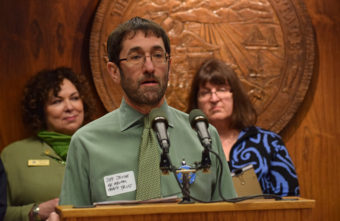
Alaska Mental Health Trust Executive Director Jeff Jessee tells reporters why he supports Gov. Bill Walker’s efforts to expand Medicaid at a press conference in the Capitol, March 17, 2015. Gov. Walker had just announced that he had introduced a bill that he hopes will lead to Medicaid overhaul and expansion. (Photo by Skip Gray/360 North)
Jeff Jessee tells reporters why he supports Gov. Bill Walker’s efforts to expand Medicaid at a press conference in the Capitol, March 17, 2015. He was CEO of the Alaska Mental Health Trust Authority at the time, but left the position on Wednesday. (Photo by Skip Gray/360 North)

The CEO of the Alaska Mental Health Trust Authority resigned on Wednesday and will take on a different role in the organization. Jeff Jessee served in the position for 21 years. He will be transitioning to a new role focused on programming ahead of his planned retirement in three years.

In a phone interview Wednesday evening, Jessee and trust board Chair Russ Webb said the transition has been under discussion for several years.

They said the primary reason for the change was so the trust could shift efforts to focus on raising revenue for its beneficiaries and programs.

Jessee said he is better suited to focus on programming, not managing financial assets.

Greg Jones, who formerly served as the executive director of the Trust Land Office, will serve as the interim CEO while the board recruits a new CEO.

The Mental Health Trust was created to fund comprehensive care for people with mental health illnesses and other disabilities. It is a state-owned corporation with cash and land assets that are managed by different state agencies.

The trust was recently criticized in a letter written by former Attorney General Bruce Botelho and former Natural Resources Commissioner Harry Noah, both of whom were involved in establishing the trust in 1994.

In the letter, Botelho and Noah ask Rep. Mike Hawker and the Legislative Budget and Audit Committee to request a special audit of the trust because they believe the corporation is not following the statutory requirements for how their assets are managed. They allege the board is taking money from the principal of the trust and using it to buy real estate instead of contracting with the Alaska Permanent Fund Corp. to manage the assets as is required.

The Oct. 22 letter indicates copies were sent to both Webb and Jessee.

Jessee and Webb say they have not seen the letter or read it in full, and it did not play a role in Jessee’s decision to resign.

Webb called it a “separate and irrelevant issue from today’s decision” and said the allegations that others are managing the fund are “manifestly untrue.”

The exact details of Jessee’s new role and salary are yet to be determined.

In 2015, he received more than $215,000 in compensation.

Editor’s note: KTOO’s building sits on land leased from the Alaska Mental Health Trust Authority. KTOO has also applied for and received occasional grants for special reporting projects from the authority.

This story has been updated and expanded. Additionally, the day Jeff Jessee stepped down has been corrected. He resigned Wednesday, not Monday.

Local attorney Kirsten Swanson appointed Juneau District Court judge

Gov. Bill Walker announced Tuesday that Juneau private attorney Kirsten Swanson will be the new Juneau District Court judge.

Ten people had applied to replace Judge Keith

Kirsten Swanson
Kirsten Swanson (Courtesy of Alaska Judicial Council)

Levy, who’s retiring at the end of October.

The district court’s jurisdiction includes municipal ordinances, misdemeanor crimes, underage alcohol and tobacco violations, and civil cases when less than $100,000 is at stake.

According to Swanson’s application materials, she is a former U.S. Army captain and judge advocate general officer.

She’s lived in Juneau for 17 years and practiced law for 20. She said she’s gone to trial 60 times.

Her legal website says she specializes in fish and game violations, federal Lacey Act cases, and federal conspiracy and military cases.

Swanson could not be reached for comment, but in her application, she wrote she’s a big supporter of the therapeutic and mental health courts, which offer treatment-based alternatives to incarceration.
“Many people who appear in District Court are chronic alcoholics, drug addicted, mentally ill and homeless,” she wrote. “These populations have additional issues that are difficult for the court to address. I am open to looking at possible new ways to address some of these issues.”

In addition to her private practice, she’s worked in the state Public Defender’s Office and in the Department of Law on natural resources cases.

While she was in law school, she worked in an Oregon correctional facility booking prisoners.

In a news release, Gov. Walker said Swanson’s vast experience as a public and private lawyer will serve Southeast Alaska well.

District court judges in Juneau earn salary of $165,852.

Group working to bring remains of 15 Alaska Natives home from Carlisle

Henry Phillips, originally "Ka-Ka-Ish," was 12 years old in 1887 when he arrived at the Carlisle Industrial Indian School in Pennsylvania. His student file says he arrived from the Presbyterian Mission in Sitka, though both of his parents were still living. He returned to Skagway to work as a printer at the Daily Alaskan newspaper. (Public Domain image from National Archives and Records Administration)
Henry Phillips, originally “Ka-Ka-Ish,” was 12 years old in 1887 when he arrived at the Carlisle Industrial Indian School in Pennsylvania. His student file says he arrived from the Presbyterian Mission in Sitka, though both of his parents were still living. He returned to Skagway to work as a printer at the Daily Alaskan newspaper. (Public Domain image from National Archives and Records Administration)

The remains of 15 Alaska Natives may soon journey home from the Carlisle Industrial Indian School in Pennsylvania. A small group of people working with the U.S. Army and the First Alaskans Institute have authored a resolution they hope to see passed at this year’s Alaska Federation of Natives convention in Fairbanks.

While the resolution is focused on students of the past, there is still concern for potential future boarding school students.

Bob Sam says the Army wants to see the repatriation process completed in less than a year, and they’re going to foot the bill. Sam is confident it can be done, but points out that the Carlisle school is just one of many schools Alaska Natives were sent away to.

“This is just the tip of the iceberg, … Carlisle school is just the beginning,” Sam says. “It’s one of the first boarding home military-type schools in America and all boarding home schools used Carlisle as a model. Chemawa, Haskell, they all have their cemeteries.”

Sam has been helping repatriate human remains for 30 years. From a former tuberculosis sanitarium in Sitka to helping a friend recover his Ainu ancestor’s remains from a university in Japan — Sam has a talent for what he calls “bringing bodies home.” And he’s well-known in Southeast for his dedication to restoring old cemeteries. There was the Russian Orthodox cemetery in Juneau and another one in Sitka.

Sam is working with Nancy Furlow and Jim LaBelle Sr. LaBelle spent 10 years at the Wrangell Institute in Southeast Alaska. He says his time there was traumatic and he’s spent a lifetime working to heal from it.

Handwritten on the back of this image: Pupils from Alaska AS THEY ARRIVED AT CARLISLE IN THE FALL OF 1897 SEE REDMAN, JUNE 1899. (Public Domain image from National Archives and Records Administration)

There is little study on the history and impacts of residential schools on Alaska Native children. In a 2005 study by the Institute for Social and Economic Research at the University of Alaska Anchorage, 61 adults who attended boarding schools from the 1940s through the 1980s were interviewed. Some said they were abused. Others experienced no abuse and enjoyed school. And some said that while they weren’t traumatized by their school, they remember seeing abuse.

Some lawmakers see regional boarding schools, or even virtual schools, as a cheaper solution to education in rural Alaska. Former Gov. Sean Parnell was a strong advocate for regional boarding schools and included increased funding for them in education bills he sent to the legislature.

As time goes on, LaBelle thinks there will be more pressure to consolidate schools and increase support for residential schools.

Jim LaBelle, his wife Susan LaBelle and Bob Sam at the 2016 Elders and Youth conference in Fairbanks. (Photo by Jennifer Canfield)
Jim LaBelle, his wife Susan LaBelle, and Bob Sam at the 2016 Elders and Youth conference in Fairbanks. (Photo by Jennifer Canfield)

“Should this happen, there needs to be a process where communities and families participate at all levels of this discussion,” LaBelle says. “If there is eventually going to be a return to boarding schools in some parts of Alaska, at least it will be done in the way that respects the culture, respects the language, doesn’t provide for an institutional setting.”

And these schools should not be forced on rural communities, he says.

“There’s got to be a full participation process. In the days when I went, we had no choice. If you protested or objected, parents were sent to jail.”

Both LaBelle and Sam say there are a lot of issues for Alaska Native people that need to be resolved. Bringing home the remains of Alaska Native students at the Carlisle school in Pennsylvania is part of the process, Sam says.

“Once we resolve these issues, American Indians and Alaska Natives will go on to be the people that they were intended to be and they will begin to have some sort of forgiveness in resolving. But there’s another side to it,” Sam says. “The non-Native people who have guilt, they will begin to resolve their guilt so that they can go on to become the human beings they were intended to be. And we get to know each other doing these kinds of things together.”

The resolution is expected to be presented to delegates Saturday.

About the Carlisle Industrial Indian School

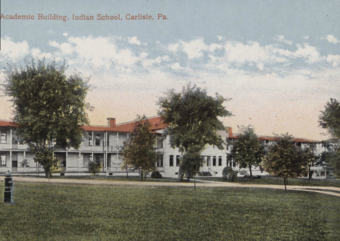
The caption on this artwork reads Academic Building, Indian School, Carlisle, PA. (Public Domain image from National Archives and Records Administration)

The Carlisle Industrial Indian School was founded in 1879 in Pennsylvania by an Army officer who believed that the federal government was holding Native American people back by segregating them.

The word “racism” is believed to have first been uttered by Richard Henry Pratt, who founded the school.

At an annual conference in 1896, Pratt said: “Segregating any class or race of people apart from the rest of the people kills the progress of the segregated people or makes their growth very slow. Association of races and classes is necessary to destroy racism and classism.”

Pratt believed Native people were intended to be inherently equal to European-Americans, they just needed to be civilized.  

“It is a great mistake to think that the Indian is born an inevitable savage. He is born a blank, like all the rest of us,” Pratt said in a speech at an 1892 convention. “Left in the surroundings of savagery, he grows to possess a savage language, superstition, and life. We, left in the surroundings of civilization, grow to possess a civilized language, life, and purpose. Transfer the infant white to the savage surroundings, he will grow to possess a savage language, superstition, and habit. Transfer the savage-born infant to the surroundings of civilization, and he will grow to possess a civilized language and habit.”

Operating throughout the height of the Progressive Era until 1918, more than 10,000 attended the school. The school’s foremost goal was assimilation of its students. English was the only language allowed to be spoken. In the dorms, no two students from the same tribe were allowed to live together. Students were made to pick out new English names. Boys were required to cut their hair. The phrase, “Kill the Indian, save the man” — Pratt coined that, too.

Correction: Earlier versions of this story misstated when the resolution will be presented to the AFN delegates. It’s expected to be presented Saturday.  

GCI announces $100,000 in donations to suicide prevention efforts

Alaska telecommunications company GCI has announced $100,000 in donations to support nine suicide prevention efforts across the state.

Two village organizations in the Yukon-Kuskokwim region will receive some of that money.

GCI’s Suicide Prevention Grant program partnered with the Alaska Community Foundation, which was established in 1995 as a grant distribution center, to administer the donations.

According to a news release Wednesday, GCI decided to launch their new program earlier this year in response to suicide rates in the state being twice the national average.

The Native Village of Paimute will get $15,000 for local leaders to attend training, and the Native Village of Tununak will get $9,500 dollars to fund more activities for youth in their village.

Organizers reviewed over 40 applicants through a strict review process; awards ranged from $5,000 to $15,000.

The goal of the grant program is to fund promising new programs, and to help successful programs reach more people in need.

At Golden Gate Bridge, Texting Offers New Lifeline To Prevent Suicides

Sitting next to the living room sofa, fully charged, is the cell phone that belonged to Kimberlyrenee and Manuel Gamboa’s son, Kyle.

“We’ve kept it on and I just think his friends, it helps,” Kimberlyrenee says. “Well it helps us to heal and I think it helps his friends to heal.”

So they can see whenever one of Kyle’s friends sends a text.

“Yeah, and here’s another one that says, ‘Love you brother, I really don’t know what happened. I miss you, I wish you were here.’ And that was June 2,” she says.

It’s been three years since the 18-year-old high school senior skipped school, drove to the Golden Gate Bridge and jumped.

New prevention strategy

The number of people younger than 25 showing up at the bridge intending to commit suicide is five times what it was in 2000, according to officials. On average, two to three people jump each month. Bridge and California Highway Patrol officers stop most of them, but they still need more help.

Each time the Bridge Board holds a public meeting, the Gamboas show up to demand the board install a suicide net — a big, expensive project that keeps getting delayed.

But, at a recent meeting, the Gamboas learned of the bridge’s new prevention strategy: the crisis text hotline.

“I’m all for it,” Manuel says.

It’s not the the ultimate solution, he says, but Manuel does believe that text messaging is a very big part of the young community. So now there are signs on the bridge urging anyone considering suicide to text the number 741741.

Texting is easier

In the dining room of her San Francisco apartment, Ellen Kaster is answering texts to the hotline, which come in from all over the the country. She’s a volunteer with the suicide prevention network called Crisis Text Line.

“Right now I have a texter who has struggled with drug addiction and has gone through phases of being clean and relapsing,” she says.

The texter tells Kaster he feels suicidal. This is a code orange, which means her supervisor — a social worker — has now joined in to monitor the conversation. They’ll call police if the suicide threats intensify.

Kaster says for many, texting these emotional conversations is easier.

“It can feel very vulnerable, especially for the younger generation to actually dial a real phone and talk to somebody, so there’s something very impersonal about text that’s very natural,” she explains.

‘Just give tomorrow a chance’

When a suicide threat is texted from the Golden Gate Bridge, the hotline counselors contact the bridge patrol. That team, which is constantly on the lookout for people who might be suicidal, is led by Capt. Lisa Locati.

“The ages here are just startling — 16, 22, 25,” she says.

In the bridge command center, Locati thumbs through a binder full of printed Facebook pages. These are people whose loved ones have called in, worried they might jump.

What really bothers Locati is how many are just kids who don’t have much perspective on life.

“They got a bad grade in class, broke up with their boyfriend or girlfriend,” she says. “There’s a lot of bullying going on in the age group.”

Locati says that can be devastating to some young people.

“You want so much to make the connection and convince this person that dying is not the answer, at least today,” she says. “Just give tomorrow a chance. So, yeah, it’s very exhausting.

Reach out, someone will answer

At the Gamboas’ home Kimberlyrenee says she doesn’t know whether her son Kyle would have reached out to the textline. But he was on his phone that morning.

“And his last contact was on Facebook, and he texted,” she says.

She hopes if Kyle’s friends will reach out to a phone he hasn’t answered in three years, maybe kids on the bridge will text for help, and someone will answer.

Copyright 2016 KQED Public Media. To see more, visit KQED Public Media.

APD: Signs of mental decline preceded suspect’s violent standoff

Ginami Street Home police standoff
Windows are broken at the home of Robert Musser on Friday morning off Upper Huffman Road on the Anchorage Hillside. Musser was found dead early Friday after keeping police at bay since Wednesday morning. (Photo by Erik Hill/Alaska Dispatch News)

A standoff between a SWAT team and 69-year-old veteran Robert Musser ended with Musser’s death early Friday morning after 42 hours.

Anchorage Police Department Chief Chris Tolley says around 3 a.m. responders discovered Musser’s body in his home. It was almost 15 hours after an exchange of gunfire that left two officers injured.

“It was unknown at the time whether or not Musser was injured in the shooting,” Tolley said.

Throughout Thursday afternoon and into the night, Tolley says there was no sign of Musser from inside his remote Hillside home. But Tolley declined to say whether he was killed by a bullet, saying the body has been sent to a state examiner to officially determine a cause of death.

Details from police suggest Musser was in a state of mental decline. In the last few months, Tolley says APD had made four welfare checks to the residence on the advice of concerned neighbors.

“Each time officers attempted to contact Musser he would yell through his window that he was fine, alive, and would demand our officers to leave,” Tolley said. “In one of the cases, the neighbors told officers that it appeared Musser was potentially experiencing some mental health issues.”

One of the reasons the standoff lasted so long was the difficulty officers faced accessing the house. Tolley described both the yard and the residence as crowded with “many, many items.” A team eventually entered the house by using armored heavy equipment, finally locating Musser’s body.

“It is not how we wanted this response to go. It’s absolutely heartbreaking when these events result in a loss of life,” Tolley said.

Because six officers discharged their weapons, the case is considered an officer-involved shooting and will be examined by the Office of Special Prosecutions. All six officers are on administrative leave. Tolley says the length and intensity of the event has left many in the department strained.

“This was a long ordeal, as well as a long week,” he said.

The standoff on the Hillside was one of just three in the municipality since Monday. One played out simultaneously for much of Thursday, finally ending in a surrender. Officials say they don’t have an explanation for the cluster of events.

Site notifications
Update notification options
Subscribe to notifications