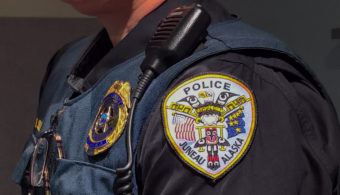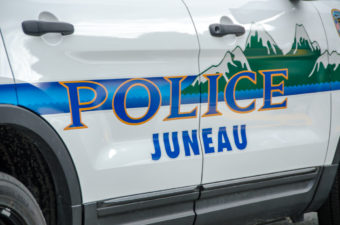
Police say a man wielding a knife in downtown Juneau on Saturday afternoon believed he was fighting off attacks from imaginary animals.
In a news release, the Juneau Police Department says they responded to reports of the 52-year-old Juneau man at 4:24 p.m. at the intersection of Main Street and Egan Drive.
Police say the man, who they did not identify by name, appeared to be under the influence of an unknown substance and to be having a mental health emergency.
Because of the knife, the responding officers had their guns drawn. The man complied with the officers’ orders and was taken to Bartlett Regional Hospital for treatment and substance abuse issues.
Juneau Police Department received a report at 4:24 p.m. Saturday, Sept. 3, about a 52-year-old man with a knife in the middle of the intersection at Main Street and Juneau Drive, according to a Juneau Police Department news release.
Officers responded to the report and contacted the Juneau man, who appeared to be under the influence of unknown substance.
He was having a mental health emergency, the report said.
The man said he was using the knife to defend himself from imaginary animals that were attacking him, the release said.
Officers had drawn their handguns because of the potential threat of the man with a knife.
Officers ordered the man to drop the knife, which he did.
He was then handcuffed and taken to Bartlett Regional Hospital for medical evaluation.
He was later admitted to the hospital for further treatment of mental health issues and substance abuse.
An inspection found that at one Los Angeles nursing home an employee took video of a co-worker “passing gas” on the face of a resident and posted it on Instagram. (Universal Images Group/Getty Images)
Editor’s note: This story contains language that some may find offensive.
Federal health regulators have announced plans to crack down on nursing home employees who take demeaning photographs and videos of residents and post them on social media.
The move follows a series of ProPublica reports that have documented abuses in nursing homes and assisted living centers using social media platforms such as Snapchat, Facebook and Instagram. These include photos and videos of residents who were naked, covered in feces or even deceased. They also include images of abuse.
The Centers for Medicare and Medicaid Services, which oversees nursing homes, said in a memo to state health departments on Friday that they should begin checking to make sure that all nursing homes have policies prohibiting staff from taking demeaning photographs of residents. The memo also calls on state officials to quickly investigate such complaints and report offending workers to state licensing agencies for investigation and possible discipline. State health departments help enforce nursing home rules for the federal government.
“Nursing homes must establish an environment that is as homelike as possible and includes a culture and environment that treats each resident with respect and dignity,” said the memo signed by David Wright, director of the CMS survey and certification group. “Treating a nursing home resident in any manner that does not uphold a resident’s sense of self-worth and individuality dehumanizes the resident and creates an environment that perpetuates a disrespectful and/or potentially abusive attitude towards the resident(s).”
CMS said that nursing homes have a responsibility to protect residents’ privacy, to prohibit abuse, to provide training on how to prevent abuse and to investigate all allegations of abuse. If homes fail to do so, they can face citations, fines and theoretically even termination from the Medicare program.
Also last week, Sen. Charles Grassley, R-Iowa and chairman of the Senate Judiciary Committee, called on other federal agencies to take action on the problem. He sent letters to the Department of Justice and to the Office for Civil Rights within the Department of Health and Human Services asking whether “rules and protections are in place to prevent and punish these types of abuses.” He also has sent letters to social media companies, calling on them to pay more attention to this. The Office for Civil Rights is working on its own guidance related to social media but hasn’t released it yet.
In a statement to ProPublica, Grassley praised the new CMS memo. “This guidance is welcome and necessary,” he wrote. “Nursing homes are obligated under the law to keep their residents free from abuse. Exploitation on social media is a form of abuse, and the agency memo makes that clear. We need to prevent it, and we need to punish it when it happens.”
ProPublica has identified 47 instances since 2012 in which workers at nursing homes and assisted-living centers shared photos or videos of residents on social media networks. This includes three discovered in recent weeks. At one Los Angeles nursing home, an employee took video of a co-worker “passing gas” on the face of a resident and posted it on Instagram, according to a May inspection report.
“An interview was conducted with Resident 1 and the resident stated that facility employees pass gas in his face as often as every month,” the report said. One employee resigned and a police report was filed.
While some states have taken harsh steps against nursing homes at which social media abuse occurs, other states have not. We reported last month that Iowa health officials recently discovered it wasn’t against state law for a nursing home worker to share a photo on Snapchat of a resident covered in feces because his genitals weren’t visible. Officials are trying to change the law when the Iowa Legislature reconvenes early next year.
The federal government memo sets uniform standards for how such abuse should be written up by inspectors and the severity of sanctions that should be levied. In the past, there was great variability.
Last month, the industry’s trade group issued its own suggestions for dealing with such situations, encouraging training and swift responses by these facilities when allegations are brought to light. The group also is holding training events around the country. While many facilities ban the use or possession of cell phones by employees when in resident areas, some have also found such rules impractical to enforce.
Greg Crist, a spokesman for the American Health Care Association, the trade group, said the CMS memo dovetails with the industry’s effort to stop social media abuse.
“The two words in that CMS directive that stand out most to me are ‘privacy’ and ‘responsibility,’ ” Crist wrote in an email Monday. “That’s why we have taken responsibility and made a concerted, nationwide effort to educate and share best practices with our centers not only on how to detect and root out this abuse, but also proactive steps to ensure it doesn’t happen in the first place.
“It’s not an issue that is conquered overnight,” he wrote, “but every day, we get smarter about it.”
No one knows the challenges of living with a mental disorder better than someone who has been diagnosed with one. That’s the argument the founder of a new nonprofit made to explain why his organization will be effective helping improve life for the mentally ill, starting with housing in Juneau.
“I suffer from a mental illness and have for about 25 years,” said Gregory Fitch, the founder of the Mental Health Consumer Action Network, or MCAN. He has schizoaffective disorder, “Which is minor schizophrenia, I also have bipolar and I have what’s called borderline personality disorder.”
“I got together and started to realize that maybe we need to come together as a people to have our voices heard. That’s what MCAN is about. MCAN is about reaching the top level of policymaking, have our voices and concerns heard, so we can get better benefits from policies that affect us,” Fitch said.
He calls people who, like himself, suffer from mental illness “consumers.” He said the word is already widely used in mental health care and it reduces the stigma attached to the words “mentally ill.”
He first thought of starting MCAN eight years ago while working for another community organizer. He said his battle with mental illness slowed the process for getting MCAN off the ground, but recently he found himself in the right place and decided it was time.
“I got better on the right medications. It’s working and I said, ‘You know what? It’s time to do this.’ So we did it. We incorporated in April.” Fitch said. “Since then we have built a massive organization. We have a major president onboard who (was) the president of ACORN International, his name is Wade Rathke. He supports us. We have a local board of representatives here in Juneau.”
ACORN International is the organization Fitch worked for when he first imagined MCAN. A funding shortage and public embarrassment from an embezzlement scandal forced ACORN to disband in 2010 after 40 years of activism.
MCAN founder Gregory Fitch on Friday at KTOO. (Photo by Quinton Chandler/KTOO)
Fitch is not a registered lobbyist yet. Under State law, he doesn’t have to register until he gets paid. His first goals on MCAN’s list are to educate people on the issues the mentally ill face and to offer a solution to one of their biggest problems – housing.
Dominic Smith is helping Fitch launch MCAN. He’s also a consumer. He said he has a slew of diagnoses starting with clinical depression and attention deficit disorder.
“I have generalized anxiety disorder. I have panic attacks, sometimes they can be minor and it’s just, you’re irritated, agitated and people think you’re just a jerk. They think you’re angry and violent, but I’m not a violent person,” Smith said.
Also on his list are post-traumatic stress disorder, seasonal affective disorder and insomnia.
“The big thing is when I have anxiety or a panic attack, I cannot function. Sometimes I cannot even breathe,” he said, his voice starting to shake. “Sorry if I get emotional but it’s even been so bad that I have flashbacks to my childhood.”
Smith said he came from Wisconsin after years of saving and planning his move to Juneau. He said he came to town with a place to live, but he was accused of stealing a laptop and had to leave.
“And it turns out that next evening they found their computer,” Smith said.
He lived in hotels for a while, then he started camping in the woods and he said he’s not the only one.
“I have many friends that live in boats, people that live in cars and people that just live in the woods like I do,” Smith said.
Recently he found a place to live but he was camping out long enough to get acquainted with the challenges of homelessness. He said multiple items were stolen from him and he was barred from entering businesses because he looked homeless.
Fitch believes MCAN will be able to help other consumers like Smith so, even if they hit a rough patch, they won’t have to sleep in the woods.
“Possibly a shelter situation for the consumer, by the consumer. We’d like to see the mental health community involved in this definitely. This is a long-term goal of ours,” Fitch said. “We’d like to possibly break ground on this within a year.”
Fitch said MCAN will find a headquarters in a few more weeks and then they’ll start making headway. He said they’re serious, that in four months they went from an idea to a social welfare nonprofit, securing support from community members, state legislators and Gov. Bill Walker.
A “Łuq’a Nagh Ghilghuzht” sculpture by Joel Isaak depicts traditional Dena’ina life at fish camp outside the Kenaitze Indian Tribe’s new Dena’ina Wellness Center in Old Town Kenai. (Photo by Patrice Kohl/Redoubt Reporter)
Alaska got a glowing report in a checkup from a top federal health care official. Though there are issues that need further treatment and support, communities showed a healthy dose of innovation in delivery and integration of care.
Mary Wakefield, acting deputy secretary for the U.S. Department of Health and Human Services, toured Alaska from Aug. 1 to 4, visiting Barrow, Fairbanks, Circle, Anchorage and Kenai. But she wasn’t bringing a prescription from Washington. Instead, she got ideas for the treatment of health care in rural communities that can be brought to other areas of the country.
“I’ve seen some phenomenal examples of Alaska Native and American Indian communities that are really focused on comprehensive services that are delivered effectively and very efficiently on behalf of their communities. So there’s some wonderful examples to draw from this state and from these communities and try to think about how we might apply some of these examples in other parts of the United States,” Wakefield said.
HHS provides funding for a wide range of community services. A big part of the department’s presence in Alaska is through Indian Health Services, which funds facilities and programs administered through Native tribes throughout the state.
During her visit to Kenai on Aug. 4, Dr. Wakefield toured the Kenaitze Indian Tribe’s Head Start program, elder center, tribal court and Dena’ina Wellness Center, which offers medical and dental care, behavioral health services and a wide variety of general health and wellness programs. The center provides care to Alaska Native and American Indian people. Behavioral health services are available to anyone in the community.
Jaylene Peterson, executive director of the Kenaitze Tribe, says it was an honor to meet with Dr. Wakefield.
“This is an unprecedented visit. It was an amazing time that we were able to share with the deputy secretary, and we were able to show her what we’ve been able to accomplish with funds that have not always met the true need. So we’ve been blessed by this trip. I believe that she has learned much about the Alaskan community and why things are so different and more challenging here in an Alaskan setting,” Peterson said.
Peterson hopes the visit will help remove some stumbling blocks that come with HHS funding. She says that some of the reporting and training requirements can be onerous.
“I don’t disagree that we should be accountable for the funds that we receive, but sometimes it can be a lot more than should be required. So, there are ways that I believe that we can be smarter with our money,” Peterson said.
Primarily, though, the tribe wanted to show its holistic approach to health care.
“It’s just phenomenal. The leadership, the commitment, the approach that is innovative in terms of the integration of a wide range of services on behalf of the people who are served here is absolutely exceptional,” Wakefield said.
Before her trip to Kenai, Wakefield participated in a summit in Wasilla on opioid abuse.
“It is an absolute epidemic in every state the across the country, including right here in Alaska. And there are some pretty serious problems in communities within the state that are really adversely impacting families and putting special burdens on law enforcement, (and) special burdens on health care providers,” Wakefield said.
She says the Obama Administration is focusing efforts on making sure health care providers have the clinical skills necessary when prescribing opioids, closing the gap between people who want treatment and access to that care, and making sure people who have overdosed have immediate access to life-saving medications.
Among its many social services, the Kenaitze Tribe offers a chemical dependency recovery program.
A mountain peak rises above the Tongass National Forest northeast of Sitka Aug. 3, 2016. (Photo by Ed Schoenfeld/CoastAlaska News)
A bill before Congress would speed a timberland trade between the federal government and the Alaska Mental Health Trust. It’s part of a larger legislative effort to increase logging in the Tongass National Forest.
Grants go toward counseling, housing, employment and other assistance to those with mental illnesses, developmental disabilities, chronic substance abuse and dementia.
It owns a million acres, about a quarter of it in Southeast.
Wyn Menefee of the trust lands office said it wants to exchange a little more than 18,000 of those acres that face opposition to development.
“Certain lands that we own next to the communities would be given to the Forest Service. In exchange, the trust [would be] receiving some lands that are more removed from the communities, that would allow development,” he said.
The land is in or near Ketchikan, Juneau, Petersburg, Wrangell, Sitka and Meyers Chuck, on the mainland between Wrangell and Ketchikan.
“Some of the parcels that the trust has already received — above Mitkof Highway near Petersburg and Deer Mountain in Ketchikan — are very high-value public-use areas. And there’s been a lot of concern about their development,” he said.
In return, the trust would get about 21,000 acres of timberlands of equal value elsewhere in the Tongass.
Menefee of the trust lands office said the acreage would be near a different part of Ketchikan, and on Prince of Wales Island.
The Tongass National Forest includes most of Southeast Alaska. (Image courtesy U.S. Forest Service.)
“By making land that we can actually use for timber harvest or for some other purpose available to us where we don’t have conflicts with cutting behind a community or something like that, that does make the asset available or the land available and the resources available for us to use for financial benefit,” he said.
SEACC’s Lindekugel said some listed parcels on or near Prince of Wales should not be part of the trade.
He calls one a wild and scenic river corridor near the El Capitan Lodge, off the northwest part of the island. Another is a cave-rich parcel near the small town of Naukati that includes a cavern that may have cultural value.
But he said he’s optimistic those will be replaced.
“So far the trust has been willing to work with folks to avoid those areas of high conflict and we’re hoping that we’re able to continue and resolve those issues,” he said.
The mental health trust and the Forest Service negotiated the land swap about a year ago. It’s already working its way through the bureaucracy.
The trust’s Menefee said the trade, and subsequent timber sales, would allow more than income for the trust. He said it will provide logs for the region’s mills, which owners say don’t have enough to continue operations much longer.
“In order to make this exchange happen in a reasonable time frame, it needs legislation. Because if you do it through the normal administrative process, it could be seven years or something like that before we get an exchange completed,” he said.
U.S. Sen. Lisa Murkowski filed the Alaska Mental Health Trust Land Exchange Act in late May.
“It was not a question of whether or not the exchange should move forward, but simply to the point of how are we going to assess the value,” she said.
The measure is one of a group of recent Murkowski bills meant to increase Tongass logging.
Another would create five new Alaska Native corporations, each with 23,000 acres of forest land to develop. Other provisions would allow two existing Native corporations to sell or swap property that’s been logged.
Sitka Conservation Society executive director Andrew Thoms said Murkowski’s bills will hurt the Tongass.
“If you look at all these pieces of legislation, there’s a huge potential for a lot of impacts to the remaining forests on Prince of Wales Island. And the potential for a lot of impacts to the high-value, salmon-producing watersheds around the Tongass that are in a state of protection that could be opened up by this legislation,” he said.
He’s particularly concerned about a provision allowing Sitka’s local Native corporation to sell 23,000 acres of land to the Forest Service. It’s in Admiralty Island’s Cube Cove.
“And now, in this situation, the government would buy back the lands that were logged? And Shee Atiká made a profit on them? It’s a strange situation,” he said.
Shee Atiká President, CEO and board chairman Ken Cameron said the Forest Service wants the acreage because it’s an inholding surrounded by a national monument.
“Congress has appropriated $4 million for the first phase of the acquisition, and the appropriation of the rest of the purchase price will be as government funds are available,” said a corporate press release. “The government’s reacquisition of Cube Cove is anticipated to proceed in installments as Congress appropriates funds for the purchase.”
The Forest Service isn’t commenting on the legislation, other than to say it will do Congress’s will.
“The bottom line is our actions will be guided by the legal mandates resulting from legislation,” said Tongass spokesperson Kent Cummins in an email.
SEACC has said proceeds from the sale would allow the corporation to purchase other federal land, possibly on Prince of Wales Island. But Cameron, who would not speak on tape, said its board has not decided what it would do with the proceeds.
The Sealaska regional Native corporation owns subsurface mineral rights at the Cube Cove property. Murkowski’s legislation would swap it for about 14,000 acres of forest on Prince of Wales Island.
“Sealaska identified potential lands to exchange at Lancaster Cove on Prince of Wales Island that are adjacent to other Native-owned lands. Some of these lands were originally considered in the Sealaska land entitlement bill,” said a prepared statement from the corporation.
“It said such a trade remains subject to negotiation with federal agencies.
A bill transferring about 70,000 acres of the Tongass National Forest to Sealaska passed Congress in 2014. It was described as completing the corporation’s land selections, but did not exclude further trades.
Close
Update notification options
Subscribe to notifications
Subscribe
Get notifications about news related to the topics you care about. You can unsubscribe anytime.