Mental Health

The Arctic Suicides: Your Questions Answered

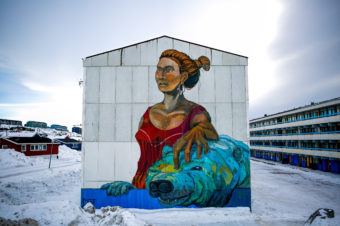
An artist's rendering of the Woman of the Sea, part of an Inuit legend, decorates an apartment block in downtown Nuuk, Greenland. Although Inuit culture was beaten down by Danish colonizers, it's now changing and thriving. John W. Poole/NPR
An artist’s rendering of the Woman of the Sea, part of an Inuit legend, decorates an apartment block in downtown Nuuk, Greenland. Although Inuit culture was beaten down by Danish colonizers, it’s now changing and thriving.
John W. Poole/NPR

Last week, NPR published a special report on suicide in native Arctic communities. Reporter Rebecca Hersher spent 10 weeks in Greenland, the Arctic country with the highest known suicide rate in the world. It’s 82.8 suicides per 100,000 people each year — six times higher than the U.S. suicide rate. She interviewed Inuit people in the Greenlandic capital, Nuuk, and in small towns on the country’s remote east coast. She spoke with community leaders and mental health professionals who are trying to prevent suicide and come to terms with its underlying causes.

Here, Rebecca Hersher answers some of your questions around the series.

The headline, “The Arctic Suicides: It’s Not The Dark That Kills You,” makes it clear that people don’t kill themselves because of the dark. So is it the cold?

A lot of people asked this. Honestly, when I started reporting this story, I asked this question, too. The dark and cold seem like natural culprits for the high suicide rate in Arctic communities. In a lot of Greenlandic towns, the temperature stays well below freezing for six months or more, and, depending on how far above the Arctic circle you are, the sun doesn’t come up for weeks and weeks in the winter. But when it comes to suicide, cold and dark are just not the problem, or at least they’re not the main problem (one can never truly know why any one person kills himself or herself).

In Greenland, and in other parts of the Arctic, there is a suicide “season” — a time when the most people die by suicide. It’s well known among public health officials and priests and teachers and other people who professionally worry about people in the community. The suicide season is spring. When the dark and the cold finally lift, and the sun is up and the ice is melting. That’s when people end their lives. It’s not the dark or the cold. It’s something a lot more complicated (which you can read about here).

A visitor rows an inflatable dinghy loaded with fresh water to a small dock at the old settlement of Kangeq, Greenland. The village was officially shut down by the Danish government in the 1970s, and its residents were moved to a concrete apartment block in the capital city. John W. Poole/NPR
A visitor rows an inflatable dinghy loaded with fresh water to a small dock at the old settlement of Kangeq, Greenland. The village was officially shut down by the Danish government in the 1970s, and its residents were moved to a concrete apartment block in the capital city.
John W. Poole/NPR

I’m very curious about why there was no mention of suicide among young girls/women. Do the suicides only involve boys and men? It seems like there should be some mention of this issue.

In Greenland, and in almost every part of the world, men kill themselves at higher rates than women. In Greenland, the majority of suicides are among men and boys, so we chose to focus on men in our story. In the U.S, the suicide rate among men is about three times higher than among women, and middle-aged white men are at the greatest risk. There are many potential reasons for this — the number of men who own guns is much higher than the number of women, and many men exhibit more impulsive or violent behavior than females. However, the suicide rate doesn’t tell the whole story. According to lots of studies, the most of recent of which came out this month from the CDC, women experience suicidal thoughts at least as frequently as men do, and perhaps even more so. Although they do not die by suicide as often, women certainly struggle with the idea of suicide, and the rate of death by suicide among women is climbing. In Greenland, the trend is similar. The suicide of a high school girl in Nuuk in December sent shudders through the capital, and in the last five years, the rate of suicide among young women has been climbing. Last year, Greenland’s National Board of Health noted that suicide prevention efforts should focus on both men and women, especially those under 25 years old.

It sounds like the Inuit culture in Greenland has been beaten down and demonized since colonization by Denmark began in the early 1900s. Are there any efforts to preserve Inuit culture?

Absolutely. Despite the twentieth-century pressure cooker of rapid modernization plus colonial racism, modern Inuit culture in Greenland is rich and complex. Part of that comes from Greenland’s increasing independence from Denmark. Most people in Greenland are Inuit — it’s about an 80 percent majority of the 56,000 person population. And starting in 1979, the government in Nuuk has taken on more responsibility for governing the largest island in the world, including public health and education. The official language of Greenland is West Greenlandic, and there is an entire agency devoted to bringing that native language into the modern era by adding vocabulary and standardizing spellings. There are new Greenlandic museums telling the history of the Inuit people. As of last year, Greenland’s first official art historian is in charge of the national art gallery in Nuuk, and the Inuit Circumpolar Council, an advocacy group for Inuit people around the Arctic, represents the interests of Inuit people at the United Nations.

Not only is Inuit culture being preserved in Greenland, it’s thriving and changing and becoming something new and modern. There’s even a smartphone app in the works for translating from Greenlandic to English.

Anda Poulsen plays the traditional Inuit drum and sings the old songs by the ocean in Nuuk. A family therapist, he started a support group for parents who had lost a child to suicide. Courtesy of Anda Poulsen
Anda Poulsen plays the traditional Inuit drum and sings the old songs by the ocean in Nuuk. A family therapist, he started a support group for parents who had lost a child to suicide.
Courtesy of Anda Poulsen

What about suicide in other native communities?

Suicide is a big problem in native communities around the world. In the circumpolar region alone — from Greenland through northern Canada into Alaska and across the Bering strait in the destitute Russian region of Chukotka — thousands of native communities struggle with very high suicide rates as well as alcoholism and child neglect. Just this month, the Attawapiskat First Nation in northern Ontario, Canada, declared a state of emergency after 11 people attempted suicide in one night.

Farther south, the situation is just as dire. Aboriginal people in Australia and New Zealand have had high suicide rates since their communities were disrupted by conquest or colonization. In the U.S., the suicide rate among American Indians age 18 to 24 is about three times higher than the rate in the general population. In some native communities in the U.S., the suicide rate is even higher than it is in Greenland. For example, among Alaska native men 15 to 24 years old, the suicide rate is about twice that of Greenland’s.

Is there any joint work between Greenland, Canada and Alaska to address the issue?

There are a lot of joint public health and suicide prevention programs. One, called the Resilience and Suicide Prevention Project, was developed in Canada. Beginning next year, the Greenlandic Ministry of Health will use it to build emotional resilience among community leaders and teach people how to recognize and react to suicidal behavior. The Arctic regions also collaborate to make mental health services more accessible. Like the towns of Alaska, Greenlandic towns are really isolated — you need a helicopter to get to most of them. Because the population is so spread out and hard to visit, and because in both Alaska and Greenland there are not enough psychologists, therapists and psychiatric nurses, it’s hard for people to get face-to-face care. For about five years, Greenland has been using a telemedicine system developed in Alaska, which puts patients in touch with doctors via video link. Doctors and patients I spoke with think the system is a vital addition to hospitals in remote parts of the country, but almost everyone acknowledges it has some limitations. Patients with chronic or complicated problems are evacuated to larger towns for care.

How can we help?

Suicide is a problem in every community. You can help the people in your life by listening and educating yourself about the professional resources available for people who are struggling with suicidal thoughts.

This Q&A with psychologists explains what to say if you’re worried about someone, and what specific questions you can ask a young person who seems depressed.

and sled driver approach a glacier outside Tiniteqilaaq. Victor Cerutti
and sled driver approach a glacier outside Tiniteqilaaq.
Victor Cerutti

Copyright 2016 NPR. To see more, visit http://www.npr.org/.

After Combat Stress, Violence Can Show Up At Home

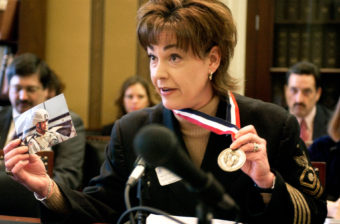
Stacy Bannerman testifies before the House Appropriations Subcommittee on Military Quality of Life and Veterans Affairs in 2006. Tom Williams/CQ-Roll Call, Inc./Getty Images
Stacy Bannerman testifies before the House Appropriations Subcommittee on Military Quality of Life and Veterans Affairs in 2006.
Tom Williams/CQ-Roll Call, Inc./Getty Images

Stacey Bannerman didn’t recognize her husband after he returned from his second tour in Iraq.

“The man I had married was not the man that came back from war,” she says.

Bannerman’s husband, a former National Guardsman, had been in combat and been diagnosed with post-traumatic stress disorder. He behaved in ways she had never expected, and one day, he tried to strangle her.

“I had been with this man for 11 years at that point and there had never been anything like this before,” Bannerman said. “I was so furious and so afraid.”

At first, she thought it was just a problem within her marriage. She called a hotline for military families to ask for help and learned something else she hadn’t expected.

“The woman operating the hotline began weeping,” Bannerman remembered. “She was getting so many of these calls from military spouses all over the country.”

The debate about the relationship between domestic violence and post-traumatic stress disorder waxed and waned since the invasions of Iraq and Afghanistan, but never quite went away. Headlines periodically reignite it, as when the son of former Alaska Gov. Sarah Palin, who is an Iraq vet, faced domestic violence allegations earlier this year.

When Stress Gives Way To Aggression

Veterans’ advocates are anxious about the stereotype of combat vets as ticking time bombs, which is contradicted by the vast majority of former troops who live with post-traumatic stress and never hurt anyone.

There is a link, however, between PTSD and violence, said Dr. Casey Taft, a top researcher with the Department of Veterans Affairs. Vets with PTSD are three times more likely to be violent, he said.

“When one is exposed to war zone trauma and combat trauma, they are going to be more likely to assume the worst and assume people are trying to do harm to them — and more likely to respond to that with aggressions,” he said.

For many sufferers of post-traumatic stress, the terror and adrenaline of a life-threatening moment won’t go away. When that builds into aggression, the target can often be a wife or girlfriend.

More than a third of women and about a fourth of men surveyed in the U.S. have experienced “intimate partner violence” at some point in their lives, according to public health statistics. Studies commissioned by the VA suggest those levels are about the same among active-duty troops and veterans, but more such research is ongoing.

Bannerman wrote a book about her experience, and says that today she hears from the partners of veterans almost every day. The stories tend to be similar.

“He was shrieking with his eyes open. And I went to shake him. He grabbed my and wrist and twisted it … I knew my wrist was broken,” one woman told NPR. “I took myself to the emergency room.”

Another woman described how her husband shoved her down just after her son was born, ripping open the scar from her cesarean section.

A third woman found that her husband would sometimes just “go blank,” she said. “You could see that he wasn’t there.”

The three women, all of whom are full-time caregivers to disabled combat veterans, talked with NPR about their experience after requesting they not be identified in order to protect their privacy and discuss it frankly.

They described, among other things, the shock they felt at how different their husbands proved after they came home from their deployments.

“It really took me by surprise,” one said. “It was completely out of his character for the man that I met and fell in love with.”

The women described how, initially, they began covering for the men. The woman whose childbirth surgery scar was torn told doctors in the hospital’s emergency department that she had tripped over their dog and fell.

“I’ve never given the ER the correct info,” said another woman about her many hospital visits.

Caregiving Burdens

Victims of domestic violence have many reasons for staying in their relationships. In the military, there are more reasons – reporting abuse can end a soldier’s career badly, which can means not only disgrace but no benefits for the family.

Some of the women who talked with NPR also said they thought that their husbands could get better with time and help.

“I wanted to keep my family together,” one said. “We had three kids at this time. I didn’t want his career to be over because of this – if I could just get him the help that he needs.”

Serving as the caregiver for a wounded vet can also be its own full-time job, with a stipend from the VA. For women in an abusive situation, leaving can also mean leaving behind that source of income.

“He would still have his pay every month,” as one wife told NPR. “He wouldn’t have to worry financially. If I were to walk out? I walk out with nothing. No job. I haven’t been working since 2012.”

All three of the women who spoke with NPR said they wanted to stay, to help their husbands recover from war. They went into their relationships with their eyes open, they said, and felt that caring for their sometimes violent husbands was its own form of service to the country.

“I thought, ‘This is my job,'” one said. “He went and did his job, and this is mine. That’s a prevalent thought among the wives of wounded soldiers. I see it all the time.”

Most veterans with post-traumatic stress are not violent, but the VA is focused on researching those who are. One thing that’s clear is that abuse of drugs and alcohol make the problems worse. Taft has set up a pilot program to try to help prevent domestic violence.

One challenge, however, is that the VA is focused on veterans, not their wives. And veterans’ groups don’t talk much about domestic violence – and most domestic violence groups don’t have expertise about veterans and post-traumatic stress.

So even with the commitments and the patriotism that some wives express about riding out rough times with their families, the silence and the lack of support can still break a marriage.

One of the women who talked with NPR eventually left her husband after an incident that she said forced her to take a new perspective about her family.

“He had shoved me down. I looked up and all three of my kids were standing there in tears,” the woman told NPR. “I thought, ‘If a man ever treats one of my girls like this, or my son ends up like this, I will never forgive myself.’ ”

Her husband wasn’t changing her behavior, she realized – “so I have to be the one who does something. I picked up the phone and I called the police. That was the first time I ever called them.”

Another woman interviewed for this story moved with her family to a different state, where her husband found better results with the local VA.

“He’s come around,” she said. “He’s started to become more the man I met and fell in love with. There hasn’t been any sort of physical alteration since 2014.”

The third woman who talked with NPR left her husband briefly, but she decided to go back. But the problems came back too.

“I haven’t regretted anything,” she said. “Have there been really hard times since then? Yeah. Have I gotten the s*** kicked out of me since then? Yeah.”

The woman helps her husband, a Marine combat vet, get to his VA appointments on time. He has cut down on his drinking and attended a Christian retreat for veterans. Even so, there’s no telling when something will come along that can create a potential crisis, as when the GPS navigation device in the car won’t work.

He hasn’t hit her since last year the woman said, when her husband smashed her face in the shower and choked her. It was over something the former Marine acknowledged was “something very stupid. A lot of these things, I can’t remember what I was so pissed off about.”

The couple was asked whether they felt they’d made it out of the woods.

“No, not even close,” the former Marine said.

“And we never will be,” his wife said.

The woman acknowledged that people urge her to leave the relationship, but she told NPR that she is staying. She does blame anyone else who leaves a situation like hers, but she said she was staying with her husband.

“He is not his post-traumatic stress disorder,” she said. “He is not his brain injury. These are things he has gotten from serving his country. And that is what we deal with.”

Copyright 2016 NPR. To see more, visit http://www.npr.org/.

How Talking Openly Against Stigma Helped A Mother And Son Cope With Bipolar Disorder

LA Johnson/NPR
LA Johnson/NPR

It was December 2012 when the country learned about the massacre at Sandy Hook Elementary School, that left 20 children dead at the hands of 20-year-old shooter Adam Lanza.

After the shock and the initial grief came questions about how it could have happened and why. Reports that Adam Lanza may have had some form of undiagnosed mental illness surfaced.

The tragedy drove Liza Long to write a blog post on that same day, titled “I Am Adam Lanza’s Mother.” She wasn’t Lanza’s mom, but she was raising a child with a mental disorder.

Her 13-year-old son had violent rages on a regular basis. He was in and out of juvenile detention. He had threatened to kill her. She detailed all this in her essay that took off online.

Now, four years later, her son is speaking out too.

This week on For The Record: a mother, a son and life on the edge of bipolar disorder.

Eric Walton, Liza Long’s son, is now a 16-year-old high school sophomore in Boise, Idaho. After a series of misdiagnoses, he’s been diagnosed with bipolar disorder.

But four years ago, he didn’t know much about his condition.

“I knew that there were times when I would have rages, didn’t like them. I knew that I wanted them to stop,” Walton says.

Except he felt a loss of control in those moments. He describes the onset of these rages as a “blackout” of sorts.

“I would start getting angry,” he says. “Then it’s like being trapped inside a box inside your own head. It was like a television on the wall that shows you what you’re seeing. You can feel everything, but you no longer have the video game controller to control your own body.”

Walton’s mom says when Eric would get into those states, “he would express a lot of suicidal thoughts, and hearing him just say, ‘I want to die, I just want to end it.'”

Then, two days before the Newtown shooting, Eric Walton had another episode.

“It was a pretty eventful day, even for my rages,” Walton recalls. “I’d woken up and I’d slipped on a pair of navy blue sweats. But my school has this policy that you have to be wearing black pants. So my mom and I got into an argument over whether navy blue was actually black.”

The fight got bad and it escalated as it often did. Eric threatened to kill himself, and he threatened to kill his mom.

“At that point, we were almost to my school, but mom decided to take me to Intermountain [Hospital] instead,” he says, referring to the mental health facility in Boise.

“It took I think three or four of the nurses to hold me down,” he says. “They shoved a needle into my arm full of some kind of tranquilizer. And I woke up the next day in Intermountain.”

That day left Liza Long feeling “completely hopeless.”

“I really felt like a failure on that day,” she says. “Here I had this child, he had seen multiple doctors, multiple specialists, numerous medications. Nothing had helped my child, he had been in juvenile detention four times at that point, every time for a behavioral symptom of a brain disease,” she says.

Two days later, the news broke out of Newtown.

“I just put my head on my desk and started to cry,” Long recalls. “I just had this overwhelming sense of empathy for Nancy Lanza. I know at that point people were already blaming her, but instead I could just see in my mind this little boy who probably had needed help.”

She started writing about how tough it was to be the single mother of four kids, one of them a middle-schooler struggling with mental illness, a kid who could violently rage one hour, and turn back into a calm, sweet boy the next.

Days after she posted the essay on her anonymous blog and millions of shares later, the Huffington Post picked it up — and then it was everywhere.

Three days after she wrote the piece, she visited her son in the hospital and read it to him off her phone.

“It was very powerful piece,” he says. “I had seen it as only from my point of view, but until that day, I hadn’t considered what it was like for someone outside, looking in.”

She got messages of support, but she also got criticism. People laid into her for comparing her son to a mass murderer, violating his privacy, and some suggested that she was somehow responsible for her son’s condition. It stung, but for the most part she pushed it away.

“Mother-blaming is as old as Eve though, right, it’s really easy for us to blame mothers, and that was exactly the point I was trying to make,” Long says. “Families are suffering in shame and silence; I was suffering in shame and silence. So is my child. But when we don’t share our stories, there’s no chance that we’re going to make change.”

That could have been the end of the story, but that blog post ended up changing everything for Long and Walton.

Long was inundated with emails, as readers continued to reach out to her.

“One person was very persistent, and she kept saying ‘I know someone who can help,’ ” Long says.

That person was a research assistant who worked for Dr. Demitri Papolos, director of research for the Juvenile Bipolar Research Foundation.

After meeting and talking with Walton and his mother, Dr. Papolos understood Walton’s symptoms. It looked like a particular strain of bipolar disorder.

“The symptoms that occur within the manic domain are hyperactivity, agitation, racing thoughts, pressured speech,” Dr. Papolos says. “In the bipolar form, you see psycho-motor retardation, lethargy, fatigue, oversleeping, depressed mood.”

“Mania feels really, really good,” says Eric Walton. “But it’s also not that good because when you start moving at that speed, no one can keep up with you.”

On the flip side of the disorder, “I go through 3-4 days of almost complete inactivity,” he says. “I’m kind of depressed and lethargic, and I don’t even want to get out of bed.”

“They are overwhelmed with fear and they misperceive things as threatening when they’re not,” says Dr. Papolos.

Those symptoms check out with Walton. “Any time I felt attacked. It was like a defense mechanism type thing.”

After Dr. Papolos diagnosed Walton with childhood bipolar disorder, everything got better.

“I got the correct diagnosis. I got put on the right medication. And I haven’t had a rage, I think, since that day,” Walton says. “It’s funny, I don’t even keep track anymore.”

But the road to pinning down the diagnosis is often the hardest part, especially for parents, who often have to become psychiatric advocates for their children.

“The problem is that we are still relatively in infancy in terms of understanding the nature of psychiatric diagnosis, particularly in children,” Dr. Papolos says. “I think [parents] have to do a lot of homework on their own. I wish I had another answer, but it’s the way things are currently.”

Today, Eric owns his diagnosis. “I choose to think of it as my superpower.”

“I’m really, really creative. I’m very empathetic. I have a lot of skills that teenagers don’t normally have: conflict resolution, mindfulness — just things I’ve had to pick up over the years because it kind of helped control myself before the right diagnosis.”

His TED Talk in Boise early this month was the first time he outed himself publicly as the boy in that essay. And he used it to deliver a broader message:

“Mental illness should be treated with respect and kindness, not fear and stigma. People with mental illness are all human beings. And they deserve the same respect as anyone else.”

And it was his mother’s willingness to talk openly against mental stigma, a few years ago that helped him carry that message in the first place

“When I wrote that blog post, I was really concerned that my son’s fate was prison or worse, and now we are talking every day about college, about what he’d like to major in,” Liza Long says. “I don’t think there are any right or wrong answers for Eric. There just a lot of great opportunities for Eric.”

And her inbox is still overflowing.

I have a tremendous sense of gratitude honestly mostly for all the — I still hear from families every day, some who just found that blog post for the first time. And to be able to connect people with resources, to be able to say ‘look there is hope for you, don’t give up on your kid,’ that’s been really powerful for me.”

Copyright 2016 NPR. To see more, visit http://www.npr.org/.

Man threatens to firebomb SEARHC clinic, prompts lockdown

SEARHC's new paid parental leave policy went into effect Aug. 1. (Photo by Lisa Phu/KTOO)
SEARHC’s campus on Salmon Creek Lane. (Photo by Lisa Phu/KTOO)

A “noticeably agitated” man threatened to firebomb a Juneau health clinic in Thursday afternoon and prompted a lockdown, according to the SouthEast Alaska Regional Health Consortium.

SEARHC says the incident began when a man demanded to see his provider at the Juneau Behavioral Health Clinic on Salmon Creek Lane.

The provider was busy. The consortium said the man became increasingly upset, yelled profanities and said he had weapons and bombs at home. He threatened to return and firebomb the building.

The man left and SEARHC contacted the authorities. The building was evacuated. Security swept the building early Friday. Routine business has resumed at the clinic, though the exterior doors will remain locked until further notice and nearby offices are on alert.

Neither SEARHC nor the Juneau Police Department released the man’s name. In a press release, police said he had a history of similar threats, but had not acted on them. Police are searching for him.

Police did not immediately return calls for comment.

Solitary Confinement Is What Destroyed My Son, Grieving Mom Says

A solitary confinement cell at New York City's Rikers Island jail. Bebeto Matthews/AP
A solitary confinement cell at New York City’s Rikers Island jail.
Bebeto Matthews/AP

This week, an unusual coalition of corrections officers and policy experts will come together in Washington, D.C., with one common goal in mind — to limit the use of solitary confinement for juveniles.

The campaign has enlisted some powerful voices to warn about the harms of isolation for young people.

Venida Browder lost her son twice: first to the lock-up at Rikers Island in New York, and then to suicide.

“Solitary confinement is what destroyed my son,” she said.

Browder’s 16-year-old son, Kalief, was accused of stealing a backpack. But he refused to plead guilty to something he said he didn’t do. Instead, he spent years in detention, waiting for a trial that never happened.

“He was a child being locked up for 23 hours a day for nearly two years,” Browder said. “That’s enough to destroy a man’s mind, let alone a child’s.”

Browder said her son tried to hang himself at Rikers. When corrections officers found him, he got a beating — and more time in isolation.

Eventually, authorities dropped the prosecution. Kalief came home, got a GED and took classes at community college. But Browder said her son was struggling.

“The look on his face — physically he was here, but mentally he wasn’t,” she said. “And it was too many days like that. It just overpowered him.”

Kalief Browder took his own life last year. Criminal justice researchers said that story is all too common.

“Young people who are held in solitary confinement have the worst outcomes, and that includes being at very high risk of suicide,” said Marc Schindler of the nonprofit Justice Policy Institute.

Schindler, a former youth corrections administrator, is helping to lead the Stop Solitary for Kids campaign that will kick off at an event at the National Press Club in Washington on Tuesday.

The coalition wants to end the use of isolation for juveniles, who are especially vulnerable because their brains are still developing. Its members include JPI, the Center for Children’s Law and Policy, the Council of Juvenile Correctional Administrators and the Center for Juvenile Justice Reform.

Too often, advocates say, facilities use solitary as a catchall — a place to house young people who won’t follow the rules or as a warehouse for kids with mental illness.

“People are increasingly seeing that the use of solitary confinement is a counterproductive approach,” Schindler said.

That includes people like Christine Blessinger. She is executive director of the Division of Youth Services in Indiana’s Department of Corrections and works closely with the American Correctional Association.

Blessinger has signed on to the national movement to sharply limit isolation for juveniles, a move she said Indiana started to adopt years ago.

The state recruited staff who wanted to work with young people and had them wear polo shirts instead of police uniforms.

“We actually redefined the purpose of isolation, using it just as a temporary response to behavior, you know, if the youth threaten or harm others, and then returning them back to general population programming as soon as possible,” she said.

Ohio, Massachusetts and Oregon have moved in that direction too. Earlier this year, President Obama banned solitary for the tiny fraction of young people in federal prisons.

Venida Browder said that’s all good, but there’s a lot more work to do.

“I don’t want another mother to have to spend a lifetime sentence like I am,” she said. “I mourn every day.”

She said she doesn’t want to see any more children damaged like her son was.

Copyright 2016 NPR. To see more, visit http://www.npr.org/.

Mentally ill inmate sues over alleged parole disparity

An advocacy law firm is suing the state of Alaska on behalf of a Palmer inmate over an alleged disparity of treatment in the parole process for those found guilty but mentally ill.

Most prisoners in the state are up for parole after serving two-thirds of their sentence if enough time is credited for good behavior, according to the lawsuit filed Friday by the Northern Justice Project for 59-year-old Kenneth Pruitt. The lawsuit says there is no such process for mentally ill defendants.

Pruitt was convicted in 1992 for attempted murder and other charges. The lawsuit says he would have been eligible for mandatory parole in September 2014 if not for the Alaska Department of Correction’s position on mentally ill offenders.

Alaska officials declined to comment Friday, saying the state has not yet been served with the complaint.

Site notifications
Update notification options
Subscribe to notifications