Mental Health

Gov. Bill Walker visits Ketchikan for Blueberry Arts Festival

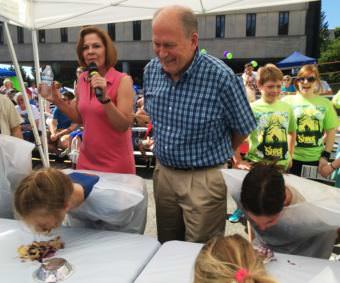
Alaska Gov. Bill Walker helps judge the Blueberry Arts Festival pie-eating contest in Ketchikan on Saturday. (Photo by Leila Kheiry/KRBD)

Gov. Bill Walker came to Alaska’s First City on Saturday to experience this year’s sun-filled Blueberry Arts Festival.

He is attending fairs and festivals around Alaska in place of scheduling the governor’s picnics that have been traditional for the past few years.

“What an honor to be back. I had never seen a slug race before I came here. I think that’s unique to Ketchikan,” Walker told the crowd from the main stage during Blueberry Arts Festival.

Walker also lent a hand judging the blueberry pie-eating contest, and walked around various art- and food-vendor booths, meeting with local residents.

Taking a break for a short interview with reporters inside the First United Methodist Church, Walker skirted the topic of whether he and Lt. Gov. Byron Mallott would seek re-election in 2018.

Walker said their intention is to seek another term, but that’s not their focus now.

“We have a lot of work to do to fix Alaska, and we are remaining focused on that,” he said.

Walker said other state lawmakers have work left, too.

He said while the Legislature has made some accomplishments, they still need to find a solution to Alaska’s fiscal challenges.

“They have a tough job to do and they’re doing it. They’re getting it done,” he said. “Not as quickly as they would like, not as quickly as I would like, but we’re not done yet. We still haven’t figured out how to pay for the services we provide. Until we get that figure out, it’s not going to be done.”

Walker said he expects there will be another special session this fall for the Legislature to find a way to fund government. But, he said, his office will work with lawmakers in the interim to find out what options are most likely to pass.

The ongoing national debate over health care, and whether to repeal the Affordable Care Act is something Walker said he has paid close attention to.

Walker said he’s part of a coalition of governors trying to help provide options and input to federal representatives. He said he doesn’t want what happens in Washington, D.C., to hurt Alaskans.

“I expanded Medicaid – accepted Medicaid expansion – that’s now provided health care for 35,000 Alaskans who didn’t have health care before that,” he said. “We don’t want to lose that kind of coverage. We don’t want those folks to go uninsured as a result of what happens in Washington. So, we’re very involved in that process.”

While President Donald Trump has been pushing for the repeal of the Affordable Care Act, with or without a replacement, Walker said that, overall, he believes Alaska will fare well under the Trump administration.

Walker said he looks at the president’s appointees, especially Secretary of the Interior Ryan Zinke.

“I think that Secretary Zinke is someone who understands the opportunities we have in Alaska with responsible resource development… There are many areas of development in Alaska that we’ve been wanting to do responsibly, but we haven’t had access under federal land to do that. I think we’re going to see a difference in that,” he said.

Asked whether he would return next year to enter the blueberry pie-eating contest, Walker said he’s not sure he’s up for that kind of competition.

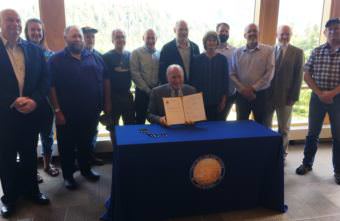
Walker is scheduled to return to Ketchikan on Thursday to sign Senate Bill 88, which approves a land transfer between the U.S. Forest Service and Alaska Mental Health Trust.
Ketchikan’s Deer Mountain was one of the parcels that the trust had said it would log if the transfer didn’t take place.

The transfer will put that parcel, and other sensitive sites in Southeast, into Forest Service ownership.

Bartlett hires former Juneau nonprofit director

(Photo by Heather Bryant/KTOO)
Rainforest Recovery Center is one of the services overseen by Bartlett Regional Hospital’s chief behavioral health officer. (Photo by Heather Bryant/KTOO)

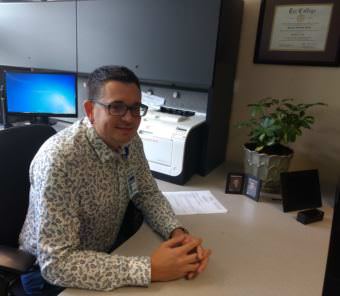
The executive director of Juneau Youth Services abruptly left the nonprofit this summer under unclear circumstances. Now, he’s a top administrator at Juneau’s hospital.

Bartlett Regional Hospital’s chief behavioral health officer left last month to take a job in Pittsburgh. Hospital CEO Chuck Bill said there were three local candidates to fill the position. One of them was Bradley Grigg, who until very recently had been the executive director of Juneau Youth Services.

“Bradley was our number one choice and accepted the position,” Bill said Thursday. “He’ll be the administrator responsible for all of our behavioral and mental health services.”

Grigg was offered the job on July 18 – seven days after he’d left Juneau Youth Services after little more than a year.

He said he’s excited about his new position.

“It’s an honor to be a part of what Bartlett is doing in the community to meet the needs, especially in my field of behavioral health,” Grigg said.

The circumstances of Griggs’s departure from Juneau Youth Services isn’t clear.

Bradley Grigg’s first day at Bartlett Regional Hospital as chief behavioral health officer was July 24. (Photo by Jacob Resneck/KTOO)

Juneau Youth Services Board President Kathi Collum wouldn’t comment except to confirm his annual salary was $130,000 when he left July 11.

Grigg wouldn’t comment either.

“The circumstances, basically – I really don’t have a comment to that, at this point,” he said Thursday. “Both the board and myself made the decision. So, I left JYS, I think it was on July 9 or July 10; so that’s my only comment on that. I was the ED up until to that date.”

The nonprofit Juneau Youth Services has run programs for at-risk youth for more than 50 years. It has more than 110 employees in the community.

Chuck Bill said the hiring committee checked that Grigg’s resume was accurate but didn’t dig deeper.

“As in most references what they did is verify his dates of employment and that’s all we got,” Bill said. “But he’s well-known in the community and well-known to us.”

Bartlett’s chief behavioral health officer supervises about 70 employees and is responsible for the 12-bed mental health unit, psychiatric outpatient services and Rainforest Recovery Center.

His salary is $161,138.

Female athletes are closing the gender gap when it comes to concussions

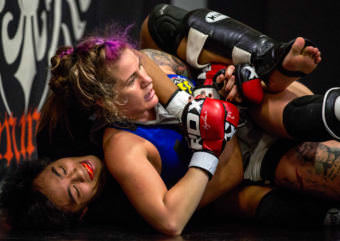
Mazany is one of 60 female fighters and 700 male fighters enrolled in a Cleveland Clinic study that's delving into how concussions might differ between women and men. (Photo by Bridget Bennett for NPR)
Mazany is one of 60 female fighters and 700 male fighters enrolled in a Cleveland Clinic study that’s delving into how concussions might differ between women and men. (Photo by Bridget Bennett for NPR)

Gina Mazany grew up in Anchorage, Alaska. And that’s where she had her first fight.

“It was right after I turned 18,” she recalls.

A local bar had a boxing ring, and Mazany decided to give it a shot. Her opponent was an older woman with a “mom haircut.”

“She beat the crap out of me,” Mazany says. “Like she didn’t knock me out, she didn’t finish me. But she just knocked me around for three rounds. And I remember, later that night I was very, very nauseous. I was throwing up that night.”

It was her first concussion.

Thanks to research on boxers and football players, both athletes and the public are becoming more aware of the dangers of sports-related head injuries. Yet there is little data on participants like Mazany. That’s because, unlike the vast majority of athletes studied, she is a woman.

“We classically have always known the male response to brain injury,” says Mark Burns, at Georgetown University. But there have been remarkably few studies of females. The bias runs throughout the scientific literature, even in studies of mice.

“Male mice have been used historically in research and not really been compared to female mice,” he says.

That’s changing now. The National Institutes of Health recently began to require scientists to include female animals.

Burns’ lab has begun using both sexes in research on head injuries. And they’re finding some differences. This summer, Burns published a study in the journal Glia that looked at mice with severe brain injuries. He says the brains of male mice showed a massive immune response within a day, but the female response was much slower — up to seven days.

There have been hints of differences in people as well. Just this year, a study of college athletes found that women are more likely than men to get concussions.

But to find out more, scientists want to study fighters like Mazany. She is 28 now and lives in Las Vegas. She’s a professional mixed martial arts fighter who competes in Ultimate Fighting Championship events.

Her nickname is “Danger.” Mazany has begun worrying about her brain.

“One day I want to get married and have a family. And I want to be able to take care of my babies and like all that kind of stuff,” she says. “So I’m not going to get the s*** kicked out of me for nothing, if that makes sense.”

So Mazany volunteered to be part of a study of fighters at the Cleveland Clinic Lou Ruvo Center for Brain Health, in Vegas. For six years now, professional fighters have been coming to the center for brain scans and blood work. They also complete tests of mental functions.

On the day of Mazany’s annual checkup, she is subjected to a battery of tests that assess her balance, reaction time, memory, and thinking.

After about 40 minutes, Mazany meets with Dr. Charles Bernick, the scientist in charge of the fighters study. They move to a quiet room. Bernick scans a chart. It shows Mazany’s test results over the past few years.

“Well you’re pretty stable,” Bernick says. There’s no obvious sign of trouble from her fighting career, at least not yet.

Bernick says the study of fighters like Mazany now includes nearly 700 men and about 60 women.

“So, [the women are] still a minority, because they are a minority in the sport,” he says. “But I think it’s a very important group to evaluate because we really don’t know if there are differences between men and women.”

Bernick does believe that there’s now enough evidence to suggest real differences between the ways men and women respond to head injuries.

“Women may be more likely to suffer concussion. Their symptoms may linger longer,” he says. “The question is: Is that because women are just more likely to report injuries, or is there a biological higher vulnerability.

Researchers have suggested some reasons women might be more vulnerable. They tend to have weaker neck muscles. So a head impact might shake the brain more violently. And hormonal differences might affect the brain’s response to an impact or injury.

Bernick says the fighters’ study offers a way to directly compare men and women who compete in combat sports where a concussion is often the goal.

He says the study has already shown that brain scans and other tests can show who’s been getting hit a lot.

“You can detect changes in brain structure even over a year’s period,” he says. “The question really is in the long run, are those changes predictors of somebody who is going to have a neurodegenerative disease later in life.”

Bernick says an answer is still years away.

In the meantime, Gina Mazany is trying to stay safe while also staying competitive.

During her training sessions at the Xtreme Couture mixed martial arts center, Mazany tries not to give anyone a head injury, though things can happen during sparring: “I have knocked out another girl in my gym on accident,” she says. “Sorry, Hannah.”

But Mazany says these days, most fighters know what they’re doing is risky.

“My theory to it all is yeah, there’s brain damage. Yeah, this sport is not safe. I don’t care who you are, it’s not safe,” she says. “But a lot of things that we do aren’t safe.”

Copyright 2017 NPR. To see more, visit http://www.npr.org/.

Brain injury survivors use mask-making to shed light on hidden trauma

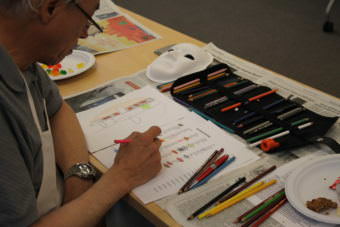
On a recent afternoon, seven people are using colorful paints, feathers, strings and beads to decorate masks inside Access Alaska, a support center for people with disabilities.

Retired Air Force Sgt. John Main is busy sketching designs. He’s methodical, coordinating colors with a list of emotions written on a separate sheet of paper.

Like everyone else at this event, Main suffers from a brain injury. In 2011 he had a stroke, but it was not diagnosed for five years.

“I didn’t have slurred speech,” Main said. “I didn’t have weakness anywhere, so they didn’t think I really had a stroke. Well, what they didn’t realize — I’d had a stroke, but it affected something different than my muscles. It affected my cognitive reasoning, my analytical abilities.”

When it comes to brain injuries, appearances can be deceiving.

Robert Barnett, a brain injury survivor who works at Access Alaska, said there’s a disconnect between the internal experience of a cognitive disability and what it looks like to an outside observer.

“It takes me a while to even understand people’s disabilities because they’re invisible,” Barnett said.

Many survivors feel like they have to put on a disguise to face the world, and that’s exactly what the Unmasking Brain Injury project hopes to address.

The idea came from Hinds’ Feet Farm, a nonprofit based in North Carolina.

More and more people started getting involved as the masks were displayed around the country.

Annette Alfonsi of Anchorage first heard about the project from a friend in another state.

Having suffered a brain injury herself, she requested materials to make her own mask and eventually became a coordinator for the project in Alaska.

She hopes that the masks, although unique to each maker, will bring them together.

“Folks, especially across Alaska, can feel very alone if they don’t know folks in their immediate area that have that kind of brain injury,” Alfonsi said. “This is a really great way to raise awareness.”

Two studies from 1999 and 2008 estimate that there are between 3 million and 5 million brain injury survivors now living with a disability in the United States.

However, these figures are limited to administrative data from hospitalizations and emergency room visits, which doesn’t give a complete picture of the problem.

A lack of awareness can make it difficult for people to find care.

While there are a few resources in Alaska, Alfonsi said it was difficult to figure out what options were available for her.

“If you’re navigating that system by yourself, you don’t have any experience with it,” she said. “Then you don’t have the ability to be proactive about it because your symptoms kind of lead to being isolated and feeling alone or quiet and in the dark.”

When John Main finishes the design for his mask, he has divided it into sections that represent different stages of his life.

The left side of the mask is a pale pink that represents life before his brain injury.

The middle section of the mask is darkly shaded and chaotic, illustrating the uncertainty of the years when his stroke had not been diagnosed.

“Before I’d seen hopelessness,” Main said. “I did not know what was going on, I just knew that I was failing in jobs that I shouldn’t have failed in.”

On the right side of the mask, however, Main colors pink for the support he has received since his stroke was diagnosed and green for the bright future he sees ahead of him.

Social worker receives national award for suicide prevention efforts in Y-K Delta

A Lower Kuskokwim School District social worker received a national award this week in Washington D.C. for his work in the Yukon-Kuskokwim Delta on suicide prevention.

James Biela is an itinerant Social Worker for LKSD, frequently traveling out to Newtok, Tununak, Toksook Bay, Nightmute, Mekoryuk, and Nunapitchuk to hold trainings and lectures on suicide prevention.

He received the Sandy Martin Grassroots Award, given out to three members of the National American Foundation for Suicide Prevention, for work in grassroots programs. Beila is a volunteer and the founder of the AFSP Alaska Chapter.

Winning the award was an honor, says Biela, an honor he was not prepared for.

“Actually, I was totally shocked that I’d be receiving this award. I didn’t have anybody giving me a heads up,” said Biela. “I feel it’s an honor, but it was also a sad time because one of my friends out in a village before I got on the plane, died by suicide.”

For Biela, the news underscored his life’s work.

“It gives you more power to do more,” said Biela. “Actually, this year I was very fortunate to have a young man from Newtok, an Alaska Native, come with me to Washington D.C. to talk to the congressional leaders about suicide. But on this one it just makes our work more important. To be the voice about how suicide can be prevented and get the Congressional leaders in D.C. to listen.”

And they did just that. They sat down for twenty-five minutes with Senator Dan Sullivan and Senator Lisa Murkowski, discussing village suicides in the YK Delta.

“I know everybody needs to pitch in with the leadership that they can afford to understand our needs,” said Biela.

That’s especially important now, said Biela, with the ongoing healthcare debate and the possibility that mental health care will be cut out of the budget.

A Pulse Nightclub responder confronts a new crisis: PTSD

Gerry Realin (left) and his wife Jessica are working to get first responders workers' compensation benefits in Florida. (Photo by Abe Aboraya/WMFE)
Gerry Realin, left, and his wife, Jessica, are working to get first responders workers’ compensation benefits in Florida. (Photo by Abe Aboraya/WMFE)

Gerry Realin wishes he had never become a police officer.

Realin, 37, was part of the hazmat team that responded to the Pulse Nightclub shooting in Orlando on June 12, 2016.

He spent four hours taking care of the dead inside the club.

Now, triggers like a Sharpie marker or a white sheet yank him out of the moment and back to the nightclub, where they used Sharpies to list the victims that night and white sheets to cover them.

He says small things make him disproportionately upset. He gets lost in memories of the shooting, he says — his young son will call him over and over again. Then, he gets angry that he let himself get trapped in thought, and that spirals into depression.

“Then there’s the moments you can’t control,” Realin says. “The images or flashbacks or nightmares you don’t even know about, and your wife tells you the next day you were screaming or twitching all night.”

Realin was diagnosed with post-traumatic stress disorder and hasn’t worked since just after the shooting. He worries about his family, he says, “hiding from your kids so that they’re not traumatized by your rage or depression,” which “gives them a sense of insecurity, which isn’t good.”

At least one other police officer has publicly discussed being diagnosed with PTSD after the Pulse shooting, and it’s possible there are more who suffer from it.

Orlando City Commissioner Patty Sheehan says there are people who go to war and don’t see what officers saw inside Pulse.

“I’ve talked to some of the officers and they’re pretty traumatized by what they saw,” Sheehan says. “It was horrible, the sights and the smells, and the thing that really haunts them is the cell phones that were in [the victims’] pockets ringing.”

Sheehan has heard from first responders and mental health workers that there are more officers, possibly with PTSD, who don’t want to come forward because they don’t want to be seen as weak or unfit for duty. She says she wishes they would, though.

“If someone is to the point where they have had an emotional stress to where they can’t perform their job, of course I don’t want to put a gun in their hand,” Sheehan says. “That’s just common sense to me.”

Researchers estimate that 28 percent of mass shooting survivors will develop post-traumatic stress disorder.

There isn’t a lot of data on PTSD rates in first responders, researchers say, but the it could range from 7 percent to 19 percent in police officers. When clinicians interviewed more than 400 officers in the Buffalo, N.Y., police department, 15 percent to 18 percent had PTSD.

A 2012 study found police officers were twice as likely to die from suicide, which can be associated with PTSD, than from traffic accidents or felony assaults.

“I don’t think officers are disposable,” says Ron Clark, a retired officer who works with Badge of Life, a police suicide-prevention group.

He says when he started with the Connecticut State Police decades ago, people were told to suck it up. Officers used alcohol, drugs or sex to cope with stress because, if they spoke up, they were likely to get fired.

But, he says, “Police officers are human beings. They’re affected by what they see out there — decapitated children, families wiped out in car accidents, suicides — just name all the horrors you can think of.”

Gerry Realin copes with his PTSD by spending time on the Intercoastal Waterway near his home in Volusia County, Fla. (Photo by Abe Aboraya/WMFE)

The Realins have been advocating for workers’ compensation in Florida to cover PTSD. Gerry’s wife, Jessica Realin, visited the state capitol in Tallahassee in April, going door-to-door to ask state senators to support a bill which would give first responders with PTSD access to benefits like lost wages if they can’t work.

She tried to meet Republican Anitere Flores, the second-in-command in the Senate, who also chairs the Banking and Insurance Committee that would be voting on the bill later that day. But, even after two attempts, the senator didn’t have time.

Realin did meet Democrat Victor Torres, a retired police officer who shepherded the bill. He’s seen first-hand what happens when PTSD goes untreated.

“You leave work, have the weekend off and you come in Monday and hear about officer so-and-so committing suicide,” Torres says. “Young man. You wonder why. What were his issues?”

The bill did not pass this session, but Torres did get the Banking and Insurance Committee to hear the bill. Realin spoke to the committee, as did Amanda Murdock, whose husband is a Vero Beach, Fla., firefighter with PTSD.

“I’m going to make myself very vulnerable, my family very vulnerable,” Murdock told the committee. “This last fall my husband attempted to take his own life. Six days later, one of his closest friends, battalion chief Dave Dangerfield, was successful in taking the final step in taking his own life, leaving behind two sons.”

Murdock says all she could think about on the way to the funeral was that it could have been her, losing her husband to suicide. After hearing the testimony from Murdocks, the Realins and others, the committee passed the bill unanimously but, ultimately, it did not move to the House. Advocates vow to try again next year.

Orlando officer Gerry Realin, meanwhile, is trying to cope. He escapes alone on his paddle board on the water, “hearing the sounds of nothing else — the breeze, maybe, wondering where the fish may be, wondering which way the tide is turning, which way the wind is blowing,” he says. “For some reason, nothing dark follows me there and I can reset, find some serenity.”

This story is part of a reporting partnership with NPR, WMFE, Health News Florida and Kaiser Health News.

Copyright 2017 WMFE. To see more, visit WMFE.
Site notifications
Update notification options
Subscribe to notifications