Anchorage Daily News reporter Kyle Hopkins authored the Anchorage Daily News’ Pulitzer Prize-winning series. (Photo by Zachariah Hughes/Alaska Public Media)
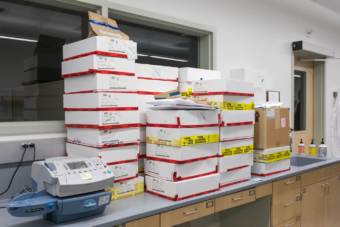
The Anchorage Daily News was awarded the Pulitzer Prize for public service Monday for “Lawless,” the newspaper’s collaborative investigation with ProPublica that revealed shocking inequities in law enforcement between Alaska’s rural and urban communities.
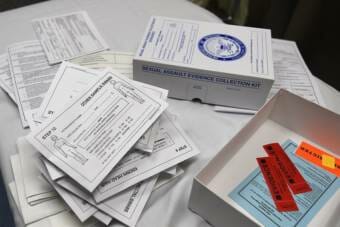
The “riveting” series, led by reporter Kyle Hopkins, “revealed that a third of Alaska’s villages had no police protection, took authorities to task for decades of neglect, and spurred an influx of money and legislative changes,” the Pulitzer organization said.
The two other finalists were The Washington Post and The New York Times.
The Pulitzer Prize is one of journalism’s highest honors, and the public service category is most coveted in the array of awards bestowed by the organization. Monday marks the third time the ADN has claimed the award, after winning it in 1989 for “People in Peril,” a series on alcoholism and suicide among Alaska Natives, and in 1976 for an exposé on the Teamsters Union.
Juneau Police Department vehicle. (Photo by Quinton Chandler/KTOO)
The confined living situations introduced by the pandemic — while necessary for slowing the spread of COVID-19 — can increase the likelihood of domestic violence for some Alaskans.
Kelsey Eggert, a Juneau-based lawyer for Alaska Legal Services Corp., said reports of domestic violence are up.
“We’ve now seen an uptick in Juneau,” Eggert said. “After extended confinement in this very stressful situation in which the whole world has changed, there is an increase in domestic violence. And unfortunately, it’s also a lot harder to get help at the moment.”
“If you’re confined with your abuser, and they’re not leaving, how do you call a resource to get help or information?” she added.
Eggert recommends anyone experiencing domestic violence to call the National Domestic Violence Hotline — that number is 800-799-7233.
Having a safety plan is also a good idea, Eggert said.
“Have a person that you can text a certain word, and they know that you’re in trouble and they can maybe call the police for you,” she said. “Have a person who you can go to and stay on their couch for a bit if you’re really afraid.”
She said she often tells clients: “If you feel really unsafe, call 911.”
For community members who may know someone who has experienced domestic violence, Eggert recommended checking in with them.
“You don’t have to ask them if there’s been domestic violence,” she said, “but check in with them.”
Alaska Legal Services also deals with another area of concern for many Alaskans: a worsening financial situation. With reduced hours or not being able to work from home, paying bills and covering rent or a mortgage are suddenly more difficult.
For renters, a state bill passed to keep people who are struggling to make rent from being evicted. According to Alaska Legal Services Executive Director Nikole Nelson, court hearings for tenants who are behind on rent have also been stalled.
“The idea behind this is that we really don’t want people becoming homeless during a pandemic, because that’s not going to create a healthy situation for any of us,” she said.
That doesn’t mean renters are completely off the hook, however. Ultimately, tenants will have to agree on a repayment plan with their landlords. And Nelson recommends people struggling to pay their mortgage talk to their banks — further protections during the pandemic prevent banks from foreclosing upon homes right now.
ACLU of Alaska Executive Director Joshua Decker speaks during a press conference Thursday in Anchorage announcing a federal lawsuit against the city of Nome. (Photo by Zachariah Hughes/Alaska Public Media)
The city of Nome has systematically failed to protect Alaska Native women from sexual assault, according to a federal lawsuit filed Thursday by the American Civil Liberties Union of Alaska.
The case is built around the experience of a former dispatcher with the Nome Police Department, who says her report of a sexual assault was ignored by colleagues for more than a year.
Clarice “Bun” Hardy says she was sexually assaulted in March 2017, and shortly afterward she told a coworker at the police department about it, asking him to investigate.
“I considered my colleagues family, and I trusted them,” Hardy said during a press conference at the ACLU’s offices in Anchorage Thursday. “So that’s who I turned to after I was raped. They told me that they’d help me. They didn’t. Instead they lied to me, over and over and over again.”
Even though she’d worked at the department for two years and told a police lieutenant where he could find witnesses and evidence, Hardy said nothing came of it. Superiors at NPD, including the chief at the time, took no action.
More than a year after the alleged assault, still waiting to hear about progress on her case, Hardy learned there had been no investigation at all. The distress contributed to her leaving her job, and eventually leaving Nome. In the winter of 2019, she moved back to her hometown of Shaktoolik, on the eastern edge of Norton Sound.
“I miss playing basketball. I miss leaving my curtains open to let the sunlight in. I miss restful night sleeps,” Hardy said.
Last year, the ACLU threatened to sue the city of Nome over its handling of Hardy’s case, asking for a $500,000 settlement on her behalf. That effort didn’t go anywhere.
Now, the organization’s lawsuit alleges a pattern of civil rights violations against Alaska Native women. The ACLU is asking for the federal court to order Nome to end what the group says are discriminatory practices in enforcement of sexual assault protections, introduce better training for police and pay unspecified financial compensation to Hardy for damages.
“I can’t undo the harm done to the hundreds of women the Nome Police Department failed to help,” Hardy said. “But maybe I can stop this from happening again. Maybe that’s my purpose.”
The lawyer representing Nome in the litigation, former Anchorage District Attorney Clint Campion, said he had not yet seen a copy of the complaint and was not able to comment on it.
ACLU’s filing claims that Nome has a reported rate of sexual assault that is six times higher than the national average, but the city has a substantially lower arrest rate for such crimes. That, the organization contends, is a direct result of policy decisions.
“Most troubling is that the city leaders were aware of these failures on a systemic basis and did nothing,” said Stephen Koteff, legal director for the ACLU of Alaska. “Unfortunately, these failures are continuing today.”
The ACLU is taking the unusual step of asking for a jury trial in Nome to handle the federal case. And they anticipate that the discovery process will bring to light even more evidence of mishandled reports of assaults.
For its part, the city of Nome has long maintained the shortcomings in investigations are from a lack of resources, not malice or discrimination. NPD has suffered from understaffing and a large call volume, hampering investigators’ ability to build cases.
Last fall, a newly-hired police chief presented a detailed report to the Nome City Council of how many more officers and investigators the town needed to effectively handle public safety. Weeks later, he resigned. Though he didn’t offer an exact reason, a publicly-released letter mentioned challenges with staffing and the case backlog.
Chief Justice Michelle Demmert of the Central Council Tlingit and Haida Indian Tribes of Alaska, left, and U.S. Sen. Lisa Murkowski, R-Alaska, center, were two of the speakers at a Senate briefing Thursday on missing and murdered Indigenous women. (Photo by Liz Ruskin/Alaska Public Media)
The victims’ families and communities had long felt the tragedy: Alaska Native women are murdered and go missing at rates that are far too high.
But it took a 2018 report from two researchers in Seattle to get the gears of the federal government turning. Sen. Lisa Murkowski, R-Alaska, said the report has focused national attention on the horrifying reality that Native women are murdered at a rate 10 times the national average.
She said it helped “being able to put numbers to what we knew from the stories.”
Murkowski spoke Thursday at a briefing on the issue of missing and murdered Indigenous women, now often known by its acronym: MMIW.
Native leaders and justice advocates packed a Senate hearing room for an update on what Congress and the Trump administration are doing to address the problem.
Murkowski is sponsoring Savanna’s Act, which aims to improve data collection, and co-sponsoring the Not Invisible Act, to target the trafficking of Native people.
And last year, for the first time, Congress appropriated funds for MMIW, Murkowski said.
“Six-point-five million dollars, dedicated solely and specifically to dealing with the issue of murdered and missing Indigenous women, to provide for tracking and for data, for forensic equipment,” the senator said.
U.S. Interior Department Assistant Secretary for Indian Affairs Tara Sweeney said one of the goals is to help the families of the victims.
“What we’ve heard time and time again, through these … roundtables, has been, ‘We report it, and then we don’t hear anything. We can’t find out the status of this case. We don’t know who to talk to,’” Sweeney said.
Trump’s 2021 budget requests $3 million for the Operation Lady Justice task force on missing and murdered Indigenous women.
Bishop Andrew E. Bellisario, C.M., the Apostolic administrator of Anchorage, speaks at a press conference Jan. 16, 2020, at the Archdiocese of Anchorage building. (Photo by Valerie Kern/Alaska Public Media)
None of the Catholic priests reported to have been involved in sexual misconduct in a 50-year review of records released last month by the Archdiocese of Anchorage was ever convicted of a crime. There is also no indication the report has prompted any new criminal investigations since its release.
The report, made public Jan. 16, is based on an independent commission’s review of the church’s records. It lists 14 employees of the Archdiocese of Anchorage, 13 of whom it says engaged in sexual misconduct with minors or vulnerable adults, and one who was caught viewing child pornography. The allegations span from 1956 to as recent as 2015.
Ten of the men are alleged to have engaged in misconduct while in Alaska. Four are accused of misconduct elsewhere, after serving in Alaska.
Half of those listed in the Anchorage report have died since the abuse is alleged to have occurred. None of them ever faced criminal charges in Alaska, though at least two were sued along with the Anchorage Archdiocese.
In releasing the report and the men’s names, officials with the Anchorage Archdiocese said they’re doing their best to encourage unknown victims to come forward and to right the wrongs of the past, while still protecting the privacy of the victims. They did not specify whether efforts had been made to report each allegation of abuse to law enforcement at the time the allegation was received.
Critics say the announcement is too little, too late.
Zach Hiner, the executive director of the Survivors Network of those Abused by Priests, said the report is lacking crucial details.
“You know, when were the allegations first received? And what did church officials do in response?” Hiner said. “You know, that kind of information, I think, is pretty critical to understanding exactly what went wrong. And when we know what went wrong, we know how to prevent it in the future, right?”
SNAP, in a statement, also noted two priests missing from the list. Both were employed by the Anchorage Archdiocese and were accused of sexual misconduct after leaving Alaska.
In an interview, officials with the Anchorage Archdiocese said the commission that compiled the report, based on the church’s records, did not determine there was credible evidence of sexual misconduct by either of the two men, and so they were not included in the report.
The Anchorage Archdiocese officials also refused to reveal the sorts of details SNAP said were needed. They also declined to go through the allegations case-by-case to discuss how each of them was handled, though they said there are safeguards in place to prevent abuse now.
At the time of the report’s release in January, the bishop currently in charge of the Anchorage Archdiocese, Andrew Bellisario, apologized to the victims and spoke generally about the report’s contents.
After a request for a follow-up interview, the archdiocese offered its chancellor, John Harmon, who described his role as an operations manager. Harmon was asked about whether law enforcement was ever contacted at the time of any of the allegations
“I’m not sure exactly how each of the different one(s) was handled, but it’s my understanding that everything was handled by the policies and procedures that we had in place at the time,” Harmon said.
Harmon was then asked whether his response meant that the archdiocese’s policies and procedures did not require telling law enforcement at the time: “I think this goes back to sort of what the bishop said in his comments when he had his press release, about how, over time, how situations were handled,” Harmon said. “But again, as it relates to — and he did mention this — that the independent commission was given a standard that they were to look at, as it relates to looking into all of our files, all of our personnel files, and then coming up with a list of recommendations for publication. And those names were published, and again, the files were reviewed, and the report is out there.”
Bellisario, a Juneau bishop overseeing the Anchorage Archdiocese, had said that all of the cases that “needed to be reported” were reported to law enforcement at the time, or in some cases, “much later.”
At this point, it appears unlikely that there will be any criminal charges or convictions related to the archdiocese report on sexual misconduct. A spokesperson for the Alaska Department of Law said the department received the same report that was released publicly and that there is not enough information in it to properly evaluate any particular case.
Department of Law officials declined a request for a recorded interview, but in a written statement, officials with the department’s Criminal Division said new charges would be impossible for some, because many of the accused have long since passed away. Additionally, the statement said prosecutors face time limits on when they can bring forward a case, “even if sufficient evidence exists to take action, which has not yet been determined in any of these matters.”
Anchorage Police Department spokesperson MJ Thim said the department’s detectives are aware of the archdiocese report.
“As with any criminal case, we will always review any new information to see if it can be used in an investigation,” Thim said in a written statement.
Officials with the Anchorage Archdiocese said they have not been contacted by any law enforcement officials seeking additional information since the report’s release.
Alaska Public Media’s Tegan Hanlon contributed reporting to this story.
Bishop Andrew Bellisario, the apostolic administrator in Anchorage, holds a press conference on January 16, 2020 at the Archdiocese of Anchorage building. (Photo by Valerie Kern/Alaska Public Media)
An Alaska bishop offered a series of apologies on Thursday, Jan. 16, in the wake of a review that disclosed reports of sexual misconduct by 14 men who worked for the Archdiocese of Anchorage — some stretching back more than 50 years.
All but one of the accused were priests. The abuse involved children and vulnerable adults.
At a press conference at the archdiocese in downtown Anchorage, Bishop Andrew Bellisario said he wanted those abused by clergy members to know: “It’s not your fault. It’s never, ever been your fault.”
“The pain that you suffer is the fault of others and representatives, most specifically, of the church who have perpetrated crimes upon you,” he said. “It’s with great shame that I stand here today, as a representative of the church, to offer this apology to you.”
The report released by the archdiocese detailed the findings from a review of church documents by an independent, three-person commission.
The review found “credible evidence” that 13 priests and one other church employee who served under the Anchorage Archdiocese engaged in sexual misconduct involving minors or vulnerable adults.
The men served across Southcentral Alaska from Valdez to Talkeetna to the Kenai Peninsula to the Matanuska-Susitna Valley.
Allegations against 10 of the men came while they served in the Anchorage Archdiocese. The other four served in the archdiocese but faced allegations elsewhere, the report said.
The allegations are as recent as 2015, and date back to 1956.
A search of state records appears to show no criminal charges filed in Alaska against the men, though some were named in various civil lawsuits and a bankruptcy case involving the Fairbanks diocese.
Bellisario said the church shared the report with the attorney general’s office before posting it online.
It wasn’t clear how many of the allegations were reported to authorities by the church at the time they were recorded.
“All of these cases that needed to be reported have been reported either at the time, later or in some cases, much later,” Bellisario said.
Bellisario said he didn’t have information on how many victims were found during the commission’s investigation. He said the commission reviewed the personnel files to create the report, and he had not.
The Anchorage Archdiocese covers 138,985 square miles — larger than the size of New Mexico. It stretches from Glennallen to Unalaska, an area with an estimated Catholic population of 32,170, according to its website.
Bellisario, the bishop of the Diocese of Juneau, is also serving as the apostolic administrator in Anchorage until a new archbishop is appointed.
Asked if the commission found that church leaders had tried to cover up the abuse, Bellisario said it didn’t “identify anybody of gross negligence.”
“However, I think we all know — throughout the United States in particular and here, too — that if things would have been done the way we do them today, as opposed to the way they did them in the ‘70s, the ‘80s and the ‘90s, I think this list would be very, very small, possibly, maybe, even nobody on that list, which would be our goal,” he said.
He said the church now has trainings, certifications, background checks, ongoing education and additional programs.
Thursday’s report is the first time the Anchorage Archdiocese has named its clergy members who have been accused of sexual misconduct. It follows a cascade of reviews and disclosures from other dioceses across the country, including in Juneau, Fairbanks and across rural Alaska, as the Catholic Church wrestles nationally and internationally with abuse allegations and their fallout.
“The purpose of putting the names out, as many dioceses throughout the United States are doing, is to have an opportunity for people to come forward for healing,” Bellisario said. “We’re doing this for people who have been harmed. People who have been victimized.”
Bellisario encouraged people who had been victimized to consider reporting to law enforcement. He said people could also contact the archdiocese’s victim assistance coordinator.